
So Proud of Our Customer!

MSFT_logo_rgb_C-Gray_DMicrosoft India has been a Cultural Detective customer for six years, and both Heather Robinson and I are so very proud of the abilities their staff members have developed to in turn coach and develop their support engineers’ customer service skills. The entire project has been amazing—truly a privilege to be a part of it! I’d like to take this opportunity to share a bit of their “Cultural Effective” story with you.

Microsoft uses Cultural Detective to coach their large enterprise customer support representatives. In the first six months using the tool, they told us they attributed a 30% increase in customer satisfaction to Cultural Detective! Now, five years later, they know Cultural Detective inside and out, and use the CD Method when interacting with both international and domestic customers.

In March of this year Heather again traveled to Bangalore to work with the trainers, to help improve their abilities to coach using Cultural Detective. The approach she used is what we call EPIC: Essential Practice for Intercultural Competence. It is a combination of Cultural Detective, with which Microsoft has been working for five years, and Personal Leadership, which their staff have been working with for the past year or so.

The design was an inspired one. Because Microsoft has experienced facilitators who are also well-versed in Cultural Detective, Heather used these facilitators to get team newcomers up to speed, as well as to facilitate small group breakout sessions. This internal group of facilitators put together the readings, sample interviews and assignments for the three-day training. As is so wonderful when training in India, there were plenty of games, activities and laughter.

As you might imagine, one of the main challenges for the support engineers is knowing how to respond to customers’ emotions. Large enterprises rely on Microsoft products to function in highly customized ways, which often means long days of problem-solving discussions, heightened emotions and frayed nerves. The March training included the learners acting out skits of engineer-customer interactions, videotaping them, and then using the Cultural Detective Worksheet to debrief the contrasting values, and the EPIC approach to discern how to respond most appropriately. We would love to share one or two of those videos with you here, but, of course, they are proprietary.

Instead, let me leave you with a few of the notes scribed in small groups. In case you’re wondering why “Kit Kats” and “Milky Ways,” the participants chose a candy bar and then broke into groups, one of ten techniques you can find in this blog post.

If you or your organization would like to be profiled in an upcoming blog post, we would be happy to talk with you about making that happen. Just let us know. Congratulations to all the Microsoft staff, who are so committed to building intercultural competence in their organization, and to you, the Cultural Detective community, for your efforts on this same journey.
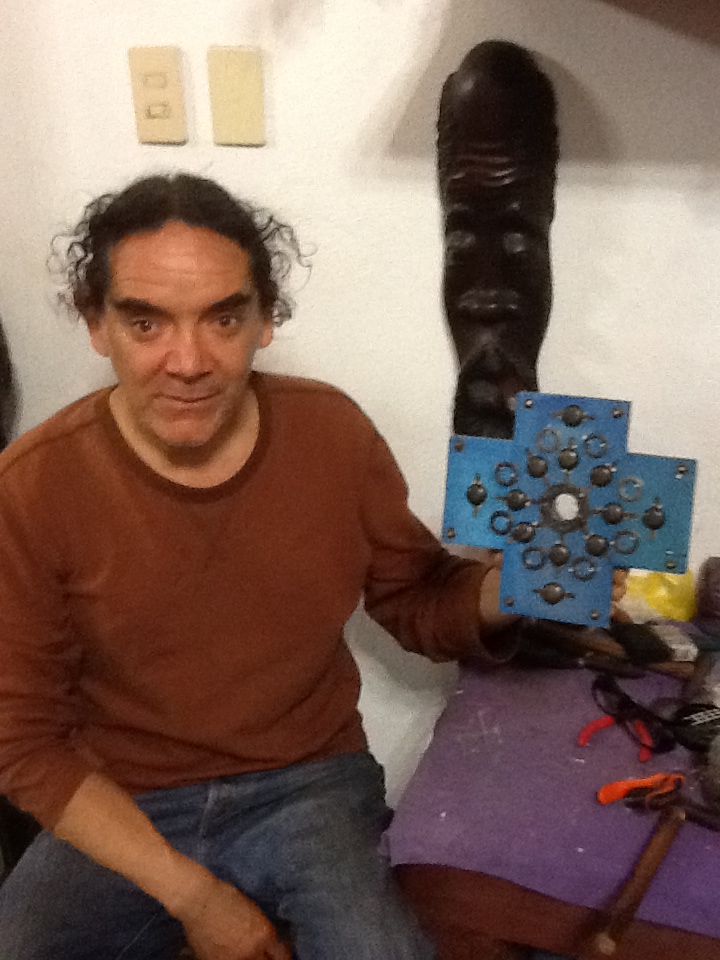
The Mexican Crafts Artist, Pedro Ramirez

A guest blog post by Rossana Miranda Johnston, Tatyana Fertelmeyster and Carrie Cameron

During our recent Cultural Detective Tenth Anniversary meetings and celebrations in Mazatlán, Mexico, some of those attending used a free hour in the program to walk out into the community to conduct short ethnographic studies—to practice their detective skills. Below is a summary of what interested one group. Click here for a link to the instructions for this activity; you are most welcome to adapt them for your own purposes!

Just think how frequently we travel to very different places for work, and how often we don’t take the time to interact with the local people in ways that help us get to know them as people. The same can be said for the beautiful places we travel as tourists. Let’s make a point of practicing our Cultural Detective skills wherever we are, building cross-cultural respect, understanding, and friendship!

TF, CC, RMJ 1 With no specific destination in mind, our group wandered down the street and away from the hotel. Trying to avoid the “tourist traps,” we were delighted to visit a local Mexican crafts store, thanks to the discerning eyes of the Mexican member of our group.

The store featured many types of handmade crafts, most of them displayed by the artist who was on-site working on his/her wares while waiting for a sale. Among the several craftspeople working, we found the artist in the photo, Pedro Ramirez—in a corner of the shop working on a new creation. We watched him as he worked and struck up a conversation.

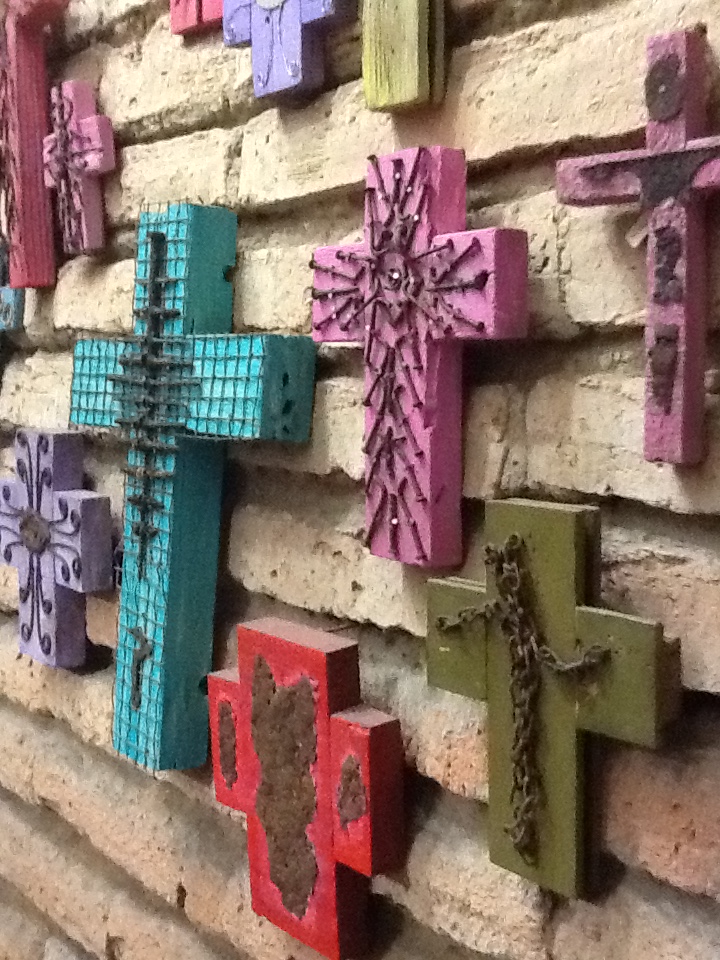
He told us, “Each piece takes several hours to a few days to be made. It depends on how complex or elaborate they are; each piece is unique.” Over the years, Pedro told us, he had tried making different items, but they didn’t always sell. Now he only makes crosses because they are popular and generally sell any time of the year. Perhaps this reflects the Mexican reverence for the Roman Catholic Church? Many tourists are probably Christian, and crosses are an easily transportable souvenir or gift item. TF, CC, RMJ 2

Pedro has been experimenting with different materials and hardware for the crosses, from old doors to windows and tables. Using mainly recycled materials has a few advantages. For one, raw materials are free—it does, however, take creativity and imagination to see what can be done with what others see as scrap or trash. In addition, using recycled materials appeals to tourists who appreciate seeing materials being reused in the form of art. For some, we surmise, this adds to the attraction and appeal of his crosses.

Pedro was warm, cordial and circular in his verbal description, demonstrating a common tendency in conversation in Mexico—Cantinflísmo (Affable circular communication) as he chatted with us. Our small group did have the advantage of a native Spanish speaker and another member who is fairly fluent. This allowed us to communicate easily and help put Pedro at ease. Once he understood our purpose, he talked more freely with us. He is proud of his work, dignified in his self-presentation, and seemed to exude a sense of Sentirse agusto (feeling good about someone or something). It seemed he was comfortable sharing information because he understood we respected his work and were genuinely interested. Our interaction with him was very pleasant, reflecting a low key effort to Caer bién—to be liked or to like others, being or finding someone pleasant—and it is an integral part of Sentirse agusto.

Meeting and talking with Pedro offered us a small glimpse into the life of an artist dependent on the tourist trade. He offered a good example of the creativity we saw in crafts and art in Mazatlan. Mr. Ramirez’ art and livelihood intertwines two salient Mexican cultural themes impacting personal economics: applying innovation/creativity to traditional religious symbols in order to create vibrant new decorative art pieces. We only wish we had more time to explore and enjoy the visual feast of goods in vibrant colors and rich textures we saw in the shops and among street vendors. Hasta la próxima, or “until next time!”

Film Review: Searching for Sugarman

MV5BMjA5Nzc2NDUyN15BMl5BanBnXkFtZTcwNjQwMjc5Nw@@._V1_SY317_CR0,0,214,317_AL_It must be summer for me: two movie reviews in just a few weeks! Another really good movie, too, this one an Academy-award-winning documentary. If you love an amazing story that serendipitously weaves together continents, champions the underdog, and echoes the resonance of truth across cultures, Searching for Sugar Man is for you!

Sixto Rodriguez is the working-class son of Mexican immigrants to the USA. As an anti-establishment folk singer he published two albums in the 1970s about the marginalized poor of the inner city. The music is powerful and haunting, but his albums met with minimal success in the US, and Rodriguez was dropped from his record label.

Unknown to the Rodriguez family, several of his songs became anthems of the anti-apartheid movement (“the system is gonna fall soon, to an angry young tune”), especially among Afrikaners. Rodriguez became a platinum-selling hero in South Africa, supposedly more famous than Elvis Presley or the Rolling Stones. He was widely rumored to have committed suicide on stage—bestowing Rodriguez with a Jimi Hendrix-like aura—yet people knew nothing more about him than what they could glean from his album covers and liners.

In the mid-90s two men—record-store owner Stephen Segerman and music journalist Craig Bartholomew—decided to play detective and learn who Rodriguez was and what had become of him. They tried to contact his record label, but it had long ago gone out of business. They contacted the label’s owner, but he was of no help. They pored over the lyrics to Rodriguez’s songs, with not a lot of luck (they needed a cultural informant, as most any midwesterner or KISS fan could tell you that the lyrics from Can’t Get Away, “born in the troubled city in rock and roll USA,” refer to Detroit). Finally, they found the thread to unravel the story. This movie is the story of their quest.

SPOILER ALERT
It turns out they found Rodriguez alive and well in Detroit’s historic Woodbridge neighborhood, having earned a B.A. in philosophy and having worked for several decades in demolition and on production lines. He became politically active, running for city council, and has three daughters. Segerman and Bartholomew arrange for Rodriguez to visit South Africa for a sold-out series of tours, and the movie includes footage of the first of those tours.

Another interesting cross-cultural tidbit is that his youngest daughter, who accompanies Rodriguez on his first South African tour, falls in love and ends up living there.

The way in which Rodriguez’s words, from inner city Detroit, speak to those on another continent and in another hemisphere, is very powerful. What is most remarkable to me, however, is the dignity, peacefulness, and clarity of the man himself. Rodriguez seems content with the life he has led (we never witness him expressing regret for lost royalties or fame), and joyous and yet non-phased by his fame and success in South Africa. It makes me want to meet a man so fully rooted in and confident of who he is.

A Streetscape in Mazatlán

A guest blog post by Carrie Cameron

During our recent Cultural Detective Tenth Anniversary meetings and celebrations in Mazatlán, Mexico, some of those attending used a free hour in the program to walk out into the community to conduct short ethnographic studies—to practice their detective skills. Below is a summary of what interested one group.

Click here for a link to the instructions for this activity; you are most welcome to adapt them for your own purposes! Just think how frequently we travel to very different places for work, and how often we don’t take the time to interact with the local people in ways that help us get to know them as people. The same can be said for the beautiful places we travel as tourists. Let’s make a point of practicing our Cultural Detective skills wherever we are, building cross-cultural respect, understanding, and friendship!

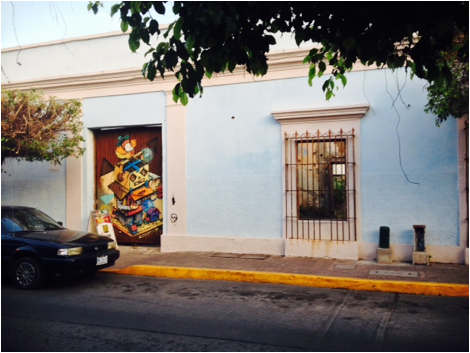
image002The two portals of this private building reflect traces of a couple of Mexican values, and provide a thought-provoking contrast. Located in the Centro Histórico district of Mazatlán, these differing window images on the same building grabbed my attention due to their stark contrast and my reaction to them.

In the eyes of many US Americans, the window on the right has an ornamental grate that is “obviously” there for self-protection. This may be due to the prevailing norm in most historically Anglo communities in the US, where the point is to organize the exteriors of houses, and the land surrounding them, for maximum street appeal—to look nice to the public. With this cultural lens, the iron grating over the window appears forbidding, almost like a jail gate.

Looking inside this window through the bars, however, one sees a lovely interior courtyard. With a different cultural lens, one can appreciate that the beauty is saved for the inhabitants inside rather than displayed outside for the passers-by. This tradition is, of course, very ancient and not specific to Mexico, but is alive and very visible in the Mexican environment. Earlier in the day, we had been on the top of a hotel looking down into the Centro Histórico, and were able to see many other lovely “hidden” gardens surrounded by buildings and/or walls.

In the photo above, the window space on the left, which has been plastered over, has a graffiti-style painting of a whimsical robot-like character, full of bright colors, dynamic angles, and high energy. These sudden and unexpected bursts of playful creativity, color, and often-humorous social commentary, seem to appear frequently on the Mazatlán streetscape.

The Mexican sense of design, decoration, ornamentation, adornment, and use of color and music appear to be a prevalent part of everyday life, even in the poorest neighborhoods or circumstances. On another level, such whimsical images as the one in the graffiti above often convey biting social commentary in an apparently lighthearted and ironic way. Other examples of this are the Día de los Muertos images and figurines, with charmingly dressed skeletons wearing flowered hats, jewelry, dancing shoes, etc.

Investigating Cultural Detective Mexico core values using this image provides many possibilities. The value of Tradición (Tradition) is evidenced in both the old window and the new graffiti. The stability and sense of history provided by the old window is a subtle reminder that the past had value, and remains as the base upon which to build—even to build expression of an artistic nature!

The bright colors of the graffiti echo the traditional colors of clothing, weaving, and handicrafts by many of the indigenous peoples of Mexico. So, in a sense, this newer form of artistic expression has a connection with the past, also.

Another core Mexican value reflected in the photo is that of Posición social (Social position). Peeking through the grate on the window into the garden, one can only imagine its original splendor. The family who built the home had to be of some means, and the house reflects their social position. And now, a street artist has seen the plastered-over window as a canvas on which to display his/her work, a statement of her/his position in society as an artist.

Of course, an interior garden may add to one’s ability to Sentirse agusto (feel good about someone or something) by providing a serene setting in contrast to the outside world. And dare we imagine that the artist also felt good about his/her creation—had a sense of Sentirse agusto upon completion of the work?