There are loads of talented people in this gorgeous world of ours. We all have a unique contribution to make, and if we collaborate, I am confident we have all the pieces we need to solve any problem we face.
I have been an intercultural organizational effectiveness consultant since 1979, working primarily with for-profit multinational corporations. I lived and worked in Japan in the late 70s through the 80s, and currently live in and work from México, where with a wonderful partner we've raised a bicultural, global-minded son. I have worked with organizations and people from over 100 nations in my career.
What's your story?
Only half of 1120 instructional design professionals surveyed recently feel their designs help meet business goals, and LESS THAN 40% feel their designs meet learning needs! That means that 60% believe their learning designs do NOT accomplish objectives! Survey results also showed that even in 2015, traditional classroom training ranks #1 on a list of the top ten learning approaches; 92% of instructional designers responding said they rely on it ahead of online or blended learning, coaching or mentoring.
Such findings help explain why sales of Cultural Detective‘s old-fashioned though beautiful, printed PDF handouts still outsell our state-of-the-art Cultural Detective Online, which provides unbelievable value for the investment (63 packages integrated into one interactive system at very affordable subscription prices). It also shows that you, our community, are learning leaders who are very quickly turning that reality on its head—if trends continue, CD Online sales will soon surpass PDF package sales.
Neither are you part of that 60% in the study who feel their designs don’t meet learning goals! You, our users, report that CD Online makes it easy to make learning creative and practical—and to achieve outstanding results.
Are most organizations embracing high-tech options, such as mobile learning, social learning, and MOOCs?
Which of the newer tools and approaches produce better learning results for companies?
What can instructional designers expect the next few years to bring?
Does formal education still play a valuable role in preparing designers for the challenges of the workplace?
Organizations participating in the survey include LinkedIn, NASCO, and Novartis Pharmaceuticals Corporation.
The last study in this series—from 2010—showed that instructional design needed to become faster, more strategic, global, and tech-savvy. Other key points from the 2010 study included:
Emerging learning methodologies would challenge designers to craft multifaceted content.
Growth in social media would expand its use in learning.
Budget constraints and staffing issues would be stumbling blocks for instructional designers.
Measurement capabilities would be increasingly necessary to capture and communicate the value of learning assets.
Efforts would be required to get organizational stakeholders onboard with new learning mechanisms.
We frequently share designs and results from our user community on this blog. It’s a great way to help others, to encourage the development of intercultural competence in this world of ours, and to get you and your organization’s name out there as leaders in intercultural competence development. Contact us if you’d like to share a summary of your work or have us interview you.
1. SUSA 15th Anniversary Contest: Detect Opportunities for Cultural Bridging
During April subscribe for one-month to CD Online, giving you access to the complete packages including Values Lenses for more than 60 cultures.
Upload your original critical incident on CD Online, do a debrief, download it all as a PDF, and then submit to SUSA@culturaldetective.com.
That’s all you need to do. What do you get out of it?
Upon receipt of your completed Incident and Debrief, Cultural Detective will upgrade your one-month subscription to six months. This means you will get 5 months of Cultural Detective Online free!
CD will determine Incident and Debrief winners, who will receive a one-year subscription to Cultural Detective Online!
Winning Incident and Debrief will also be showcased in a webinar in which winners can promote their services/organization as well as teach others.
2. April SIETAR USA Member Product Discount In addition to the contest, SIETAR USA is offering their members a code for a 15-month subscription for the price of 12 months. If you are a SUSA member and participate in the contest, you’ll end up getting 21 months for the price of 12! Now that’s a YOU WIN! contest!
3. SIETAR USA 15th Anniversary Conference Proposal Submissions Being Accepted Through May 4th!
Want to earn the opportunity to present at this historic 15th annual conference, October 14-17, 2015 in Orlando, FL.? Session proposals will be accepted through May 4th. Be among the field’s leaders and submit yours now!
I have been fascinated with CarouLLou ever since I met her online about a year ago. She and her husband have been global nomads together for 21 years (and on their own before that). They are, however, unlike any other global nomad I have ever met. Initially they would live two years in a given location—fairly normal, expatriate-type stuff. Over the years, however, as the internet came into being, as communication became easier, as it became possible to rent furnished apartments online, and as visas became more complicated (e.g., non-EU citizens may stay in Europe for six month per year, but only three months in a six-month period), CarouLLou and her “mystery photographer” became more and more nomadic, living in each location for shorter and shorter periods of time. Nowadays, they often stay in a place one-to-three months.
Do they feel like tourists? Well, they do some touristy things; they see the sights, particularly when a place is new to them. But, that place, at that time, is their home. Their only home. What they love is feeling like locals: eating where locals eat, discovering hidden treasures that only locals know about, and doing things even locals wish they could do.
Sound familiar? I know it’s true for me, and I’m confident it’s true for many of you readers as well. How often have we been told we are more Japanese or Mexican than many born to that nationality? Untrue, of course; a metaphor, of course—but a compliment that reflects a desire on the part of the global nomad to put ourselves in the shoes of other people.
In the video below, CarouLLou answers my question about feeling like a tourist vs. being “at home,” what home means to her, and she tells us an interesting story about their life in Venice.
Error
This video doesn’t exist
Why do CarouLLou and her husband choose this lifestyle? Isn’t it difficult? It surely isn’t “normal”! To hear her tell it, the global nomadic life is almost addictive, with the constant stimulation of new experiences and learning. Below she explains why they live the way they do, and the advantages and downsides of their extreme global nomad lifestyle.
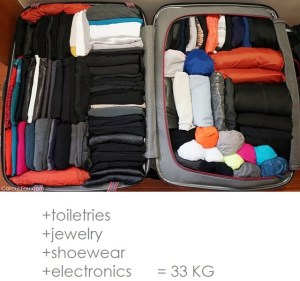
Photo courtesy CarouLLou. Click on the photo to learn her packing tips!
CarouLLou and her love travel with one medium-sized suitcase and one carry-on each—65 kilos of luggage. Remember, those suitcases contain everything they own. It definitely puts the quantity of “things” I have in my 3-bedroom condominium to shame. And my stuff has been actively downsized for several years now! So many of us want to live simpler, lighter lives. CarouLLou definitely lives lighter, if not simpler, than most of us.
I am fascinated that all her belongings fit in one medium-sized suitcase and a carry-on, because CarouLLou always looks so gorgeous, so put-together, and so in her element—whether she is in Mexico City, Tokyo or Rome. How in the world does a woman look that great and own so few pieces of clothing and accessories? Her response seems a good guide for many of us.
I well know that the life of an entrepreneur, local or global, can get lonely and isolated if we’re not careful. We don’t have an office full of people to work with everyday, so we have to reach out and actively build community more than some others. The very creative CarouLLou found an innovative way to connect with like-minded people in new cities in which she lives: “brainstorm lunches.” Click on the link to read a full article about these, or view the video clip below to hear her talk about the fit between treasuring friends and family, and the life of a global nomad.
CarouLLou speaks four languages, but obviously she has visited a lot of places in which she doesn’t speak the language of the place. How does she get along? I asked her to share some tips with us on how to communicate and get what we need when we don’t speak the local language.
There are so very many countries in the world, and even though CarouLLou and her husband choose to live mostly in metropolises, how do they choose where to live next? How do they decide whether to go to a new place or revisit a previous “home”? And how do they agree? I love her answer; based on decades of experience, it provides a sound guide for any traveller or sojourner.
Are you curious to know whether, after 21 years of nomadic life, CarouLLou still experiences culture shock? Here is what she says about this challenge.
The Facts This couple has been in 68 countries by the UN nation-count, 82 countries according to the “Travelers’ Century Club.” They like urban areas, and tend to travel East to West, following the seasons. They have twelve or so absolute favorite cities in which they feel at “home” and revisit regularly, and they rotate favorite places with places they’ve never before been to.
Photo courtesy CarouLLou
In 1994, CarouLLou and her husband began traveling, subletting their Montreal apartment, but in 1996 they announced to their family and friends that they were “jumping into the unknown!” They sold all of their belongings—minus a couple of suitcases full of personal items—and a FAX machine—to make their home portable.
How does CarouLLou support herself? She became “location independent” years ago with her marketing business, and then with her coaching business, because she could meet with her clients via fax and phone. (CarouLLou actually gave her clients and collaborators prepaid phone cards so they wouldn’t incur extra charges to communicate with her; how fast technology has changed!) She got her first email in 1998—quite late to the technology world, in my global nomad experience—and started a few online businesses as well as a photo site for her family and friends.
Currently, CarouLLou provides consulting on life potential, for start-up businesses, and marketing strategies, has several websites, some information funded by publicity, and others with affiliate partnerships (among them her travel site, as well as hotel booking and apartment booking sites). She loves fashion; in her blog and Facebook photos she always looks perfectly put together, and her looks are her own, yet change with each city in which she lives. She also has an online jewelry store to enable us to share some of her “finds,” and shares her inspired “looks” for various cities and sells clothes online. She is an investor, engages in currency trading, and has passive income from international organizations she’s set up over the years. CarouLLou also has several paper.li papers: Style, Nomads, and Travel.
Her philosophy includes:
“When we travel with an open heart, our world is full of hearts.”
“Don’t try to spend less, try to find ideas to make more! The more you spend, the more people benefit.”
“Remember the word currency comes from ‘current,’ so be in the current!”
“Work a little everyday, and do something special every day… and you will feel on vacation all your life!”
You can subscribe to CarouLLou’s blog, or follow her on most every social media. Like Cultural Detective, she has about 20,000 followers on social media, and she definitely shares our passion for cultural diversity and competence.
Remember the goal of intercultural communication? To help us be able to better understand one another, talk to each other, collaborate, and make our communities and our world a better place in which to live?
Sometimes, however, I get discouraged that my beloved intercultural field has lost its way. It’s great that we now have so many PhD and MA programs, but when did intercultural communication become all about dimensions and theories? Or about exercises and activities without an underlying coherent design?
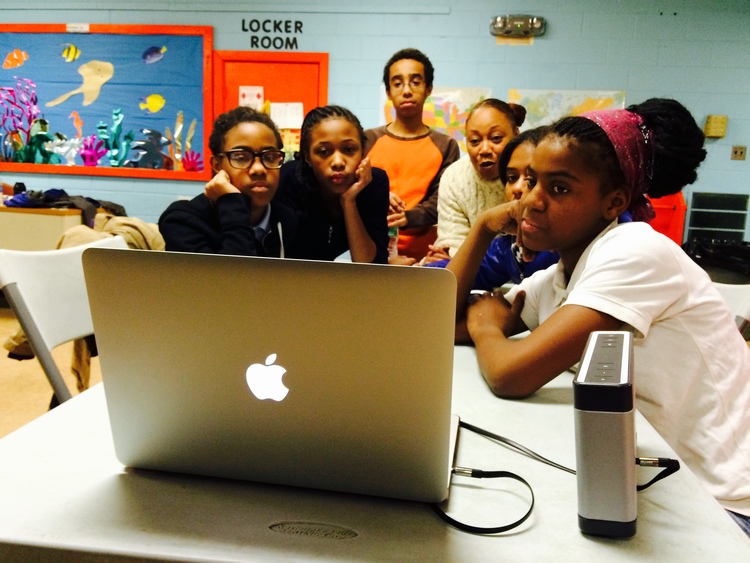
Yes, perhaps these are expected mid-life or late-career gripes. Then I come across a movie entitled, “The World Is As Big Or As Small As You Make It,” showcasing a most excellent-sounding project called “Skyping Around the World” by a group called “Do Remember Me: Connect, Dispel, Build,” and my faith is restored. The project gathers youth aged 12-15 at neighborhood recreation centers in France, Kazakhstan, Kenya, Nigeria, Tanzania, Uganda and the USA for a series of workshops that use art for social advocacy and to motivate activism.
Kids connect with one another via Skype to engage in positive dialogue and dispel the myths of hopelessness, overcome media stereotypes, and bridge cultural differences. Their mission is to delve deeply to find their common ground, to share experiences, and to work toward actively supporting one another. They encourage activism and advocacy for issues such as peer violence, the absence of leaders and heroes, and many other pressing issues.
Regular readers of this blog know that the “contact hypothesis” tells us that merely bringing kids together via Skype isn’t enough to achieve these lofty goals. The meaning they make of their Skype experiences must be facilitated, and that is apparently done, at least in Philadelphia, by two teaching artists, Sannii Crespina-Flores and DJ Lean Wit It.
The 12-minute film is most definitely worth viewing. It is embedded it below. Come on, get your cup of tea ready, and prepare to smile and be encouraged.
These kids use their phones and iPads, which they would normally use to text local friends, take selfies, or make social plans, to enlarge their worlds by forging friendships with peers across the world. For young people who have often never left their hometown, these exchanges prove to be both touching and surprising, giving them exposure to new corners of planet Earth and encouraging them to witness to the great (and sometimes unfulfilled) potential that exists in their own back yards.
The film came to be when it was the winner of a 140-character story entry in the Sundance Institute Short Film Challenge, designed to help put an end to extreme poverty in creative ways:
“As technology advances, our world grows smaller. Yet, while we are more connected than ever before, we remain separated by the lottery of where we are born. Around the world, people just like you – with the same beliefs, dreams, and aspirations – have drastically fewer opportunities due to extreme poverty and hunger.
Through the universal power of storytelling, the Sundance Institute Short Film Challenge will put a spotlight on our similarities—showcasing stories that communicate how we can support one another to end poverty and hunger once and for all. There is a more hopeful future for millions of people around the world, it’s up to us to inspire a positive change together.
In 2015, storytellers from around the world will gather to showcase how creativity can change the world.”
–Sundance Institute Short Film Challenge website
Obviously a very noble cause—ending poverty—though the Film Challenge is taking a Minimization (in DMIS and IDC terminology) approach to intercultural competence. A Minimalist approach, of course, is probably most appropriate to build critical mass; while it by no means stretches us to the levels of intercultural competence needed to end poverty, it can, at least, help build momentum to get people on-board and helping to accomplish the goal. The Film Challenge is an impressive global partnership of the Bill and Melinda Gates Foundation, the Sundance Institute, and the following organizations:
There is some connection to Global Citizen as well, though I can’t figure out from the website exactly what that affiliation is. The Global Citizen is a platform that advocates for the achievable goal of ending extreme poverty in the world by 2030; it was created in 2012 by the Global Poverty Project. Kudos to the Bill and Melinda Gates Foundation and Sundance Institute, as well as all the sponsors and participating organizations!
Some of the other films in this challenge are also very interesting; all highlight successful attempts to bridge cultural differences in order to end world poverty. Watch them here.
Thank you for joining with Cultural Detective on this journey to build intercultural competence. We are thrilled to be able to share projects like these that parallel our goals: better understanding of others and ourselves, and innovative and meaningful collaboration. Together, we can transform our world. As Dr. Seuss, the children’s author, wrote in The Lorax: “Unless someone like you cares a whole awful lot, nothing is going to get better. It’s not.”
Four years ago the FBI (Federal Bureau of Investigation) conducted a raid on a mosque in Miami, Florida. What could have been a disastrous, public relations nightmare for both the Muslim community and the FBI was carried out so well and so carefully that most of us had no idea the raid took place. I wrote about it then, but I bring it up again now.
I believe this story has good insight into how cultural competency helps in any area of work.
I am not one to praise the FBI or government in general, but it is important to give credit and recognition where it is deserved. I was amazed with the thoughtfulness and cultural awareness with which the raid was carried out. All the evidence points to actions that took into account the larger Muslim community and efforts that were taken to inform and involve this community.
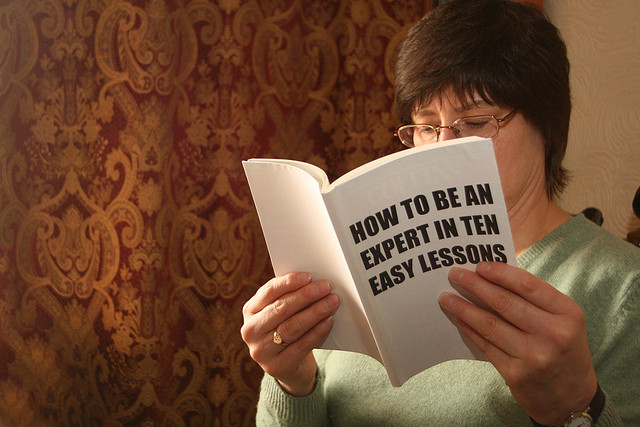
Clients want to hire experts. Are you an expert? I hope not! At least, not in the sense many of us traditionally think of “experts.”
Cross-cultural service providers need to be deeply competent in a variety of disciplines: intercultural communication, learning theory, the context of the organization or community, the people involved, etc. However, even though clients frequently push us into the role of “the expert with the answers,” assuming that role tends to be the wrong approach to building intercultural competence. That’s probably why I find the video below so amusing, and why Cultural Detective Facilitator Certifications focus on facilitation competence rather than information delivery.
Sure, cross-cultural effectiveness may require that we know how to tie a sari correctly, bow appropriately, or kiss the expected number of times. And we need to know the business at hand, e.g., the requirements of virtual teaming or methods of procurement—the specifics of what we’re involved in. It may require that we know how to draw red lines, as in the video. These things require information—a positivist approach. There may be a single “right” answer.
Most often, a client tells an expert what he wants, and then hopes the expert will simply “make it happen.” No need for the client to get overly involved; just leave it up to the expert. When a client (or student) asks an expert a question, they want a clear, specific answer—not “it depends.” Yet, in cross-cultural situations, so much does depend. “Correct” answers are contextual: how well do you know someone, are you meeting them socially or professionally, what country and region are you in, what social strata? Do you want to build market share or gain return on investment? Are you new to a market or have you been there for decades? What’s your reputation? A relativist approach allows for cultural and contextual differences—key to effectiveness and appropriateness.
While both positivism and relativism have their place in developing cross-cultural competence, the real change-maker is in a constructivist approach. The Japanese may generally do something a certain way, but that doesn’t mean an expat, immigrant, or visitor should or must do it that way. People need to find their way of being successful in a new environment—a way that works for them personally. True intercultural effectiveness requires client engagement, along with expert guidance.
Take my friend Doug. He is US American, and he has a loud and infectious laugh that he regularly engages in with a wide-open mouth and a slap on his leg. Most definitely not common Japanese practice, right? So, when he goes to Japan, do you take a positivist approach, and teach him a Japanese-style laugh? Will that be the key to his success in Japan? Do you compare Japanese laughter to US American laughter, or his friends’ laughter to his? In Doug’s case, when he moved to Japan he didn’t really adjust his laughter at all. His laugh is a core part of who he is, and most Japanese colleagues and friends love him for it. Sure, they may have been surprised at first. But his laugh is genuine, it’s him, and they understand that. Doug was highly successful in Japan, perhaps despite his loud laugh, but more probably, in part, because of it. He adapted his style in other ways.
Such is the constructivist nature of intercultural competence. Together, we co-construe, we “construct” our shared experience, and through that, we make sense of our relationships. Cultural Detective takes a constructivist approach. Yes, the CD Method contains elements of positivism (Values Lenses) and relativism (Worksheets), too, but they are used with the goal of learning about ourselves and others, and creating bridges that will enable each of us, and our organizations and communities, to be our best.
“The wise man doesn’t give the right answers,
he poses the right questions.”
—Claude Lévi-Strauss
French Anthropologist, 1908-2009
In dealing with a client that wants an “expert,” the clue to remember is what kind of expert you are. Effective intercultural facilitation is difficult, and we as facilitators do not have the “answers.” The “answers” reside in the client, the team members, community members, or key stakeholders. Our job is to bring the answers out, help make them known, help refine them so they are real and workable, and so that they enable intercultural effectiveness. This requires a high level of expertise: to help the client look inward and develop the answers themselves, when they are looking for a “magic” solution from an outside expert.
Learning opportunities to acquire good, effective intercultural facilitation skills are often hard to find. We are pleased to offer workshops that will help you gain and improve facilitation skills useful in intercultural contexts. Our Cultural Detective Facilitation Certification workshops are quite popular with both new and experienced facilitators, who always learn more than they expected. Three opportunities are scheduled this year:
In addition, Daniel Yalowitz and I are offering a course at SIIC, “Gaining Gaming Competence: The Meaning Is in the Debriefing.” This experiential workshop focuses on current best practices and theories for creating, facilitating, and debriefing meaningful intercultural games, activities, and simulations. This is an excellent opportunity to gain a wealth of information in a short period of time. More information can be found here: http://www.intercultural.org/11.php.
Please join us for one of these upcoming events, to hone your intercultural facilitation skills to an “expert” level! In this way we can accomplish our shared goals of spreading intercultural competence to build understanding, collaboration, equity and justice in our world.
Our Tribal Elders and the Global Nomad Medicine Wheel, from Djibouti Jones’ blog
I love Djibouti Jones, though I am new to Paul Asbury Seaman. Paul wrote a paper summarizing the huge contributions that Ruth Van Reken, Ruth Hill Useem, David Pollock and Norma McCaig have made to the intercultural field and the world. They all contributed to definitions and recognition of the term, “Third Culture Kids.” Djibouti Jones is publishing the paper, in its entirety, over six Tuesdays. The first segment is linked below.
A culture doesn’t happen by accident. Neither does it simply evolve through inevitable phases and developments. The beliefs and emotional tone of a culture are based on countless discoveries and the meanings assigned to the structures created. As global nomads, our culture is largely invisible. It has no geographic boundaries and no designated symbols. We resort to surveys and anecdotes, cautiously giving labels to the patterns we see. What we name becomes an identity, but one that is never quite complete because the labels are porous and the patterns keep shifting. A roving heart and ambiguity are commonly part of the global nomad legacy; but they are also aspects of a way of life many of us have chosen—with all its costs and merits. Living in limbo means we might often feel anchorless, but it also suggests that we are good sailors and bridge builders.
Instead of pushing boundaries, we pull on them—curious about what they are made of, what function they are supposed to serve.
We find commonalities where others may see none. We ourselves can be bridges across the limbo, not to explain it away, but to provide someplace solid from which to explore it.”…
Have you registered for the SIETAR Europa conference in Valencia, Spain May 21-23? The conference is the leading gathering of interculturalists in Europe, and is attended by many professionals from around the world. It is known for the quality of presentations and the intellectual exchange.
“This congress welcomes all those whose life and work puts them at the interface of cultures, from the perspectives of economy, society, and education with the aim of reshaping intercultural discourse, questioning our current cultural paradigms and exploring new thinking to help us navigate complexity in our emerging global world.”
—SIETAR Europa
Since our founding, the Cultural Detective Team has been committed to transparency, professional development, and vetting by our peers, and this congress will be no exception. Cultural Detective will have a huge presence at the congress, and we sincerely hope to see you there!
Also on May 19th, Pari Namazie and I will have the pleasure of conducting a pre-conference workshop, heavily based on Cultural Detective tools, entitled Blended Culture Identity, Global Ethics and their Value for Leadership and Teaming. I am very excited about where this workshop will take us. Ethics and authenticity are of crucial importance to cross-cultural leadership and teaming, and are too often overlooked.
You’ll find pre-conference and concurrent sessions by Cultural Detective authors Marie-Therese Claes, Patricia Coleman, Heather Robinson, Catherine Roignan, George Simons, Jolanda Tromp, Rita Wuebbeler, Tatyana and myself, plus sessions by CD translators, certified facilitators and partners. We look forward to meeting you or reconnecting with you in Valencia!
Shall we, as team members or neighbors, do something “my way” or “your way”? When in Rome, do we do as the Romans do, or as headquarters wants us to do?
As organizational effectiveness consultants, diversity and inclusion practitioners, or as intercultural trainers, educators and coaches, so much of what we do is to help people learn to manage differences. “Either-or” thinking is appropriate when there are answers that are independently correct. Do we need to get to the top of the mountain? A helicopter, hiking, tram, or driving are all possible “correct” solutions to our problem. What shall we eat for our lunch together? We both may enjoy sushi, tacos, or lasagna; a choice is probably much better than eating them all in the same meal.
Solutions to many of the issues that face us in daily life, however, involve the interdependence of two or more “right” answers. Children should learn to share and to take care of themselves. A new business may need to build market share (which requires ongoing investment) and get a return on its initial investment. An NGO needs to follow global protocol and provide services in a locally appropriate manner. A teacher needs to correct students and encourage them. These are not either-or choices; the “correct” answer involves “both-and” thinking—the type of thinking that Ash Beckham discusses in the video below.
But such thinking—holding contradictory ideas simultaneously and accepting them both as “correct” and even “necessary”—is often distrusted. It is sometimes seen as evasive or indecisive. George Orwell coined a name for it with a very negative connotation: “doublethink,” which was the result of brainwashing by the state in his novel, 1984. “Both-and” thinking requires more effort, and involves mental and sometimes also emotional stress. Thus, we get the term “cognitive dissonance.”
“Cognitive dissonance is the mental stress or discomfort experienced by an individual who holds two or more contradictory beliefs, ideas, or values at the same time, or is confronted by new information that conflicts with existing beliefs, ideas, or values.” —wikipedia
That’s why the work of interculturalists and diversity and inclusion professionals is so very important. Working or living together effectively involves give-and-take; it is a process. There is not one “right” way and one “wrong” way. Sometimes we may do it your way, sometimes my way, and hopefully, many times, we are creating better, more innovative, effective, and enjoyable ways to do whatever it is we need to do, by using the unique talents that all of us have to offer. And that, of course, is what Cultural Detective is all about—learning how to collaborate and work together, while recognizing that there are often many “right” ways to get things done!


 Only half of 1120 instructional design professionals surveyed recently feel their designs help meet business goals, and LESS THAN 40% feel their designs meet learning needs! That means that 60% believe their learning designs do NOT accomplish objectives! Survey results also showed that even in 2015, traditional classroom training ranks #1 on a list of the top ten learning approaches; 92% of instructional designers responding said they rely on it ahead of online or blended learning, coaching or mentoring.







 Cultural Detective Blog