 Eight Words of the Year from Other Countries
Great, short, fun, informative re-post. Thank you, Mental Floss!
Which words do you know? Which ones would you add?

Eight Words of the Year from Other Countries
Great, short, fun, informative re-post. Thank you, Mental Floss!
Which words do you know? Which ones would you add?
Our world is swimming in information, so much so that we often drown in it and find it difficult to make sense of. That’s why infographics play such a valuable role. Recently I’ve come across two different sets that I thought Cultural Detectives might be interested in seeing and using (or making your own for your own purposes).
Borrowing heavily from a concept by Danish designer Peter Orntoft, the Millward Brown Agency designed the two infographics below that put data in context. Interesting, no? More memorable than otherwise?

Photo by Millward Brown

Photo by Millward Brown
Secondly, Lam Thuy Vo of USA’s National Public Radio (NPR) created two graphics which clearly make the point that immigrants comprise about the same percentage of the US population as they did 100 years ago, though their geographic origins have changed.
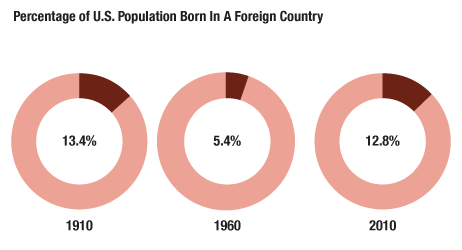
Graphic by Lam Thuy Vo of USA’s National Public Radio (NPR)

Graphic by Lam Thuy Vo of USA’s National Public Radio (NPR)
Do you use infographics in your work? Please share! Have you created any? Strikes me that interculturalists could sure use this terrific approach to creating and communicating meaning.
 Andrés Tapia has written an article for Diversity Executive, in which he outlines the need to adapt US business practices in order to attract, retain and make the most of Latino talent. In the article, he references (and gives you a sneak peak of) our upcoming Cultural Detective Latino/Hispanic.
 Experts estimate that only 50% of the languages that are alive today will be spoken by the year 2100. The disappearance of a language means the loss of valuable scientific and cultural information, comparable to the loss of a species. Tools for collaboration between world communities, scholars, organizations and concerned individuals can make a difference. Such is the raison d’être of the Endangered Languages Project, an online collaborative effort to protect global linguistic diversity.
The first thing I noticed on this site is the incredibly high quantity of red dots on the world map, each indicating a severely endangered language. The site enabled me quickly and easily to look up endangered languages in Mexico, where I live (the closest red dot to my home is the Seri language, one I’d never even heard of!). I also looked up the language that first interested me as a pre-teen in the southwestern USA: Navajo (it is labelled “at risk” and is currently a featured language on the site). Even in my adopted homeland of Japan, as I expected, the Ainu language is ranked “critically endangered.”
The languages included in the project and the information displayed about them are provided by the Catalogue of Endangered Languages (ELCat), produced by the University of Hawai’i at Manoa and The Institute for Language Information and Technology (The Linguist List) at Eastern Michigan University. The list of collaborators in the Alliance for Linguistic Diversity is indeed impressive. The project site is definitely worth using!
 This article by Vijay Nagaswami, “Culture vs. culture,” was sent to us via the marvelous Cultural Detective certified facilitator and current SIETAR India President, Sunita Nichani. She says, “Here is an interesting article published this Sunday in one of India’s leading newspapers, The Hindu. With the slow erosion of the custom of marrying within similar communities in India, intercultural competence will be vital for making marriages work.”
Lots of work to do in this world, in so many ways and places. Let’s get started, everyone!
What was the only economy in Europe that did not suffer a contraction in the global debt crisis of 2008-2009?
Think before you read! Do you know the answer???
Poland! And you have a terrific resource at your fingertips for doing business in Poland and working with Poles: Cultural Detective Poland.
Here are some reasons you want to keep your eyes on Poland, as explained by CNN:
“Ever since it broke from the Soviet Union back in 1989, Poland has been racing to make up for last time, as a member in good standing of Western Europe. Today Warsaw is the far side of the moon from the decadence and growing indebtedness of Moscow. Poland is staid, predictable, with no wild parties even on weekdays or outrageous displays of new wealth. Since joining the European Union in 2004, Poland has been working hard to meet the additional requirements of joining the Eurozone, which sets very specific targets for government deficits, debt, and other keys to economic stability like inflation and long-term interest rates. While many states that already belong to the Eurozone (from Greece to Spain) failed to achieve these targets, Poland largely succeeded, which is why it was in such good position to weather the crisis of 2008.
Today things look so good that Poland has the most vibrant labor market in Europe, creating jobs at a pace so rapid that many immigrant Poles are returning from the United Kingdom and other hard-hit nations to find work at home. Poland’s success was quite unusual – the only other EU economy in a similar position is the Czech Republic – but it does show that Europe can be a model for growth, at least for those who follow the rules.”
 Or so claims Jeanne Brett in a recent Harvard Business Review blog post. I will agree that most of the multicultural teams I’ve worked with over the past 28 years have been dominated by a sub-group of members. My guess is that’s the same for most teams, no matter the visible diversity of their composition.
This idea caught my attention, and I also really liked that rather than the usual analogy of talking about multicultural teams as symphony orchestras or likening them to herding cats, Jeanne relates multicultural teams to fusion cuisine. And who doesn’t like fusion cuisine? Way to sell multiculturalism!
“It turns out that fusion teams often … break a large team into smaller subgroups, encourage informal conversations, and thereby get input from previously quiet team members. Eventually, the subparts have to be integrated back into a whole; this turns out to be less of a problem than you’d think. In the teams we studied, the trust and respect generated within the subgroups made it reasonably easy to facilitate collaboration in the larger group.”
Another of Jeanne’s points very much echoes what the six expert, globally dispersed authors of Cultural Detective Global Teamwork have to say. Many of you know what a dynamite package that is and, if you don’t, please be sure to check it out! To quote Jeanne’s post:
“We’ve come across team leaders who achieve the same result (getting the most out of all cultural subgroups) by carefully establishing team norms at the start of a project. For example, we know of one manager who was leading an English-language software-development project; English was not his first language. In fact, his English was strongly accented. When he met with the team for the first time, he told them, ‘You’ve probably noticed I have an accent. If I could get rid of it, I’d be happy to do so, but since I cannot, we’re going to have to communicate … regardless of my accent or for that matter yours. If you do not understand me, or one another, whether it’s because of accent or anything else, we need to communicate until we do understand.'”
What do you think? In what ways are multicultural teams like fusion cuisine? What are some of your tried-and-true best practices for multicultural teamwork?
I have been waiting for someone to speak in an even-handed way to the pros and cons of the KONY 2012 video, which so many of us have had to respond to with a complex mix of feelings. Thank you, Liz Grover, for passing this on to us. Thank you, Laura Peterson, for taking the time to sort through your heart and your experiences and share your thoughts with us: Kony 2012 – My 2 Cents | Hands to Hearts.

 Cultural Detective Blog