The Pulitzer’s of Diversity

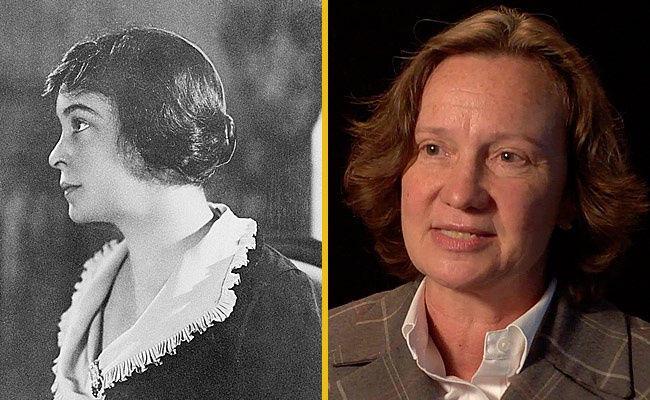
Edith Anisfield Wolf, Photo from the Cleveland Foundation

Edith Anisfield Wolf, photo from the Cleveland Foundation

Do you think you are well-read on world cultures? Do you occasionally wonder what one person can do to promote justice in this world of ours? Are you someone who thinks that it’s primarily people of color who recognize the vital importance of diversity on our planet? If so, think again and most definitely read on.

Edith Anisfield Wolf, born way back in 1889, was a poet, businesswoman and philanthropist from Cleveland who had a lifelong passion for social justice. The daughter of immigrants, Edith spoke four languages (English, French, German and Spanish) and used literature as a means to explore racial prejudice and celebrate human diversity.

In 1935 she created the Anisfield-Wolf Book Awards, to honor books that explore these very issues. That makes 2015 the Award’s 80th anniversary! Congratulations and thank you, Edith! Note how visionary that makes her—establishing this important Award 20 years before the U.S. Supreme Court’s landmark Brown v. Board of Education decision! Edith died in 1963, but her legacy lives on.

“The Anisfield-Wolf Book Awards recognize books that have made important contributions to our understanding of racism and our appreciation of the rich diversity of human cultures…Today it remains the only American book prize focusing on works that address racism and diversity. Past winners have presented the extraordinary art and culture of peoples around the world, explored human-rights violations, exposed the effects of racism on children, reflected on growing up biracial, and illuminated the dignity of people as they search for justice.”
—Anisfield-Wolf website

Over the past 80 years the Award has highlighted nearly 200 significant books, most of which I have not read. So I need to get going! For those of us who may be intimidated by such a long list, they also have a smaller list of 24 “Lifetime Achievement” books, or you can sort winners by year or according to the categories of fiction, non-fiction or poetry.

Again from the Award’s website: “The Cleveland Foundation, the world’s first community foundation, has administered the Anisfield-Wolf prize since 1963. Before then, the Saturday Review sponsored the awards. From the early 1960s until 1996, internationally renowned anthropologist and author Ashley Montagu chaired the awards jury. That panel of globally prominent scholars and writers has since been overseen by Henry Louis Gates Jr., the acclaimed scholar, lecturer, social critic, writer, and editor.”

Have you heard of this Award? Despite its prestigious history and huge contribution, and the fact that the Anisfield-Wolf’s cash prizes equal the Pulitzer’s, many people haven’t heard of it. Perhaps that’s due to how ahead of its time the Award was, though Karen Long, the Award’s manager, has another theory:

“[The] Anisfield-Wolf remains a relatively unknown honor. Awards manager Karen Long suspects she knows why. ‘Things that address race are considered, sometimes in the larger culture, as homework or broccoli or good for you.'” —USA’s National Public Radio

Cultural Detectives, I am thrilled to be on the journey to developing intercultural competence, respect, understanding, collaboration and justice with you. And, I’m feeling like we need to work together to make sure more people know about this incredible resource! Let’s start by watching the Awards via live feed this Thursday, September 10, at 6:00 pm Cleveland time (GMT-4), and by circulating this post widely to your networks.

Terrific Summertime Intercultural Movie: McFarland USA

MV5BMjMwNjY2Mjk5OV5BMl5BanBnXkFtZTgwODM2NTA0MzE@._V1_SX214_AL_Preparing to waste some time watching an in-flight movie as I flew to Europe from Mexico, I perked up considerably as soon as Los Tigres del Norte’s America came on. This film, McFarland USA, was not going to be a standard high school sports movie after all!

Todos son Americanos, sin importar el color
De América, yo soy, de América, yo soy

We are all Americans, no matter our color
I’m from America, I’m from America

The plot line:
Track coach Kevin Costner’s (Mr. White) temper has resulted in him and his family bouncing from one high school to another in a downward spiral of disenfranchisement from family and friends, as well as loss of self esteem and family cohesion. As the movie opens, Mr. White is forced to leave a (very white) school in Idaho for a very rural school in another part of the USA. His daughter’s first words as they pull into their new home? “Dad, are we in Mexico?” It turns out they’ve moved to the agricultural Central Valley of California. Living as a US expat in Mexico, their cultural confusion delighted my soul.

The initial culture shock:
Arriving tired and hungry, the White family heads to a restaurant in search of a burger. “We have tacos, tortas, burritos, quesadillas, tostadas…” recites the waitress. After several repetitions of the phrase, the family orders the only thing they apparently understand, tacos. They imagine their confusion has ended, but oh no… “Do you want asada, al pastor, chorizo, cabeza, lengua…?” While they are dumbfounded by the options, my family would be in heaven!

Low riders cruise the streets and Dad is scared he won’t be able to protect his family—bias incarnate. A rooster wakes them up at dawn, in stereotypical fashion, and a neighbor lady gives them one as a welcome gift. Dad finds a simpatico cultural informant in the local grocery store owner. They go from hating the Virgen de Guadalupe colorfully painted on their living room wall, to loving it.

Cultural adaptation:
Within a week of his arrival to their new home, Dad is fired from his position coaching football. His students’ reaction to the news? “Congratulations, Mr. White. They are treating you like a picker.”

A teacher now without a head coach position, Costner notices that many of the local kids run far distances as part of their daily lives—there isn’t any transportation other than one’s own two feet. He also realizes that the kids wake up early in the morning to help their parents pick crops, before they begin their second day later in the morning at school. The kids’ abilities impress the heck out of him; he is blown away that they have the stamina for both work and study, and disappointed when his students’ parents don’t support their kids’ after-school activities (they need the kids’ help in the fields).

Mr. White gets to know a couple of the local kids, and enlists their help to put together a cross-country running team. Part of his learning journey includes a day with the kids out picking in the fields where, as expected, Mr. White fails miserably.

The movie does an excellent job capturing Mexican values such as family, respect for elders, hard work, dealing with adversity, and joy in life. We watch with delight as Mr. White and his family learn invaluable life skills from their new neighbors and friends, and experience, for the first time in their lives, some of the joys of community and tradition.

The movie as a learning resource
McFarland USA is a predictable movie, rather stereotypical, but refreshing and timely. I found it a very worthwhile way to spend a couple of hours on an international flight, and would recommend it to you for summer viewing. I can definitely see using clips from this film in coaching, educational or training environments. Please let me know what you think.

Do you have a favorite cross-cultural movie, book or resource? Share with us your review!

“On the Road with Migrants” Game

IMG_3100World Refugee Day is June 20th, and I am honored to be able to share with you a powerful new game available free-of-charge to help raise awareness and understanding of the refugee and migrant experience.

Catherine Roignan, co-author of Cultural Detective Morocco, conducted the game at the recent SIETAR Europa conference in Valencia, and it was my favorite session of the conference. Many people in the room had tears running down their cheeks, and in the days following we found ourselves often talking about the experience we’d shared.

The game is called On the Road with Migrants, and it was created by Caritas France, the Association des Cités du Secours Catholique or ACSC. At the conference we had only a brief 15-20 minutes to play, but it was remarkable!

Groups of us gathered at tables with game boards showing different continents of the world, including Africa, the Americas, Asia, and Europe. Each player had a pawn representing an immigrant, who was identified by name and story. We threw dice, drew cards and moved our pawns around the board according to the instructions on the cards and the dice.

Kudos to Caritas France for their brilliant work on this! It is a terrific game!

The materials are available for download free-of-charge; you print out the cards and boards, and add dice and pawns—1 die and 4 pawns (one color for each of four characters) per continent/board. Our SIETAR Europa group helped with the English translation—this is collaboration with a purpose!

Learn more and download the game in French, English, Portuguese or German: En route avec les migrants. I am leading a team that is translating the game into Spanish.

Please, share with us your resources and ideas for commemorating World Refugee Day and for building empathy for the migrant experience in this world of ours.

Since When is 40% Acceptable?

Instructional_Design-InfographicOnly half of 1120 instructional design professionals surveyed recently feel their designs help meet business goals, and LESS THAN 40% feel their designs meet learning needs! That means that 60% believe their learning designs do NOT accomplish objectives! Survey results also showed that even in 2015, traditional classroom training ranks #1 on a list of the top ten learning approaches; 92% of instructional designers responding said they rely on it ahead of online or blended learning, coaching or mentoring.

Such findings help explain why sales of Cultural Detective‘s old-fashioned though beautiful, printed PDF handouts still outsell our state-of-the-art Cultural Detective Online, which provides unbelievable value for the investment (63 packages integrated into one interactive system at very affordable subscription prices). It also shows that you, our community, are learning leaders who are very quickly turning that reality on its head—if trends continue, CD Online sales will soon surpass PDF package sales.

Neither are you part of that 60% in the study who feel their designs don’t meet learning goals! You, our users, report that CD Online makes it easy to make learning creative and practical—and to achieve outstanding results.

The research findings I shared above are by ATD Research and the Institute for Corporate Productivity (i4cp), and appear in Instructional Design Now: A New Age of Learning and Beyond. The report retails for $499 ($199 for ATD members). A white paper is available for $19.99 (free to ATD members), and ATD has made a very short free preview available as well. The research addresses such questions as:

  • Are most organizations embracing high-tech options, such as mobile learning, social learning, and MOOCs?
  • Which of the newer tools and approaches produce better learning results for companies?
  • What can instructional designers expect the next few years to bring?
  • Does formal education still play a valuable role in preparing designers for the challenges of the workplace?

Organizations participating in the survey include LinkedIn, NASCO, and Novartis Pharmaceuticals Corporation.

The last study in this series—from 2010—showed that instructional design needed to become faster, more strategic, global, and tech-savvy. Other key points from the 2010 study included:

  • Emerging learning methodologies would challenge designers to craft multifaceted content.
  • Growth in social media would expand its use in learning.
  • Budget constraints and staffing issues would be stumbling blocks for instructional designers.
  • Measurement capabilities would be increasingly necessary to capture and communicate the value of learning assets.
  • Efforts would be required to get organizational stakeholders onboard with new learning mechanisms.

We frequently share designs and results from our user community on this blog. It’s a great way to help others, to encourage the development of intercultural competence in this world of ours, and to get you and your organization’s name out there as leaders in intercultural competence development. Contact us if you’d like to share a summary of your work or have us interview you.

And, for goodness sake, if you haven’t explored the potential of Cultural Detective Online, what’s stopping you? Join our next free webinar on Tuesday, May 12th. Information and registration can be found here.

Standards of Good Practice for Education Abroad

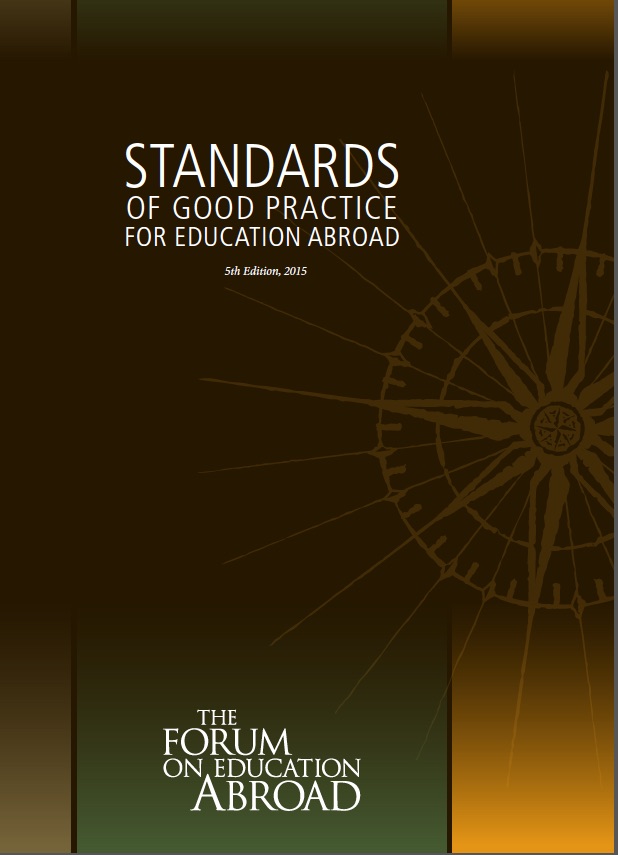
Standards Good Practice, FEAAre you a study abroad professional? Are you looking for like-minded professionals who share the same challenges and frustrations as you do? Are you wondering where you can turn for some solid advice and guidance to make your institution’s study abroad programs high-quality learning experiences for your students? Ever heard of The Forum?

The Forum on Education Abroad is a nifty organization, first conceived in San Diego, California, in May 2000, by a group of education abroad professionals who felt the need for a stand-alone organization. At that time, there were study abroad programs at numerous educational institutions, yet nothing existed in terms of standardization of policies and practices. Essentially, each program was on its own, and its quality was as good as the director of the program was able to make it, given the knowledge and resources available.

From its inception, standards of good practice for education abroad have been a priority for The Forum. Beginning in November of 2002, they began to lead the development of a set of standards. They used a distinctive approach: they structured the Standards by stating each Standard, followed by a set of questions designed to be used for assessment of that Standard. The first formal edition of the Standards of Good Practice for Education Abroad was published in November 2004.

The group moved quickly (history of The Forum), and by 2005, it was recognized by the US Department of Justice as the as the Standards Development Organization (SDO) for the field of education abroad. This status gives The Forum legal protection in undertaking standards-development work, and obligates the organization to exhibit “Openness, Balance, Transparency, Consensus, and Due Process in developing and disseminating standards.”

FEA Logo

“The Forum on Education Abroad is an institutional membership association and welcomes as members all institutions of higher learning, consortia, agencies, and organizations who are committed to improving education abroad. Members join a community of dynamic, thoughtful dialogue about the issues facing the field of education abroad.”

Among the variety of resources and training opportunities The Forum offers for its members and the public, a “must have” for every study abroad office is the recently published Standards of Good Practice for Education Abroad, 5th edition, 2015. This document offers authoritative and comprehensive guidelines for the development, management, assessment, and improvement of education abroad programming, in order to make students’ experiences as rewarding and meaningful as possible.

If you are a study abroad professional and are not familiar with this resource, please take a look. You will be doing yourself, your institution, and your students a big favor. As we have discussed before in this blog, meaningful intercultural experiences arise not just from being in the vicinity of an event, but from the meaning we give to those events. If we are to truly offer high-quality study abroad programs, we need to consider the pre-departure preparation, the on-going support during the time abroad, and the integration of the international experience into the life of the a student upon return home. Standards explores all these areas and more. Forum members have exclusive access to additional resources related to each Standard.

Cultural Detective salutes the work of The Forum and its ongoing efforts to promote cultural competence through well-run, ethical, study abroad programs! Cultural Detective Method and materials integrate seamlessly into all stages of study abroad—pre-departure, on-going support, and reentry— helping students to make sense of and integrate their experience.

Movie Review: Zindagi Na Milegi Dobra, “You Only Live Once”

MV5BMzQzMTA4ODY4OF5BMl5BanBnXkFtZTcwNjgyMDQxNw@@._V1_SY317_CR2,0,214,317_AL_A guest post by global nomad and terrific Cultural Detective community member Anita Thomas. Originally from Hungary, Anita has lived in India and Ireland, and currently resides in the UK. She enjoys meeting new people and understanding how they think about life.

Many thanks to Anita for this film review!

You Only Live Once, a 2011 Zoya Akhtar film, is one of my all-time favourites, which I have seen at least ten times. It is a well-crafted movie that never get bores me. It shows some aspects of Indian culture—marriage, friendship—and at the same time gives a true insight into Spanish culture. I highly recommend it to Cultural Detectives!

Adventures
Three friends—Arjun, Kabir and Imraan—set off to Spain to enjoy the trip of their lifetimes. Each of them suggests an adventure, which he shares with his friends the night before. They aim to get over their fears. Viewers enjoy beautiful scenery through the magnificent camera shots, and feel themselves totally in the shoes of the three friends.

Music
This is a Bollywood movie from India, hence there are lots of songs in it. Most of the songs are in Hindi, but there is one in Spanish, too! Tired of sitting on the sofa? Stand up and dance!

Emotions
Plenty. Love is happening with all three of the friends. If there is love, there must be jealousy, too! One of the friends has a never-seen dad living in Spain; he is afraid to see him. Another friend manages to overcome his workaholism. There is a strong bond of friendship among the three men throughout. The emotions are supported by the great music and the poems written by one of the friends.

Zindagi Na Milegi Dobra brings joy to the eyes, ears, heart and mind. And to the tummy as well: there are many jokes and funny scenes to balance out all those emotions flowing in this two and a half hour movie. See the trailer here:

And my favourite songs from the movie:

Enjoy!

3 Fundamental Skills for Intercultural (and Life) Effectiveness

Chef

A, B, C of intercultural effectiveness, and a film recommendation

For well over twenty years I travelled 25 days out of every month. I loved it. Always a new place, thriving off the energy of the people I had the pleasure of working with, each week or two entering a new industry and learning how things work. The fundamentals of human interaction that I dealt with did not vary significantly by industry; the content, however, did.

When my son was small, he and the nanny travelled with me. As he got older, he accompanied me. He sat through my training workshops, he accompanied me on some consulting gigs, and he enjoyed babysitters, daycare and children’s learning clubs around the world. Ten years ago, when my son was about eight, I began scaling back my travels. The impetus for scaling back was that my son was now old enough that it became challenging to take him out of school; he would miss too much. And, there was no way I was going to miss his childhood! An additional reality was that the constant travel was ruining my health, I always felt tired, and, I was honestly just ready for a change.

So, I stopped the 25 days/month travel schedule. It was difficult to say “no” to interesting and high-paying work, but I’d set my priority. I started staying home. I started a small publishing project (Cultural Detective). I absolutely loved it. I was now able to take time to cook regularly, a passion I love. I was able to exercise daily, and meet new people locally via exercise classes and groups. I was able to go out for coffee with girlfriends, and to be present for friends’ major life events—so many things I’d missed when I travelled a lot. Of course, I also missed the travel, and seeing my far away friends.

Now, when I occasionally travel (every couple of months), I find myself grateful for the experience rather than resentful. The journey is enjoyable again. Thus, on a recent flight to Vienna, I relished having two seats to myself. I was grateful for the free-flowing, high-quality red wine on Tirolian/Austrian Air. I read the in-flight magazines on two different airlines and got several blog post ideas. And I very much enjoyed watching a Blended Culture movie entitled, Chef.

The film is an enjoyable reminder of some fundamental intercultural competencies and life truths…

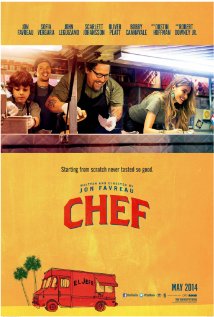
Chef is a 2014 movie starring Jon Favreau, Scarlett Johansson, Dustin Hoffman, and Robert Downey, Jr., about a chef whose family and career have both become frustratingly dull. He’s caught up in the busy-ness that can be modern life, and failing to pick up on the cues that his relationships and creativity require a major shift. He reminded me a bit of myself, actually. Have you ever found yourself in a rut? Going through the motions, not paying enough attention to what really matters, focusing primarily on accomplishing all the tasks on your plate?

In true Hollywood style, by the end of the movie the chef figures it all out, and happiness reigns as the credits roll. Along the way, the film is an enjoyable reminder of some fundamental intercultural competencies and life truths.
  1. Attentiveness: Stay alert to what’s around you (family, friends, work environment), as well as to what’s inside you (your passions, talents and desires). Prioritize your activities so that you feed what’s important to you and minimize that which diminishes you. Staying externally attentive will help ensure that you adapt appropriately in cross-cultural situations, while internal attentiveness will help ensure that you do not lose yourself, your ethics and your talents, in the process.
  2. Bravery: Don’t be afraid to take risks. There are many euphemisms for failing to do what we know we need to do: “going through the motions,” “paying the bills,” “not rocking the boat,” “keeping one’s head low.” Staying true to oneself and what you know to be “right” often requires bravery and trust. I’ve seen many times that foreigners or outsiders can effect positive and needed change to a system when old-timers can not. I’ve worked with many people who try so hard to “fit in” to cross-cultural situations that they lose who they are, their authenticity. Be brave enough to adapt, and be brave enough to be yourself.
  3. Creativity: If you’re not feeling energized, if you fail to see connections between the different areas of your daily life, if you’re not frequently generating ideas, experimenting with innovative projects, or exploring new territory, take note. You are probably pushing and trying to do too much too quickly. Slow down, step off the rat race, refresh, restore and recuperate. You are far too precious, and your insights and talents are too needed, in this world of ours. How can any of us bridge cultures if we don’t have access to our innate creativity? And, let’s remember: it takes all of us to be creative if we are to form a truly inclusive society or organization.

Linked to the My Global Life Link-Up at SmallPlanetStudio.com

Let’s Investigate What Makes Cultural Detective Unique

ICToolsCollage

Country Navigator™, GlobeSmart®, CultureWizard™, Cultural Navigator® and their logos are the property of their respective parent companies.

We get calls and emails every day, asking us how Cultural Detective compares with some of the other intercultural tools on the market. Thank goodness people are passionate about developing intercultural knowledge and skills, and that there are so many intercultural tools available! That’s a big change in the last two decades, and a huge step in the direction of building intercultural competence in our organizations, our communities, and ourselves!

Most of the well-known development tools in the field—Cultural Detective®, Country NavigatorTM, GlobeSmart®, CultureWizardTM, and Cultural Navigator®, among others, use a values-based approach to understanding cultural differences. Such a method has proven significantly more effective than a “do’s and don’ts” approach, because behavior depends on context. Thus, do’s-and-don’ts advice is frequently erroneous because it has little or no connection to a specific situation you may find yourself confronting.

In addition to a shared focus on values, these tools share the aim of improving cross-cultural understanding. That, however, is about where the similarity ends. Comparing Cultural Detective and the other tools on the market is difficult because, according to leading intercultural competence researcher Doug Stuart, “it’s like comparing apples and oranges.” Both fruits are tasty, and they go well together in a salad, but they are oh-so-different on nearly every other criterion!

Goals

Cultural Detective (CD) is a process-based tool designed to improve communication and collaboration. The other tools mentioned above are designed to compare and contrast cultures. There are strengths in both of these goals, and they can complement one another very well. But the differing goals make these tools fundamentally different species.

Dimensions

Dimensions-based tools allow users to easily compare whether Chinese are more group-oriented than Japanese or Brazilians, and how we personally compare with the national averages of each of those places. The creators of the best of these tools conduct a lot of research to produce statistically reliable comparison data. According to Doug, the strength and weakness of a dimensional comparison (for example, where a culture or an individual stands on Hierarchy vs. Egalitarianism) is that we get a clear general picture of how different two populations may be, but no specifics on how that difference looks behaviorally. The numbers on the scales produced by these tools are culture-specific, but the categories are universal and broad.

Process

Cultural Detective helps develop skill and strategy, both culture-general and culture-specific. The core method is a process designed for use and practice over time, in specific situations and multiple cultures, so that it becomes second nature. Thus, Cultural Detective provides appropriate stimulation at all stages of intercultural competence development. Users develop critical thinking skills to discern similarities, differences, and how best to leverage them for mutual benefit.

Context

Cultural Detective is contextually grounded—the method centers on stories or critical incidents. This reinforces the need to understand people as complex individuals who are influenced by multiple cultures including gender, generation, professional training, sexual orientation, spiritual tradition, organizational and national culture, and lived multicultural experience—not just passport nationality.

Inside-Out vs. Outside-In

Cultural Detective looks at culture from the inside-out. Values Lenses focus on the core values natives of the culture hold near and dear. These are the same values that often confuse non-members of the culture and get in the way of cross-cultural collaboration. This approach enables a native, or someone very familiar with a culture, to explain the culture in a meaningful way to a newcomer. We might consider these Value Lenses as extremely culture-specific “themes” (internal discourse, logic or “common sense”) that are intimately tied to behaviors, and easily and meaningfully illuminated through stories. A culture is a unique expression of these themes, which are difficult or impossible to capture successfully within broad global dimensions.

The other tools mostly look at culture from the outside-in, comparing national cultures according to well-researched categories such as Power Distance or Achievement/Ascription. A table of cultural dimensions that contrasts China and Japan tells you nothing practical about how people behave. Comparing Cultural Detective Values Lenses for China and Japan offers a completely different, immediately applicable line of inquiry: what are the underlying motivators of people’s behavior? Both approaches have their strengths, and many successful coaches, trainers, and educators use them in combination.

Self-Assessment

Many of the other intercultural tools on the market provide users a self-assessment, which, when completed, statistically compares them with their home society and other cultures. Users love seeing themselves, their values and style, especially when correlated with numbers or illustrated in a chart—it’s interesting and engaging.

Cultural Detective users reflect on their personal values, developing a Personal Values Lens that they can compare and contrast with those of team members, their own or other cultures. One approach is dimensions-based, the other based on qualitative analysis. Used in combination, one enhances the other. But they are two very different animals.

Experiential

Cultural Detective Online encourages learners to upload and analyze real stories from their own lives. Users can easily integrate the system’s Values Lenses and Worksheet into analysis of their personal critical incidents. They can invite team members to help them fine-tune the story and the debriefing. As Doug says, “While the cultural themes of Cultural Detective Value Lenses are very transparent to natives and, thus, easily illustrated by stories, the dimensions-based tools usually require an experienced cultural trainer to create ‘critical incidents’ illustrating universal dimension differences, which are more difficult to specify behaviorally across cultures (unless one is very familiar with both cultures). Simply summarized, universal dimensions are generic; they provide a good ‘first look’ at how different two cultures might be. To actually understand those differences as they play out behaviorally, we need the Cultural Detective’s Value Lenses.”

Cultural Detective is not your father’s intercultural tool, to paraphrase an auto industry advert. It utilizes a “culture-specific” approach, while simultaneously building users’ “culture-general” understanding. It provides not just a knowledge base, but a personal skill base from which to strengthen intercultural competence. Best of all, it can be used in a variety of settings to help facilitate intercultural communication and collaboration. Our global team of 130 continues to work hard to collaboratively build a productivity tool that will deepen your learning and jumpstart your effectiveness. Give it a spin! Join us in one of our upcoming free webinars to learn more, and receive a 3-day pass to Cultural Detective Online!

4 Methods of Learning Culture

cover_selfdiscovery copy

“…the things we take for granted can trip us up and cause untold discomfort and frequently anger.” Edward Hall (“How Cultures Collide,” Psychology Today, July, 1976.)

It is generally acknowledged that it is important to understand one’s own cultural values before we can begin to understand another’s worldview, let alone develop intercultural competence. Cultural Detective Self Discovery offers a way to investigate our own values through a series of guided questions designed to help us discover more about ourselves. Below is an excerpt from Cultural Detective Self Discovery by Dianne Hofner Saphiere, George Simons, and Kate Berardo in which we address various approaches to culture learning.

Why learn about such a complex thing as culture? Certainly no one can learn everything about every other culture or even about one’s own, so why try at all?

At a very practical level, having the ability to work across cultures is a key skill in daily life and the workplace. When we think about “culture” as different organizational departments, communities, regions, companies, nations, genders, or religions, we realize that we cross cultures daily and constantly.

While we can never learn everything about every culture, what we can do is know our own values and how they affect us. We can be determined to go beyond auto-pilot thinking and to question our assumptions. We can approach working across cultures with curiosity and the intent to learn about others. Doing all this helps us to communicate more effectively and to avoid misunderstandings that lead to bad feelings and conflicts. In communities, this translates into greater cohesion. In the workplace, it means higher productivity, creativity, and synergy.

Encountering people who see the world differently, act differently, and speak differently challenges us to understand others and become more open and creative.

As Cultural Detectives, we want to understand what makes people tick. So where do we begin? There are a number of approaches to learning about cultures:

The Etiquette & Customs Approach
First of all, it is useful to know about people’s customs and habits, for example, when and how they greet others. There are many books on this topic, from professional studies to popular travel guides. There are videos and websites that help us know how to behave in everyday encounters with people who are different from us. Knowing what behavior is expected in particular situations can help us enormously—we can more quickly feel comfortable and blend in a bit, and we can prevent some unintentional insults. The downsides to this approach are that it is 1) difficult to memorize a long list of do’s and don’ts; 2) too easy to misunderstand which situations call for which behavior; 3) too easy to act stereotypically—in other words, the rules will not apply in all situations; and, of course, 4) most people do not expect outsiders to behave like insiders. Learning customs and habits is one way of getting to know others, but is not the only—nor necessarily the most effective—strategy.

The Language Learning Approach
We can also learn the language of our colleagues, clients, students, or neighbors. This could mean anything from learning their slang or TLAs (three-letter abbreviations) to mastering Arabic, Mandarin, or Verlan. Language is, of course, a key to understanding how people think, how they see the world, and what is important to them. It is supremely valuable for communicating across cultures. But, learning another tongue takes a long time. Learning their language may not be a step that you have time to take before interacting with people from another culture. Yet, you will certainly benefit from picking up that phrase book and learning at least a few polite words. So what then?

The Cultural Dimensions Approach
Another approach is to learn models of culture that help alert us to those areas where in our differences are likely to show up and where the differences will make a difference. For example, some people have a deep respect for authority and hierarchy—the boss is important and is to be treated accordingly, while other groups are very egalitarian—in meetings it is hard to tell who the boss is or even whether there is one. Or, you find that some people are likely to proceed on their own as individuals while others are inclined to act only when everybody in their group is in agreement.

To catch sight of the broad range of differences within which people think and act, it sometimes helps to use the dozen or so dimensions of difference developed by Western intercultural researchers. These models can help us recognize, classify, and respond appropriately to differences. They are categories of the ways in which people may be different. But they do not necessarily tell us why these differences work the way they do, or how these differences are viewed by our colleagues and neighbors.

Some of these categories of cultural difference ask us to look at ourselves and others to see whether…
  • We feel in control of our lives and our world, or if fate, destiny or other forces outside of us have a decisive impact on our lives.
  • We think deductively or inductively.
  • We focus, when we first work together, on taking action or on forming relationships.
  • We believe that rules and laws apply uniformly to everyone, everywhere, or that rules and laws need to be applied differently in different circumstances.

You can learn more about such categories from the work of Edward Hall and Geert Hofstede, who are among the pioneers of modern intercultural studies.

The Cultural Detective Approach
A powerful way to understand the motives of others and ourselves is by learning about core values. As a Cultural Detective we want to know what lies behind peoples’ many differences and what drives the gestures, words, and preferences of the people with whom we interact. What better way to learn than to have people themselves tell us what they value and how it motivates them to speak and act? The Cultural Detective Method begins by looking at a culture’s core values as they are seen by the people in that culture and by people who have experienced the culture deeply.

We encourage you to learn more about yourself and your core values via the Cultural Detective Self Discovery package. It has been used extensively by educational institutions, businesses, NGOs, and individuals throughout the world, and is currently available in a printable PDF format.

We are pleased to announce that Cultural Detective Self Discovery will soon be available as part of your subscription to Cultural Detective Online. Watch here for details in the coming months!

Cultural “Madeleines”

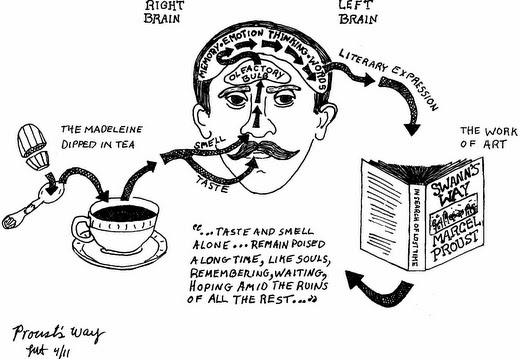
Image from "Foodies," a blog by L. John Harris on Zester Daily

Image from “Foodies,” a blog by L. John Harris on Zester Daily

Another terrific guest blog post by CD Russia co-author Carrie Cameron, combining two of your favorites: food and literature. Smells and tastes evoke our deepest memories, and for Blended Culture people they can easily lead to a round-the-world reverie…

Perhaps you’re familiar with the famous madeleine of Marcel Proust’s A La Recherche Du Temps Perdu (Remembrance of Things Past, or In Search of Lost Time, depending on the translation). The author takes a bite of a madeleine, a simple cookie, and the taste-memory drifts him off on a long reverie of his childhood, connecting him to the people and moments of long ago:

“…when from a long-distant past nothing subsists, after the people are dead, after the things are broken and scattered, taste and smell alone, more fragile but more enduring…remain poised a long time, like souls, remembering, waiting, hoping, amid the ruins of all the rest; and bear unflinchingly, in the tiny and almost impalpable drop of their essence, the vast structure of recollection.”

Mastering the Art of Soviet Cooking, by Anya von Bremzen, is not a cookbook, but a literary madeleine, evoking through food memories her childhood in Soviet Russia. It’s not about her favorite foods or emblematic Russian dishes. It’s about how a taste connects us with a moment in time and space.

Vobla, dried and salted Caspian roach fish, “brings out that particular Russian masochism: we love it because it’s such a torment to eat…I’d happily trade all Hemingway’s snails and Proust’s cakes for a strip of [this] petrified fish flesh.” A half-piece of black-market Juicy Fruit gum takes her back to the girls’ bathroom in elementary school, where she would auction it off to the other girls, having obtained it through some elite family connections. She describes salat Olivier as a “metaphor for a Soviet émigré’s memory… loosely cemented with mayo.” In her mother’s American kitchen in the 90’s, making the salat, she notes how “a taste of Lebanese pickle that uncannily resembles a Russian gherkin leads to a snippet from a Rodina song, which in turn rouses a political morality tale, or reawakens a recollection of a long-ago dream, of a fleeting pang of yearning.” Starting from these tastes and smells, the author skillfully depicts the cultural intimacies of a point in time and place which no longer exists, yet is very real and alive in her memory.

What tastes and smells evoke your cultural insights? What clues do they provide to other ways of life, and why?? Post your answers in the comments, and let’s compare!