
Can you read this?

No? Yes? If you can read the above, quick, tell me what it has to do with culture. If not….

Can you read the next one?

Yes? Perhaps this second one was easier for you? Why? Why is it we can read the above?

Our minds interpret a lot of things every day, constantly. They make sense of the world around us. They do this by recognizing patterns, putting information into templates that are familiar to us.

Obviously when we enter a new culture, the rules are different. The patterns are different, the templates unfamiliar. Our inability to make sense of what’s happening around us can cause us to feel disconcerted, maybe to lose confidence. Our past knowledge, from another place, can cause confusion. It can lead us to think we understand what we really don’t, to fail to see what is really there, or to miss important information.

There are so many interesting photos and images floating around social media networks. How many of them are you able to use to promote cross-cultural understanding, like the two above? Come on, share your favorites!

Reading key to the above images is below:

Este mensaje es para demostrar las
cosas tan increibles que puede
hacer nuestro cerebro. si logras
leer esto puedes sentirte
orgulloso de tu inteligencia, ya
que solo ciertas personas lo
logran. esto se debe a que el
hemisferio derecho del cerebro
asocia los simbolos parecidos a las
letras que conocemos normalmente
y asi logramos leer con facilidad.

This message
serves to prove how our minds
can do amazing things!
Impressive things!
In the beginning it was hard but now,
on this line your mind is reading
automatically without even
thinking about it. Be proud!
Only certain people can read this.

Grains of Sand and Cross-cultural Adjustment

Ever look at something and find it so beautiful or fascinating that it just sort of sticks with you? Perhaps it gives you a gut feeling that it speaks to something you’re working on? Then, maybe in the shower the next day, it hits you?

That’s what happened to me a while ago when our Intercultural Competence News Feed curated Dr. Gary Greenberg’s photos, taken through a microscope, of grains of sand.

While most of us normally think of grains of sand as looking fairly similar — tan or brown, some crystals, shiny — Gary’s photos show us that deep down, once we “get to know” the grains of sand, so to speak, each of them is quite unique! Now if that isn’t a metaphor for diversity, inclusion and cultural differences, what is?

We hope you’ll be pleased with the train of thought Dr. Greenberg’s gorgeous photos produced. We put together a PowerPoint on cross-cultural dynamics that you are most welcome to download and use. It hasn’t been polished and perfected like the grains of sand, but if you read the presenter notes, we are confident you’ll have fun customizing the ppt for your programs.

We all have favorite photos, metaphors, comics, and stories, or even video clips, that we love to use in teaching, training and coaching. If you have something you would be willing to share, please pass it on. We’ll be happy to get it out there for you and link through to your website or contact information. Together we can build a more respectful, understanding and collaborative world!

Oldie but Goodie: Map of Key Cultural Differences

Intercultural communication is about how we can communicate effectively with one another. A frequent approach to improving intercultural communication is to develop our understanding of ourselves and of others. And probably the most common way of doing that is to teach about cultural differences, often referred to as the “dimensions of culture.”

There are many different versions of the dimensions of culture. I generally find them valuable as tools to help us compare cultures, or to cognitively learn about ourselves and others. And I also find they really limit us. While not intended this way, their use has a tendency to reify culture, to cause us to think about culture as a “thing” rather than a process. It’s why I’m such a fan of the Cultural Detective Worksheet: it’s a process for understanding self and others, for leveraging similarities and differences in order to collaborate in more innovative, rewarding, and satisfying ways.

Enough about that. This post is about cultural differences. In my training one of the ways I talk about cultural differences is to ask people to think of them as a map of the terrain, and to use them as a scanning tool. In a given interaction, which difference(s) got in the way? For example, was status important for her and not for me, and I just missed it? Was it a different sense of responsibility that really upset me? Maybe he likes to do several things at once, and I’m more one-thing-at-a-time? Was it the fact that I don’t think religion belongs in the workplace that caused him to think I’m not trustworthy?

That is how the map above came to be. It is a graphic summary of some of the cultural differences or dimensions, at least as I saw them back in 2008. It is available for you to use freely under a Creative Commons license. You can introduce the various cultural differences to your team and then, when you get mired in cross-cultural miscommunication, you can take out your map of differences and decipher just which dimension might be causing the problem. Or, maybe it’s something not even on the map.

Just click on the link above for a larger image, and to download the accompanying 11-page article entitled, “Detecting the Culprits of Miscommunication: Values, Actions and Beliefs.” Please feel free to copy and distribute, as long as you retain the copyright and source url.

I’m really interested to hear from you about how you use the dimensions of culture to promote effective interaction. What are your tools and techniques? Your dos and don’ts? And what do you think about this “map of the culprits of miscommunication” idea?

Link

Kevin and Rita Booker, very active Cultural Detective community members and extremely talented professionals, have put together a series of three articles on using film in intercultural education that I think you will find very helpful. If you use movie clips or YouTube videos in your coaching, training or teaching, or if you want to do that more, be sure to take a look. Lots of learning there.

By the way, if you love film, be sure to check out CDTV, our Cultural Detective channel on YouTube, with over 20 playlists. We welcome your recommendations (urls) on videos to add. Together we can build a convenient central repository of films to use to help our world become a more inclusive and collaborative place!

Much-Anticipated New Release! Cultural Detective: Bridging Cultures

Cultural Detective Bridging Cultures coverIntercultural understanding is essential to working in a global world, though by itself it is simply not enough. There is a critical need beyond awareness of differences: an ability to generate and demonstrate effective, transformative, out-of-the-box solutions to challenging intercultural situations. Since 2004, the Cultural Detective series has successfully enabled people to do just that.

We are proud to announce the debut of our latest offering, Cultural Detective: Bridging Cultures. This new tool enables individuals, teams and organizations to purposefully strengthen mindsets and skills in order to leverage cultural differences as assets. It contains worksheets, exercises, tools, tips, and complete instructions. The learning package is authored by Kate Berardo.

Not every situation can be bridged, perhaps not every situation should be bridged, and the act of bridging, as many things in life, may involve an investment of time and energy. This new set of learning materials begins, therefore, by helping you distinguish whether “to bridge, or not to bridge.”

Cultural Detective: Bridging Cultures will enable you to understand how you tend to react when encountering cultural bridging opportunities, identify more effective strategies for bridging both in-the-moment and over time, and practice putting these skills into action. More specifically, you will:
  • Identify when a conversation is about to spiral up or down.
  • Identify “bridge builders” and “bridge blockers” to your successful intercultural communication.
  • Learn techniques for in the moment bridging of differences to ensure conversations spiral upward instead of downward.
  • Develop holistic strategies that consider influencing factors such as history, context, and structure of the interaction.
  • Learn how to expand, filter and test effective bridging solutions.
  • Develop high-impact, creative bridging solutions to both prepare for and repair intercultural relationships.
  • Practice, and receive feedback, on bridging strategies in situations that are real and relevant for you.
Cultural Detective: Bridging Cultures is organized around four main competencies that are essential to bridging cultural differences. They are:
  1. Self-Awareness: Being aware of the mindset you bring to challenging intercultural situations, and knowing both your strengths and blocks in turning such situations into bridging opportunities.
  2. Course Correction: Recognizing points in an interaction where misunderstanding or conflict starts to occur, and responding appropriately.
  3. Holistic Analysis: Being able to analyze complex intercultural situations in a detailed and holistic way that considers a variety of influencing factors, and, thereby, more effective solutions.
  4. Creative Solving: Learning skills and methods to generate “beyond the obvious” solutions to bridge intercultural differences.

While this is not to suggest these are all the skills needed to work effectively across cultures, these are often under-developed abilities that need to be strengthened to enable effective intercultural bridging, and, therefore, are the focus of this package.

SAMPLE EXERCISE

How about an exercise to get you started? The purpose of this activity is to learn what bridging and blocking look like for you, so you can hold a bridging mindset more often.

Let’s begin with some simple definitions.
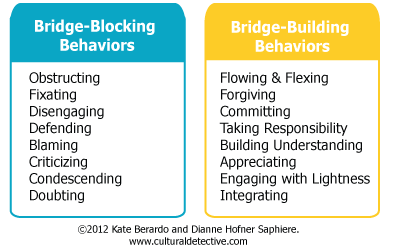
Blocking Mindset:
  • Focused on own agenda
  • May become defensive or impatient
  • Unintentionally harming the relationship

Think about a challenging interaction in your own life (who, what, when, why) during which you held a blocking mindset. How did you feel? What did your blocking mindset look like? What behaviors did it entail? What outcomes did you achieve?

What do your reactions tell you about yourself and how you might improve your intercultural effectiveness?

Bridging Mindset:
  • Open and curious about others
  • Willingness to meet others more than half-way
  • Belief that others are NOT “out to get us” but that they have positive intentions

Think about a challenging interaction in your own life (who, what, when, why) during which you held a bridging mindset.  How did you feel? What did your bridging mindset look like? What behaviors did it entail? What outcomes did you achieve?

Learn more about Cultural Detective: Bridging Cultures; view a short video on the core Cultural Detective method, which a major software manufacturer credits with a 30% increase in customer support satisfaction; purchase small quantities of the package; or contact Kris Bibler about a site license.