A Design for Incorporating Cross-cultural Effectiveness into Existing Programs

arton235-88ad2Do you have an existing curriculum or training design and wish you could simply add a cross-cultural element to it? You probably don’t realize how easy and affordable it is to keep your existing objectives and design, while weaving in key cross-cultural dynamics using Cultural Detective. Below is a half-day design using Cultural Detective that works well in a variety of contexts with a variety of topics:

  • In business for global management, leadership across cultures, multicultural or international customer service, multicultural team effectiveness, negotiating across cultures, management and motivation, new hire orientation, expatriation (prior to departure, during the assignment, reentry).
  • In study abroad for students during orientation, their sojourn and reentry; orientations for host families; teamwork and community-building for students, receiving organizations, and host families.
  • For special purposes such as patient-care across cultures, multicultural spiritual communities, and neighborhood community building.

A Sample Half-Day Training Design Leveraging the Cultural Detective® Method

1. Objectives, introductions, agenda (of your chosen topic).

2. “What’s in it for me?” Present your topic in context; why is it important?

3. Skills for [workshop topic, e.g., leadership, teamwork, healthcare, sales, etc.] Across Cultures:

  • Tell a story or show a video of cross-cultural interaction in the context of the [workshop topic]. The playlists and videos on Cultural Detective‘s YouTube channel may give you some ideas.
  • Lead the participants through an analysis of the story (debrief) using the Cultural Detective Worksheet.
  • Once complete, ask participants what they learn from this approach (values, beliefs and “common sense” world view motivate behavior; world views are often different but all are “correct”; similar values can lead to different behavior; different values can motivate similar behavior; bridges must leverage similarities and shared objectives as well as differences/complementarities; bridges must be interpersonal and multidirectional but also organizational/systemic)
  • Summarize: What skills for [workshop topic] can we learn from this Cultural Detective (CD) approach?
  • Apply: How can participants use this CD approach in their daily work?

4. Culture-specific Skills for [workshop topic]

  • Introduce Values Lenses: what they are and aren’t; explain values and negative perceptions.
  • Introduce the Values Lens for each of the cultures in the story you told or the video clip you showed.
  • Ask participants if these values provide them further insight or deeper understanding of the incident. Do the Lenses provide any clues to help them add information to the CD Worksheet debrief? If not, fine. If yes, use that info.
  • Summarize: What skills for [workshop topic] can we learn by using Values Lenses? How can we use the Lens tools well? How should we never use the Lenses? (Lenses are guides to societal norms, and should never be used to stereotype or “box-in” individuals, but rather as clues for learning and dialogue.)
  • Apply: How could participants use Values Lenses in their daily work?

5. Knowing Oneself as a Cultural Being in the Context of [workshop topic]

  • Use a couple of the activities from Cultural Detective Self Discovery and guide participants to complete a Personal Values Lens
  • In pairs or threes, have participants share their Personal Lenses with one another
  • Have them discuss how they could best work together in the context of [workshop topic], to bring out the best in one another.
  • Summarize: What are some best practices for cross-cultural [workshop topic]? What have you learned?
  • Provide the Cultural Detective’s “A Dozen Best Practices for Cross-Cultural Effectiveness.”
  • Apply: What will you do to ensure you perform at your best in a cross-cultural [workshop topic] situation? To ensure you bring out the best in your team/clients/patients?

6. Summary and Application

  • Provide a list of skills for effective cross-cultural [workshop topic].
  • Ask participants what they have learned about themselves today as regards [workshop topic]?
  • What are the top 1-3 skills each participant wants to demonstrate to enhance their cross-cultural effectiveness at [workshop topic]?
  • How will they hold themselves accountable?

What cost does this add to your curriculum? If you are training 30 or more people, Cultural Detective Self Discovery licenses are just US$15 per participant. For Values Lenses, you can subscribe to Cultural Detective Online for less than $100 per year and project Lenses in a group training environment. The subscription price goes down for multiple users, to less than $30 per year per subscriber.

We hope you find this sample design useful, and that you will share with us your tried-and-true designs and curricula for integrating Cultural Detective into educational or training programs. We know you do terrific work, in such a broad variety of contexts, and your designs will no doubt stimulate others’ creativity and effectiveness. Together we can build a more equitable, just, respectful world in which we collaborate for a sustainable future!

Transforming Lives: Education as an Alternative to Violence

AUN “The youth in Nigeria are beginning to speak—some with violence.
They attract attention. But others are also speaking.
The question is, is anyone listening to this plea
for western education, for training, for reform, for help?”

—Margee Ensign, President, American University of Nigeria

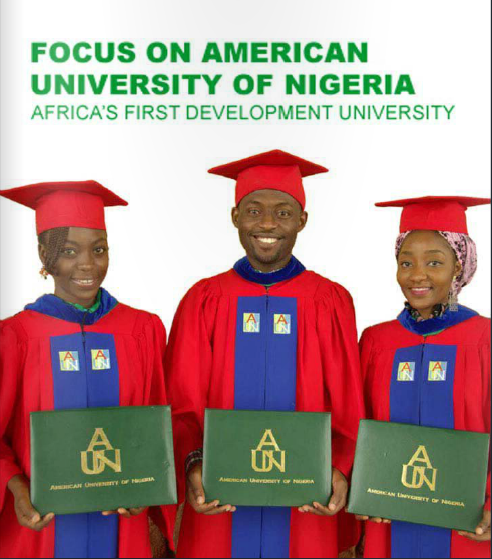
With all the grim news coming out of Nigeria these days, I thought you might want to hear about a little-known educational bright spot in the country: the unique programs offered at the American University of Nigeria, founded in Yola (capital of Adamwa state) in 2005 by the country’s former vice-president, Atiku Abubakar.

Despite Boko Haram’s year-long campaign of terror, including kidnapping over 300 girls from a school, murdering family members, burning villages, and displacing thousands of people, most families still desire an education for their girls and their boys, says Margee Ensign, President of AUN. And AUN provides it.

Both the university’s valedictorian and its graduating class speaker this year are women. The university is one of the leaders in the interfaith peace initiative. It has hired and trained more than 500 female and male security guards to protect the campus and its housing, offering each of them a free education. AUN facilities include a nursery school, primary and secondary school, in addition to the university itself. It recently dedicated a new library that has received international accolades for its efforts to create the finest e-library in Africa.

“Security comes not from our security force, but from our development and peace efforts,” Margee reports. In one of the poorest places on earth, AUN has a program to teach local women literacy and entrepreneurship skills, to enable them to generate income for their families. The university’s Peace Council has created 32 football and volleyball “unity teams” for young people to play in tournaments year-round. None of the young people have jobs, over half have dropped out of high school, and 10% have not even completed elementary school. Sports team members study a peace curriculum focused on building understanding and tolerance. The unity teams help ensure that these youth stay active and involved in their communities—making them less vulnerable to recruiting by terrorist groups like Boko Haram.

This kind of creative programming doesn’t happen by accident. Margee is a tough, dedicated, innovative, and tireless educator. Her extensive experience in administrative and faculty positions in universities in the USA (including Columbia University in New York, Tulane University in New Orleans, and the University of the Pacific, Stockton, California), and her interest and experience in international development in Africa, make her well-prepared to be president of AUN.

“I met with about 80 women in the [AUN entrepreneurship] program…They wanted to learn English, Nigeria’s official language, so that they could read to their children. In modern education, they knew, lay the only hope for the future.”

Margee relishes the challenges of working across cultures. She has embraced the local community culture, while building a university culture that retains important aspects of the US educational experience. After all, this is why parents are sending their children to college at AUN. She’s always recruiting—looking for people with just the right skills, willing to give their time and talent to join the international faculty and staff at AUN, a growing academic community in Nigeria.

The Cultural Detective Team believes it is possible to help make the world a better place through our actions. Yet, it isn’t always easy! Cultural Detective: Global Teamwork investigates some of the challenges involved in managing culturally diverse teams in today’s global environment, even if working in the same geographical location. What is the task? How do we form and maintain a high performing team? How do we manage the terrain or contexts in which team members work? How do we choose the right technology to support the team? How do time and space affect communication? Add culture to this mix, and it is even more complex! These are just the beginning of the challenges Margee faces each day—and she loves it!

All around the globe, dedicated, competent people are working to make a corner of the world a better place—often, not the corner of the world in which they were born and raised. Yet, they are motivated to share their skills in multiple arenas and diverse geographical locations. You probably know people that match this description—or are you one?! We’d be delighted to share their stories or yours with our readers!

With all the doom and gloom in the news, it is good to remind ourselves that generous people are doing wonderful things in difficult circumstances. A recent article written by Margee and published on the BBC.com website offers an often overlooked perspective on the area better known for the rampages of Boko Haram. We invite you to read Margee’s entire article here: “Nigerians defy terror to keep learning.”

Ecotonos: Simulación Intercultural en una Clase de Negociación en Colombia

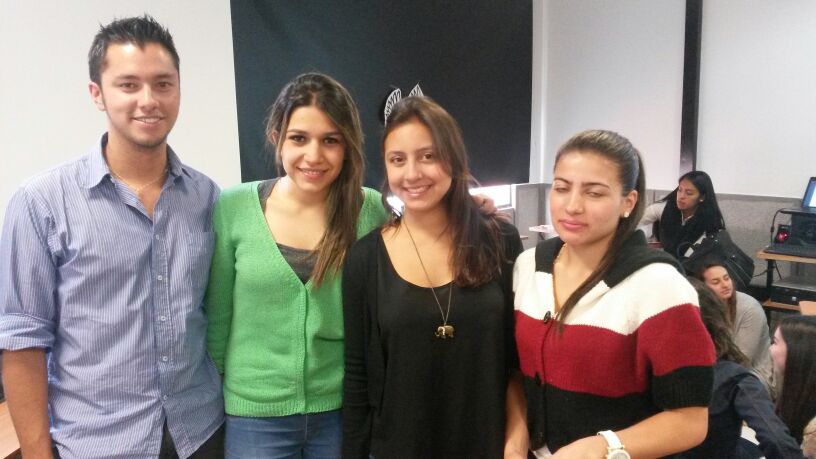
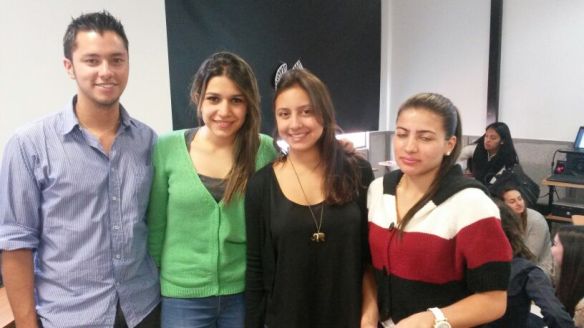
Sixth semester students (juniors) David, Lina, Gabriela and Ximena helped facilitate the simulation

Sixth semester students (juniors) David, Lina, Gabriela y Ximena helped facilitate the simulation

Ecotonos: An Intercultural Simulation in a Negotiation Class in Colombia

La Universidad Sergio Arboleda in Bogotá, Colombia, recently utilized Ecotonos: A Simulation for Collaborating Across Cultures for the third time in its International Negotiation class. The professor, Fernando Parrado, gave four of his experienced students the opportunity to act as co-facilitators, and they learned so much from the experience. Below is their report.

Translation to English by Dianne Hofner Saphiere follows the Spanish original.

AGUILAS

Las Águilas estaban conformadas por un grupo total de diez estudiantes, por lo que en primera estancia se repartieron las fichas de valores a cada uno de los integrantes. Los valores e acciones de las Águilas eran:

  • Tú crees que es grosero expresar tu propia opinión demasiado fuerte. Tú prefieres preguntar la opinión de los otros antes de afirmar la tuya y frecuentemente ilustras con ejemplos los puntos que los demás han dado.
  • Cuando una persona te dice algo que tú has escuchado antes, tú aplaudes. Miras sobre la cabeza de las personas cuando deseas demostrarles que estas en desacuerdo.
  • Para entender completamente que está diciendo alguien, tú interrumpes, aclaras y resumes.
  • Tú crees que todo se mueve a su propio ritmo y que el tiempo es artificial. No te das prisa con las decisiones o tareas sino que prefieres que esta se desenvuelva. Los relojes o tiempos de referencia te hacen sentir incómodo.
  • En discusiones tu estas más cómodo parado o sentado al menos a un brazo de distancia de las otras personas. El contacto físico es extremadamente incómodo para ti.

Después de entendidos y discutidos los comportamientos a seguir por las Águilas, se realiza la creación del mito por parte de todo el grupo. Los miembros fueron muy creativos y relacionaron los valores con el nombre del grupo (las Águilas), determinando así que se habían independizado hace poco tiempo, y que además su Dios era el águila, lo que determinaba su necesidad de espacio, no contacto físico, y comportamiento sumiso ante la opinión de los demás.

20140407_075252

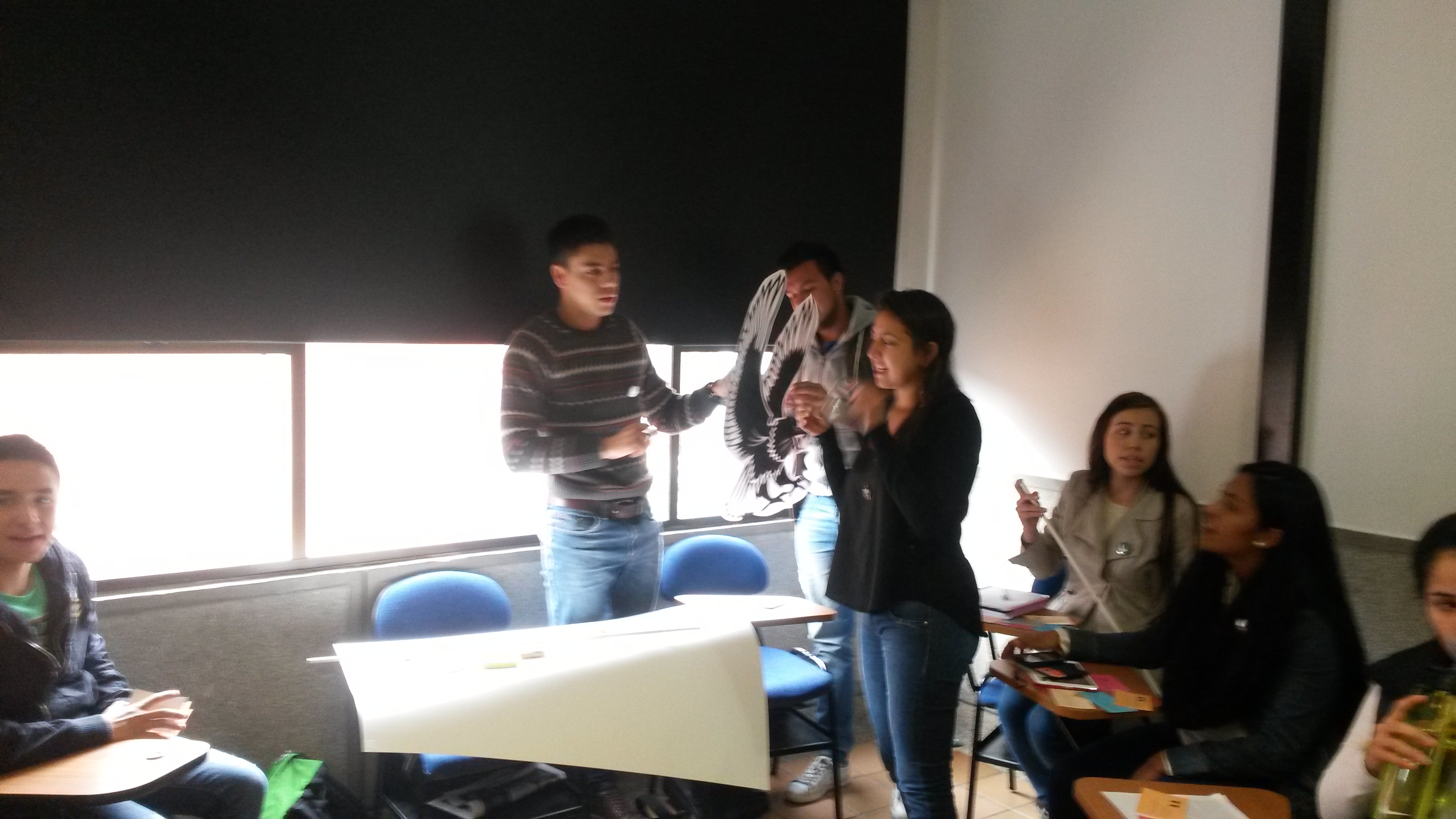
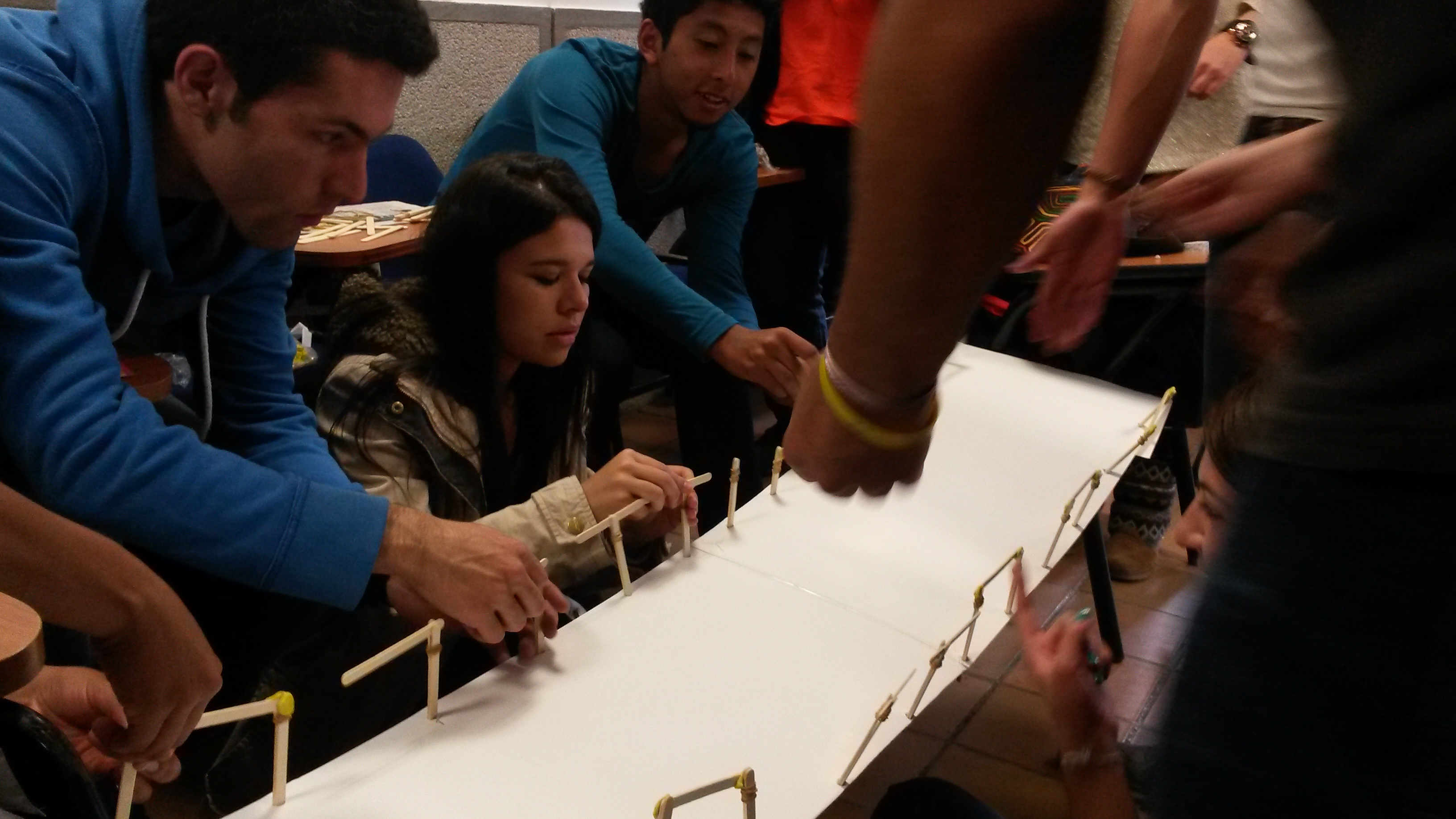
Posteriormente se inició la construcción de los puentes. Los miembros decidieron recurrir a otros recursos, además de los ya otorgados por los facilitadores, como sus sacos.

Luego se realizó la mezcla de los participantes. Las Águilas fueron determinadas a ser un Joint Venture, por lo que cinco participantes del grupo de los Zantes se unieron a las Águilas, de la misma manera que cinco integrantes se fueron a los Delfines y a los Zantes. Dado así el grupo quedo conformado por cinco Águilas y cinco Zantes. La cultura de los Zantes era absolutamente opuesta por lo que la continuación del puente fue un reto, mas sin embargo a pesar de las diferencias, todos participaron activamente y sacaron adelante el proyecto.

A continuación se realizó la presentación del mito por parte de uno de los participantes, y luego se realizó la retroalimentación de la cual el grupo tuvo las siguientes conclusiones:

Los elementos que ayudaron tener mayor efectividad y colaboración entre las dos culturas:

  • Ambas culturas saben escuchar.
  • Ambas culturas trabajan en grupo con un fin común.
  • A pesar de la diferencia cultural, había tolerancia lo que no genero conflictos, por lo que el trabajo en equipo fue flexible.

Los elementos que impidieron tener mayor efectividad y colaboración entre las dos culturas:

  • La cultura de las Águilas era muy flexible al tiempo, por lo cual el tiempo no fue aprovechado de manera efectiva. “El tiempo vale oro”.
  • La diferencia y falta de conocimiento del lenguaje verbal y corporal de cada una de las otras culturas
  • La diferencia en la afectividad y contacto físico por parte de cada una de las culturas

Las Águilas plantearon tres estrategias que hubieran ayudado a los grupos a entenderse mejor y utilizar las habilidades de cada uno de los miembros fueron:

  • Tener un contacto previo con la otra cultura, para entender y comprender los diferentes comportamientos.
  • Reemplazar el lenguaje corporal por lenguaje verbal, para lograr un mayor entendimiento.
  • Tener clara la tarea a realizar para poder planificar y realizar de manera correcta.
  • Implementar la división del trabajo.

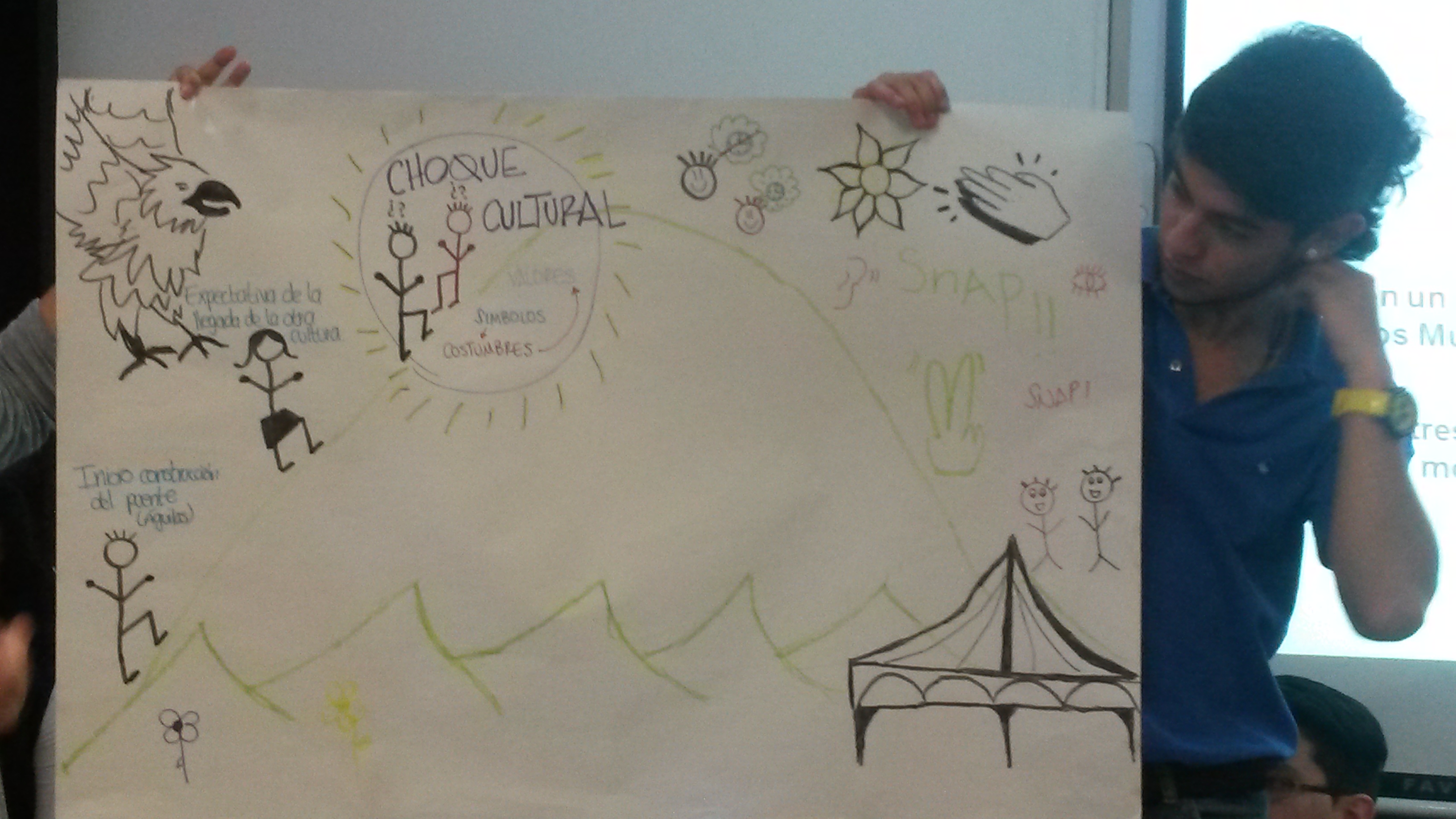
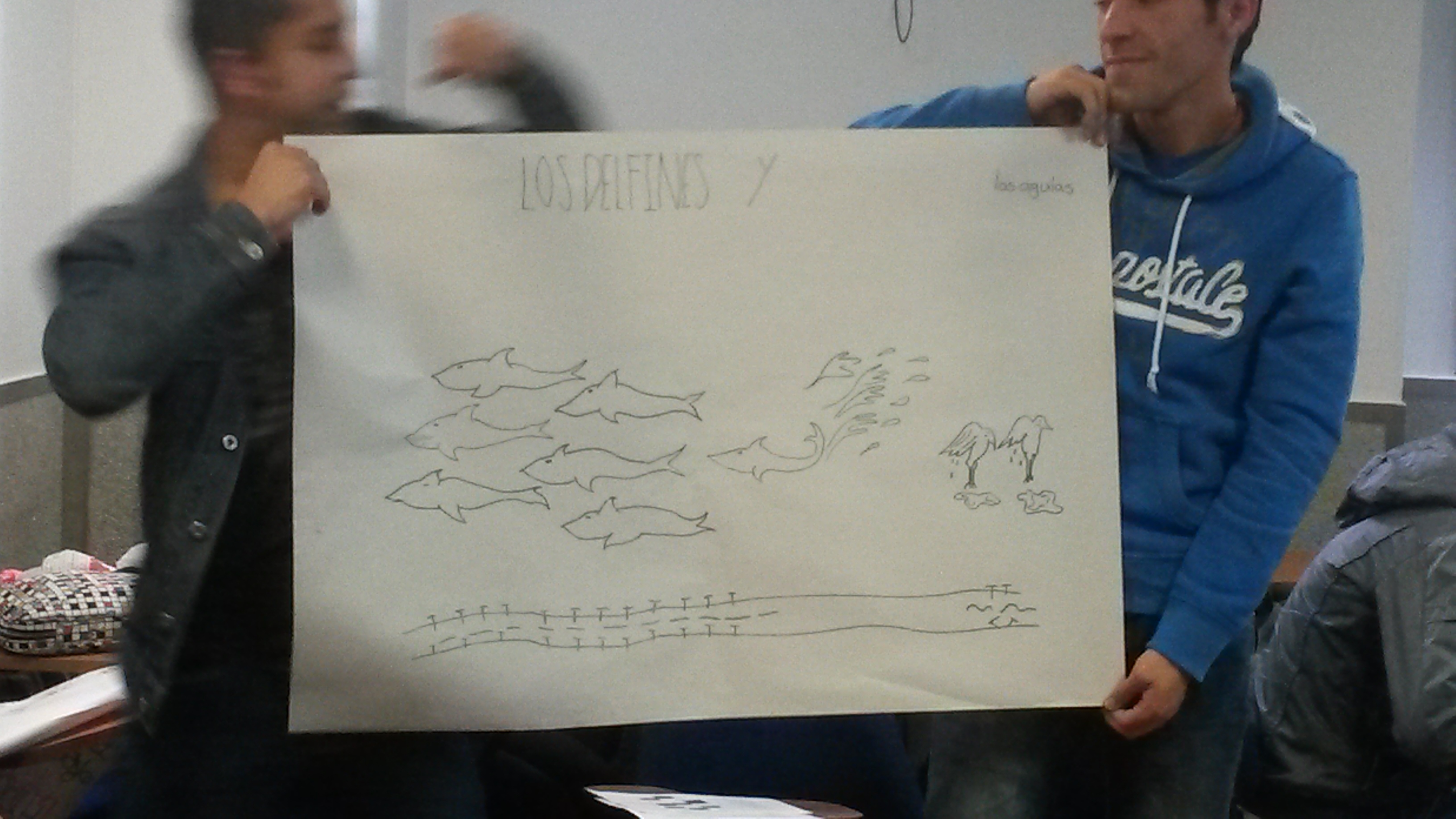
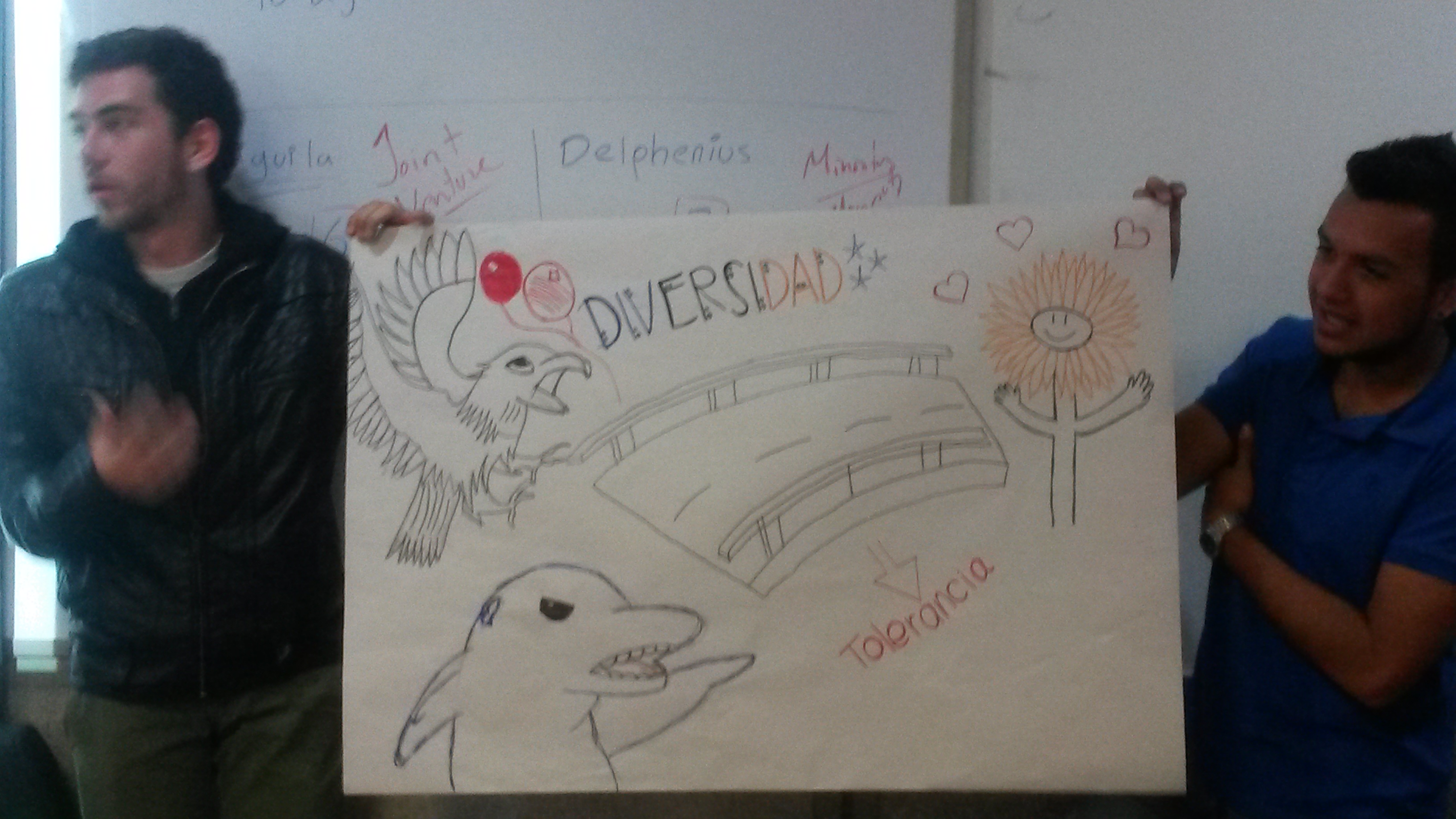
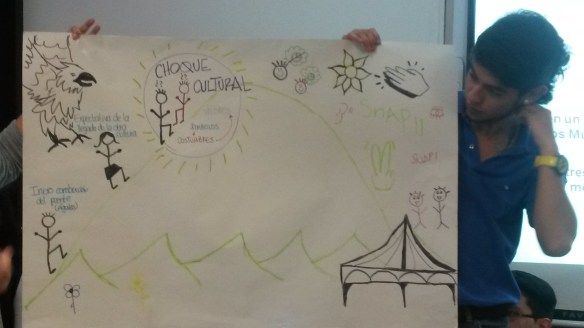
Por último el grupo realizo el siguiente mapa de procesos para evidenciar el proceso vivido.
20140407_093659

DELFINES

La personalidad de los Delfines los describe como una cultura apartada que no les gusta tener contacto con otras culturas, aparte de esto siempre quieren tener siempre la razón motivo por el cual cuando van a comunicarse con otros es más difícil llegar a un acuerdo, en el trabajo se evidencio cuando hubo cambios de culturas que era complicado llegar a aportar algo a esta cultura.

Los Delfines estaban armando su puente, todos los integrantes tenían un cargo y así fueron armando su puente, todos se entendían bien y cuando no estaban de acuerdo lo hablaban y rápidamente llegaban a un acuerdo para beneficiarse todos, entre la cultura nunca hubo un problema o discusiones por las decisiones tomadas.

20140407_083401

Cuando las dos Águilas intervinieron este grupo para continuar armando el puente pero como había mayoría de Delfines se evidencio que las Águilas quedaron de lado discriminadas, ya que los Delfines no les gusta tener interacción con otras culturas, es claro que cuando hay una mayoría vs minoría siempre la mayoría va a tomar las decisiones y la minoría va a tener que adaptarse a estas decisiones.

En el momento en el que a los grupos se les puso a mirar las fortalezas y debilidades de la interacción con otras culturas los Delfines se dieron cuenta que las fortalezas que esto trajo para armar el puente fue que tanto las Águilas como los Delfines tenían un tiempo flexible el cual hizo que ninguno tuviera un choque ahí, también los Delfines debieron reconocer el trabajo de otra cultura que quiso intervenir para ayudarlos y por ultimo tuvieron que tener respeto y tolerancia hacia las Águilas, no hay mejor comunicación que saber hablar pero más importante es saber escuchar.
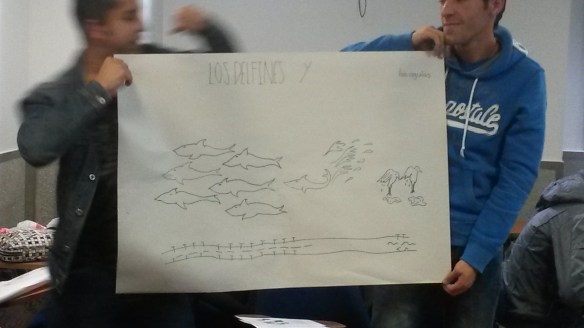
20140407_094511

Las debilidades que los Delfines encontraron al interactuar con las dos Águilas que llegaron al grupo fue que había falta de comunicación ya que las dos culturas se comunicaban de forma diferente, además se notaba un impedimento entre las dos culturas ya que la distancia era muy notable. Sin embargo, pudieron armar el puente y al finalizar el logro fue compartido entre Águilas y Delfines.
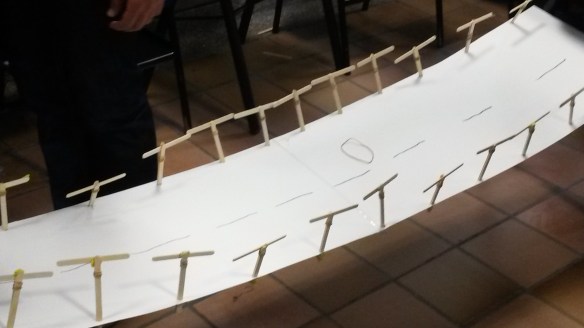
20140407_085533

ZANTES

En el juego de simulación intercultural el grupo tres era el grupo de los Zantes, el cual estaba conformado por diez integrantes.

La primera actividad que se realizo fue escoger algunas cartas de reglas culturales y con estas se creó una nueva cultura con las acciones dados, para ello tenían que crear un mito explicando cómo nació la cultura. Las que escogimos fueron las de color naranja las cuales representan los gestos y el contacto con los ojos (hacer sonar nuestros dedos y mirar fijamente), azul clara que eran los estilos de escucha (sabían escuchar y hablan cuando el otro terminaba), el color rosado representa contacto (se caracterizaban los Zantes porque les gustaba el contacto con los demás), realizaban gestos mientras hablan para ayudar a los otros a entender, y por ultimo estaba la carta beige que era la orientación al tiempo (eran muy rigurosos con el tiempo, para ellos este valía oro). En el desarrollo de esta primera actividad se pudo notar que dentro del grupo había integrantes con personalidades muy distintas, ya que algunos estaban muy concentrados en el juego y muy participativos, mientras que otros miembros del grupo solo estaban escuchando y no aportaban ideas sino al contrario hacen lo que otros compañeros decían. Con el tiempo todos los integrantes empezaron a practicar sus características culturales respectivas y finalmente para esta actividad trabajaron muy bien porque todos se familiarizaron con sus valores (que eran iguales) por lo cual no existió ningún conflicto.

20140407_084830

La segunda actividad que se realizo fue la de crear un puente con unos materiales que los monitores suministramos al grupo, el puente debía ser innovador y confortable. Al comenzar el puente el grupo trabajo muy bien ya que todos se escuchaban y trabajaban efectivamente para poder realizar un buen trabajo, a cada instante se percibían los valores del grupo porque constantemente los estaban practicando y utilizando para realizar su trabajo. Cuando ya tenían la mitad del puente el grupo fue dividido y a los Zantes llegaron integrantes de los Delfines y de las Águilas, con los cuales se pudo evidenciar el impacto cultural de estos nuevos integrantes ya que tenían características totalmente distintas, algunos llegaron a ser ofensivos, aplaudían constantemente, no les gustaba el contacto, todos tenían sus características culturales muy marcadas y distintas lo cual produjo que se crearan conflictos. Cuando los miembros de los Delfines y de las Águilas intervinieron en la creación del puente se pudo notar que en un principio cambiaron drásticamente la estructura del puente, construyeron algo totalmente distinto a lo que habían realizado los Zantes, pero con el tiempo esta estructura se volvía a acoplar un poco a lo que fue la de los Zantes y el grupo multicultural pudo crear un excelente puente. Los jugadores pudieron comprender el impacto que la cultura tiene en cada una de sus vidas.

Los juegos anteriores permitieron comprender al grupo el impacto que tiene la cultura, por esto es indispensable que a la hora de negociar se conozca y además se entienda la cultura con la que se va a negociar para tener la capacidad de resolver problemas y para trabajar de manera efectiva. Y finalmente la conclusión más importante es que hay que aprender a manejar nuestras conductas y valores a la hora de negociar con personas que tengan diferencias culturales.

20140407_095110

CONCLUSIÓN

En conclusión esta actividad a los 4 monitores fue muy productiva. Entendimos las diferencias culturales con unas simples actividades que nos dan un ejemplo de cómo serian una negociación o trabajo en equipo con miembros de otros países, nos enseño como escuchar y ser de mente abierta siempre para la negociación aprender lo mejor del otro y siempre respetar a los demás.

AGUILAS

The Aguilas were a group of ten students, each given rule cards. The values and actions on the Aguila cards were:

  • You believe it is rude to express your opinions too strongly. You prefer to question others’ opinions before sharing your own, and you frequently affirm the points others have made by offering examples.
  • When someone tells you something you’ve heard before, you clap. You look above the person’s head when you wish to demonstrate disagreement.
  • To understand more fully what someone is saying, you interrupt, clarify and summarize.
  • You believe that things move according to their own rhythm, and that time is artificial. You don’t hurry decisions or tasks and rather prefer that they unfold. Clocks and references to time make you uncomfortable.
  • In discussions you are more comfortable standing or sitting at least an arm’s length away from others. Physical contact is extremely uncomfortable for you.

After discussing and understanding the behaviors to follow, the Aguilas created their myth. The members were very creative and related their values with the name of the group, determining that they became independent fairly recently, and that their god was the eagle, which determined their need for space, no physical contact, and submissiveness to the opinions of others.

Next they began the construction of the bridge. The members decided to use other resources in addition to those provided by the facilitators.

After building for a while, participants were mixed. Five Aguilas left to join the Delfins and the Zantes. The remaining Aguilas were joined by five Zante participants, forming a Joint Venture group of five Zanteans and five Aguilas. The culture of the Zantes was absolutely opposite to that of the Aguilas, so the joint bridge building was quite a challenge. Despite the differences, however, everyone participated actively and took the project forward.

Upon concluding the simulation the participants presented their creation myth, and then conducted a debriefing discussion that led to the following conclusions:

The elements that helped the mixed group of two cultures to be more effective and collaborative were:

  • Each culture’s members knew how to listen.
  • Members of both cultures worked in groups to a common purpose.
  • Despite the cultural differences, there was tolerance, and participants did not generate conflict, so the group work was flexible.

The elements that impeded effectiveness and collaboration between the two cultures were:

  • The Aguila culture was very flexible with time, which meant that time was not used in an effective manner. “Time is gold.”
  • Differences in and lack of knowledge of verbal and body language of the different culture
  • Difference in affection and physical contact in each of the cultures

Group members came up with three strategies that would have helped them understand each other better and utilize the abilities of each of the members of the mixed culture:

  • Have previous contact with the other culture, in order to understand the different behaviors.
  • Replace body language with verbal language, in order to have better understanding.
  • Keep the task clearly in mind in order to plan and perform it correctly.
  • Implement a division of labor.

Finally, the group created the following process map illustrating the process they experienced:

DELFINUS

The personality of the Delfins can be described as that of a secluded culture that doesn’t like to have contact with other cultures. Apart from this, they always want to be right when they communicate with others, making it difficult to come to an agreement. This was evident in the work: when there was a change of cultures it was difficult to contribute anything to this culture.

The Delfins were assembling their bridge, all of its members had their job and were working to build the bridge, and everyone understood each other well. When they disagreed they spoke and quickly reached an agreement that would benefit everyone. Within the culture there was not a problem or discussion of the decisions made.

When the two Aguilas joined the group to continue assembling the bridge, since there were a majority of Delfins, you could see the Aguilas were a bit left out and discriminated against, as Delfins don’t like to interact with other cultures. It was clear that with the majority and minority in this group, the majority made decisions and the minority had to adapt itself to those decisions.

When the group members reflected on their strengths and weaknesses interacting with other cultures, the Delfins realized that the strengths for building the bridge included that both the Aguilas and the Delfins had a flexible sense of time, so there was no problem there. Also, the Delfins needed to acknowledge the work of the other culture, to have respect and tolerance for the Aguilas and realize that they wanted to help, that there is no better way to communicate than to know how to speak but even more to know how to listen.

The weaknesses that the Delfins encountered when interacting with the two Aguilas who arrived to the group were that there was a lack of communication due to the fact that the two cultures communicated in a different form, in addition another impediment between the two cultures was that the distance was very notable. Nevertheless, they were able to build the bridge and the accomplishment was shared between the Aguilas and the Delfins.

ZANTES

In the intercultural simulation, the third group was the Zantes, composed of ten members.

The first activity was to choose cultural rule cards to create a new culture with the actions described on them. In order to do that, the members needed to use the rules to author a myth about how the culture was born. The rules chosen included the orange color—gestures and eye contact (snap one’s fingers and stare), light blue — listening style (listen closely and speak only when the other has finished), pink—representing touch (this characterized the Zantes because they loved touching others), gesticulating while talking in order to help others understand, and the last was the beige card—time orientation (very rigorous with time, as time is golden). During this first activity it was noteworthy that there were members of the group with very distinct personalities. Some concentrated on the game and were very participatory, others in the group were only listening and rather than contribute ideas they did what the others said. With time the group members began practicing their cultural characteristics and finally they worked together very well, because everyone was familiar with their values (they were all equal) and there was no conflict.

The second activity the group realized was to create a bridge with some materials that the facilitators gave the group. The bridge needed to be innovative and aesthetically pleasing. When beginning the bridge the group worked very well together; everyone listened to one another and they worked effectively to complete the work. At each moment one could perceive the values of the group because they were constantly practicing and utilizing them during their work. When they already had half the bridge built, the group was divided and some Delfins and Aguilas joined the Zantes. At this point the cultural impact was evident; some arrived offensively—they clapped constantly, they didn’t like touching others—everyone had cultural characteristics that were very marked and distinct and that created conflicts. When the members of the Delfins and the Aguilas joined the creation of the bridge, it was noted that at one point the structure of the bridge changed drastically; they constructed something completely distinct from what the Zantes had originally been building. However, with time the structure returned to something similar to what the Zantes had intended, and the multicultural group was able to create an excellent bridge. The players were able to understand the impact that culture has on each of their lives.

The simulation permitted group members to understand the impact of culture, and that it is indispensable to recognize and understand culture when negotiating, in order to be able to resolve problems and work in an effective manner. Finally, the most important conclusion is that we need to learn to manage our conduct and values when negotiating with people who are culturally different from us.

CONCLUSION

In conclusion, this activity was very productive for the four of us as co-facilitators. We understood cultural differences with these simple activities. It provided us an example of how a negotiation or teamwork could be with people from other countries. It taught us how to listen and to maintain an open mind during negotiations, to learn the best of the other and to always respect others.

Thank you very much for sharing your experiences with us, students! Any of our readers who are interested in Ecotonos, you can find more information or order the simulation by clicking here.
World Day for Cultural Diversity

unlogoMay 21st is World Day for Cultural Diversity for Dialogue and Development. It is a day on which we are all encouraged to do one thing to promote diversity and inclusion in our spheres of influence.

What one thing will you do today? Please share!

As for me, besides publishing this blog post, today I’ll be working on designs for two different workshops, one on identity and authenticity in our blended culture world, and the second on strategic development of inclusive organizations. I will be finishing up the editing on a second chapter of a book on cultural differences, and talking to professionals about conducting webinars to promote diversity, inclusion and cross-cultural collaboration. Last night I attended a book signing for a new novel centered around immigration, published by a dear friend of mine. Who knows what else this day might bring?

“Our cultural diversity is a stimulator of creativity. Investing in this creativity can transform societies. It is our responsibility to develop education and intercultural skills in young people to sustain the diversity of our world and to learn to live together in the diversity of our languages, cultures and religions, to bring about change.”
—Irina Bokova, Director-General of UNESCO

Please do share what one thing you’re doing today to promote inclusion, collaboration and justice in our world! Thanks for being on the journey with me and our terrific Cultural Detective team!

Strong, Strategic Global Leadership

leadershipCompanies today need to be good at whatever their main business is, but they also need to be quickly adaptable to change. And, these days, they need to adhere to a strict set of ethical standards that are demanded by an increasingly informed and diverse customer base. Such a tough bundle of abilities requires strong, strategic leadership.

I recently came across an interesting infographic from New England College’s School of Graduate and Professional Studies, and thought you would like to see it. The graphic summarizes the findings of six different studies—from McKinsey, Deloitte, LRN, the Center for Creative Leadership, and Harvard—saying that companies are seeking:
  • Simultaneous growth, cost reduction and increased innovation.
  • Better alignment of organizational values and operational behavior.
  • To create environments in which employees are comfortable voicing their opinions and ideas—inclusive spaces.

The graphic illustrates the four leadership skills needed to achieve these too-often elusive goals. To view the infographic in larger format click here, then click on the image that opens.

1391539920-you-good-leader-infographic

Leadership Skill #1: Ethical Leadership

Interestingly, the top skill identified is ethical leadership—studies correlate business success to ethical initiatives. Aligning organizational values with operational behavior, and ensuring ethical practice across the organization, is all the more challenging given the international nature of business today. Add in the diversity of the worldviews and “cultural sense” of the mobile workforces of this millennium, and things become even more complex.

Let’s face it, employees in different geographies, from different cultural backgrounds, view the concept of “ethical” differently. They operationalize corporate values differently. Cultural Detective Global Business Ethics (CD GBE) is a perfect tool to aid organizations in achieving the alignment that’s needed. The package is designed to help leadership think through the cross-cultural permutations—the ways members of different cultures may operationalize organizational values and ethics—and develop strategy to build alignment.

CD GBE can also be used to help train staff worldwide, so they know how your organizational values translate into everyday operations. It can help open the dialogue among all levels of the organization to ensure your values are understood and implemented consistently—and with local appropriateness.

Leadership Skill #2: Use Your Power Wisely

Power is a leadership trait no matter where in the world you work, whether that power is real or perceived. In certain locations power may be based on title or position in the hierarchy. In others it is based on expertise—but does this mean a person is perceived powerful due to credentials and education, or to skills and experience? The Values Lenses and critical incidents in every Cultural Detective package can help you and your organization learn to project and perceive power wisely, no matter where or with whom you work.

Another key aspect of power resides in the relationships we build, the influence we have on others. Whom we trust, whom we allow to sway us, is perhaps one of the most culturally determined aspects of our lives.

Do we trust the person who speaks plainly (who could be perceived by some as rude or uneducated), or the person who speaks diplomatically (and could be perceived as “brown-nosing” or unprincipled)? Are we swayed by the person who tries to convince us via logic and argument, by someone who shows us by example, or by the person who enthusiastically invites us to use a new service? Again, the Cultural Detective series will help leaders and a global workforce better understand and navigate such differences.

Leadership Skill #3: Manage Crises

The Chinese characters for “crisis” remind us it can be a danger or an opportunity. Leaders can convert crisis into opportunity by knowing themselves and being solidly grounded in their values. A well-rooted tree will sway in the wind and not become uprooted. Cultural Detective Self Discovery is the perfect tool to enable leaders to clarify their personal core values, and to reconcile them with organizational values, the values of the various cultures in which they do business, and the values of other members of their team. Leaders will be better able to manage crises; to anticipate their reactions so they can wisely choose, in the moment, how to respond; and to be better able to explain their actions to others who may not share or enact their values in the same way. Try it out with a pilot group of your leaders, and you will be amazed by the results.

Leadership Skill #4: Cultivate Change

Change is cultivated by providing opportunities for employees to practice what they’ve learned. Cultural Detective Online (CD Online) enables you to provide just that opportunity—teach a skill, then encourage your employees actively practice it for several weeks, using the CD Online system for reflection and learning. Several weeks of on-the-job practice leads to employee retention, and provides a practical method to resolve employee conflicts and encourage understanding.

Change is also effected by leaders realizing that workers’ motivations may be different than theirs. Research in the graphic supports this idea. And, that is the core Cultural Detective process, as you’ve by now surmised—perspective taking. There are two specific packages in the series, as well, to aid in this regard—Cultural Detective Global Diversity and Inclusion, and Cultural Detective Global Teamwork. Wonderfully, both are included in the very reasonably priced (less than US$100/year for access to 60 packages) CD Online.

What are you waiting for? Are you a strong, strategic global leader? Do you want to help others to be? Learn how to use Cultural Detective Online by joining one of our free webinars or get your subscription now!


Are You Nice???

Woman-Holding-Gift-Wrapped-in-Yellow460x300

This is a guest blog post by Carrie Cameron, co-author of Cultural Detective Russia.

Take the following quiz:

  1. Someone surprises you with a beautifully wrapped gift. You’re so appreciative! You…
    1. Tear it open enthusiastically and express great admiration for the object, whatever it is, and thank the giver.
    2. Accept the gift, warmly thank the giver for his or her thoughtfulness, and put the unwrapped gift, whatever it is, on the table behind you.
  2. You’re seated on the airplane next to someone of the same gender who looks nice. You…
    1. Strike up a friendly conversation.
    2. Quietly mind your own business.
  3. You’re at a reception where few people know one another. You…
    1. Approach someone, extend your hand, and introduce yourself.
    2. Find the host who will then make an introduction for you.
  4. A member of your office staff comes in one day looking upset, maybe they’ve even been crying. You…
    1. Approach them in the break room and say, “Are you okay?? Did something happen to you?”
    2. Pretend you don’t notice so they won’t feel embarrassed.

If you tended towards the “A” answers above, your cultural style might be one of “expressive” politeness. If you had more “B” answers, your cultural style may be one of “reserved” politeness. This dimension of culture was introduced by social scientists Penelope Brown and Stephen Levinson, who termed these differences “positive” and “negative” politeness. (To avoid any confusion about the original terms, we use here the terms “expressive” and “reserved,” respectively.)

“Politeness strategies” are the customs, often unnoticed or unconscious, by which we express favorable attitudes toward others. But it is important to remember that not every culture uses the same strategies to do this.

Expressive-politeness cultures generally show good intentions by reaching out actively to others. They have a tendency to reveal emotions before knowing whether the approach is acceptable or not to the other person. Reserved-politeness cultures tend to show good intentions by never imposing themselves on another without first knowing the other person’s attitude.

Both of these cultural styles are polite, but they are different ways of demonstrating it. The same behavior that may be considered polite in one culture could be considered rude in another culture. Remember those examples in the quiz above?

Some cultures traditionally thought of as reserved are British, German, and Japanese, while characteristics of expressive cultures are found in US American culture (especially Southern and African American cultures), Australian, Mexican, and Italian. Which style resonates with you most?

It’s important to remember that not all expressive cultures are alike, and not all reserved cultures are alike. While each culture is unique in how it shows politeness, knowing something about this dynamic can help people be more accepting of unfamiliar styles. It may also help individuals become more aware of how their own behaviors and actions may appear to others. This additional cultural self-awareness allows the opportunity to adjust one’s behavior to actually be polite—from the viewpoint of someone culturally different from oneself.

Check out some of the critical incidents in Cultural Detective Online to see the cultural variations of politeness in action, and learn to navigate them more effectively. Use Cultural Detective Self Discovery to clarify your own values and styles, and develop a better ability to explain yourself to those who are different.

Brown, Penelope and Stephen C. Levinson. 1987. Politeness: Some universals in language usage. Cambridge: Cambridge University Press. ISBN 978-0-521-31355-1

A Rainbow with a Streak of Gray: Demographic Trends in the United States

dreamstimecomp_39321275

Photo ©Dreamstime.com

“Demographic transformations are dramas in slow motion. America is in the midst of two right now. Our population is becoming majority non-white at the same time a record share is going gray. Each of these shifts would by itself be the defining demographic story of its era. The fact that both are unfolding simultaneously has generated big generation gaps that will put stress on our politics, families, pocketbooks, entitlement programs and social cohesion.”
—Paul Taylor, Pew Research Center

As a US American interested in diversity issues, I was intrigued by the recently released Pew Center report based on the book, The Next America, examining demographic changes taking place in the United States. Pew reports are well-researched, present interesting and useful data, and never fail to give me a different perspective on the world in which we live.

The United States is changing demographically faster than many of us realize. I remember a few years ago, when working for an educational institution that offered diversity courses, a city official from California called to say they needed help because the “minority” population was soon to be over 50%! Today, I rarely hear the term “minority,” and this study definitely shows why.

“In 1960, the population of the United States was 85% white; by 2060, it will be only 43% white. We were once a black and white country. Now, we’re a rainbow.”

Immigration is the main force behind this rainbow, according to the report. Large numbers of immigrants during the late 19th and early 20th century were from Europe; today only 12% are European. Since 1965, the USA has seen more than 40 million immigrants; about half are Hispanic and nearly three-in-ten are Asian.

As this shift in demographics has taken place, so have shifts in attitudes. According to Mark Lopez, Director of Hispanic Research at Pew, ““Intermarriage is playing a big role in changing some of our views of ethnicity.” Currently, 15% of marriages are between people who are not of the same race or ethnicity—that is, one out of six marriages. Talk about a “melting pot!”

As these marriages produce children, a new set of issues arises.  One example: categories of race and ethnicity on government forms are less likely to fit or be meaningful. What do you call yourself when you are confronted with choosing just one part of your interracial or interethnic (Blended Culture) identity?

This situation arose recently when my son (White) and his wife (African American/White) had to complete a form to enroll their three-year old son in pre-school. Although one-quarter African American, my grandson looks very White, like his dad. There was lengthy discussion about what race to choose: African American or White. There were no other options, available for them—they could only choose one “race”—and they were uncomfortable with either choice as it didn’t reflect his heritage accurately.

Not only is the USA becoming more ethnically and racially diverse, but our population is aging. According to the study’s author, “10,000 Baby Boomers a day will turn 65—every single day between now and the year 2030.” That’s a lot of old people!

Contrast their lives with that of the first generation of “digital natives”—people for whom the online world has always existed. Their experience is shaped in part by their technological comfort and ease, while many of the older generation struggle to simply use their cell phones.

However, more than a “digital divide” exists among the generations in the USA. Growing up in different times and having radically different experiences means that the generations don’t always see eye-to-eye on lifestyle, issues, or politics. Yet, these days, a record number of US Americans—over 50 million—live in multi-generational family households, according to the report.

While this may seem perfectly normal to some of our blog readers, it is a new reality in the US. In the past several years, a stigma became attached to returning home after moving out for school or a job. To many, an adult “boomerang” child returning home to live with their parents was “clearly” a failure or had problems of some sort. No longer! Due to the poor economy, it is now seen as quite practical to live together when one can’t find a job or has limited (or no) means. And, as much as they might like each other, differences in opinion can cause stress in a household.

“It is a challenge for our society how we navigate this change at a time when the young and old don’t look alike, don’t think alike, and don’t vote alike.”
—Paul Taylor, author  The Next America

Cultural Detective has tools to facilitate change by helping users to better understand some of the different cultures making up the USA today. First, however, as intercultural professionals worldwide know, before one can understand others, one needs to understand oneself.

Cultural Detective Self Discovery helps people discover their values, preferences, and the cultural influences driving their thinking and their actions, and explore their cultural identities. It can be used as a stand-alone exercise or as a powerful component in sessions focused on cultural awareness, diversity and self-development, or as a process to facilitate teambuilding and organizational synergies.

Cultural Detective Generational Harmony provides a glimpse into four distinct generations in the USA, each with differing experience, expectations, and lifestyle requirements. By understanding these distinctions, one can be better prepared to recognize and manage issues that may arise due to generational differences in the workplace, while at the same time meeting organizational demands and objectives.

Cultural Detective African American explores the complexities of African American culture in the USA today. It investigates the values and communication styles of this community in an effort to bridge cultural gaps and support more inclusive groups, communities, and workplaces.

Cultural Detective Latino/Hispanic introduces this heterogeneous, multiracial group residing in the United States, people with cultural, historical, and ethnic roots in countries of Latin America. Comprising the fastest-growing ethnic minority group in the United States, Latino/Hispanics now number over 50 million, and account for one-out-of-four public school students in the US.

Cultural Detective USA offers insight into some of the key values that are representative of the dominant societal norm, in large measure Protestant, Anglo-Saxon values. While there is a wealth of ethnic, racial and cultural diversity within the USA, one needs to be aware of the power of the dominant culture in influencing behavior, as well as the specific values of other cultural groups, when learning about the USA.

Cultural Detective Blended Culture investigates those who hold multiple frames of cultural reference within themselves. This may include such individuals as internationally assigned employees and their families, immigrants and refugees; those who have grown up as members of ethnic minority communities within a dominant culture; and people raised by parents of different cultural backgrounds.

Cultural Detective Bridging Cultures helps take cultural awareness and savvy to the next level by looking at how to develop effective bridging strategies for working across cultures. Recognizing that cultural understanding is essential but not enough, this packages focuses exclusively on connecting cultural similarities and bridging cultural differences effectively to reap the benefits of diversity.

Any of these packages sound interesting? Cultural Detective Self-Discovery and Cultural Detective Bridging Cultures are available for purchase through our website. The other packages mentioned are available for handy reference, 24/7, as part of Cultural Detective Online. What are you waiting for? Use Cultural Detective to investigate the cultures shaping the USA and our world, and Get A Clue!

New Ways of Working Together: Technology, Innovation and Intercultural Collaboration for Africa

ngoFrThis is a guest blog post by Jolanda Tromp, co-author of Cultural Detective Global Teamwork.

In February 2014, n’GO magazine published a review of the Cultural Detective Method. For readers of n’GO not familiar with Cultural Detective, the article provided a way for them to learn about this unique intercultural-competence tool, grounded in developmental theory, yet simple to use and very practical.

n’GO magazine is free, published online in French and Dutch, and offers insights, reflections, examples, and tools around behavioral and relational aspects of intercultural contact. Its goal is to search for the truth behind prejudices and blockages, and provide positive alternatives by interviewing experts and academics. n’GO is produced by the Belgium NGO Echos Communications, which runs a variety of projects aimed at helping to redefine the Euro-African dialogue by showing that Africa participating in the world community is value-added. They work to demonstrate their belief that the Internet is a communication tool that can help strengthen the relationships between the actors in the North and South. They believe the Internet may change the course of action in the field of international cooperation.

This vision and effort is clearly part of many African progressives’ point-of-view, as witnessed by the young social innovator and blogger, Mac-Jordan Degadjan, blogging about African and Ghanaian technology and innovation:

“The world’s impression of Africa is hopelessly outdated. Africa’s technology and innovation boom is rapidly expanding. The penetration of the internet and mobile technology is radical and unprecedented. Across African cities, technology innovation hubs are mushrooming and playing a central role in the fledgling technological and entrepreneurial innovation scenes, all over the African continent.”

For the computer-savvy, Generation-Y Africans, Cultural Detective Online (CDO) can be a great resource, because it is accessible from anywhere as long as you can get onto the Internet. CDO combines 60 of the series’ culture-specific and topic-specific packages into one integrated and easy-to-use system, including access to over 400 critical incidents involving people from 90 cultures and spanning multiple industries and professional functions. Subscribers receive a personal virtual intercultural coach that is available anytime, anywhere, online.

Currently, the Cultural Detective series includes culture-specific packages on Cameroon (by Emmanuel Ngomsi), West Africa (by Emmanuel Ngomsi and Seidu Sofo), and South Africa (by Kathi Lyn Tarantal and Denise Hill).

Cultural Detective: West Africa looks at core values of the 14 countries and 250 million people of the region, ethnically heterogeneous and mixed with two other non-indigenous cultures, the French and the British. The critical incidents describe individuals from several different backgrounds including a Nigerian, a Senegalese, and a Ghanaian.

Cultural Detective: South Africa provides insight into this country that is both first world and third world. There are eleven official languages and a multi-coloured landscape of people. The values of these different groups are contrasting, and CD: South Africa explores both black and white cultural values. It contains critical incidents with individuals from several different cultural backgrounds, including an Afrikaner, a Northern Sotho, a Zulu South African, an Ndebele South African, and a Tsonga South African.

Clearly, the work of describing African cultural values has only just begun with the writing of these brave African pioneers. President Paul Kagame of Rwanda at the World Economic Forum, in Davos said: “The major problem I see is that Africa’s story is written from somewhere else and not by Africans themselves. That is why the rest of the world looks at Africa and Africans and wants to define us. They want to shape the perception about Africa. The best thing we can do for ourselves is own our problems, own our solutions and write our own story.”

The n’GO editor and journalist who authored the article about Cultural Detective, Sylvie Walraevens, is based in Waterloo, about 20 km south of Brussels, Belgium. She put out a call on the Internet for people to interview about the Cultural Detective Method in a LinkedIn forum. I replied, explaining that I am not an expert on African culture, but work as an online sparring partner and coach for Global Teamworkers and managers; I am in the Dutch section of the ISO Norm Committee for assessing the usefulness of an International Norm for International Business Collaborations; and a certified Cultural Detective facilitator.

We discussed the options via email and arranged to meet in Amsterdam for the interview. The interview went very smoothly in my favorite flex-workplace—the lobby of a 5-star hotel with WiFi, directly opposite Amsterdam central station. After the interview, we talked about the African economy and the fact that it is actually growing fast despite the global economic downturn.

We agreed to end the article with a call for African authors to chart their culture’s values and write about them in order to facilitate successful intercultural collaborations. Emmanuel Ngomsi, Sylvie Walreavens, myself, and—we are sure—many others, offer our assistance. We are curious to find out which African experts will take on the challenge of writing Cultural Detective packages on all the African cultures that have not been charted yet!

You can register for the n’Go newsletter here: [FR ] – [NL ] and read the article about Cultural Detective (French and Dutch only) here: [FR ] – [NL ]. For additional information about Cultural Detective Online, register for a free webinar and receive a complimentary 3-day trail subscription. For information about authoring a package, contact Cultural Detective.

Using Cultural Detective Online in a College Class

BCCUNYhoriz_PMS288_PMS286A guest blog post by Dr. Elisabeth Gareis (Communication Studies, Baruch College, City University of New York)

With many colleges increasing their online course offerings, there is a great need for training tools that can be used as segments in online classes. Last fall, I was looking for such a tool for my graduate class in International Business Communication. In previous face-to-face renditions of the course, I had used Ecotonos with great success. When I couldn’t find a simulation game for online asynchronous settings, I decided to try the Cultural Detective Online (CDO).

One course assignment involves student groups investigating a country of their choice through readings and interviews, focusing on sub-topics such as oral and written communication, business customs, and business-related news events. In the end, the groups create webpages on their country, complete with narrated slideshows on each sub-topic.

Last fall, I assigned the CDO only for exploratory purposes. Before the students embarked on their adventure, I gave a screencast lecture on training tools, covering differences in type (e.g., simulations versus games), giving examples of specific ones (e.g., Barnga, Ecotonos, Diversophy), and discussing different uses (e.g., training versus coaching). The students had various levels of exposure to intercultural communication: some had overseas experience and others were new to the subject matter. None of them had used a training tool before.

Ellissa Corwin (COM 9656 Fall 2013)
The students all obtained a one-month subscription to explore CDO as an example of a training tool, and, at the same time, to get started on their country research. Their assignment was to view the video tutorials and then to complete the CDO package for their target country (i.e., to explore all sections, including the Lenses, proverbs/sayings, daily life examples, negative perceptions, and all incidents). In the end, they analyzed and discussed the experience. Here are some representative responses:

  • “The interface is easy to use.”
  • “The dashboard is a great way to orient the user at the start of their cultural investigation. It can be very helpful to write out what your aims are when doing research.”
  • “I think the Cultural Detective does a very good job of outlining primary Lenses. I particularly enjoyed the in-depth materials associated with each lens and learning from the interactions. I also appreciated that they include both positive and possibly negative perceptions of each trait.”
  • “I like how the Lenses are organized. I especially like the proverbs and daily-life examples.”
  • “I found it useful to begin learning about my group’s particular country and a good starting point for further research.”
  • “This type of in-the-moment skill-building practice really helps reinforce learning and build user confidence. The Cultural Detective also helped bring our textbook to life and clarify learning.”
  • “I liked the fact that all of the site’s sources are listed. This can really help someone who wants to dive deeper into a particular country.”
  • “Very organized and user friendly!”

Exploring the CDO gave the students insight into the world of intercultural training and coaching, and provided them with quality information on their target country. As it is self-paced, it is easily integrated into asynchronous online college classes.

I am using CDO again this semester, but this time a little differently. In addition to exploring the tool, students’ final presentations will include using their research findings (readings and interviews) to design an activity that is modeled after the incidents in CDO. In other words, each student will contribute an issue from his/her sub-topic to a scenario or dialogue, which will then be analyzed by other classmates. Not only will this better integrate CDO into the course, it will also allow students to directly apply their learning.

Cultural Detective Online is a great tool, and I recommend it highly. Students greatly enjoy their learning via the CDO.

A note from the Cultural Detective Team:

Please contact us if you’d like to learn how to integrate CDO into your classroom experience.

Coming soon—exciting new CDO functionality will allow members of a “group” (e.g., a class or a team) to collaboratively create critical incidents, which can be submitted to the group administrator (professor or team leader) for approval, and then shared with other group members for analysis and discussion.

Have you joined us for a free webinar to see how Cultural Detective Online can be integrated in your academic or business setting? We hold them twice a month—attendance is limited so register now: Cultural Detective Online Webinar


Lack of Diversity Correlates with Religious Hostility

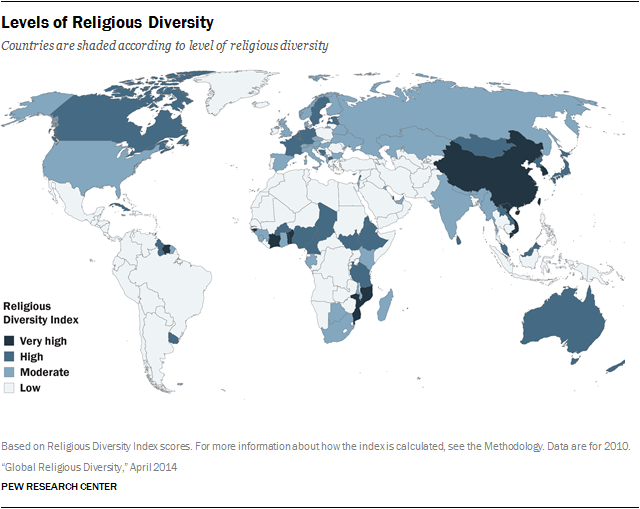
world-religious-diversityQuick! What is the most religiously diverse area of the world? Not the Middle East—it’s primarily Muslim, and not Latin America—it’s primarily Christian.

It is, of course, the Asia Pacific region, home to a great diversity of religious traditions including Islam and Christianity, as well as Buddhism, Hinduism, Confucianism, and loads more. This is just one interesting tidbit from a report on world religions released this week by the Pew Research Center.

More noteworthy than this fact, however, is that some of the world’s least religiously diverse places are home to the highest rates of social violence involving religion. Of the five countries exhibiting the most religious violence:
  • Afghanistan and Somalia both rank in the bottom ten for religious diversity, with a “Religious Diversity Index” or RDI of 0.1.
  • Pakistan ranks as having “low diversity,” with an RDI of 0.8.
  • India (RDI 4.0) and Israel (RDI 4.5) are ranked as “moderately diverse.”

If diversity indeed correlates with lower violence, that is indeed good news for diversity and pluralism, and a desire to discourage violence and promote inclusion are good reasons to put Cultural Detective Islam and Cultural Detective Jewish Culture to good use! And please, help us create packages for other major world religions! Such tools are especially needed given that the Pew Research studies show huge increases in religious hostilities in nearly every world region.

increase in religious hostilities

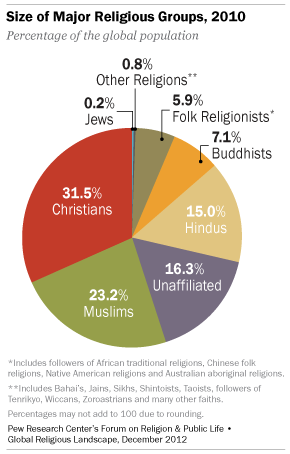
How did this finding, correlating the lack of religious diversity and hostility, come about? In December 2012, Pew Research Center’s Forum on Religion and Public Life published a report entitled, “The Global Religious Landscape,” based on data gathered in 2010. It found, in part, that:

“Worldwide, more than eight-in-ten people identify with a religious group. A comprehensive demographic study of more than 230 countries and territories … estimates that there are 5.8 billion religiously affiliated adults and children around the globe, representing 84% of the 2010 world population of 6.9 billion.”

01_groupsThen, in January 2014 Pew published the results of another study in its article, “Religious Hostilities Reach Six-Year High.” It involved data on 198 countries:

“A third (33%) of the countries and territories in the study had high religious hostilities in 2012, up from 29% in 2011 and 20% as of mid-2007. Religious hostilities increased in every major region of the world except the Americas.”

socialHostilitiesJust this month, April 4, 2014, the Pew-Templeton Global Religious Futures project, which analyzes religious change and its impact on societies around the world, published further analysis that it conducted on the 2010 data. They produced a very interesting index that ranks each country by its level of religious diversity—its RDI, or “Religious Diversity Index.” RDI was calculated based on the percentage of each country’s population that belongs to the eight major religious groups defined by Pew. The closer a country comes to having equal shares of the eight groups, the higher its score on the 10-point index.

To quote from the report,

“In order to have data that were comparable across many countries, the study focused on five widely recognized world religions—Buddhism, Christianity, Hinduism, Islam and Judaism—that collectively account for roughly three-quarters of the world’s population. The remainder of the global population was consolidated into three additional groups: the religiously unaffiliated (those who say they are atheists, agnostics or nothing in particular); adherents of folk or traditional religions (including members of African traditional religions, Chinese folk religions, Native American religions and Australian aboriginal religions); and adherents of other religions (such as the Baha’i faith, Jainism, Shintoism, Sikhism, Taoism, Tenrikyo, Wicca and Zoroastrianism).”

This, of course, means that diversity within these larger religious sub-groups was not examined.

Linking the findings from phase two (social hostility) and phase three (religious diversity) shows the correlation between lack of religious diversity and social hostility.

I would emphasize that the link between lack of religious diversity and increased social violence does not appear to be a finding reported by Pew Research. Rather, it is an observation written by Emma Green in The Atlantic. The top five—and many others—of the most socially hostile countries do indeed have lower RDIs. However, there are countries with low religious diversity that also show low ratings for religious hostility: Namibia, Marshall Islands, Malta, Kiribati, Cambodia, Djibouti, Lesotho, and Grenada among them.

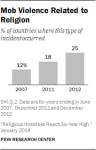
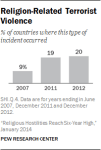
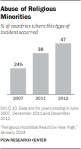
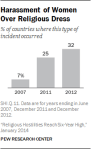
The research is definitely worth reading. The overall increase in religious hostility is driven by certain types of hostility, including abuse of religious minorities, harassment of women over religious dress, violence to enforce religious norms, mob violence related to religion, and religion-related terrorist violence. Click on any photo to enlarge.

Emma Green ends her article with an interesting thought:

“It may not be true everywhere, but these data suggest something remarkable: Religious pluralism can be, and often is, compatible with peaceful societies.”

What do you think? What is your experience? What successful efforts have you seen to bridge religious differences and increase tolerance and respect?