Ochobo’s “Liberation Wrapper”

liberation-wrapper-415x260What a terrific, culturally appropriate marketing ploy! When I lived in Japan, I was oh-so-conscious to cover my mouth with my hand when I laughed out loud, or if I had to open it real wide while eating. “Ochobo,” or a small mouth, is traditionally seen as a sign of feminine beauty in Japan.

A national hamburger chain wanted to sell more of its biggest, juiciest, wide-mouthed burgers to women, so it came up with an ingenious idea: the “liberation wrapper”—a stiff paper burger wrapper, imprinted with a closed mouth. The person eating is able to hide behind a dainty little face, saving others from having to watch them chow down.
Every society is changing, and there are plenty of women in Japan who eat burgers in public. There are also those who don’t cover their mouths when laughing. But, hey, this is fun and cool! Maybe next will come a not-so-culturally-necessary but cool men’s “liberation wrapper”!

Here’s an article on the promotion, from the Japan Daily Press.

This promotion reminds me of a story years ago, recounted to me by the then-Director of Tokyo Disneyland. In planning for Adults’ Day (成人の日), the workers realized that many young women would be coming to Disneyland in silk kimono. Knowing that the water spray could damage the expensive kimono, the workers prepared signs, warning the young women of the danger and cautioning them to avoid certain water rides.

The Director scolded them, saying their signs ran counter to the Disney way. “You must figure out a way to let the young women enjoy the rides, in their expensive silk kimono.” The solution? They had a bunch of plastic raincoats made special for Adults’ Day.

What is your favorite culturally appropriate customer service or marketing story?

Use of a typical Indian metaphor by Devdatt Pattnaik to speak of culture: Kolam

tumblr_lk8iuxl2vK1qa2x4yo1_500This guest post is written by , cross cultural consultant and trainer. Remember, don’t think “chaos;” think “pattern!”

Often times in my intercultural trainings to Indian audiences, I have sensed a discomfort in my participants with using models (the iceberg of culture, for example) and imagery that are often more easily understood by Westerners. Perhaps, I am more sensitive to this discomfort because I felt the same when I learned not only one but two foreign languages (English and French), with their intrinsic imagery that was so far removed from my local reality.

You can imagine my joy when I stumbled upon Devdutt Pattnaik’s use of a typical Indian custom of drawing kolams (rangoli in North India) to explain the Indian world view. Used to adorn the floor at the entrance of even the most humble abode in India, it is basically a pattern that is drawn, using lines to connect a grid of dots. There is nothing rigid about how the dots need to be connected—each person chooses to connect the dots as s/he desires, and each pattern is a legitimate one, just as is each culture.

Below you can watch his thought provoking presentation on India. I particularly love his closing lines. Enjoy! What are your favorite local metaphors and imagery that resonate with the local contexts you work in?

New Study on How the Language We Speak Affects Us

“The structure of languages affects our judgments and decisions about the future, and this might have dramatic long-term consequences.”

On October 1st I read an interesting article in Scientific American, entitled, “How Your Language Affects Your Wealth and Health.” Dr. Keith Chen, of Yale Business School, had conducted a study analyzing individual-level data — economic decisions, retirement assets, smoking and exercising habits, and general health in older age — from 76 developed and developing countries. He also analyzed national savings rates, country GDP and GDP growth rates. Premised on the fact that some languages have explicit future markers while others have more ambiguous markers between present and future, Dr. Chen correlated the economic and health data with language structure, with striking results. “Speaking a language that has obligatory future markers, such as English, makes people 30 percent less likely to save money for the future,” according to Scientific American.

I shared the article on Facebook, Twitter, and LinkedIn, and today I came across a terrific little video that summarizes the study’s findings. Good visuals nearly always help me make sense of information; it’s why I made this video, summarizing a different cross-cultural study, earlier this year. I bet you’ll find the movie below helpful as well:

The original study is entitled, “The Effect of Language on Economic Behavior: Evidence from Savings Rates, Health Behaviors, and Retirement Assets,” written by M. Keith Chen, Yale University, School of Management and Cowles Foundation, April, 2013
Published in the American Economic Review 2013, 103(2): 690-731
Editor’s choice, Science Magazine, Vol 339(4)
Permanent address: http://dx.doi.org/10.1257/aer.103.2.690http://www.anderson.ucla.edu/faculty/keith.chen/papers/LanguageWorkingPaper.pdf

Remember, Cultural Detective is a leading-edge process not only for understanding values and behavioral differences across cultures, but for navigating them successfully.

World Epidemic of Domestic Violence & India’s “Abused Goddesses”

Durga: domestic violence goddess

The Hindu goddess Durga in an ad to end domestic violence in India

According to the World Health Organization, violence against women is a worldwide epidemic. Findings from the first extensive research of its kind, published in August 2013 and conducted by the World Health Organization, the London School of Hygiene and Tropical Medicine, and the South African Medical Research Council, show that 35% of women worldwide experience either domestic or sexual violence! Globally, as many as 38% of all murders of women are committed by intimate partners. And this, despite a 1993 United Nations Declaration on the Elimination of Violence Against Women. This unacceptable reality is not limited to any one region of the world, as you can see in the map below.

Domestic violence by world region

From the report, “Global and Regional Estimates of Violence Against Women,” World Health Organization, London School of Hygience & Tropical Medicine, South African Medical Research Council.

Both men and women are victims of domestic violence, though worldwide statistics show that four-out-of-five victims are women. I know this epidemic first-hand: domestic violence knows no boundaries of ethnicity, socioeconomic level, or education. While physical abuse is against the law in the USA, thankfully for us, mental abuse is not and can be far, far worse.

Save Our Sisters, an initiative of the NGO Save the Children India, recently returned to my attention when they released a dramatic series of ads designed to stem the tide of domestic violence. The ads show three bruised and battered Hindu goddesses (Durga, Saraswati, and Lakshmi), along with important statistics—68% of women in India are victims of domestic violence—and a helpline number. The campaign, blending hand painting in the traditional style with photography, was created by the Mumbai-based advertising agency Taproot, and it has already won several awards. You can see the three ads in the slideshow below, along with another closeup.

This slideshow requires JavaScript.

Recent reports show that one Indian woman is killed every hour just in dowry-related crimes! Most people that I have spoken to in India find the “abused goddess” campaign highly effective: it grabs one’s attention, it is culturally appropriate, and it seems to be raising awareness and reporting. In sharing the campaign on social media, however, I especially found one response (from Darshana Davé—who has given me permission to use her name and asked that we link to her email) insightful:

“It’s a good, effective campaign, but why must it be that only goddesses, mothers, sisters and daughters be treated well? Why can’t Indian men treat all women with respect? Those questions remain unanswered… A powerful campaign, but it also is guilty of perpetuating the goddess versus whore stereotype, where the woman is either a goddess, sister, mother or daughter, who should not be abused, or if not those, a whore, who can be abused.”

Darshana also shared this provocative (though challenging to wade through) article, entitled, “No more goddesses, please. Bring in the sluts,” which I feel makes some valid points—and I do love the title.

What do you think? Have you seen culturally appropriate campaigns to eliminate violence against women where you are? If so, please share!

Violence against women is both a major world health issue and a human rights problem, as indicated in the diagram below, from the same WHO report.

Health effects of domestic violence

From the report, “Global and Regional Estimates of Violence Against Women,” World Health Organization, London School of Hygience & Tropical Medicine, South African Medical Research Council.

In Mexico, where I live, we suffer an epidemic of “lost women,” women who just disappear one day, never to be seen again, victims of sexual violence and murder. Violence against women is a systemic problem, a societal and cultural problem. We need to stand up, to speak up, each of us, in our families, with our friends, neighbors and colleagues. We need to use our cross-cultural skills to help people realize, in ways that make sense to them, that violence is never appropriate.

“There is one universal truth, applicable to all countries, cultures and communities: violence against women is never acceptable, never excusable, never tolerable.”

—United Nations Secretary-General, Ban Ki-Moon (2008)

Today as this blog post was published, I happened upon this particularly powerful and discouraging article from the Harvard Gazette. If this topic interests you, be sure to read it and let me know what you think.

Also, do not miss this just-released UNDP study on preventing violence against women in the Asia-Pacific region.

Burka-Clad Super Hero Fights for Girls’ Rights!


ba-cover
This week saw the television launch of an exciting new female superhero, direct from Islamabad, Pakistan: The Burka Avenger!

The star of the animated series of thirteen, 22-minute episodes is a teacher who uses books and pens to fight the evil people who shut down schools and prevent girls from getting an education. The humorous show also teaches kids to protect the environment, and, good news for the Cultural Detective community, to respect diversity and include others.

Each episode features an original song and guest appearances by some of the biggest musical acts in South Asia, including Ali Zafar, Haroon, Ali Azmat, Adil Omar, and Josh. Goals include entertainment and positive messages to youth. The series’ trailer (in English) is below.


The Burka Avenger is the brainchild of Aaron Haroon Rashid, a Pakistan pop star who wanted to create a positive role model to counter the Taliban’s ongoing opposition to girls’ education. In explaining the choice of the burka, which the teacher, Jiya, only wears in superhero mode, Rashid explained, “It’s not a sign of oppression. She is using the burka to hide her identity like other superheroes. Since she is a woman, we could have dressed her up like Catwoman or Wonder Woman, but that probably wouldn’t have worked in Pakistan.”

Of course this may well remind us of the indomitable Malala Yousafzai, whom the Taliban   famously attempted to assassinate last October. On her 16th birthday this past July 12, the amazingly poised and well-spoken Malala delivered the first-ever education policy recommendations written for youth, by youth, to the United Nations (video below). July 12th has now been named Malala Day in her honor.


It is not just Pakistan where girls’ rights to education are in danger. Fortunately, the people at Mighty Girl Books have assembled a terrific list of books for children and teens that explore the challenge of girls’ access to education, worldwide and throughout history.

You may also remember the comic book series “The 99,” in which superheroes inspired by Islam (they are named after the 99 attributes of Allah) fight crime, smash stereotypes and battle extremism. Series creator Naif Al-Mutawa gave a talk at TED Global 2010. A video of his talk is below, and a free online issue is also available.

Need help figuring out 50 million Latinos?

coverLatino—Guest blog post by Brenda Machado-Koller

Yes, I know, it’s a loaded question. But it’s worthwhile taking a look at possible answers.

Latinos or Hispanics are the largest, fastest-growing, and one of the most influential socio-economic ethnic groups in the USA. More than 50 million Latinos reside in the USA today. By 2050, one-in-four US Americans are projected to be of Hispanic descent.

We encounter Latinos in virtually every setting, including business, education, healthcare, politics and in our communities-at-large. It’s time to gain an even deeper understanding of Latinos and to continue building more successful organizations and communities.

You’ll find some of the answers to the fundamental changes in US society in the Cultural Detective® Latino/Hispanic. Interculturalist Dianne Hofner Saphiere and I developed this latest installment of the Cultural Detective Series, and many experts contributed their thoughts to the training materials (my heartfelt thanks to all!). The Cultural Detective Series now includes more than 65 culture- and topic-specific educational guides that have been published over the past decade and frequently updated.

Cultural Detective Latino/Hispanic is available as part of a Cultural Detective Online subscription, or via license as a printable PDF. The participant materials are a 26-page educational guide that introduces an insightful Cultural Lens of overarching Latino values that drive beliefs and behavior. In addition, the package features real life scenarios, best practices and a broad selection of reference materials for further study. Cultural Detective Latino/Hispanic is a powerful tool for human resources professionals, training experts, line managers, team leads or interculturalists who are dedicated to improving organizational effectiveness in a broad variety of settings.

Brenda Machado-Koller is President of Intercultural Business Services LLC. She was born and raised in Puerto Rico by a US American mother and a Puerto Rican father. Brenda holds an M.A. in Intercultural Relations.

#nochildforsale

Check out this excellent, simple and clear video from WorldVision, designed to combat child trafficking.

Those of us committed to intercultural competence know that child labor is sadly a matter of family survival in many places on our planet. We work to change this systemic reality and create a more equitable world in which children can study and better their lot. Children who are loved and contribute to their family’s sustenance can indeed feel proud, despite the hardships they face and while we effect change.

Child trafficking, on the other hand, is a reality we need to say no to NOW. Absolutely not. There are many levels of “wrong” in the world. Putting an end to human trafficking has got to be a key focus of our efforts.

Update Istanbul

IstFutI would very much like to thank Erika Leuteritz, talented and passionate member of our Cultural Detective community, for sharing this guest post:

Am I competent to write something about Istanbul? I’m German, I live and work in Germany. I love Istanbul, and I have been traveling to Istanbul every year for the past decade. I’ve been taught to be a Cultural Detective in a three-day course — in Istanbul. I have Turkish friends in Istanbul, Ankara, Izmir, Antalya and some smaller towns. Some are real friends, some are Facebook friends — acquaintances would be the old-fashioned word.
 These are normal women and men between 28 and 55. Usually they post photos of their children, their holidays, of flowers, insects, cats, information about books, music, quotations, cartoons, soccer … sometimes a political statement.

Last Friday night, I noticed that something must have happened. 
Nearly ALL of them were posting photos and videos of demonstrations, of drastic police violence. I know the area around Taksim Square. I was shocked. I asked one of my friends what was going on, and I checked German and British media. 
The following day, several of my friends asked me to help spread the news to the world because Turkish media remained silent. Since Saturday, I’ve been looking at videos, photos, information — since I don’t speak Turkish, I had to check German and English media as well.

These are the facts:
 A small group of demonstrators wanted to stop the government from felling over a hundred old trees in a park near Taksim Square for a shopping mall. They were few, they had a small camp, they were peaceful. The police disrupted the camp with tear gas and water canons. I’ve corroborated this with friends, Facebook, German and English media. This triggered, as it would in any country, a huge demonstration against police violence and against the government. These demonstrations have been continuing in Istanbul and have spread to about 50 other cities in Turkey — with police violence. More than 1700 people have been arrested, more than 2000 have been injured, per German and English media.

These demonstrations were triggered by some comments by Turkish Prime Minister Erdogan. He called the demonstrators extremists and looters. In the German and English media, I couldn’t find any reports of looting.
 PM Erdogan has emphasized that he has been elected three times by the majority of the people, and that therefore the demonstrators are just a small minority.

It is true that Erdogan had been reelected several times. His conservative Islam party, AKP, has paved the way for the largely conservative, religious, rural majority to better education and job opportunities.
 The mainly secular and well-educated urban population has always feared that Erdogan wants to create an Islamic state.

Here we have a division along culture lines: Islamic – secular, more rural – more urban. This may be the underlying current of these demonstrations. But usually things don’t tend to be so simple.

Only last week, the AKP majority passed a law forbidding the sale of alcohol between 10 PM and 6 AM.
 In some of the demonstrations people deliberately drank alcohol. The Erdogan administration has in past years put massive pressure on the media: There are more journalists imprisoned in Turkey than in China! 
And there’s also the headscarf issue … German and English commentaries say that people are getting increasingly fed up with Erdogan getting more and more authoritarian. They say that these demonstrations could for the first time pose a serious problem for him.

I perceive that people who formerly nursed their differences are uniting in these demonstrations. There was a photo on Facebook saying that Turks, Kurds, Alevis and Sunnis are uniting
. In the 2007 election, a lot of the (religious) minorities voted for Erdogan. They felt sure that Erdogan and his AKP, sice he had been a political minority in a secular state, would be good for and good to other minorities as well. I was on a study tour in October 2007 and had the chance to meet representatives of some of these minorities. 
One of the main charges the demonstrators hold against Erdogan is that, in the end, he’s not paying any attention to minorities …

On the videos and photos I don’t only see young people, women and men, but people of all ages — though the younger ones are predominant
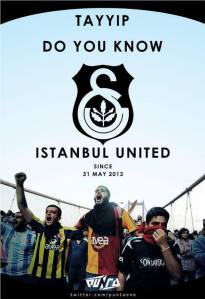
 — and the three big soccer teams of Istanbul (Besiktas, Fenerbahce and Galatasray) have all united as well!
 THAT really is cross cultural competence!!!

There is support: at least one of the big hotels at Taksim is offering food to demonstrators, as is a cultural center. Not only hospitals and universities but also mosques are looking after the injured. In the night, women clank pots on their balconies in support of the demonstrators.

Now what about Erdogan’s majority? My friends are all secular — though I don’t believe such a condition really exists. Common sense and my training tell me that there is no such thing as black and white, as two granite blocks: “secular” and “religious.” The other day, there was a a photo on Facebook showing women with head-scarves at a demonstration — Devrimci Müslümanlar. I asked a friend about them. She told me that they are a (small) group of Muslim socialists who openly counter rumors of demonstrators attacking women with headscarves and demolishing mosques.

Yes, it is a question of values, but not (only) of secular and religious, but of freedom — freedom of speech, for instance.

Here is a news report that I trust may help explain the situation.
Using Our Perceptions to Discover Ourselves: Two Iconic Embraces

We often hear that feedback says as much about the person giving the feedback as it does about the subject of the evaluation.

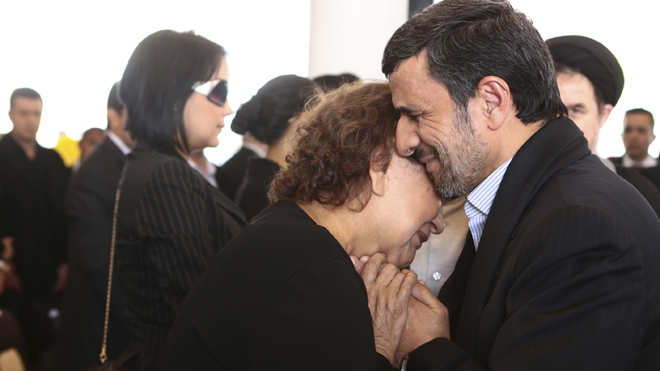
Our perceptions can tell us loads about ourselves. Take a quick look at the photo below, and take a few notes on what you see.

Mahmoud Ahmadinejad, Elena FriasKeep looking at the photo above. In case you do not already know, the photo was taken at the funeral of Venezuela’s President Hugo Chavez in March 2013. On the left is Chavez’s mother, Elena Frias de Chavez, and on the right is Iran’s President Ahmadinejad. Now, pause and take a few more notes on what you see in the photo.

Did your perceptions change between the first and second times you took notes? Before you proceed, take a moment to reflect on the values, assumptions, and beliefs that underly your perceptions.

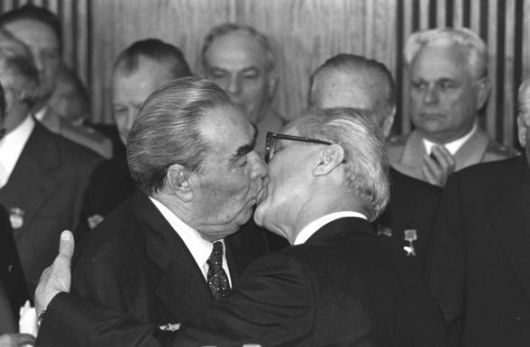
Once you’ve done that, how about looking at another photo? Same instructions: take a look at this photo, and jot a few notes about what you see. Perhaps you have already seen both of these rather iconic photos.

Breznev-Honecker_1979

Keep looking at the second photo. If you did not already know this, the photo was taken during the 30th anniversary celebrations of the Democratic Republic of Germany (East Germany) in 1979. On the left is Leonid Brezhnev, leader of the USSR, and on the right is East German President Erich Honecker. Now, take a few more notes on what you see in the photo.

Did your perceptions change between the first and second times you took notes? Before you proceed, take a moment to reflect on the values, assumptions, and beliefs that underly the perceptions you noted this second time around.

Finally, compare your perceptions, and your values, assumptions, and beliefs about both of these photos. In what ways did you respond similarly? In what ways differently? Why?

FIRST PHOTO
In fact, President Mahmoud Ahmadinejad was criticized for consoling Chavez’s mother in this way; she is not a member of his family, and thus, such touching is haram or forbidden. While my research shows the photo to be real, there are reports of the photo being doctored in order to cause problems. I personally find the actions captured in the photo quite believable: a man consoling a grieving mother and bridging cultures in the moment. Below are two sources for those of you curious to learn more about this photo and the response to it:

  1. Daily Mail article
  2. IranPulse English language news blog

SECOND PHOTO
It was quite commonplace for Communist leaders to kiss on the mouth as an expression of brotherhood and solidarity. This iconic photo was taken by Régis Bossu, a freelance photographer for European Stars and Stripes, Stern, Spiegel, and Sygma. Most observers of the time viewed this Brezhnev-Honecker kiss as more enthusiastic than usual. The photo was quickly and widely circulated.

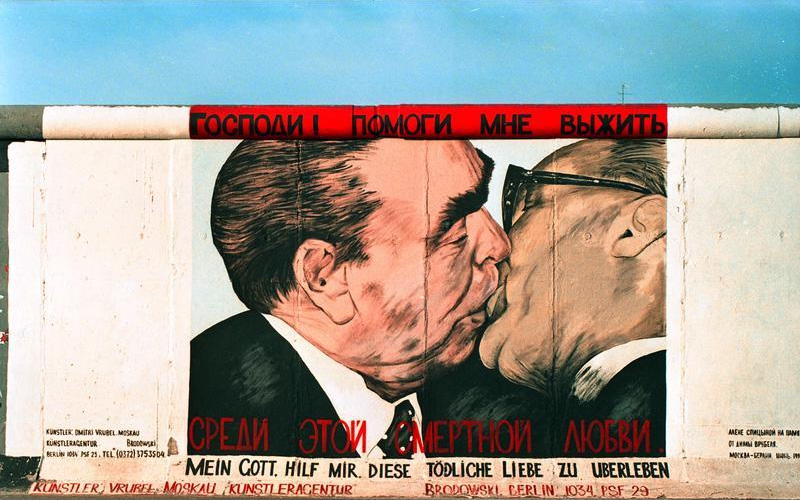
Berlin, East Side GalleryIn 1989, during the euphoria following the fall of the Berlin Wall, Dmitri Vrubel painted a replica of the kiss on the Eastern side of the Wall. If you wish to learn a bit more about the photo and the painting, here are a couple of links:

  1. Lite Strabo Stories from History blog
  2. Wikipedia

While we can learn much about history and politics from photos such as these, we can also learn about customs and values. And, perhaps most importantly, we can learn to see our own cultural filters and biases a bit more clearly. Exercises such as these can be used to complement the learning we gain about ourselves via the Cultural Detective Self Discovery.

Coincidentally, when she was proofreading this post for me, our editor, Kathryn Stillings, shared with me that she had just read this article, about our perceptions (socially constructed) of race: What Does “Black” and “White” Look Like, Anyway?: Obama and His Grandpa. I share it with you as it would seem to support, as well as build on, the point of this post. I particularly love the morphed photos at the bottom of the article.

Before I close, I’d like to thank a few of the members of SIETAR Argentina, who recently used the second photo above in a training, and reminded me of it after so many years.

And, in conclusion, I leave you today with a few quotes:

There is no truth. There is only perception.
—Gustave Flaubert

Science is nothing but perception.
—Plato

Studies have shown that 90% of error in thinking is due to error in perception. If you can change your perception, you can change your emotion and this can lead to new ideas.
—Edward de Bono

The Turkish Spring

Bosphorous Bridge ProtestI woke up with a message from Istanbul: “Mai! We are having a Turkish Spring!”

Bosphorus Bridge was captured with thousands of protesters flowing across the bridge that links Asia and Europe. My friend is probably among those people who are angrily demanding that Prime Minister Erdogan respect the will of his people instead of silencing dissidents, Islamizing Ataturk’s legacy, and blaming social media as the “the worst menace to society.”

With a population almost 100% Muslim, for me, strangely, Turkey has never felt like an Islamic country. Probably because the bedrock of this nation is firmly Greek and Roman, and because Istanbul used to be the pride of western civilization. Today the country is a meeting point of two powerful flows between East and West, presenting to the world a wonderful concert conducted by the elements of two most terrific symphonies: Asian and European cultures. The Bosphorus Bridge, glamorously lit up with colorful lights every night, connects the two continents and stands as a symbol for that reality.

Of course, living up to expectations is not always easy. A perfect balance is not always the case, especially when contrasts, sometimes radical contrasts, seem to be the very points that make Turkey attractive. For my friend, she is acting to gain back that balance. The protests at the moment are about that momentum as well, balancing ideologies, adding on, taking off, gaining and losing here and there to keep that balance of contrasts to the point that it does not topple the whole system, but rebalances it safely and interestingly enough to sustain itself and continue to attract people.

I dug up a picture of the Bosphorus Bridge in its peaceful times, sending a message to my friend with a quote from none other than Napoleon himself, who put his Parisian pride in the back room and declared to everyone: “if the world was a country, Istanbul would be its capital.”