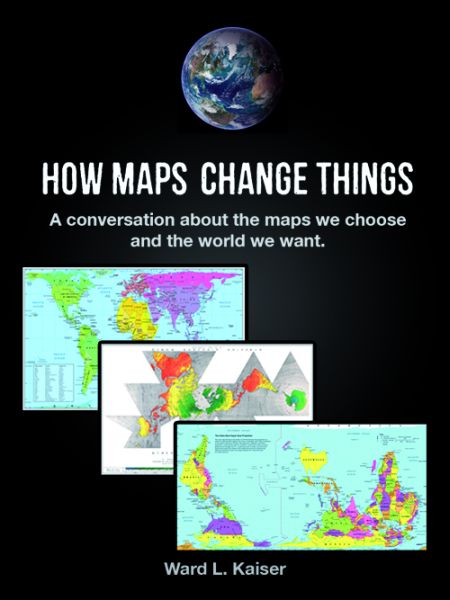
by Ward L. Kaiser, published by the New Internationalist and ODT Maps, 2012.
Free download through March 31 for Cultural Detectives
Anyone looking to develop a new class or training program to improve intercultural competence? This just-released book, How Maps Change Things: A conversation about the maps we choose and the world we want, could be the basis of one terrific learning journey! I highlighted something on nearly every one of its 188 pages. I learned so much, on so many different yet related topics, that I now have five or six threads of learning and discovery I want to pursue!
At first glance you might think this is a book about maps. Then you read on page six that it is about
“… how we shape and use maps and how they in turn shape us. It’s about how we see the world and how we therefore understand our place in it.”
So you start to hope that How Maps Change Things could teach us to be careful whether we label a certain body of water the “Arabian Gulf” or the “Persian Gulf,” or color-code parts of Kashmir as Indian or Pakistani, but it goes way beyond that.
“Because such maps encourage the feeling that some areas are home to movers and shakers while others shelter mere pawns.” — page 74
Mr. Kaiser, the author, is a big fan of equal-area projection maps such as the Peters, as most in the global diversity and inclusion field are, and points out how maps such as the Mercator aren’t good for much other than navigation. But in addition to showing us how maps can be used to perpetuate bias, he shows us how maps can also be used to promote perspective shifting, equity, and social justice:
“Through internalizing many ways to see the world we may even develop openness to other people’s points of view and greater self-awareness.”
— page 164
“What if people all over the world threatened by, well, you name it – logging, commercial development, polluting factories, hydrofracking chemicals in drinking water, say – what if they could all see maps as tools of analysis and action? …
How about a map to make clear where the hazardous electronic wastes of the developed world get dumped …
Bring together maps, available technology, human creativity, and people’s willingness to take a stand and you’ve got a powerful recipe for changing events.” — page 176
For these reasons and others this volume will be useful to interculturalists and those interested in diversity, sustainability, and social action.
The author premises that maps are tools that serve a purpose.
“Maps are verbs. They may seem to be tactile objects, documents we can handle or fold – nouns – but don’t be fooled. In persuasively framing questions and selectively supplying answers they act; they initiate; they function as agents.” — page 15
To illustrate this point he shares some terrific stories: one about the role of maps in a territorial dispute between First Nations people and the Canadian government (pages 35-39); another about how a map can skew our view of a country as a source of oil or as a residence of people and families (pages 8-17); and a third showing how a map was used to get one county to pay for a highway interchange that served another county (pages 34-35). There is a chapter about the connection between maps and faith/values (chapter 10 page 141), and how maps are used for disease control and health (page 170), as well as for crime prevention (page 173), a topic of special interest lately with concerns of profiling and ethnic bias.
The book is written in a lively, accessible style, though it gets heavier and slower toward the end; ironically, the final chapters are where Mr. Kaiser’s true passion seems to lie. It contains several embedded learning exercises (e.g., page 121) and interesting conversations such as how indigenous North Americans mapped (page 40). Via this latter conversation, he shows that the “culture” of map-makers is not universal. This, to me, is a hugely important point. Too many people believe their area of professional practice is culture-neutral or universal when, in fact, even science is culturally relative (as well as discipline-relative!).
One of the pleasures of reading How Maps Change Things is that it contains quite a few valuable “hidden” gems. One of my favorites: as the author discusses the huge socio-economic gap in our world, variously referred to by such inadequate (or judgment-laden) terms as North-South, 1st/3rd world, Developed/Developing nations, and Viable/Failed states, he provides in the footnotes a list of experts from diverse political persuasions and walks of life who share a consensus on the absolute need to bridge this gap (pages 138-139).
Through March 31 our friends at ODT Maps, the publisher, are offering this ebook FREE to our Cultural Detective community. I urge you to take advantage of this offer and help the author get this book put to good use!
—
Maps are tools, and can be purposed to perpetuate bias or to help us to create a better world. Cultural Detective has long been passionate about maps as learning tools. Way back in December of 2005 we dedicated an entire edition of our Cultural Detective e-news to maps (including 3 articles of activities and curricular ideas and a quiz), relying in large part on the expertise and generosity of our friends at ODT Maps.
It included: Using Physical Maps to Transform Mental Maps; 8 Map Activities for Intercultural Learning; a World Map Detective quiz; Training with Map Power; and a free offer (a Mecca-centered Azimuthal map, a Peters Projection map, and a Population Map) from our friends at ODT Maps.
Bob Abramms at ODT has a wealth of books, DVDs, globes, puzzles, games, props, and world maps for different purposes — terrific training material for intercultural and global diversity and inclusion professionals. If you’re not familiar with his great stuff, be sure to check it out.
 Cultural Detective Blog