Developmental Intercultural Competence Using Cultural Detective Online

CDO
Are you doing your best to develop cross-cultural effectiveness in your organization, and want better results? Quicker results? Longer lasting results? Or, maybe even just results—heightened productivity and satisfaction? Our clients have achieved amazing increases in cross-cultural effectiveness—their people improving two stages on the DMIS (the Developmental Model of Intercultural Sensitivity) in a few months, and customer satisfaction increasing 30%—using Cultural Detective developmentally. How did they do that?…

Index for This Post (jump ahead if you’d like)
The DMIS
The DMIS and Cultural Detective
How Customers Successfully Build Intercultural Competence
Additional Resources

Developmental Model of Intercultural Sensitivity ©Dr. Milton J. Bennett, 1986 & 1993.

Developmental Model of Intercultural Sensitivity ©Dr. Milton J. Bennett, 1986 & 1993.

The DMIS
Let me start by telling you about the DMIS. First published by Dr. Milton Bennett in the International Journal of Intercultural Relations in 1986, and more fully developed in Education for the Intercultural Experience in 1993, the DMIS has proven to be a key milestone in the intercultural field. It provides a roadmap for those of us who aim to develop intercultural competence.

A developmental model is a conceptual framework that helps us better understand a progressive process, as well as providing guides for continued development. Examples of a developmental model with which most parents are familiar are those charts that track the major milestones of an infant’s growth. Such models help us anticipate when our baby will smile, sit up, crawl, or distinguish right from wrong, and they can help us ready our children for their next big challenge. There are abilities our baby generally must develop (e.g., roll over) before being ready to accomplish tasks at a higher stage of development (e.g., crawl). At each stage, the baby needs to be appropriately encouraged, while also feeling safe enough to take the risk to try something new.

Similarly, the DMIS is a conceptual model of six stages of the development of intercultural sensitivity, from ethnocentrism to ethno-relativism. The IDI, or Intercultural Development Inventory, is a psychometric instrument that assesses one’s stage of development. Its origins are based in the DMIS, though it uses a slightly modified version of the model today, called the IDC (Intercultural Development Continuum). The DMIS and the IDI enable us to track where we are in the development of our intercultural sensitivity, and ready ourselves for enhanced sensitivity or effectiveness.

The DMIS and Cultural Detective
The beauty our clients have found in the Cultural Detective Method is that it challenges and supports, stretches and comforts, learners at each stage of their development of intercultural sensitivity. While the DMIS and IDI indicate where one is on the developmental continuum, Cultural Detective assists in the learning and development of the skills needed to succeed in cross-cultural interactions.

The process works organically. The designer must make the case for diversity and inclusion in developmentally appropriate ways, and debrief learning in ways that comfort and challenge the learners. However, the Cultural Detective (CD) Method itself need not vary, no matter the developmental stage. Learners, depending on their abilities, will naturally use the CD Method differently at different levels of development.

Let me give a couple of examples.
  • Learners in ethnocentric stages of development will easily and fairly quickly solve a Cultural Detective mystery—they will be eager to complete the Worksheet, solve the problem, give the participants in the critical incident advice on what they should have done differently. Facilitators will observe, however, that learners at earlier development stages will suggest Cultural Bridges that are naïve or unrealistic, though of course possible. They might suggest, for example, that “the Japanese person just needs to speak up more assertively,” or “the Mexican manager needs to be more considerate of others and trust that his and his company’s welfare will be looked after.” Both of these recommendations are within the realm of possibility, both are achievable by Japanese and Mexicans of certain personality types or personal discipline, but such Bridges are not realistic for the majority of people from those cultures. Learners in ethnocentric stages feel good that they are able to solve the problem, which encourages them to try another and, with practice, learn what really works and what doesn’t when teaming across cultures.
  • When completing that same Cultural Detective Worksheet, learners in ethno-relative stages of development will enjoy pairing Values, Beliefs and Cultural Sense with the Words and Actions they motivate. They will invest effort into discerning the commonalties, as well as the differences, between the participants in the critical incident. They will develop ways to build on shared interests, while also leveraging diverse opinions and abilities, so that all players more fully contribute and the organization or community benefits. They will, without prompting, compare themselves, their values and beliefs, to the players in the incident—constantly learning, discovering, and refining their self-understanding. They will, in an organic way, explore and cultivate their cultural (or multicultural) identities, their understanding of and empathy for others, and their abilities to collaborate across cultures.

Thus, in a very natural way, learners at all stages of development receive the support as well as the challenge they need to continue their developmental journey towards intercultural sensitivity. There is very little stress on the facilitator to adapt the CD Method for the learner’s level of development, freeing the facilitator to focus effort on answering questions and dealing with resistance in ways that are both appropriately challenging and supportive to the learner.

And such a flexible process can be a blessing when we work with groups from mixed developmental levels. I often compare the Cultural Detective Method to the Montessori approach, because learners at all developmental levels can gain from helping one another.

So, How Do Customers Do It? How Do They Successfully Build Competence?

1. Research shows the development of intercultural competence requires ongoing, structured learning. That is precisely what a subscription to Cultural Detective Online (CDO) provides. So, first, get a subscription. If you want to build competence in your team or organization, if you are an experienced interculturalist, or if you are new to the Diversity and Inclusion space, a CDO subscription is a small investment with huge potential. The subscription agreement allows you to project CDO contents onto a screen for group viewing in any work you personally deliver, as long as you explain to your learners that Cultural Detective Online is a tool that anyone can subscribe to. Our goal is to get these materials used!

2. USE the system, regularly. Cultural Detective Online isn’t an entertainment system; it isn’t passive; it won’t give you intercultural competence through osmosis or by using magic dust. (That’ll be version 2! Just kidding.) Log onto the system once a week, and spend 20-30 minutes debriefing a critical incident, and using Values Lenses to supplement what you see. Respond to the prompts asking you what you’ve learned. Review your notes.

3. After a few weeks using your subscription, once you feel comfortable and competent with the Cultural Detective Worksheet, upload your own incident. Choose something from your real life: perhaps an interaction with a family member, friend, or colleague that puzzled you. Once you write the brief story, link the participants in your incident (yourself and others) to the Values Lenses in the Cultural Detective Online system. Think about why you behaved the way you did, and reflect on the influence that national, gender, generational, and spiritual values had on your behavior. Think about these same influences on the other people in your incident.

4. Then, you can discuss the incident with the real people involved in the situation. Having worked through a CD Worksheet, you will be able to move beyond judgment in your discussion. You will have already thought through the possible positive intentions of the other person, so your dialogue will proceed constructively. You both can learn, and collectively develop strategies to collaborate, or cohabitate, more enjoyably.

5. If you are a team lead or an organizational facilitator, gather your learners together regularly (monthly, quarterly), to discuss what skills they are acquiring using the CD Online system, questions they have, and the challenges they’re experiencing in developing intercultural competence.

6. Remember, Cultural Detective need not stand alone; supplement the tool with your favorite activities: simulations, exercises, videos, role-plays, etc. The core Cultural Detective Method dovetails smoothly with just about any other intercultural tool or technique, because it is a process.

7. If you want to track your progress, be sure to use the IDI to get baseline measurements of participants in your group. I’d then recommend participants take the IDI again, after three months of structured learning using CDO. You will be amazed by the results!

8. Cultural Detective Online is a tool. It doesn’t replace skilled facilitation; it supplements and extends it. You may already use the MBTI, the IDI, dimensions models, etc., in the training or coaching you do. Add CD Online to your repertoire and you will be delighted at how it transforms what you are able to achieve with your learners.

9. Be sure to share your Cultural Effective success story with us, and get your organization some positive kudos!

Additional Resources
A few years ago, two very experienced and well-regarded intercultural facilitators, Heather Robinson and Laura Bathurst, wrote an article explaining what I’m talking about.

I am also happy to share with you one of the handouts I prepared for a session at a recent IDI Conference (be sure to scroll down to view all three pages). This handout is a table showing the needs for challenge and support at each stage of development, and explicates the ways in which the Cultural Detective Method meets those needs. You are most welcome to download and print this handout. Note that in the handout you will find the five stages of development that are currently used by the IDI (slightly different than those of the DMIS, above).

Please let us know how you have used Cultural Detective in your teaching and training to facilitate your learners’ intercultural development. I would also like to invite any researchers or graduate students who are interested in conducting research on this important topic to contact us.


Tips for Working Cross-culturally in Health Care Settings and Beyond

Marilyn does an excellent job with her blog, and today’s is no exception. If you work in healthcare, I believe you’ll find this helpful. —Best, Dianne

Marilyn's avatarMarilyn R. Gardner

Through my years of living, working, and communicating across cultural boundaries I’ve realized two things that sum it all up: one — this road is humbling and two – it’s a life-long learning process. Just when I think I have it all figured out, something, someone will come into my life and challenge my thinking and my well-worn tool box of ‘how to live and communicate across cultures’.

This is setting the stage for this post that is co-authored (though she doesn’t know it yet) by my cultural broker, colleague, and close friend Cathy. Cathy has taught me much about living and working across cultural boundaries. We have worked together to bring resources and workshops on culturally responsive, culturally competent care to health care providers in the Northeast for a number of years. Together we have come up with this list, compiled from a variety of sources. While we work…

View original post 433 more words

What do you REALLY intend?

Car crashA guest blog by Susan McCuistion, Principal, daiOne—Strategy building for business and for life

We see any situation we’re dealing with first from our own perspective. While this is a perfectly natural thing to do, if we don’t also think about the situation from other perspectives, we may jump to conclusions that are incorrect.

The Cultural Detective Model is a great way to help us interpret and understand different perspectives. Key to using this model is to assume positive intent on the part of all parties involved. This gives us the opportunity to step back from our immediate interpretation of a situation, based only on our own perspective, and consider other ways in which the same situation may be viewed.

While this external view—assuming positive intent on the part of others—is important, there is also an internal step we can take before any interaction. That step is to understand our own intentions in what we are communicating.

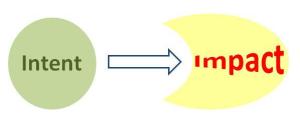
Let’s face it . . . we’re all human and sometimes we say or do stupid things. No one is immune. We often say we don’t “intend” to hurt someone or do something thoughtless, but whether we intend it or not, the impact of what we say or do is felt by other people.

If other people are continually upset by our words or actions, at some point, we need to stop hiding behind “I didn’t intend to do that.” When we keep bumping up against reactions and challenges that we did not intend to cause, then we need to understand that the impact of what we are doing is not effective.

intent impact

When we continue to do something “unintentionally,” after awhile, doesn’t that become “intentional”? If we aren’t changing how we’re acting or what we’re doing or saying, that means we’re intentionally choosing to remain ignorant of ourselves, our motivations, and the effect of our words and actions on others. If you are not self-aware, and you keep running into the same problems, then you’re just being deliberately unaware.

Getting really clear on what we want to say or do requires self-awareness. We need to be able to understand what we are feeling and take a moment to think before we act. We must take some ownership in the communication process, especially when the reaction we get is not what we expect. And finally, we must take time to develop an understanding of other perspectives, so we can recognize at least some of the ways in which our message might be received. Cultural Detective Self Discovery as well as all the series’ other packages can greatly help in this regard.

“That’s not what I intended” may be an excuse the first time, but not the tenth. Once you are aware of the impact of your words or actions, adjusting them is up to you.

How are You Celebrating Hispanic Heritage Month ?

national-hispanic-heritage-month(or do you even know it is happening now?)

September 15th to October 15th is National Hispanic Heritage Month in the USA.

I’ve always been interested in the application of intercultural communication concepts to domestic diversity issues. Perhaps this has to do with where I was living when I first learned about intercultural theory—a racially mixed neighborhood where people of good intentions occasionally had minor misunderstandings.

Working with the Cultural Detective: Latino/Hispanic package renewed my interest in the link between USA diversity and intercultural, specifically about Hispanic issues and how they impact USA society today. Latinos are a vital and dynamic part of the country, yet many in the USA do not know much about the underlying values that may influence Hispanic world views and behavior.

The Pew Research Center recently published an article in their FactTank, “5 facts about Hispanics for Hispanic Heritage Month.” It inspired me to prepare the following short quiz, to see how much you know about Latinos and Hispanics in the USA. Check your answers in the original article.

QUIZ

1. More than half of the USA’s Hispanics live in three states. Which three?
    • New York
    • Florida
    • New Mexico
    • Arizona
    • California
    • Alabama
    • Texas

Latinos are moving to all parts of the USA, and are no longer only living in the areas where they have more traditionally settled. A comprehensive report by the Pew Research Center, based on analysis of U.S. Census Bureau data, shows Hispanics residing in every state: Mapping the Latino Population, By State, County and City.

2. How much did the Latino population grow between 2000 and 2011?
    • 22%
    • 36.4%
    • 57%
    • 47.5%
    • 63.5%

Not only did the number of Hispanics grow tremendously between 2000 and 2011, Pew found that Hispanics account for more than half of the nation’s growth in the past decade. The human resource potential is enormous, and understanding the underlying values of this group will allow organizations and communities to be more inclusive and utilize these resources more effectively. Cultural Detective: Latino/ Hispanic explores the important core values that may guide behavior and influence decision-making among Hispanics.

3. The terms “Hispanic” and “Latino” embrace a wide variety of backgrounds. What percentage of Hispanics/Latinos trace their heritage to Mexico?
    • One-half
    • Two-thirds
    • Three-quarters
    • Seven-eights

In the USA, people who trace their heritage to over 20 nations consider themselves to be (or are considered by others as) of Hispanic origin. Statistical information on the largest groups are examined in the Pew report, Diverse Origins: The Nation’s 14 Largest Hispanic-Origin Groups.

4. Over the last decade, college enrollment has increased among Latino high school graduates. Can you match the correct percentage of USA high school graduates who enrolled in college in 2012 with their ethnicity?
    • Hispanics                                                  • 45%
    • African-Americans                                    • 49%
    • White Americans                                       • 47%

What are the current educational trends? Latinos now make up one-quarter of all public school students in the USA, the rate of Hispanics dropping out of high school continues to fall, and more young Latinos than ever are preparing to go to college. In fact, among recent high school grads, Hispanic college enrollment rate surpasses that of whites.

5. According to the USA Census bureau, how many of the nearly 52 million Hispanics (age 5 and older) speak Spanish at home?
    • 47 million
    • 35 million
    • 25 million

Spanish is the most frequently spoken language other than English in USA homes, and it is also spoken among non-Hispanics. Among Latinos, most agree it is important for future generations to learn Spanish as well as English, even though a growing share of Latinos get their news in English.

As part of Hispanic Heritage Month, let’s take a fresh look at our organizations and communities. Are structures and policies in place to facilitate the contributions of Hispanics? Do we respect a different point of view, and can we incorporate it to better our communities for all members? How can we get from “here” to “there”?

If you are looking for a resource that can be easily woven into existing training to learn about Latino/Hispanic culture, Cultural Detective: Latino/Hispanic is your answer! By exploring the core cultural values and using the Cultural Detective Method to analyze real-life situations, you can offer practical skills to build bridges within your workplace and community.

Happy Mid-Autumn Festival! (What do you call a witch at the beach?)

mid-autumn6The Mid-autumn Festival — 中秋节, often called the Chinese Moon Festival, is held on the 15th day of the eighth lunar month, when the moon is at its roundest. It is the second most important Chinese holiday after lunar new year, and celebrates the Chinese value on home and family — 家庭. People travel from far and wide in order to be able to spend time with extended family.

Customs on this day include moon viewing and appreciation, getting together with family and friends, eating moon cakes, reciting poems, dragon dancing, and lantern riddles.

Lantern riddles are a terrific exercise for Cultural Detectives, teaching us to think beyond our normal habits. They are also an engaging cross-generational activity. Many thanks to cultural-china.com for the riddles below. I’ve selected a lucky number, eight of them, for your enjoyment. Take your time and guess, then scroll down past the moon cake recipe for the answers.

Lantern Riddles:
  1. Which is faster, hot or cold?
  2. What building has the most stories?
  3. When is your mind like a rumpled bed?
  4. What do you call a witch at the beach?
  5. They are twin sisters of the same height. they work in the kitchen, arm in arm. whatever is cooked, they always try it first.
  6. When I slap you, I slap me. When I hit you, my blood flows.
  7. It will follow you for 1000 miles and never miss home. It desires neither food nor flowers. It fears not water, fire, knives nor soldiers. It disappears when the sun sets behind the western mountains.
  8. Half is above ground, and half is in the ground. Half is solid, and half empty. Half is white, and half green. Half is eaten, and half thrown away.

Moon cakesWant a recipe to make your own moon cakes? Try this one!

Answers to the Riddles:
  1. Hot’s faster; you can catch a cold.
  2. A library
  3. When it’s not made up.
  4. A sandwich
  5. Chopsticks
  6. A mosquito
  7. A shadow
  8. A scallion

Happy Mid-autumn Festival, everyone! Please share with us your favorite holiday traditions or riddles.

Dr. Carlos Cortés on Multicultural Identity

ForkhashiMany of you have probably heard of Young SIETAR, one of the most vibrant groups in our professional association. If not, you should—they are a terrific organization of not necessarily young professional from a variety of disciplines who share an interest in intercultural relations, and use virtual communication to interact with members around the world.

Dr. Carlos CortésYoung SIETAR recently offered a webinar with Dr. Carlos Cortés, Professor Emeritus of History at the University of California, Riverside, who is globally esteemed for his work on multiculturalism. He’s the general editor of the newly released Multicultural America: A Multimedia Encyclopedia, and the author of many other excellent books. The webinar was moderated by the very capable and personable Melissa Hahn.

I really respect Carlos. He’s intelligent, he’s funny, and he speaks his truth regardless of context. We’ve shared several wonderful dinners in the home of a mutual friend, and I have enjoyed our collegial relationship as we have both been on the faculty of the Summer Institute for Intercultural Communication for the past two decades. I’ve treasured every moment and learned a great deal.

Carlos said a few things in the public webinar that I was delighted to hear from a man of his experience and expertise. They are key components of the Cultural Detective (CD) Method, yet sometimes I feel that we are a solitary voice on the subject. It felt good to have someone else beating the drum for a change!

Carlos opened his presentation with a slide that Melissa had made, illustrating multicultural identity. A screen shot of that slide is below.

What is MC Identity?

©Melissa Hahn, used in the webinar by Dr. Carlos Cortés

Does the slide remind you of anything? If you are at all familiar with our Cultural Detective Method, I believe you’ll immediately think of two things. First, the image contained on the definitions page in every CD package:CultDiffsMap

This image that reminds us that none of us are one story. We have multiple layers of identity, we have been influenced by multiple cultural experiences, and we should never diminish ourselves or others by only acknowledging one layer.

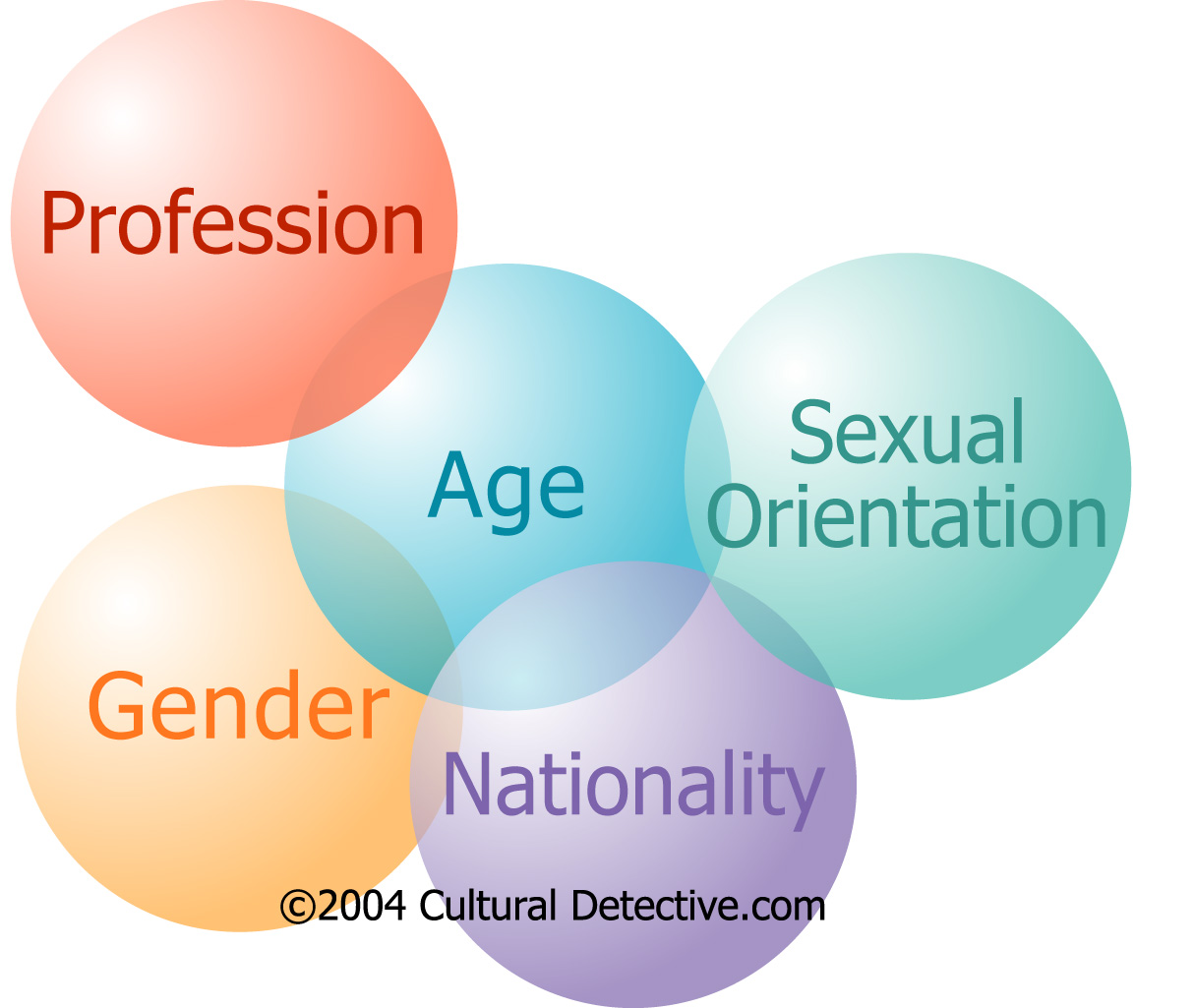
Second, the slide may remind you of our graphic illustrating the layering of our Values Lenses, showing how complex we are as individuals. This is an approach we teach over and over again in our webinars and facilitator workshops using the following graphic:

LayeredLensesFinalCarlos explained that most intercultural instruments look primarily at nationality, and he supposes that this is because it’s the easiest: “low-hanging fruit.” He explained that while a multi-layered model is important, it’s also more difficult, and that is perhaps why no one has created one. I realized that we have one such model and process here, in our CD series, and I’ve failed to communicate that to Carlos!

The second point he made was in response to a question: “Is it easier if you have a clear identity for yourself before going overseas?” While most people I know would advocate such a linear development (self before other, or other before self), Carlos didn’t hesitate for a moment before stating, emphatically, “No!” He went on to explain that just understanding others is not enough, however, and that:

“We need a dialectic between understanding others and understanding self. I’m 79 and I’m still developing and understanding my identity.”

What an elegant, concise summary of the Cultural Detective Worksheet and the yin-yang nature of relationships! Many clients use our CD tools to understand others. Many use them to understand themselves. But every client ends up developing a better understanding of both self and others in an organic, dialectic process.

Carlos addressed a question about how can we help people develop their multicultural identities in positive ways. He returned to the topic of instruments, saying that he’s not against using them as long as they open us up to discussion and discovery, and help us to confront and expand our limitations, rather than boxing us in. That is exactly what CD is all about: dialogue, discovery, mutual learning and adaptation, then synergy and innovation.

Carlos talked about the need to discuss concrete things rather than generalities (a good example is the practical, real-life focus of Cultural Detective‘s critical incidents), and the need to hear from the voice of the people themselves (our Values Lenses use native language terms rather than global, externally imposed dimensions).

Some other highlights from Carlos’ talk include:
  1. The challenge of multicultural (or in CD parlance, Blended Culture) identity is that you don’t “slot into a silo”; you don’t seem to fit, and that causes fear in some people. You can start to feel that you give the “wrong” answer on every form, and that you an oddity in any system.
  2. Self-identity negotiation takes a long time. It may sound easy, to pick and choose the “best of” your multiple heritages, but even if you try to push “pieces” aside, they can creep back at the most inopportune times. Your multicultural identity is and will remain part of you. It’s not about reconciling identity; it’s about enjoying being multicultural.
  3. TCKs (third culture/blended culture kids) need two kinds of understanding about the journey they face. They need to feel comfortable with their multiple strands, and to understand that they don’t have to pick and choose among the various parts of their identity. Talking generalizations isn’t enough—specific examples help, e.g., how difficult it can be when you don’t fit a category on an application form.
  4. The only way to truly understand multicultural identity is to listen to people with that identity. They need to share their stories and we need to listen.
  5. There are three distinct yet intersecting concepts that many people confuse:
    • Heritage: Something we all have, the layout of our family tree.
    • Identity: This comes from within, though, of course, there are always others’ perceptions of our identity that help shape us.
    • Culture: You can self-identify with a culture, yet not participate in every aspect of the culture. For example, you can self-identify as Irish, but not speak Gaelic. Therefore, you are part of the culture, but not part of the Gaelic language portion of it.
  6. Carlos recounted his personal story. He was born of a mixed marriage (Catholic and Jew, Mexican and US America). The more his parents pushed him to learn their two differing cultures, to “choose sides,” so to speak, the more they actually pushed him to develop an integrated multicultural identity.
  7. Research on multicultural identity is nearly non-existent. It’s an open topic for young people. The information currently exists in separate disciplines: racial identity, disability, etc. We need people to write their stories, hundreds of them, and study them. Carlos has studied multiculturalism for 40 years, yet he learned more by writing his autobiography (Rose Hill: An Intermarriage Before Its Time, Berkeley, CA: Heyday, 2012).
  8. Every time we enter a new cultural milieu, it’s a growth opportunity in which we can deepen and expand our understanding of who we are in a new context.
  9. Regarding national identity and social fragmentation worldwide, Carlos said that the solution to fragmentation is that a common identity/culture is needed along with space for people to have alternative sub-groups/diversity.
  10. For those looking for good resources on this topic, he highly recommends Bill Cross’ Shades of Black and Stephen Murphy Shigamatsu’s work on Asian-American identity, When Half is Whole.

As you can tell by my enthusiastic review, the webinar was a delight. Young SIETAR has loaded the recording if you’d care to listen to the entire one hour discussion. Carlos tells me he’s also happy to have you write him directly.

What does multicultural identity mean to you? What are its challenges? And its benefits? What strategies have you used to help yourself or others develop constructive Blended Culture identities? Do Carlos’ ideas mesh with your experience?

Names Across Cultures (First in a Series of Video Interviews with Authors!)

Name ChangesThere are many reasons people change their names: some people have a stage name, pen name, nickname, religious name, or an earned title or name. All too frequently, however, a name is involuntarily changed when someone immigrates, or when a teacher or teammates have trouble pronouncing the person’s birth name.

Many of us work with individuals who have been “renamed” by other colleagues, or who have changed their names to make them more palatable and pronounceable in a new location. Other times people adopt a different name due to a change in circumstance, profession, or age. For example, as a kid growing up in a small town, my father was called “Charlie:’ however, as a middle-aged adult living in a different town, he became known as “Chuck.”

Many people’s names have special meaning or significance. An interesting way to learn about a new acquaintance can be to ask the meaning and origin of the person’s name. And, if we wish to build trust with our friends and colleagues, in addition to understanding the meaning of their names, we can learn to pronounce their names correctly. You may recall that in January 2012 we shared a link for a handy-dandy little software that allows YOU to record the pronunciation of your name, and add it to your email signature, website, LinkedIn account, etc. What a great way for those unfamiliar with your name to hear it prior to meeting you!

Perhaps you, like me, are known by several different names bestowed on us by friends and colleagues. Dianne is the name given to me by my parents at birth, while my name in Japan is Dai-an (大安 or “great peace”, also a very auspicious day of the month). My Spanish-speaking friends and colleagues call me Diana María, and close friends and family call me Di. In my case, I’d rather be known as “Diana” or “Dai-an” than have my birth name “Dianne” mispronounced.

In many cultures, such as Mexico where I live, it is a sign of cariño or affection to bestow a nickname on others (click here for a list of some unusual terms of endearment in various languages). However, many people worldwide love their birth names, believe they are imbued with power, and would honestly prefer we not change their names for them.

Yet some people do want to change their name for various reasons, and have done so. Here’s a special little drag-and-drop game for you, to see if you can match some famous people’s birth names with the names they are more commonly known by now.

I recently spoke with Dr. Emmanuel Ngomsi, a diversity consultant originally from Cameroon, about the topic of naming. Emmanuel has a wealth of experience, is very passionate, and a consummate storyteller, as you’ll see in the interview below.

Do you have a story related to naming that you’d be kind enough to share with us? Have you changed your name, or has it been changed for you? How do you feel about that? Do you have any advice for others about names and naming?

See Part 2 of this interview.

We Have to Teach in Context!

Apple-butterfly

What we learn has to “fit” with what we know.
It has to be appropriate for where we live and work.
Part of learning is to apply the new to the old, integrating the two.

A client called us, saying they had hired a young woman with an MS in Intercultural Communication to design courseware for them. The objective of the courseware is to improve participants’ job performance, in this case, to make them more effective and efficient at servicing international customers.

“We had a lot of hope for intercultural communication training. But we’ve been doing it for nearly two years now, and we are very disappointed with the results. We have seen no bottom-line impact on performance.”

In reviewing the courseware, I found that it in many ways it was very savvy, but appeared to have been taken nearly verbatim from the woman’s graduate studies. The exercises and activities were designed for master’s students in intercultural communication, and had not been adapted for customer service representatives!

We heard from another client recently that had invested three years developing a curriculum to improve the intercultural competence of their global staff. A diverse group of their international employees attended professional development classes in intercultural communication, and an elite group at head office developed a standardized curriculum to be used worldwide. One of the main objectives of this effort is to be able to better resolve conflicts and misunderstandings more effectively.

So what’s the problem? Everyone loves the new curriculum. However, they leave the program feeling no better equipped to resolve conflicts. They love the tools they’ve learned, they enjoy the trainers, but they don’t know how to use the new tools and skills in a real situation!

THE PROBLEM IN BOTH SCENARIOS
What do these two scenarios have in common? In both cases, the training designer was replicating a graduate-level education course—designed for professionals—and repurpose it, as-is, for skill building. And that just doesn’t work! I’ve seen it far too often in recent years, and it’s a distinction we really need to make. Doctors graduate to practice medicine and to help their patients learn healthy lifestyles; they do not generally teach patients how to be doctors.

Professionals need skills they can use on the job, and that includes cross-cultural skills. But those skills must be taught in context, via application and practice in simulated and, eventually, real situations.

SOLUTION ONE
In the first case, Cultural Detective was added into the client’s existing customer service training. Leveraging pre-existing company-specific case studies and audio-visual scenarios, we used the Cultural Detective Worksheet and Values Lenses to supplement the debriefing. In this way, the need for intercultural skills became more evident and was linked to job success for the customer support engineers. In addition, all practice of cross-cultural skills was integrated with the practice of vital job skills.

We retained many of the exercises and activities included in the original, separate cross-cultural curriculum. However, we wove them into the customer service training to supplement, amplify, and deepen learning using the Cultural Detective Method. Once cross-cultural skills were grounded in the business at hand—the purposes of the employees’ work (customer service)—they made all the difference in the world.

This client reported to us a 30% increase in customer satisfaction that they directly attribute to Cultural Detective.

SOLUTION TWO
The second case is still in process. I very much admire the quality of the curriculum and the incredible coordination it has taken to get so many trainers in such diverse locations “up to speed” with the material. Yet, they are starting to realize that although the training has been well-received, staff is not able to use what they have learned once they are back on the job. Yet with so much investment, they don’t want to completely redesign. And they don’t want to be dependent on outside material.

I advised them to weave into their curriculum a simulated conflict scenario, one that could be worked on and revisited throughout the training. In this way they do not need to completely redo their superb design, and the training they have already provided will still be useful. The difference? The revised curriculum is grounded in their reality and will allow staff to practice cross-cultural skills in simulated situations. That way, when they return to work, they will know when and how to apply the cross-cultural skills and tools they have learned.

SAMPLE DESIGN
Let’s look at a typical training curriculum, and then look at how easy it is to weave Cultural Detective into the existing design. Let’s say on Day One they teach what is culture (Iceberg, observable behavior linked to underlying values) and D.I.E. (learn to Describe before we Interpret and then only with culturally appropriate information, to Evaluate). On Day Two, they teach intention/perception and cross-cultural adjustment (culture shock).

Instead, they might start Day One by introducing a case study involving an everyday challenge. Having introduced the context, trainers facilitate learning as planned in the original curriculum (Iceberg and D.I.E.—Description, Interpretation, Evaluation). After doing so, however, they return to the case study, the professional context, and explore: how do values apply to this case study? What are the Evaluations that I am making, based on what Descriptions? From there, it’s a very easy introduction to the Cultural Detective Method, which this client has already licensed and, therefore, is welcome to use.

On Day Two, intention/perception can be taught as part of the debrief of the Cultural Detective Worksheet for the case study. And, the same case study can be used to ground teaching around culturally-appropriate service or cultural adaptation. From there, as they facilitate the remainder of the designed curriculum, they can provide staff the opportunity to speak with the individuals in the case study, in a simulated environment, and to use CD Values Lenses and the CD Worksheet to help them better understand their own values and worldviews. Finally, staff can use the CD Worksheet Method to facilitate a resolution to the case study—harnessing the advantages of diversity rather than navigating around or ignoring them.

If you’ve licensed the CD Method, you know how versatile it is. But what you may not realize is that Cultural Detective doesn’t need to replace other methods. Often, if you put Cultural Detective at the core of what you are already doing, you’ll find the rest supplements it quite naturally.

Always remember, adults tend to learn best in context; they want to know why something is important to know or do. If adults learn to use and apply intercultural tools in situations that replicate real life, they’ll be much more likely to employ them when the need arises.

I Have a Dream, #DreamDay

Oh how those words, spoken 50 years ago today — August 28, 1963 — have inspired us! The wisdom and passion with which they were spoken!

I Have a DreamSo many have shared their memories on this anniversary of Dr. Martin Luther King Jr.’s famous address. There have been incredibly motivational talks, such as this short one by the Dalai Lama.

Through all of it, however, most of us remain troubled. Are we any closer to that dream? Have each of us done our best, in our lives and in our own ways, to help make that dream a reality?

One thing I know, both from my heart and professional training, is that the Dalai Lama’s message about focusing on the oneness of humanity is based upon a deep recognition of and respect for diversity. Those who know the oneness also respect individual and cultural differences.

I say this because it’s too easy to fall into the superficial “feel good”-ness of “it’s a small world.” Common goals, shared dreams, are necessary to tie us together. And our distinct gifts are necessary to implement those dreams. It’s a converge-diverge dynamic, a yin-yang, in which both commonality and diversity are needed.

Today, let us renew our quest. Inclusion, the oneness of humanity, is not the polar opposite of diversity, as too many believe. A oneness of humanity must be accompanied by a respect for diversity; the two go together hand in glove.

Thank you all, today and always, for being part of our community, for helping us all achieve the dream that justice will roll down like water upon us! That we all will be free at last!

If you haven’t yet rewatched the famous speech, here it is. Sit down, enjoy, and refocus.

Burka-Clad Super Hero Fights for Girls’ Rights!


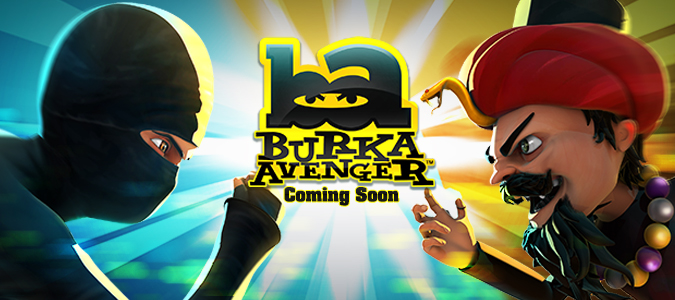
ba-cover
This week saw the television launch of an exciting new female superhero, direct from Islamabad, Pakistan: The Burka Avenger!

The star of the animated series of thirteen, 22-minute episodes is a teacher who uses books and pens to fight the evil people who shut down schools and prevent girls from getting an education. The humorous show also teaches kids to protect the environment, and, good news for the Cultural Detective community, to respect diversity and include others.

Each episode features an original song and guest appearances by some of the biggest musical acts in South Asia, including Ali Zafar, Haroon, Ali Azmat, Adil Omar, and Josh. Goals include entertainment and positive messages to youth. The series’ trailer (in English) is below.


The Burka Avenger is the brainchild of Aaron Haroon Rashid, a Pakistan pop star who wanted to create a positive role model to counter the Taliban’s ongoing opposition to girls’ education. In explaining the choice of the burka, which the teacher, Jiya, only wears in superhero mode, Rashid explained, “It’s not a sign of oppression. She is using the burka to hide her identity like other superheroes. Since she is a woman, we could have dressed her up like Catwoman or Wonder Woman, but that probably wouldn’t have worked in Pakistan.”

Of course this may well remind us of the indomitable Malala Yousafzai, whom the Taliban   famously attempted to assassinate last October. On her 16th birthday this past July 12, the amazingly poised and well-spoken Malala delivered the first-ever education policy recommendations written for youth, by youth, to the United Nations (video below). July 12th has now been named Malala Day in her honor.


It is not just Pakistan where girls’ rights to education are in danger. Fortunately, the people at Mighty Girl Books have assembled a terrific list of books for children and teens that explore the challenge of girls’ access to education, worldwide and throughout history.

You may also remember the comic book series “The 99,” in which superheroes inspired by Islam (they are named after the 99 attributes of Allah) fight crime, smash stereotypes and battle extremism. Series creator Naif Al-Mutawa gave a talk at TED Global 2010. A video of his talk is below, and a free online issue is also available.