Strong, Strategic Global Leadership

leadershipCompanies today need to be good at whatever their main business is, but they also need to be quickly adaptable to change. And, these days, they need to adhere to a strict set of ethical standards that are demanded by an increasingly informed and diverse customer base. Such a tough bundle of abilities requires strong, strategic leadership.

I recently came across an interesting infographic from New England College’s School of Graduate and Professional Studies, and thought you would like to see it. The graphic summarizes the findings of six different studies—from McKinsey, Deloitte, LRN, the Center for Creative Leadership, and Harvard—saying that companies are seeking:
  • Simultaneous growth, cost reduction and increased innovation.
  • Better alignment of organizational values and operational behavior.
  • To create environments in which employees are comfortable voicing their opinions and ideas—inclusive spaces.

The graphic illustrates the four leadership skills needed to achieve these too-often elusive goals. To view the infographic in larger format click here, then click on the image that opens.

1391539920-you-good-leader-infographic

Leadership Skill #1: Ethical Leadership

Interestingly, the top skill identified is ethical leadership—studies correlate business success to ethical initiatives. Aligning organizational values with operational behavior, and ensuring ethical practice across the organization, is all the more challenging given the international nature of business today. Add in the diversity of the worldviews and “cultural sense” of the mobile workforces of this millennium, and things become even more complex.

Let’s face it, employees in different geographies, from different cultural backgrounds, view the concept of “ethical” differently. They operationalize corporate values differently. Cultural Detective Global Business Ethics (CD GBE) is a perfect tool to aid organizations in achieving the alignment that’s needed. The package is designed to help leadership think through the cross-cultural permutations—the ways members of different cultures may operationalize organizational values and ethics—and develop strategy to build alignment.

CD GBE can also be used to help train staff worldwide, so they know how your organizational values translate into everyday operations. It can help open the dialogue among all levels of the organization to ensure your values are understood and implemented consistently—and with local appropriateness.

Leadership Skill #2: Use Your Power Wisely

Power is a leadership trait no matter where in the world you work, whether that power is real or perceived. In certain locations power may be based on title or position in the hierarchy. In others it is based on expertise—but does this mean a person is perceived powerful due to credentials and education, or to skills and experience? The Values Lenses and critical incidents in every Cultural Detective package can help you and your organization learn to project and perceive power wisely, no matter where or with whom you work.

Another key aspect of power resides in the relationships we build, the influence we have on others. Whom we trust, whom we allow to sway us, is perhaps one of the most culturally determined aspects of our lives.

Do we trust the person who speaks plainly (who could be perceived by some as rude or uneducated), or the person who speaks diplomatically (and could be perceived as “brown-nosing” or unprincipled)? Are we swayed by the person who tries to convince us via logic and argument, by someone who shows us by example, or by the person who enthusiastically invites us to use a new service? Again, the Cultural Detective series will help leaders and a global workforce better understand and navigate such differences.

Leadership Skill #3: Manage Crises

The Chinese characters for “crisis” remind us it can be a danger or an opportunity. Leaders can convert crisis into opportunity by knowing themselves and being solidly grounded in their values. A well-rooted tree will sway in the wind and not become uprooted. Cultural Detective Self Discovery is the perfect tool to enable leaders to clarify their personal core values, and to reconcile them with organizational values, the values of the various cultures in which they do business, and the values of other members of their team. Leaders will be better able to manage crises; to anticipate their reactions so they can wisely choose, in the moment, how to respond; and to be better able to explain their actions to others who may not share or enact their values in the same way. Try it out with a pilot group of your leaders, and you will be amazed by the results.

Leadership Skill #4: Cultivate Change

Change is cultivated by providing opportunities for employees to practice what they’ve learned. Cultural Detective Online (CD Online) enables you to provide just that opportunity—teach a skill, then encourage your employees actively practice it for several weeks, using the CD Online system for reflection and learning. Several weeks of on-the-job practice leads to employee retention, and provides a practical method to resolve employee conflicts and encourage understanding.

Change is also effected by leaders realizing that workers’ motivations may be different than theirs. Research in the graphic supports this idea. And, that is the core Cultural Detective process, as you’ve by now surmised—perspective taking. There are two specific packages in the series, as well, to aid in this regard—Cultural Detective Global Diversity and Inclusion, and Cultural Detective Global Teamwork. Wonderfully, both are included in the very reasonably priced (less than US$100/year for access to 60 packages) CD Online.

What are you waiting for? Are you a strong, strategic global leader? Do you want to help others to be? Learn how to use Cultural Detective Online by joining one of our free webinars or get your subscription now!


Are You Nice???

Woman-Holding-Gift-Wrapped-in-Yellow460x300

This is a guest blog post by Carrie Cameron, co-author of Cultural Detective Russia.

Take the following quiz:

  1. Someone surprises you with a beautifully wrapped gift. You’re so appreciative! You…
    1. Tear it open enthusiastically and express great admiration for the object, whatever it is, and thank the giver.
    2. Accept the gift, warmly thank the giver for his or her thoughtfulness, and put the unwrapped gift, whatever it is, on the table behind you.
  2. You’re seated on the airplane next to someone of the same gender who looks nice. You…
    1. Strike up a friendly conversation.
    2. Quietly mind your own business.
  3. You’re at a reception where few people know one another. You…
    1. Approach someone, extend your hand, and introduce yourself.
    2. Find the host who will then make an introduction for you.
  4. A member of your office staff comes in one day looking upset, maybe they’ve even been crying. You…
    1. Approach them in the break room and say, “Are you okay?? Did something happen to you?”
    2. Pretend you don’t notice so they won’t feel embarrassed.

If you tended towards the “A” answers above, your cultural style might be one of “expressive” politeness. If you had more “B” answers, your cultural style may be one of “reserved” politeness. This dimension of culture was introduced by social scientists Penelope Brown and Stephen Levinson, who termed these differences “positive” and “negative” politeness. (To avoid any confusion about the original terms, we use here the terms “expressive” and “reserved,” respectively.)

“Politeness strategies” are the customs, often unnoticed or unconscious, by which we express favorable attitudes toward others. But it is important to remember that not every culture uses the same strategies to do this.

Expressive-politeness cultures generally show good intentions by reaching out actively to others. They have a tendency to reveal emotions before knowing whether the approach is acceptable or not to the other person. Reserved-politeness cultures tend to show good intentions by never imposing themselves on another without first knowing the other person’s attitude.

Both of these cultural styles are polite, but they are different ways of demonstrating it. The same behavior that may be considered polite in one culture could be considered rude in another culture. Remember those examples in the quiz above?

Some cultures traditionally thought of as reserved are British, German, and Japanese, while characteristics of expressive cultures are found in US American culture (especially Southern and African American cultures), Australian, Mexican, and Italian. Which style resonates with you most?

It’s important to remember that not all expressive cultures are alike, and not all reserved cultures are alike. While each culture is unique in how it shows politeness, knowing something about this dynamic can help people be more accepting of unfamiliar styles. It may also help individuals become more aware of how their own behaviors and actions may appear to others. This additional cultural self-awareness allows the opportunity to adjust one’s behavior to actually be polite—from the viewpoint of someone culturally different from oneself.

Check out some of the critical incidents in Cultural Detective Online to see the cultural variations of politeness in action, and learn to navigate them more effectively. Use Cultural Detective Self Discovery to clarify your own values and styles, and develop a better ability to explain yourself to those who are different.

Brown, Penelope and Stephen C. Levinson. 1987. Politeness: Some universals in language usage. Cambridge: Cambridge University Press. ISBN 978-0-521-31355-1

Transgender Hijras Promote Traffic Safety

Long live the hijras! I love this public service announcement, on so many levels! Just had to share.

A Rainbow with a Streak of Gray: Demographic Trends in the United States

dreamstimecomp_39321275

Photo ©Dreamstime.com

“Demographic transformations are dramas in slow motion. America is in the midst of two right now. Our population is becoming majority non-white at the same time a record share is going gray. Each of these shifts would by itself be the defining demographic story of its era. The fact that both are unfolding simultaneously has generated big generation gaps that will put stress on our politics, families, pocketbooks, entitlement programs and social cohesion.”
—Paul Taylor, Pew Research Center

As a US American interested in diversity issues, I was intrigued by the recently released Pew Center report based on the book, The Next America, examining demographic changes taking place in the United States. Pew reports are well-researched, present interesting and useful data, and never fail to give me a different perspective on the world in which we live.

The United States is changing demographically faster than many of us realize. I remember a few years ago, when working for an educational institution that offered diversity courses, a city official from California called to say they needed help because the “minority” population was soon to be over 50%! Today, I rarely hear the term “minority,” and this study definitely shows why.

“In 1960, the population of the United States was 85% white; by 2060, it will be only 43% white. We were once a black and white country. Now, we’re a rainbow.”

Immigration is the main force behind this rainbow, according to the report. Large numbers of immigrants during the late 19th and early 20th century were from Europe; today only 12% are European. Since 1965, the USA has seen more than 40 million immigrants; about half are Hispanic and nearly three-in-ten are Asian.

As this shift in demographics has taken place, so have shifts in attitudes. According to Mark Lopez, Director of Hispanic Research at Pew, ““Intermarriage is playing a big role in changing some of our views of ethnicity.” Currently, 15% of marriages are between people who are not of the same race or ethnicity—that is, one out of six marriages. Talk about a “melting pot!”

As these marriages produce children, a new set of issues arises.  One example: categories of race and ethnicity on government forms are less likely to fit or be meaningful. What do you call yourself when you are confronted with choosing just one part of your interracial or interethnic (Blended Culture) identity?

This situation arose recently when my son (White) and his wife (African American/White) had to complete a form to enroll their three-year old son in pre-school. Although one-quarter African American, my grandson looks very White, like his dad. There was lengthy discussion about what race to choose: African American or White. There were no other options, available for them—they could only choose one “race”—and they were uncomfortable with either choice as it didn’t reflect his heritage accurately.

Not only is the USA becoming more ethnically and racially diverse, but our population is aging. According to the study’s author, “10,000 Baby Boomers a day will turn 65—every single day between now and the year 2030.” That’s a lot of old people!

Contrast their lives with that of the first generation of “digital natives”—people for whom the online world has always existed. Their experience is shaped in part by their technological comfort and ease, while many of the older generation struggle to simply use their cell phones.

However, more than a “digital divide” exists among the generations in the USA. Growing up in different times and having radically different experiences means that the generations don’t always see eye-to-eye on lifestyle, issues, or politics. Yet, these days, a record number of US Americans—over 50 million—live in multi-generational family households, according to the report.

While this may seem perfectly normal to some of our blog readers, it is a new reality in the US. In the past several years, a stigma became attached to returning home after moving out for school or a job. To many, an adult “boomerang” child returning home to live with their parents was “clearly” a failure or had problems of some sort. No longer! Due to the poor economy, it is now seen as quite practical to live together when one can’t find a job or has limited (or no) means. And, as much as they might like each other, differences in opinion can cause stress in a household.

“It is a challenge for our society how we navigate this change at a time when the young and old don’t look alike, don’t think alike, and don’t vote alike.”
—Paul Taylor, author  The Next America

Cultural Detective has tools to facilitate change by helping users to better understand some of the different cultures making up the USA today. First, however, as intercultural professionals worldwide know, before one can understand others, one needs to understand oneself.

Cultural Detective Self Discovery helps people discover their values, preferences, and the cultural influences driving their thinking and their actions, and explore their cultural identities. It can be used as a stand-alone exercise or as a powerful component in sessions focused on cultural awareness, diversity and self-development, or as a process to facilitate teambuilding and organizational synergies.

Cultural Detective Generational Harmony provides a glimpse into four distinct generations in the USA, each with differing experience, expectations, and lifestyle requirements. By understanding these distinctions, one can be better prepared to recognize and manage issues that may arise due to generational differences in the workplace, while at the same time meeting organizational demands and objectives.

Cultural Detective African American explores the complexities of African American culture in the USA today. It investigates the values and communication styles of this community in an effort to bridge cultural gaps and support more inclusive groups, communities, and workplaces.

Cultural Detective Latino/Hispanic introduces this heterogeneous, multiracial group residing in the United States, people with cultural, historical, and ethnic roots in countries of Latin America. Comprising the fastest-growing ethnic minority group in the United States, Latino/Hispanics now number over 50 million, and account for one-out-of-four public school students in the US.

Cultural Detective USA offers insight into some of the key values that are representative of the dominant societal norm, in large measure Protestant, Anglo-Saxon values. While there is a wealth of ethnic, racial and cultural diversity within the USA, one needs to be aware of the power of the dominant culture in influencing behavior, as well as the specific values of other cultural groups, when learning about the USA.

Cultural Detective Blended Culture investigates those who hold multiple frames of cultural reference within themselves. This may include such individuals as internationally assigned employees and their families, immigrants and refugees; those who have grown up as members of ethnic minority communities within a dominant culture; and people raised by parents of different cultural backgrounds.

Cultural Detective Bridging Cultures helps take cultural awareness and savvy to the next level by looking at how to develop effective bridging strategies for working across cultures. Recognizing that cultural understanding is essential but not enough, this packages focuses exclusively on connecting cultural similarities and bridging cultural differences effectively to reap the benefits of diversity.

Any of these packages sound interesting? Cultural Detective Self-Discovery and Cultural Detective Bridging Cultures are available for purchase through our website. The other packages mentioned are available for handy reference, 24/7, as part of Cultural Detective Online. What are you waiting for? Use Cultural Detective to investigate the cultures shaping the USA and our world, and Get A Clue!

On Keeping Traditions Traditional

How do we preserve traditions, really? By sealing them in amber or putting them in a museum? Or by exercising them, giving them air to breathe and a song to sing?

Dianne Hofner Saphiere's avatar¡VidaMaz!

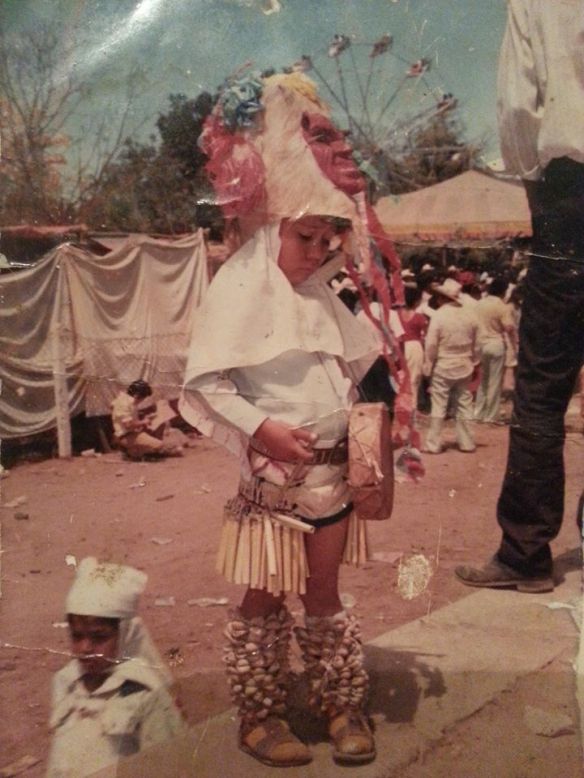
10009854_10151968950151246_1414383763_n Photo of Omar Castro around taken 1992 in Mochicahui, Sinaloa, Mexico

¡Feliz Día del Niño! Happy Children’s Day! April 30, 2014, Children’s Day here in Mexico.

The photo above is of a new friend of ours whom I greatly admire, Omar Castro. In this photo he looks to be about five years old. It was one of the first times he danced with his father in El KONTI, and the photo is taken in the central plaza of Mochicahui, in front of the church.

If you follow this blog, you know we had the pleasure of fulfilling my dream and attending KONTI this year. A week or so after that, I spent some time with a nationally renowned photographer and a well-known international journalist. As Greg and I were talking to them about our recent trip to Mochicahui for these Yoreme Mayo festivities, they were both bemoaning that EL KONTI had become…

View original post 641 more words

New Ways of Working Together: Technology, Innovation and Intercultural Collaboration for Africa

ngoFrThis is a guest blog post by Jolanda Tromp, co-author of Cultural Detective Global Teamwork.

In February 2014, n’GO magazine published a review of the Cultural Detective Method. For readers of n’GO not familiar with Cultural Detective, the article provided a way for them to learn about this unique intercultural-competence tool, grounded in developmental theory, yet simple to use and very practical.

n’GO magazine is free, published online in French and Dutch, and offers insights, reflections, examples, and tools around behavioral and relational aspects of intercultural contact. Its goal is to search for the truth behind prejudices and blockages, and provide positive alternatives by interviewing experts and academics. n’GO is produced by the Belgium NGO Echos Communications, which runs a variety of projects aimed at helping to redefine the Euro-African dialogue by showing that Africa participating in the world community is value-added. They work to demonstrate their belief that the Internet is a communication tool that can help strengthen the relationships between the actors in the North and South. They believe the Internet may change the course of action in the field of international cooperation.

This vision and effort is clearly part of many African progressives’ point-of-view, as witnessed by the young social innovator and blogger, Mac-Jordan Degadjan, blogging about African and Ghanaian technology and innovation:

“The world’s impression of Africa is hopelessly outdated. Africa’s technology and innovation boom is rapidly expanding. The penetration of the internet and mobile technology is radical and unprecedented. Across African cities, technology innovation hubs are mushrooming and playing a central role in the fledgling technological and entrepreneurial innovation scenes, all over the African continent.”

For the computer-savvy, Generation-Y Africans, Cultural Detective Online (CDO) can be a great resource, because it is accessible from anywhere as long as you can get onto the Internet. CDO combines 60 of the series’ culture-specific and topic-specific packages into one integrated and easy-to-use system, including access to over 400 critical incidents involving people from 90 cultures and spanning multiple industries and professional functions. Subscribers receive a personal virtual intercultural coach that is available anytime, anywhere, online.

Currently, the Cultural Detective series includes culture-specific packages on Cameroon (by Emmanuel Ngomsi), West Africa (by Emmanuel Ngomsi and Seidu Sofo), and South Africa (by Kathi Lyn Tarantal and Denise Hill).

Cultural Detective: West Africa looks at core values of the 14 countries and 250 million people of the region, ethnically heterogeneous and mixed with two other non-indigenous cultures, the French and the British. The critical incidents describe individuals from several different backgrounds including a Nigerian, a Senegalese, and a Ghanaian.

Cultural Detective: South Africa provides insight into this country that is both first world and third world. There are eleven official languages and a multi-coloured landscape of people. The values of these different groups are contrasting, and CD: South Africa explores both black and white cultural values. It contains critical incidents with individuals from several different cultural backgrounds, including an Afrikaner, a Northern Sotho, a Zulu South African, an Ndebele South African, and a Tsonga South African.

Clearly, the work of describing African cultural values has only just begun with the writing of these brave African pioneers. President Paul Kagame of Rwanda at the World Economic Forum, in Davos said: “The major problem I see is that Africa’s story is written from somewhere else and not by Africans themselves. That is why the rest of the world looks at Africa and Africans and wants to define us. They want to shape the perception about Africa. The best thing we can do for ourselves is own our problems, own our solutions and write our own story.”

The n’GO editor and journalist who authored the article about Cultural Detective, Sylvie Walraevens, is based in Waterloo, about 20 km south of Brussels, Belgium. She put out a call on the Internet for people to interview about the Cultural Detective Method in a LinkedIn forum. I replied, explaining that I am not an expert on African culture, but work as an online sparring partner and coach for Global Teamworkers and managers; I am in the Dutch section of the ISO Norm Committee for assessing the usefulness of an International Norm for International Business Collaborations; and a certified Cultural Detective facilitator.

We discussed the options via email and arranged to meet in Amsterdam for the interview. The interview went very smoothly in my favorite flex-workplace—the lobby of a 5-star hotel with WiFi, directly opposite Amsterdam central station. After the interview, we talked about the African economy and the fact that it is actually growing fast despite the global economic downturn.

We agreed to end the article with a call for African authors to chart their culture’s values and write about them in order to facilitate successful intercultural collaborations. Emmanuel Ngomsi, Sylvie Walreavens, myself, and—we are sure—many others, offer our assistance. We are curious to find out which African experts will take on the challenge of writing Cultural Detective packages on all the African cultures that have not been charted yet!

You can register for the n’Go newsletter here: [FR ] – [NL ] and read the article about Cultural Detective (French and Dutch only) here: [FR ] – [NL ]. For additional information about Cultural Detective Online, register for a free webinar and receive a complimentary 3-day trail subscription. For information about authoring a package, contact Cultural Detective.

Lack of Diversity Correlates with Religious Hostility

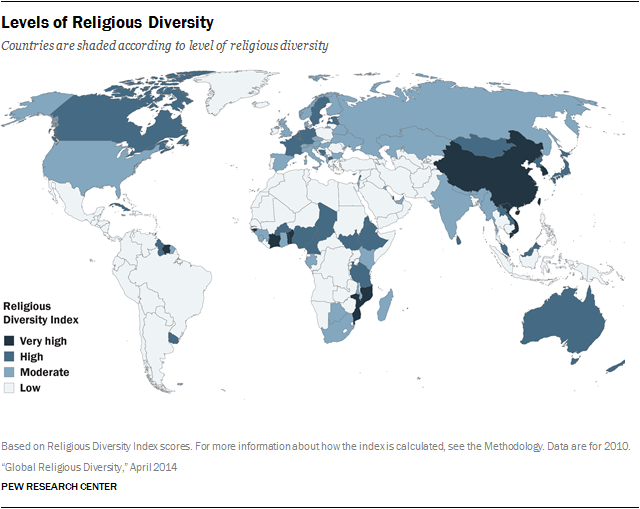
world-religious-diversityQuick! What is the most religiously diverse area of the world? Not the Middle East—it’s primarily Muslim, and not Latin America—it’s primarily Christian.

It is, of course, the Asia Pacific region, home to a great diversity of religious traditions including Islam and Christianity, as well as Buddhism, Hinduism, Confucianism, and loads more. This is just one interesting tidbit from a report on world religions released this week by the Pew Research Center.

More noteworthy than this fact, however, is that some of the world’s least religiously diverse places are home to the highest rates of social violence involving religion. Of the five countries exhibiting the most religious violence:
  • Afghanistan and Somalia both rank in the bottom ten for religious diversity, with a “Religious Diversity Index” or RDI of 0.1.
  • Pakistan ranks as having “low diversity,” with an RDI of 0.8.
  • India (RDI 4.0) and Israel (RDI 4.5) are ranked as “moderately diverse.”

If diversity indeed correlates with lower violence, that is indeed good news for diversity and pluralism, and a desire to discourage violence and promote inclusion are good reasons to put Cultural Detective Islam and Cultural Detective Jewish Culture to good use! And please, help us create packages for other major world religions! Such tools are especially needed given that the Pew Research studies show huge increases in religious hostilities in nearly every world region.

increase in religious hostilities

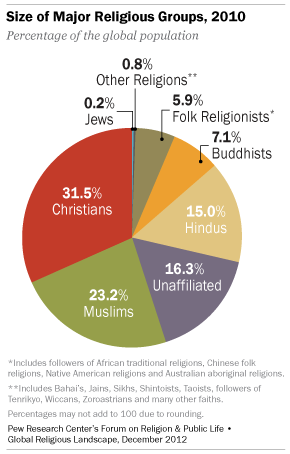
How did this finding, correlating the lack of religious diversity and hostility, come about? In December 2012, Pew Research Center’s Forum on Religion and Public Life published a report entitled, “The Global Religious Landscape,” based on data gathered in 2010. It found, in part, that:

“Worldwide, more than eight-in-ten people identify with a religious group. A comprehensive demographic study of more than 230 countries and territories … estimates that there are 5.8 billion religiously affiliated adults and children around the globe, representing 84% of the 2010 world population of 6.9 billion.”

01_groupsThen, in January 2014 Pew published the results of another study in its article, “Religious Hostilities Reach Six-Year High.” It involved data on 198 countries:

“A third (33%) of the countries and territories in the study had high religious hostilities in 2012, up from 29% in 2011 and 20% as of mid-2007. Religious hostilities increased in every major region of the world except the Americas.”

socialHostilitiesJust this month, April 4, 2014, the Pew-Templeton Global Religious Futures project, which analyzes religious change and its impact on societies around the world, published further analysis that it conducted on the 2010 data. They produced a very interesting index that ranks each country by its level of religious diversity—its RDI, or “Religious Diversity Index.” RDI was calculated based on the percentage of each country’s population that belongs to the eight major religious groups defined by Pew. The closer a country comes to having equal shares of the eight groups, the higher its score on the 10-point index.

To quote from the report,

“In order to have data that were comparable across many countries, the study focused on five widely recognized world religions—Buddhism, Christianity, Hinduism, Islam and Judaism—that collectively account for roughly three-quarters of the world’s population. The remainder of the global population was consolidated into three additional groups: the religiously unaffiliated (those who say they are atheists, agnostics or nothing in particular); adherents of folk or traditional religions (including members of African traditional religions, Chinese folk religions, Native American religions and Australian aboriginal religions); and adherents of other religions (such as the Baha’i faith, Jainism, Shintoism, Sikhism, Taoism, Tenrikyo, Wicca and Zoroastrianism).”

This, of course, means that diversity within these larger religious sub-groups was not examined.

Linking the findings from phase two (social hostility) and phase three (religious diversity) shows the correlation between lack of religious diversity and social hostility.

I would emphasize that the link between lack of religious diversity and increased social violence does not appear to be a finding reported by Pew Research. Rather, it is an observation written by Emma Green in The Atlantic. The top five—and many others—of the most socially hostile countries do indeed have lower RDIs. However, there are countries with low religious diversity that also show low ratings for religious hostility: Namibia, Marshall Islands, Malta, Kiribati, Cambodia, Djibouti, Lesotho, and Grenada among them.

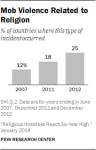
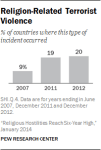
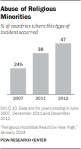
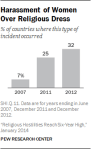
The research is definitely worth reading. The overall increase in religious hostility is driven by certain types of hostility, including abuse of religious minorities, harassment of women over religious dress, violence to enforce religious norms, mob violence related to religion, and religion-related terrorist violence. Click on any photo to enlarge.

Emma Green ends her article with an interesting thought:

“It may not be true everywhere, but these data suggest something remarkable: Religious pluralism can be, and often is, compatible with peaceful societies.”

What do you think? What is your experience? What successful efforts have you seen to bridge religious differences and increase tolerance and respect?

El Konti—An Age-Old Tradition Stronger Than Ever

Gallery

This gallery contains 13 photos.

Originally posted on ¡VidaMaz!:
Some of the Judíos en route to Mochicahui, with yours truly in the center. I am passionate about culture. My friends, family and professional colleagues know that. I hate to see a language or a cultural…

Ten Years of Building Respect, Understanding, Justice and Collaboration!

P1110373Thank you for joining us on the journey to build respect, justice and collaboration across cultures!

A group of our authors recently gathered in Mazatlán, Mexico to celebrate the tenth anniversary of this collaborative project, Cultural Detective. We held three days of work meetings and a facilitator certification workshop; we hosted a wonderful party that included the indigenous Yoreme Deer Dance; and we played—on the beach, in the water, at restaurants, with music, and all around town!

Our community members will have more celebrations around the world throughout 2014; contact us if you’d like to join one!

Below is a slideshow of just some of the many authors and community members who have contributed to making Cultural Detective such an amazing tool, and to using it to transform the world in which we live, bit by bit.

Are you curious about how Cultural Detective came to be? You might want to read this short history of our project.

We have received quite a few greetings from customers and community members—their videos show the breadth of application of this toolset. Take a look at the anniversary playlist on the Cultural Detective YouTube channel.

Want to become more active, transforming the communities in which you live and work? Join us for a free webinar and three-day pass to Cultural Detective Online, or join the conversation on Twitter, LinkedIn or Facebook.

Happy Tet—New Year of the Horse!

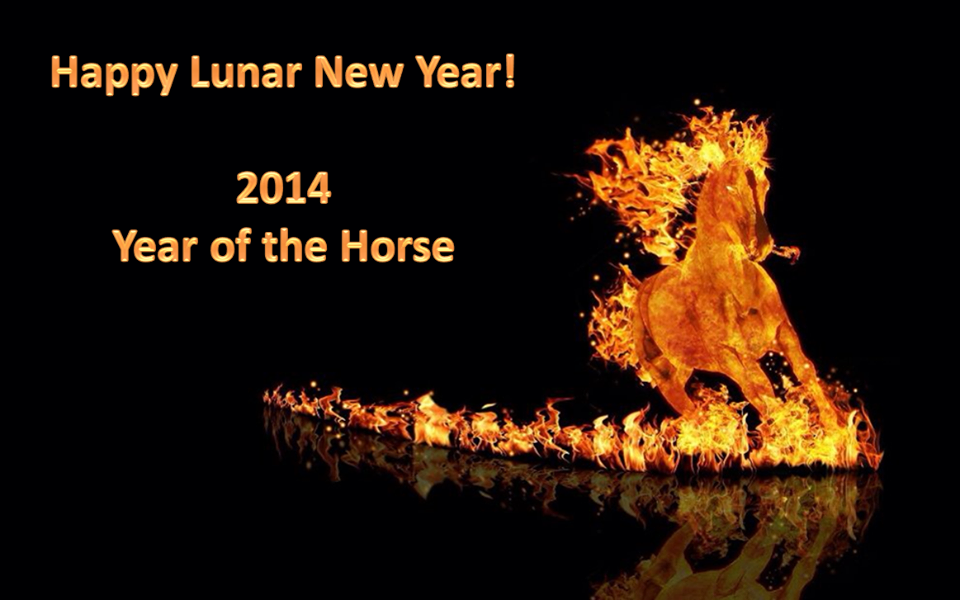
1555587_10152184068913988_503611650_nMay the Lunar New Year of the Horse bring you health, joy, and much success in spreading cross-cultural respect, understanding, collaboration and justice in this world of ours!

2014 is the Year of the Horse. It is also Cultural Detective‘s 10th anniversary year (our CD project was born in the Year of the Monkey). Characteristics of the horse are unremitting efforts to improve oneself, communication, kindness, perseverance, and a love of travel—which is definitely in keeping with what the CD Method and our community are all about! May this new year bring out these and more positive traits in all of us!

On behalf of the Cultural Detective team, here is Phuong Mai Nguyen, co-author of Cultural Detective Vietnam (and her mother) with a greeting for everyone: