Intercultural Work—Stuck in its own past? (#1 in a series)

GSportrait

Dr. George Simons has long been researching the stories that make us who we are. In this series of blog posts he will be leading us in an examination of critical challenges that can lead us toward a fresh vision of culture. We will explore how we come to terms with our inner and shared identities and learn about how we construct the realities that shape our now and our future world.

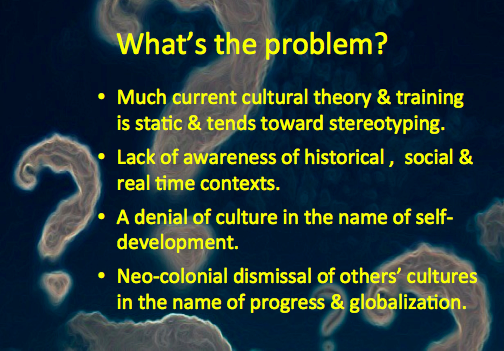
Despite a tide swell in intercultural communication and worldwide immersion in social media, the current field of intercultural communication itself seems static. This blog post articulates five ways in which the field appears to be moving too slowly for the world around it.

1. Essentialism
The word used for the kind of intercultural intervention that leads in the direction of stereotyping is called “essentialism.” One tends to assume that a certain person must inevitably share certain cultural characteristics or behaviors if they come from a particular group, ethnicity or culture. Saying that I am from the USA or that I am German or Nigerian makes a whole mess of things stick to me as stereotypes. Of course, we do have cultural characteristics, but who has them, to what degree as well as when, how and where they’ll be expressed is what we don’t know, and is what we need to learn about each other as we work together. Moreover, we belong to multiple cultural circles that may define us in variable, even contradictory ways. Interculturalists loudly condemn stereotyping but seem less adept at escaping from delivering cultural information.

There may be benefits to identifying with a group despite or in some cases because of the stereotypes, though all too easily an identity is painfully imposed on us. A little story to illustrate this. Nordstrom is a big department store in Los Angeles, in the San Fernando Valley. A young woman in my class at Loyola—let’s call her Yuko—told me how, when working there, a woman making a purchase asked, “Honey, where are you from?” (Yuko had identifiably Asian features in her face). The young woman said, “Oh I’m from right here in the Valley. The woman went on, “But where did your parents come from?” Yuko answered, “Oh, they came from the Valley, too.” The woman persisted, “But where did your grandparents come from?” Yuko answered, “Oh, they weren’t from the Valley, they were from Fresno [another California town].” In fact, Yuko’s Japanese-American family predated the many European immigrants that came at the end of the 19th and first half of the 20th century. Essentialism looks at “difference” as “not belonging.” Yuko suffered this kind of pain repeatedly just because she didn’t look like “everybody else.”

2. Ignoring context
A lack of awareness of the social and particularly historical contexts is another way the intercultural thinking and practice can remain static. A lot of people’s feelings about those different from themselves is not simply a matter of their looking or sounding different, and may be anchored in a story of things that happened in the past. Remember, for example, when Yugoslavia disintegrated into smaller states, how politics called into popular sentiment old memories of “what they did to us” 50 years ago, 500 years ago, 1000 years ago, and so on. These memories live in a culture and affect how we react to individuals in other groups. This is to say nothing of social context, particularly now. Since the financial crisis, we’ve been struggling, in a more conscious way than most of us have done in our lifetimes, with those who have and those who have not. This also provides subtext for our communication with each other.
Questions

©George Simons, blog.culturaldetective.com

3. Cultural denial
A lot of people I work with, particularly many younger people today, have or are encouraged to have an attitude that expresses itself as, “I don’t have a culture,” or “I’m a global person, a global citizen.” This suggests that prioritizing individualism, so strongly promoted in the West, makes it in a way shameful to be connected to our past, to have identifiable roots. This is true not simply of third culture kids (TCK’s), some of whom have been jetsetters while in the womb, but of others, and seems to be part of the educational process. All too many people, and not exclusively the young, have suffered by or are fearful of being labeled, of being stereotyped, as we mentioned above, or they feel a need to disassociate with what feels like the oppression of their origins, their family, religious faith or local context. Having cultural features seems a liability to them, a restriction of freedom. Inability to address this inclination is another point of stasis in intercultural work.

4. Implicit colonialism
An even bigger issue is a kind of lingering sense of better-than-thou-ness, and noblesse-oblige do-goodism that results in a kind of hidden chauvinism, a myopic view of other cultures that too easily infects intercultural efforts and holds them back. Part of this involves interculturalists’ need to come to grips with colonial history and its enduring effects in political and economic terms , not just hand wringing. We are fully aware of having a long history of European colonialism and US colonialism that doesn’t take other people’s cultural and environmental ownership seriously. So we come to enlighten them, to bring them progress, to bring globalization, of course to sell them our products. The need for cultural savvy makes it an important commodity today and this situation begs us to take a larger view. But even more important for intercultural professionals are discovery, exploration and treatment of the psychological residue of colonial thinking in themselves. Failing this, it is hard to imagine our efforts moving forward in the ways we like to think that we intend.

5. Dyadic dimensional thinking
Traditionally, in the boilerplate of the intercultural profession, we studied values in what are called “dimensions.” This was our starting point, something for which we are very grateful to the original researchers, people like Geert Hofstede and Edward Hall. In their observations and studies they raised questions and classified the answers. For example, they identified people as more or less “individualistic” or “collective,” “masculine” or “feminine,” “direct or indirect,” according to how people in different cultures reported their likely behavior given similar situations. Their work made us aware of the fact that there were areas of life in which different people had different ways. Yet, on the other hand, the resulting value labels were a product of Western academic mentality, an attempt to understand other people on our own terms rather than on theirs. This may have been the key to the antechamber of understanding, but leaves us standing in front of a second locked door.

In sum, five road blocks, often in combination with each other, that challenge intercultural thinking and practice. Will social media change our static habits? Perhaps so, because they regularly confront us with evidence from around the world, literally at our fingertips, that may challenge these notions. Yet confirmation bias, our ability to see only what we know or expect to see and make otherness fit into it, is likely to be operative in the online world as well. What think you?

This post originally appeared in the blog of the Center for Intercultural New Media Research and is provided with the assistance of its editor Anastacia Kurylo.

Cultural Detective African-American Now Available!

coverAfAmThe Cultural Detective team is very pleased to announce the release of one of our most requested and highly anticipated packages — Cultural Detective African American! It is now available both in Cultural Detective Online and via site license.

Cultural Detective® African American explores the complexities of the culture and examines the values and communication styles of this community in an effort to bridge cultural gaps and support more inclusive groups, communities, and workplaces. It joins other domestic diversity packages in the series, including Cultural Detective Generational Harmony, Cultural Detective Women and Men, Cultural Detective LGBT, and the soon-to-be-released, Cultural Detective Latino/Hispanic.

Below, a message from package co-author Kelli McLoud Schingen:

ALI 1I facilitated an Advanced Leadership Institute for the Southwestern Black Student Leadership Conference January 17-20th, and thought that this would be the perfect place to pilot the Cultural Detective African American package that I co-authored with Patricia M. Coleman. There were 25 male and female upper-level students from universities all over the U.S., prepared for an intensive three-day workshop with me on leadership skills and cultural self-awareness. I spent the first day building trust and laying the foundation for the weekend. I facilitated activities that took the students on an exploration of their leadership styles, emotional intelligence, personality types and finally, cultural self-awareness.

ALI 2On the last day I Introduced the Cultural Detective, the purpose and intent of it, and the extensive research and in-depth process that Patricia and I went through to develop the tool. Understandably, the students met the tool with a great deal of suspicion. To say they were skeptical would be a gross understatement. I implored the students to stay with me and trust the process. The students started by working on the critical incidents in the package. I then asked the small groups to present on their findings. They were surprised that there was so much to consider and really convinced that the only valid perspective was the perspective and values of the African American “character” in the incident. I spent a great deal of time sharing how we view things through our own cultural lens, and then I unveiled the African American Values Lens. It didn’t take long for the students to be sold on the process and the values as I walked them through the positive and negative interpretations of each value. They seemed to be having fun and were fully engaged. Many of them commented just how grateful they were to FINALLY have words to describe their feelings, experiences, and cultural norms that they’ve inherited. They laughed at themselves and each other as they peeled back the onion of culture, and were grateful for the opportunity to explore cultural difference in this way. When I asked if they felt that the tool was an authentic representation of African American values they said, “Absolutely Ms. Kelli!”  Then I thought, “I guess we’re ready for launch.”

SIETAR Florida will honor Black History Month 2013 with a dialogue entitled, “Am I Black or African American?” via teleconference.  Featuring co-authors of Cultural Detective African American, Kelli McLoud-Schingen, Immediate Past President of SIETAR USA, and Patricia Coleman, President of SIETAR Florida. Please join us on Wednesday February 13, 2013 at 13h Miami time (1pm EST/12 CST/11MST/10PST).
Please RSVP by February 11th.

Access the event via conference line:

Dial-in Number: (559) 726-1000
Participant Access Code: 857895


Some Cultural Detective Training and Coaching Activities

Exploring how we value our own and each other’s cultural values–another step in CD sleuthing.

All too often we trainers are apportioned a less than useful amount of time for impacting the attitudes of our trainees. This affects our use of Cultural Detective as well as many other tools that we may choose or not choose to use under the pressure of diminished schedules.

When using Cultural Detective, I find it ever more important to differentiate what we do with the Values Lenses and the indigenous discourse that lies behind them from a lot of other intercultural training approaches that focus on dimensions and increasingly lead to stereotyping. When we speak about the values in Cultural Detective, it is important to remember that these have been developed through and by the inner language and feelings of the very members of those cultures that the instruments represent.

Nonetheless, when speaking of values, it is becoming increasingly common for us to have individual participants who question them, who do not identify with them, or who even dismiss them as stereotypes. Given that the best way of dealing with resistance in a pedagogical context (as well as many other contexts) may be to flow with it and direct its energies, I have developed a few approaches that I feel may help us in these somewhat challenging situations. I’ve described them as they might be used in a teaching or training context, but they may be adapted to individual and team coaching situations as well.

First, wherever possible, I use Cultural Detective: Self-Discovery, or at least an exercise or two from it, so that participants can at least claim some inheritance of cultural values and identify them as their own. This legitimizes the discussion of culture where it might be resisted. It usually overcomes or at least mitigates the participant’s temptation to see him or herself as acultural and the tendency to vaunt oneself as a global citizen, uncontaminated by inherited culture. This is not to deny, but to affirm the fact that TCKs and others like them may be digesting a smorgasbord of cultural influences as well as generating certain cultural features pertinent to their common experiences (explored in Cultural Detective: Blended Culture and CD Generational Harmony). Often elements of cultural identity are denied because they have caused pain in growing up and finding social inclusion. Once culture is legitimated as a topic of discussion and a relevant problematic for the individual being coached or the group being trained, other things become possible.

Here are some approaches that we use when one culture is trying to learn about another specific culture, as for example, when working with teams resulting from mergers and foreign acquisitions and installations. In such cases cultural conflicts and misunderstandings are often the elephant in the room, potentially touchy subjects. While Cultural Detective may be the ideal tool for pursuing understanding on both sides, it is not always a given that participants will spontaneously identify with the values of their own culture as they are presented in the Cultural Detective materials.

So, let’s say, for example, that we are dealing with German and US cultures, either in an organizational relationship or collaborative team. Daimler-Chrysler has already demonstrated that even a good bit of upfront diversity work and intercultural instruction may not be adequate to deal with our own deeply rooted values and our perceptions of others unless they are continually identified and addressed. Thus the Cultural Detective process must be mastered and practiced and in many cases facilitation must be applied on an ongoing basis until a functional collaborative culture is established. This can take quite a while.

Facing the possibility of denial of difference as well as the possibility of participants rejecting their own or the others’ cultural Values Lens as stereotypical or just plain wrong, here are a few strategies that I’ve found to be successful. Perhaps some of you have already discovered these on your own. If so, I would be interested in hearing your versions.

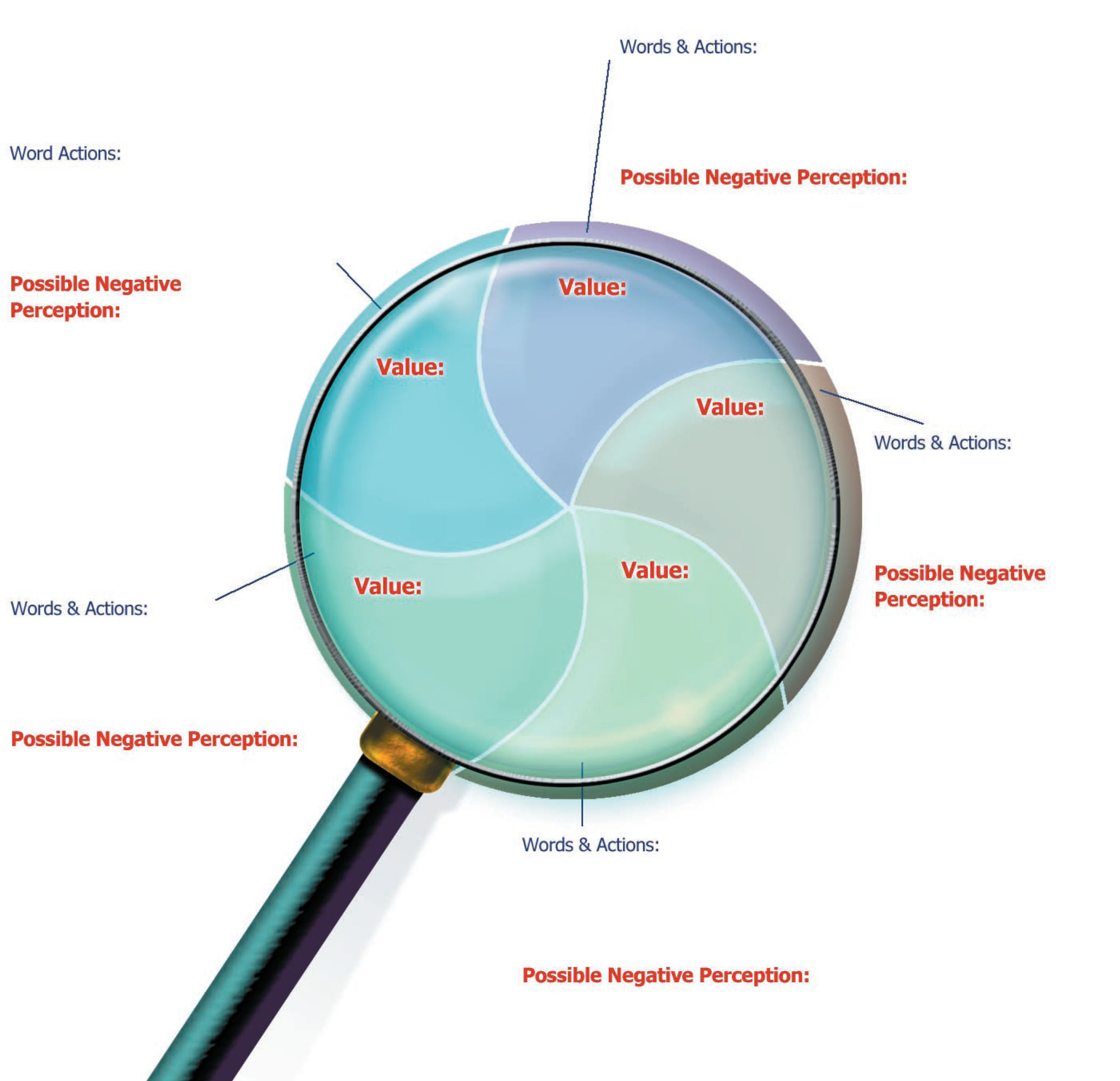
  1. Evaluating the strength of the discourse and the value that sums it up. I ask participants to study their own culture’s Lens and then rate on a scale of 0 to 5, weak to strong, their own sense of how they’ve personally appropriated and express in everyday words and actions each of the values described. Then I ask them to share this with their compatriots as well as with the representatives of the other culture who are participating with them. This is a matter of not only sharing their numerical rating of the values, but talking about how each cultural value expresses itself in their thinking and behavior, as well as what parts of it don’t seem to fit or which they don’t like to identify with. This may or may not resemble or relate to the “Negative Perceptions” found on the Lens itself.
  2. Identifying commonalities: Following this discussion, I ask the individuals of each culture to study the other culture’s Lens and to do two things. First, again on a scale of 0 to 5 to assess whether, and if so, the degree to which they identify with each of the cultural values of the other group as found on the lens. Then, secondly, and this is extremely important, to identify and jot down the keywords of their own inner conversation or discourse about the importance they accord to the values they seem to share and the ways in which they may practice each of them.  Thirdly, depending on the size of the group, ask them to share their results either individually, or to conduct a discussion within their same culture group and then have the groups report out their results to each other. Here is where the essential value is gained from seeing how people would express their appropriation of elements belonging to the other culture.
  3. How do we like to be treated? Given adequate time, here is another very valuable activity that could occur at this point, but might be even better to use after the group has resolved a critical incident or two. Ask each separate culture as a group to meet together to discuss and identify and list both the attitudes and kinds of treatment that they appreciate coming from the other culture, as well as those kinds of speech and behavior that they may find uncomfortable or even damaging to the collaborative and social relationship they are trying to create with each other. The previous activities at various points are likely to lead toward the identification and discussion of stereotypes, giving rise to another possibly useful activity. I have found that frequently trainers and teachers, perhaps out of a misguided sense of political correctness avoid the discussion of specific stereotypes or stereotypical expressions, missing a valuable learning opportunity.
  4. Investigating stereotypes: We’ve long accepted the fact that stereotypes contain a kernel of truth, but that the perspective with which they are expressed maybe overgeneralized and conducive to negative judgment. So, instead of dismissing stereotypes out of hand, we can use them as starting points for deeper discussion and further understanding. So, when stereotypes surface, I ask participants to discuss questions like the following ones:
    • What is the truth in them, however small? What do you think brought them about in the first place? What perpetuates them? What insights or cautions do they deliver to us? What is the discourse that we carry about self that makes them true for us when they are about us?
    • What exaggeration do they contain? What is the discourse that makes them noxious, conflictual, etc.? When are they likely to be painful or damaging? What limits do they place on our knowledge and our inquiry about others?

So, as I mentioned above these are some of the useful practices that I keep in my tool bag for enhancing the effectiveness of Cultural Detective.  It would be good to hear what others of you have developed or ways in which you view similar activities.

Two Values Lens Stories

©Cultural Detective, from Cultural Detective Self Discovery

©Cultural Detective, from Cultural Detective Self Discovery

The beauty of Cultural Detective Values Lenses?

A colleague was just telling me this morning that he had a class of students from France and Italy, and one Thai woman. The students had worked with Cultural Detective Self Discovery; they had reflected on their personal values and history, and created personal Values Lenses.

Next my colleague had walked through the French Values Lens with the class, and asked them to compare their personal Lenses with the national Lens, the country in which all of the students were residing and studying. The French students perceived a lot of resonance with their national culture, and the foreign students identified their experience in France as well.

Next my friend walked through the Italian Values Lens, and got the same reaction.

Finally, when he went to the Thai Values Lens, he realized he knew next to nothing about Thais, and that he couldn’t even pronounce the words on the Lens. Thus, he elected to ask the Thai student, blindsiding her or putting her on the spot if you will — he asked her to come up and introduce the class to the Thai Values Lens, which she had only just seen in that moment!

This Thai participant led the other students, and the professor, on a journey into Thai culture that took their breath away! She shared examples of Thai behavior and their meaning that built the other students’, and the teacher’s, respect for who she is and where she comes from.

Such can be the power of a Values Lens. It is not a stereotype. It captures the central tendency, the norm, of a group of people, in terms people can identify with. Thus, it is usually quite easy for a representative of the culture to introduce the values in a Values Lens, using stories from everyday life in that culture.

Second example, much shorter:

So many people nowadays tell us they are global nomads, TCKs, Blended Culture people. And they are. And, this does not mean that they don’t have a culture; it means they have more cultural strands woven into their identity than perhaps the average person!

The second story involves one young woman, who insisted she was nothing like her national culture. She was an individual, a global citizen: culture-less, in a way. In looking at her national culture Values Lens, she exclaimed out loud during class, “Oh my God! I AM Slovak!”

The goal of Cultural Detective Values Lenses as tools is to facilitate dialogue and understanding, both understanding of self and others, and thus enable collaboration that brings out the best of each of us. Please help us make that happen, by sharing your tips, techniques, and designs, and by encouraging best practice.