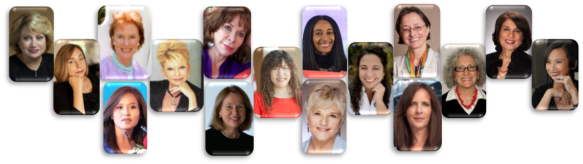
 Seven success values and the immigrant women who cultivated them by Fiona Citkin, due to publish in December 2018 by a Simon & Schuster affiliate
How They Made it in America is a welcome dose of reality amidst a very worrisome worldwide rise in nationalism and xenophobia. With 40.4 million foreign-born people living in the USA—one in every eight residents—this book is enormously important and timely, providing an inside look at the personal journeys of 18 women from five continents who emigrated to the USA.
The women interviewed represent all socio-economic origins, from some who grew up as daughters of government officials and business leaders, to those born into poverty, and everything in between. Some chose to emigrate; others’ lives depended upon doing so. Each has made her mark in disciplines as diverse as technology, development, business, education, journalism, and the arts; most of them are also philanthropists and community volunteers. The author’s choice of these specific women provides a broad and deep spectrum of experience in the book’s quick-reading 314 pages.
There are over one million foreign-born women business owners in the USA—that’s 13% of all women-owned firms in the country. This book offers an understanding of how starting a new life overseas not only changed these immigrant women themselves, but the economy and community as a whole—locally, nationally, and internationally. One woman’s impact comes from starting a company that has annual revenues of $3 billion, another developed a brand now sold at 10,000 stores in 68 countries, and another is changing the world through her micro-lending organization. We see how some immigrant women struggle to regain the status they had at home, while others begin on the ground floor and work their way up step-by-step.
Interview subjects include such well-known women as Chilean-born Isabel Allende and Ivana Trump, originally from the Czech Republic, to women I’d never heard of like social entrepreneur Alfa Demmellash from Ethiopia or Weili Dai from China, the only female co-founder of a major semiconductor company. By the end of the book most any US American reader will feel blessed to have such talented immigrants in our country!
We learn what these women love about the USA, what brought them in the first place, and what keeps them proudly living there. We gain insight about the effect immigration has on their relationships with those who stayed behind, with the children they birth in their new home, and with their American friends and colleagues. We hear about their struggles—from language, accents, and schoolyard bullying to the professional glass ceiling, assertiveness, and risk taking. Plus, we are privy to their hard-earned advice for others like them.
The author, Fiona Citkin, writes that she and her husband made the decision to immigrate because they wanted their 16-year-old daughter to “grow up in a country where she could fulfill her potential through her own efforts—not because of bribery, conformism, or her parents’ connections” (p. 7). Fiona’s first-hand experience informs the book deeply; she’s an immigrant who has had success as an academic, a corporate employee and executive, and an entrepreneur. “My own struggles in America have helped me understand what skills people need to develop in order to succeed in this U.S.—and the special set of challenges faced by immigrant women” (p. 8).
The book is divided into three parts, with two-thirds of it comprised of interviews with the women. From these interviews, Fiona distills seven “success values” that are explained in a second section, and the book concludes with an “Achiever’s Handbook” offered as a guidebook for immigrants wanting to succeed in the USA. Included is a Foreword by Cultural Detective extraordinaire George Simons and an Introduction by Carlos Cortés. The author has certainly done her research; the volume includes 15 pages of footnotes for those who wish to learn more.
Of particular interest and value to me was how the various women describe their blended culture experience. I most definitely wish I could share a copy of Cultural Detective Blended Culture with each of these women, individually and as a group! Most of the interviewees came across as “constructive marginals”—a term used to describe multicultural individuals who have integrated the positive aspects of their various cultural backgrounds into their identities.
- “I am an eternal transplant… My roots would have dried up by now had they not been nourished by the rich magma of the past,” states Isabel Allende (Chile).
- Verónica Montes (Mexico) tells us, “I had to reinvent my cultural practices in a different social and cultural context, and in that sense, I have consciously selected those practices that I find more significant and relevant to me. It is like becoming an orphan and needing to make your own cultural framework.” She sees herself as incorporating the best of American traits into Mexican culture, thereby enriching her world.
- Alfa Demmellash (Ethiopia) shares with us a frequent theme among the 18 women: “I consider myself a global citizen residing in America.”
- “Immigrants end up being hybrids with two hearts; two countries they love; two languages; and two cultures” is Ani Palacios McBride (Perú)’s take on the subject.
- Raegan Moya-Jones (Australia) relates, “My children will be culturally richer for having parents from Australia and Chile. Life and work are all becoming more global; this is nothing but a good thing for me personally and for my children.” Her proudest achievement, like mine, is raising “respectful, unbiased, globally-minded children.”
- Rohini Anand (India), tells us of her blended culture experience: “The U.S. is home, not India. I’m comfortable with my cultural mix and can navigate cultures comfortably. I love the sense of the extended Indian community and an associated support structure. If my family were here, it could change the whole dynamic for me.”
A couple of the interviewees, however, either shared more deeply and realistically, or perhaps have not yet found a way to make peace with the various facets of their multicultural selves. In the intercultural literature, this is called being an “encapsulated marginal.”
- Irmgard Lafrentz (Germany), like most others, has felt her traditional values change since moving to the U.S. “I feel more American [than German], but as I get older, I long for more belonging somewhere. I am rooted neither here nor in Germany. I am not sure whether it’s possible to become totally integrated, and if it’s an emotional or intellectual issue. There is a social identity that unites all immigrants, regardless of country of origin.”
- Elena Gogokhove (Russia), “My Russian brain does the speaking with my Russian friends and sometimes my daughter. My English brain takes over when it comes to writing. I write only in English. Like a spy, I live with two identities, American and Russian—two selves perpetually crossing swords over the split inside me. There is no bridge between the two lives.” Unlike most of the interviewees who discussed themselves as changing drastically after emigrating, Elena says, “Moving to America failed to make me a different person… Russia, like a virus, has settled in my blood and hitched a ride across the ocean.”
While references to feminism in each of the interviews are interesting, they aren’t very well-connected to anything larger and feel a bit out of place. That said, this is an interesting and remarkable work that offers valuable insight into the creativity and perseverance needed to be a successful woman immigrant in the USA. How They Made it in America would be a terrific holiday gift for friends and family, and for any immigrants you might wish to help. And, of course, the best gift of all would be to combine the book with a subscription to Cultural Detective Online!
 Stories are the cornerstone of the Cultural Detective Method, and we have written about them on this blog quite often. Today I am very pleased to share with you a guest blog post by Joanna Sell, storyteller extraordinaire. She will be leading a complimentary webinar for us on 6th December 2018. Register now!
 Cultural Detective Blog