
Unknown's avatar

About Dianne Hofner Saphiere

There are loads of talented people in this gorgeous world of ours. We all have a unique contribution to make, and if we collaborate, I am confident we have all the pieces we need to solve any problem we face. I have been an intercultural organizational effectiveness consultant since 1979, working primarily with for-profit multinational corporations. I lived and worked in Japan in the late 70s through the 80s, and currently live in and work from México, where with a wonderful partner we've raised a bicultural, global-minded son. I have worked with organizations and people from over 100 nations in my career. What's your story?

Best Wishes for 2014

Happy-New-Year-2014-1-1Happy New Year! May 2014 bring you health, joy, love, and much success in your endeavors to build respect, understanding, and collaboration across cultures! We so appreciate you being part of the Cultural Detective community!

As we enter into the third year of this blog, I am quite proud of the quality—and the quantity—of what we have been able to provide. Are you curious about which posts were the most viewed in 2013?

  1. Our top post of 2013 was Research Findings: The Value of Intercultural Skills in the Workplace. A very powerful study of 367 employers in nine countries, commissioned by The British Council and conducted by Booz Allen Hamilton and IPSOS Public Affairs, found that employers want to hire people with intercultural skills. The most frequently cited intercultural skills these employers desired were the ability to demonstrate respect for others, the ability to build trust across cultures, and the ability to work effectively in diverse teams. This was my first time creating an animated-drawing video, and I am pleased that it was republished widely. The British Council put narration to it and published it on their YouTube channel to help promote the original study, and we published a Spanish language version of the video as well. If you didn’t get a chance to read this important study or view the video summary, don’t miss it.
  2. Many of you work in virtual teams and across distances, so not surprisingly, our second most popular post of 2013 was 5 Top (Free & Easy) Virtual Collaboration Tools that You May Not (Yet) Be Using. These five virtual collaboration tools attracted broad readership, and in addition so did the summaries of important research on virtual, multicultural team development. I am hoping that by sharing such information we can heighten awareness of the need for cross-cultural skills, and promote understanding that development of these skills requires discipline and practice.
  3. Our third most popular post of the year was rather surprising to me: 10 Surefire Ways to Divide into Groups. This post gained traction and spread throughout the training and education communities, rather than staying purely within the intercultural space. Perhaps the popularity of this post shows that teachers and trainers are always looking for new-to-them creative techniques. Frankly, I have consulted the list a couple of times myself when designing workshops! It’s so easy to reinforce cross-cultural awareness—even in the ways we divide our learners into small groups.
  4. I am proud that the post on the Benchmark Statement on Intercultural Competence: AEA was among our top five for 2013. It is a terrific example of an organization committing itself to intercultural competence, developing a strategic plan, and investing in competence development over an extended period of time. If you have not read through the American Evaluation Association’s statement, I urge you to do so. As I said in the original post, some of their definitions are better than some of those provided by interculturalists!
  5. Rounding out our top-five blog posts of 2013 was a guest post by Joe Lurie, entitled Catalysts For Intercultural Conversations and Insights: Advertisements. Joe authored several of our most popular blog posts last year, all focused on food and eating. In 2013 his top post focused on print- and video-advertising and how to use them in a classroom environment to compare and contrast cultures. As always, Joe, thank you for your contributions to this community, and to building intercultural competence!

A big and very sincere THANK YOU to all our guest bloggers in 2013, and to those whose work we re-posted. And many thanks, also, to those who contributed comments and additional resources, either directly here on the blog, or via our pages on LinkedIn, Facebook and Twitter. Our community now numbers about 14,000 people, including 130 authors, 420 certified facilitators, a solid group of experienced customers, and an ever-growing group of users and collaborators. Together we can achieve our goals to develop intercultural respect, understanding and collaboration!

We welcome posts by those of you who wish to reach out to our community and aid us in developing intercultural competence in this world of ours. Please contact me about requirements and benefits.

If you are curious what the Cultural Detective project is all about, join us for one of our twice-monthly complimentary webinars. Subscribing to Cultural Detective Online or licensing our print materials does not require certification, but even the most experienced coaches, teachers and trainers rave about our Facilitator Certification Workshops. Sign up for one near you today!

Finally, we would also like to extend our sincere thanks and bring your attention to those who have most frequently referred new readers to this blog in 2013. These, of course, include social media, search engines (Google, Yahoo…), and content curation sites (Scoop.it, Paper.li, Clipboard) that I have not included in the list below. However, this top-15 list shows the broad diversity of contexts and applications for the Cultural Detective Method and materials:

  1. feel like you belong: sharing the life stories of immigrants, expatriates, and refugees to the United States
  2. Expat Everyday Support Center: we help expats connect to their worlds
  3. Zest n Zen/Anne Egros, Intercultural Executive Coach: Global Leadership, International Career, Expat Life, Intercultural Communication
  4. Jenny Ebermann: coach, trainer, speaker, consultant
  5. Slovensko drustvo evalvatorjev
  6. Worldwise: intercultural training and services
  7. KQED: public media for Northern California
  8. InCulture Parent: for parents raising little global citizens
  9. Vekantiebabbels.nl: voor het uitwisselen van je vakantieverhalen
  10. Southeast Schnitzel: interpreting German-American differences in the Tennessee Valley and beyond
  11. Intercultural Humanities Manchester
  12. The Intercultural Communication Center: its all about communication
  13. Global Minds: consultoría en Colombia
  14. Blogos: news and views on languages and technology
  15. ESL: language studies abroad

Thank you all for joining us in this grand endeavor! We hope to see you, dear readers, on this list next year. Let us know what is on your mind, and how this blog can you help further intercultural competence in your corner of the world! Happy New Year!
Year-end Gift from diversophy

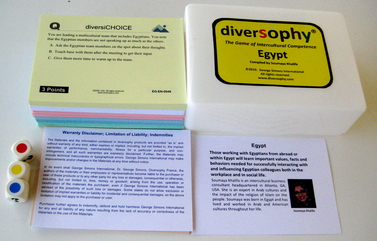
DiversophyMany thanks to Cultural Detective author George Simons and his colleague Wiebke Döscher, who have put together a small diversophy game about holiday food habits across cultures and traditions, and offered it free to their colleagues to play as we slip into the New Year.

Each of the zip files contains the full game of fifty cards, along with printing and playing instructions:
  1. If you are in a place where A4 is the standard size paper, download from this link:
  2. If you use US letter size paper, download from this link:

Terrific Video Clip on “Funny” Names Across Cultures

The clip below is both very funny and a reminder for some of what it feels like to be on the other end of having a “funny name.” It comes from a hugely popular British TV comedy sketch series of the late 1990s —“Goodness Gracious Me”—in which almost the entire cast were British Asians (or “Hounslow Punjabis, to be precise,” as one of the cast members once said). The running gags were about the Asian migrant experience. Many thanks to David Patterson for bringing this clip to our attention.

I share it with you today, Christmas Eve for those of us who celebrate it, in the hopes that it might add some humor to your day, as well as serve as an enjoyable (yet insightful) clip to share with those uncles, cousins or other family members who, despite our love and affection for them, drive us crazy with their stereotypical (racist?) comments during family get-togethers.

This clip is a terrific complement to the video interview I conducted with Dr. Emmanuel Ngomsi on names. Below are the links to those two posts:

New Brain Study Illustrates Gender Differences

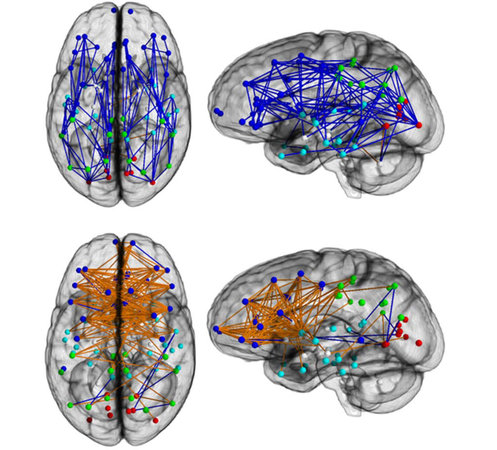
Top: male brain networks Bottom: female brain networks

Top: male brain networks • Bottom: female brain networks
Average findings from the University of Pennsylvania study
Images ©study authors

“At any given moment, a woman is likely to be using her whole brain while a man is using half of his. Men are more likely to be right-brained (more intuitive) or left-brained (more logical) than women.”
—Ruben Gur, neuropsychologist and one of the study authors

A just-published study of the brain functionality of 949 young people shows striking differences in brain wiring between men and women. The authors of the study suggest that male brains are biologically structured to facilitate connectivity between perception and coordinated action (motor and spatial abilities), whereas female brains are designed to facilitate communication between analytical and intuitive processing modes (memory, social adeptness, multi-tasking).

The study of 428 males and 521 females aged 8-22 was conducted by ten colleagues at the University of Pennsylvania and published in the Proceedings of the National Academy of Sciences. They used a technique called “diffusion tensor imaging” (DTI), which scans the paths travelled by water molecules around the brain.

“The maps show us a stark difference in the architecture of the human brain that helps provide a potential neural basis as to why men excel at certain tasks and women at others.”
—Ragini Verma, researcher

The story is making a big splash in the press and in social media. It is a notable study, however, the main interpretation the researchers and the media seem to be taking from the study is that gender differences are biologically determined. I found such a conclusion very puzzling, because the study results themselves show that differences in brain wiring are not congenital!

The study showed that boys and girls are born with similar connectivity, and that differences in brain pathways between the genders begin to manifest at about 13 years of age, and diverge even further at 17. The study authors attribute this to the time sex begins to become important in a person’s life. I suppose that means the time hormones begin to kick in? But, of course I wondered if the differences emerge during the teenage years because that is about the age that gender socialization really begins to manifest.

Then Kathryn Stillings, our editor, found this article by science writer of the year Robin McKie. Robin explains that the study’s findings actually disprove the authors’ interpretations and reinforce the view that gender differences are the result of acculturation.

“Yes, men and women probably do have differently wired brains, but there is little convincing evidence to suggest these variations are caused by anything other than cultural factors. Verma’s results showed that the neuronal connectivity differences between the sexes increased with the age of her subjects. Such a finding is entirely consistent with the idea that cultural factors are driving changes in the brain’s wiring. The longer we live, the more our intellectual biases are exaggerated and intensified by our culture, with cumulative effects on our neurons. In other words, the intellectual differences we observe between the sexes are not the result of different genetic birthrights but are a consequence of what we expect a boy or a girl to be.”
—Robin McKie, The Observer

I trust you’ll read the study and the various interpretations, and draw your own conclusions. Either way, via biological determinism, acculturation/socialization, or a mix of the two, Cultural Detective Women and Men is a terrific package that delves into gender differences in a practical, dynamic way. It combines beautifully with national, religious tradition or generational packages. We trust you will try it out in your work, to help ensure that the broadest spectrum of cognitive skills are accessed for innovation and effectiveness in our organizations and societies.

More on the New Brain Study

The study’s findings show that the dominant connections in the male cerebrum (top left image above) are within either the left or right hemisphere (blue lines), and the dominant connections for females are between hemispheres (bottom left image/orange lines).

In the cerebellum (right-hand images, lower part of brain) it is just the opposite: the average male brain shows connections between hemispheres while the average female brain has dominant connections within hemispheres.

“Forget right-brain or left-brain thinking. What may be more important from a gender standpoint is back-to-front or side-to-side thinking.”
—Stacey Burling, Philly.com

“The strong link with the cerebellum might make men more action oriented, better at tasks that require quick response time or an ‘I-see-and-then-I-do’ attitude. The side-to-side thinking likely boosts women’s memory and social skills and seems designed, the authors said, to combine analytical and intuitive thinking. Communication within the hemisphere facilitates connection between perception and coordinated action,” writes Stacey Burling in her online review of the study in philly.com. Women’s brains “more easily integrate the rational, logical, verbal mode of thinking and the more intuitive, spatial, holistic mode of thinking,” she quotes Gur as saying. “Women’s thinking is likely to be more contextual. Their brains are better connected between their decisions and their memories. For men, memories are memories. Decisions are decisions.”

It is noteworthy that DTI or diffusion tensor imaging provides only indirect measures of structural connectivity and is, therefore, different from the well validated microscopic techniques that show the real anatomy of axonal connections,” says Marco Catani, of London’s Institute of Psychiatry. “Images of the brain derived from diffusion tensor MRI should extreme caution.”

I am curious about the results we’d see of a similar brain study of people older than 22, as I feel we change significantly as we age. This point is echoed by Professor Heidi Johansen-Berg of Oxford University, who attacked the idea that brain connections should be considered as hard-wired. “Connections can change throughout life, in response to experience and learning.” Hopefully the next step of this work will include such a study.

Care to learn more? Click the link above to the abstract of the original study, or read this terrific article from The Atlantic.

Film Review: The Lunchbox (India)

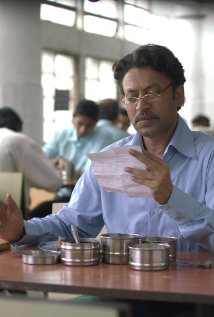
MV5BMjM2ODkxMzA5NV5BMl5BanBnXkFtZTgwOTYwOTYxMDE@._V1_SY317_CR175,0,214,317_Another terrific movie for us to watch, thanks to the generosity of the very talented Sunita Nichani, President of SIETAR India.

The Lunchbox by Ritesh Batra, screened during International Critic’s week at the 2013 Cannes Film Festival

A film set in Mumbai, around the service of the iconic dabbawallahs who ferry thousands of lunchboxes to office-goers in the crowded city without the slightest glitch. The film, however, revolves around one such lunchbox delivered to the wrong person, leading to an epistolary romance between the unintended recipient and the lonely housewife who prepares the gastronomic treats hoping to win her indifferent husband’s heart through his stomach.

What personally facinating me was the contrast between the almost antiquated means of communication showcased in the movie — a basket hanging on a rope to exchange tidbits with the upstairs neighbor, paper notes in the lunchbox instead of the ubiquitous text messages of today—and the modernity of the characters who each broke their cultural shackles to choose freedom and second chances.

Unlike typical Bollywood cinema, the film ends on an ambiguous note, letting the viewer connect the dots as s/he wishes. A wonderful visual resource for exploring some of the facets of contemporary evolving Indian society.

Comment from Dianne: If you are unfamiliar with the dabbawallah system, you owe it to yourself to learn! Please click on this link for a quick intro.

Incredible Offer for USA Law Enforcement and Policy Making Agencies!

Luby Ismael is a colleague I very much respect. I am delighted to be able to pass on her note, below.

If you work in law enforcement or policy making, and are interested in more effectively engaging Muslims in your community, act quickly to take advantage of this opportunity, please.

For the past 12 years, I have conducted trainings on Building Cultural Competency: Understanding American Arabs and Muslims.

Today, I am writing to let you know of a new training opportunity, based on a generous grant from my partners Unity Productions Foundation, that I am offering to law enforcement and policy making agencies.

This training is designed to improve cultural competency and promote more effective engagement with American Muslims. The content and interactive modules have been cleared by the U.S. Attorney General’s special committee.

Beginning immediately, I am able to waive the training fee for the first 10 agencies that email me to schedule a training. Trainings can be scheduled beginning January 2014. 

Please contact me at luby@connecting-cultures.net or (301) 438-3153 to learn more and ask me any questions.

I look forward to working with you,

Luby

Lobna “Luby” Ismail
T. 301-438-3153
luby@connecting-cultures.net
www.connecting-cultures.net

Leading Across Cultures

Leading X CulturesBack in February, my friend and respected colleague, Michael Tucker, sent me a white paper on leading across cultures that he had just completed with one of our customers, Right Management. I meant to write about the 24-page report at the time, but, alas, time passes while we are focusing on other exciting things.

This was an interesting study due to its scope: participants included 1867 leaders of 13 nationalities, representing 134 industries.

“As we enter the Human Age, where Talentism is the new Capitalism, no organization can afford to overlook optimizing the performance of leaders who operate globally. … The fact is that cultural issues will dominate the competencies required for global leaders to be successful, now and in the future.”

80% of CEOs and human resource professionals reported Cultural Assimilation as the greatest challenge facing successful expatriates. Study findings showed that global leadership differs from domestic leadership due to the complexity of working with people from different cultures. “The global experience results in leaders developing new worldviews, mindsets, perceptual acumen and perspectives,” the white paper states.

“Leading across cultures is a critical element of leading in the Human Age and unleashing the power of what is humanly possible. It often requires making decisions in complex or ambiguous environments, understanding cultural nuances and adapting one’s style accordingly.”

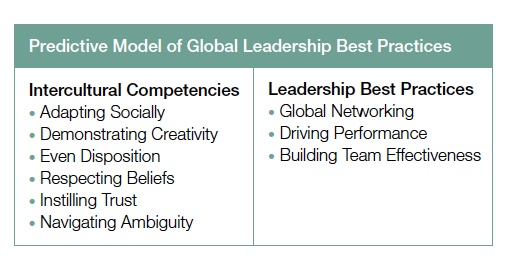
Global Leadership Best PracticesThe study found six competencies required for global leadership success:

  1. Adapting Socially: the ability to socialize comfortably with new people in unfamiliar social situations and to demonstrate genuine interest in other people.
  2. Demonstrating Creativity: the ability to enjoy new challenges, strive for innovative solutions to social and situational issues, and learn from a variety of sources.
  3. Even Disposition: the ability to remain calm, not be critical of self, and learn from mistakes.
  4. Respecting Beliefs: the ability to demonstrate respect for the political and spiritual beliefs of people in other cultures, and the ability to use appropriate humor to diffuse tense situations.
  5. Instilling Trust: the ability to build and maintain trusting relationships. According to the report, trust is the one glue that holds diverse teams together.
  6. Navigating Ambiguity: the ability to work through vagueness and uncertainty, without becoming frustrated, and figure out how things are done in other cultures. Ambiguous situations are the norm in leading across cultures.

“Human Age leaders have the responsibility and opportunity to unleash the potential of all employees who work for them. To effectively unleash this passion and accelerate business success, leaders need new and different skills—managing diverse talent.”

The white paper concludes with four strategies for selecting, developing and retaining leaders who will succeed in a global business environment. An ongoing, structured learning experience such as Cultural Detective Online not only supports, but makes possible, each of the four:

  1. Select Overseas Managers includes assessment processes such as Tucker’s, and developmental tools such as Cultural Detective, used by a competent administrator/facilitator.
  2. Grow International Leadership Bench Strength includes developing and nurturing leaders as well as providing coaching—each of which are greatly aided by the Cultural Detective toolset.
  3. Ensure Success of Leaders in New International Roles includes assigning a coach and meeting for regular reviews, both of which can be significantly enhanced with a subscription to Cultural Detective Online.
  4. Localize Country Management Teams includes the creation of customized leader plans and coaching support. Again, you know what toolset is perfect for this!

This is an excellent report, which I recommend you review in its entirety. We appreciate Tucker International and Right Management making it available. I suspect we can all learn something from this reminder of what it takes to be a competent global leader.

Reconciling Dilemmas—Les Miserables

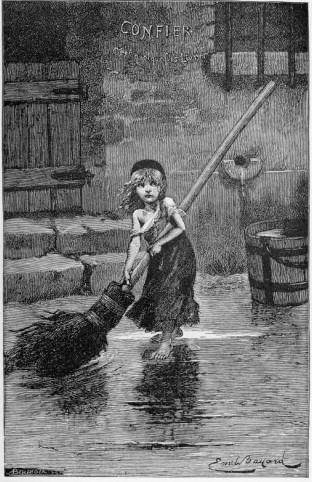
Portrait of "Cosette" by Emile Bayard, from the original edition of Les Misérables (1862)

Portrait of “Cosette” by Emile Bayard, from the original edition of Les Misérables (1862)

I was a 19-year-old coed when I first became a fan of Charles Hampden-Turner. His just-published Maps of the Mind had me so excited about our brains’ potential! In the decades since, having the pleasure of teaching on the faculty of the Summer Institute for Intercultural Communication with Charles, I have learned how truly incredible his mind is, and what a terrific person he is, as well. I’ve threatened to make him autograph my first-edition copy of Maps of the Mind!

Unfortunately, I was unable to make it to the recent SIETAR Europa (Society for Intercultural Education, Training and Research) Congress in Tallinn, Estonia. However, Cultural Detective was very well represented: our authors delivered about ten pre-conference workshops and concurrent sessions. Plus, we had a booth in the exhibit hall so attendees could chat with our authors and experience CD Online. 

One of the conference events that sounded particularly attractive was a special session on  Friday evening of the Congress, conducted by this very same Renaissance man, Charles Hampden-Turner. It was titled, Diversity and Dualism in Les Miserables. Here is the session description that enticed me:

Victor Hugo said, “I condemn slavery, I banish poverty, I teach (to) ignorance, I treat disease, I lighten the night, and I hate hatred. That is what I am, and that is why I have written Les Miserables.”

This session will use video excerpts and song lyric transcriptions from the musical rendition of Les Miserables to explore its unusually enlightened 19th century view of social deviance and its equally sophisticated treatment of dualism and value reconciliation. Attendees can expect to participate in a lively discussion of justice, ethicality, identity, and other issues that figure centrally in the living and teaching of intercultural communication.

The event’s sponsors, our colleagues over at IDRI (Intercultural Development Research Institute in Milano), have mostly kindly uploaded the slides used during this event. Not nearly as good as being there, but wonderful nonetheless. If you loved Victor Hugo’s book, or the musical on stage or film, definitely take some time to review the slides.

Ubuntu, Nietzsche and a Learning Activity

hsubuntuarewe2

This very interesting image is © Jean-Pierre Hallet, and is of an Osani (Congo) children’s game: http://www.connectingdotz.com/osani-circle-game/

A guest post by Joe Lurie

” Those who were seen dancing were thought to be insane by those who could not hear the music.”
—Nietzsche

Like the frog who could not understand the sea because it had never left its pond, so we often cannot see, hear or understand the meaning of behaviors beyond our experience.

So what do you think happened when the following game was once proposed to children in an African community? A basket full of luscious fruit was placed near a tree in the distance, and the children were told that whoever got there first would win the sweet fruits. When they were told to run, they all took each other’s hands and ran together, then sat together enjoying their treats. When asked why they had run like that, as one of them could have had all the fruits for himself or herself, they said: “UBUNTU, how can one of us be happy if all the others are sad?”

“UBUNTU” in the South African language Xhosa means, “I am because we are.”

Perhaps it was this story that helped me understand the reaction of some Korean journalists on their first field study experience in the United States:

Perhaps, in the spirit of the Nietzsche quote, the Koreans did not hear our music. But then again, perhaps we often do not hear the music of “Ubuntu.”

View Part 1 of this interview here.

Frogs, Caged Birds, Underwear and Camel Humps

Frogs, Caged Birds, Underwear & Camel HumpsWhat do these four things—frogs, birds, underwear and camel humps—possibly have in common with one another? In the hands of Cultural Detective certified facilitator Joe Lurie, quite a bit, actually. In this series of short video clips, Joe shares with us a couple of proverbs and a few stories on the power of perception. Watch below to learn why some of his Chinese students were utterly shocked…

The first clip is only a minute and a half long. It’s where Joe sets up his story:

Ah, the ability to see beyond our pond involves the ability to ALSO see and understand the pond we are in! An all too often forgotten reality in intercultural competence. How can we explain ourselves to others, or help others to adapt to our home, if we ourselves don’t understand the culture in which we live?

The second clip, three minutes long, tells you just why some of Joe’s Chinese students thought his behavior was so strange.

What do you think? What values show through in the way you do your laundry? In the way you view birds, frogs, and the rest of your world?

You can find these and all sorts of other videos on Cultural Detective‘s YouTube channel: www.youtube.com/CulturalDetective.

See Part 2 of this interview here.