There are loads of talented people in this gorgeous world of ours. We all have a unique contribution to make, and if we collaborate, I am confident we have all the pieces we need to solve any problem we face.
I have been an intercultural organizational effectiveness consultant since 1979, working primarily with for-profit multinational corporations. I lived and worked in Japan in the late 70s through the 80s, and currently live in and work from México, where with a wonderful partner we've raised a bicultural, global-minded son. I have worked with organizations and people from over 100 nations in my career.
What's your story?
This guest blog post is written by Joe Lurie, Executive Director Emeritus, University of California Berkeley’s International House.
—
Recently, I taught a course attended by Chinese and French students on the intercultural challenges of marketing across cultures. Midway through the course I asked students to select a print, web or YouTube ad describing how the following items reflected cultural preoccupations, values and behaviors in their cultures:
the product being promoted
the selection of words in the headers
the images and colors being used to reinforce the message
After analyzing the ad as a reflection of one’s culture, the student was to ask a fellow classmate from another culture why the ad would or would not work in their culture. In one example, a Chinese student demonstrated how Lipton tea is marketed in China. He noted that no tea bag was explicitly shown, as tea bags do not speak to the traditional way of preparing tea in China, and so not the best way to convince people to drink the Lipton product in China. Rather, the image was of green tea flowing from a cup on its side, producing green images in the style of Chinese paintings of mountains, fish and flowers, each with a particular symbolic value in Chinese culture. The French student who was interviewed had no exposure to traditional Chinese painting and saw not lovely images, but rather incomprehensible splotches! He added that the ad would not work in France as tea drinkers are generally accustomed to black or brown teas.
Color in many other ads revealed the power and status implications of yellow in China, yet something to beware of in France where it often suggests infidelity. Below from a French student are two different ways that Volkswagon is promoted in China and France, reflecting a powerful individualistic/collectivistic contrast, and a terrific way for students to engage in a conversation of cultural discovery:
Below you will find an ad for a cleaning sponge selected by a French student, revealing what the student felt is a preoccupation with sex—reflected in explicit and other seductive ways in many other ads for other products in France. Sexual suggestions, so graphically portrayed, would not, according to the Chinese students in my class, be acceptable in Chinese product promotions. And in a French ad for BMW, a man is shown making love to the body of a woman whose face is in fact a BMW!
A Chinese ad for a very strong 38% alcohol rice beverage portrayed a bottle whose shape was interpreted by the French as a perfume bottle, and so it would not be a convincing way of promoting an alcoholic beverage there.
The bold red color signifying affluence and status for the Chinese was seen as over the top by the French students, who noted a preference in the French aesthetic for far more nuanced, muted colors. This prompted a spirited conversation between the Chinese and French in which it was revealed that ads with very high alcoholic content are discouraged or banned in France, but visual ads for condoms were common there, though not generally acceptable in China. That conversation ended with a comparison of toasting custom—the French “drink and sip” vs the Chinese GAMBAY or “bottoms up”—ALL at ONCE!
Should readers of this blog try this approach in their intercultural classes and training sessions, I hope you will consider sharing the fun and insights here….
—Joe Lurie
Executive Director Emeritus at the University of California’s International House, Joe is currently a cross-cultural communications consultant, university instructor and Cultural Detectivecertified facilitator. Contact Joe via email or LinkedIn.
You may have had the same experience I have: clients, students, trainees and colleagues often ask me what assessment tools I recommend. My response, of course, is “for what purpose? What do you want to assess?” Sadly they usually can not answer that question. They know they want something online, something quick. They want something that provides immediate feedback, either inexpensively or for free. But, they rarely have focused in on a purpose, on what they want to learn through the “assessment.”
Sometimes I hear, “To give our people a profile of themselves—a profile of their style that tells them who and how they are.” The assumption is that, by understanding ourselves via this hypothetical quick, online, inexpensive or free assessment, we will immediately (almost magically) become empowered to collaborate more effectively across cultures.
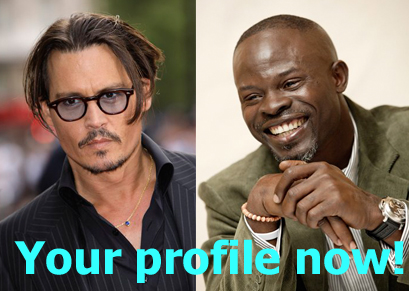
Now don’t misunderstand me: assessments and inventories can be incredibly helpful tools. We are all better served by understanding our learning styles, personality traits, and communication skills. Taking a quick online assessment can also be fun. Heck, those quizzes in the magazines can be entertaining: What kind of personality am I in the bedroom based on whether the quiz says I’m more attracted to Johnny Depp or Djimon Honsou. I had fun just writing that sentence!
However, I can’t help but feel the world is just a WEE bit out of whack when we trust a personal profile, produced by a quick survey, more than we trust our own 20, 50 or more years of experience living with and as ourselves. Profiles can be informative: they can stimulate thinking and conversation. But they are not going to, in and of themselves, improve my ability, either in the bedroom or to work cross-culturally.
What causes us to want a profile? We are by and large intelligent people. We are adults. We know ourselves. Many of us want the quick and easy “answer” because our days are so full. Many of us don’t take time for contemplation, practice, or deep meaningful dialogue—even though these are precisely the acts via which wisdom, happiness and, yes, competence are achieved.
Let’s face it: intercultural competence, like all the other important abilities in life (good parenting, sound health, even skills with technology) involves PRACTICE. We need to stay current, we need to both broaden and deepen our abilities and experience.
So, keeping in mind the importance of HOW we use assessment tools, and the importance of a regular structured practice to improve our abilities, there are a handful of “profile” tools in the cross-cultural field that I find useful. Why do I like these particular instruments? They involve or encourage the contemplation, practice and deep meaningful dialogue of which I’ve written, and that research shows is required in order to improve cross-cultural competence. Some tools I can recommend are:
Cultural Detective Self Discovery: This unique product in the Cultural Detective series helps individuals to investigate their cultural identities and develop a “Personal Values Lens.” Through a structured sequence of short exercises and discussions, individuals identify their core values, the positive and negative aspects of these values, and the thinking and behavior that flows from them. They then explore how their values and behaviors may be similar to and different from those of cultural groups. This Personal Values Lens can be used in conjunction with the Cultural Detective Online system for individualized structured learning, or, better yet, with the guidance of a facilitator or coach.
The International Profiler: This terrific tool by our friends and colleagues at WorldWork involves a web-based psychometric questionnaire, followed by coaching sessions, to help develop an individual’s ability to operate effectively in unfamiliar cultural contexts. Nigel Ewington has been piloting ways of combining The International Profiler (TIP) and Cultural Detective (CD), to harness the best of both. Perhaps we can ask him to do a guest post about that?
Personal Leadership: This methodology offers a way of being and interacting with the world that begins from the “inside out,” one that asks people to be fully present in their lives, awake to their habitual behaviors, and willing to look at situations with “beginner’s mind.” Of particular interest in this context is the personal visioning practice. Barbara Schaetti and Heather Robinson and I have created a MashUp process aimed at leveraging the dynamic interaction possible with Personal Leadership (PL) and Cultural Detective (CD).
The Intercultural Development Inventory (IDI), originally based on the Developmental Model of Intercultural Sensitivity (DMIS), is a statistically reliable, cross-culturally valid measure of intercultural sensitivity. What I love about it is that it is developmental: great for charting individual or group progress. It can be completed online, with the assistance of a qualified administrator, and involves individualized feedback. Ideally the IDI is used as part of a process that also involves development planning and coaching.
We can have all the information in the world about ourselves, but if we do not have the courage and diligence to act on it, it is worth very little. None of the tools discussed above provides instantaneous transformation or the magic pixie dust of cross-cultural collaboration. Nor, I imagine, will they give me an evening with either Johnny or Djimon. But with ongoing, mindful practice and the guidance of a good coach or trainer, we will find worlds open to us that we might never have imagined, and we will develop the ability to collaborate more effectively across cultures—exactly what many of our clients are asking for. Each of the tools above dovetails very well with the Cultural Detective Series: TIP and IDI can help you chart progress using CD as a developmental tool, and PL helps ensure the inner work that should accompany CD use happens.
There are many more inventories, assessments and collaborative tools in the intercultural field. What are some of your favorites? How do you use them for maximum effectiveness? How do you motivate yourself and others to practice? What do you wish existed to address specific developmental needs and challenges?
Global Gender Intelligence Assessment and Cultural Detective Women and Men
Guest post by Donna M. Stringer
Using these two instruments in combination could have ground-breaking results in the area of gender relationships in the working environment (and beyond). And if we can improve gender relations, it would be nothing less than a global revolution!
The Global Gender Intelligence Assessment is a new online tool created by Barbara Annis and Alan Richter. It is an outstanding resource that measures gender attitudes and competence in the areas of Insight (Head), Inclusion (Heart) and Adaptation (Hands). These three constructs are combined with scores for Self, Others and World, giving you a 3 x 3 grid of nine gender-related competencies—each with interpretation and developmental suggestions. There are two versions of the assessment: one for general staff and one for leaders.
The most useful aspects of this assessment are the Interpretations and Personal Action Planning sections. These areas offer detailed, practical, and “doable” suggestions for building competencies. Many assessments provide “Developmental” suggestions that are so general that they read like “can’t we just get along.” The GGIA developmental options are different. They are well thought out and so varied that individuals from a wide range of cultural perspectives can find culturally effective and appropriate ideas to implement.
The assessment is also affordable at $11-$15/per person depending on numbers purchased. For further information contact Alan Richter.
Culture Detective: Women and Menis, of course, not a new tool—it was developed as the first non-national Cultural Detective package in 2007 and revised in 2010. One of the many advantages of CD programs is that they help people understand culture and their own responses to cultural differences. Exposing people to CDs is a developmental process: it is non-judgmental and allows participants to see the world through a different lens, shift perspectives, and identify ways to bridge the differences that might otherwise create conflict or mis-understanding. CDs take a general understanding and problem solving approach that allows cultural differences to be seen as interesting issues to “solve.” The Cultural Detective Women and Men allows people to explore gender differences in a manner that is fun but not personal. Once individuals are able to approach gender in this manner, they are ready for the next step: examining their own individual gender competencies.
The Gender Mashup!
As a developmental process, it would work beautifully to use the GGIA as a follow-up to the CD Women and Men. Having experienced a non-judgmental process of understanding and considering both one’s own and the “other” gender, and identifying bridging behaviors, most individuals would now be ready to complete an assessment that allows them an interpretation of their responses followed by outstanding strategies for personal development suggestions.
Regardless of one’s occupation, organization, or country, gender is a primary diversity characteristic—and one that virtually everyone encounters in life. As I have traveled and worked around the globe, virtually every organization has gender as a diversity and inclusion issue. Using these two instruments in combination could have ground-breaking results in the area of gender relationships in the working environment (and beyond)—and if we can improve gender relations, it would be nothing less than a global revolution!
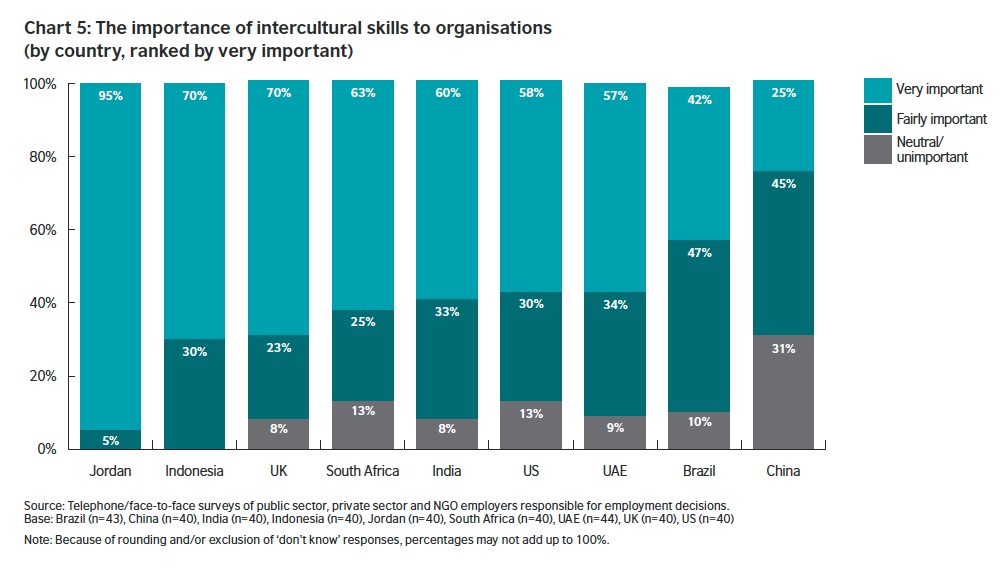
Culture at Work: The value of intercultural skills in the workplace —A survey conducted by the British Council, Booz Allen Hamilton and Ipsos Public Affairs, of HR managers at 367 large employers in nine countries: Brazil, China, India, Indonesia, Jordan, South Africa, the United Arab Emirates (UAE), the United Kingdom (UK), and the United States (US)
The Report’s Conclusions
“Our ability to engage successfully with other countries, organisations and people will depend to a large extent on whether we possess the necessary intercultural and foreign language skills to make fruitful connections, whether in trade and investment, charity/NGO programmes or as government and international organisations. This is fundamentally changing the way in which employers value and seek to develop intercultural skills in the workplace.”
“More and more business leaders are identifying real business value in employing staff with intercultural skills. These skills are vital, not just in smoothing international business transactions, but also in developing long term relationships with customers and suppliers. Increasingly they also play a key role within the workplace, enhancing team working, fostering creativity, improving communication and reducing conflict. All this translates into greater efficiency, stronger brand identity, enhanced reputation and ultimately impact on the bottom line.”
“Employers believe that intercultural skills are integral to the workplace.”
“A common challenge shared by employers around the world is finding employees with adequate intercultural skills. Given that the operating environments of all organisations is increasingly global, it comes as no surprise that employers need employees who can understand and adapt to different cultural contexts.”
What is the international reality in the workplace?
The research shows that employees in most large companies surveyed engage in extensive interaction across international borders.
More than two thirds of employers report that their employees engage frequently with colleagues outside of their country, and over half say that their employees engage frequently with partners and clients outside of their country.
THE BUSINESS VALUE OF INTERCULTURAL SKILLS Intercultural skills provide business value and help mitigate risk.
The research shows that HR managers associate intercultural skills with significant business benefits. Overall, the organisations surveyed are most interested in intercultural skills for the benefits they bring—benefits that carry significant monetary value to employers:
Keeping teams running efficiently
Good for reputation
Bringing in new clients
Building trust with clients
Communicating with overseas partners
Able to work with diverse colleagues
Increased productivity
Increased sales
Employers also see significant risk to their organisations when employees lack intercultural skills. Top risks that organisations surveyed are concerned about are:
Miscommunication and conflict within teams
Global reputational damage
Los of clients
Cultural insensitivity to clients/partners overseas
Project mistakes
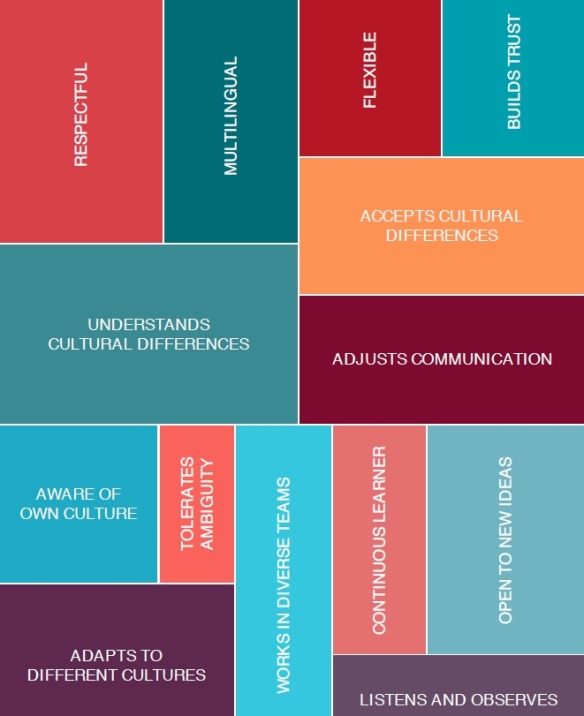
How do the organisations surveyed define “intercultural skills”?
The graphic below shows the words employers used, with size of the block equating to frequency of use.
The terms employers use to define intercultural skills Source: Telephone/face-to-face surveys of public sector, private sector and NGO employers responsible for employment decisions. Base: Ipsos Public Affairs, 2012: Global (n=367).
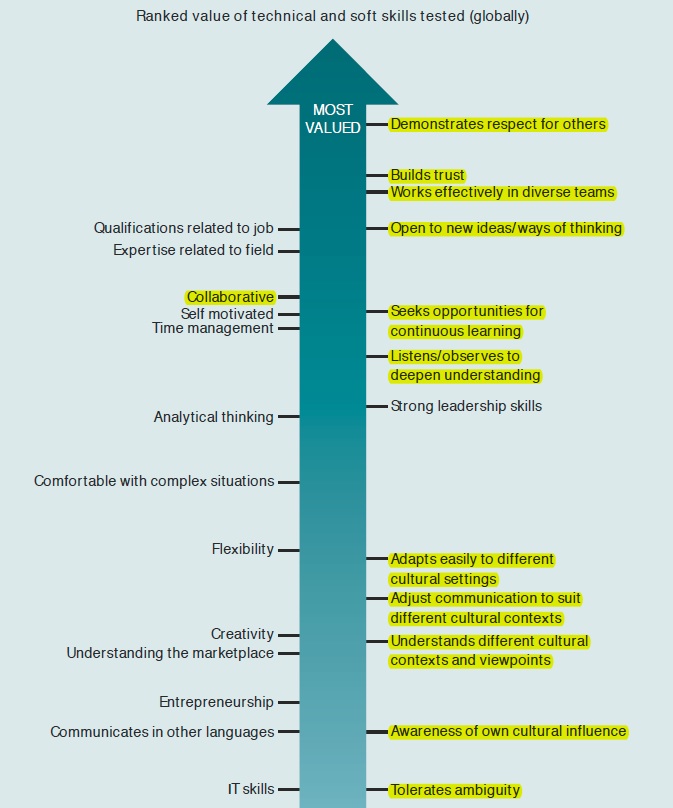
In particular, employers highlight the following as important intercultural skills that they look for in job candidates:
the ability to understand different cultural contexts and viewpoints
demonstrating respect for others
accepting different cultural contexts and viewpoints
openness to new ideas and ways of thinking
knowledge of a foreign language.
How employers rank different skills in terms of importance
How does the research indicate these skills are developed?
Most employers report encouraging their staff to develop intercultural skills through in-house training, meetings and events. However, employers also say that educational institutions could do more to equip students with intercultural skills.
The findings suggest that policy makers and education providers could do more to contribute to the development of a workforce with the necessary intercultural skills through interventions, such as prioritising:
teaching communication skills
offering foreign language classes
availability of opportunities for students to gain international experience
development of international research partnerships.
This research suggests that there is significant opportunity for employers, policy makers and education providers to work together to strengthen the development of intercultural skills to meet the needs of an increasingly global workforce.
How about watching a terrific film from Chile? Our local rental place had a closeout a few weeks ago, and one of the DVDs we happened upon was Machuca, a 2004 film by Andrés Wood. What a terrific find!
I am often asked about status and class in Latin America by those who come from more egalitarian societies. Navigating class differences has been one of our greatest challenges living in México; neither life in the US, Spain, nor Japan equipped us for the expected and often desired separateness here. While a period piece, Machuca viscerally illustrates the class differences and tensions of the era, and I would recommend it as a worthwhile resource.
Machuca takes place in Chile during the final years of Salvador Allende’s government — the first Marxist ever to be elected head of a democracy — and ends about the time of General Augusto Pinochet’s military coup d’état. Taking place during this period of heightened civil unrest, this is fundamentally a story about the friendship of two boys: Gonzalo and Pedro, who come from opposite sides of the river and opposite ends of society. Thus, we get a micro and a macro-level taste of class tension.
Gonzalo is a “junior,” the son of a wealthy family who attends St. Patrick’s, an elite Catholic boys’ school. He is frequently forced to accompany his mother during her afternoon trysts. Pedro (Machuca) lives in a shanty town, and is the son of the woman who cleans house for Gonzalo’s family. Pedro is one of a group of “scholarship students” that the head priest has invited to St. Patrick’s in an attempt to create a bit of equity in society.
The movie shows how difficult it is for these new students to integrate, and there is a memorable bullying scene in which Gonzalo defends Pedro. We gain insight into the home lives of both boys, proving of course that richer or poorer, life is not all roses.
The backdrop to the main story is, of course, a Chile in turmoil. Gonzalo’s own parents seem to come down on opposite sides of the issue, his mother content as a socialite, his father at least to some degree believing in the need for increased equity. The street demonstration scenes capture the anger, the power, and the fear of the time.
We witness the backlash of the parents at school to the priest’s “communist” tendencies, because he attempts to integrate groups they feel best remain separate. We glimpse the resourcefulness of Pedro’s “uncle,” who makes a living selling flags to both sides: the Marxists and the traditionalists. We hear about land redistribution and industry nationalization through radio broadcasts and posters in the streets. In movies like Machuca, stories about young friends trying to make sense of the world around them, there is usually a girl. In this case, she is the girl with whom both boys learn how to kiss. And she is most definitely and passionately a socialist.
Watching this film you will learn a lot about Chilean history, the ingrained status in Latin America, and the difficulty in bridging rich and poor and vice versa. If you’re anything like the members of my family, you’ll be talking about it for days afterwards. I’d urge you to get out your copy of Cultural Detective Chile, particularly the Chilean Values Lens, to aid your discussions of the movie. Enjoy! And please, let me know what you think!
It seems I missed a huge fifteen minutes of fame during Superstorm Sandy. Such frequently happens to me, living in the “provincias” of Mexico as I do.
The events I mention involve NYC Mayor Bloomberg’s sign language interpreter, Lydia Callis. Reactions by the Hearing community to Lydia’s powerful interpreting skills were discussed on prime-time news and talk shows domestically and internationally. Parodies of Lydia signing appeared on a seemingly endless array of radio and television shows and internet sites.
Mayor Bloomberg deserves major kudos for including sign language interpreting in all major press conferences during the state of emergency. Not only did it convey important information to a large number of people, it raised awareness of the Deaf community and created opportunities for Hearing people to learn about American Sign Language (ASL), professional ASL interpreters and Deaf Culture.There is little question that Lydia is a skilled professional who loves her job. Want to see her in action? A video is below. (My apologies to those of you reading this from places where you are unable to access YouTube. And, the video does not include closed captioning.)
We all know that it usually takes controversy to create those fifteen minutes of fame. So where was the controversy? It centered around some in the Hearing community’s perception of the “animated” nature of Lydia’s “whole body” interpreting.
Just read some of the viewers’ comments posted to the video above: Lydia’s signing is “dumb,” “weird,” and one person types that Lydia looks like a “mime.” These are comments that come from a lack of understanding, from ignorance; they provide—or rather, demand—an opportunity for education.
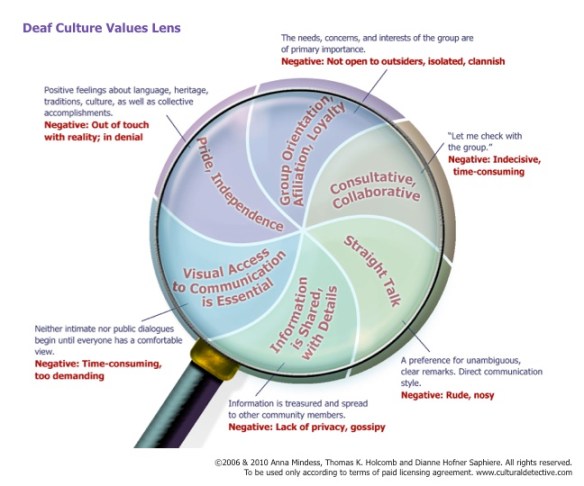
This is exactly the classic Cultural Detective “critical incident”: one person behaving correctly according to the values of her (Deaf) culture, while “outsiders” (Hearing culture) negatively judge that same behavior. One of the strengths of the Cultural Detective series is that each of our Values Lenses includes the Negative Perceptions that may frequently accompany the positive application of values, as does our CD Deaf Culture Lens.
If we take a look at the Deaf Culture Values Lens image above, it’s easy to understand why members of the Deaf community could take serious offense at such evaluative comments. The Mayor understood it was important to get information to everyone. For some in the Deaf community ASL is their first language, not English. This was a way to ensure accurate information was communicated to the Deaf and Hearing communities simultaneously. Signing and universal access were finally getting the attention and respect they deserved.
Then came the spoofs. The icon of US late-night comedy, Saturday Night Live, aired a parody that involved an actual ASL interpreter playing Lydia’s role and using funny signs for “President Obama” (his big ears), “pizzazz” (jazz hands), and quite a few other terms. The SNL skit included a comedic contrast of New York City vs. New Jersey communication styles, as reflected by the two mayors and their interpreters, a spoof of Bloomberg’s poor Spanish, and a send-up of “white” US culture. Want to take a look?
Like any comedy, spoofs can offend, and this one is potentially offensive to interpreters, Deaf people, New Yorkers, people from New Jersey, Latinos and “las personas blancas.” No doubt I’m missing someone here! While I personally find this skit pretty funny, Oscar-winning actress Marlee Matlin, who is deaf, publicly stated that the skit was very offensive.
A Deaf commentator (video below) discussed this situation, and I find it quite interesting to view his take on the situation. Just the fact that he signs it (fairly silently), and that the video does include English language closed captioning, provides a bit of an immersion experience with which many of us who hear may not be familiar. This commentator is not using ASL nor any other of the world’s naturally evolved sign languages, but a more recent pidgin called International Sign, for accessibility to the greatest numbers of Deaf viewers.
Sign language is not universal: “Almost every country in the world has sign language; some even have more than one, as is the case in Canada, with ASL and LSQ (Langue de Signes Quebecois), and Switzerland, which has Swiss-German, Swiss-French and Swiss-Italian Sign Languages.” Like any of the world’s languages, some of these are more inter-related than others.
Lydia’s “animated” interpreting is due to the fact that ASL, as most of the world’s other sign languages, uses facial expressions for grammatical features and emphasis. Again, quoting from CD Deaf Culture: “There are several common features of Deaf people’s language use… An example would be the use of adverbs in signed languages. Although the signs for actions such as ‘working’ and ‘driving’ vary from one sign language to another, inflecting these verbs (for example, ‘working hard’ or ‘driving very fast’) would probably not be accomplished by adding a second, distinct sign, but by altering the manner of making the action sign, including the use of facial grammar.” What a Hearing person might perceive as “animated,” a Deaf person perceives as clarity and accuracy of communication.
Another quick look at the Deaf Culture Values Lens image above will show us why so many people were so deeply offended by the satires of Lydia’s interpreting. Deaf Culture values include pride, loyalty, and group orientation; of course satire could be offensive. Another value is straight talk, a reason so many may have spoken out so quickly and clearly. Here is an opportunity for clarity, for helping the Hearing world understand there is a Deaf Culture. Again, quoting from CD Deaf Culture: “It is often said that language determines culture, and this is true for Deaf people all over the world. Since Deaf people do not have easy access to the spoken languages that surround them, signed languages have developed over hundreds of years, in almost every part of the world, as the most natural mode for communicating. Shared language, traditions, folklore, a strong identity, and a sense of group cohesion work together to create a Deaf culture. “
Finally, according to Anna Mindess, co-author of Cultural Detective Deaf Culture, “The kind of work ASL interpreters often do is interpreting between one deaf person and one hearing person, where we can judge the educational level and language style of the Deaf person involved. However, Lydia was interpreting for anyone who happened to be watching TV (in NY that certainly included foreign-born Deaf people who may not have full command of ASL and deaf people with more or less educational experience) so that’s another reason she made her interpretation so broad as to be clear to the largest possible audience.” Lydia herself, in the Registry of Interpreters for the Deaf, said, “I knew my audience was going to be very broad. I decided to provide as much access for the Deaf Community that I could by mouthing the words and using ASL so that people who fit all along the spectrum could understand what was being interpreted.”
There is much that the Hearing have to learn about Deaf Culture. I urge you to logon to Cultural Detective Online and take a deeper look at Cultural Detective Deaf Culture, authored by Thomas Holcomb and Anna Mindess. In the package resources there you will see links to other tools, including the terrific books and DVDs from Deaf Culture THAT.
I’d also like to share with you three other resources on this topic that I found interesting.
The second is a great blog post by Kambri Crews, a child of deaf parents who explains both “sides” of the controversy and demonstrates the danger of right/wrong thinking.
And the third is an interesting piece in Forbes Magazine in response to the Lydia Callis buzz, this one on the more general topic of interpreting and translating and their role in our world today.
Please let me know what you think about all of this. What role do those of us building cross-cultural understanding and collaboration have to play? How can we support interpreters as they work to translate not only the message but also the meaning?
—
I’ve been told that we have a special offer for those of you who read through this post all the way to the very end! You get to take a look at Cultural Detective Deaf Culture in our CD Online version (plus all the other good stuff in there), free for a period of three days. Redeem the code below now through April 12, 2013.
Enter your name and email address where indicated. The email address you enter will be your user ID and will be validated before you can use your subscription.
Enter the promotional code < Callis2013 > in the last box.
In a few minutes you should receive an email from cdonline@culturaldetective.com
This email may go into your junk or spam folder. To avoid this, please add our cdonline email address to your approved senders list.
In the email you receive there will be link to verify your email. Click that link and follow the instructions in the email and you will be all set.
Earthquake in Haiti. Tsunami in Indonesia. Cyclone in Burma. Extreme weather worldwide, from drought and fire to blizzard and flood. Natural disasters are horrific, with perhaps their only redeeming aspect being the way in which human beings come together to aid one another in their wake.
3/11, the “Great East Japan Earthquake,” was a triple disaster: earthquake followed by tsunami followed by nuclear meltdowns. And today is its second anniversary. At 2:46 pm Japan time people will observe a moment of silence in honor of those lost.
I mention it here in commemoration not only of all the lives lost in Japan, but also for those multitude of lives lost worldwide in disasters in recent memory. It has opened a huge and much-needed debate around climate change, the interconnectedness of our planet, sustainable development, nuclear power and alternative energies, and citizen involvement.
On this second anniversary of 3/11, the clearing of debris has mostly been completed. You can take a look in this powerful series of photos from The Atlantic. Though rebuilding is only just beginning, plans are now mostly completed. My college-hood friend Dan Kahl has been very faithful in keeping those of us outside Japan up-to-date on post-3/11 developments. You can find his Twitter feed here.
I find it meaningful that as we commemorate 3/11, many people in Japan are wearing haz-masks and staying indoors, away from the cloud of yellow sand and chemical pollutants that have blown their way from China. Our planet, indeed, is so inextricably connected; what any one of us does, impacts others, in ways we so often do not anticipate.
My heart is with all my friends, family and colleagues in Japan. I am so sorry for all these trials. And I am so very proud of all of you. May we all do our best to protect this planet we cohabit, and to share our unique gifts fully with one another.
Cultural Detective is about collaboration, authenticity, respect, and bridging differences. The CD Method has long leveraged drama — primarily through the acting out and resolution of critical incidents — as it involves our whole person: body, heart, head and spirit.
I was delighted to learn recently about one colleague who combines our goals with one of our favorite techniques in incredibly powerful ways! On a daily basis I am astounded by and grateful for the unique contributions you, our Cultural Detective community, make to the world around us, and I’m eager to share with you this latest example.
Armand Volkas is a psychotherapist and drama therapist, the son of Auschwitz survivors and resistance fighters from World War II. He is also the life partner of Anna Mindess, frequent Cultural Detective Series editor and co-author of CD Deaf Culture.
Armand created a process called “Healing the Wounds of History,” in which a group of people sharing a common legacy of historical trauma (Germans and Jews; Palestinians and Israelis; Japanese, Chinese and Koreans; African-Americans and European-Americans, to name a few) use experiential techniques to transform the pain of such legacies into constructive action.
“Healing the Wounds of History is based on the premise that there can be no political solutions to intercultural conflict until we understand and take into consideration the needs, emotions and unconscious drives of the human being.”
The project involves:
Breaking the taboo against “enemies” speaking to each other.
Humanizing each other through sharing our personal stories.
Taking steps towards healing personal and collective wounds using creative and experiential methods.
Transforming historical trauma into constructive action and service.
While unfortunately the sensitive nature of Armand’s work doesn’t lend itself to filming, those of you interested in a deeper feel for it can read through the transcript of one of his keynotes, which was acted out by members of a theater ensemble as well as Armand himself.
For more information on or to support the Healing the Wounds of History project contact Armand Volkas at +1 (510) 595-5500, Ext 11 or via email at info@livingartscenter.org
There is a Russian saying, “If a face is ugly, don’t blame the mirror.” I have been thinking about it lately as the topic of Russia has come up in different mirrors, and it is not looking all that good.
Reporters without Borders’ latest Press Freedom Index: Russia ranks148 out of 179.
In addition to all these, Human Rights Watch, in its World Report 2013, addresses a long list of concerns, concluding that 2012 was “the worst year for human rights in Russia in recent memory,” according to Hugh Williamson, Europe and Central Asia Director at Human Rights Watch.
The official Russian response to all of that? It is complex, nuanced, and as contextual as everything in Russia. And most often it is about blaming the mirror or whoever is putting this mirror in front of Russia’s face. Just in the last few months Russia enacted laws that
Require NGOs with any foreign funding to register as “foreign agents”,
Reinterpret treason so broadly that almost anybody cooperating with foreigners can be — if necessary — accused of selling out the Motherland,
Prohibit Russian orphans to be adopted by US Americans.
Two other very common Russian sayings come to mind:
“I am a fool? You are a fool yourself!” and
“Don’t teach me how to live my life!”
Considering that Russia is the largest country in the world, with the seventh largest domestic market and the second largest nuclear arsenal, it might be useful to know what they say in Russia. And it will be priceless to understand what they mean when they say it.
I once heard a Zen Buddhist monk say that the definition of suffering is the gap between what is and what we think should be. The wider that gap, the more we experience stress. Today’s global virtual team, without the right tools, might end up spending a lot of time in that gap. Most teams want to becoming high-performing units with all individuals feeling valued, all cultures being respected, and all tasks getting completed on time. The reality can look quite different, however. In today’s taxing environment, many teams find themselves reacting to fires, completing their tasks but without the benefit of time for intentional reflection or action.
As an intercultural practitioner I’ve had the privilege of working with a variety of global teams in industries from manufacturing to finance. Many of them display similar characteristics. They are often comprised of talented individuals who appreciate cultural diversity and want to collaborate effectively. But why do few teams achieve that vision? What causes the gap between that desire to collaborate and the reality of division or confusion?
So many factors play into the health of a global team, some of which defy explanation — call it chemistry, dynamics, or magic. Some of the factors, however, are more visible. For example, I see many teams become misaligned because they do not have proper communication protocols in place. They make false assumptions about shared understanding of terms or processes which can delay projects. Cultural differences also play a significant role in the effectiveness of global teams. Team members might run into disparate cultural approaches to a project, and rather than observe the problem objectively they immediately begin jumping to conclusions and/or negative evaluations. This premature leap can cause them to chase down incorrect solutions and again delay the project. Also, the team may not take full advantage of the diverse perspectives and resources that the members provide.
How do we close this gap between the theory of a collaborative team and the practice of one? First, a global team must realize that intercultural competence is a learned skill, in some ways like welding or computer programming. Cross-cultural skills may be harder to acquire or measure, but they must be studied and practiced. Cultural Detective Online is an incredible tool for global teams to unite around and hone their intercultural proficiency.
CD Online makes it possible, for example, for teams represented in fifteen countries to come together in a virtual training room and explore several important aspects of collaboration. First, they learn to separate objective facts from their perceptions of situations. That skill alone can increase team trust dramatically. Then they learn through what lenses their colleagues might be looking, and how those values impact the outcome of a business problem. Imagine eighteen members of a global team, all online and on the phone, working through a CD Online scenario together that illuminates the values of cultures they work with every day. Everyone gets to contribute and they physically practice those vital cross-cultural skills right there in the training.
I feel a great sense of excitement about what Cultural Detective Online does to increase the effectiveness of global teams, and not just in theory. Join me and the Cultural Detective team as I walk through a case study of a virtual training designed for a global team using CD Online. This event is free and will take place April 9, 2013. To learn more about this event click here, or to register please click here.
Global teams have amazing potential. What tools have you used to get your global team to high-performance?
—
Vicki Flier Hudson, speaker and Chief Collaboration Officer for Highroad Global Services, inspires people to live, work, and build teams across cultures. She has helped countless large-sized corporations establish successful operations between the United States and India or Europe. Vicki is a certified administrator of the Cultural Detective methodology and the Intercultural Development Inventory (IDI). She has been featured on NBC News, and many of her articles have been published in a variety of magazines.


 This guest blog post is written by Joe Lurie, Executive Director Emeritus, University of California Berkeley’s International House.
 The French student who was interviewed had no exposure to traditional Chinese painting and saw not lovely images, but rather incomprehensible splotches! He added that the ad would not work in France as tea drinkers are generally accustomed to black or brown teas.
 A Chinese ad for a very strong 38% alcohol rice beverage portrayed a bottle whose shape was interpreted by the French as a perfume bottle, and so it would not be a convincing way of promoting an alcoholic beverage there.




 Cultural Detective Blog