The Connection between Creativity and Intercultural Competence

If I were to ask you what it takes to be effective across cultures, what comes to mind? If you are anything like me, then you have probably started to rattle off some of the classics: self-awareness, open-mindedness, curiosity, flexibility—maybe communication skills. All important.

But where is creativity in this picture? And why isn’t it closer to the top of the list when it comes to what it takes to be effective when working across cultures?

You could argue that creativity is an output of some of the above: if you are open-minded, curious, and flexible, you are likely to be able to be more creative, which will help you to be more effective. But I think it’s worth highlighting the importance of creativity as a stand-alone competency for working across cultures—especially when it comes not just to being aware of cultural differences, but being able to develop effective bridging solutions to differences you may experience.

Take Morfie, our newly named CD animal mascot, as an example. Sure, he may be curious as he scuttles across the ocean floor, but what makes him effective is his creative problem-solving in the face of challenging situations: his ability to morph himself into another sea-creature to ward off danger.

The importance of creativity is something I learned the hard way. When I first moved to Japan, I moved into an apartment subsidized by the company I was working for. There were all kinds of problems with the apartment when I arrived (for example, the heating was broken and it was the middle of winter in Sapporo—yes, the same location as the Winter Olympics in 1972). What would you do in this situation?

My initial instinct was to take a more ‘American’ approach—to take my contract in to my employer, highlight the conditions outlined in the contract that had not been met, and ask for these to be amended. But I wasn’t in the US. I was in Japan, a more relationship-focused and indirect culture. Surely going in and making these kinds of demands and pointing to a contract would not exactly start me off on the right foot with my employer, I thought.

So instead, I tried a more indirect approach. When they asked me how things were in the apartment, I remember trying to be subtle about naming some of the problems. I think at one juncture I might have even said something like, “This is the first time I’ve lived in an apartment where frost and ice forms on the insides of windows.” I kid you not. This raises a whole other topic of the ineffectiveness that can often happen when more direct speakers try to be more indirect.

The point of that story, beyond revealing how much I had to learn about Japanese culture when I arrived, was that I was far from creative in my solving of that situation. In my mind, I had two options: take the American approach, or take the Japanese approach (at least my limited understanding of it at that juncture). Be direct or indirect. It was bifurcated, dichotomized, overly simplified, and therefore ineffective.
  • What if I had invited some of my colleagues over to my apartment for a meal, during which they could have experienced the issues first-hand?
  • What if I had asked a colleague for a recommendation for a repair service? Or even asked them to call a repair company for me, since I had yet to learn the Japanese word for moldy?
  • What if I had written to the American colleague whose role I was taking over and asked him what he would do in this situation?

The point being, I could have and should have considered a lot more creative solutions here, but simply didn’t. And that’s really the point. Often when we are working across cultures, we stop at the first, most obvious answer, and that’s a limitation.

The good news is that my little housing adventure in Japan likely has helped me to become more creative—and it certainly proved the need for me to do so. Interestingly, recent research at Northwestern University in the US and INSEAD in France has highlighted that individuals who have lived abroad often demonstrate higher levels of creativity on classic ‘creative problem solving’ tasks.

That said, waiting until you are stuck in challenging intercultural dilemmas to flex your creativity muscles—or relying solely on living abroad to develop the muscle, doesn’t seem the right answer. It’s the kind of thing that you want to have so ingrained in you, that when you are faced with a tough situation, you naturally think through a number of different possibilities. In essence, it’s about learning to be Morfie-like, to be able to quickly run through a rolodex of possible options as to how to transform yourself effectively in those situations—and to continually be expanding your repertoire of possible options.

Developing your creative problem-solving skills is one of four main competencies we focus on in the newly released Cultural Detective Bridging Cultures for that reason. In the package, we go through a series of exercises that help people to expand their solution space—to really get beyond solutions of the generic, ‘he should get cross-cultural training, she should take the other person out to dinner’ nature. In an earlier post I shared with you an exercise to get started.

One really useful technique that we practice in the package comes from the work of Michael Michalko, a pioneer in creativity. It’s called challenging assumptions. The process is simple. When you are faced with a challenging situation, you name all the assumptions you are making about those situations and challenge those assumptions. The premise is that often the way we frame a problem limits the potential solutions to it.

If we go back to my Japan example, I made a lot of assumptions:
  • that I couldn’t take a typically American approach (yet my colleagues were very accustomed to working with US Americans)
  • that my colleagues were typically Japanese (they may have been attracted to the company I was working with very specifically because it wasn’t typically Japanese)
  • that the solution lied in me adjusting the way I communicated, from a more direct to indirect style (versus, for example, emphasizing another shared value we had), etc.

Challenging even just one of the assumptions would have opened up a lot of other options for me to effectively address this situation.

The experience I had in Japan was ten years ago now, but the lesson it taught me about the importance of creativity is invaluable. I now adopt a number of different creativity techniques regularly in my work. Beyond challenging assumptions, I also regularly change my physical location to prompt me to think about things differently, and I use techniques like thinking through analogies and wearing the hat of the other individual to help me identify more creative and effective solutions.

I would love to hear your experiences with creativity as they relate to intercultural problem solving: whether you’ve experienced situations similar to mine in Japan where it would have served you to be more creative; whether you’ve found other techniques that have helped you to continue to develop truly innovative intercultural solutions; even whether I should challenge the assumption I now have that creativity is a powerful, often overlooked skill in intercultural problem solving.


Culture Eats Strategy For Breakfast!

“Culture eats strategy for breakfast!” — a quote that grabbed me during a recent keynote address by BNI (Business Network International) founder and Chairman Dr. Ivan Misner. He was introducing his new book, Business Networking and Sex (Not What YouThink!).

Those (in the audience of more than 1000 Kansas Citians) with more exposure to culture-related topics probably guessed that the book focuses on networking techniques of the different genders and how to be successful networking with the opposite sex. But to hear so boldly from this networking icon how powerful culture truly is in relationship building and the networking process resonated strongly with this Cultural Detective!

When I heard this statement from Dr. Misner, I wished I could have jumped up on stage and displayed the Cultural Detective Women and Men Values Lenses. It would add to the value of his research by providing clear underpinnings as to what motivates the networking behaviors of men and women, and it would help explain the “whys” behind the stories illustrating their differences which seem to be highlighted throughout the book.

Dr. Misner’s book takes a three-pronged look at business networking across the sexes by offering a surveyed objective look at how men and women think about, approach, and in what ways they are successful at business networking. He then counters that with a “he said” (Frank) and “she said” (Hazel) analysis and interpretation of the survey results.

Over a four-year period they surveyed more than 12,000 businesspeople globally (covering every continent) on 25 questions about business networking. The results and interpreted analysis could bring about some interesting and revolutionary changes to the way in which each sex approaches networking with the other. Communication gaps could be narrowed and connections broadened through Hazel and Frank’s guidance and revealing a bit of the opposite sexes “Lens.”

My only wish was that Dr. Misner would have take the results of the survey to a deeper level by breaking it down to country-specific data. But then again, that’s where Cultural Detective national Values Lenses could shed some light!

NOTE: While the book reviewed in this post references two genders, and we offer an excellent package with this same approach, Cultural Detective Women and Men, there are other ways to look at gender than just a polar division of male/female. Cultural Detective LGBT examines some of these complexities of gender and sexual orientation.

Talent Development Huge Topic For Keeping Employees

It’s commonly known (but not necessarily budgeted for during economic downturns) that talent development serves many purposes. Successful organizations use talent development for employee attraction and retention as well as superior employee performances. Recently, in discussing how best one of our site license clients could leverage Cultural Detective in one of their employee networks, the client mentioned there is a big push for employee development again, now that the economy is coming back. Their focus is on keeping people by teaching the skills that support inclusive and collaborative teams.

Cultural Detective is a phenomenal tool for teaching both of these skills and applying them on a global, as well as domestic level. As Janet Bennett points out in her article, “Culture General or Cultural Specific? That is the Question!“, “Rare is the professional arena where we face colleagues from only one or two cultures. Instead, each of us operates with a wealth of cultural diversity that is rich, complex, and challenging. This reality suggests that learning a single specific culture serves us well, and learning about cultural difference in general serves us even better.”

So developing employees to operate effectively in an inclusive and collaborative environment can be accomplished by learning the core Cultural Detective Method which builds the skills of knowing oneself, understanding others and building cultural bridges. As Janet goes on to say, “Cultural Detective® provides both the necessary culture-general breadth of application across many cultures while developing the culture-specific depth. The Worksheet provides a unifying and consistent process for examining yourself and others, and for bridging differences as assets. CD develops intercultural competence by simultaneously improving culture-general and culture-specific expertise in a variety of realistic contexts. By examining key cultural similarities and differences in a culture-general way, we come to know ourselves, and are able to compare and contrast our own perspective with that of others. By focusing the Values Lens on a specific culture, we enhance our capacity to untangle problems, negotiate differences, and look below the surface within and across cultures.” And through this process we can understand how to be inclusive in our multicultural environments and collaborate with those we don’t necessarily share common experiences and work styles.

With feedback like I heard from our client it seems talent development is perhaps again ready to be supported both financially and in practice — let Cultural Detective be your tool-set for achieving an inclusive and collaborative workforce!

Official Cultural Detective Animal

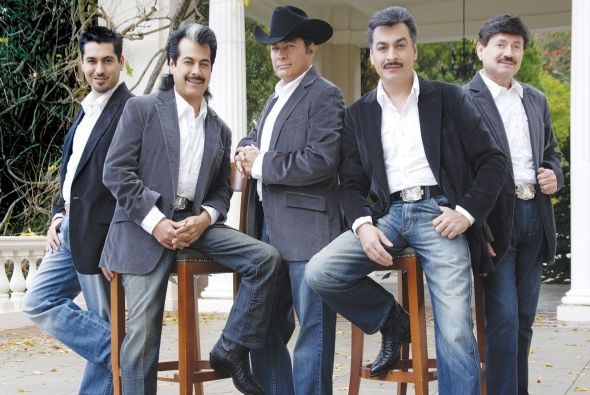
We already have a Cultural Detective theme song (La Boca de Cultura) thanks to our multicultural, multi-talented friends Kotolán. I now suggest that, as do many nations of our world, we name an official Cultural Detective animal. And my nomination is the thaumoctopus mimicus.

While many animals change shape or color, the Mimic Octopus studies others and then mimics their movements and their looks — instantly! And this octopus’ repertoire includes at least 15 different species!

Come on, polyglots, global nomads, TCKs, and other blended culture people, can you top that? It changes its behavior to suit its environment, and its behavior is contextually effective. Sound like anyone you know? Wonder who teaches, trains or coaches these octopi?

The thaumoctopus mimicus, or Culturoctopus Detecticus, would definitely seem to be one ethnorelatively developed, or, ahem, shall I say, “marizo-relatively” developed animal. Below you can view a short video of my nomination in action.

Let me know if you have other nominations, or thoughts on this one!

Spiritual Traditions, Passover and Easter Greetings

Throughout my life I have felt strongly that most of the world’s spiritual traditions, paths and practices share a great deal in common. Of course they have significant differences, and in understanding those differences we come to appreciate the true beauty of each. At their core are perhaps some messages hugely important to all of us and the well-being of our world.

Please allow me to wish those of you who practice a blessed Easter and a blessed Passover, Pesach Same’ach. I would like to take this opportunity to share with everyone a prayer and hymn which I sing in my heart frequently during my travels, whether I’m journeying through daily life or through the world at large. While it is a Christian hymn, I believe it carries a message that resonates with many of us who embrace interculturalism and diversity.

First in Spanish, as I most often hear it and think it living here in Mexico, then in English. The words are from Saint Francis of Asisi.

Hazme instrumento de tu paz,
donde haya odio lleve yo tu amor,
donde haya injuria tu perdón Señor,
donde haya duda fe en ti.

Hazme instrumento de tu paz,
que lleve tu esperanza por doquier,
donde haya oscuridad lleve tu luz,
donde haya pena tu gozo Señor.

Maestro, ayúdame a nunca buscar
querer ser consolado sino consolar,
ser comprendido sino comprender,
ser amado sino yo amar.

Hazme instrumento de tu paz,
es perdonando que nos das perdón,
es dando a todos que tú nos das,
y muriendo es que volvemos a nacer.

O Maestro hazme un instrumento de tu paz.

Make me a channel of your peace,
Where there is hatred let me bring you love,
Where there is injury your healing power,
Where there is doubt true faith in you.

Make me a channel of your peace,
Where there’s despair in life let me bring hope,
Where there is darkness only light,
Where there is sadness ever joy.

O Master, grant that I may never seek
So much to be consolded as to  console,
To be understood as to understand,
To be loved as to love with all my soul.

Make me a channel of your peace,
It is in pardoning that we are pardoned,
In giving to all that we receive,
And in dying that we’re born to eternal life.

O Master… Make me a channel of your peace.

Please, share with some of your favorite prayers, meditations and blessings, with a bit of context so that we might learn, won’t you? Another of my childhood favorites comes from the Navajo tradition, but I will save that for another time.

“Diversity Training Doesn’t Work!”

“Diversity Training Doesn’t Work: Rather than extinguish prejudice, diversity training promotes it!” This was the title of a 12 March 2012 Psychology Today online article.

While so many of us complain about media sensationalism, I begrudgingly have to admit that, in this case, the inflammatory title led me to read this article from among the 200+ crossing my desk that day.

The article’s author, Peter Bregman, relies on research from 2007 to prove his point. He repeats or paraphrases the subtitle four times throughout his article, each time stating it as fact. Yet, in reviewing the original research he cites, I feel it does not support his premise. The original paper is much more nuanced and even-handed (“certain programs increase diversity in management jobs but others do little or nothing”).

While I take issue with much of what Mr. Bregman says in his article (that there are two types of diversity training, for example: those that tell people what to say/not say, and those that break people into categories. Come on, really?), there is also learning to be gained from it. His conclusion: “We decided to [teach all managers] to listen and speak with each other — no matter the difference — which is the key to creating a vibrant and inclusive environment,” was one I could heartily agree with.

Let me focus this post on the constructive learning we might get from this article. Mr. Bregman urges the reader to do nine different things. I consolidate them, as there was quite a bit of redundancy. They are:
  1. See people as people instead of categories. Train them to work with a diversity of individuals, not with a diversity of categories. Move beyond similarity and diversity to individuality. Don’t reinforce labels, which only serve to stereotype. Reveal singularities. Help them resist the urge to think about people as categories.
    • I wholeheartedly agree! Yes!!! Please! That is exactly why Cultural Detective looks at an interactional process of how people communicate in real situations (using the Worksheet with real-life or prepared critical incidents).
    • It is why we have a package titled, Cultural Detective: Self Discovery, aiding users to create Personal Values Lenses.
    • It is why Cultural Detective: Blended Culture looks at the multicultural experience of so many of the individuals in our world today.
    • It is why our definitions of “culture” go way beyond nationality or ethnicity, and include looking at multiple influences on why we are the way we are (see Layering Lenses).
    • While we are all unique individuals, we are also all members of groups and communities, and our world views are shaped by those groups (cultures) in which we were raised. Cultures establish patterns of behavior that are historically sanctioned, so we each learn all kinds of things that seem natural, yet are culturally determined. Viewing people as unique individuals not influenced by culture is a step backwards, and not helpful in understanding others.
  2. Stop training people to be “accepting” because it doesn’t work.
    • Again I agree! If people can better understand themselves, and get a bit of insight into why others might behave the way they do, we won’t need to lecture them. These are two of the Cultural Detective Model’s three core capacities (Subjective Culture/know ourselves, Cultural Literacy/understand others’ intent, Cultural Bridge/skills and systems for leveraging similarities and differences).
  3. Teach people to have difficult conversations with a range of individuals.
    • Yes! The CD Worksheet came to life as a conflict resolution tool in multicultural workplaces in Japan in the 1980s and 90s. It emerged from diverse individuals having just such difficult conversations.
  4. Teach managers how to manage the variety of employees who report to them. Teach them how to develop the skills of their various employees.
    • While I might offer this as one reason to conduct diversity training, coaching, or mentoring, I can definitely agree with the goal. Cultural Detective offers a process for understanding, valuing and leveraging individual cultural differences. Our newest package, Cultural Detective Bridging Cultures, focuses precisely on skill development.
  5. Help them resist the urge to think about others as just like themselves.
    • Yes! Thinking about others as just like ourselves is one stage of a developmental process. Learning to distinguish the ways in which we truly are similar and different, seeing value in the similarities and the differences, and creating ways to benefit from them, is what Cultural Detective is all about.

The initial research referenced in the article, (“Diversity Management in Corporate America,” Frank Dobbin, Alexandra Kalev, and Erin Kelly, American Sociological Association, 2007), was a systemic study of 829 companies, designed to see which kinds of diversity programs work best, on average. A weakness in the original study is that it looked purely at diversity, not on inclusion or competence to manage diversity.

Having said that, the findings showed that diversity councils, diversity leaders, and mentoring programs most strongly correlate with increased management diversity, while training and diversity performance evaluations have a lower correlation. To quote the study authors, “On average, programs designed to reduce bias among managers responsible for hiring and promotion have not worked. Neither diversity training to extinguish stereotypes, nor diversity performance evaluations to provide feedback and oversight to people making hiring and promotion decisions, have accomplished much. This is not surprising in the light of research showing that stereotypes are difficult to extinguish. … Research shows that educating people about members of other groups may reduce stereotyping.”

“Optional (not mandatory) training programs and those that focus on cultural awareness (not the threat of the law) can have positive effects. In firms where training is mandatory or emphasizes the threat of lawsuits, training actually has negative effects on management diversity. Managers respond negatively when they feel that someone is pointing a finger at them.”

The original article by Dobbin, Kaley, and Kelley presents three broad approaches to increasing diversity:
  • Changing the attitudes and behaviors of managers
  • Improving the social ties of women and minorities
  • Assigning responsibility for diversity to special managers and task forces

These are all situations in which the Cultural Detective Model can be used to help shape constructive interactions and manage differences effectively.

What do you think?

Culture Change and Free Speech

Los Tigres del Norte, one of my favorite (and one of the world’s most popular) bands, was banned yesterday from playing in the city of Chihuahua. They were banned because they played a very popular narco-corrido based on a soap opera and book, La Reina del Sur. The ban occurred not in some foreign place that might be unfamiliar with the band’s norteña music, but rather in a city that is steeped in norteña culture. The Mexican press, and most Mexican people, are upset about and vocal in objecting to this cavalier censorship.

A bit of background is in order. As has been well publicized worldwide, Mexico has been a sad battle route in the drug buying and the arms selling of its northern neighbor. Locally and similar to criminals worldwide, drug lords take over and strong arm mountain pueblos, also sometimes building schools or hospitals and taking care of people, thereby building loyalty and security for themselves.

Around this drug trade has grown a culture, which has closely mixed with the pre-existing norteña culture. That cultural mix includes a style of dress (one extreme is those tippy-toed guarachero boots), a unique vocabulary and style of speech, songs (narco-corridos are songs that glorify the life of the outlaw), and even a patron saint whose image, likeness and altars can be found in most any colonía (Jesús Malverde, so-called patron saint of the drug lords and lost causes).

Mexico is a large country, as is northern Mexico, and norteña culture as influenced by narco culture has a diversity within it. There is also spillover; many people who have nothing to do with the drug trade may build an altar to Malverde (unwed mothers may pray to him, for example, as might people who have lost their jobs) or have his face emblazoned on the window of their pickup truck. And, MANY of them listen to what can be called narco-corridos. The particular song for which my Tigres were banned, ironically, ends with the outlaw (a woman) being punished for her crimes.

I believe that most Cultural Detectives value free speech, and do not believe in censorship. It is interesting, though, that this ban occurred because Chihuahua city is trying to change its culture. It is trying to take the narco out of norteña, to stop the glamorization of criminal activity, to restore responsibility and good citizenship to its citizens.

It is personally ironic to me because last year, I posted on the Facebook page of another favorite band of mine, la Banda El Recodo, sharing with them my disappointment that they had released a song so far below the respect and esteem with which they are held by the public (the song talks about guns, arms, bulletproof vests; it encourages people to get drunk and shoot bullets into the air; the official video involves non-stop drinking, high-priced cars and watches, and ends with the lead singer pretending to shoot the viewer). In hindsight, was I censoring? I know my motivations were the same as those of the city of Chihuahua: El Recodo is at the top of their craft; people respect them. I love them, and I love Mexico. I wanted them to stand for and promote what is good about Mexico, help make it a better place, not glorify and feed the worst of our local culture.

What do you all think? We interculturalists work with culture change on a daily basis. Have you advocated censorship in your role? Have the opinions you’ve expressed served to censor another? What are your strategies for culture change?

Inside Egypt: Recent Gallup Poll Results

English: Derivative work of File:BlankMap-Worl...

Image via Wikipedia

We have all been captivated by the hope, strength, and commitment to democracy of participants in the Arab Spring. I’ve also long been a “fan” of Egypt, studying Arabic for two years while living in Tokyo, in hopes of relocating to that country (hasn’t happened yet). Thus, I was excited recently to be able to hear Mohamed Younis speak about Gallup’s research in Egypt.

Over the past decade I seem to quote more and more from Pew Research, so I was very happy to see that Gallup has made a major commitment to conduct 100% self-funded, independent polls regularly in 140 countries. This should provide invaluable data for the intercultural field.

The research on Egyptians’ opinions that Mohamed presented had been conducted just after the parliamentary elections, in December 2011. The top findings he shared with us included:
  • Despite recent challenges in the country’s transition, Egyptians are still optimistic that Mubarak’s overthrow will improve their lives.
  • There is overwhelming confidence in the transparency of the upcoming presidential elections and in participation — 86% of those polled plan to vote in the presidential election.
  • Most Egyptians believe SCAF will hand over power to a civilian government after the presidential elections.
  • Islamists and Liberals very much agree on the issues of most immediate concern for Egyptian households, including women’s rights and economic priorities such as inflation and jobs.
 Some other interesting statistics from the polling:
  • 63% of the Egyptians polled felt that protests and revolts in their country have been the result of an indigenous desire for change. Mohamed said he felt this reflected a “hyper-nationalism” and “hyper-distrust” of foreign intervention, which he said can also be seen in the fact that 46% of the Egyptians polled opposed NATO intervention in Libya (compared to just 18% who were in favor).
  • Our group of listeners was largely US American, so Mohamed shared that 41% of the Egyptians polled said closer relations between Egypt and the US would be a good thing. 40% said it would be a bad thing, for a fairly even split on the issue. His interpretation is that this split is closely related to the fact that 73% of the Egyptians they polled do not feel that the USA is genuine in supporting democracy (rather they support their allies and economic interests).
  • When asked “If drafting a constitution for a new country, which rights should be included?” the vast majority of those polled cited freedom of speech, freedom of religion, and women’s rights (ahead of others in the region). The people of Egypt are definitely envisioning a representative government.

During questions and answers, Mohamed told us how some of the Islamist parties had won seats because they had bankrolled local services such as providing burial services or pilgrimages to Mecca for those who couldn’t afford them. He did not feel the rise of these parties reflected a rise in Islamism per se, and definitely not in the desire for a theocracy.

When asked what foreign governments could do to support Egypt, the clear response was: trade not aid, due to the rising sense of independence, nationalism and regionalism he perceives.

Mohamed also talked about the need for education around democracy, and the fact that an overthrow of Mubarak is not in itself going to create jobs. He said many young Egyptians expect a government job, with high salary and a pension, but with 80 million people and much poverty, they can not expect what young people in Saudi might be able to expect.

When asked about the high price of gas sales to the Sinai, and the fact that many Egyptians blame the Camp David Accords, Mohamed responded that even though this has nothing to do with the peace accords, they are nonetheless blamed. Most Egyptians have no interest in re-engaging Israel.

When asked about security for the Coptic church, Mohamed reiterated that most Egyptians very much respect religious diversity, and that the decision to protect churches was not a government mandate but rather an organic, people-led effort.

If you’re interested in hearing Mohamed present the Gallup findings, they do have a video posted and you can also find a download of his slides. He mentioned there was also audio available on iTunes.

Please note that any errors in my report of the data and Mohamed’s comments are no doubt my own.

Other Gallup reports on related subjects available online:

“Never Again,” an Apropos Motto in a Climate Increasingly Hostile to Roma

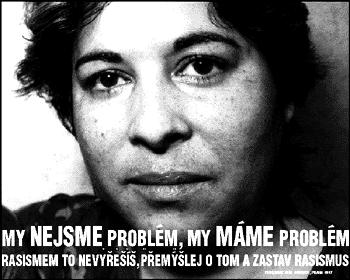
"We are NOT the problem; we HAVE a problem. You won't solve anything with racism.
Think about it and stop racism."
(Czech anti-racism ad campaign poster)

Two generations have not yet passed since ninety percent of Czech Roma, and between a half million and two million European Roma in total perished at the hands of the Nazis in The Great Devouring, or Porrajmos, the Romani word for the Holocaust. Roma, also known by the pejorative term “Gypsies,” make up the largest minority in Europe today with some 10 to 12 million members. Roma face fierce discrimination in accessing employment, education, health care, and public and social services. In spite of repetitious cases of racist violence and hate speech targeting Roma, the community continues its struggle for human rights all across the continent.

Two years ago I paid my homage to those who died in Auschwitz and Hodonín u Kunštátu, a Czech concentration camp for Roma. “Tensions in society are heightening. Perhaps the time will come again when we are sent away to designated areas,” were the words of the priest leading the commemoration service.

Today, many in the Romani community echo these fears, afraid for their safety since numerous neo-Nazi-led marches have been taking place periodically across the country, and several arson attacks at Romani residences have been perpetrated by white supremacists. Racial tensions have been growing more intense with the media printing negative stereotypes, inventing damaging reports and spreading fabricated accounts blaming criminal acts on members of the Romani community.

In mid-February, the director of the European Roma Rights Center, testified that violence against the Roma is on the rise at a hearing in Washington DC held by the Commission on Security and Cooperation in Europe (US Helsinki Commission).

In the Czech Republic, where I was born and raised, a study on extremism commissioned by the Czech Interior Ministry states that there are currently about 4,000 militant neo-Nazi activists in the country. Experts warn that violent crimes committed by neo-Nazis against Romani people will likely rise. The risk of race wars in some regions of the country, specifically between gangs of white Czechs and groups of ethnic Roma, looms large, experts say.

Today’s white supremacist movement is pan-European (with strong German and Italian influences), and international (namely US-inspired). Since the years 2008 and 2009 the movement has become more radicalized and organizationally sophisticated in the Czech Republic, becoming more visible in the streets and infiltrating the political scene.

In Hungary, an armed militia group has been patrolling and terrorizing a Romani village. This following a series of racially motivated murders.

“Gypsy criminality” is one of the most prevalent anti-Roma stereotypes. It permeates all parts of central European life—and can be found as commonly in the media as the local pub. The Roma are also said to abuse welfare and to not want to work. The World Bank just showed the former was absolutely untrue in Slovakia. The latter is a also a damaging myth held by the white majority. These stereotypes are all the more exaggerated in light of the economic downturn and the scarcity thinking the crisis triggers in the white majority.

What are the solutions? Many rights groups are pushing for economic betterment in the form of job creation and training. Organizations are active in producing independent media with a human rights bent, as well as waging campaigns pressuring mainstream media outlets to be accountable and responsible in their reporting. Key are also positive opportunities for cross-ethnic social interactions and education. Those aware must remain vigilant and spread the word about the threat of extremism that exists in European societies. We must never again permit another Great Devouring.

Response to Time’s “Yo Decido” Cover

I am blessed to have a comadre who is one incredibly intelligent, wise, and loving woman. Her name is Carmen DeNeve, and she is Mexican-born, living and teaching for decades now in Los Angeles California.

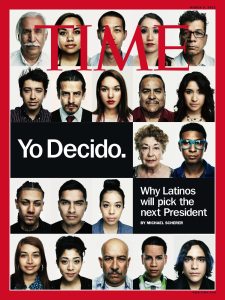
A day or so ago I posted this Time magazine cover to my personal Facebook wall. Many people shared it, as it’s exciting – that the voice of Latinos can be so strong in the USA!

Well, I heard very quickly from my comadrita. I find Carmen’s response so important and quite thought-provoking. It tells a tale that is true for countries around the world with new immigrant voters, I believe, and I’ve received her permission to share it with you here.

“Comadrita, I wish, but too many issues here. First, I wonder about the numbers who really vote and are well informed, even if the total figure is huge. I’m working on this where I teach because some Latino voters have called me the night before election day to ask me, ‘Who do I vote for?’ Or doubting if they should vote. Their thinking is if they don’t study hard about who they need to vote for, maybe it’s better not to exercise their vote — sounds almost sacrilegious.

I think we need neutral political education for new voters like many Latinos, but it doesn’t happen, unfortunately. I want us to be prepared to vote, not only exercise a right that is precious. That’s why later some people blame the victims! And, maybe rightly so.”

[Additional comment from Carmen the following day:] “Dianne, I started reading the article, but I don’t like that journalists give misleading information and manipulate facts, exaggerating such as YO DECIDO. Out of the 50.5 million Hispanic/Latinos they mention, or 17% of the total US population, not all of these can vote, of course. About 10.2 million according to the Census 2010 are not authorized in the U.S. (undocumented) and of course there are more in actuality. This brings us down to 40.5 million potential voters. BUT, from this number there are those under 18 years of age, which roughly I calculated looking at last Census data to be in the 18-20 million range. The recent Census data show roughly one in four children under the age of 10 in the U.S. are Hispanic.

So we don’t really have 50.5 million voting if we take out 30 million not able to vote! This leaves us with 20 million potential voters. Do all vote? Unfortunately not so. I’m trying to educate those who can vote from among these 20 million in my community. They are adorable, but not interested in politics rather focusing on survival. The education of these potential voters will take a long time.

On the other hand, the manipulation of numbers is unbelievable as we all know. I see it as a big scheme for what? I wish, I wish we could all vote and we could actually be 50.5 million and not for example only 13.7% possible voters in Colorado. So I don’t get how we will pick the next President.

We are as diverse in political issues as in religion and socioeconomics. The Miami Cubans seem to have little in common with the Sacramento Mexicans or the New Mexico Hispanics or the Chicago Latinos. But if they want to present us as a common strong block that’s their prerogative, but misleading after all.