
Culture’s Dynamic… What Are You Listening? (#2 in a series)

Dilemma

Dr. George Simons has long been researching the stories that make us who we are. In this series of blog posts he will be leading us in an examination of critical challenges that can lead us toward a fresh vision of culture. We will explore how we come to terms with our inner and shared identities and learn about how we construct the realities that shape our now and our future world.

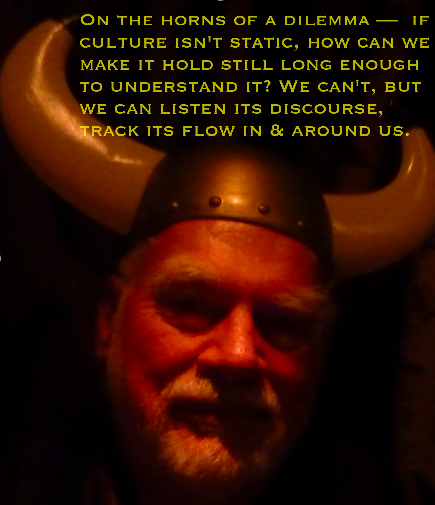
If how we talk about culture, as I mentioned in the last post, appears too static, it is not because culture itself is static. Its dynamism penetrates every corner of life. Why this paradox? Why? We need to look at culture not as an idea, but in action.

I can’t tell how many of you are having conversations with your partner, children, dog, or friends at the moment you are looking at this blog, but what I am sure of is that, even if you’re not talking to anybody, you are talking a mile a minute. Research suggests that even in a face-to-face conversation, people are speaking to themselves about eight times as fast as they talk to each other. In a tele-conversation you can mute the microphone but not your mind. This means that, even if you’re not talking to any friends, pets, or other things in your ambience at the moment, you’re talking to yourself—unless of course you’ve fallen asleep and may be dreaming. Sometimes we are totally with these inner conversations—we call it “daydreaming.”

Screen Shot 2013-02-09 at 10.28.47 AMTalking and listening
This is to say, with your inner chatter you’re asking yourself, “What’s this all about?” “What’s he saying?” “Is this useful to me?” “Do I understand this, or this, or this?” Your mind is proposing all kinds of things about what’s going on around and in you, “What am I hearing?” “What am I doing?” “What am I feeling?” Trying to make what we are sensing fit in with what we know. There are even those little conversations we mislabel as distractions, “What’ll I do tomorrow or this afternoon or have for lunch?” We’re always talking to ourselves. We can’t help it. It’s the way we are. Some of us may have learned to meditate to slow down or to quiet our inner voices at times, but they keep chattering on most of the time, whether you pay attention to them or not. What are you talking to yourself about at this moment?

What is this inner flow all about? It is what we call “listening.” I know that sounds crazy because we’ve all probably been taught that to listen, we should shut up, stop thinking and hear the other out. Well, you can’t do that very well. What really happens is that the mind is forever proposing theories about: What’s going on here? What am I reading, hearing? Do I have a second opinion? What should I do? Is this good bad, beautiful or ugly, worth my time? Should I go do something else? And so on and so forth.

Listening is that voice—I’m describing it simply as a voice, but the flow of listening contains pictures, imaginative scenarios and feelings of all kinds that come up in reaction to what’s going on around you and in you. Actively listening means engaging with these conversations, deciding which are focal, which should take priority, which ones we wish to avoid, pursue, take action on.

This is culture!
The conversations, the discourse that you listen to is what we call “culture.” In other words we have inherited, built, built upon, and shared such discourse all of our lives. Today I’m inviting you to take a look at it in this new and different way.  Listening is culture speaking.  It is at once process and content. We have inner conversations, discourses about all kinds of things, about our goals, about the people we are, whether we’re how we should be or not. We have basic discourses about such things as: What’s a man? What’s a woman? How to live out my masculinity, my femininity? We have discourses that come from where we are born, the gangs we hang out with, and discourses that prevail at a certain point in my generation, in your generation.

That discourse not only originates from outside of us, but also springs up from within, as our unconscious mind brings these strains together. With old conversations rubbing up against the new, sometimes helpful, sometimes contradictory, we are ever awash with fresh ideas in the wired, or should we start saying, “wireless” world that we live in.

A torrent of discourse
So today the culture that builds our inner listening is a flow of discourse coming from countless sources; we live in worlds that are continually shaped by these flows of discourse within us and around us. They are continually flowing over us and into us, following old channels and carving new paths. What was once a slower moving stream of discourse has now become a torrent with the explosive growth of social media and facile, inexpensive means of communication. It sometime seems that everyone is wired, everywhere, or, again replacing the aging terminology, it seems that “everyone is wireless everywhere!”

When I was a student at Notre Dame graduate school, I kept a notebook in my dorm room where I jotted down what I needed to research at the library. Every Tuesday and Friday afternoon I trekked across campus toward the arms of “Touchdown Jesus,” the mosaic mural that welcomed scholars to the Hesburgh Library, to satisfy my learning needs and humor my serendipity. Today I can Google and Wiki most information quicker than I can stand up and walk over to the bookcase where I know the exact book that holds my answers. In terms of sheer quantity, I suspect that, now as a septuagenarian, I am learning a hundred times more each day than I did as a collegian. Shivering in the wee hours of the winter morning, I Skype with heat-oppressed colleagues in Australia or friends in Indonesia without thinking it magic. Yesterday I bought a USB flash drive about the size of the first joint of my index finger, but large enough, I am told, to hold 32 copies of the Encyclopedia Britannica I once owned. Go figure!

On the sociopolitical level, we see new media: Twitter, blogs, and Facebook, support the Occupy protests, the Arab Spring, and provide a conduit for wikileaks, all calling into question the way the culture of power is structured and exercised. Battlefields are managed from half a world away. On the commercial level we may feel helpless in the face of mind-bending electronic advertising, victims of strangers who can know everything about us, not just where but how we live, but our likes and dislikes, as well as the GPS coordinates of our smart phones at any given moment. Ought we call in the exorcist or take a digital sabbatical when our inner voices start to babble?

Dynamic culture
There is no end in sight. On one hand our identity seems diluted in the flow of discourse, sound bites and memes, while on the other hand we have powerful means to connect and coordinate our values and our actions to shape both the world we have inherited and this emergent electronic global village we now live in. Given this, we need a truly dynamic discourse about culture, not just a static definition that puts labels on what people have in common and do in similar ways, but one that enlightens us on the ways we share and influence, as well as misunderstand each other.

Please share some reflections on how you see your identity in this new context. What is changing? What is not? How are you and those about you connected, supported, or threatened by the discourse you share? What do you listen? What are the inner voices saying? What is culture telling you?

This post originally appeared in the blog of the Center for Intercultural New Media Research and is provided with the assistance of its editor Anastacia Kurylo.

Intercultural Work—Stuck in its own past? (#1 in a series)

GSportrait

Dr. George Simons has long been researching the stories that make us who we are. In this series of blog posts he will be leading us in an examination of critical challenges that can lead us toward a fresh vision of culture. We will explore how we come to terms with our inner and shared identities and learn about how we construct the realities that shape our now and our future world.

Despite a tide swell in intercultural communication and worldwide immersion in social media, the current field of intercultural communication itself seems static. This blog post articulates five ways in which the field appears to be moving too slowly for the world around it.

1. Essentialism
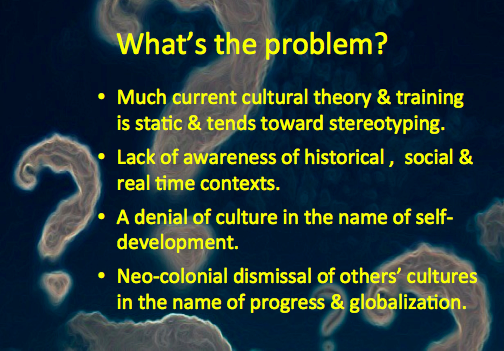
The word used for the kind of intercultural intervention that leads in the direction of stereotyping is called “essentialism.” One tends to assume that a certain person must inevitably share certain cultural characteristics or behaviors if they come from a particular group, ethnicity or culture. Saying that I am from the USA or that I am German or Nigerian makes a whole mess of things stick to me as stereotypes. Of course, we do have cultural characteristics, but who has them, to what degree as well as when, how and where they’ll be expressed is what we don’t know, and is what we need to learn about each other as we work together. Moreover, we belong to multiple cultural circles that may define us in variable, even contradictory ways. Interculturalists loudly condemn stereotyping but seem less adept at escaping from delivering cultural information.

There may be benefits to identifying with a group despite or in some cases because of the stereotypes, though all too easily an identity is painfully imposed on us. A little story to illustrate this. Nordstrom is a big department store in Los Angeles, in the San Fernando Valley. A young woman in my class at Loyola—let’s call her Yuko—told me how, when working there, a woman making a purchase asked, “Honey, where are you from?” (Yuko had identifiably Asian features in her face). The young woman said, “Oh I’m from right here in the Valley. The woman went on, “But where did your parents come from?” Yuko answered, “Oh, they came from the Valley, too.” The woman persisted, “But where did your grandparents come from?” Yuko answered, “Oh, they weren’t from the Valley, they were from Fresno [another California town].” In fact, Yuko’s Japanese-American family predated the many European immigrants that came at the end of the 19th and first half of the 20th century. Essentialism looks at “difference” as “not belonging.” Yuko suffered this kind of pain repeatedly just because she didn’t look like “everybody else.”

2. Ignoring context
A lack of awareness of the social and particularly historical contexts is another way the intercultural thinking and practice can remain static. A lot of people’s feelings about those different from themselves is not simply a matter of their looking or sounding different, and may be anchored in a story of things that happened in the past. Remember, for example, when Yugoslavia disintegrated into smaller states, how politics called into popular sentiment old memories of “what they did to us” 50 years ago, 500 years ago, 1000 years ago, and so on. These memories live in a culture and affect how we react to individuals in other groups. This is to say nothing of social context, particularly now. Since the financial crisis, we’ve been struggling, in a more conscious way than most of us have done in our lifetimes, with those who have and those who have not. This also provides subtext for our communication with each other.

Questions

©George Simons, blog.culturaldetective.com

3. Cultural denial
A lot of people I work with, particularly many younger people today, have or are encouraged to have an attitude that expresses itself as, “I don’t have a culture,” or “I’m a global person, a global citizen.” This suggests that prioritizing individualism, so strongly promoted in the West, makes it in a way shameful to be connected to our past, to have identifiable roots. This is true not simply of third culture kids (TCK’s), some of whom have been jetsetters while in the womb, but of others, and seems to be part of the educational process. All too many people, and not exclusively the young, have suffered by or are fearful of being labeled, of being stereotyped, as we mentioned above, or they feel a need to disassociate with what feels like the oppression of their origins, their family, religious faith or local context. Having cultural features seems a liability to them, a restriction of freedom. Inability to address this inclination is another point of stasis in intercultural work.

4. Implicit colonialism
An even bigger issue is a kind of lingering sense of better-than-thou-ness, and noblesse-oblige do-goodism that results in a kind of hidden chauvinism, a myopic view of other cultures that too easily infects intercultural efforts and holds them back. Part of this involves interculturalists’ need to come to grips with colonial history and its enduring effects in political and economic terms , not just hand wringing. We are fully aware of having a long history of European colonialism and US colonialism that doesn’t take other people’s cultural and environmental ownership seriously. So we come to enlighten them, to bring them progress, to bring globalization, of course to sell them our products. The need for cultural savvy makes it an important commodity today and this situation begs us to take a larger view. But even more important for intercultural professionals are discovery, exploration and treatment of the psychological residue of colonial thinking in themselves. Failing this, it is hard to imagine our efforts moving forward in the ways we like to think that we intend.

5. Dyadic dimensional thinking
Traditionally, in the boilerplate of the intercultural profession, we studied values in what are called “dimensions.” This was our starting point, something for which we are very grateful to the original researchers, people like Geert Hofstede and Edward Hall. In their observations and studies they raised questions and classified the answers. For example, they identified people as more or less “individualistic” or “collective,” “masculine” or “feminine,” “direct or indirect,” according to how people in different cultures reported their likely behavior given similar situations. Their work made us aware of the fact that there were areas of life in which different people had different ways. Yet, on the other hand, the resulting value labels were a product of Western academic mentality, an attempt to understand other people on our own terms rather than on theirs. This may have been the key to the antechamber of understanding, but leaves us standing in front of a second locked door.

In sum, five road blocks, often in combination with each other, that challenge intercultural thinking and practice. Will social media change our static habits? Perhaps so, because they regularly confront us with evidence from around the world, literally at our fingertips, that may challenge these notions. Yet confirmation bias, our ability to see only what we know or expect to see and make otherness fit into it, is likely to be operative in the online world as well. What think you?

This post originally appeared in the blog of the Center for Intercultural New Media Research and is provided with the assistance of its editor Anastacia Kurylo.

“Interculturalidad” – View on Interculturalism from Latin America

During my recent and incredibly learning- and success-filled trip to Colombia, a client asked me to do a short presentation on the state of intercultural competence in Latin America. Such a small request, right (asked wryly and facetiously)? I live in México, but after four years I sure don’t count myself a culture-specific expert, and I am surely not qualified to speak for over half the hemisphere! So, what to do? Turn to an esteemed colleague’s expertise, of course. In this case, I turned to Adriana Medina (and her co-author, John Sinnigen).

The beauty of the source article I used, “Interculturality vs. Intercultural Competencies in Latin America,” is that the authors introduce facts and history we all know, but they put them into a context in such a way that makes total sense and creates new meaning. At least for me.

For example, one of their points is how Latin Americans have lived interculturality for hundreds of years if not longer: wars, imperialism and commerce between the many distinct indigenous cultures, then conquistadores, colonialism, slavery and intercontinental commerce. Intercultural competence on this stage is not some new import during the current age of global economic interdependence. Rather, Latin America’s gold, silver, emeralds and such were important to European economies beginning centuries ago. The authors’ point is, one of the valuable contributions that Latin American interculturalidad can add to the largely northern and western-originated notions of intercultural communication or intercultural competence is this: power, specifically power imbalances.

“Interculturality, the preferred term in Latin America, refers to a historic condition, a radical restructuring of the historically uneven relations of wealth and power that have existed between Europeans and their descendants and indigenous and other subordinated groups during the last half millennium. The aim is decolonization of institutions and the sociocultural fabric of the country.”
— A. Medina-López-Portillo and John H. Sinnigen, “Interculturality vs. Intercultural Competencies in Latin America,” chapter 13 in Deardorff 2009, Sage Handbook of Intercultural Competence

In their article the authors present six strengths that Latin American interculturalidad can contribute to the intercultural communication and competence field. And, speaking for myself, our field is in huge need of hearing and incorporating these perspectives into our theory and practice! Contributions of interculturalidad, according to Medina and Sinnigen,  include that it:
  1. Is counter-hegemonic; focuses on the balance of power
  2. Starts with the needs of marginalized cultures (diverse indigenous movements from Mexico to Bolivia and Ecuador)
  3. Advocates mutual respect and economic and political equality rather than the acculturation of the oppressed
  4. Incorporates Andean/Amazonian concepts such as respect for Pachamama, good living, communitarian practices
  5. Multilingual integration
  6. Decades of dialogue leading to constitutional specificity

I want to thank this client for making this request of me, as it spurred me to learn more about a colleague’s work, and also to learn more about the work of Nestor García Canclini (more about his work in another blog post). I also want to thank Adri and John, whose work, I feel, is very important. I hope this might spur more of us to read, incorporate and build on their findings.

I have posted three PowerPoint slides summarizing this article, and you are welcome to download and use them if they might serve you. Please be sure to retain all source references, including the authors’ and Cultural Detective‘s. Together we can make a difference!

What do you think about the authors’ premises? How might we help the intercultural field to incorporate the Latin American perspective? How do you handle power differences in your work? I look forward to hearing from you!

Born and raised in Mexico City, Adriana Medina-López-Portillo is Assistant Professor of Intercultural Communication and Spanish in the Department of Modern Languages, Linguistics and Intercultural Communication at the University of Maryland, Baltimore County (UMBC). She is an accomplished intercultural trainer, having designed and led workshops for higher education, not-for-profit, governmental, and corporate clients in the United States and abroad. Among her favorite appointments are training for The Scholar Ship, a transnational academic program housed on a passenger ship, and offering pre-departure and on site orientations for the King Abdullah University of Science and Technology (KAUST) in Saudi Arabia. John Sinnigen is Prof. of Spanish and Intercultural Communication at UMBC.  He is the co-editor of América para todos los americanos:  prácticas interculturales (Mexico: UNAM, 2012).

“Belief Holding” as an Intercultural Competence – Religious less motivated by compassion

Frequently and for many years I have cited Milton Rokeach’s The Open and Closed Mind when people ask me about intercultural competence. In this book he talks about the importance of holding beliefs tentatively and situationally instead of imposing them on or expecting them of others.

“A closed way of thinking could be associated with any ideology regardless of content. It includes an authoritarian outlook on life, an intolerance towards those with opposing beliefs, and a sufferance of those with similar beliefs.”

According to this line of thinking, open-minded people may hold their beliefs firmly and strongly, but they also respect others’ rights to believe something different. They believe their path is right for them, but they do not believe it is necessarily the one and only path for everyone on the planet. “It is not so much what you believe that counts, but how you believe,” Rokeach tells us.

In our current age of heightened religious and nationalistic fervor, “belief holding” or “permeability of beliefs” seems more important than ever. As do religious or spiritual beliefs as dimensions of culture and cross-cultural interaction.

In this context, today I read the headline, “Highly Religious Less Motivated by Compassion.” Oh dear. I read on to find out that it is the key finding of social psychologists at the University of California Berkeley, who have conducted three separate studies since 2004 on a largely US American sample.

“Overall, we find that for less religious people, the strength of their emotional connection to another person is critical to whether they will help a person or not. The more religious, on the other hand, may ground their generosity less in emotion, and more in other factors such as doctrine, a communal identity, or reputational concerns.”

Perhaps it is time for all of us who coach, train, or educate on the topic of intercultural communication to remember this important competence, which was first published back in 1960.

The Connection between Creativity and Intercultural Competence

If I were to ask you what it takes to be effective across cultures, what comes to mind? If you are anything like me, then you have probably started to rattle off some of the classics: self-awareness, open-mindedness, curiosity, flexibility—maybe communication skills. All important.

But where is creativity in this picture? And why isn’t it closer to the top of the list when it comes to what it takes to be effective when working across cultures?

You could argue that creativity is an output of some of the above: if you are open-minded, curious, and flexible, you are likely to be able to be more creative, which will help you to be more effective. But I think it’s worth highlighting the importance of creativity as a stand-alone competency for working across cultures—especially when it comes not just to being aware of cultural differences, but being able to develop effective bridging solutions to differences you may experience.

Take Morfie, our newly named CD animal mascot, as an example. Sure, he may be curious as he scuttles across the ocean floor, but what makes him effective is his creative problem-solving in the face of challenging situations: his ability to morph himself into another sea-creature to ward off danger.

The importance of creativity is something I learned the hard way. When I first moved to Japan, I moved into an apartment subsidized by the company I was working for. There were all kinds of problems with the apartment when I arrived (for example, the heating was broken and it was the middle of winter in Sapporo—yes, the same location as the Winter Olympics in 1972). What would you do in this situation?

My initial instinct was to take a more ‘American’ approach—to take my contract in to my employer, highlight the conditions outlined in the contract that had not been met, and ask for these to be amended. But I wasn’t in the US. I was in Japan, a more relationship-focused and indirect culture. Surely going in and making these kinds of demands and pointing to a contract would not exactly start me off on the right foot with my employer, I thought.

So instead, I tried a more indirect approach. When they asked me how things were in the apartment, I remember trying to be subtle about naming some of the problems. I think at one juncture I might have even said something like, “This is the first time I’ve lived in an apartment where frost and ice forms on the insides of windows.” I kid you not. This raises a whole other topic of the ineffectiveness that can often happen when more direct speakers try to be more indirect.

The point of that story, beyond revealing how much I had to learn about Japanese culture when I arrived, was that I was far from creative in my solving of that situation. In my mind, I had two options: take the American approach, or take the Japanese approach (at least my limited understanding of it at that juncture). Be direct or indirect. It was bifurcated, dichotomized, overly simplified, and therefore ineffective.
  • What if I had invited some of my colleagues over to my apartment for a meal, during which they could have experienced the issues first-hand?
  • What if I had asked a colleague for a recommendation for a repair service? Or even asked them to call a repair company for me, since I had yet to learn the Japanese word for moldy?
  • What if I had written to the American colleague whose role I was taking over and asked him what he would do in this situation?

The point being, I could have and should have considered a lot more creative solutions here, but simply didn’t. And that’s really the point. Often when we are working across cultures, we stop at the first, most obvious answer, and that’s a limitation.

The good news is that my little housing adventure in Japan likely has helped me to become more creative—and it certainly proved the need for me to do so. Interestingly, recent research at Northwestern University in the US and INSEAD in France has highlighted that individuals who have lived abroad often demonstrate higher levels of creativity on classic ‘creative problem solving’ tasks.

That said, waiting until you are stuck in challenging intercultural dilemmas to flex your creativity muscles—or relying solely on living abroad to develop the muscle, doesn’t seem the right answer. It’s the kind of thing that you want to have so ingrained in you, that when you are faced with a tough situation, you naturally think through a number of different possibilities. In essence, it’s about learning to be Morfie-like, to be able to quickly run through a rolodex of possible options as to how to transform yourself effectively in those situations—and to continually be expanding your repertoire of possible options.

Developing your creative problem-solving skills is one of four main competencies we focus on in the newly released Cultural Detective Bridging Cultures for that reason. In the package, we go through a series of exercises that help people to expand their solution space—to really get beyond solutions of the generic, ‘he should get cross-cultural training, she should take the other person out to dinner’ nature. In an earlier post I shared with you an exercise to get started.

One really useful technique that we practice in the package comes from the work of Michael Michalko, a pioneer in creativity. It’s called challenging assumptions. The process is simple. When you are faced with a challenging situation, you name all the assumptions you are making about those situations and challenge those assumptions. The premise is that often the way we frame a problem limits the potential solutions to it.

If we go back to my Japan example, I made a lot of assumptions:
  • that I couldn’t take a typically American approach (yet my colleagues were very accustomed to working with US Americans)
  • that my colleagues were typically Japanese (they may have been attracted to the company I was working with very specifically because it wasn’t typically Japanese)
  • that the solution lied in me adjusting the way I communicated, from a more direct to indirect style (versus, for example, emphasizing another shared value we had), etc.

Challenging even just one of the assumptions would have opened up a lot of other options for me to effectively address this situation.

The experience I had in Japan was ten years ago now, but the lesson it taught me about the importance of creativity is invaluable. I now adopt a number of different creativity techniques regularly in my work. Beyond challenging assumptions, I also regularly change my physical location to prompt me to think about things differently, and I use techniques like thinking through analogies and wearing the hat of the other individual to help me identify more creative and effective solutions.

I would love to hear your experiences with creativity as they relate to intercultural problem solving: whether you’ve experienced situations similar to mine in Japan where it would have served you to be more creative; whether you’ve found other techniques that have helped you to continue to develop truly innovative intercultural solutions; even whether I should challenge the assumption I now have that creativity is a powerful, often overlooked skill in intercultural problem solving.

“Diversity Training Doesn’t Work!”

“Diversity Training Doesn’t Work: Rather than extinguish prejudice, diversity training promotes it!” This was the title of a 12 March 2012 Psychology Today online article.

While so many of us complain about media sensationalism, I begrudgingly have to admit that, in this case, the inflammatory title led me to read this article from among the 200+ crossing my desk that day.

The article’s author, Peter Bregman, relies on research from 2007 to prove his point. He repeats or paraphrases the subtitle four times throughout his article, each time stating it as fact. Yet, in reviewing the original research he cites, I feel it does not support his premise. The original paper is much more nuanced and even-handed (“certain programs increase diversity in management jobs but others do little or nothing”).

While I take issue with much of what Mr. Bregman says in his article (that there are two types of diversity training, for example: those that tell people what to say/not say, and those that break people into categories. Come on, really?), there is also learning to be gained from it. His conclusion: “We decided to [teach all managers] to listen and speak with each other — no matter the difference — which is the key to creating a vibrant and inclusive environment,” was one I could heartily agree with.

Let me focus this post on the constructive learning we might get from this article. Mr. Bregman urges the reader to do nine different things. I consolidate them, as there was quite a bit of redundancy. They are:
  1. See people as people instead of categories. Train them to work with a diversity of individuals, not with a diversity of categories. Move beyond similarity and diversity to individuality. Don’t reinforce labels, which only serve to stereotype. Reveal singularities. Help them resist the urge to think about people as categories.
    • I wholeheartedly agree! Yes!!! Please! That is exactly why Cultural Detective looks at an interactional process of how people communicate in real situations (using the Worksheet with real-life or prepared critical incidents).
    • It is why we have a package titled, Cultural Detective: Self Discovery, aiding users to create Personal Values Lenses.
    • It is why Cultural Detective: Blended Culture looks at the multicultural experience of so many of the individuals in our world today.
    • It is why our definitions of “culture” go way beyond nationality or ethnicity, and include looking at multiple influences on why we are the way we are (see Layering Lenses).
    • While we are all unique individuals, we are also all members of groups and communities, and our world views are shaped by those groups (cultures) in which we were raised. Cultures establish patterns of behavior that are historically sanctioned, so we each learn all kinds of things that seem natural, yet are culturally determined. Viewing people as unique individuals not influenced by culture is a step backwards, and not helpful in understanding others.
  2. Stop training people to be “accepting” because it doesn’t work.
    • Again I agree! If people can better understand themselves, and get a bit of insight into why others might behave the way they do, we won’t need to lecture them. These are two of the Cultural Detective Model’s three core capacities (Subjective Culture/know ourselves, Cultural Literacy/understand others’ intent, Cultural Bridge/skills and systems for leveraging similarities and differences).
  3. Teach people to have difficult conversations with a range of individuals.
    • Yes! The CD Worksheet came to life as a conflict resolution tool in multicultural workplaces in Japan in the 1980s and 90s. It emerged from diverse individuals having just such difficult conversations.
  4. Teach managers how to manage the variety of employees who report to them. Teach them how to develop the skills of their various employees.
    • While I might offer this as one reason to conduct diversity training, coaching, or mentoring, I can definitely agree with the goal. Cultural Detective offers a process for understanding, valuing and leveraging individual cultural differences. Our newest package, Cultural Detective Bridging Cultures, focuses precisely on skill development.
  5. Help them resist the urge to think about others as just like themselves.
    • Yes! Thinking about others as just like ourselves is one stage of a developmental process. Learning to distinguish the ways in which we truly are similar and different, seeing value in the similarities and the differences, and creating ways to benefit from them, is what Cultural Detective is all about.

The initial research referenced in the article, (“Diversity Management in Corporate America,” Frank Dobbin, Alexandra Kalev, and Erin Kelly, American Sociological Association, 2007), was a systemic study of 829 companies, designed to see which kinds of diversity programs work best, on average. A weakness in the original study is that it looked purely at diversity, not on inclusion or competence to manage diversity.

Having said that, the findings showed that diversity councils, diversity leaders, and mentoring programs most strongly correlate with increased management diversity, while training and diversity performance evaluations have a lower correlation. To quote the study authors, “On average, programs designed to reduce bias among managers responsible for hiring and promotion have not worked. Neither diversity training to extinguish stereotypes, nor diversity performance evaluations to provide feedback and oversight to people making hiring and promotion decisions, have accomplished much. This is not surprising in the light of research showing that stereotypes are difficult to extinguish. … Research shows that educating people about members of other groups may reduce stereotyping.”

“Optional (not mandatory) training programs and those that focus on cultural awareness (not the threat of the law) can have positive effects. In firms where training is mandatory or emphasizes the threat of lawsuits, training actually has negative effects on management diversity. Managers respond negatively when they feel that someone is pointing a finger at them.”

The original article by Dobbin, Kaley, and Kelley presents three broad approaches to increasing diversity:
  • Changing the attitudes and behaviors of managers
  • Improving the social ties of women and minorities
  • Assigning responsibility for diversity to special managers and task forces

These are all situations in which the Cultural Detective Model can be used to help shape constructive interactions and manage differences effectively.

What do you think?