Reconciling Dilemmas—Les Miserables

Portrait of "Cosette" by Emile Bayard, from the original edition of Les Misérables (1862)

Portrait of “Cosette” by Emile Bayard, from the original edition of Les Misérables (1862)

I was a 19-year-old coed when I first became a fan of Charles Hampden-Turner. His just-published Maps of the Mind had me so excited about our brains’ potential! In the decades since, having the pleasure of teaching on the faculty of the Summer Institute for Intercultural Communication with Charles, I have learned how truly incredible his mind is, and what a terrific person he is, as well. I’ve threatened to make him autograph my first-edition copy of Maps of the Mind!

Unfortunately, I was unable to make it to the recent SIETAR Europa (Society for Intercultural Education, Training and Research) Congress in Tallinn, Estonia. However, Cultural Detective was very well represented: our authors delivered about ten pre-conference workshops and concurrent sessions. Plus, we had a booth in the exhibit hall so attendees could chat with our authors and experience CD Online. 

One of the conference events that sounded particularly attractive was a special session on  Friday evening of the Congress, conducted by this very same Renaissance man, Charles Hampden-Turner. It was titled, Diversity and Dualism in Les Miserables. Here is the session description that enticed me:

Victor Hugo said, “I condemn slavery, I banish poverty, I teach (to) ignorance, I treat disease, I lighten the night, and I hate hatred. That is what I am, and that is why I have written Les Miserables.”

This session will use video excerpts and song lyric transcriptions from the musical rendition of Les Miserables to explore its unusually enlightened 19th century view of social deviance and its equally sophisticated treatment of dualism and value reconciliation. Attendees can expect to participate in a lively discussion of justice, ethicality, identity, and other issues that figure centrally in the living and teaching of intercultural communication.

The event’s sponsors, our colleagues over at IDRI (Intercultural Development Research Institute in Milano), have mostly kindly uploaded the slides used during this event. Not nearly as good as being there, but wonderful nonetheless. If you loved Victor Hugo’s book, or the musical on stage or film, definitely take some time to review the slides.

Una Historia de Abrir Mercados Nuevos

web2Tomado del webinar “Desarrollando habilidades interculturales en  profesionales globales”, el 24 de Octubre, 2013, en cuyo video cuento la historia de unos clientes míos, tratando de abrir nuevos mercados sin haber desarrollado las competencias interculturales requeridas. Es una situación muy común, que conlleva la pérdida de millones de dólares y la reputación en el mercado. Es una experiencia que Cultural Detective te ayuda a evitar.

Por favor, cuéntanos tu historia…

Historia 2

Historia 3

Use of a typical Indian metaphor by Devdatt Pattnaik to speak of culture: Kolam

tumblr_lk8iuxl2vK1qa2x4yo1_500This guest post is written by , cross cultural consultant and trainer. Remember, don’t think “chaos;” think “pattern!”

Often times in my intercultural trainings to Indian audiences, I have sensed a discomfort in my participants with using models (the iceberg of culture, for example) and imagery that are often more easily understood by Westerners. Perhaps, I am more sensitive to this discomfort because I felt the same when I learned not only one but two foreign languages (English and French), with their intrinsic imagery that was so far removed from my local reality.

You can imagine my joy when I stumbled upon Devdutt Pattnaik’s use of a typical Indian custom of drawing kolams (rangoli in North India) to explain the Indian world view. Used to adorn the floor at the entrance of even the most humble abode in India, it is basically a pattern that is drawn, using lines to connect a grid of dots. There is nothing rigid about how the dots need to be connected—each person chooses to connect the dots as s/he desires, and each pattern is a legitimate one, just as is each culture.

Below you can watch his thought provoking presentation on India. I particularly love his closing lines. Enjoy! What are your favorite local metaphors and imagery that resonate with the local contexts you work in?

We Have to Teach in Context!

Apple-butterfly

What we learn has to “fit” with what we know.
It has to be appropriate for where we live and work.
Part of learning is to apply the new to the old, integrating the two.

A client called us, saying they had hired a young woman with an MS in Intercultural Communication to design courseware for them. The objective of the courseware is to improve participants’ job performance, in this case, to make them more effective and efficient at servicing international customers.

“We had a lot of hope for intercultural communication training. But we’ve been doing it for nearly two years now, and we are very disappointed with the results. We have seen no bottom-line impact on performance.”

In reviewing the courseware, I found that it in many ways it was very savvy, but appeared to have been taken nearly verbatim from the woman’s graduate studies. The exercises and activities were designed for master’s students in intercultural communication, and had not been adapted for customer service representatives!

We heard from another client recently that had invested three years developing a curriculum to improve the intercultural competence of their global staff. A diverse group of their international employees attended professional development classes in intercultural communication, and an elite group at head office developed a standardized curriculum to be used worldwide. One of the main objectives of this effort is to be able to better resolve conflicts and misunderstandings more effectively.

So what’s the problem? Everyone loves the new curriculum. However, they leave the program feeling no better equipped to resolve conflicts. They love the tools they’ve learned, they enjoy the trainers, but they don’t know how to use the new tools and skills in a real situation!

THE PROBLEM IN BOTH SCENARIOS
What do these two scenarios have in common? In both cases, the training designer was replicating a graduate-level education course—designed for professionals—and repurpose it, as-is, for skill building. And that just doesn’t work! I’ve seen it far too often in recent years, and it’s a distinction we really need to make. Doctors graduate to practice medicine and to help their patients learn healthy lifestyles; they do not generally teach patients how to be doctors.

Professionals need skills they can use on the job, and that includes cross-cultural skills. But those skills must be taught in context, via application and practice in simulated and, eventually, real situations.

SOLUTION ONE
In the first case, Cultural Detective was added into the client’s existing customer service training. Leveraging pre-existing company-specific case studies and audio-visual scenarios, we used the Cultural Detective Worksheet and Values Lenses to supplement the debriefing. In this way, the need for intercultural skills became more evident and was linked to job success for the customer support engineers. In addition, all practice of cross-cultural skills was integrated with the practice of vital job skills.

We retained many of the exercises and activities included in the original, separate cross-cultural curriculum. However, we wove them into the customer service training to supplement, amplify, and deepen learning using the Cultural Detective Method. Once cross-cultural skills were grounded in the business at hand—the purposes of the employees’ work (customer service)—they made all the difference in the world.

This client reported to us a 30% increase in customer satisfaction that they directly attribute to Cultural Detective.

SOLUTION TWO
The second case is still in process. I very much admire the quality of the curriculum and the incredible coordination it has taken to get so many trainers in such diverse locations “up to speed” with the material. Yet, they are starting to realize that although the training has been well-received, staff is not able to use what they have learned once they are back on the job. Yet with so much investment, they don’t want to completely redesign. And they don’t want to be dependent on outside material.

I advised them to weave into their curriculum a simulated conflict scenario, one that could be worked on and revisited throughout the training. In this way they do not need to completely redo their superb design, and the training they have already provided will still be useful. The difference? The revised curriculum is grounded in their reality and will allow staff to practice cross-cultural skills in simulated situations. That way, when they return to work, they will know when and how to apply the cross-cultural skills and tools they have learned.

SAMPLE DESIGN
Let’s look at a typical training curriculum, and then look at how easy it is to weave Cultural Detective into the existing design. Let’s say on Day One they teach what is culture (Iceberg, observable behavior linked to underlying values) and D.I.E. (learn to Describe before we Interpret and then only with culturally appropriate information, to Evaluate). On Day Two, they teach intention/perception and cross-cultural adjustment (culture shock).

Instead, they might start Day One by introducing a case study involving an everyday challenge. Having introduced the context, trainers facilitate learning as planned in the original curriculum (Iceberg and D.I.E.—Description, Interpretation, Evaluation). After doing so, however, they return to the case study, the professional context, and explore: how do values apply to this case study? What are the Evaluations that I am making, based on what Descriptions? From there, it’s a very easy introduction to the Cultural Detective Method, which this client has already licensed and, therefore, is welcome to use.

On Day Two, intention/perception can be taught as part of the debrief of the Cultural Detective Worksheet for the case study. And, the same case study can be used to ground teaching around culturally-appropriate service or cultural adaptation. From there, as they facilitate the remainder of the designed curriculum, they can provide staff the opportunity to speak with the individuals in the case study, in a simulated environment, and to use CD Values Lenses and the CD Worksheet to help them better understand their own values and worldviews. Finally, staff can use the CD Worksheet Method to facilitate a resolution to the case study—harnessing the advantages of diversity rather than navigating around or ignoring them.

If you’ve licensed the CD Method, you know how versatile it is. But what you may not realize is that Cultural Detective doesn’t need to replace other methods. Often, if you put Cultural Detective at the core of what you are already doing, you’ll find the rest supplements it quite naturally.

Always remember, adults tend to learn best in context; they want to know why something is important to know or do. If adults learn to use and apply intercultural tools in situations that replicate real life, they’ll be much more likely to employ them when the need arises.

I Have a Dream, #DreamDay

Oh how those words, spoken 50 years ago today — August 28, 1963 — have inspired us! The wisdom and passion with which they were spoken!

I Have a DreamSo many have shared their memories on this anniversary of Dr. Martin Luther King Jr.’s famous address. There have been incredibly motivational talks, such as this short one by the Dalai Lama.

Through all of it, however, most of us remain troubled. Are we any closer to that dream? Have each of us done our best, in our lives and in our own ways, to help make that dream a reality?

One thing I know, both from my heart and professional training, is that the Dalai Lama’s message about focusing on the oneness of humanity is based upon a deep recognition of and respect for diversity. Those who know the oneness also respect individual and cultural differences.

I say this because it’s too easy to fall into the superficial “feel good”-ness of “it’s a small world.” Common goals, shared dreams, are necessary to tie us together. And our distinct gifts are necessary to implement those dreams. It’s a converge-diverge dynamic, a yin-yang, in which both commonality and diversity are needed.

Today, let us renew our quest. Inclusion, the oneness of humanity, is not the polar opposite of diversity, as too many believe. A oneness of humanity must be accompanied by a respect for diversity; the two go together hand in glove.

Thank you all, today and always, for being part of our community, for helping us all achieve the dream that justice will roll down like water upon us! That we all will be free at last!

If you haven’t yet rewatched the famous speech, here it is. Sit down, enjoy, and refocus.

Have You Taken Advantage of Our Free Webinars?

Night work

  • “Really? You are logging into this webinar, willingly and of your own accord, at midnight? No joke? And for you it’s 3 am?”
  • “Yes! I am so very excited to be here! Thank you for offering this learning opportunity!”

The response to the free “Cross-Cultural Effectiveness” webinars we have been conducting since February of this year has truly overwhelmed me. We’ve already welcomed hundreds of participants from six of the seven continents, including a broad diversity of professions and experiences—from hospitals to schools, disaster relief to hospitality. I’ve had the pleasure to meet incredible people who are building cross-cultural competence and using or hoping to use Cultural Detective in the most creative and needed ways! It has been such a joy and learning experience. Thank you all!

People don’t need to be inconvenienced by the time difference to participate in these webinars. We offer them twice a month, once at times convenient to the Americas, Europe, and Africa, and another more convenient to Asia and Oceania.

Would you like even better news? Those who participate receive a COMPLIMENTARY 3-day pass to Cultural Detective Online!

I’ve promised myself to use a different critical incident each and every webinar, and it’s amazed me the richness of the discussion this has generated, the powerful ways in which we can overcome stereotypes, the innovative ways the groups have generated to harness the power of diversity.

We also are committed to conducting special-interest webinars for you, to aid in ongoing cross-cultural competence development. Thus far we have held two, both in partnership with customers and colleagues: one on virtual teaming, and another on coaching across cultures. Stay tuned for future additions to the schedule!

If you would like to participate in a webinar, or get more of your colleagues and friends excited about intercultural competence, please register now. We have just updated the calendar through the end of December 2013.

If you use Cultural Detective in your work, and you would like to share what you do and how you do it in hopes of helping others succeed, please contact us. We may be able to partner on an upcoming webinar, or share your story in a future blog post! We also welcome your topic ideas. Keep ’em coming!

Today’s Cultural Defective: A Humorous Short Story

ImageThe past few weeks our family has been busy traveling around visiting universities with our son, who will be a senior in high school as of next week, as well as visiting family and, of course, working in between. Many thanks to all our wonderful guest bloggers who contributed posts during this time.

We are home again, and I thought you might enjoy a humorous “Cultural Defective” or cultural misstep story that happened to us upon our return. The guard, our neighbor, and our family had a good chuckle over it. Hopefully we’ll be a bit clearer in our communication with our building staff going forward, but more importantly, we gained a better understanding of our own worldview and that of the people working in our building. Here’s the story:

We live in a large condominium building. We receive a newspaper delivered to our door every day. Normally when we leave town, we tell the building staff that they are welcome to keep and read our paper while we are gone, and that we don’t need them back. It tends to be much easier and less confusing than starting and stopping delivery, and the staff enjoys the small perk. This time, however, our neighbor was in town, so we invited him to take and read our paper every day while we were gone.

Today, one of our building guards showed up at our door with a huge stack of newspapers. He most kindly explained to us that someone had been stealing our newspaper every day while we were gone (we live on a floor with three other families). Therefore, the staff had decided to hold the papers in the office, to guard them, and give them to us upon our return.

I guess we should have communicated our plans with the building staff more clearly. This was certainly nothing I would have expected. I do hope that at least the staff read them!

To me this incident is refreshing in that it didn’t really harm anyone, as many cross-cultural misunderstandings unfortunately do. However, I’m sure if confused our neighbor (why has newspaper delivery stopped?)!
If we take a bit of time to apply the Cultural Detective Method, we can easily see the value differences it illustrates:
  • The value placed upon a daily newspaper delivery—a luxury available to professionals, but beyond the reach of a laborer here in western Mexico.
  • Feelings of protectiveness and responsibility—the building guards are accustomed to a huge status differential; they don’t want to do anything that might disappoint a homeowner, or that an owner might accuse them of doing incorrectly. They were protecting us, and they were protecting themselves.

In my worldview, it never occurred to me that an owner might want six weeks of newspapers saved. Also, I have a different the sense of responsibility than our guards have. I might figure, “Hey, if the lady didn’t tell me to save her papers for her, or what to do with them while she is gone, I can’t be responsible.”

Of course, it could also have been that the guards really wanted their few weeks of leisurely newspaper reading, and resented an owner (our neighbor) taking what would otherwise be theirs, but I really don’t think that’s what happened. They just figured we’d forgotten about our paper, and that a neighbor was taking advantage of our absence. And, they did the right thing—they protected us.

This is just a small, humorous story of daily life as an expat, and how easily any of us can jump to negative conclusions. Or, if we take a few moments to reflect on our missteps, we can gain insight about ourselves, others, and living together enjoyably.

We have such a wide range of readers—I’ll bet many of you have similar anecdotes of unintended consequences to your actions (or lack of action) as you have navigated life in a foreign culture. We’d be delighted to hear your “Cultural Defective” stories and the insights you gained through the experiences.

Book Review: Global Dexterity

GlobalDexterity

Molinsky, Andy, Harvard Business Review Press. 2013.
ISBN10:1422187276, ISBN13:9781422187272

When it comes to cultural competence, there are some big gaps between knowing about, knowing how to, and actually developing and applying the skills to manage self in real situations. Andy Molinsky, in his new book, Global Dexterity: How to Adapt Your Behavior Across Cultures without Losing Yourself in the Process, has provided us with a methodology for bridging into the third and most critical of these steps. His choice of the word “dexterity” in the title of the book is well chosen to express the fact that we become effective when we have learned how to develop “muscle memory” to respond to real situations in intercultural management and in life, when on strange turf. It is about translating knowledge into behavior and acquiring the habits that make us good at it.

The insights Molinsky provides are not so much about how cultures differ, though the stories he tells make the reader fully aware of the dynamics of these differences. Certainly, one must know and recognize difference, but the book’s key insights are more about how we function wholistically in the circumstances in which we find ourselves. Global Dexterity is a workbook, and the work is up to the user.

Molinsky helps us identify our own “culture code” and that of others — differences in what he calls prototypical thinking and behavior, which may belong to people, to a place or a situation, or to all three at a given moment. In other words, the “detective” work of sniffing out the rules for what is seen as appropriate behavior in a specific cultural setting. The now online Cultural Detective, though not explicitly mentioned in Molinsky’s book, is a good tool for this work. Also, “culture code” as used here should not be limited to the Jungian approach for decoding cultural discourse developed by Clotaire Rapaille, for those familiar with it, though that is also a relevant form of investigation.

Since the variations in code can be almost infinite and therefore paralyzing when it comes to seeking out the right approach to a culture, Molinsky insists we not look for a single “right” behavior, but for a “zone of appropriateness,” a range within which to operate successfully in each culture. He then provides a practical navigational framework for looking into what is most likely to differ as we face situations in this zone. He asks us to pay attention to the relative measures of how direct, enthusiastic, assertive, self promoting and disclosing our behaviors are in comparison with those of the other party. These measures are, admittedly, not exhaustive, but are likely to give us the solid return on our investment of time used to understand and adapt our behavior.

Once aware of the culture code and the zones of appropriateness, the question is how can one stretch one’s comfort zone to overlap with the appropriateness zone of the other’s cultural code. Of course this can be a two way street, but in any case one must diagnose the situation, customize one’s behavior options to fit or bridge the gap, and, ultimately, integrate the customized behavior to the point that it feels right and can become the “new normal” for the situations it fits.

The author identifies three psychological challenges along the way, and he provides a process for dealing with them. First, he uses the word authenticity to speak of the challenge raised by conflict with values and beliefs. Secondly comes competence — does one have the know-how and skill to actually perform the new behavior? The final challenge is dealing with resentment — even if one can perform the behavior, will he or she feel embittered about having to do so?

The helpful metaphor in discussing these challenges is “acting.” An actor needs to learn a new role for a specific part of a drama. Here too, mastering the role needs to be seen as positive acquisition, the realization of potential, rather than as a loss or suppression of self. Today’s language teachers realize this when they no longer speak of “accent reduction” but rather of “accent acquisition.” The search for “authenticity” (the real me) unfortunately is wed to US pop psychology. Objecting, “It’s just not me,” is often an obstacle or an excuse for avoiding the discomfort involved in widening one’s repertoire. Thus, the theater metaphor is particularly useful here. In learning and practicing new skills, it is okay to say, “No, it’s not me…yet…”

So how does one make adopting new paradigm or behavior acceptable to the old self? Besides thinking of it as theater, one can enhance the recognition and acceptance of new behavior by calling on one’s own inner diversity to change one’s perceptions, viz., by aligning the new behavior with one’s goals, weaving it in with other personal or cultural values, or by working to understand and accept the other culture’s logic. If this automatically sounds like rationalistic deviation from what one holds as norms, it must be remembered that we regularly play one value against another in making changes and decisions, and that cultures themselves have both conflicting and complementary discourse to help us navigate life. The author again offers us process, “workbook” pages, for applying this alignment process.

None of this adaptation is likely to occur simply by knowing about differences, and it is here that Molinsky has most to offer to intercultural pedagogy and pedagogues. Few people can incoporate new and alien behaviors spontaneously. It takes practice, practice, paractice, and it is this feature that is most neglected in current intercultural praxis. Gone are the days when a trainer had four or five days to offer participants enough hands-on exercises to try out and then integrate new behaviors in a process of familiarization, rehearsal, and “dress rehearsal” or application to real situations. The reader will have to do this on his or her own, so the author provides pages, tools and questions to facilitate this. There is a potential here for online learning that should be pursued, and Molinsky’s approaches would combine extremely well with a subscription to the Cultural Detective Online tool to provide the ongoing, structured learning needed.

Inevitably, Molinsky points out, we are awash in trial and error, in the challenge of experiential learning. So, he offers further help. There are tips on how to increase one’s chances of being forgiven one’s mistakes, how to look for a cultural model to pattern oneself after, or even how to find a mentor who understands you and your culture well enough to provide feedback, information and support.

What happens, however, when absolutes collide, when ethical standards will be violated if one adapts behavior and accepts practices that are beyond the pale? Here is where the “without losing yourself in the process” line of the book’s title most comes into play. Our creativity for building options is challenged. Humor, gentle insistence, and, if the stakes are not too high, simply contradicting the local norm in your behavior, are given as examples.

Molinsky concludes the book and sums up its import with five key takeaways that compare conventional attitudes about cultural adaptation with the realities that become actionable using the insights, the paradigms and the processes he proposes.

The book is well written and an easy read. The challenge comes if one truly uses the tools it provides to put adaptation into practice. This is incumbant on intercultural professionals who need to model it for their clientele and students. We need to play with Global Dexterity’s excellent start and take it further, lest the old adage, “Those who can do, do; those who can not do, teach!” be applied to preachers of cultural competence who fail to develop and practice “dexterity.”


The Power of French Food Culture…Even for Selling Men’s Underwear!

underwear omeletteAnother guest blog by the wonderful Joe Lurie—I will say that I’m about ready to get on a plane and enroll in Joe’s next class!

As a follow-up to my blog posts, Bicycling in the Yogurt — the French Food Fixation and Ads as Catalysts for Intercultural Conversations, I’d like to share this French ad for men’s underwear, shared with me by a French student:

The ad shocked my Chinese students — underwear in the kitchen? References to a man’s genitals in a TV ad? Not only does it reflect in an amusing and extraordinary way the seduction of food in French culture, it also reveals a theme of sensuality commonly accepted in the French public square.

While there’s plenty of pornography in North America, a French marketing professional explained to me recently that using a bare breasted mermaid to sell an ordinary product in the United States simply did not work. And so, one understands why many visitors to France are shocked by bare breasted women on public beaches. Everything, in every culture, has its own culturally accepted place.

While discussing the French underwear ad, some of the French students noted that to break one’s eggs would often suggest breaking one’s balls — being a real pain. This occasioned a vigorous, animated debate, some French students insisting that breaking one’s eggs does mean breaking one’s balls, others countering with equal force that this was generally not true, rather at best a gross exaggeration. And so in that conversation emerged other common French values and related behaviors, emerging nearly verbatim as they appear in the Cultural Detective French Values Lens — the importance of debate, of challenging ideas, of being rational, of not exaggerating, of being precise. Listen to French conversation and you will hear, over and over again, the words preciser, “to be precise,” and il faut pas exaggerer— “one must not exaggerate!”

Joe Lurie is Executive Director Emeritus at University of California Berkeley’s International House, a cross-cultural communications trainer, consultant, university lecturer, and certified Cultural Detective facilitator. He is a frequent guest contributor to this blog.

Linked to the My Global Life Link-Up at SmallPlanetStudio.

Using Our Perceptions to Discover Ourselves: Two Iconic Embraces

We often hear that feedback says as much about the person giving the feedback as it does about the subject of the evaluation.

Our perceptions can tell us loads about ourselves. Take a quick look at the photo below, and take a few notes on what you see.

Mahmoud Ahmadinejad, Elena FriasKeep looking at the photo above. In case you do not already know, the photo was taken at the funeral of Venezuela’s President Hugo Chavez in March 2013. On the left is Chavez’s mother, Elena Frias de Chavez, and on the right is Iran’s President Ahmadinejad. Now, pause and take a few more notes on what you see in the photo.

Did your perceptions change between the first and second times you took notes? Before you proceed, take a moment to reflect on the values, assumptions, and beliefs that underly your perceptions.

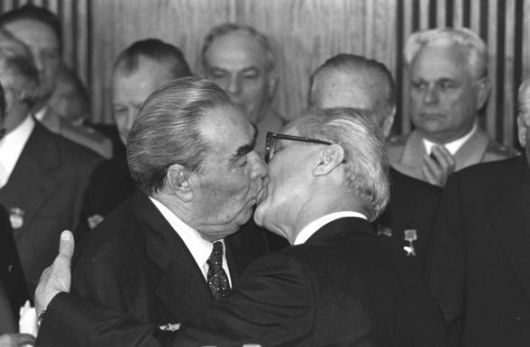
Once you’ve done that, how about looking at another photo? Same instructions: take a look at this photo, and jot a few notes about what you see. Perhaps you have already seen both of these rather iconic photos.

Breznev-Honecker_1979

Keep looking at the second photo. If you did not already know this, the photo was taken during the 30th anniversary celebrations of the Democratic Republic of Germany (East Germany) in 1979. On the left is Leonid Brezhnev, leader of the USSR, and on the right is East German President Erich Honecker. Now, take a few more notes on what you see in the photo.

Did your perceptions change between the first and second times you took notes? Before you proceed, take a moment to reflect on the values, assumptions, and beliefs that underly the perceptions you noted this second time around.

Finally, compare your perceptions, and your values, assumptions, and beliefs about both of these photos. In what ways did you respond similarly? In what ways differently? Why?

FIRST PHOTO
In fact, President Mahmoud Ahmadinejad was criticized for consoling Chavez’s mother in this way; she is not a member of his family, and thus, such touching is haram or forbidden. While my research shows the photo to be real, there are reports of the photo being doctored in order to cause problems. I personally find the actions captured in the photo quite believable: a man consoling a grieving mother and bridging cultures in the moment. Below are two sources for those of you curious to learn more about this photo and the response to it:

  1. Daily Mail article
  2. IranPulse English language news blog

SECOND PHOTO
It was quite commonplace for Communist leaders to kiss on the mouth as an expression of brotherhood and solidarity. This iconic photo was taken by Régis Bossu, a freelance photographer for European Stars and Stripes, Stern, Spiegel, and Sygma. Most observers of the time viewed this Brezhnev-Honecker kiss as more enthusiastic than usual. The photo was quickly and widely circulated.

Berlin, East Side GalleryIn 1989, during the euphoria following the fall of the Berlin Wall, Dmitri Vrubel painted a replica of the kiss on the Eastern side of the Wall. If you wish to learn a bit more about the photo and the painting, here are a couple of links:

  1. Lite Strabo Stories from History blog
  2. Wikipedia

While we can learn much about history and politics from photos such as these, we can also learn about customs and values. And, perhaps most importantly, we can learn to see our own cultural filters and biases a bit more clearly. Exercises such as these can be used to complement the learning we gain about ourselves via the Cultural Detective Self Discovery.

Coincidentally, when she was proofreading this post for me, our editor, Kathryn Stillings, shared with me that she had just read this article, about our perceptions (socially constructed) of race: What Does “Black” and “White” Look Like, Anyway?: Obama and His Grandpa. I share it with you as it would seem to support, as well as build on, the point of this post. I particularly love the morphed photos at the bottom of the article.

Before I close, I’d like to thank a few of the members of SIETAR Argentina, who recently used the second photo above in a training, and reminded me of it after so many years.

And, in conclusion, I leave you today with a few quotes:

There is no truth. There is only perception.
—Gustave Flaubert

Science is nothing but perception.
—Plato

Studies have shown that 90% of error in thinking is due to error in perception. If you can change your perception, you can change your emotion and this can lead to new ideas.
—Edward de Bono