We Want to Get Rid of You!

“The Power of Storytelling in Intercultural Communication”
Many thanks to Joanna Sell, a certified Cultural Detective facilitator, for this terrific guest blog post. Be sure to check out her new intercultural storytelling blog at http://www.interculturalcompass.com/blog/.

DOD

It was early autumn when Martin, a German project leader, relocated to Mexico. At the beginning of his assignment he was very excited about the new challenge and curious about the host culture. His only concern was the fact that he was an introvert.

Every day before going to his company he threw a coin and “played heads or tails”. When he saw heads he would talk to the very first employee he encountered on his way. While seeing tails he would breath a sigh of relief that he did not have to “jump over his shadow” to practice small talk. Nobody knew about his habit and his team members were quite puzzled by his behavior, seeing that he did not talk to them as often as had their former leaders.

Pretty soon even those who had been very talkative at the beginning of Martin’s assignment limited their exchanges with him to the minimum. His assignment became challenging and Martin could not help feeling excluded, not only in the professional context but also in private life. Actually, he almost had no private life at all. Spending extra hours at work in the evening and during weekends resulted in isolation amidst a crowd of smiling faces in Mexico.

One late October morning, shortly after arriving at the office, Martin noticed a colorful skull made of sugar on top of his desk. He closed the door and slowly sat down. He remained frozen for half an hour or longer. He noticed that his colleagues barely spoke to him. Seeing the skull, he got terrified that they most probably wanted to get rid of him.

What happened next?

When Katrin Sihling—a dear colleague of mine from the Munich area who was raised by her Mexican mom and her German dad in South Germany—finished the story and asked that question, everyone in our group at Jena University smiled. Someone hurried with a possible explanation: “People in Mexico celebrate November 1st with parties to commemorate their ancestors and give one another sweet skulls to highlight the festive character of this feast”.

Listening to that explanation I sketched the following concluding scene in my head: Luckily, Elena, one of Martin’s team members, originally from Switzerland, entered his office and got concerned when she saw Martin’s pale face and absent gaze. When he indicated towards the skull without saying a word, she immediately noticed the cultural misunderstanding. It was she who had put the colorful sugar skull on his desk, as she did every year for all the people in their department. She explained the symbolic meaning of the sweet skull and asked Martin whether he wished to join the Mexican part of her family in celebrating El Dia de los Muertos.

That day both of them learned something new: not to take the world of obviousness (their world of obviousness) for granted, but to ask for new meanings instead.

The power of the storytelling approach in the intercultural context lies exactly in this attitude. Exchanging stories across cultures enhances curiosity and redirects attention from a focus on general, simplified assumptions and towards sense making and re-narrating the world of obviousness; that’s why the Cultural Detective Method is built around stories! Every critical incident in our series is a true story, sometimes a combination, involving real people in real situations.

“Culture is a set of stories that we enter” (Jerome Brunner) and exchanging facts and data about cultures without exchanging stories is a dead-end street.

“It is the stories we share with each other that help us to overcome cultural conflicts, cope with transition stress, and shape how we perceive the past and see the future. Thanks to an exchange of stories we become able to rethink our assumptions and change our behavior. Changing behaviors definitely requires mindfulness in order to recognize which behaviors are inappropriate and which are desirable in different cultural contexts.

To sum up why we need storytelling in the intercultural context, I would like to offer a short list (instead of a story) that includes the following issues:

  • Storytelling suppports zooming in and out effects and, therefore, enables perspective change.
  • Storytelling allows the discovery of cultural roots from multiple perspectives.
  • Storytelling offers insights into the complexity of multicultural identities.
  • Storytelling can be an eye-opener in new cultural surroundings.
  • Storytelling adds the emotional layer to the cognitive level.
  • Storytelling serves as a means of transmitting cultures.
  • Storytelling deals with new stories of belonging.
  • Storytelling initiates change processes.
  • Storytelling serves as sensemaking.
  • Storytelling moves hearts.

Sell, J. (2017): Storytelling for Intercultural Understanding and Intercultural Sensitivity Development in: Chlopczyk, J. (ed.) Beyond Storytelling. Springer Gabler, pp.234-235.

Made you curious? Please find more about the storytelling approach in the intercultural context with a focus on choice biographies and identities in flux, coping with the danger of a single story, new stories of belonging and a hands on compilation of storytelling methods that can be applied in intercultural programs in two of my chapters published in following books:

Sell, J. (2017): Storytelling for Intercultural Understanding and Intercultural Sensitivity Development in: Chlopczyk, J. (ed.) Beyond Storytelling. Springer Gabler.

Sell, J. (2017): Segel hoch und auf zu neuen Ufern – Eine Reise durch die Welt der Storytelling-Methoden im unterkulturellen Kontext in: Schach, A. (ed.) Storytelling. Geschichten in Text, Bild und Film, Springer Gabler.
Of Friends and Transitions

Living overseas seems to bring with it a mobile and transitory lifestyle of a caliber foreign to those who steward the home traditions. We become accustomed to a series of pronounced and frequent life transitions. In Tokyo foreign friends would transfer to assignments in other exotic locations every three to five years. It makes it nice for traveling, a privilege to be able to stay with friends around the world, but their departures leave huge holes in our lives. In Mazatlán there seems to be a frequent seven to ten year cycle to expat life, with beloved friends moving to the interior of the country or back home, closer to grandkids, so they can be an integral part of those children’s lives.

Transitions are a normal part of life; I know this. Life is comprised of cycles; I know and believe this from the depths of my heart. Yet dealing constructively with transitions is the reason I made a career as an interculturalist oh so many decades ago. I am not good at them. They hurt. Things change. They can even change for the better, open new doors and windows for which we’ll forever be grateful. But, they involve change nonetheless. Someone “moves our cheese.”

Read full article: Of Friends and Transitions

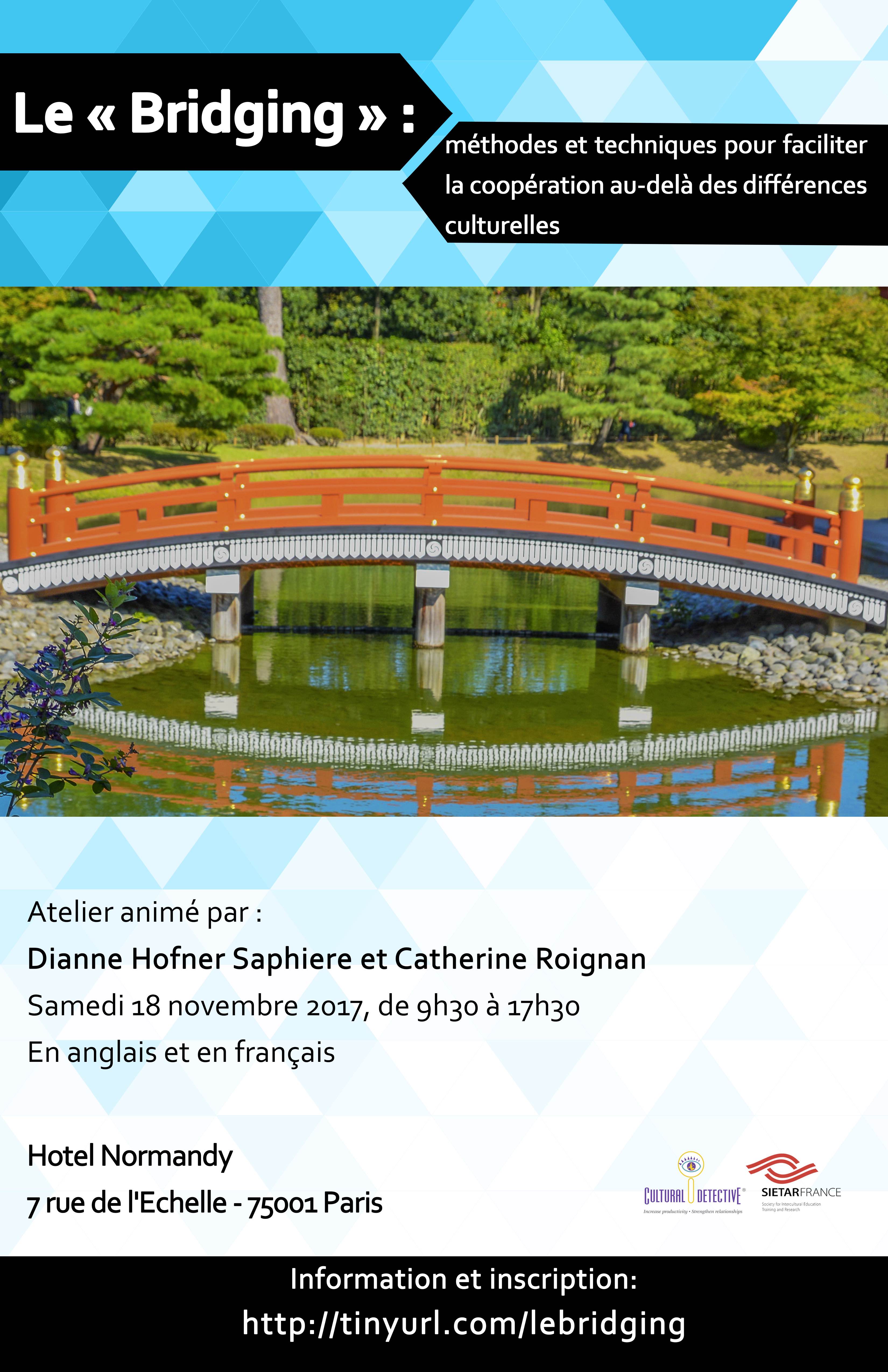
Le « Bridging » 

I hope you’ll join Catherine Roignan and myself in the heart of Paris on 18 November for this terrific one-day, bilingual workshop! English follows the French.

Atelier le samedi 18 novembre 2017 de 9h30 à 17h30
Hotel Normandy, 7 rue de l’Echelle – 75001 Paris
Animé par Dianne Hofner Saphiere et Catherine Roignan
Organisé par SIETAR France

Le « Bridging » : méthodes et techniques pour faciliter la coopération
au-delà des différences culturelles

Savoir « créer des ponts » entre personnes ou groupes culturellement différents, les mettre en situation et en capacité de communiquer et coopérer de façon efficace : c’est à la fois une nécessité et un but pour de nombreux chefs d’équipe, que ce soit en entreprise, dans les administrations ou les ONG.

Le « bridging » est aussi l’objectif ultime du travail interculturel : si on apprend à remettre sa propre culture en perspective et à se familiariser avec la culture de l’autre, c’est précisément pour parvenir à construire ce pont sur lequel se rencontrer.

Mais comment s’y prend-on concrètement? Comment les managers et les professionnels de la formation et du conseil peuvent-ils favoriser la synergie des efforts et des équipes internationales?

Le Cultural Detective® « Bridging Cultures » capitalise sur l’expertise existant désormais dans ce domaine : compétences, activités, grilles d’analyse, bonnes pratiques pour faire évoluer les esprits et les pratiques, issues d’expériences dans différentes organisations dans le monde.

Dans cet atelier dynamique et participatif, vous apprendrez comment :

  • Renforcer votre capacité personnelle à « faire le pont » avec des personnes différentes de vous
  • Prévenir et surmonter les blocages dans la communication
  • Adapter votre stratégie de « bridging » à des contextes particuliers
  • Identifier des mesures concrètes permettant de faciliter la coopération entre groupes culturellement divers.

Vous serez amenés à expérimenter vous-mêmes plusieurs exercices du Cultural Detective® « Faire le pont entre les cultures », de manière à pouvoir ensuite les transposer dans vos groupes et organisations.

L’atelier sera bilingue, en français et en anglais.

Programme de la journée :

9h30      Qu’est-ce que le « bridging » ? Présentation de la problématique
10h30    Compétence 1 : Identifier son attitude personnelle face au « bridging »
11h30    Pause café
11h40    Compétence 2 : Prévenir et surmonter des blocages de communication
13h         Déjeuner libre
14h15     Compétence 3 : Analyser les contextes d’intervention
16h         Pause café
16h15     Compétence 4 : Identifier des mesures concrètes et adaptées pour créer des
ponts
17h15     Conclusion, retours des participants et pistes pour action.

Registration: http://sietarfrancecongres.com/events/le-bridging-un-atelier-propose-par-dianne-hofner-saphiere-et-catherine-roignan/

Bridging Cultural Differences: Methods and Techniques to Create Cooperation that Leverage Differences

18th November 2017 from 9.30 am to 5.30 pm
Hotel Normandy, 7 rue de l’Echelle – 75001 Paris
Facilitated by Dianne Hofner Saphiere and Catherine Roignan
Organized by SIETAR France

To build a bridge between culturally diverse persons or groups and develop the environment and ability to communicate and cooperate efficiently: that’s both a necessity and a goal of many team leaders in organizations worldwide.

Bridging is also the ultimate goal of any intercultural work: learning to put our own culture in perspective and learn about the other’s cultures is part of the process.

But how to do this concretely? And how can managers and training and consultancy professionals best support the synergy of efforts and teams, so that differences become assets ?

Cultural Detective Bridging Cultures capitalizes on the now-existing expertise of intercultural bridging practices in different organisations around the world. It identifies key competencies, offers activities, grids for analysis and best practices to help mindsets and habits evolve and to create cooperation.

In this dynamic and interactive Cultural Detective®Bridging Cultures workshop you will learn how to:

  • Reinforce your personal ability to communicate and bridge with different people.
  • Prevent and overcome blocking situations.
  • Adapt your bridging strategy to specific contexts.
  • Explore different techniques to foster cooperation between culturally different groups.

This workshop will leverage select exercises from Cultural Detective® Bridging Cultures so that you can replicate them in your work, communities and organizations. You will leave the workshop with practices you can implement immediately as well as extensive handouts.

The workshop will be facilitated bilingually in French and English.

Program of the day :

9.30 am                               What is « bridging » ? Definition and issues at stake
10.30                                    Key Competency 1 : Self-awareness and bridging mindset
11.30                                    Coffee Break
11.40                                    Key Competency 2 : Overcoming blocking situations in
communication
1 pm                                     Open Lunch
2.15 pm                                Key Competency 3 : Contextual analysis
4 pm                                     Coffee Break
4.15                                       Key Competency 4 : Generating bridges
5.15 – 5.30                           Conclusion, feedback and tips for action

Registration: http://sietarfrancecongres.com/events/le-bridging-un-atelier-propose-par-dianne-hofner-saphiere-et-catherine-roignan/

Focus on Responsible Tourism

We greet hundreds of thousands of national and international visitors each year on the west coast of México where I live. For years I have promoted cultural and religious tourism to the State Secretary of Tourism, trying to encourage travelers to get beyond the beer and beaches to experience a bit of the “real Mexico.”

Recently, a colleague in Milan, Maura di Mauro, told me about a special film track she coordinated in May at the SIETAR Europa Congress in Dublin entitled, Focus on Responsible Tourism. She cautioned me about how the culture of Mursi villagers in Ethiopia was changing due to tourism. Thanks to an influx of camera-toting tourists willing to pay for photos, the villagers increasingly exaggerate their traditional practices and even falsely embellish them, to make them more attractive to visitors. She also told me about Chinese tourists descending en masse on a small village in The Netherlands. Many of the Dutch residents welcome the added economic boost such international tourism provides, but there are also downsides to such tourism and, again, changes to the host culture.

Maura got me excited and I can not WAIT to view these two films!

The first documentary Maura told me about is called Framing the Other” by Ilja Kok and Willem Timmers  (25 min, English and Mursi with English subtitles, €445 for the film in an educational package with guide and readings on tourism’s impact).The Mursi tribe lives in the basin of the Omo River in the south of the east African state of Ethiopia. The women are known for placing large plates in their lower lips and wearing enormous, richly decorated earrings. Every year hundreds of Western tourists come to see the unusually adorned natives; posing for camera-toting visitors has become the main source of income for the Mursi. To make more money, they embellish their “costumes” and finery in such a manner that less of their original authentic culture remains. The film contrasts the views of Mursi women and those of Dutch tourists preparing for a meeting. This humorous and at the same time chilling film shows the destructive impact tourism has on traditional communities. The film screening was followed by a Q&A with producer Ilja Kok. A preview follows:

The second film is called Ni Hao Holland: The Chinese are coming” by Willem Timmers (25 min, Mandarin and Dutch with English subtitles, €395 for the film in an educational package with slides and readings on understanding Chinese tourists). This is a documentary about Chinese tourists and their quest for the authentic Dutch experience. Cherry, the main character, has long dreamed of swapping her home city Beijing for the Dutch village Giethoorn. She has heard and read a lot about this mythical place. The day arrives that she and her friend hop on the plane in search of adventure. In the meantime, entrepreneurs from Giethoorn work hard behind the scenes to cater to this “Holland experience.” They want to make the most of the fast-growing flow of Chinese tourists to their village. How is this authenticity created by some and experienced by others? Below is a preview:

Maura also curated a third film for the festival at SIETAR Europa:Holi-days” by Randi Malkin Steinberger (50 min). If you’re interested in tourism and its impact on culture, it looks very worthwhile.
Why do we visit pilgrim’s places, art capitols and tourist’s paradises en masse? Traveling from Jerusalem via Florence to Las Vegas, Steinberger takes the answers to these questions to an increasingly general plane. In Jerusalem (welcoming three million visitors a year) we see tourists visiting the holy places, buying souvenirs, and putting themselves through torments that Jesus Christ once endured. What they are looking for is elucidated in short statements by pilgrims, tour operators, church leaders, guides, scientists, and souvenir vendors. All these opinions put forward a few basic ideas: tourism and commerce overgrow religion, and sacred places and objects give people the feeling that they are part of some higher order. We could look at Florence in the same way, where annually six million tourists drink in the best of Renaissance Art. The street interviews allow the same conclusion as in Jerusalem: people feel dumbfounded and overwhelmed. The countless tourists and the massive trade in souvenirs “have turned the city into a congealed moment in time.” The climax of this film journey is reached in Las Vegas. In this city, 36 million people a year enjoy replicas of famous cities and monuments, cinematic reconstructions of historical moments, spectacular shows, and dazzling gambling palaces. Here, the reality, which people also look for in Jerusalem and Florence, is better and more typical (and even more soulless) than in reality.