Ochobo’s “Liberation Wrapper”

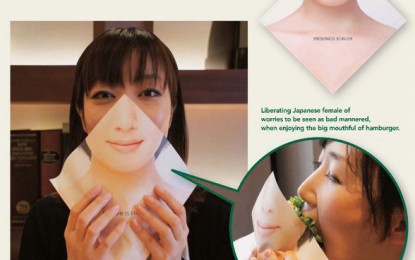
liberation-wrapper-415x260What a terrific, culturally appropriate marketing ploy! When I lived in Japan, I was oh-so-conscious to cover my mouth with my hand when I laughed out loud, or if I had to open it real wide while eating. “Ochobo,” or a small mouth, is traditionally seen as a sign of feminine beauty in Japan.

A national hamburger chain wanted to sell more of its biggest, juiciest, wide-mouthed burgers to women, so it came up with an ingenious idea: the “liberation wrapper”—a stiff paper burger wrapper, imprinted with a closed mouth. The person eating is able to hide behind a dainty little face, saving others from having to watch them chow down.
Every society is changing, and there are plenty of women in Japan who eat burgers in public. There are also those who don’t cover their mouths when laughing. But, hey, this is fun and cool! Maybe next will come a not-so-culturally-necessary but cool men’s “liberation wrapper”!

Here’s an article on the promotion, from the Japan Daily Press.

This promotion reminds me of a story years ago, recounted to me by the then-Director of Tokyo Disneyland. In planning for Adults’ Day (成人の日), the workers realized that many young women would be coming to Disneyland in silk kimono. Knowing that the water spray could damage the expensive kimono, the workers prepared signs, warning the young women of the danger and cautioning them to avoid certain water rides.

The Director scolded them, saying their signs ran counter to the Disney way. “You must figure out a way to let the young women enjoy the rides, in their expensive silk kimono.” The solution? They had a bunch of plastic raincoats made special for Adults’ Day.

What is your favorite culturally appropriate customer service or marketing story?

HUGE Response to Our Post on Names Across Cultures

Name ChangesOur first blog post on Names Across Cultures hit powerfully and emotionally for so many of you! A few typical comments include:

“Names are part of a person’s identity. If people ‘get it’ across cultures we often feel they ‘get’ us, too.”

“We can’t know all languages or accents or tones, now could we? Having said this I would consider it wrong to be forced to change a name because someone can’t pronounce it—are you kidding? Why should the weakness or inability of one (the name changer) be even acceptable?!”

“My name is a point of pride for me. Even though nearly nothing about me screams ‘I’m a Korean immigrant,’ my name tells a very interesting story about who I am. I suppose my life would be marginally easier and I’ve probably gotten looked over for a handful of jobs because of the ‘foreignness’ of my name, but I like it. It’s unique and it’s me.”

“Changing people’s names was another turn of the screw in the arsenal of tricks that the colonial powers used to subjugate people under their dominion.”

We very much enjoyed reading the stories and comments posted here on the blog as well as in the social media. Thank you! We found them quite insightful, and believe you will, too. We heard from people who:
  1. Feel they are avoided at parties and gatherings because others find their names hard to pronounce. “People are embarrassed to mispronounce my name, so they sometimes avoid me altogether.” Talk about insidious discrimination!
  2. Have had others correct their pronunciation of their own name! “Such arrogance! How dare they! Do they even look at signatures on emails? They invariably correct me!” Sadly, this wasn’t just one person sharing this experience with us.
  3. Have been told their name is “wrong,” because it’s a man’s name not a lady’s, or because its origins are in a certain language and this is how it SHOULD be pronounced.
  4. Express the opposite opinion: “Many of us actually mispronounce our own name without knowing it. People who live in countries with a long history of immigrants and their intermarriage, will in due time pronounce a name according to what their ‘new’ language has taught them. Is this now wrong? Well, maybe to some degree yes, but since the new pronunciation is not something done out of maliciousness but rather due to having been told of it wrong.”
  5. Proclaim, “Those of us with unusual names need to stand our ground!”
    1. “I am waiting for the day I can go back to my roots and not cringe every time someone speaks to me!”
    2. “I prefer to have people change my name than butcher (by mispronouncing) my name!”
  6. Advise, “Forget my last name; use my first!” (or vice-versa) for ease in pronunciation.
  7. Are happy to have a different name for the varied contexts in which they live and work.
    1. “If someone calls me Karinka, or makes up another name that is easier for them, or pronounces my name incorrectly, I do not mind at all. I myself am certainly not in a position to pronounce everybody’s names properly, and I know how difficult it can be.”
    2. “It is all relative. When people ask me ‘What is your name?’ I say ‘Marianne.” The spelling stays the same but I pronounce it differently: Marianne (pronounced the German way), Mary Ann (the English way) or Ma Li An (pronounced the Chinese way). Personally I like to make people comfortable in my presence and have no preference how people pronounce my name.”
    3. “My name is Robert. I call myself Rob. In Egypt I’m Mr. Rob, in Finland I am Roope, in China I’m Lobert’t, and in Japan I’m Lobba. I answer to them all, and I’m comfortable with them all. But, then again, I am an intercultural trainer.”
    4. “I had a friend in China and was trying really hard to pronounce his name in Chinese, except he got mad at me. He wanted to be called by his self-assigned English name, and considered it rude that I was even trying to pronounce his name in Chinese.”
  8. Find the whole thing amusing, and leverage the pronunciation difficulties as a method to build relationship and understanding: “I really don’t mind you butchering my name. I understand: Höferle is hard to say if you are unfamiliar with the German language. Changing my last name’s spelling to the English keyboard-friendly Hoeferle also hasn’t helped. It made for funny moments, though. Something sounding awfully close to ‘hopefully’ or ‘hofferly’ has been the usual outcome in recent years. No matter how often I tell people to just forget about saying my last name and instead stick with Christian, they still try to get it right. Which is a really nice gesture, I think.” Bravo! Christian even, most kindly, sent us a link to his blog post on names and a link to learn more about pronouncing names with umlauts.
  9. Comment, “My last name has been spelled, Simons, Simmons, Simms, Symonds, Simonis, Simon, Simone—sometimes two or more versions in the same document. I find this more annoying than mispronunciation, which I am used to and expect, given that I am widely traveled and have lived in a number of countries, and realize that different language speakers use their own preferences for how the vowels sound. Misspelling can make authentication of documents difficult. Sometimes my family name is taken as a first name in documents and George(s) becomes my last name.”
  10. Share with us, “US immigration officers in the 19th and early 20th centuries were not beyond renaming immigrants on the spot, crossing out ‘Walentinowicz’ and writing in ‘Walters.’ 

Catholic Baptisms were conducted in Latin years ago, and it was required that a Saint’s name be given a child. There is no St. Nancy, so my cousin was named Venantia Fortunata (which I never let her forget).”
  11. “Dutch speakers use their digraph ij pronunciation which is the wrong pronunciation for my surname, as the languages are not even remotely related. Ironically, English language has roots in Anglo Frisian, yet native English speakers seem to have more difficulty with pronouncing my surname than just about any other heritage speaker. I can understand difficulties arising from having no equivalent sounds in other languages, but can not fathom where anyone gets the additional consonants…”
  12. And the humorous, “I once dated a guy who couldn’t pronounce my name properly, even though his former girlfriend of seven years was also called Kaisa. No need to say it didn’t last long…”

Readers very much enjoyed the quiz we put together, and shared with us another name to add to it: by what far more famous name was Margaretha Geertruida Zelle known? (answer at the bottom *)

There was obviously a broad range of responses from one imaginable end of a continuum to another—just begging for someone to conduct research into naming and our responses to name changes, spelling and pronunciation across cultures.

How do the use, pronunciation and spelling of names affect international organizations? Readers expressed:
  1. A lot of resentment around computer systems not having non-“standard” letters, because it means that people’s names often show up with strange characters in them, rather than being spelled correctly (“Brünnemann” not “Brünnemann”). “I do wonder when big, supposedly ‘international’ organisations or institutes do not even have their software in a position to spell international names,” said one of our community members. We know first-hand. It seems every other week one of our web pages has spontaneously changed to show strange rather than correct characters in one of our author’s names!
  2. “Dear marketers and copywriters: Inserting umlauts into your American brand names, logos or slogans may help you create some awareness. But it will also let you look really ignorant of other languages and cultures.”
  3. “I do have a problem when, for example, I read in a Peruvian paper, ‘Principe Carlos,’ where both the word ‘Prince’ and ‘Charles’ were translated into Spanish. It would have been OK if it were only Principe Charles. Why did they not stop there? Why not call Michael Jackson ‘Miguel HijoDeJacobo’? I know the reason behind it, btw, nevertheless I find it amusing.”
  4. “It’s so unfortunate when people and institutions feel they need to change the spelling of my name. Went to vote today in the NYC primaries and somehow my name got automatically changed to Bo Y. Kang. I have never written my name like that and I’m super duper conscious of getting the whole Bo Young part right under the section that says First Name so that they realize that’s my first name. I always leave the Middle initial section completely blank. Other ways my name gets written even after I’ve spelled it correctly:
    1. The magical hyphen: Bo-Young Kang
    2. The other magical hyphen: Bo Young-Kang
    3. The switcharoo: Bo Kang Young (and all its variations Kang Bo Young, Young Bo Kang, Kang Young Bo, Young Kang Bo)
    4. The disappearing game: Bo Kang
    5. The other disappearing game: Bo Young (this one I don’t mind so much because it’s technically correct, just missing a part)
    6. The condenser: Boyoung Kang
    7. The other condenser: Bo Youngkang
    8. And those are just the ones that include all the right letters. You don’t even want to get me started on the Bow, Boo, Booh, Yung, Ying, Yong, Kan, Li, Rhee variations I get all the time. 
    9. My name isn’t that hard. It’s spelled exactly like it sounds.”
Strategies for dealing with difficult-to-pronounce names that our readers shared with us included:
  1. Rhymes and mnemonics you’ve made up to help people learn to pronounce your name: “

Over the decades I’ve created stories to help people pronounce my name—’Think of going to the MALL. After a long day of shopping, you need a cup UH TEA. 

One year ago, someone blithely said, ‘Oh, your name rhymes with ‘Quality.’ 

Now when I meet someone, I introduce myself cheerfully: ‘Hi, my name is Malati. It rhymes with ‘Quality.’ This immediately releases the tension. 

’Rhymes with Quality’ is on my email signature, business cards, nearly anywhere my name appears!”
  2. “An interesting way to learn about a new acquaintance can be to ask the meaning and origin of the person’s name. Every nation has a trend of calling up by some peculiar name which helps a lot for better communication and understanding.”
  3. “Years back while in Nigeria the head of the Media Department there was Igbo. One time I listened carefully and repeated his family name again and again and could never get it right—though it did sound the same to my year (and herein lies an importance to note) I could not do so. Time passed, making myself more familiar to the language so I tried again, and once more I could not achieve it. More time passed with the same negative results. He would smile at me every time I pronounced his last name, knowing I had it wrong but was at least genuinely trying. He was also nice enough to let me know I was the one who came closest to it and that no one before or after me ever tried so hard. Just so you know, the Igbo language is one of the few languages that actually has sounds going in (like inhaling) when speaking.”
  4. “I actually take great pains myself to repeat until I have someone’s name correct if it is ‘foreign’ to me … surely this is a minimum sign of respect!!!”
  5. “Your link to audioname.com is a terrific resource, and I recommend all in this community adopt its use. If your name is not hard to pronounce, you can use your 30-second audio-byte to talk about the origins of your name. It will encourage others to use this and help make our world more pronounceable and accommodating.”

The common theme, however, is BE CAREFUL WITH NAMES. Ask! Show respect. Discuss and don’t assume. And definitely avoid changing someone’s name without their permission; it’s a rare person who loves a nickname or name change that has been “assigned” or “imposed.”

I have one more video clip to share with you, from my interview with Dr. Emmanuel Ngomsi. In this short clip, he tells us how names are traditionally given in his home, Cameroon.

A common characteristic of many cultures around the world is the importance placed on naming a child. Factors that may be considered might include gender, birth order, astrological factors, family tradition, naming the child after a parent or beloved relative, date of birth, or characteristics valued in the birth culture or family and with which those naming the child want to imbue the newborn, among a wide variety of others. In some traditions family members do not share a family name. Do the parents choose a child’s name? Do the grandparents? Is there some ceremony in which the child chooses his/her own name? Does the state dictate selection from an official list of acceptable names, as has been the case in Iceland?

Here’s the video:

* Answer: Mata Hari

Please do share with us your further reactions, experiences, stories and advice. It is obviously a topic that merits some study as well as some training.

See Part 1 of this interview.

My Global Life Link-Up

Use of a typical Indian metaphor by Devdatt Pattnaik to speak of culture: Kolam

tumblr_lk8iuxl2vK1qa2x4yo1_500This guest post is written by , cross cultural consultant and trainer. Remember, don’t think “chaos;” think “pattern!”

Often times in my intercultural trainings to Indian audiences, I have sensed a discomfort in my participants with using models (the iceberg of culture, for example) and imagery that are often more easily understood by Westerners. Perhaps, I am more sensitive to this discomfort because I felt the same when I learned not only one but two foreign languages (English and French), with their intrinsic imagery that was so far removed from my local reality.

You can imagine my joy when I stumbled upon Devdutt Pattnaik’s use of a typical Indian custom of drawing kolams (rangoli in North India) to explain the Indian world view. Used to adorn the floor at the entrance of even the most humble abode in India, it is basically a pattern that is drawn, using lines to connect a grid of dots. There is nothing rigid about how the dots need to be connected—each person chooses to connect the dots as s/he desires, and each pattern is a legitimate one, just as is each culture.

Below you can watch his thought provoking presentation on India. I particularly love his closing lines. Enjoy! What are your favorite local metaphors and imagery that resonate with the local contexts you work in?

Building Leadership Resilience with Cultural Detective

ILA_logoBlackblue
Cultural Detective® will be featured in a workshop at the 15th Annual International Leadership Association Conference in Montreal, Canada, Oct 30 – Nov 2, 2013.  Dr. Karen Lokkesmoe, Leadership Across Meridians, and Tatyana Fertelmeyster, Connecting Differences Consulting, co-author of the Cultural Detective® Russia, will lead a workshop demonstrating how CD can be used to build global leadership competencies.

Session Description:
Building Leadership Resilience with Cultural Detective
Saturday, Nov 2  10:15 -11:15   Room: Gatineau
At the Fairmont Queen Elizabeth in Montreal

There are many facets of global leadership, and any number of skills that are required of today’s leaders, but one of the core skill sets is intercultural competency (Moodian, 2010; Lokkesmoe, 2009; Mendenhall, 2008). It has become clear that good intentions, awareness-raising, and exposure to other cultures are not sufficient, in and of themselves, to build global leadership and intercultural capacity (Mendenhall et al., 2008; Vande Berg & Paige, 2009). The focus must be on intentional capacity building. Cultural Detective® is an innovative and engaging methodology that allows for building concrete skills and developing sustainable ability to understand, engage, and lead others in intercultural situations more effectively.

This interactive workshop demonstrates how to use the Cultural Detective framework to build and develop intercultural leadership skills. Participants can expect to learn how to use specific elements of the Cultural Detective (culture-specific Value Lens, Worksheet, and Cultural Detective Online) as practical tools in situational analysis and decision making. Using Cultural Detective as part of your global leadership development strategy will help you increase performance, productivity and profits through loyalty, teamwork, and return on investment. It is a tool you and your employees can use immediately to achieve the bottom-line results that intercultural competence can bring to your organization.

Come put on your detective hat and learn how you can use this fun and engaging tool to enhance your (and your organization’s) global leadership competence! While our world may be shifting rapidly, developing skills to identify cultural similarities and differences, accurately interpreting real life situations from multiple perspectives, and designing creative, interculturally sound solutions help foster the resilience we need to be effective leaders today. We hope to have you join us.


Developmental Intercultural Competence Using Cultural Detective Online

CDO
Are you doing your best to develop cross-cultural effectiveness in your organization, and want better results? Quicker results? Longer lasting results? Or, maybe even just results—heightened productivity and satisfaction? Our clients have achieved amazing increases in cross-cultural effectiveness—their people improving two stages on the DMIS (the Developmental Model of Intercultural Sensitivity) in a few months, and customer satisfaction increasing 30%—using Cultural Detective developmentally. How did they do that?…

Index for This Post (jump ahead if you’d like)
The DMIS
The DMIS and Cultural Detective
How Customers Successfully Build Intercultural Competence
Additional Resources

Developmental Model of Intercultural Sensitivity ©Dr. Milton J. Bennett, 1986 & 1993.

Developmental Model of Intercultural Sensitivity ©Dr. Milton J. Bennett, 1986 & 1993.

The DMIS
Let me start by telling you about the DMIS. First published by Dr. Milton Bennett in the International Journal of Intercultural Relations in 1986, and more fully developed in Education for the Intercultural Experience in 1993, the DMIS has proven to be a key milestone in the intercultural field. It provides a roadmap for those of us who aim to develop intercultural competence.

A developmental model is a conceptual framework that helps us better understand a progressive process, as well as providing guides for continued development. Examples of a developmental model with which most parents are familiar are those charts that track the major milestones of an infant’s growth. Such models help us anticipate when our baby will smile, sit up, crawl, or distinguish right from wrong, and they can help us ready our children for their next big challenge. There are abilities our baby generally must develop (e.g., roll over) before being ready to accomplish tasks at a higher stage of development (e.g., crawl). At each stage, the baby needs to be appropriately encouraged, while also feeling safe enough to take the risk to try something new.

Similarly, the DMIS is a conceptual model of six stages of the development of intercultural sensitivity, from ethnocentrism to ethno-relativism. The IDI, or Intercultural Development Inventory, is a psychometric instrument that assesses one’s stage of development. Its origins are based in the DMIS, though it uses a slightly modified version of the model today, called the IDC (Intercultural Development Continuum). The DMIS and the IDI enable us to track where we are in the development of our intercultural sensitivity, and ready ourselves for enhanced sensitivity or effectiveness.

The DMIS and Cultural Detective
The beauty our clients have found in the Cultural Detective Method is that it challenges and supports, stretches and comforts, learners at each stage of their development of intercultural sensitivity. While the DMIS and IDI indicate where one is on the developmental continuum, Cultural Detective assists in the learning and development of the skills needed to succeed in cross-cultural interactions.

The process works organically. The designer must make the case for diversity and inclusion in developmentally appropriate ways, and debrief learning in ways that comfort and challenge the learners. However, the Cultural Detective (CD) Method itself need not vary, no matter the developmental stage. Learners, depending on their abilities, will naturally use the CD Method differently at different levels of development.

Let me give a couple of examples.
  • Learners in ethnocentric stages of development will easily and fairly quickly solve a Cultural Detective mystery—they will be eager to complete the Worksheet, solve the problem, give the participants in the critical incident advice on what they should have done differently. Facilitators will observe, however, that learners at earlier development stages will suggest Cultural Bridges that are naïve or unrealistic, though of course possible. They might suggest, for example, that “the Japanese person just needs to speak up more assertively,” or “the Mexican manager needs to be more considerate of others and trust that his and his company’s welfare will be looked after.” Both of these recommendations are within the realm of possibility, both are achievable by Japanese and Mexicans of certain personality types or personal discipline, but such Bridges are not realistic for the majority of people from those cultures. Learners in ethnocentric stages feel good that they are able to solve the problem, which encourages them to try another and, with practice, learn what really works and what doesn’t when teaming across cultures.
  • When completing that same Cultural Detective Worksheet, learners in ethno-relative stages of development will enjoy pairing Values, Beliefs and Cultural Sense with the Words and Actions they motivate. They will invest effort into discerning the commonalties, as well as the differences, between the participants in the critical incident. They will develop ways to build on shared interests, while also leveraging diverse opinions and abilities, so that all players more fully contribute and the organization or community benefits. They will, without prompting, compare themselves, their values and beliefs, to the players in the incident—constantly learning, discovering, and refining their self-understanding. They will, in an organic way, explore and cultivate their cultural (or multicultural) identities, their understanding of and empathy for others, and their abilities to collaborate across cultures.

Thus, in a very natural way, learners at all stages of development receive the support as well as the challenge they need to continue their developmental journey towards intercultural sensitivity. There is very little stress on the facilitator to adapt the CD Method for the learner’s level of development, freeing the facilitator to focus effort on answering questions and dealing with resistance in ways that are both appropriately challenging and supportive to the learner.

And such a flexible process can be a blessing when we work with groups from mixed developmental levels. I often compare the Cultural Detective Method to the Montessori approach, because learners at all developmental levels can gain from helping one another.

So, How Do Customers Do It? How Do They Successfully Build Competence?

1. Research shows the development of intercultural competence requires ongoing, structured learning. That is precisely what a subscription to Cultural Detective Online (CDO) provides. So, first, get a subscription. If you want to build competence in your team or organization, if you are an experienced interculturalist, or if you are new to the Diversity and Inclusion space, a CDO subscription is a small investment with huge potential. The subscription agreement allows you to project CDO contents onto a screen for group viewing in any work you personally deliver, as long as you explain to your learners that Cultural Detective Online is a tool that anyone can subscribe to. Our goal is to get these materials used!

2. USE the system, regularly. Cultural Detective Online isn’t an entertainment system; it isn’t passive; it won’t give you intercultural competence through osmosis or by using magic dust. (That’ll be version 2! Just kidding.) Log onto the system once a week, and spend 20-30 minutes debriefing a critical incident, and using Values Lenses to supplement what you see. Respond to the prompts asking you what you’ve learned. Review your notes.

3. After a few weeks using your subscription, once you feel comfortable and competent with the Cultural Detective Worksheet, upload your own incident. Choose something from your real life: perhaps an interaction with a family member, friend, or colleague that puzzled you. Once you write the brief story, link the participants in your incident (yourself and others) to the Values Lenses in the Cultural Detective Online system. Think about why you behaved the way you did, and reflect on the influence that national, gender, generational, and spiritual values had on your behavior. Think about these same influences on the other people in your incident.

4. Then, you can discuss the incident with the real people involved in the situation. Having worked through a CD Worksheet, you will be able to move beyond judgment in your discussion. You will have already thought through the possible positive intentions of the other person, so your dialogue will proceed constructively. You both can learn, and collectively develop strategies to collaborate, or cohabitate, more enjoyably.

5. If you are a team lead or an organizational facilitator, gather your learners together regularly (monthly, quarterly), to discuss what skills they are acquiring using the CD Online system, questions they have, and the challenges they’re experiencing in developing intercultural competence.

6. Remember, Cultural Detective need not stand alone; supplement the tool with your favorite activities: simulations, exercises, videos, role-plays, etc. The core Cultural Detective Method dovetails smoothly with just about any other intercultural tool or technique, because it is a process.

7. If you want to track your progress, be sure to use the IDI to get baseline measurements of participants in your group. I’d then recommend participants take the IDI again, after three months of structured learning using CDO. You will be amazed by the results!

8. Cultural Detective Online is a tool. It doesn’t replace skilled facilitation; it supplements and extends it. You may already use the MBTI, the IDI, dimensions models, etc., in the training or coaching you do. Add CD Online to your repertoire and you will be delighted at how it transforms what you are able to achieve with your learners.

9. Be sure to share your Cultural Effective success story with us, and get your organization some positive kudos!

Additional Resources
A few years ago, two very experienced and well-regarded intercultural facilitators, Heather Robinson and Laura Bathurst, wrote an article explaining what I’m talking about.

I am also happy to share with you one of the handouts I prepared for a session at a recent IDI Conference (be sure to scroll down to view all three pages). This handout is a table showing the needs for challenge and support at each stage of development, and explicates the ways in which the Cultural Detective Method meets those needs. You are most welcome to download and print this handout. Note that in the handout you will find the five stages of development that are currently used by the IDI (slightly different than those of the DMIS, above).

Please let us know how you have used Cultural Detective in your teaching and training to facilitate your learners’ intercultural development. I would also like to invite any researchers or graduate students who are interested in conducting research on this important topic to contact us.
Tips for Working Cross-culturally in Health Care Settings and Beyond

Marilyn does an excellent job with her blog, and today’s is no exception. If you work in healthcare, I believe you’ll find this helpful. —Best, Dianne

Marilyn's avatarMarilyn R. Gardner

Through my years of living, working, and communicating across cultural boundaries I’ve realized two things that sum it all up: one — this road is humbling and two – it’s a life-long learning process. Just when I think I have it all figured out, something, someone will come into my life and challenge my thinking and my well-worn tool box of ‘how to live and communicate across cultures’.

This is setting the stage for this post that is co-authored (though she doesn’t know it yet) by my cultural broker, colleague, and close friend Cathy. Cathy has taught me much about living and working across cultural boundaries. We have worked together to bring resources and workshops on culturally responsive, culturally competent care to health care providers in the Northeast for a number of years. Together we have come up with this list, compiled from a variety of sources. While we work…

View original post 433 more words

What do you REALLY intend?

Car crashA guest blog by Susan McCuistion, Principal, daiOne—Strategy building for business and for life

We see any situation we’re dealing with first from our own perspective. While this is a perfectly natural thing to do, if we don’t also think about the situation from other perspectives, we may jump to conclusions that are incorrect.

The Cultural Detective Model is a great way to help us interpret and understand different perspectives. Key to using this model is to assume positive intent on the part of all parties involved. This gives us the opportunity to step back from our immediate interpretation of a situation, based only on our own perspective, and consider other ways in which the same situation may be viewed.

While this external view—assuming positive intent on the part of others—is important, there is also an internal step we can take before any interaction. That step is to understand our own intentions in what we are communicating.

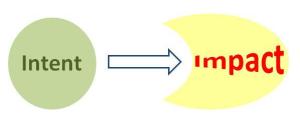
Let’s face it . . . we’re all human and sometimes we say or do stupid things. No one is immune. We often say we don’t “intend” to hurt someone or do something thoughtless, but whether we intend it or not, the impact of what we say or do is felt by other people.

If other people are continually upset by our words or actions, at some point, we need to stop hiding behind “I didn’t intend to do that.” When we keep bumping up against reactions and challenges that we did not intend to cause, then we need to understand that the impact of what we are doing is not effective.

intent impact

When we continue to do something “unintentionally,” after awhile, doesn’t that become “intentional”? If we aren’t changing how we’re acting or what we’re doing or saying, that means we’re intentionally choosing to remain ignorant of ourselves, our motivations, and the effect of our words and actions on others. If you are not self-aware, and you keep running into the same problems, then you’re just being deliberately unaware.

Getting really clear on what we want to say or do requires self-awareness. We need to be able to understand what we are feeling and take a moment to think before we act. We must take some ownership in the communication process, especially when the reaction we get is not what we expect. And finally, we must take time to develop an understanding of other perspectives, so we can recognize at least some of the ways in which our message might be received. Cultural Detective Self Discovery as well as all the series’ other packages can greatly help in this regard.

“That’s not what I intended” may be an excuse the first time, but not the tenth. Once you are aware of the impact of your words or actions, adjusting them is up to you.

How are You Celebrating Hispanic Heritage Month ?

national-hispanic-heritage-month(or do you even know it is happening now?)

September 15th to October 15th is National Hispanic Heritage Month in the USA.

I’ve always been interested in the application of intercultural communication concepts to domestic diversity issues. Perhaps this has to do with where I was living when I first learned about intercultural theory—a racially mixed neighborhood where people of good intentions occasionally had minor misunderstandings.

Working with the Cultural Detective: Latino/Hispanic package renewed my interest in the link between USA diversity and intercultural, specifically about Hispanic issues and how they impact USA society today. Latinos are a vital and dynamic part of the country, yet many in the USA do not know much about the underlying values that may influence Hispanic world views and behavior.

The Pew Research Center recently published an article in their FactTank, “5 facts about Hispanics for Hispanic Heritage Month.” It inspired me to prepare the following short quiz, to see how much you know about Latinos and Hispanics in the USA. Check your answers in the original article.

QUIZ

1. More than half of the USA’s Hispanics live in three states. Which three?
    • New York
    • Florida
    • New Mexico
    • Arizona
    • California
    • Alabama
    • Texas

Latinos are moving to all parts of the USA, and are no longer only living in the areas where they have more traditionally settled. A comprehensive report by the Pew Research Center, based on analysis of U.S. Census Bureau data, shows Hispanics residing in every state: Mapping the Latino Population, By State, County and City.

2. How much did the Latino population grow between 2000 and 2011?
    • 22%
    • 36.4%
    • 57%
    • 47.5%
    • 63.5%

Not only did the number of Hispanics grow tremendously between 2000 and 2011, Pew found that Hispanics account for more than half of the nation’s growth in the past decade. The human resource potential is enormous, and understanding the underlying values of this group will allow organizations and communities to be more inclusive and utilize these resources more effectively. Cultural Detective: Latino/ Hispanic explores the important core values that may guide behavior and influence decision-making among Hispanics.

3. The terms “Hispanic” and “Latino” embrace a wide variety of backgrounds. What percentage of Hispanics/Latinos trace their heritage to Mexico?
    • One-half
    • Two-thirds
    • Three-quarters
    • Seven-eights

In the USA, people who trace their heritage to over 20 nations consider themselves to be (or are considered by others as) of Hispanic origin. Statistical information on the largest groups are examined in the Pew report, Diverse Origins: The Nation’s 14 Largest Hispanic-Origin Groups.

4. Over the last decade, college enrollment has increased among Latino high school graduates. Can you match the correct percentage of USA high school graduates who enrolled in college in 2012 with their ethnicity?
    • Hispanics                                                  • 45%
    • African-Americans                                    • 49%
    • White Americans                                       • 47%

What are the current educational trends? Latinos now make up one-quarter of all public school students in the USA, the rate of Hispanics dropping out of high school continues to fall, and more young Latinos than ever are preparing to go to college. In fact, among recent high school grads, Hispanic college enrollment rate surpasses that of whites.

5. According to the USA Census bureau, how many of the nearly 52 million Hispanics (age 5 and older) speak Spanish at home?
    • 47 million
    • 35 million
    • 25 million

Spanish is the most frequently spoken language other than English in USA homes, and it is also spoken among non-Hispanics. Among Latinos, most agree it is important for future generations to learn Spanish as well as English, even though a growing share of Latinos get their news in English.

As part of Hispanic Heritage Month, let’s take a fresh look at our organizations and communities. Are structures and policies in place to facilitate the contributions of Hispanics? Do we respect a different point of view, and can we incorporate it to better our communities for all members? How can we get from “here” to “there”?

If you are looking for a resource that can be easily woven into existing training to learn about Latino/Hispanic culture, Cultural Detective: Latino/Hispanic is your answer! By exploring the core cultural values and using the Cultural Detective Method to analyze real-life situations, you can offer practical skills to build bridges within your workplace and community.

World Epidemic of Domestic Violence & India’s “Abused Goddesses”

Durga: domestic violence goddess

The Hindu goddess Durga in an ad to end domestic violence in India

According to the World Health Organization, violence against women is a worldwide epidemic. Findings from the first extensive research of its kind, published in August 2013 and conducted by the World Health Organization, the London School of Hygiene and Tropical Medicine, and the South African Medical Research Council, show that 35% of women worldwide experience either domestic or sexual violence! Globally, as many as 38% of all murders of women are committed by intimate partners. And this, despite a 1993 United Nations Declaration on the Elimination of Violence Against Women. This unacceptable reality is not limited to any one region of the world, as you can see in the map below.

Domestic violence by world region

From the report, “Global and Regional Estimates of Violence Against Women,” World Health Organization, London School of Hygience & Tropical Medicine, South African Medical Research Council.

Both men and women are victims of domestic violence, though worldwide statistics show that four-out-of-five victims are women. I know this epidemic first-hand: domestic violence knows no boundaries of ethnicity, socioeconomic level, or education. While physical abuse is against the law in the USA, thankfully for us, mental abuse is not and can be far, far worse.

Save Our Sisters, an initiative of the NGO Save the Children India, recently returned to my attention when they released a dramatic series of ads designed to stem the tide of domestic violence. The ads show three bruised and battered Hindu goddesses (Durga, Saraswati, and Lakshmi), along with important statistics—68% of women in India are victims of domestic violence—and a helpline number. The campaign, blending hand painting in the traditional style with photography, was created by the Mumbai-based advertising agency Taproot, and it has already won several awards. You can see the three ads in the slideshow below, along with another closeup.

This slideshow requires JavaScript.

Recent reports show that one Indian woman is killed every hour just in dowry-related crimes! Most people that I have spoken to in India find the “abused goddess” campaign highly effective: it grabs one’s attention, it is culturally appropriate, and it seems to be raising awareness and reporting. In sharing the campaign on social media, however, I especially found one response (from Darshana Davé—who has given me permission to use her name and asked that we link to her email) insightful:

“It’s a good, effective campaign, but why must it be that only goddesses, mothers, sisters and daughters be treated well? Why can’t Indian men treat all women with respect? Those questions remain unanswered… A powerful campaign, but it also is guilty of perpetuating the goddess versus whore stereotype, where the woman is either a goddess, sister, mother or daughter, who should not be abused, or if not those, a whore, who can be abused.”

Darshana also shared this provocative (though challenging to wade through) article, entitled, “No more goddesses, please. Bring in the sluts,” which I feel makes some valid points—and I do love the title.

What do you think? Have you seen culturally appropriate campaigns to eliminate violence against women where you are? If so, please share!

Violence against women is both a major world health issue and a human rights problem, as indicated in the diagram below, from the same WHO report.

Health effects of domestic violence

From the report, “Global and Regional Estimates of Violence Against Women,” World Health Organization, London School of Hygience & Tropical Medicine, South African Medical Research Council.

In Mexico, where I live, we suffer an epidemic of “lost women,” women who just disappear one day, never to be seen again, victims of sexual violence and murder. Violence against women is a systemic problem, a societal and cultural problem. We need to stand up, to speak up, each of us, in our families, with our friends, neighbors and colleagues. We need to use our cross-cultural skills to help people realize, in ways that make sense to them, that violence is never appropriate.

“There is one universal truth, applicable to all countries, cultures and communities: violence against women is never acceptable, never excusable, never tolerable.”

—United Nations Secretary-General, Ban Ki-Moon (2008)

Today as this blog post was published, I happened upon this particularly powerful and discouraging article from the Harvard Gazette. If this topic interests you, be sure to read it and let me know what you think.

Also, do not miss this just-released UNDP study on preventing violence against women in the Asia-Pacific region.

Happy Mid-Autumn Festival! (What do you call a witch at the beach?)

mid-autumn6The Mid-autumn Festival — 中秋节, often called the Chinese Moon Festival, is held on the 15th day of the eighth lunar month, when the moon is at its roundest. It is the second most important Chinese holiday after lunar new year, and celebrates the Chinese value on home and family — 家庭. People travel from far and wide in order to be able to spend time with extended family.

Customs on this day include moon viewing and appreciation, getting together with family and friends, eating moon cakes, reciting poems, dragon dancing, and lantern riddles.

Lantern riddles are a terrific exercise for Cultural Detectives, teaching us to think beyond our normal habits. They are also an engaging cross-generational activity. Many thanks to cultural-china.com for the riddles below. I’ve selected a lucky number, eight of them, for your enjoyment. Take your time and guess, then scroll down past the moon cake recipe for the answers.

Lantern Riddles:
  1. Which is faster, hot or cold?
  2. What building has the most stories?
  3. When is your mind like a rumpled bed?
  4. What do you call a witch at the beach?
  5. They are twin sisters of the same height. they work in the kitchen, arm in arm. whatever is cooked, they always try it first.
  6. When I slap you, I slap me. When I hit you, my blood flows.
  7. It will follow you for 1000 miles and never miss home. It desires neither food nor flowers. It fears not water, fire, knives nor soldiers. It disappears when the sun sets behind the western mountains.
  8. Half is above ground, and half is in the ground. Half is solid, and half empty. Half is white, and half green. Half is eaten, and half thrown away.

Moon cakesWant a recipe to make your own moon cakes? Try this one!

Answers to the Riddles:
  1. Hot’s faster; you can catch a cold.
  2. A library
  3. When it’s not made up.
  4. A sandwich
  5. Chopsticks
  6. A mosquito
  7. A shadow
  8. A scallion

Happy Mid-autumn Festival, everyone! Please share with us your favorite holiday traditions or riddles.