Ever Feel Crazy? Van Gogh and the Blended Culture Person

seeAs a Blended Culture person, do you ever feel crazy? Do you feel that you see things others can’t? Being skilled in multiple cultures is a great asset, a blessing, really. Our ability to see multiple perspectives, multiple realities, is such a needed ability in this world of ours. Very little in life is truly black or white; we need people who can distinguish and navigate—lead us through—the grays. Our world needs Blended Culture leaders, artists, mediators.

Being a Blended Culture person, however, can cause us to feel, well, isolated. Misunderstood. Tired. We might occasionally feel distrusted by those around us. Like too much responsibility for helping others to understand falls on our shoulders. Like we never fully fit in anywhere. Or, if we do, that we are always missing someone else or something else. Always torn.

I was reminded of the Blended Culture experience recently, when I saw the video below. The video uses animation to explain that Van Gogh, while psychotic, was able to perceive something others didn’t—one of nature’s most complex concepts—turbulence, or turbulent flow. Turbulent flow is something that science is only now, 125 years after Van Gogh’s death, starting to understand. Van Gogh painted such turbulence while he was in an insane asylum, no doubt feeling isolated and misunderstood, as so many Blended Culture people occasionally do.

To thrive as Blended Culture people we need patience as well as communication skills. We need to be able to translate what we know, see, and feel so that others who don’t have our multiple perspectives can get a glimpse into other worlds. This is the other huge gift that Van Gogh demonstrated. He was not only able to perceive turbulence when others didn’t, he was able to show us, communicate about it via his paintings, so that the rest of us are able to see it, too! That is the true gift of a Cultural Bridge person!

How does one become a person who builds Cultural Bridges? Using the Cultural Detective Method helps us understand that there are multiple, valid perspectives in any situation and suggests ways to build “communication bridges” across cultural divides. Cultural Detective Online provides low-cost access to more than 60 cultures so you can practice your “bridging skills” and learn to facilitate communication with those who are culturally different.

So the next time you are feeling a bit crazy as a Blended Culture person, seeing “too many” sides of a situation, remember you have a skill—and that you can learn the ability to communicate it to others and build bridges between perspectives!

#MyGlobalLife Link-Up

Want to Get Out of the One-Shot Training Rut?

Ribbet collageOne Client’s Story

A few months ago I received a call from a dear friend and respected colleague. He told me that he had a client very committed to diversity and inclusion, that hired him once a quarter, every quarter, to design a 2-1/2 hour workshop. He delivered the workshop to a total of 300 employees, so he facilitated it about eight times over. Great client, right? A full week of work every quarter, on an ongoing basis…

He told me about some of the topics he’d covered, and some of the methods he’d used; they were all fantastic. He reported to me that everyone attending would have a really great time. The participants would learn, the evaluations would be excellent, and my friend would get hired back.

But he also told me that, while lucrative for him and enjoyable for the learners, he felt his approach wasn’t really accomplishing anything. My colleague was frustrated because he didn’t feel the learners were really developing skills, they weren’t changing what they did at work, and the organization wasn’t developing the intercultural competence it needs. He knows that real competence requires ongoing practice, and he thought Cultural Detective could help.

The client is a division of a major university. The employees interface daily with students and scholars from all over the world, and they, themselves, are a very diverse team. My colleague wanted to embark on a two-year project with a coherent, developmental design for his workshop series. He felt that Cultural Detective could be the anchor, the “backbone,” so to speak, the constant throughout the two years. But how did he plan to do this?

He wanted to start by having me join him for the first workshop, so that I could introduce the 300 employees of this university division to the Cultural Detective Model. While I was there with them, he wanted me to also train him and a few on-site facilitators (Diversity and Inclusion trainers as well as those from Organizational Effectiveness) in the Cultural Detective Method.

coverIslamOver the next two years, he wants to use Cultural Detective to help the employees develop more in-depth knowledge and skills for working with individual cultures. For example, one quarter they might learn more about how to work with East Asians, using CD ChinaCD Japan, etc., as resources. Another quarter they might focus on Muslim cultures, using CD IslamCD MalaysiaCD Arab Gulf, and CD Turkey, etc. In the months between workshops, supervisors will work with employees to ensure that the skills they learn in the workshops are applied on the job. They will use university staff and students as resources and after each workshop, program leaders will agree on an “application plan” to encourage employees to use the ideas presented and practice their skills between workshops.

How, exactly?

In the first workshop, we used critical incidents that were drafted by the client’s Diversity and Inclusion Task Force. These included stories of staff interaction with students from around the world, as well as stories of employee interaction with one another. We analyzed these incidents together in the workshop, and learned what each of us could do to improve our performance, to better understand our customers (in this case, students) and colleagues, and we generated ideas for improving the organization’s systems, procedures, and structures, to make it more inclusive. We also played several learning games and simulations, and participated in other, supplementary exercises.

Here is what program leaders agree will take place after the first workshop and before the second in order to help ensure skill development and application:

  • In the weekly “mini-meetings” that all supervisors conduct with staff, they will ask employees to share a “best intercultural practice” they’ve learned that week, as well as cross-cultural questions or incidents they’ve experienced.
  • The Diversity and Inclusion Task Force members will write up critical incidents and Sample Debriefs for each of the areas of the workplace that they represent. They will invite employees to attend sessions in which they discuss and analyze the incidents, thereby continuing to build employee knowledge and skill, and continuing to interculturalize organizational processes.

cover_selfdiscovery copyThe second workshop is planned for the first quarter of 2015. In that workshop, my colleague is planning to introduce Cultural Detective Self Discovery to the employees, helping them each to develop their own Personal Values Lenses. Employees will then compare their personal values with US American, African-American, and Latino-Hispanic values (the primary composition of the workforce), as well as to those values of the many nationalities of students with whom the employees work. They’ll learn how to remain true to themselves, and how to adapt their behavior to be more cross-culturally effective. They will also use their Personal Values Lenses to get to know one another in a more meaningful way, and to discuss ways to improve their work teams: how to effectively collaborate to bring out the best in each other.

Employee representatives, supervisors, and Diversity and Inclusion Task Force members will meet after the second workshop to decide on an application plan for what the employees have learned. Their goal will be to figure out how best to reinforce the learning on the job, to be sure it gets used, and that employees continue to develop their competence. In addition, they will work to ensure that the organization continues to refine its policies, procedures and structures for intercultural effectiveness.

My guess is they will recommend ongoing team meetings that use the Personal Values Lenses, as well as having teams share their own critical incidents based on their own experiences. In this manner, the group will continue developing their intercultural competence, they will develop a library of resources on intercultural effectiveness to use to train new hires and continue to develop themselves, and they will maximize the intercultural effectiveness of the organization. Program leaders will then plan the third workshop, followed by an application plan, and so on.

In this way, over the next two years, my colleague is confident that these 300 employees he’s had the pleasure of working with will truly develop their understanding of themselves as cultural beings. They will learn how to better manage cross-cultural situations with the students, and how to better function in the multicultural teams of which they are members. Plus, they will help improve the intercultural competence of the division in which they work.

I do hope they will do a pre- and post-assessment, using the IDI (Intercultural Development Inventory) or some other instrument, to track employees’ progress. It would also be useful to record the systemic and procedural changes made, and see if there are differences in work-team functioning and in student satisfaction with employee performance. I believe research of this sort would be invaluable in showing how improving cultural competence can be a worthwhile investment of time, money and people’s energy.

I greatly appreciate the invitation to join the group to be part of the beginning of this grand undertaking. I look forward to watching as the program moves along its path, and intercultural competence spreads among the staff and organization. I am confident my friend’s plan is going to be hugely successful and wish him and the organization the best of luck!
There is No Such Thing as Common Sense

CDModel&BridgeOrganizations want to hire employees with common sense. Parents want to raise children with good common sense. Universities and schools want to teach our young people to have common sense.

The trouble with the concept is this: my “common sense” is not your “common sense.” What’s common sense to one person is not to another. For example, if a friend stumbles and trips but is obviously unhurt, do you:
  1. Express verbal concern, asking if they are ok?
  2. Pretend you did not notice, to spare any embarrassment?
  3. Make a joke, to lighten the mood and relieve any awkwardness?
  4. Smile or laugh awkwardly, to share the embarrassment with your friend?
Each of these responses can be “common sense” in different circumstances, in different cultures. What if an angry customer calls me? A “common sense” customer service response could include, depending on the corporate culture, national, ethnic or generational culture of the customer service agent:
  1. Doing whatever is within my power, exerting all possible avenues to make the customer happy;
  2. Apologizing and then educating the customer so that they learn how something works and won’t feel frustrated again the next time; or
  3. Telling the customer “no,” as what the customer wants is not part of the contract.

What does the dictionary provide us as the meaning of the term?

Common Sense
noun Sound practical judgment that is independent of specialized knowledge, training, or the like; normal native intelligence.
Origin 1525-35; translation of Latin sēnsus commūnis, itself translation of Greek koinḕ aísthēsis

With such a terrific definition, anyone would want to have common sense. Yet, what is “sound practical judgment” in the tropics (how to stay hydrated and prevent heat and sun stroke) is quite different from “normal native intelligence” in snow country (how to stay warm and find food when it’s cold). Common sense for accountants (income vs. payments needs to balance or be positive) may be quite different than that for sales people (invest now for payoffs later). Sound judgment for women is, fortunately or unfortunately, frequently different than that for men; common sense for a Baby Boomer is often remarkably different than that of a Millennial; and US American society is finally starting to realize that common sense (survival instincts) for a black person is radically different than that for whites.

Common sense depends on where we are, how we’ve been raised, and what knowledge is “common” or shared by members of our communities. Common sense is developed so that we can survive and thrive in the world around us. Thus, common sense is really “cultural sense,” common only to those who share it: those who share a given culture.

Common sense is really “cultural sense,” common only to those who share it: those who share a given culture.

How do we say “common sense” in some major world languages? Might that provide further insight?

     Key: native language, transliteration, “literal meaning”

  • In Arabic: الحِس العام, Al ḥes al ‘aaam, “public sense” or “general sense”
  • In Chinese: 常识, chángshì, or “general knowledge”
  • In French: le bon sense, or “good sense”
  • In German: de gesunder Menschenverstand, “the healthy human sense”
  • In Japanese: 常識, johshiki, or “everyday thinking”
  • In Russian: здравый смысл, zdravyy smysl, or “healthy wit,” meaning you must be crazy not to agree with it
  • In Spanish: sentido común, or “shared sense”

This is why “cultural sense” is a core concept in the Cultural Detective Model. You can see it prominently featured in the graphic at the top of this post, along the bottom edge of the circle. What does “cultural sense” mean, exactly?

Most of us act with the best of intentions on a daily basis. We perform our jobs in ways that we feel they should be done. We treat our co-workers in ways we feel reflect sound judgment. We deal with our neighbors in ways our native intelligence tells us is neighborly. We talk to our children in ways we believe will guide and motivate them, help them become better people. We put our common sense, our cultural sense, to use everyday.

Yet, all too often our actions are misperceived, and our customers, co-workers, neighbors and family members experience negativity in our behavior. They may get angry, frustrated, or disappointed with us. They may be confused about why we do what we do. That is because their common sense, their cultural sense, is different than ours. Their assumptions about appropriate behavior in a given situation are different than our own. Their beliefs about how the world is may differ from ours.

We all aspire to have common sense and to form teams and organizations with common sense. But it is important to remember that establishing shared “common sense” is an ongoing process. Miscommunication and misperception provide opportunities for us to better understand our own values and “native intelligence,” as well as to learn more about the values and native intelligence of those around us.

So, the next time you shake your head at someone’s behavior and wonder if they have any common sense, remember that their cultural sense may just be different than your own! It takes effort, but creating a “shared intelligence” or shared common sense provides a context in which all of us can work, live, and be our best. Regular use of Cultural Detective can help you achieve just that.

Part of the #MyGlobalLife Link-Up.

Cuisine, Culture and Performance

10438640_715299471895885_8128051140435588302_n“A collective. International. Pushing boundaries. Longing to discover new cultures and exchange knowledge. Collaborative. Find your tribe. Exploring the unknown, adapting to uncertain situations, charting new territories to sharpen creativity…”

Does this sound to you like a Cultural Detective? It’s actually taken from the home page of the Gelinaz! website, a collaborative of international chefs doing amazingly creative things. I sooooo want to attend one of their dinners!

Below is a short introductory video to what they are all about:

The group’s tagline is “Cook. Art. Performance.” They last got together at the Villa Panna estate in Tuscany in July for a four-hour, 13-course feast, including a dish with seven varieties of Latin American potatoes, a soup of pig’s blood and chocolate, tripe with wild mushrooms, and crispy pig’s head. Ok, that probably would not have been my favorite meal.

The name “Gelinaz!” pays campy homage to the virtual band “Gorillaz,” who play a fusion of rock, hip hop, reggae, electronica and pop. Like the band, Gelinaz! members combine different genres of cooking in experimental ways. They aim to “build bridges between cuisine and other means of expression,” according to Andrea Petrini, the Italian food writer and founder of the group.Thus far their meals have included Japanese dance, a violinist playing Iron Maiden, and various topless performances.

Gellinaz! reminds me of the myriad of innovative ways you are using Cultural Detective to build intercultural competence in NGOs, communities, faith traditions, at universities, for study abroad, and in multinational organizations. Be sure to share with us your designs and ideas! Together we can change the world.

Bananas!!! Training Activity and Nourishment

images

Click on the audio player above to listen to the “Banana Boat Song” by Harry Belafonte as you read this post.

“Vitamin A deficiency is probably the third largest public health problem in the world,” according to James Dale, Director of the Centre for Tropical Crops and Biocommodities at Queensland University of Technology in Australia. “Somewhere between 600,000 and two million children die every year of Vitamin A deficiency, and another million or so go permanently blind. We’ve relied on supplements for a long time to fight malnutrition,” but supplements can be expensive, and many people don’t want to take them.

Stephen Buah, a researcher at the same institution, chimes in, “Ugandans consume about 1.5 kilograms of banana a day, so we’re talking about 400 to 600 kilograms a year. A recent health survey has actually shown that up to 30% of children in Uganda are Vitamin A deficient, and a similar figure goes for women who are pregnant.”

Enter a new project to bio-fortify the East African Highland cooking banana, a staple in the Ugandan diet. Our bodies convert beta-carotene to Vitamin A, so the idea is to increase the naturally occurring beta-carotene in the banana through bio-fortification, using a Papua New Guinean banana. The project has been funded by the Bill and Melinda Gates Foundation since 2005, and the “super-bananas” have just been cleared to begin human trials in the USA.

You may firmly believe that GMO foods are not the answer to world nutritional deficits, or you may applaud this effort. Either way, the project involves cultural twists and ramifications, as such projects always do. This is the interesting part for a Cultural Detective.

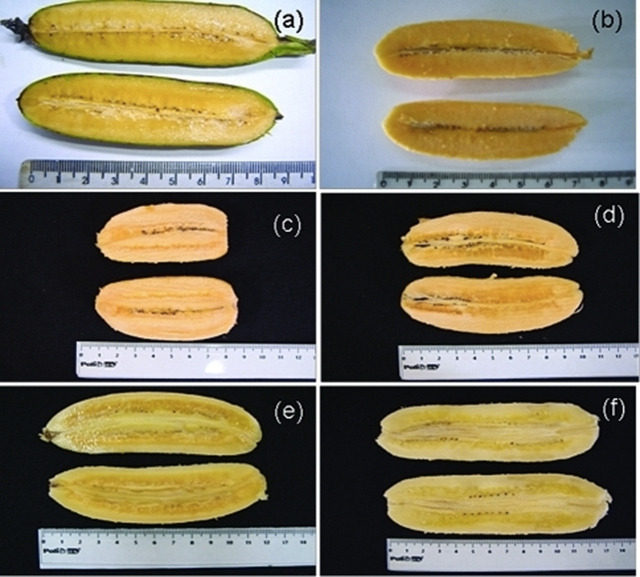
Beta-carotene-heavy "super banana" is very orange

Beta-carotene-heavy “super banana” is very orange

Our challenge is that the beta-carotene-heavy “super banana” is bright orange inside. This could prove an impediment to Ugandans and others adopting it into their diets and using it in their traditional dishes. Here are some thoughts from a recent article in Scientific American:

“…bananas are more than just a food staple in Uganda; they are part of the cultural fabric. The Ugandan word for food is actually the same as the word for a traditional meal made of the stewed banana: matooke. Physical attributes of the fruit itself are particularly important to Ugandans, so altering the fruit could have social consequences. For example, when matooke is prepared properly, it obtains a certain yellow color. If you are a woman who prepares matooke of the incorrect color or texture for your husband, you can be beaten.”

“Furthermore, when we asked what trait farmers would like to see most improved about their crops, they consistently selected nearly every other trait before nutrition.”
—Matthew Schnurr, Dalhousie University, Canada

There are many challenges to making sure everyone gets enough nourishment; cross-cultural understanding and communication are one of them. We applaud those who are taking on these challenges and building bridges to enhance access to healthy food and clean water.

Speaking of bananas, I heard about an activity recently that I think might be helpful to you. If anyone knows the original source of the activity, would you please share it with me, for citation here? Thank you. The instructions and debriefing below are my own, based on the idea of exploring how people peel bananas.

bananaActivity: The Banana Peel

Objectives:
Learners will discover that:
  1. Many of us go through life believing that “our way” is “the way” to do something. We often fail to investigate—or even notice—if there are other approaches to performing a task (such as peeling a banana).
  2. “Common sense” (e.g., how to peel a banana) is really “cultural sense,” common only to those who share the same learned patterns of behavior.
  3. “My way” is not the only “right way” and, in fact, may not be the “best way” for the purpose.
  4. Having alternatives, diversity, and knowing more than one way to do something are assets.

Procedure:
This is a terrific activity to conduct prior to a break, or mid-afternoon when learners may be hungry. After making sure your learners have no banana allergies or other restrictions, give each of them a banana.

Ask your learners to peel their bananas and hold onto the peels. Let them know they are welcome to eat the bananas, as well.

That’s it—quick and simple! Remember, the key to experiential learning is the meaning-making that takes place during the debriefing.

Debrief:
The debriefing is the most important part of any learning activity. It is where sense is made of the experience.

  1. Ask learners how they peeled their bananas. Have a few people share.
  2. Ask learners how they learned how to peel a banana. Who taught them? When? Where? Explain to them that this is how culture is learned. Culture is our “common sense,” the template (learned behavior, habits) for how we make decisions and interact with the world.
  3. Ask learners if everyone in the group peeled their bananas in the same way. Encourage learners to look around and discuss. Usually there will be, at minimum, two different ways learners peel their bananas, particularly if you have an international or multi-ethnic group. Many people peel from the stem end, but others peel from the “top,” as illustrated in the video below.
  4. Ask learners if they realized that others were peeling their bananas differently than they were. If they did not, why not? What “blinded” them to seeing the difference? What assumptions did they make?
  5. Ask learners if they think their way of peeling a banana is better than another way. You can ask a couple of learners to speak to this, even setting up a debate if appropriate for your context. You can even make a list of pros and cons of the different methods of peeling. Be sure to note that people tend to be perfectly happy with the way in which they are used to peeling a banana. It’s the same with culture. We think “our” way of doing things is the “right” way or, often, the “only” way. Then, we discover there are other ways of doing things.
  6. Summarize main learning points, e.g., that differences provide us alternatives and add interest to life. Rather than feeling threatened by difference or resisting it, asking people to “fit in,” we can learn from differences and choose the best ways for our team, family, or organization. In a sense, we can create a “third culture.”

I hope you’ve enjoyed the activity, as well as the info on the super-banana. If you have a favorite cross-cultural training activity that you use in conjunction with Cultural Detective, please share it! We’ll be happy to credit you and link to your page. Together, we can build intercultural competence, justice, and respect in this world of ours. Thank you for being with us on this journey!

3 Fundamental Skills for Intercultural (and Life) Effectiveness

Chef

A, B, C of intercultural effectiveness, and a film recommendation

For well over twenty years I travelled 25 days out of every month. I loved it. Always a new place, thriving off the energy of the people I had the pleasure of working with, each week or two entering a new industry and learning how things work. The fundamentals of human interaction that I dealt with did not vary significantly by industry; the content, however, did.

When my son was small, he and the nanny travelled with me. As he got older, he accompanied me. He sat through my training workshops, he accompanied me on some consulting gigs, and he enjoyed babysitters, daycare and children’s learning clubs around the world. Ten years ago, when my son was about eight, I began scaling back my travels. The impetus for scaling back was that my son was now old enough that it became challenging to take him out of school; he would miss too much. And, there was no way I was going to miss his childhood! An additional reality was that the constant travel was ruining my health, I always felt tired, and, I was honestly just ready for a change.

So, I stopped the 25 days/month travel schedule. It was difficult to say “no” to interesting and high-paying work, but I’d set my priority. I started staying home. I started a small publishing project (Cultural Detective). I absolutely loved it. I was now able to take time to cook regularly, a passion I love. I was able to exercise daily, and meet new people locally via exercise classes and groups. I was able to go out for coffee with girlfriends, and to be present for friends’ major life events—so many things I’d missed when I travelled a lot. Of course, I also missed the travel, and seeing my far away friends.

Now, when I occasionally travel (every couple of months), I find myself grateful for the experience rather than resentful. The journey is enjoyable again. Thus, on a recent flight to Vienna, I relished having two seats to myself. I was grateful for the free-flowing, high-quality red wine on Tirolian/Austrian Air. I read the in-flight magazines on two different airlines and got several blog post ideas. And I very much enjoyed watching a Blended Culture movie entitled, Chef.

The film is an enjoyable reminder of some fundamental intercultural competencies and life truths…

Chef is a 2014 movie starring Jon Favreau, Scarlett Johansson, Dustin Hoffman, and Robert Downey, Jr., about a chef whose family and career have both become frustratingly dull. He’s caught up in the busy-ness that can be modern life, and failing to pick up on the cues that his relationships and creativity require a major shift. He reminded me a bit of myself, actually. Have you ever found yourself in a rut? Going through the motions, not paying enough attention to what really matters, focusing primarily on accomplishing all the tasks on your plate?

In true Hollywood style, by the end of the movie the chef figures it all out, and happiness reigns as the credits roll. Along the way, the film is an enjoyable reminder of some fundamental intercultural competencies and life truths.
  1. Attentiveness: Stay alert to what’s around you (family, friends, work environment), as well as to what’s inside you (your passions, talents and desires). Prioritize your activities so that you feed what’s important to you and minimize that which diminishes you. Staying externally attentive will help ensure that you adapt appropriately in cross-cultural situations, while internal attentiveness will help ensure that you do not lose yourself, your ethics and your talents, in the process.
  2. Bravery: Don’t be afraid to take risks. There are many euphemisms for failing to do what we know we need to do: “going through the motions,” “paying the bills,” “not rocking the boat,” “keeping one’s head low.” Staying true to oneself and what you know to be “right” often requires bravery and trust. I’ve seen many times that foreigners or outsiders can effect positive and needed change to a system when old-timers can not. I’ve worked with many people who try so hard to “fit in” to cross-cultural situations that they lose who they are, their authenticity. Be brave enough to adapt, and be brave enough to be yourself.
  3. Creativity: If you’re not feeling energized, if you fail to see connections between the different areas of your daily life, if you’re not frequently generating ideas, experimenting with innovative projects, or exploring new territory, take note. You are probably pushing and trying to do too much too quickly. Slow down, step off the rat race, refresh, restore and recuperate. You are far too precious, and your insights and talents are too needed, in this world of ours. How can any of us bridge cultures if we don’t have access to our innate creativity? And, let’s remember: it takes all of us to be creative if we are to form a truly inclusive society or organization.

Linked to the My Global Life Link-Up at SmallPlanetStudio.com

User Tip: Bridging Cultures

Bridging Cultures2
One of Cultural Detective‘s valued and respected long-time users, Meg Quinn, recently shared with us a new technique that she has developed for introducing her learners to building more powerful cross-cultural bridges.

When she introduces the Cultural Detective Worksheet, Meg asks participants to think about three different approaches:
  1. Assimilation (bridging from just one side)
  2. Adaptation (“true” bridging in the CD sense), and
  3. Time Machine (What might the parties do/have done before all this came to a head? This is how some of the author-suggested Bridges in the CD series are framed.)

Meg has found that such an introduction helps learners to move beyond their initial responses, think more deeply and more creatively, and develop bridging ideas that are more realistic and enduring.

Thank you for sharing, Meg!

Trainers and educators love the flexibility that Cultural Detective allows them. It is easy to adjust your presentation to help your audience think in more innovative ways, as Meg has done. And whether working with students, experienced professionals, government officials, or your local community group, you can always find a “hook” that resonates with the participants and gives them the opportunity to understand and apply the CD Method to their personal lives.

Readers, please be sure to share with us your tips, designs, and experiences; we are happy to pass them on.

Clean House and Change the Bedding to Greet the Lava

Photo by Pahoa-based photographer Sean King/Caters

Photo by Pahoa-based photographer Sean King/Caters

The gem of a video clip below offers a glimpse into an aspect of native Hawaiian culture of which many people may be unaware. As lava flows on the island, there are vast cultural differences in how the native and immigrant cultures view the event. While native Hawaiians prepare to welcome a guest, others talk about ways to change the course of the lava to flow in a more convenient direction.

I am so proud of what the government in Pahoa, district of Puna, county of Hawaii is doing, and not doing, to “divert” the lava flow that is destroying homes, businesses, and lives. The clarity, patience, and wisdom they show in their answers to community members’ questions make me wish they worked in my county.

In the video, you will see Pi’ilani Ka’awaloa, an INCREDIBLE cultural resource person!!! She demonstrates wisdom in her people’s truth, and openness to teaching as well as acting in collaboration with others. She tells us that the native Hawaiians have adjusted to western culture, in that they now “buy” their land. But she also tells us they will never “own” it; it belongs to the goddess Pele.

“We would never tell Pele to go here or there in her own home! If she feels she needs to clean her house, then let her clean her house!”

I believe you will very much enjoy the cross-cultural differences visible in this Question and Answer session after a county informational meeting on the lava flow. What a challenge to bridge two such vastly different cultural orientations, on such a very sensitive subject as saving our homes and businesses.


I learned about what is going on in Pahoa from a friend I have only met virtually, Tim Sullivan, who lives there. Some people say that online “friends” aren’t real, but I can assure you that via social media I am now connected with many people whom I respect and learn much from. Tim recently wrote an extremely insightful and powerful blog post on the cross-cultural aspects of the lava flow in Pahoa. Be sure to check it out.

I think this short video clip would be an excellent piece of material to debrief using a Cultural Detective Worksheet. Give it a try and let us know how it goes! And may blessings be upon all those who make Pahoa their home.

5 Things Mexicans Say to Avoid the Word “No”

Excellent article by Susannah Rigg

MEXICANS ARE VERY POLITE and can seem downright formal compared to residents of other Spanish-speaking countries. People greet each other in elevators, on buses, and shared taxis almost always with “con permiso,” — “with your permission,” — and “propio” — “you may grant your own permission, as you don’t need mine.”

I love all this about Mexican culture. However, it took me a long time to realize that, because of all the politeness, Mexicans really struggle to say “no” and will find any number of ways to avoid the accursed word. Here are just a few examples.

1. Yes

It’s very common in Mexico that yes means no….

Read more here

How to Get Promoted in 3 Hours

mexican-american flagsI’m going to tell you a real story, of an actual person, who was promoted to a management position from an administrative assistant position because of a three-hour workshop she conducted for her bosses.

How’d it happen? The woman, let’s call her Yolanda, worked for a very large multinational in Texas. The firm, of course, did a lot of business with Mexico. Over the ten years or so Yolanda had been with the company, she’d worked for a succession of bosses, most of whom did not understand Mexican culture and had committed many errors, losing opportunity and revenue, as well as credibility, for themselves and the company. Yolanda is Mexican-American, and her bosses’ actions used to frustrate and embarrass her. She could see that her bosses could be a lot more effective, she wanted to help, but she didn’t know where to begin to explain Mexican culture to her bosses. She was an administrative assistant, not a consultant, executive coach, or trainer.

Enter Cultural Detective. Yolanda looked over the Cultural Detective Mexico package. It made sense to her. She intuitively understood the values in the package’s Mexican Values Lens. She could tell stories from her own organizational experience to illustrate each value and correlating negative perception. Yolanda had so many stories, stories that were real, that had cost her company money and, in some cases, staff.

Yolanda got her four bosses to agree to a three-hour “lunch and learn,” during which she’d teach them about Mexican culture. She was excited, but she was also scared. She wasn’t a facilitator, she’d never studied culture or cross-cultural communication. But, she knew her organization, she knew her bosses, and she knew both US American and Mexican cultures. So, she gave the workshop her best.

At the outset of her seminar, Yolanda told her bosses a story—a story they clearly recognized from their own experience, a story of a time they’d been frustrated, and less than successful. They all knew the details; she had only to remind them of the event she was talking about. Yolanda drew a Cultural Detective Worksheet on the flip chart. She asked her bosses what they had done in that situation. Then, she asked them to think about why they had done what they’d done—what was the underlying “common sense” that motivated their behavior? That wasn’t so easy, but they did it. And it proved pretty insightful. They hadn’t consciously thought about the reasons for their actions, hadn’t spent time thinking about how culture-bound their behavior was. This was Yolanda’s first successful “aha” of the three hours.

Next, she asked them what their Mexican colleagues had done in the given situation. Yolanda encouraged her bosses to quote the words that were said and the actions the Mexicans took. Of course, her bosses said things like, “I couldn’t trust them,” “he wouldn’t tell me the truth,” or “they went behind our backs,” but on the flip chart she recorded the actual words and behavior of the Mexican colleagues. Yolanda then asked her bosses to do the same thing for the Mexicans that they had done for themselves. She said, “Maybe your colleagues really were dishonest, untrustworthy, conniving. But, for the sake of learning, for a few minutes let’s give them the benefit of the doubt. What could have been the positive intentions behind their words and actions? If we look at your side of this Worksheet, you have all positive intent, nothing negative. Let’s see if we can’t fill in their side the same way. Maybe at the end we decide to throw it all out, decide that they were just bad people. But first let’s see.”

Her bosses came up with several guesses—possible motivators of their Mexican counterparts’ behavior. Then Yolanda filled in a couple more, explaining the reasons these colleagues had probably acted and responded the way they had. Her bosses said things like, “That makes sense,” “I’d never considered that before,” and “so I did exactly the wrong thing; I shot myself in the foot!” Her bosses experienced their second “aha” of the workshop.

Next, Yolanda handed out a copy of Cultural Detective Mexico to each of her bosses. She walked them through the Mexican Values Lens, telling stories from her organizational experience. She asked them how they felt about each of the values, and reminded her bosses that each Mexican is unique—that the values in the Lens are societal tendencies. After introducing the Values Lens, she focused her bosses’ attention back on the Worksheet. Now they had lots of ideas about why their Mexican colleagues might have acted the way they did. And even more importantly, her bosses had lots of ideas on how they could have acted in ways more conducive to achieving their business objectives—to bridging cultures. A third round of “aha” learning was achieved.

The three hours sped by quickly. Her bosses learned so much. Their ability to do business in Mexico and with Mexicans was greatly enhanced. They learned about themselves, about their own personal and US cultural values, which enabled them to better explain themselves to any new colleague, whether Mexican, Chinese, or US American. And, very key to me, Yolanda’s bosses learned what a valuable asset she was as a cultural resource. They began using Yolanda as a sounding board, asking her to help them write emails and reports, and also to help plan strategy. Within a couple of months, Yolanda left her job as an administrative assistant because she was promoted to a more prestigious and much better paid management position. She achieved her dream of being able to travel for business, and she loved the kind of work she was able to do. Her company gained an employee who was confident and able to use her bicultural heritage in ways that added value.

Now, I’m not promising that using Cultural Detective will get you a promotion, but if you and your organization work across cultures—and what organization doesn’t these days—you will definitely gain a whole lot of skill and expertise by using Cultural Detective. Add it to your priority list! Start building your intercultural competence by attending one of our free 90-minute webinars, or subscribing to (and using!) Cultural Detective Online today.