2014 Year in Review

240_F_71469226_XoKVyVhM4OzQ7CXxB9e3H6myQHfmjOP7The entire Cultural Detective Team would like to thank you most sincerely for being part of our community, and wish you much joy, health and success in the new year!

2014 was a big year for Cultural Detective, as we celebrated our 10th anniversary! We are thrilled to have grown into such a large and talented community of people worldwide, committed to making our world more respectful, collaborative, just and sustainable. Thank you for joining us on this very important journey!

LayeredLensesFinalThis year we were able to achieve another milestone: launching our best-selling Cultural Detective Self Discovery (currently in beta) as part of our Cultural Detective Online platform. This is a huge step forward for our small business.

We are proud that our online tool encourages people to look at themselves and others as beings that are influenced by various cultures, not just nationalities. Now, people are able to explore their individual values as well—their uniqueness—and how they’ve been personally influenced by the cultures around them.

After developing a Personal Values Lens, users can then compare their values with those of any other Values Lens in the online system. This offers a way to investigate aspects of a new culture they might resonate with or find challenging. And it provide a way to strategize about how best to adapt for success cross-culturally, while preserving their sense of self and, also very importantly, their ethics. If you haven’t yet given CD Online a go, you are certainly missing out! Nearly every day I hear a new customer tell me they can’t believe how powerful Cultural Detective Online is, and how affordable. So what are you waiting for?

One additional huge milestone in the CD Online system is the improved group functionality. We are thrilled that users within a group can now collaborate on writing critical incidents and debriefs. Think of the possibilities: your learners working together on cross-cultural stories, told from each person’s perspective! Individual learners can choose to share (or not share) their incidents with the group by submitting it to the group administrator—trainer, coach, professor or team lead. The group administrator can then request the learner to edit the incident and debrief further, or can share the incident and debrief with the entire group. This functionality is transforming the way customers use our system and develop intercultural competence. It is thrilling to witness!

online-learningBecause of these two huge enhancements to our online system, we will be adding a couple of standard webinars to our lineup. As you know, we already conduct monthly complimentary webinars introducing people to this powerful process for cross-cultural collaboration. In 2015, we will add to that lineup by offering a webinar on Cultural Detective Self Discovery, and a second one on Using Group Functionality in CD Online.

The first quarter schedule is live at www.CulturalDetective.EventBrite.com, and additional webinars will be announced throughout the year. One series we are hoping to add will deal with race and power issues, with the intent that by the end of the year we will have some constructive ideas on how to dialogue more effectively with friends, family and colleagues, and how to promote societal change and healing.

Check back frequently and please let your friends and colleagues know about these terrific professional development opportunities. We have people joining our webinars at all hours of the day and night. More importantly and unbelievably, they actually THANK us for keeping them up at 3 am! (We do schedule our webinars at different times to allow for time zone differences, by the way. It’s just that some people are more eager than others.)

In 2014, we added 5000 new readers to our blog, with readers joining us from 167 countries this past year. I find that very encouraging! Our social media reach has grown extensively. Cultural Detective has an active presence on Twitter, LinkedIn (group), Facebook (page), YouTube (channel) and GooglePlus, as well as a Pinterest board of proverbs, several ScoopIt boards, and a weekly Paper.li Intercultural Competence News Feed.

Are you curious what sorts of posts attracted all these new readers? Here is a list of the top ten most popular posts we published this year:

  1. The Nasty (and Noble) Truth about Culture Shock Published in August and already outranking posts published earlier in the year, this post contains a wealth of information, debunks a common myth, and includes free downloadable training materials.
  2. Another Intercultural Research Paper Supports the Cultural Detective Approach Published in January 2014, this post soared to the top of our list and proves you are hungry for research. This study came from Bertelsmann, Stiftung and Fundazione Cariplo.
  3. New Year’s Gift: Oldie but Goodie—The STADIApproach An excellent, tried-and-true design piece, this freebie is still yours for the downloading.
  4. Are You Nice? A guest blog post by Carrie Cameron from May, 2014, recommending to our readers the excellent work of Penelope Brown and Stephen Levinson. Congratulations and thanks, Carrie!
  5. We Are Not (Just) Our Nationalities A very important post from June of this year, we hope each and every one of you will read it and pass it around. None of us has just one story, and Cultural Detective helps us learn about the multiple cultures that influence us, while reminding us we are each unique individuals.
  6. Lack of Diversity Correlates with Religious Hostility This post looks at the powerful results of a Pew Research study and was published in April of this year. If you missed it, be sure to take a look now!
  7. Cultural Detective as a Facilitator’s Magic Tool This guest blog post by facilitator and joke-teller extraordinaire, Tatyana Fertelmeyster, is from June 2014. Congratulations and thank you, Tatyana!
  8. User Tip: Bridging Cultures Offering advice for getting the most out of Cultural Detective, this post was shared with us by long-time expert user Meg Quinn, and just published in October. Congratulations and thank you, Meg!
  9. Clean House and Change the Bedding to Greet the Lava A terrific post that came about because an esteemed colleague, Tim Sullivan, shared the video with us. TERRIFIC training material and an excellent resource on the cultural dynamics of current news! Do not miss this one.
  10. 4 Methods of Learning Culture A short and very powerful excerpt from Cultural Detective Self Discovery, published in early September and quickly gaining in popularity.
  11. Are Emoji the World’s Newest Language A world language quiz and Beyoncé video subtitled in emoji accompanied this post, published in October.

We are thrilled that our blog is now read by over 20,000 people worldwide! We would be proud to showcase the work you are doing to promote intercultural competence, so send your draft article or idea to: blog@culturaldetective.com.

Five of the posts that made it into the top ten list of most-read posts this year were actually written in previous years. Those posts include:

  1. Ten Surefire Ways to Divide into Groups Originally published in June 2013, this post hit its height of popularity in September and October 2014, with over a thousand hits each month—proving that trainers love new ideas!
  2. Five Top (Free and Easy) Virtual Collaboration Tools You May Not (Yet) Be Using Published in November 2013, this post has been a consistent reference tool for our readers ever since.
  3. Can you read this? Originally published in July 2012, this post has slowly but steadily gained popularity every month since. It takes a popular Facebook image created for Spanish readers, accompanied by a similar one created for English readers, and asks you to reflect on the definition of culture and its role in what we perceive. If you haven’t read it, you are overdue.
  4. Research Findings: The Value of Intercultural Skills in the Workplace Published March 2013, this is the post with the most popular video we have ever produced, and presents the findings of the British Council study. Videographers we are not, but even the British Council added our video to their web page.
  5. Want to Feel Ukiuki, Pichipichi and Pinpin? Japanese Food Onomatopoeia One of my personal favorites, this post has gained popularity among our food-related posts, and we know you love food!

From the list above, there are four posts that were not in our top ten for 2014, but still make the blog’s overall top ten list. Those include:

  1. Bicycling in the Yogurt: the French Food Fixation, a terrific guest post by Joe Lurie. If you speak French or enjoy eating, give it a read. Thanks again to Joe for his terrific collaboration in so many ways.
  2. “Belief Holding” as an Intercultural Competence: Religious less motivated by compassion One of my all-time favorite comics and one of my all-time favorite cross-cultural competencies (Michael Rokeach’s Open and Closed Mind), plus the findings of a UC Berkeley study.
  3. Using Film in Intercultural Education I’m very grateful this post is still in our all-time top ten, because it helps me feel our dear colleague and friend Kevin Booker is still with us.
  4. More Cultural Appropriation: The Swastika Also grateful to still see this post up high on the list, because it’s about my all-time favorite critical incident. I shouldn’t play favorites, but I absolutely love this story; it’s just so typical of what happens in Global Diversity work.

Finally, when you write a blog, you love it when someone comments. Otherwise, you can easily get to feeling you are writing in a vacuum. Hearty and heartfelt thanks, therefore, to our most frequent commenters in 2014, each of whom are extraordinary builders of intercultural competence in their own right: George Simons, Vanessa Shaw, Shan McSpadden, Anna Mindess, Jenny Ebermann, and Olivier Marsily.

We look forward to having you join us in a webinar, to reading a guest blog post you might submit, or to dialoguing with you via comments on the blog or social media. Bless you for your commitment to building respect, understanding, collaboration and justice in this world of ours! May 2015 bring you health, joy, love and success!


There is No Such Thing as Common Sense

CDModel&BridgeOrganizations want to hire employees with common sense. Parents want to raise children with good common sense. Universities and schools want to teach our young people to have common sense.

The trouble with the concept is this: my “common sense” is not your “common sense.” What’s common sense to one person is not to another. For example, if a friend stumbles and trips but is obviously unhurt, do you:
  1. Express verbal concern, asking if they are ok?
  2. Pretend you did not notice, to spare any embarrassment?
  3. Make a joke, to lighten the mood and relieve any awkwardness?
  4. Smile or laugh awkwardly, to share the embarrassment with your friend?
Each of these responses can be “common sense” in different circumstances, in different cultures. What if an angry customer calls me? A “common sense” customer service response could include, depending on the corporate culture, national, ethnic or generational culture of the customer service agent:
  1. Doing whatever is within my power, exerting all possible avenues to make the customer happy;
  2. Apologizing and then educating the customer so that they learn how something works and won’t feel frustrated again the next time; or
  3. Telling the customer “no,” as what the customer wants is not part of the contract.

What does the dictionary provide us as the meaning of the term?

Common Sense
noun Sound practical judgment that is independent of specialized knowledge, training, or the like; normal native intelligence.
Origin 1525-35; translation of Latin sēnsus commūnis, itself translation of Greek koinḕ aísthēsis

With such a terrific definition, anyone would want to have common sense. Yet, what is “sound practical judgment” in the tropics (how to stay hydrated and prevent heat and sun stroke) is quite different from “normal native intelligence” in snow country (how to stay warm and find food when it’s cold). Common sense for accountants (income vs. payments needs to balance or be positive) may be quite different than that for sales people (invest now for payoffs later). Sound judgment for women is, fortunately or unfortunately, frequently different than that for men; common sense for a Baby Boomer is often remarkably different than that of a Millennial; and US American society is finally starting to realize that common sense (survival instincts) for a black person is radically different than that for whites.

Common sense depends on where we are, how we’ve been raised, and what knowledge is “common” or shared by members of our communities. Common sense is developed so that we can survive and thrive in the world around us. Thus, common sense is really “cultural sense,” common only to those who share it: those who share a given culture.

Common sense is really “cultural sense,” common only to those who share it: those who share a given culture.

How do we say “common sense” in some major world languages? Might that provide further insight?

     Key: native language, transliteration, “literal meaning”

  • In Arabic: الحِس العام, Al ḥes al ‘aaam, “public sense” or “general sense”
  • In Chinese: 常识, chángshì, or “general knowledge”
  • In French: le bon sense, or “good sense”
  • In German: de gesunder Menschenverstand, “the healthy human sense”
  • In Japanese: 常識, johshiki, or “everyday thinking”
  • In Russian: здравый смысл, zdravyy smysl, or “healthy wit,” meaning you must be crazy not to agree with it
  • In Spanish: sentido común, or “shared sense”

This is why “cultural sense” is a core concept in the Cultural Detective Model. You can see it prominently featured in the graphic at the top of this post, along the bottom edge of the circle. What does “cultural sense” mean, exactly?

Most of us act with the best of intentions on a daily basis. We perform our jobs in ways that we feel they should be done. We treat our co-workers in ways we feel reflect sound judgment. We deal with our neighbors in ways our native intelligence tells us is neighborly. We talk to our children in ways we believe will guide and motivate them, help them become better people. We put our common sense, our cultural sense, to use everyday.

Yet, all too often our actions are misperceived, and our customers, co-workers, neighbors and family members experience negativity in our behavior. They may get angry, frustrated, or disappointed with us. They may be confused about why we do what we do. That is because their common sense, their cultural sense, is different than ours. Their assumptions about appropriate behavior in a given situation are different than our own. Their beliefs about how the world is may differ from ours.

We all aspire to have common sense and to form teams and organizations with common sense. But it is important to remember that establishing shared “common sense” is an ongoing process. Miscommunication and misperception provide opportunities for us to better understand our own values and “native intelligence,” as well as to learn more about the values and native intelligence of those around us.

So, the next time you shake your head at someone’s behavior and wonder if they have any common sense, remember that their cultural sense may just be different than your own! It takes effort, but creating a “shared intelligence” or shared common sense provides a context in which all of us can work, live, and be our best. Regular use of Cultural Detective can help you achieve just that.

Part of the #MyGlobalLife Link-Up.

How Do Universities Develop Students’ Intercultural Competence?

543266_10150772354506354_665823583_nAnd why is Cultural Detective quickly becoming a preferred tool?

University of Southern California is the most international campus in the USA. The Marshall School of Business at USC recognizes the value of intercultural competence and is committed to truly developing it in their students.

They know that the mere experience of study abroad, or working in a multicultural team, does not build competence. Experience is not learning. Learning is the sense that we make of our experience. USC knows that research shows developing competence requires ongoing, structured reflection on the part of students—with faculty guidance. They have been using Cultural Detective for the past two years, in a growing variety of programs, because they realize the tool helps them accomplish their goals.

The video below is of Assistant Dean Gita Govahi, telling us why the Marshall School of Business has chosen Cultural Detective, and how they use it:

At Cultural Detective we are particularly impressed with something USC has done: they have students generate learning material for the following semester. For example, while students are abroad and after they return, they are required to upload stories of intercultural interaction from their own experience into Cultural Detective Online. They are also required to debrief those stories, to make sense from them. Each program and each semester, faculty award prizes for the “best of” these stories and debriefs, and honor the student-authors by using them in the pre-departure orientation for the next cadre of students.

This second video shows Professor Jolanta Aritz, giving her opinion as an instructor:

I often say that launching a book or a tool into the world is much like having a child: you nurture them to the best of your ability, and at some point you just have to pray that they do good in the world. Children become independent, with minds and lives of their own. Books and tools are used by people in ways we, the authors and creators, can not always control, despite our best efforts. It’s people like the talented professionals at USC who make us very, very proud of the tool we have created. They are putting it to excellent use and students are learning lifelong skills.

We know you all are doing some incredible things with our tools. Please, share your story and make sure we know about it!

Link

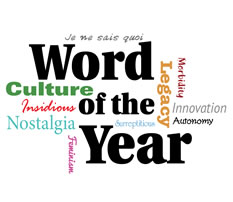
top10_woty2014_cultureHow very wonderful is this?! 2014 is my 35th anniversary working in the intercultural field, and we finally make it to number one! Merriam Webster has just named “culture” the word of the year for 2014.
“Traffic throughout the year indicates that culture is a ‘chameleon. When you put it next to another word it means something very different. For example, `consumer culture’ or `rape culture,’ which we’ve been reading about lately.

There’s the ‘culture of transparency’ in government and business, and ‘celebrity culture,’ and the ‘culture of winning’ in sports. It’s a word that can be very specific, like `test prep culture,’ or it can be very, very broad, like `coffee culture.'”
—Peter Sokolowski, Merriam Webster editor-at-large

Read all about how and why Merriam Webster dictionary named “culture” the word of the year for 2014.

Webinar Takes a Closer Look at the USA’s Current Racial Climate

6174660_G

Photo from KTVU.com

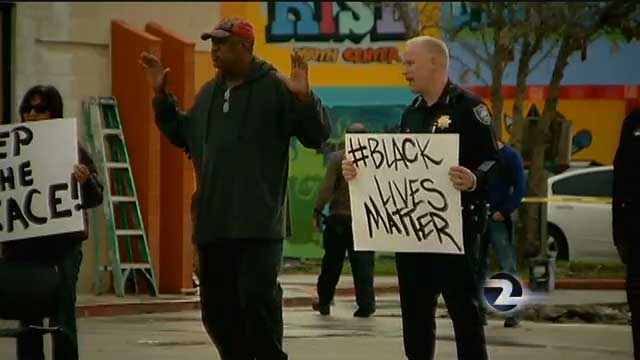
Readers of this blog have been as upset about current events in the USA as we are. You read my earlier post, Time for a Racism Revolution. You no doubt have colleagues, friends and family, as we do, who don’t see what the big deal is. The dialogue is important and difficult, because it’s such a deep-seated issue that involves so many of our emotions and lived experiences. How to make forward progress? I had a glimmer of hope seeing that police chief (Richmond, CA) joining the protests and carrying a “Black Lives Matter” placard. Getting the police to join in breaks down the us vs. them divide and unites us all to work together to do what needs to be done and realize a society more in keeping with our ideals of justice and equality.

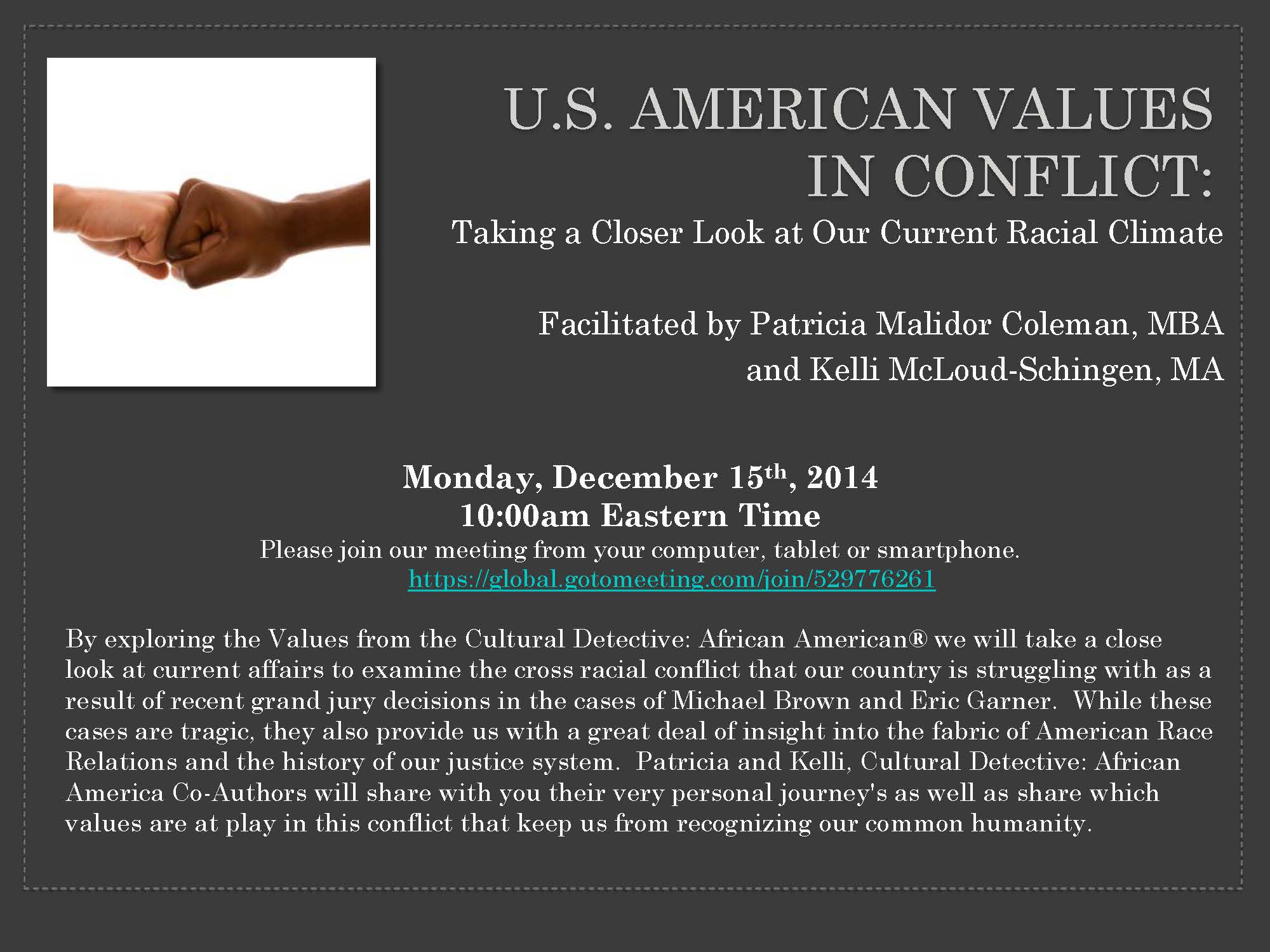
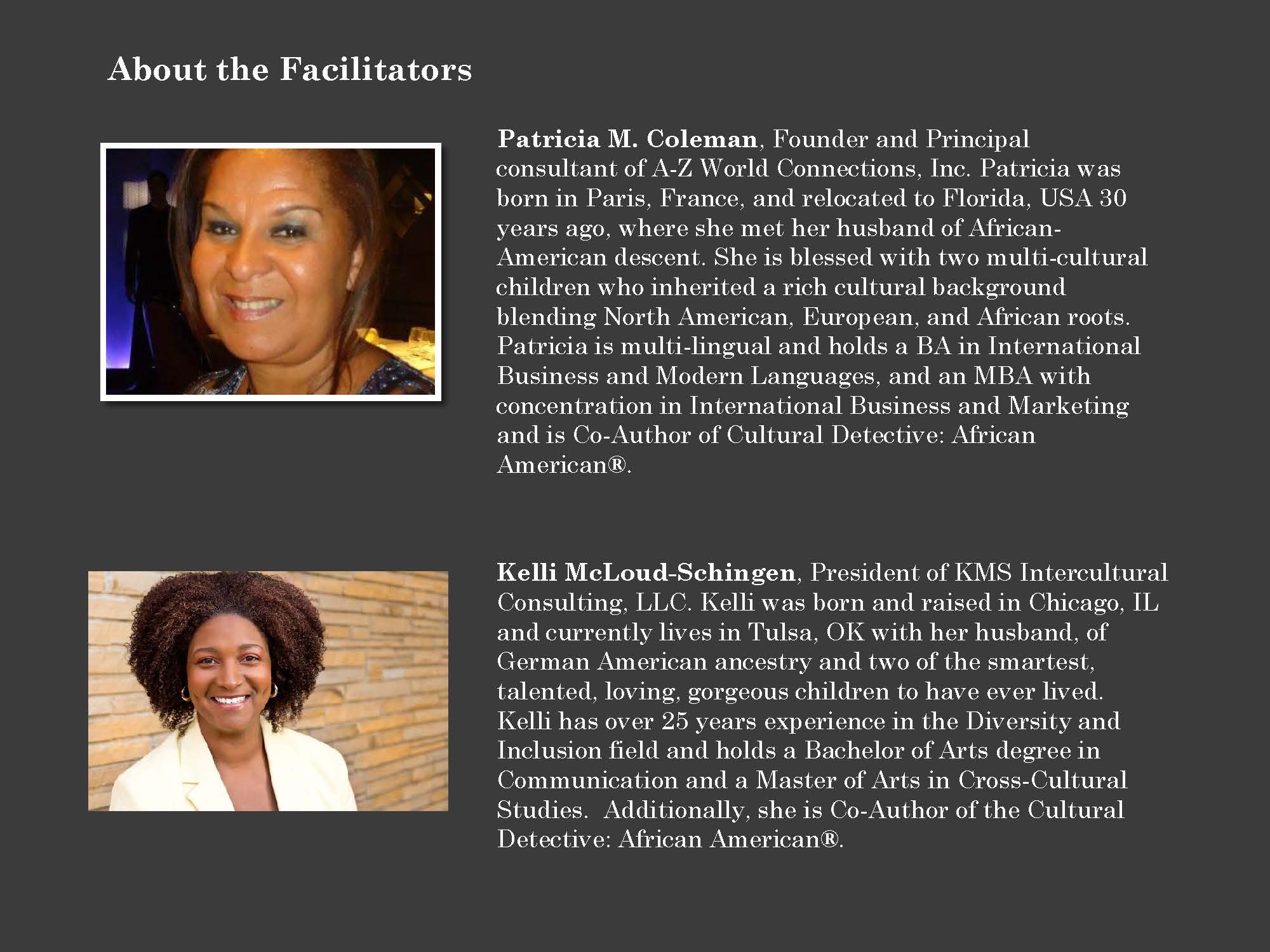
Cultural Detective African American co-authors, Patricia Coleman and Kelli McLoud Schingen, will facilitate a complimentary webinar this next Monday, December 15, 10:00 am – 11:30 am US Central (Chicago) time, in which they will review the current racial divide through the Values Lenses of African American and (white or dominant) US American culture. Do not miss this event! Details below; click on a photo to view it larger or print it out. To share this on social media, you might prefer this link. Please, help us spread the word!

BWValuesinConflict_Page_1

BWValuesinConflict_Page_2

Cuisine, Culture and Performance

10438640_715299471895885_8128051140435588302_n“A collective. International. Pushing boundaries. Longing to discover new cultures and exchange knowledge. Collaborative. Find your tribe. Exploring the unknown, adapting to uncertain situations, charting new territories to sharpen creativity…”

Does this sound to you like a Cultural Detective? It’s actually taken from the home page of the Gelinaz! website, a collaborative of international chefs doing amazingly creative things. I sooooo want to attend one of their dinners!

Below is a short introductory video to what they are all about:

The group’s tagline is “Cook. Art. Performance.” They last got together at the Villa Panna estate in Tuscany in July for a four-hour, 13-course feast, including a dish with seven varieties of Latin American potatoes, a soup of pig’s blood and chocolate, tripe with wild mushrooms, and crispy pig’s head. Ok, that probably would not have been my favorite meal.

The name “Gelinaz!” pays campy homage to the virtual band “Gorillaz,” who play a fusion of rock, hip hop, reggae, electronica and pop. Like the band, Gelinaz! members combine different genres of cooking in experimental ways. They aim to “build bridges between cuisine and other means of expression,” according to Andrea Petrini, the Italian food writer and founder of the group.Thus far their meals have included Japanese dance, a violinist playing Iron Maiden, and various topless performances.

Gellinaz! reminds me of the myriad of innovative ways you are using Cultural Detective to build intercultural competence in NGOs, communities, faith traditions, at universities, for study abroad, and in multinational organizations. Be sure to share with us your designs and ideas! Together we can change the world.

Time for a Racism Revolution!

Just a week later… RIP Eric Garner. Black lives matter! Listen up, everyone! We can and we need to change our systems, break the dysfunction. No one wants such a biased system, and together we can transform it, and ourselves. Reread the post, and also view the very powerful video by NYC’s Mayor, including his remarks about how he has had to caution his own biracial son: http://mic.com/articles/105692/everyone-needs-to-read-nyc-mayor-bill-de-blasio-s-heartbreaking-remarks-on-eric-garner

Dianne Hofner Saphiere's avatarCultural Detective Blog

racism-ruins-lives-logo Image from http://aboriginalwoman.uregina.wikispaces.net

My eyes fill with tears
Bitter, pain-filled, sad-hearted
Flowers in the snow?
***

I am beyond words. As are so many. Racism sucks. It punishes everyone, and has a hugely detrimental effect on society. It breaks my heart to know how hopeless and powerless “ism”s make so many young people feel, in my birth country and elsewhere around this planet. Young people should be feeling passionate and enthusiastic, not alienated.

Racism is a human construct, and WE are the ones who can deconstruct it.

So let’s do it! I type these words habitually. Today, I am not up to it. Today is a day of mourning, of licking the painful wound. I sit at my desk this morning, unable to work. My heart and mind are filled with a confusion of thoughts and emotions. Then, one of my automatically scheduled blog posts is published, on the topic of bananas! I am horrified. How can such…

View original post 892 more words

Global Nomad: Santa (Seriously)

P1210029SantaIn October of this year, walking around after a long week’s work in Vienna, the sight of Santa in a motorized scooter in front of St. Stephen’s Cathedral brought a smile to my face and delight to my heart. Who was this guy? And what in the world was he doing?

Approaching the man, I found him quite jolly, and happy to share his story with me. While insisting that his real name is St. Niklaus, he told me that over the past 50 years he has traveled in 81 countries on six continents, hitchhiking over one million miles. He regaled me with stories, joy and laughter, and it warmed my heart to learn that this man is devoted to making the world a better place. Since he is a global nomad and shares our Cultural Detective vision, I thought you might enjoy his story. Maybe you’ve even met this unique gentleman yourself sometime during his world travels.

Santa, or Michael Klein (I learned his real name online), has been traveling the world since he was 29. He was born in Maryland USA, one of 14 children. Michael practiced being Santa ever since he was in elementary school; he loved sharing gifts and candy, and making people laugh. The past few years he has lived in Vienna, after a heart attack, health concerns, and resulting money woes paused his wandering ways. When I met him he was selling postcards of himself in various global locations. I bought one of him with a surfboard in Hawaii, as it reminded me of home in Mexico. Michael doesn’t speak German, at least not very well, but he sure does seem to fully enjoy life in Austria.

Santa urged me to check him out on the Internet, and there I found a campy Advent calendar in video format, with one two-minute episode for each of the first 24 days of December. I embed the first episode below; the link above will take you to all the rest. The calendar was produced by the Vienna Tourist Bureau, so you get to experience some of the sights, sounds and tastes of Wien as you get to know St. Niklaus. What I most enjoy is hearing his stories: what motivated him to pursue his nomadic ways, his value on freedom, how he financed his way around the world, the people he met, the experiences he had, and what his journeys have taught him.


How about sharing a story describing some of the quirky, unique people you’ve met during your journeys around the globe? Tell us about those wonderful people who remind us that it is our differences that bring some of the greatest joy to our everyday lives!