There are loads of talented people in this gorgeous world of ours. We all have a unique contribution to make, and if we collaborate, I am confident we have all the pieces we need to solve any problem we face.
I have been an intercultural organizational effectiveness consultant since 1979, working primarily with for-profit multinational corporations. I lived and worked in Japan in the late 70s through the 80s, and currently live in and work from México, where with a wonderful partner we've raised a bicultural, global-minded son. I have worked with organizations and people from over 100 nations in my career.
What's your story?
Un tercer video tomado del webinar “Desarrollando habilidades interculturales en profesionales globales”, el 24 de Octubre 2013, en cual cuento la historia de una empresa Chilena que intenta importar parte de su producción de China. Por falta de no desarrollar las competencias interculturales requeridas, no son los primeros en llegar al mercado con el nuevo producto y conlleva la pérdida de mucho dinero y la reputación de la empresa en el mercado. Desafortunadamente es una situación muy común—una que Cultural Detective te ayuda a evitar.
I just read a blog post that I found really interesting. It explains a bit about me from a perspective I hadn’t really thought about before. And, I feel it speaks to many Blended Culture people of the world. What is “Blended Culture”?
“The term ‘Blended Culture’ is used to describe individuals who, by birth, upbringing, and/or adult experience hold multiple frames of cultural reference within themselves. These individuals may include those who have extensive international life experience or those whose exposure to different cultures took place within a single national context.”
—Cultural Detective Blended Culture
I remember reading Csikszentmihalyi’s Flow: The Psychology of Optimal Experience, but I don’t remember him talking about the nine points Matthew summarizes. Perhaps it’s just that I read the book too long ago.
You perhaps admire Csikszentmihalyi, as I do. He is a seminal professor of Psychology and Management, and the Founding Co-Director of the Quality of Life Research Center at the Claremont Graduate University. His work focuses on happiness and creativity, and he is the architect of the concept of flow.
In his blog post Matthew quotes Csikszentmihalyi:
“I have devoted 30 years of research to how creative people live and work, to make more understandable the mysterious process by which they come up with new ideas and new things. If I had to express in one word what makes their personalities different from others, it’s complexity. They show tendencies of thought and action that in most people are segregated. They contain contradictory extremes; instead of being an individual, each of them is a multitude.”
Matthew shares with us nine contradictory traits frequently present in creative people. I am of the opinion that they are traits frequently present in Blended Culture people as well. To amplify that definition:
“Blended Culture: people who have had the experience of a culturally varied life, and who have integrated their multicultural experiences into a Blended Culture value set, and who are relatively high-functioning (constructive) despite the complex influence their Blended Culture values exert on their decisions and behaviors.”
—Cultural Detective Blended Culture
Mihaly’s nine contradictions of creative people as Matthew summarizes them are:
Energetic yet quiet/concentrating
Smart and naïve
Playful and productive, responsible and irresponsible
Fluently alternate between fantasy and reality
Humble yet proud
Passionate yet objective about their work
Have experienced suffering and pain, and found joy and life within it
Please let me know what you think in reading Matthew’s post, about the correlation between Blended Culture and Creative People behaviors. Perhaps the mere reality of having to, on a daily basis, reconcile oft-competing realities provides BC people ongoing practice with the creative experience? What do you think? At a minimum, it motivates me to want to read this other book! Those who have read it: please, tell us what you think.
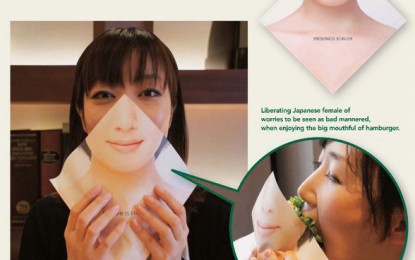
What a terrific, culturally appropriate marketing ploy! When I lived in Japan, I was oh-so-conscious to cover my mouth with my hand when I laughed out loud, or if I had to open it real wide while eating. “Ochobo,” or a small mouth, is traditionally seen as a sign of feminine beauty in Japan.
A national hamburger chain wanted to sell more of its biggest, juiciest, wide-mouthed burgers to women, so it came up with an ingenious idea: the “liberation wrapper”—a stiff paper burger wrapper, imprinted with a closed mouth. The person eating is able to hide behind a dainty little face, saving others from having to watch them chow down.
Every society is changing, and there are plenty of women in Japan who eat burgers in public. There are also those who don’t cover their mouths when laughing. But, hey, this is fun and cool! Maybe next will come a not-so-culturally-necessary but cool men’s “liberation wrapper”!
This promotion reminds me of a story years ago, recounted to me by the then-Director of Tokyo Disneyland. In planning for Adults’ Day (成人の日), the workers realized that many young women would be coming to Disneyland in silk kimono. Knowing that the water spray could damage the expensive kimono, the workers prepared signs, warning the young women of the danger and cautioning them to avoid certain water rides.
The Director scolded them, saying their signs ran counter to the Disney way. “You must figure out a way to let the young women enjoy the rides, in their expensive silk kimono.” The solution? They had a bunch of plastic raincoats made special for Adults’ Day.
What is your favorite culturally appropriate customer service or marketing story?
Our first blog post on Names Across Cultures hit powerfully and emotionally for so many of you! A few typical comments include:
“Names are part of a person’s identity. If people ‘get it’ across cultures we often feel they ‘get’ us, too.”
“We can’t know all languages or accents or tones, now could we? Having said this I would consider it wrong to be forced to change a name because someone can’t pronounce it—are you kidding? Why should the weakness or inability of one (the name changer) be even acceptable?!”
“My name is a point of pride for me. Even though nearly nothing about me screams ‘I’m a Korean immigrant,’ my name tells a very interesting story about who I am. I suppose my life would be marginally easier and I’ve probably gotten looked over for a handful of jobs because of the ‘foreignness’ of my name, but I like it. It’s unique and it’s me.”
“Changing people’s names was another turn of the screw in the arsenal of tricks that the colonial powers used to subjugate people under their dominion.”
We very much enjoyed reading the stories and comments posted here on the blog as well as in the social media. Thank you! We found them quite insightful, and believe you will, too. We heard from people who:
Feel they are avoided at parties and gatherings because others find their names hard to pronounce. “People are embarrassed to mispronounce my name, so they sometimes avoid me altogether.” Talk about insidious discrimination!
Have had others correct their pronunciation of their own name! “Such arrogance! How dare they! Do they even look at signatures on emails? They invariably correct me!” Sadly, this wasn’t just one person sharing this experience with us.
Have been told their name is “wrong,” because it’s a man’s name not a lady’s, or because its origins are in a certain language and this is how it SHOULD be pronounced.
Express the opposite opinion: “Many of us actually mispronounce our own name without knowing it. People who live in countries with a long history of immigrants and their intermarriage, will in due time pronounce a name according to what their ‘new’ language has taught them. Is this now wrong? Well, maybe to some degree yes, but since the new pronunciation is not something done out of maliciousness but rather due to having been told of it wrong.”
Proclaim, “Those of us with unusual names need to stand our ground!”
“I am waiting for the day I can go back to my roots and not cringe every time someone speaks to me!”
“I prefer to have people change my name than butcher (by mispronouncing) my name!”
Advise, “Forget my last name; use my first!” (or vice-versa) for ease in pronunciation.
Are happy to have a different name for the varied contexts in which they live and work.
“If someone calls me Karinka, or makes up another name that is easier for them, or pronounces my name incorrectly, I do not mind at all. I myself am certainly not in a position to pronounce everybody’s names properly, and I know how difficult it can be.”
“It is all relative. When people ask me ‘What is your name?’ I say ‘Marianne.” The spelling stays the same but I pronounce it differently: Marianne (pronounced the German way), Mary Ann (the English way) or Ma Li An (pronounced the Chinese way). Personally I like to make people comfortable in my presence and have no preference how people pronounce my name.”
“My name is Robert. I call myself Rob. In Egypt I’m Mr. Rob, in Finland I am Roope, in China I’m Lobert’t, and in Japan I’m Lobba. I answer to them all, and I’m comfortable with them all. But, then again, I am an intercultural trainer.”
“I had a friend in China and was trying really hard to pronounce his name in Chinese, except he got mad at me. He wanted to be called by his self-assigned English name, and considered it rude that I was even trying to pronounce his name in Chinese.”
Find the whole thing amusing, and leverage the pronunciation difficulties as a method to build relationship and understanding: “I really don’t mind you butchering my name. I understand: Höferle is hard to say if you are unfamiliar with the German language. Changing my last name’s spelling to the English keyboard-friendly Hoeferle also hasn’t helped. It made for funny moments, though. Something sounding awfully close to ‘hopefully’ or ‘hofferly’ has been the usual outcome in recent years. No matter how often I tell people to just forget about saying my last name and instead stick with Christian, they still try to get it right. Which is a really nice gesture, I think.” Bravo! Christian even, most kindly, sent us a link to his blog post on names and a link to learn more about pronouncing names with umlauts.
Comment, “My last name has been spelled, Simons, Simmons, Simms, Symonds, Simonis, Simon, Simone—sometimes two or more versions in the same document. I find this more annoying than mispronunciation, which I am used to and expect, given that I am widely traveled and have lived in a number of countries, and realize that different language speakers use their own preferences for how the vowels sound. Misspelling can make authentication of documents difficult. Sometimes my family name is taken as a first name in documents and George(s) becomes my last name.”
Share with us, “US immigration officers in the 19th and early 20th centuries were not beyond renaming immigrants on the spot, crossing out ‘Walentinowicz’ and writing in ‘Walters.’ Catholic Baptisms were conducted in Latin years ago, and it was required that a Saint’s name be given a child. There is no St. Nancy, so my cousin was named Venantia Fortunata (which I never let her forget).”
“Dutch speakers use their digraph ij pronunciation which is the wrong pronunciation for my surname, as the languages are not even remotely related. Ironically, English language has roots in Anglo Frisian, yet native English speakers seem to have more difficulty with pronouncing my surname than just about any other heritage speaker. I can understand difficulties arising from having no equivalent sounds in other languages, but can not fathom where anyone gets the additional consonants…”
And the humorous, “I once dated a guy who couldn’t pronounce my name properly, even though his former girlfriend of seven years was also called Kaisa. No need to say it didn’t last long…”
Readers very much enjoyed the quiz we put together, and shared with us another name to add to it: by what far more famous name was Margaretha Geertruida Zelle known? (answer at the bottom *)
There was obviously a broad range of responses from one imaginable end of a continuum to another—just begging for someone to conduct research into naming and our responses to name changes, spelling and pronunciation across cultures.
How do the use, pronunciation and spelling of names affect international organizations? Readers expressed:
A lot of resentment around computer systems not having non-“standard” letters, because it means that people’s names often show up with strange characters in them, rather than being spelled correctly (“Brünnemann” not “Brünnemann”). “I do wonder when big, supposedly ‘international’ organisations or institutes do not even have their software in a position to spell international names,” said one of our community members. We know first-hand. It seems every other week one of our web pages has spontaneously changed to show strange rather than correct characters in one of our author’s names!
“Dear marketers and copywriters: Inserting umlauts into your American brand names, logos or slogans may help you create some awareness. But it will also let you look really ignorant of other languages and cultures.”
“I do have a problem when, for example, I read in a Peruvian paper, ‘Principe Carlos,’ where both the word ‘Prince’ and ‘Charles’ were translated into Spanish. It would have been OK if it were only Principe Charles. Why did they not stop there? Why not call Michael Jackson ‘Miguel HijoDeJacobo’? I know the reason behind it, btw, nevertheless I find it amusing.”
“It’s so unfortunate when people and institutions feel they need to change the spelling of my name. Went to vote today in the NYC primaries and somehow my name got automatically changed to Bo Y. Kang. I have never written my name like that and I’m super duper conscious of getting the whole Bo Young part right under the section that says First Name so that they realize that’s my first name. I always leave the Middle initial section completely blank. Other ways my name gets written even after I’ve spelled it correctly:
The magical hyphen: Bo-Young Kang
The other magical hyphen: Bo Young-Kang
The switcharoo: Bo Kang Young (and all its variations Kang Bo Young, Young Bo Kang, Kang Young Bo, Young Kang Bo)
The disappearing game: Bo Kang
The other disappearing game: Bo Young (this one I don’t mind so much because it’s technically correct, just missing a part)
The condenser: Boyoung Kang
The other condenser: Bo Youngkang
And those are just the ones that include all the right letters. You don’t even want to get me started on the Bow, Boo, Booh, Yung, Ying, Yong, Kan, Li, Rhee variations I get all the time.
My name isn’t that hard. It’s spelled exactly like it sounds.”
Strategies for dealing with difficult-to-pronounce names that our readers shared with us included:
Rhymes and mnemonics you’ve made up to help people learn to pronounce your name: “ Over the decades I’ve created stories to help people pronounce my name—’Think of going to the MALL. After a long day of shopping, you need a cup UH TEA. One year ago, someone blithely said, ‘Oh, your name rhymes with ‘Quality.’ Now when I meet someone, I introduce myself cheerfully: ‘Hi, my name is Malati. It rhymes with ‘Quality.’ This immediately releases the tension. ’Rhymes with Quality’ is on my email signature, business cards, nearly anywhere my name appears!”
“An interesting way to learn about a new acquaintance can be to ask the meaning and origin of the person’s name. Every nation has a trend of calling up by some peculiar name which helps a lot for better communication and understanding.”
“Years back while in Nigeria the head of the Media Department there was Igbo. One time I listened carefully and repeated his family name again and again and could never get it right—though it did sound the same to my year (and herein lies an importance to note) I could not do so. Time passed, making myself more familiar to the language so I tried again, and once more I could not achieve it. More time passed with the same negative results. He would smile at me every time I pronounced his last name, knowing I had it wrong but was at least genuinely trying. He was also nice enough to let me know I was the one who came closest to it and that no one before or after me ever tried so hard. Just so you know, the Igbo language is one of the few languages that actually has sounds going in (like inhaling) when speaking.”
“I actually take great pains myself to repeat until I have someone’s name correct if it is ‘foreign’ to me … surely this is a minimum sign of respect!!!”
“Your link to audioname.com is a terrific resource, and I recommend all in this community adopt its use. If your name is not hard to pronounce, you can use your 30-second audio-byte to talk about the origins of your name. It will encourage others to use this and help make our world more pronounceable and accommodating.”
The common theme, however, is BE CAREFUL WITH NAMES. Ask! Show respect. Discuss and don’t assume. And definitely avoid changing someone’s name without their permission; it’s a rare person who loves a nickname or name change that has been “assigned” or “imposed.”
I have one more video clip to share with you, from my interview with Dr. Emmanuel Ngomsi. In this short clip, he tells us how names are traditionally given in his home, Cameroon.
A common characteristic of many cultures around the world is the importance placed on naming a child. Factors that may be considered might include gender, birth order, astrological factors, family tradition, naming the child after a parent or beloved relative, date of birth, or characteristics valued in the birth culture or family and with which those naming the child want to imbue the newborn, among a wide variety of others. In some traditions family members do not share a family name. Do the parents choose a child’s name? Do the grandparents? Is there some ceremony in which the child chooses his/her own name? Does the state dictate selection from an official list of acceptable names, as has been the case in Iceland?
Here’s the video:
* Answer: Mata Hari
Please do share with us your further reactions, experiences, stories and advice. It is obviously a topic that merits some study as well as some training.
Un segundo video tomado del webinar “Desarrollando habilidades interculturales en profesionales globales”, el 24 de Octubre 2013, en el cual cuento una historia de la gerencia de un equipo de trabajo intercultural. Es la historia de un mecánico Holandés que trabaja como jefe de equipo en un buque de perforación petrolera frente a las costas de Argentina. La falta de competencias interculturales requeridas conlleva la pérdida de tres empleados, mucho dinero, y la reputación de la empresa en el mercado. Desafortunadamente es una situación muy común—una que Cultural Detective te ayuda a evitar.
“When organizations elect to create virtual teams, they focus on the potential advantages, such as the diversity of the team, or the potential for ’round the clock’ productivity with employees working in multiple time zones. However, companies must also be aware of the challenges that accompany virtual teams. For these groups to be successful, managers cannot use the old rules of leadership. New ways of working require different skills.”
The success of virtual teams requires new rules of leadership and new skills, as Karen suggests, but also new tools. The tools we use to collaborate can make or break our effectiveness. How do we establish trust when we rarely if ever see one another? How do we build a new relationship with someone we’ve never met? Can technology help in this regard? Of course it can. It can also get in the way, causing more problems than it solves (how many times has a phone call or video conference cut in-and-out, or the sound during a webinar not worked properly?).
In this blog post I share with you my selection of Five Top Free Virtual Collaboration Tools available today, and my guess is you’re not using most of them. Trying them out may greatly increase your virtual team effectiveness. First, let me give you a bit of context, to aid in your use of the tools.
Tomado del webinar “Desarrollando habilidades interculturales en profesionales globales”, el 24 de Octubre, 2013, en cuyo video cuento la historia de unos clientes míos, tratando de abrir nuevos mercados sin haber desarrollado las competencias interculturales requeridas. Es una situación muy común, que conlleva la pérdida de millones de dólares y la reputación en el mercado. Es una experiencia que Cultural Detective te ayuda a evitar.
This guest post is written by Sunita Nichani, cross cultural consultant and trainer. Remember, don’t think “chaos;” think “pattern!”
—
Often times in my intercultural trainings to Indian audiences, I have sensed a discomfort in my participants with using models (the iceberg of culture, for example) and imagery that are often more easily understood by Westerners. Perhaps, I am more sensitive to this discomfort because I felt the same when I learned not only one but two foreign languages (English and French), with their intrinsic imagery that was so far removed from my local reality.
You can imagine my joy when I stumbled upon Devdutt Pattnaik’s use of a typical Indian custom of drawing kolams (rangoli in North India) to explain the Indian world view. Used to adorn the floor at the entrance of even the most humble abode in India, it is basically a pattern that is drawn, using lines to connect a grid of dots. There is nothing rigid about how the dots need to be connected—each person chooses to connect the dots as s/he desires, and each pattern is a legitimate one, just as is each culture.
Below you can watch his thought provoking presentation on India. I particularly love his closing lines. Enjoy! What are your favorite local metaphors and imagery that resonate with the local contexts you work in?
Dr. William (Bill) Dant of WPD Global Solutions and Tatyana Fertelmeyster of Connecting Differences Consulting will present a session titled Little Church on the Prairie: The Training of International Priests Serving in Roman Catholic Parishes in the Rural U.S.A. at the SIETAR-USA conference in Arlington, VA on Thursday, November 7th, 3:45-5:00 pm.
In 2012 almost one out of every five priests serving as parish clergy in the USA came from abroad. The majority of these priests are from developing countries across Asia, Africa and Latin America. Despite the acknowledged universality of the Roman Catholic Church’s liturgy around the world, the cultural and interpersonal contexts of these priests back home are often drastically different from those of a US-born priest practicing in parish service in his own culture.
Our presentation shares and engages with participants on a work in progress: in 2012 the Lilly Endowment provided a grant to the Seminary of St. Meinrad in Indiana to develop intercultural and linguistic training materials for Roman Catholic priests, and to pilot them in five different rural areas across the United States. As consultants to this project — as the principal curriculum developer (Tatyana Fertelmeyster) and training facilitator (Bill Dant) — we wanted to share with our colleagues the experiences and challenges we faced in working with this “niche” population and set of intercultural challenges.
Several of the Cultural Detective packages (CD: Self-Discovery and CD-USAas core design elements, as well as CD packages for specific countries/regions represented by the priests: India, Philippines, Poland, West Africa, etc.) have been used in the program design, and Cultural Detective Online is employed as a way to engage diverse participants in building bridges between their own cultural perspectives and those they experience in the US-American culture.
Re-post of an excellent—short, powerful and true—blog by Cultural Detective LGBT co-author Rebecca Parrilla. WTG, woman! Cultural Detective can help you put differences on the table, as resources and assets. Get a clue!

 Un tercer video tomado del webinar “Desarrollando habilidades interculturales en profesionales globales”, el 24 de Octubre 2013, en cual cuento la historia de una empresa Chilena que intenta importar parte de su producción de China. Por falta de no desarrollar las competencias interculturales requeridas, no son los primeros en llegar al mercado con el nuevo producto y conlleva la pérdida de mucho dinero y la reputación de la empresa en el mercado. Desafortunadamente es una situación muy común—una que Cultural Detective te ayuda a evitar.


 Cultural Detective Blog