Unknown's avatar

About Dianne Hofner Saphiere

There are loads of talented people in this gorgeous world of ours. We all have a unique contribution to make, and if we collaborate, I am confident we have all the pieces we need to solve any problem we face. I have been an intercultural organizational effectiveness consultant since 1979, working primarily with for-profit multinational corporations. I lived and worked in Japan in the late 70s through the 80s, and currently live in and work from México, where with a wonderful partner we've raised a bicultural, global-minded son. I have worked with organizations and people from over 100 nations in my career. What's your story?

Open Letter to Home Office Senior Management & Their Agents

130124120043-overseas-job-assignment-614xaThis is a guest blog post by Reyno Magat (full bio at bottom of the post), leadership and talent development consultant, coach and mentor, about a topic of crucial importance in the global mobility arena: management of headquarters’ expectations. I find it far too infrequently talked about, particularly in light of the huge impact it has on both expatriate and subsidiary (and in turn, overall organizational) success. I have previously written on this subject. I trust this open letter, intended as an exercise in empathy and walking in an expat’s shoes, and not as an indictment (unless the shoe fits), will help raise awareness and effect some change. Put those Cultural Detective subscriptions to good use, please! We need organizations that enable sustainable success, in all locations in which we operate.

“Much of expats’ energy, motivation and performance are affected by having to contend with home office senior leaders and their agents, who can be clueless and typically, frankly disinterested in the local realities, other than financial targets being met. These leaders and their collaborators often place unremitting pressure on expats to continue to conform to a home office-centric mindset, group-think, and timelines, with complete disregard of the challenges actually faced locally. All of these factors are at play as the expats are expected to perform and deliver results whilst mindful of risks to their personal reputation and consequent relationships with these leaders—affecting pay, bonuses, career progression AND family.”
—Reyno Magat

Dear former colleagues,

Before you ask, I’m happy to say my family and I are settled back home, having secured a really incredible new job at one of your competitors. As an added incentive, they have given me the promotion I had missed out on [for the second time, even though it had been verbally promised to me when you offered me the foreign assignment], and they’ve generously made up the cumulative pay awards and bonuses which you have steadfastly refused to give me, all on top of their superlative relocation package. Although I guess it was rather flattering that you had me flown back home for a series of discussions [business class flights and fine dining at your expense no less!] after I sent you my resignation letter, I have to say all of your efforts were too late, frankly, far too late.

Oh, just in case you’re genuinely interested to know, my dear wife is now able to have the medical attention she wasn’t entitled to whilst we were abroad, because your medical benefits package did not apply to her. You considered her a local national there, even though she has lived abroad for most of her life. You would have enjoyed meeting her when you visited, but of course you always had such tight schedules, having to fit in client meetings and their entertainment at the grand sporting and social events there [I always assured the local team that the timing was purely coincidental]. Memories of having to cajole the team to drop whatever they were doing [with unpaid overtime, as Group Finance would not have approved it] so that your visits, however frankly disrupting, went smoothly, are all in the distant past.

Speaking of clients, I’m relieved I no longer have to ask them, plead even, to provide yet more information to comply with your constant demands [which by the way seemed to invariably arrive late on Friday afternoons]. Thankfully, I’ve built very good relationships with them, although it never stopped them naturally making barely polite comments about what they call ‘imperialist/colonialist’ mentality and behaviours that must prevail at your home office. As I have often pointed out to you, many of your clients and, indeed, your employees there are well educated [including graduates from some of the best universities/business schools in the world], cosmopolitan and culturally sophisticated, some of whom coming from families, dynasties even, dating back to a time before our own nation became one. Unlike in our own culture, where people seemingly seek every opportunity to boast about their personal achievements, status and wealth, they are far too well brought up and well mannered to ever behave with such brashness, immodesty and self-publicity.

The local nationals there certainly never appreciated your inability and unwillingness to recognise that they come from an independent, sovereign nation which is only one, albeit in their eyes the most economically vibrant, of several that make up a region of different  histories, politics, economics and cultures. Yes, as I had pointed out so many times until I was blue in the face, indeed that country belongs to a geographical region, but their nation has a distinct market, business practices and customs, and political sensitivities [which may be different to ours, but not to be equated or conveniently labelled as being ‘corrupt’, ‘illegal’ or ‘laissez faire’]. I always felt very uncomfortable and worried about having to translate your memos, circulars and announcements into a language that all can understand, and have them not be seen as offensive. Inevitably, I was often accused by yourselves of having gone ‘native’ and not being mindful of Group initiatives or indeed being a dutiful corporate citizen. Frankly, frequently I didn’t understand them either, and our lives were made tougher, especially when the timelines were so compressed that they required all of us to stop everything else to comply. And, when I queried some of the content, somehow I was invariably referred to the corporate intranet. Because of time zone differences, it was often difficult to find anyone at your offices in any case who was available to help. Actually, even when I did visit your home office as part of my bi-annual leave, I found there were so many new faces, and that some of the people I had known well before I departed seemed to have moved on.

I believe you really ought to stop believing your own advertisement; that of being a truly global company, as in reality you are principally a domestic company that happens to have international offices. The market there as well as the clients, competitors and your very own employees think the same. Certainly, the employees witness on a daily basis the battles between yourselves and the local management team, with yours truly often being ‘piggy in the middle’! I know for sure that none of you ever appreciated my many sincere  efforts to mediate, and to offer what I believed to be workable solutions, as such actions had most certainly cost me my promotion and any chances of pay awards and bonuses during the time I was there. How I wish I was wiser when you asked me to take on the assignment and uproot my family, for what you then described as a ‘fast track’ for my career. I should have suspected earlier on, indeed even before I left the home office, that you were really ever only interested in sending a ‘body’ over there when HR suggested, as my own and my family’s only preparation, to go to the CIA website to read the country report of where we were going, as well as to go to the Amazon website to search for books about that country. Apart from a lengthy briefing on the company’s tax equalisation policy, that was the sum total of help my family and I were ever given.

I had actually used my own initiative before departing, by contacting Manuel Jones who you know had been an expat himself in several countries [mostly in other regions], and had been assigned previously to that country. After arrival though, I soon discovered that despite his many years of working and living abroad, his perceptions were inaccurate, dated, narrowly focused, and on many occasions, frankly racist. In fact, it made me wonder whether he actually met or formed any meaningful relationships with the local nationals, as he painted a significantly different picture of the people and the country. I suppose it was some years ago when he had all that foreign experience, and norms and business practices and realities have moved on rapidly since his time.

Looking ahead, and positively, senior management [and HR!] in my new company have warmly welcomed my offer to assist them in selecting people for foreign assignments, and to coach and mentor current and future expats. As HR is presently reviewing their foreign assignment policies and procedures, they have asked me to be one of their advisors, and I shall be collaborating with them too to identify new methods and sources of direct help aimed at all foreign assignees and their families. These will include setting up a panel of coaches and mentors specifically available to assist them [despite her own ill-treatment from you, my wife is certainly willing to assist too]. The Group CEO has already started introducing me as the Executive Committee’s newly appointed ‘BS detector’, who is expected to carry out reality checks on important home office directives before they are issued.

My experience with your company has made me justifiably sceptical, naturally, about what my new company will actually ‘deliver’ vs. intent, but I shall nevertheless be optimistic. I owe it to other expats and their families.

Sincerely,

Disillusioned but unbowed

*Reyno Magat is a London-based leadership and talent development consultant, coach and mentor. Over 35 years of working in the learning and development field has not diminished his  relish and enthusiasm for working with leaders at various levels to equip them with the self-awareness, skills and motivation to perform at their best and to develop to their full potential. Having worked with some 30 nationalities in about 15 countries from 5 sectors, he brings to bear his own personal international background, extensive insights into business and organisational realities, creative spark, and a healthy dose of pragmatism, whether he is facilitating a leadership workshop or on an executive coaching assignment. With the added direct experience of having been a corporate buyer of external leadership and cross-cultural development services, he is keenly aware of the imperative to seamlessly integrate learning interventions with the values, culture, priorities and realities within, client organisations. By being challenging and provoking honest reflection, his primary focus typically is on consistent, culturally-appropriate behaviours, and commercially-anchored, sustainable decisions that will produce the desired results for the client.
Building Leadership Resilience with Cultural Detective

ILA_logoBlackblue
Cultural Detective® will be featured in a workshop at the 15th Annual International Leadership Association Conference in Montreal, Canada, Oct 30 – Nov 2, 2013.  Dr. Karen Lokkesmoe, Leadership Across Meridians, and Tatyana Fertelmeyster, Connecting Differences Consulting, co-author of the Cultural Detective® Russia, will lead a workshop demonstrating how CD can be used to build global leadership competencies.

Session Description:
Building Leadership Resilience with Cultural Detective
Saturday, Nov 2  10:15 -11:15   Room: Gatineau
At the Fairmont Queen Elizabeth in Montreal

There are many facets of global leadership, and any number of skills that are required of today’s leaders, but one of the core skill sets is intercultural competency (Moodian, 2010; Lokkesmoe, 2009; Mendenhall, 2008). It has become clear that good intentions, awareness-raising, and exposure to other cultures are not sufficient, in and of themselves, to build global leadership and intercultural capacity (Mendenhall et al., 2008; Vande Berg & Paige, 2009). The focus must be on intentional capacity building. Cultural Detective® is an innovative and engaging methodology that allows for building concrete skills and developing sustainable ability to understand, engage, and lead others in intercultural situations more effectively.

This interactive workshop demonstrates how to use the Cultural Detective framework to build and develop intercultural leadership skills. Participants can expect to learn how to use specific elements of the Cultural Detective (culture-specific Value Lens, Worksheet, and Cultural Detective Online) as practical tools in situational analysis and decision making. Using Cultural Detective as part of your global leadership development strategy will help you increase performance, productivity and profits through loyalty, teamwork, and return on investment. It is a tool you and your employees can use immediately to achieve the bottom-line results that intercultural competence can bring to your organization.

Come put on your detective hat and learn how you can use this fun and engaging tool to enhance your (and your organization’s) global leadership competence! While our world may be shifting rapidly, developing skills to identify cultural similarities and differences, accurately interpreting real life situations from multiple perspectives, and designing creative, interculturally sound solutions help foster the resilience we need to be effective leaders today. We hope to have you join us.


Firearms Policy—Role of Interculturalists?

Rate of Firearm Possession per 100
Guest blog post by Jeffrey Cookson, Global Diversity Inclusion Specialist, Organizational Effectiveness Consultant

U.S. firearms policy… a very heated national debate, and a frequent topic of discussion worldwide. You might already have a sense of the role you play personally, among friends and family, or politically. To move towards a society less polarized by the ownership/control debate, we ask you this — what role in this effort might you play as an interculturalist?

With similar and different values held by firearms and control enthusiasts, how can we bridge the gap? We’ve been exploring just that and invite you to join us at the upcoming SIETAR-USA (Society for Intercultural Education, Training and Research) conference in Arlington, VA, November 6-9, 2013.

Cultural Detective will be used in several concurrent sessions during the conference, including in Dianne Hofner Saphiere’s and my session: Gun Violence, Gun Rights and Gun Control: Do Interculturalists Have a Role in Firearm Policy? That session will be held Friday afternoon, November 8, from 3:45-5:00. We hope to see you there!

We believe interculturalists are uniquely positioned to build constructive dialogue around this important national concern and using the Cultural Detective Model, we would like to share our work with you.

Developmental Intercultural Competence Using Cultural Detective Online

CDO
Are you doing your best to develop cross-cultural effectiveness in your organization, and want better results? Quicker results? Longer lasting results? Or, maybe even just results—heightened productivity and satisfaction? Our clients have achieved amazing increases in cross-cultural effectiveness—their people improving two stages on the DMIS (the Developmental Model of Intercultural Sensitivity) in a few months, and customer satisfaction increasing 30%—using Cultural Detective developmentally. How did they do that?…

Index for This Post (jump ahead if you’d like)
The DMIS
The DMIS and Cultural Detective
How Customers Successfully Build Intercultural Competence
Additional Resources

Developmental Model of Intercultural Sensitivity ©Dr. Milton J. Bennett, 1986 & 1993.

Developmental Model of Intercultural Sensitivity ©Dr. Milton J. Bennett, 1986 & 1993.

The DMIS
Let me start by telling you about the DMIS. First published by Dr. Milton Bennett in the International Journal of Intercultural Relations in 1986, and more fully developed in Education for the Intercultural Experience in 1993, the DMIS has proven to be a key milestone in the intercultural field. It provides a roadmap for those of us who aim to develop intercultural competence.

A developmental model is a conceptual framework that helps us better understand a progressive process, as well as providing guides for continued development. Examples of a developmental model with which most parents are familiar are those charts that track the major milestones of an infant’s growth. Such models help us anticipate when our baby will smile, sit up, crawl, or distinguish right from wrong, and they can help us ready our children for their next big challenge. There are abilities our baby generally must develop (e.g., roll over) before being ready to accomplish tasks at a higher stage of development (e.g., crawl). At each stage, the baby needs to be appropriately encouraged, while also feeling safe enough to take the risk to try something new.

Similarly, the DMIS is a conceptual model of six stages of the development of intercultural sensitivity, from ethnocentrism to ethno-relativism. The IDI, or Intercultural Development Inventory, is a psychometric instrument that assesses one’s stage of development. Its origins are based in the DMIS, though it uses a slightly modified version of the model today, called the IDC (Intercultural Development Continuum). The DMIS and the IDI enable us to track where we are in the development of our intercultural sensitivity, and ready ourselves for enhanced sensitivity or effectiveness.

The DMIS and Cultural Detective
The beauty our clients have found in the Cultural Detective Method is that it challenges and supports, stretches and comforts, learners at each stage of their development of intercultural sensitivity. While the DMIS and IDI indicate where one is on the developmental continuum, Cultural Detective assists in the learning and development of the skills needed to succeed in cross-cultural interactions.

The process works organically. The designer must make the case for diversity and inclusion in developmentally appropriate ways, and debrief learning in ways that comfort and challenge the learners. However, the Cultural Detective (CD) Method itself need not vary, no matter the developmental stage. Learners, depending on their abilities, will naturally use the CD Method differently at different levels of development.

Let me give a couple of examples.
  • Learners in ethnocentric stages of development will easily and fairly quickly solve a Cultural Detective mystery—they will be eager to complete the Worksheet, solve the problem, give the participants in the critical incident advice on what they should have done differently. Facilitators will observe, however, that learners at earlier development stages will suggest Cultural Bridges that are naïve or unrealistic, though of course possible. They might suggest, for example, that “the Japanese person just needs to speak up more assertively,” or “the Mexican manager needs to be more considerate of others and trust that his and his company’s welfare will be looked after.” Both of these recommendations are within the realm of possibility, both are achievable by Japanese and Mexicans of certain personality types or personal discipline, but such Bridges are not realistic for the majority of people from those cultures. Learners in ethnocentric stages feel good that they are able to solve the problem, which encourages them to try another and, with practice, learn what really works and what doesn’t when teaming across cultures.
  • When completing that same Cultural Detective Worksheet, learners in ethno-relative stages of development will enjoy pairing Values, Beliefs and Cultural Sense with the Words and Actions they motivate. They will invest effort into discerning the commonalties, as well as the differences, between the participants in the critical incident. They will develop ways to build on shared interests, while also leveraging diverse opinions and abilities, so that all players more fully contribute and the organization or community benefits. They will, without prompting, compare themselves, their values and beliefs, to the players in the incident—constantly learning, discovering, and refining their self-understanding. They will, in an organic way, explore and cultivate their cultural (or multicultural) identities, their understanding of and empathy for others, and their abilities to collaborate across cultures.

Thus, in a very natural way, learners at all stages of development receive the support as well as the challenge they need to continue their developmental journey towards intercultural sensitivity. There is very little stress on the facilitator to adapt the CD Method for the learner’s level of development, freeing the facilitator to focus effort on answering questions and dealing with resistance in ways that are both appropriately challenging and supportive to the learner.

And such a flexible process can be a blessing when we work with groups from mixed developmental levels. I often compare the Cultural Detective Method to the Montessori approach, because learners at all developmental levels can gain from helping one another.

So, How Do Customers Do It? How Do They Successfully Build Competence?

1. Research shows the development of intercultural competence requires ongoing, structured learning. That is precisely what a subscription to Cultural Detective Online (CDO) provides. So, first, get a subscription. If you want to build competence in your team or organization, if you are an experienced interculturalist, or if you are new to the Diversity and Inclusion space, a CDO subscription is a small investment with huge potential. The subscription agreement allows you to project CDO contents onto a screen for group viewing in any work you personally deliver, as long as you explain to your learners that Cultural Detective Online is a tool that anyone can subscribe to. Our goal is to get these materials used!

2. USE the system, regularly. Cultural Detective Online isn’t an entertainment system; it isn’t passive; it won’t give you intercultural competence through osmosis or by using magic dust. (That’ll be version 2! Just kidding.) Log onto the system once a week, and spend 20-30 minutes debriefing a critical incident, and using Values Lenses to supplement what you see. Respond to the prompts asking you what you’ve learned. Review your notes.

3. After a few weeks using your subscription, once you feel comfortable and competent with the Cultural Detective Worksheet, upload your own incident. Choose something from your real life: perhaps an interaction with a family member, friend, or colleague that puzzled you. Once you write the brief story, link the participants in your incident (yourself and others) to the Values Lenses in the Cultural Detective Online system. Think about why you behaved the way you did, and reflect on the influence that national, gender, generational, and spiritual values had on your behavior. Think about these same influences on the other people in your incident.

4. Then, you can discuss the incident with the real people involved in the situation. Having worked through a CD Worksheet, you will be able to move beyond judgment in your discussion. You will have already thought through the possible positive intentions of the other person, so your dialogue will proceed constructively. You both can learn, and collectively develop strategies to collaborate, or cohabitate, more enjoyably.

5. If you are a team lead or an organizational facilitator, gather your learners together regularly (monthly, quarterly), to discuss what skills they are acquiring using the CD Online system, questions they have, and the challenges they’re experiencing in developing intercultural competence.

6. Remember, Cultural Detective need not stand alone; supplement the tool with your favorite activities: simulations, exercises, videos, role-plays, etc. The core Cultural Detective Method dovetails smoothly with just about any other intercultural tool or technique, because it is a process.

7. If you want to track your progress, be sure to use the IDI to get baseline measurements of participants in your group. I’d then recommend participants take the IDI again, after three months of structured learning using CDO. You will be amazed by the results!

8. Cultural Detective Online is a tool. It doesn’t replace skilled facilitation; it supplements and extends it. You may already use the MBTI, the IDI, dimensions models, etc., in the training or coaching you do. Add CD Online to your repertoire and you will be delighted at how it transforms what you are able to achieve with your learners.

9. Be sure to share your Cultural Effective success story with us, and get your organization some positive kudos!

Additional Resources
A few years ago, two very experienced and well-regarded intercultural facilitators, Heather Robinson and Laura Bathurst, wrote an article explaining what I’m talking about.

I am also happy to share with you one of the handouts I prepared for a session at a recent IDI Conference (be sure to scroll down to view all three pages). This handout is a table showing the needs for challenge and support at each stage of development, and explicates the ways in which the Cultural Detective Method meets those needs. You are most welcome to download and print this handout. Note that in the handout you will find the five stages of development that are currently used by the IDI (slightly different than those of the DMIS, above).

Please let us know how you have used Cultural Detective in your teaching and training to facilitate your learners’ intercultural development. I would also like to invite any researchers or graduate students who are interested in conducting research on this important topic to contact us.

Tips for Working Cross-culturally in Health Care Settings and Beyond

Marilyn does an excellent job with her blog, and today’s is no exception. If you work in healthcare, I believe you’ll find this helpful. —Best, Dianne

Marilyn's avatarMarilyn R. Gardner

Through my years of living, working, and communicating across cultural boundaries I’ve realized two things that sum it all up: one — this road is humbling and two – it’s a life-long learning process. Just when I think I have it all figured out, something, someone will come into my life and challenge my thinking and my well-worn tool box of ‘how to live and communicate across cultures’.

This is setting the stage for this post that is co-authored (though she doesn’t know it yet) by my cultural broker, colleague, and close friend Cathy. Cathy has taught me much about living and working across cultural boundaries. We have worked together to bring resources and workshops on culturally responsive, culturally competent care to health care providers in the Northeast for a number of years. Together we have come up with this list, compiled from a variety of sources. While we work…

View original post 433 more words

What do you REALLY intend?

Car crashA guest blog by Susan McCuistion, Principal, daiOne—Strategy building for business and for life

We see any situation we’re dealing with first from our own perspective. While this is a perfectly natural thing to do, if we don’t also think about the situation from other perspectives, we may jump to conclusions that are incorrect.

The Cultural Detective Model is a great way to help us interpret and understand different perspectives. Key to using this model is to assume positive intent on the part of all parties involved. This gives us the opportunity to step back from our immediate interpretation of a situation, based only on our own perspective, and consider other ways in which the same situation may be viewed.

While this external view—assuming positive intent on the part of others—is important, there is also an internal step we can take before any interaction. That step is to understand our own intentions in what we are communicating.

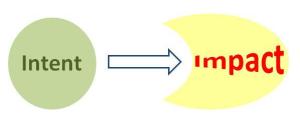
Let’s face it . . . we’re all human and sometimes we say or do stupid things. No one is immune. We often say we don’t “intend” to hurt someone or do something thoughtless, but whether we intend it or not, the impact of what we say or do is felt by other people.

If other people are continually upset by our words or actions, at some point, we need to stop hiding behind “I didn’t intend to do that.” When we keep bumping up against reactions and challenges that we did not intend to cause, then we need to understand that the impact of what we are doing is not effective.

intent impact

When we continue to do something “unintentionally,” after awhile, doesn’t that become “intentional”? If we aren’t changing how we’re acting or what we’re doing or saying, that means we’re intentionally choosing to remain ignorant of ourselves, our motivations, and the effect of our words and actions on others. If you are not self-aware, and you keep running into the same problems, then you’re just being deliberately unaware.

Getting really clear on what we want to say or do requires self-awareness. We need to be able to understand what we are feeling and take a moment to think before we act. We must take some ownership in the communication process, especially when the reaction we get is not what we expect. And finally, we must take time to develop an understanding of other perspectives, so we can recognize at least some of the ways in which our message might be received. Cultural Detective Self Discovery as well as all the series’ other packages can greatly help in this regard.

“That’s not what I intended” may be an excuse the first time, but not the tenth. Once you are aware of the impact of your words or actions, adjusting them is up to you.

New Study on How the Language We Speak Affects Us

“The structure of languages affects our judgments and decisions about the future, and this might have dramatic long-term consequences.”

On October 1st I read an interesting article in Scientific American, entitled, “How Your Language Affects Your Wealth and Health.” Dr. Keith Chen, of Yale Business School, had conducted a study analyzing individual-level data — economic decisions, retirement assets, smoking and exercising habits, and general health in older age — from 76 developed and developing countries. He also analyzed national savings rates, country GDP and GDP growth rates. Premised on the fact that some languages have explicit future markers while others have more ambiguous markers between present and future, Dr. Chen correlated the economic and health data with language structure, with striking results. “Speaking a language that has obligatory future markers, such as English, makes people 30 percent less likely to save money for the future,” according to Scientific American.

I shared the article on Facebook, Twitter, and LinkedIn, and today I came across a terrific little video that summarizes the study’s findings. Good visuals nearly always help me make sense of information; it’s why I made this video, summarizing a different cross-cultural study, earlier this year. I bet you’ll find the movie below helpful as well:

The original study is entitled, “The Effect of Language on Economic Behavior: Evidence from Savings Rates, Health Behaviors, and Retirement Assets,” written by M. Keith Chen, Yale University, School of Management and Cowles Foundation, April, 2013
Published in the American Economic Review 2013, 103(2): 690-731
Editor’s choice, Science Magazine, Vol 339(4)
Permanent address: http://dx.doi.org/10.1257/aer.103.2.690http://www.anderson.ucla.edu/faculty/keith.chen/papers/LanguageWorkingPaper.pdf

Remember, Cultural Detective is a leading-edge process not only for understanding values and behavioral differences across cultures, but for navigating them successfully.

World Epidemic of Domestic Violence & India’s “Abused Goddesses”

Durga: domestic violence goddess

The Hindu goddess Durga in an ad to end domestic violence in India

According to the World Health Organization, violence against women is a worldwide epidemic. Findings from the first extensive research of its kind, published in August 2013 and conducted by the World Health Organization, the London School of Hygiene and Tropical Medicine, and the South African Medical Research Council, show that 35% of women worldwide experience either domestic or sexual violence! Globally, as many as 38% of all murders of women are committed by intimate partners. And this, despite a 1993 United Nations Declaration on the Elimination of Violence Against Women. This unacceptable reality is not limited to any one region of the world, as you can see in the map below.

Domestic violence by world region

From the report, “Global and Regional Estimates of Violence Against Women,” World Health Organization, London School of Hygience & Tropical Medicine, South African Medical Research Council.

Both men and women are victims of domestic violence, though worldwide statistics show that four-out-of-five victims are women. I know this epidemic first-hand: domestic violence knows no boundaries of ethnicity, socioeconomic level, or education. While physical abuse is against the law in the USA, thankfully for us, mental abuse is not and can be far, far worse.

Save Our Sisters, an initiative of the NGO Save the Children India, recently returned to my attention when they released a dramatic series of ads designed to stem the tide of domestic violence. The ads show three bruised and battered Hindu goddesses (Durga, Saraswati, and Lakshmi), along with important statistics—68% of women in India are victims of domestic violence—and a helpline number. The campaign, blending hand painting in the traditional style with photography, was created by the Mumbai-based advertising agency Taproot, and it has already won several awards. You can see the three ads in the slideshow below, along with another closeup.

This slideshow requires JavaScript.

Recent reports show that one Indian woman is killed every hour just in dowry-related crimes! Most people that I have spoken to in India find the “abused goddess” campaign highly effective: it grabs one’s attention, it is culturally appropriate, and it seems to be raising awareness and reporting. In sharing the campaign on social media, however, I especially found one response (from Darshana Davé—who has given me permission to use her name and asked that we link to her email) insightful:

“It’s a good, effective campaign, but why must it be that only goddesses, mothers, sisters and daughters be treated well? Why can’t Indian men treat all women with respect? Those questions remain unanswered… A powerful campaign, but it also is guilty of perpetuating the goddess versus whore stereotype, where the woman is either a goddess, sister, mother or daughter, who should not be abused, or if not those, a whore, who can be abused.”

Darshana also shared this provocative (though challenging to wade through) article, entitled, “No more goddesses, please. Bring in the sluts,” which I feel makes some valid points—and I do love the title.

What do you think? Have you seen culturally appropriate campaigns to eliminate violence against women where you are? If so, please share!

Violence against women is both a major world health issue and a human rights problem, as indicated in the diagram below, from the same WHO report.

Health effects of domestic violence

From the report, “Global and Regional Estimates of Violence Against Women,” World Health Organization, London School of Hygience & Tropical Medicine, South African Medical Research Council.

In Mexico, where I live, we suffer an epidemic of “lost women,” women who just disappear one day, never to be seen again, victims of sexual violence and murder. Violence against women is a systemic problem, a societal and cultural problem. We need to stand up, to speak up, each of us, in our families, with our friends, neighbors and colleagues. We need to use our cross-cultural skills to help people realize, in ways that make sense to them, that violence is never appropriate.

“There is one universal truth, applicable to all countries, cultures and communities: violence against women is never acceptable, never excusable, never tolerable.”

—United Nations Secretary-General, Ban Ki-Moon (2008)

Today as this blog post was published, I happened upon this particularly powerful and discouraging article from the Harvard Gazette. If this topic interests you, be sure to read it and let me know what you think.

Also, do not miss this just-released UNDP study on preventing violence against women in the Asia-Pacific region.

Happy Mid-Autumn Festival! (What do you call a witch at the beach?)

mid-autumn6The Mid-autumn Festival — 中秋节, often called the Chinese Moon Festival, is held on the 15th day of the eighth lunar month, when the moon is at its roundest. It is the second most important Chinese holiday after lunar new year, and celebrates the Chinese value on home and family — 家庭. People travel from far and wide in order to be able to spend time with extended family.

Customs on this day include moon viewing and appreciation, getting together with family and friends, eating moon cakes, reciting poems, dragon dancing, and lantern riddles.

Lantern riddles are a terrific exercise for Cultural Detectives, teaching us to think beyond our normal habits. They are also an engaging cross-generational activity. Many thanks to cultural-china.com for the riddles below. I’ve selected a lucky number, eight of them, for your enjoyment. Take your time and guess, then scroll down past the moon cake recipe for the answers.

Lantern Riddles:
  1. Which is faster, hot or cold?
  2. What building has the most stories?
  3. When is your mind like a rumpled bed?
  4. What do you call a witch at the beach?
  5. They are twin sisters of the same height. they work in the kitchen, arm in arm. whatever is cooked, they always try it first.
  6. When I slap you, I slap me. When I hit you, my blood flows.
  7. It will follow you for 1000 miles and never miss home. It desires neither food nor flowers. It fears not water, fire, knives nor soldiers. It disappears when the sun sets behind the western mountains.
  8. Half is above ground, and half is in the ground. Half is solid, and half empty. Half is white, and half green. Half is eaten, and half thrown away.

Moon cakesWant a recipe to make your own moon cakes? Try this one!

Answers to the Riddles:
  1. Hot’s faster; you can catch a cold.
  2. A library
  3. When it’s not made up.
  4. A sandwich
  5. Chopsticks
  6. A mosquito
  7. A shadow
  8. A scallion

Happy Mid-autumn Festival, everyone! Please share with us your favorite holiday traditions or riddles.

[Day 1 of 5] SIETAR Europa Congress Tallinn: Daily Wrap Up

For those of you who are passionate about intercultural but, like me, were not able to get to Tallinn, Estonia for the SIETAR (Society for Intercultural Education, Training and Research) Europa Congress, here is Vanessa’s first day wrap up. Enjoy!


Vanessa's avatarthe book of ness

Wednesday was “Pre-Congress How-To Workshop Day”.  We are wrapping up, and what were the biggest take-aways?

Image

Sabrina and I were first to present this morning.

We framed Social Media Marketing through an intercultural lens.  Have you ever been a tourist?  Have you ever been a traveler?  What’s the difference?  Tourists might just casually visit a country, without a strong connection or engagement with the local community, perhaps get easily distracted to shiny objects and come home with a suitcase packed full of purchases they didn’t anticipate.

What about a traveler?  Perhaps they spend more time planning and preparing for the visit to the new land.  Relationship building, engaging with local community, and being a conscious participant is the approach of a traveler.  Apply this to Social Media and get your passport ready for your journey.

Image

We have more inspiring stories about building a social media campaign using competencies…

View original post 428 more words