Endangered Languages Project

Experts estimate that only 50% of the languages that are alive today will be spoken by the year 2100. The disappearance of a language means the loss of valuable scientific and cultural information, comparable to the loss of a species. Tools for collaboration between world communities, scholars, organizations and concerned individuals can make a difference. Such is the raison d’être of the Endangered Languages Project, an online collaborative effort to protect global linguistic diversity.

The first thing I noticed on this site is the incredibly high quantity of red dots on the world map, each indicating a severely endangered language. The site enabled me quickly and easily to look up endangered languages in Mexico, where I live (the closest red dot to my home is the Seri language, one I’d never even heard of!). I also looked up the language that first interested me as a pre-teen in the southwestern USA: Navajo (it is labelled “at risk” and is currently a featured language on the site). Even in my adopted homeland of Japan, as I expected, the Ainu language is ranked “critically endangered.”

The languages included in the project and the information displayed about them are provided by the Catalogue of Endangered Languages (ELCat), produced by the University of Hawai’i at Manoa and The Institute for Language Information and Technology (The Linguist List) at Eastern Michigan University. The list of collaborators in the Alliance for Linguistic Diversity is indeed impressive. The project site is definitely worth using!

Global Edge: Terrific resource

Are you familiar with GlobalEdge? Funded in part by the USA Department of Education, the project provides free, centrally located international data from a variety of sources.

  • The Global Insights section includes data sortable by country, by 11 trade blocs, or by industry.
  • The Reference Desk includes a resource directory, online course modules, tutorials on international business, and a glossary of international business terms.
  • Their Knowledge Tools, my personal favorite, include tests of knowledge, economic rankings, a terrific “Database of International Business Statistics” to help you generate the custom reports you might need, an index to evaluate emerging markets, diagnostic tools to aid your business decisions, and a country comparison tool.

Many thanks to Cultural Detective facilitator Janet Graham, Baker University professor of international business, for highlighting this resource !

Grains of Sand and Cross-cultural Adjustment

Ever look at something and find it so beautiful or fascinating that it just sort of sticks with you? Perhaps it gives you a gut feeling that it speaks to something you’re working on? Then, maybe in the shower the next day, it hits you?

That’s what happened to me a while ago when our Intercultural Competence News Feed curated Dr. Gary Greenberg’s photos, taken through a microscope, of grains of sand.

While most of us normally think of grains of sand as looking fairly similar — tan or brown, some crystals, shiny — Gary’s photos show us that deep down, once we “get to know” the grains of sand, so to speak, each of them is quite unique! Now if that isn’t a metaphor for diversity, inclusion and cultural differences, what is?

We hope you’ll be pleased with the train of thought Dr. Greenberg’s gorgeous photos produced. We put together a PowerPoint on cross-cultural dynamics that you are most welcome to download and use. It hasn’t been polished and perfected like the grains of sand, but if you read the presenter notes, we are confident you’ll have fun customizing the ppt for your programs.

We all have favorite photos, metaphors, comics, and stories, or even video clips, that we love to use in teaching, training and coaching. If you have something you would be willing to share, please pass it on. We’ll be happy to get it out there for you and link through to your website or contact information. Together we can build a more respectful, understanding and collaborative world!

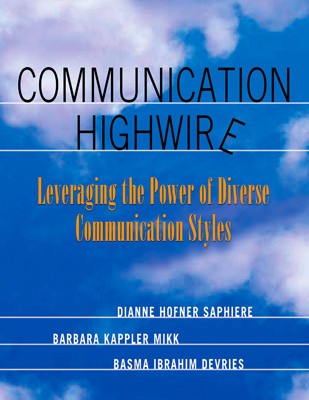
Book Review: Communication Highwire

by Dianne Hofner Saphiere, Barbara Kappler Mikk, and Basma Ibrahim DeVries
Intercultural Press, ©2005

Communication Highwire: Leveraging the Power of Diverse Communication Styles

Review written by Piper McNulty
Originally published in the The CATESOL Journal vol. 20.1

Communication Highwire, as the circus metaphor implies, explores the balancing act inherent in any intercultural interaction: how to remain true to oneself while exploring aspects of other styles, with a goal of achieving more effective communication.

After decades of teaching and training across, and about, cultural differences, these three authors have found that labels such as “direct,” “low context,” or “polychronic,” while providing initial insights, are not sufficient for their purposes, and that a more “robust, and dynamic” (p. xi) analysis framework is needed. In addition, unlike most books on intercultural interactions, Communication Highwire moves beyond appreciation of cultural difference to suggest ways to leverage diverse styles for improved communication across cultures.

Their model is additive, with a goal of expanding each individual’s communication-style repertoire. The book is divided into four sections: an introduction, five factors affecting communication style, a detailed breakdown of 16 specific styles, and an extensive collection of activities. The authors return throughout the book to the ongoing, often contentious relationship between two businessmen, Mike and Tanaka-san, who struggle to understand each other’s behaviors, articulate their own goals and preferences, try each other’s styles, and ultimately work together productively. Examples from many other cultures and contexts are also used to illustrate the concepts and strategies throughout the book, drawing on the authors’ extensive intercultural experience, both professional and personal.

Saphiere, Mikk, and DeVries explore communication across cultures from different client needs and perspectives, and they argue persuasively that successful communication requires a combination of styles. The best coauthored books present a mixture of ideas, experiences, and analysis and we are the richer for these authors’ extensive collaboration. Each chapter, and the themes that carry throughout the text, appear to be the result of extensive discussion, reflection, and collaboration. The book is full of engaging, highly readable examples, discussion prompts, and skills activities, which take the reader well beyond the obvious and the “common sense” of communication theory. Occasionally the sentences get a bit wordy, but the writing is clear and cogent throughout, and the authors do an excellent job of selectively substituting everyday terms where field-specific jargon could simply distract and frustrate the reader.

The book also stands out for its gentle reminders to consider multiple perspectives, to “hold…individual goals loosely enough to hear, accept and more fully understand each other’s goals” (p. 79). In addition, the analysis checklists are exceptionally thorough. For example, most intercultural communication (IC) texts simply state that in some cultures one should avoid eye contact with authority figures, yet we all know that eye-contact rules are not that simple.

These authors list four different descriptors of eye contact, and while such detailed analyses might seem more than the average ESL/EFL student needs, or can handle, adults in a second-culture context often struggle to adjust their communication behaviors to be more effective with their new interlocutors, and they are often very aware of fine nuances of style. Such students are usually more than ready to embrace this depth of analysis, because they want to understand why their interactions across cultures do not always go as intended.

Of particular interest to TESOL members will be the detailed analyses of functional language. Students trained to analyze miscommunication as these authors suggest will be at a significant advantage when discussing, negotiating, persuading, critiquing, or receiving feedback, skills that can come into play in academic contexts, the workplace, when renting an apartment, or opening a bank account. Also addressed are idea presentation, turn taking, expectations of communication process, use of emotion, permeability of new ideas, apologies, requests, praise and disagreement, feedback, and humor, among others. Language for describing details of both vocal characteristics and nonverbal behaviors are also provided. Making this global range of styles explicit is of great benefit to instructors and students alike.

The authors also emphasize that no individual will be predictably direct, or emotionally expressive, or quick to touch others in all contexts (to name just a few), but that communication styles are a situational tendency, providing a link between behavior and underlying intentions. To leverage our understanding of others’ styles, they present a four-step method: (a) reflecting, (b) analyzing, (c) discussing, and (d) deciding. While these steps might seem easy to carry out, discussing and deciding are not found in most IC literature, and the authors’ engaging analysis of the ongoing relationship between Mike and Tanaka-san helps instructors and clients develop their own version of the suggested analysis strategies.

The book is such a rich source of information and analysis tools to seem, at times, overwhelming, but the outline format and use of charts allow the reader to skim the chapters’ subtopics, selecting the specific communication styles or functions that are most applicable to their client/student population.

As for the activities, we have all read step-by-step instructions of skill-building activities and wondered whether we could achieve the outcomes promised by the author. Intercultural and diversity training can be particularly idiosyncratic and context specific, making it difficult for others to duplicate their success. However, the activities presented here are easy to envision, and the tips and suggested adaptations allay concerns that the exercises are too dependent on the original facilitator’s approach. In addition, the relatively large font, line spacing, and the wide margins leave plenty of room for underlining and notes.

Communication Highwire is an excellent resource for ESL/EFL instructors whether or not they use the activities in their own classrooms, as the tools provided may help them recognize where, and why, their own interactions with their clients, of any age or level, have gone awry, and what may be causing disconnects in their classrooms. The authors explore culturally different communication styles with depth, clarity, and insight.

Communication Highwire would be a useful supplement for teacher-training programs and a valuable addition to any ESL/EFL instructor or trainer’s library, no matter what the level or context of instruction.

Communication Highwire: Leveraging the Power of Diverse Communication Styles is a gem!

“Interculturalidad” – View on Interculturalism from Latin America

During my recent and incredibly learning- and success-filled trip to Colombia, a client asked me to do a short presentation on the state of intercultural competence in Latin America. Such a small request, right (asked wryly and facetiously)? I live in México, but after four years I sure don’t count myself a culture-specific expert, and I am surely not qualified to speak for over half the hemisphere! So, what to do? Turn to an esteemed colleague’s expertise, of course. In this case, I turned to Adriana Medina (and her co-author, John Sinnigen).

The beauty of the source article I used, “Interculturality vs. Intercultural Competencies in Latin America,” is that the authors introduce facts and history we all know, but they put them into a context in such a way that makes total sense and creates new meaning. At least for me.

For example, one of their points is how Latin Americans have lived interculturality for hundreds of years if not longer: wars, imperialism and commerce between the many distinct indigenous cultures, then conquistadores, colonialism, slavery and intercontinental commerce. Intercultural competence on this stage is not some new import during the current age of global economic interdependence. Rather, Latin America’s gold, silver, emeralds and such were important to European economies beginning centuries ago. The authors’ point is, one of the valuable contributions that Latin American interculturalidad can add to the largely northern and western-originated notions of intercultural communication or intercultural competence is this: power, specifically power imbalances.

“Interculturality, the preferred term in Latin America, refers to a historic condition, a radical restructuring of the historically uneven relations of wealth and power that have existed between Europeans and their descendants and indigenous and other subordinated groups during the last half millennium. The aim is decolonization of institutions and the sociocultural fabric of the country.”
— A. Medina-López-Portillo and John H. Sinnigen, “Interculturality vs. Intercultural Competencies in Latin America,” chapter 13 in Deardorff 2009, Sage Handbook of Intercultural Competence

In their article the authors present six strengths that Latin American interculturalidad can contribute to the intercultural communication and competence field. And, speaking for myself, our field is in huge need of hearing and incorporating these perspectives into our theory and practice! Contributions of interculturalidad, according to Medina and Sinnigen,  include that it:
  1. Is counter-hegemonic; focuses on the balance of power
  2. Starts with the needs of marginalized cultures (diverse indigenous movements from Mexico to Bolivia and Ecuador)
  3. Advocates mutual respect and economic and political equality rather than the acculturation of the oppressed
  4. Incorporates Andean/Amazonian concepts such as respect for Pachamama, good living, communitarian practices
  5. Multilingual integration
  6. Decades of dialogue leading to constitutional specificity

I want to thank this client for making this request of me, as it spurred me to learn more about a colleague’s work, and also to learn more about the work of Nestor García Canclini (more about his work in another blog post). I also want to thank Adri and John, whose work, I feel, is very important. I hope this might spur more of us to read, incorporate and build on their findings.

I have posted three PowerPoint slides summarizing this article, and you are welcome to download and use them if they might serve you. Please be sure to retain all source references, including the authors’ and Cultural Detective‘s. Together we can make a difference!

What do you think about the authors’ premises? How might we help the intercultural field to incorporate the Latin American perspective? How do you handle power differences in your work? I look forward to hearing from you!

Born and raised in Mexico City, Adriana Medina-López-Portillo is Assistant Professor of Intercultural Communication and Spanish in the Department of Modern Languages, Linguistics and Intercultural Communication at the University of Maryland, Baltimore County (UMBC). She is an accomplished intercultural trainer, having designed and led workshops for higher education, not-for-profit, governmental, and corporate clients in the United States and abroad. Among her favorite appointments are training for The Scholar Ship, a transnational academic program housed on a passenger ship, and offering pre-departure and on site orientations for the King Abdullah University of Science and Technology (KAUST) in Saudi Arabia. John Sinnigen is Prof. of Spanish and Intercultural Communication at UMBC.  He is the co-editor of América para todos los americanos:  prácticas interculturales (Mexico: UNAM, 2012).

Book Review: Intercultural Communication, Globalization and Social Justice

by Kathryn Sorrells, Sage Publications, ©2013 ISBN 978-1-4129-2744-4

Intercultural Communication: Globalization and Social Justice provides fresh voice and much-needed current perspective on intercultural communication competence. Written as an undergraduate and graduate level text, as a 30+ year professional I also read it enthusiastically. From Sorrells’ debunking of racial color blindness (p. 62), to the commodification of culture (p. 190), to her closing call for global citizenship (p. 227), her keen intellect and passionate commitment to social justice is evident and unwavering throughout.

From the beginning the author makes clear the need to put intercultural communication in context and with a clear purpose:

“Regrettably, some of the most egregious injustices—exploitation of workers in homes, fields, and factories and violence perpetrated through racial profiling and ethnic cleansing—are performed within intercultural contexts and are enabled by intercultural communication.” (p. xiv)

…”the globalized context in which we live today makes ethnocentrism and ethnocentric approaches extremely problematic. The assumption that one’s own group is superior to others leads to negative evaluations of others and can result in dehumanization, legitimization of prejudices, discrimination, conflict and violence.” (p. 13)

“This text … provides a framework to create a more equitable and socially just world through communication.” (p. xiv)

By page 38, I knew I was in good hands, as Sorrells wove Amy Chua and her World on Fire into the intercultural mix, providing it as counterpoint to Francis Fukuyama’s The End of History and the Last Man.

The author appears to have challenged herself to address each topic, even the most familiar, through at least four lenses:
  • in what ways is the topic complex and contradictory,
  • how does the topic appear from micro, mess and macro views,
  • what are the local and global connections, and
  • how do the complexities and contradictions play out in our world today, particularly in terms of equity and justice?

Sorrells is an excellent teacher, providing rich yet succinct examples—unraveling the various interwoven threads of her stories to enable the reader to more clearly see each thread—while keeping the overall tapestry in mind. Her writing should energize and guide cadres of undergraduates, as well as professionals, to use intercultural communication theory and practice to bring more equity and justice to our world.

Sorrells covers the content you’d typically expect in a basic text on intercultural communication: nonverbal communication, context, dialogue, relationships, communication style, identity theory, use of space. What makes this book different is that she uses important current issues and topics to provide a fresh perspective and powerful, meaningful insight. She examines intercultural communication informed by topics such as power, hegemony, growing socio-economic inequities, the culture of capitalism, race, color-blindness, immigration, glocalization, hip-hop culture, appropriation, hybrid cultures, and online communication. She pulls from a variety of disciplines including feminist theory to address her topic. In the process, she introduced to this practitioner new ideas such as fragmegration (p. 131), culture jamming (p. 144) and polysemic space (p. 91).

The book begins by looking at why the intercultural field has not been able to settle on one definition of culture, tracing definitions of culture from anthropology, cultural studies, and globalization. The author next guides us through a much-needed review of the history of intercultural communication, doing so crisply and meaningfully. Revisiting the origins of the field may help us return to our collaborative purposes and away from the overly analytical comparative studies trends of today.

Each chapter concludes with discussion activities and questions, which for a trainer or coach will be invaluable. And they’ll make lesson planning for the classroom easy.

To enable students to navigate the complex intercultural spaces they inhabit, the author introduces a process of critical, reflective thinking and acting. She calls this “intercultural praxis.” Via six interrelated points of entry (inquiry, framing, positioning, dialogue, reflection, and action), “intercultural praxis uses our multifaceted identity positions and shifting access to privilege and power to develop our consciousness, imagine alternatives, and build alliances in our struggles for social responsibility and social justice.” (p. xvi)

Obviously the text is not intended for a basic-level reader of English! And, while this praxis model is definitely conceptually sound, it is far from easy to put into practice.

What were some of the points in this book that stood out for me? The concept of “positioning” is important:

… “how our geographic positioning is related to social and political positions. As you read these sentences, where are you positioned socioculturally? The globe we inhabit is stratified by socially constructed hierarchical categories based on culture, race, class, gender, nationality, religion, age, and physical abilities, among others. Like the lines of longitude and latitude that divide, map and position us geographically on the earth, these hierarchical categories position us socially, politically and materially in relation to each other and in relation to power.” (p. 18)

Sorrells explains that positioning “directs us to interrogate who can speak and who is silenced; whose language is spoken and whose language trivialized or denied; whose actions have the power to shape and impact others and whose actions are dismissed, unreported and marginalized.”

The author’s reference to modern-day anthropologists Jonathan Xavier Inda and Renato Rosaldo was also valuable. Their premise is that culture, in the context of globalization, has been “deterritorialized.” What this means is that “cultural subjects (people) and cultural objects (film, food, traditions, and ideas) are uprooted from their ‘situatedness’ in a particular physical, geographic location and reterritorialized, or relocated in new, multiple and varied geographic spaces,” (p. 43).

Hence, we find Hindi films and Amitabh Bachchan posters worldwide, with wildly different meanings attached. “Similarly, a person’s or group’s sense of identity, who migrates from Iran to Israel to the United States, for example, is reinscribed in new and different cultural contexts, altering, fusing, and sometimes transforming that identity.”

There were two very minor disappointments for me, amidst all the positives in this text. The first is that while this volume includes a great deal of content that other intercultural texts omit, Sorrells does not adequately address religion and its role in society today. The clash of religious and spiritual beliefs, the gaps between believers and non-believers, the judgments one to another, the fact that religion can provide access to power or motive for distrust, are important. Religion can divide or unite communities, nations, and continents. A chapter or at least a couple of pages devoted to the topic, as seen through Sorrells’ keen perspective, would be a valuable addition.

Second, while the book is overflowing with examples from all over the world, it is unnecessarily US-centered. Perhaps a US publisher wanted the book to sell to US universities, and thus preferred it be written that way. This could so easily have been a non-nation-centric book—with an even bigger market. It comes so very close that it seems a shame not to have gone the extra step.

Intercultural Communication: Globalization and Social Justice is a must-read for any intercultural professional or serious student of the field. And if you have the pleasure of teaching an intercultural communications class, this is a terrific new text.


Mashing-it-Up in Hong Kong: International Schools

By Barbara Schaetti, co-author of Cultural Detective Blended Culture
Reposted from Personal Leadership May 2012 Newsletter

International educators have historically assumed that K-12 international schools are, by default serving multinational and multicultural expatriate communities, providing students with experiences that result in intercultural competence. But are international schools truly teaching students to make meaning of their unique cultural experiences or, when it happens, is it more by good-fortune than by design?

I recently had the honor of being invited to HKISpresent a series of half-, one-, and two-day programs, at the Student Services Summit sponsored by the Hong Kong International School (HKIS). HKIS is among the top tier of K-12 international schools worldwide, and enjoys a well-deserved reputation as a premium institution. Although it was my first time at HKIS, working with and at the School had a quality of home-coming for me: I grew up attending international schools in West Africa and South East Asia, and consulted extensively with international schools throughout Europe and South Asia in the 1990’s. Although each international school varies from the next, the culturally diverse environment they typically offer is very much home territory for me.

And so what a joy to be asked to facilitate a two-day program for international educators titled Deepening Intercultural Competence: Developing an Intercultural Practice. Participants were international educators from across Asia and beyond, mainly developmental guidance counselors (with a couple of administrators too), who share a common passion for preparing their students to participate successfully in a globalized world. They were very ready for a professional development program focused on strengthening their own abilities to role model moment-to-moment intercultural practice.

I centered our time together on The MashUp: A Professional Toolkit for Developing Intercultural Competence. The MashUp (MU) is a natural and powerful combination of two leading processes in the development of intercultural competence: Cultural Detective (CD) and Personal Leadership (PL). Where PL provides a process to disentangle from automatic judgments, emotions, and physical sensations, and to open to the unique possibilities of the present moment, CD provides a process for deconstructing the intercultural dynamics at play, considering the values, beliefs and personal cultural sense that may be motivating people’s words and actions, and developing cultural bridges to close the gap. As an integration of the two, the MashUp offers a proven and exceptionally effective way to successfully strengthen intercultural competence in individuals, in teams, and across organizations.

In Hong Kong, the MashUp was very well received by participants who immediately saw its relevance and practical service to the daily situations they encounter – as international educators and as expatriates themselves. As one person put it:

“How thrilled I am to have experienced these past 2 days – I feel excited and energized, ready to begin a new journey! This has been everything I had hoped it would be, and more. I am leaving today with great ideas to enrich my practice, and steps to move towards this goal. I also believe that I have a group of colleagues who have a similar mindset and interest in adding value to their practice.”

I too left the session inspired. These international HK BAYeducators are ready to intentionally provide their students (no longer simply to trust to good-fortune) with the role-modeling, orientations, and practices that develop intercultural competence. And if that’s true of the educators in my session, then we can know it’s true of many more!


You have two opportunities to learn more about this developmental MashUp of PL and CD.

  1. The first opportunity will be live and in-person at the Summer Institute for Intercultural Communication, July 16-20. Developing Intercultural Competence: An Integrated Practice will be conducted by Dianne Hofner Saphiere and myself, Barbara F. Schaetti.
  2. The second opportunity will be a blended learning course to be held September-December 2012. Developmental Intercultural Competence: Cultural Detective, Personal Leadership, and the DMIS, a transformative professional development course is an avant garde blended learning course focuses on how best to use the MashUp to support the development of intercultural sensitivity as illustrated by the DMIS (Developmental Model of Intercultural Sensitivity). This course will be conducted by Dianne, Heather Robinson, and me.

Oldie but Goodie: Map of Key Cultural Differences

Intercultural communication is about how we can communicate effectively with one another. A frequent approach to improving intercultural communication is to develop our understanding of ourselves and of others. And probably the most common way of doing that is to teach about cultural differences, often referred to as the “dimensions of culture.”

There are many different versions of the dimensions of culture. I generally find them valuable as tools to help us compare cultures, or to cognitively learn about ourselves and others. And I also find they really limit us. While not intended this way, their use has a tendency to reify culture, to cause us to think about culture as a “thing” rather than a process. It’s why I’m such a fan of the Cultural Detective Worksheet: it’s a process for understanding self and others, for leveraging similarities and differences in order to collaborate in more innovative, rewarding, and satisfying ways.

Enough about that. This post is about cultural differences. In my training one of the ways I talk about cultural differences is to ask people to think of them as a map of the terrain, and to use them as a scanning tool. In a given interaction, which difference(s) got in the way? For example, was status important for her and not for me, and I just missed it? Was it a different sense of responsibility that really upset me? Maybe he likes to do several things at once, and I’m more one-thing-at-a-time? Was it the fact that I don’t think religion belongs in the workplace that caused him to think I’m not trustworthy?

That is how the map above came to be. It is a graphic summary of some of the cultural differences or dimensions, at least as I saw them back in 2008. It is available for you to use freely under a Creative Commons license. You can introduce the various cultural differences to your team and then, when you get mired in cross-cultural miscommunication, you can take out your map of differences and decipher just which dimension might be causing the problem. Or, maybe it’s something not even on the map.

Just click on the link above for a larger image, and to download the accompanying 11-page article entitled, “Detecting the Culprits of Miscommunication: Values, Actions and Beliefs.” Please feel free to copy and distribute, as long as you retain the copyright and source url.

I’m really interested to hear from you about how you use the dimensions of culture to promote effective interaction. What are your tools and techniques? Your dos and don’ts? And what do you think about this “map of the culprits of miscommunication” idea?

Culture Eats Strategy For Breakfast!

“Culture eats strategy for breakfast!” — a quote that grabbed me during a recent keynote address by BNI (Business Network International) founder and Chairman Dr. Ivan Misner. He was introducing his new book, Business Networking and Sex (Not What YouThink!).

Those (in the audience of more than 1000 Kansas Citians) with more exposure to culture-related topics probably guessed that the book focuses on networking techniques of the different genders and how to be successful networking with the opposite sex. But to hear so boldly from this networking icon how powerful culture truly is in relationship building and the networking process resonated strongly with this Cultural Detective!

When I heard this statement from Dr. Misner, I wished I could have jumped up on stage and displayed the Cultural Detective Women and Men Values Lenses. It would add to the value of his research by providing clear underpinnings as to what motivates the networking behaviors of men and women, and it would help explain the “whys” behind the stories illustrating their differences which seem to be highlighted throughout the book.

Dr. Misner’s book takes a three-pronged look at business networking across the sexes by offering a surveyed objective look at how men and women think about, approach, and in what ways they are successful at business networking. He then counters that with a “he said” (Frank) and “she said” (Hazel) analysis and interpretation of the survey results.

Over a four-year period they surveyed more than 12,000 businesspeople globally (covering every continent) on 25 questions about business networking. The results and interpreted analysis could bring about some interesting and revolutionary changes to the way in which each sex approaches networking with the other. Communication gaps could be narrowed and connections broadened through Hazel and Frank’s guidance and revealing a bit of the opposite sexes “Lens.”

My only wish was that Dr. Misner would have take the results of the survey to a deeper level by breaking it down to country-specific data. But then again, that’s where Cultural Detective national Values Lenses could shed some light!

NOTE: While the book reviewed in this post references two genders, and we offer an excellent package with this same approach, Cultural Detective Women and Men, there are other ways to look at gender than just a polar division of male/female. Cultural Detective LGBT examines some of these complexities of gender and sexual orientation.

Movie Review: The Separation of Nader va Simin (Iran)

The media attention on Israel’s potential response to Iran’s nuclear activity has piqued my interest to learn a bit more about Iranian culture. Last week our family watched a most incredible film that I felt provided so much insight, so I asked my very good friend, Cultural Detective certified facilitator Pari Namazie, what she thought about what I had learned and seen.

I trust you’ll all enjoy her insights as much as I have. It would seem that this film could be an excellent learning tool for those working with Iranians.

Pari joon, thank you for sharing your insights with us!

They were proud moments for us Iranians when Asghar Farhadi received the Oscar for Best Foreign Film, as well as the Golden Globe and the Golden Bear of Berlinale, for his film A Separation (Jodaeiye Nader az Simin).

The film, which talks about a divorce between Nader and Simin, has two main underlying themes: responsibility and truth. Though one initially thinks the film is about a divorce case, Farhadi cleverly weaves many layers of Iranian society into his film, including power, religion, truth, gender, family, and social class. The points which stuck out most when I watched the film were:

The role of women: Iran is governed by Islamic law. The society is patriarchal and the laws between men and women unequal. Although the foreign media might portray Iranian women as weak and dominated by men, the reality of the matter was captured well in Farhadi’s film, which showed Simin wanting to leave Iran with her daughter, as she believed it was not an environment for a child to grow up in. When her husband refused to immigrate with her (due to his father’s condition), she then insisted on divorce and moved into her parents’ home. It also showed a more religious woman taking fate into her own hands looking for a job, despite the fact that in her family the breadwinner was undoubtedly her husband. Any one who has visited Iran will know the strength of character and conviction of its women.

Truth: The film beautifully portrayed the search for truth in the Iranian culture: from the court, to Termeh (the daughter) asking her father if he knew Razieh (the helper) was pregnant when he pushed her out of the house, to Razieh swearing on the Koran that Nader’s pushing her caused her miscarriage — if she swore on the Koran and it were untrue, then she would condemn her daughter’s future and fate. These behaviors show one of the strongest elements in Iranian culture: the search for truth.

Religion: Beautiful to see how Farhadi craftfully showed the secular and religious segments of society, how they came together respectful of one another, and yet also their existing tensions. Nader and Simin are more secular and Razieh and her family, religious. On one occasion Razieh called her religious authority to ask if it was permitted by Islam to work with an elderly old man, who was not related to her and where she would have to wash and change him.

Responsibility and Family: The relationship and responsibility towards family from the younger to the older generation. In the opening scene at the family court, Nader tells the judge that he cannot immigrate with Simin as he has an elderly father suffering with Alzheimer’s and can not leave him. Other scenes show Nader’s commitment to his father and his relationship with his daughter Termeh. Although he is under many pressures he still maintains his attentive concentration towards Termeh’s studies and taking care of his father, the two main priorities in his life.

Farhadi competently shows the different viewpoints of all the actors, without taking sides, and lets the audience reflect on the circumstances and situations. This film is a must-see if you have not yet!