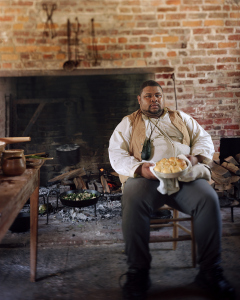
Righting Culinary Injustice

Photo © Johnathan M. Lewis

Photo of Michael W. Twitty © Johnathan M. Lewis

“I challenge you to find anyone in the history of the world who was enslaved and who revolutionized the food, sex lives, religion, dance, music, and aesthetics of the people who enslaved them—like Africans in the Americas did. The man and woman who became enslaved enslaved the palates of those who enslaved them.”
—Michael W. Twitty, food historian

Michael Twitty is aspiring to be the first US Civil War-era Black chef in 150 years. To that end, since 2011 he has researched, written, and, amazingly, performed the day-to-day labor of an enslaved person. Why? “It’s my job, using imagination, body, archeology, ethnography, anything I can, to honor and restore dignity to my ancestors.”

It is important that we not only honor the ancestors but provide a lifeline to contemporary communities and people of color looking for a better life in the new economy, a way out of the health and chronic illness crisis, and a way to reduce the vast food deserts that plague many of our communities. To honor the food past and provide for the food future is “culinary justice.”
—from Michael’s website, Afroculinaria

All over the world, people have lost and are losing proprietorship of their ancestral traditions. As Michael explains, “Spam colonized Oceania, Korean traditions were usurped during the Japanese occupation, there was the pseudo-history of the Columbian Exchange, Native Americans probably exchanged recipes with immigrants as they shivered under small pox blankets and dodged musket balls.” Too many people have no claim over their own heritage, no access to a field of heirloom vegetables that their ancestors brought to a country or a continent.

Maybe you have heard about Michael Twitty. I had not until I read a post by colleague Missy Gluckmann from Melibee Global this morning. Learning from Michael has occupied my entire morning, and I can’t tell you how thrilled and how moved I am by his work and who he is! Bless you, Missy and Michael!

Readers of this blog know that we often write about food (1, 2, 3, 4, 5); it is central to the soul of a culture. We also frequently write about cultural appropriation (1, 2, 3), from fashion to symbols to traditions, how to avoid it, and how to extend power and privilege, credit and honor where they belong—to origins and originators—while also continuing to be generative. Heck, bridging and blending cultures is what Cultural Detective is all about! Building on others’ work while honoring it respectfully and justly is a difficult line to maintain, however, one that requires ongoing dialogue, learning, and adjustment. Living as a gringa in Mexico, I learn more about that “thin line” on a daily basis.

Here in Latin America, where colonization and the appropriation of historic lands remain modern-day concerns, and the switching from heritage to GMO crops breaks my heart and worries many for our future, Michael’s work provides a much-needed vocabulary and conceptual framework. According to Michael, “In a world where oppressed communities worldwide are struggling with food security and economic inequalities, advancing culinary justice is essential to a better and more sustainable future for the global community.”

How does he define some of his terms?

  • Culinary Injustice: “When the descendants of historically oppressed people have no sovereignty over their culinary traditions, and essentially go from a state of sustainable production and ownership to a state of dependency, mal- or under-nutrition and food injustice. It results in feelings of shame for being under history’s boot heel, and puts distance between our past, ourselves and our future. Culinary injustice places originators in a tertiary and passive rather than a primary and active role in the transformation of culinary traditions, and results in fortunes being made for others”—those who oppress, appropriate, or innovate unjustly.
  • Culinary Justice: “Respect for truth and honesty in telling the stories and traditions of the oppressed. Reconciliation not blame, hope not guilt, the power of working together not avoiding one another. Ensuring that children of color have access to the land, ecosystems, clean water and legal protections to grow the heirloom crops and heritage breed animals of their ancestors. This results in a greater connection to nature, spirit, and our ancestors. Culinary justice enables the oppressed to become entrepreneurs, producers and providers by using their unique cultural heritage, and lifts communities out of poverty.”

Bridging Cultures via Culinary Traditions

Michael himself is a Blended Culture person, both African-American and Jewish, among, no doubt, many other identities. How does he bridge cultures? Again, in his words, “Food is extremely culturally connected and inherently economic and political. It is a proving ground for racial reconciliation and healing and dialogue. The responsible exploration of the Southern food heritage demands that the cooks of colonial, federal era and antebellum kitchens and enslaved people’s cabins be honored for their unique role in giving the Southland her mother cuisine.”

Think about this a minute. Here’s a culinary historian who has dedicated his life to reclaiming the Black culinary heritage of the Americas, especially in the US South. How do you think he might feel about someone, like, say, Paula Deen, celebrity chef and doyenne of Southern comfort food, who, when you think about it, has made a fortune off adapting (or appropriating) African-American recipes and traditions? In fact, Michael named one of his projects “The Southern Discomfort Tour,” to help us redefine how we think about what is commonly referred to as “Southern comfort food.”

Again, in Michael’s words, “I invited Paula Deen to dinner, at a plantation, to engage her as a cousin, not a combatant. The Cooking Gene seeks to connect the whole of the Southern food family—with cousins near and far—by drawing all of us into the story of how we got here and where we are going. There is power in food traditions for bridging the pseudo-boundaries of race.”

Bravo!

Michael talks about “identity cooking,” which relates directly to the Blended Culture that we as Cultural Detectives talk about. He tells us, “Identity cooking isn’t about fusion; rather it’s how we construct complex identities and then express them through how we eat. Very few people in the modern West eat one cuisine or live within one culinary construct. Being Kosher/Soul is about melding the histories, tastes, flavors, and diasporic wisdom of being Black and being Jewish. Both cultures express many of their cultural and spiritual values through the plate, and Kosher/Soul is about that ongoing journey.”

He talks about the Americas as “a culinary cornucopia unknown anywhere else in the world, where foods from Africa, the Americas, Eurasia, the Middle East and Southeast Asia met. Cooks from modern-day Ghana, Angola and Nigeria perhaps exchanged recipes with each other in their new Afro-Creole pidgeon English,” and here, paraphrasing him, sharing with one another how they adapt their ingredient list to the plants and herbs available in the Americas, as well as the palates of their new owners. “What results is not like anything they have cooked before, but is the essential truth of all of the parts.”

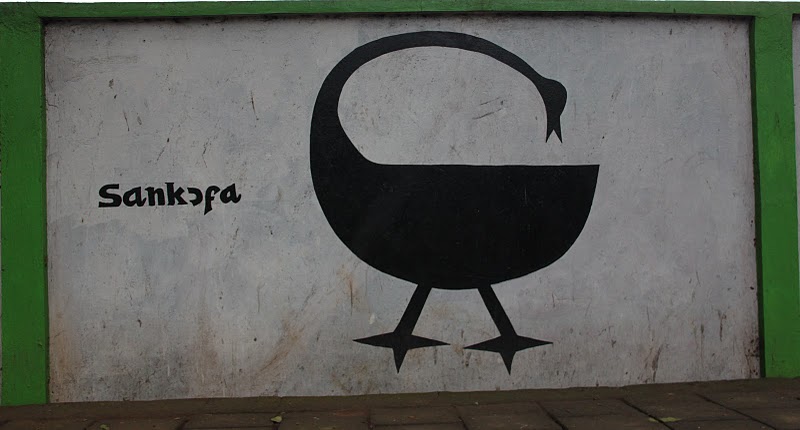
Remember when I told you that modern science is proving that memory is biological, that it crosses generations? Michael Twitty, with his one-man mission to reclaim African-American culinary heritage, recently found out through DNA testing that he his paternal ancestors were the Akan of modern-day Ghana. The Akan language, called Twi, has a word and an Adinkra symbol called sankofa. Sankofa means that we must go back and reclaim our past in order to move forward! You tell me Michael isn’t doing what his ancestors, and his genes, tell him needs to be done! Inside each of us, indeed, is a piece of the puzzle, an answer to the challenges facing our world!

Akindra-sankofa

The Akindra symbol for sankofa

Sankofa_bird

Akindra bird symbol for sankofa

Personal Learning (or Reframing) Points

What are some of the key points I learned, or reframed, from Michael Twitty this morning? Most of the below is verbatim from Michael via his videos on the internet.

  1. African slaves were not unskilled labor. They were brought to the Americas for their skills, to help build nations. They knew how to grow rice and cotton from West Africa, and brought it to the USA. We brought over 20 different African crops and animals to the Americas on slave ships. They brought their ability to cook. Post-slavery, they were the first generation of caterers in America, culinary aristocracy, cooking for the White House, embassies, highest society. Yet our children don’t know that!
  2. “Yam yam” is a Wolof word, the word enslaved women used when caring for white children in the big house, encouraging them to eat her food. Look in the dictionary under “yummy”: “origin unknown”? Black people!
  3. As new generations were born in the USA, kids’ palates changed. They don’t like guts, which of course contained the spirit, the soul, the essence of the animal that was sacrificed to feed us. We began to lose the mystical, the mythological, the metaphysical, and the magical… Those chitlins (small intestine): they contain the soul, that’s why it’s called soul food!
  4. Enslaved cooks from Central West Africa used spirituals to time their cooking; there were no clocks. To roast the meat, bake the bread… they’d reference the number of times they could sing the song before the food would be done.
  5. Rice in South Carolina made 10 out of the first 12 millionaires, all of whom were involved in the Declaration of Independence and the Constitution. It took only two seasons to make the rice planters of Charleston millionaires. Charleston Gold Rice sells for $14/bag today, yet not one black person owns a rice field in Charleston. That’s food injustice.
  6. It’s important to respect and revive the culinary knowledge of the oppressed. It takes guts to insist that the chef act as a keeper of tradition, an advocate of memory, of ecological integrity, of ethnographic and historical respect, with contemporary awareness and a sense of urgency to acknowledge debt. Culinary reconciliation will lead to healing and a better life.

I’m sure you’d love to see Michael in action. Below is a video of an 18-minute presentation he gave to MAD, a Danish non-profit.

If you have heard Michael speak or, better yet, eaten some of his food, please let me know about your experience. Bless you, Michael Twitty! Thank you for helping make our world more respectful, equitable and just!


How Language Can Deceive

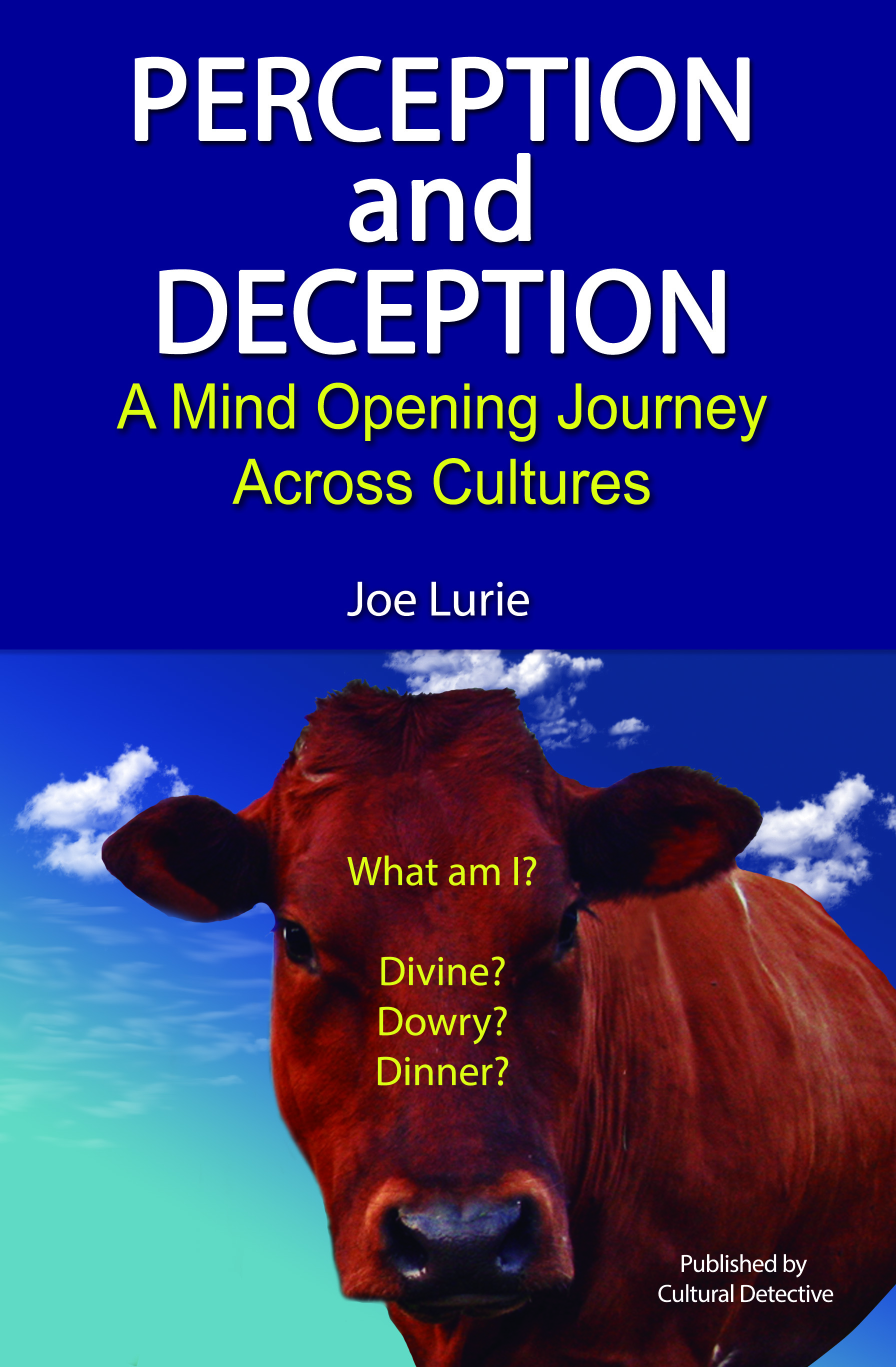
PERCEPTION AND DECEPTION COVER FACE 3“We’re all coming to be like each other. While there’s some truth to that, it’s also truth that in coming together so rapidly—with technology, migration across borders—we are unprepared for the contact between people and cultures we know nothing about.”

Joe Lurie recently spoke to a sold-out crowd at the Commonwealth Club of California. In this two-minute excerpt from that presentation, Joe tells the sad story of a woman looking for a job who isn’t hired, at least in part, because of her name.

We’ve published about the importance of names previously on this blog. While Joe and Fadwa’s story is anecdotal, it echoes the experience of thousands of others worldwide. You may recall the widely reported story of José Zamora, who was hired only after he changed the name on his resumé to “Joe.” According to Recruiter magazine:

Job applicants with white names needed to send about 10 resumes to get one callback; those with African-American names needed to send around 15 resumes to get one callback. This would suggest either employer prejudice or employer perception that race signals lower productivity.

The book, Perception and Deception: A Mind Opening Journey Across Cultures, tells hundreds of stories like this one, in an effort to help the reader develop awareness and understanding, so they can then use Cultural Detective to build their skills and competence. If you haven’t yet read the book, be sure to order it now. Better yet, order a copy for Aunt Margret or your Cousin Vinny, too.

Refugee Resettlement: Cultural Values in the Remaking

refugee coverThere are over 20 million refugees in our world, according to UNHCR. The AVERAGE length of time a refugee spends in a camp—in limbo, in transition, waiting—is 17 years; not months: YEARS!
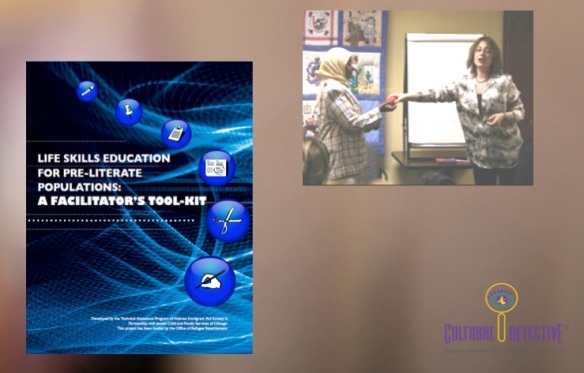
Cultural Detective conducted a complimentary webinar on strategies for helping refugees and their receiving communities. It was conducted by Tatyana Fertelmeyster, herself a refugee, who has worked in refugee resettlement for several decades.

Tatyana

The webinar was so well received that we did a second one, for a different time zone. Then, SIETAR Austria and SIETAR Europa asked us to do a third. The next step will probably be a dialogue among seasoned practitioners. Interculturalists have crucial talent and resources to contribute to this crisis, and Cultural Detective is a tool that provides a remarkable service to both refugees themselves and their receiving communities.

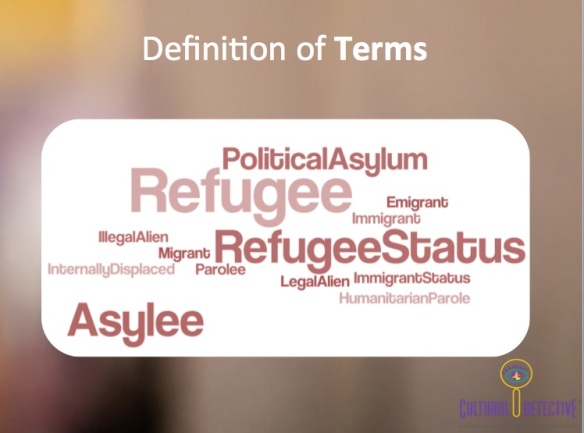
There are several powerful learnings that participants take away from the ninety minutes. One is how complicated and confusing the entire resettlement process is. For example, there are so many different terms, which technically mean so many different things. The key component underlying the refugee experience is fear, and legally, refugees are those who travel across national boundaries. Those who are forced to relocate out of fear yet remain in their own countries are internally displaced.

termsThen there is the statelessness. Most refugees are forced to abandon their citizenship when they emigrate. Since, on average, they wait 17 years before finding a new home, that’s an awfully long time not to “belong” anywhere! Then there is the concept of time, of waiting, of living in limbo. If a child has been raised in a refugee camp, or an adult has lived in one for years, and now in a new home has to keep timely appointments and behave proactively, it’s a HUGE cultural shift we’re expecting. The countries that receive the most refugees are often not the countries in which the refugees will live long-term; they are transit countries. This means that the refugees go through waves of transition and re-acculturation.

There is the loss of everything that is familiar, everything the refugee knows and is comfortable with. They basically fall down Maslow’s hierarchy of needs, losing self-actualization, self-esteem, love and belonging, in the quest for survival and safety. In the new country refugees often need to learn a new language, a new culture and way of life, at a time when they are nursing the wounds of loss and at their lowest emotionally. Members of refugee families experience and respond to these intense emotions in a diversity of ways. Grandparents may not adjust to new ways; parents may be insulted by children who adopt new ways and seem disrespectful; children may resent or feel ashamed of parents who don’t understand or who have values different than those they’ve learned to adopt.

A second powerful take-away from the webinar is an empathy for the loss that refugees experience. Several participants reported tears and crying during one of the activities, saying they felt sad, lost, desperate, a fear of the unknown, anger, resistance, shock, feelings of depression. The refugee experience demands extremely high levels of resilience.

exerciseACTIVITY
So, what was this exercise?

Objective: To establish empathy for the refugee experience.

Instructions: On a piece of paper, draw two intersecting lines, one vertical and one horizontal, to form four quadrants. Yes, sort of like a Cultural Detective Worksheet.

  1. In the upper left quadrant, list the names of the people who are your direct relatives: a legal spouse if you have one, and any minor-aged children.
  2. In the upper right corner, list the names of those you love: adult children, parents, grandchildren, dear friends, cousins. List as many people as are dear to you.
  3. In the lower left, list two to five small, portable things that are of value to you. These should be things the size of a book or so, something that fits into a pocket or a suitcase. They can have monetary or sentimental value, such as jewelry or photos.
  4. Finally, in the lower right, list the things you love about your life now that are too large or too permanently installed to move with you. This might be your home, car, heirloom furniture; or maybe it’s your ancestral grave site, a favorite park or…

Take your time. When you are finished:

  1. Take a good look at that last quadrant, the lower right. Put a big “X” through everything listed there. You won’t be able to take it with you. Let that sink in.
  2. Next, look at the upper right. One by one, draw a line through each and every name on your list. Unless those people are able and lucky enough to travel with you, you may not ever be seeing them again. You’ll have to say goodbye to them. Take a moment. How does that feel?

Debrief: Share reactions and feelings, and apply to real life.

We realized that refugees are expected to be grateful for their new homes, which most of course are; but that at the same time they are mourning losses that are beyond normal mortal capacity. Tatyana shared with us her own experience. Even as a trained social worker, as a relocated refugee she experienced anger, resentment and jealousy of her host, the very person who was helping her, and to whom she was so very grateful. The emotions are complex, intense, illogical, and very real.

The world is so focused these days on what to do with refugees—who to accept, how to ensure safety and security—that we often do not focus on what to do after the refugees reach their new homes. All too often we hear the world “assimilate,” which interculturalists know is a far-from-optimal adaptation strategy. Assimilation happens because a society is not accepting of those who are different, yet a refugee very much wants to fit in and be accepted. In the process, refugees can be successful, but they lose themselves, their heritage, and the receiving society loses the benefit of the unique insights and experience the refugees bring.

What are other options? Tatyana walked us through John Berry’s Acculturation and Adjustment Strategies. Along the “x” or horizontal axis we have how accepting society is of those who are different. Along the “y” or vertical axis we have how open an individual refugee is to change.

berry

From “Immigration, Acculturation and Adaptation,” in Applied Psychology: An International Review, 1997, 46.1, pp. 5-68.

The quadrant we of course want to avoid is Marginalization, which is where terrorism, both domestic and international, are born. This is where difference is not accepted by society, and the individual retreats internally, shutting down to and closing out from the outside world.

Separation is not an ideal adaptation strategy, either. While we may enjoy the good eats of a Chinatown or the salsa dancing of a Latino district of town, separation leads to segregation, pulling society apart and leaving its members vulnerable to discrimination.

We should of course aim for integration, which requires an openness on the part of society and on the part of the refugee or individual. Refugees learn, grow and change, as does society, transforming itself into a more innovative and inclusive community.

Tatyana used Cultural Detective Values Lenses to illustrate the worldview a refugee might start out with, the values required for successful adaptation, and what might be important to those of the receiving country. We can easily use the Cultural Detective Worksheet in Cultural Detective Online to analyze our interactions with refugees, or with those in our new home, and learn how to adjust in a more integrated, less marginalized, separate or assimilated manner.

If you like the activity here, I’d also urge you to look at Caritas France’s “On the Road with Migrants” game, which is now available in English and German as well.

Want to sign up for one of our webinars? You can find the full schedule here.


War Zones and Cultural Disconnects

PERCEPTION AND DECEPTION COVER FACE 3Our book, “Perception and Deception: A Mind Opening Journey Across Cultures,” is getting incredible reviews and selling like hotcakes (or roti, sushi, tacos…)! Quite a few successful, internationally renowned professionals leading multicultural lives—a famous news anchor, an ambassador, journalists, professors—have written on Amazon to tell us how much they’ve learned from the book. Check out the reviews for yourself. As Joe tells us:

I wrote the book because I think that in this age of globalization, more and more cultures are coming together in ways for which we are not prepared. We don’t understand the real intent behind behaviors, behind images, gestures, and how we use our voices.

Perception and Deception‘s author, Joe Lurie, is born a storyteller. Most of his speaking engagements to promote the book have been sold out, including the one in the video below, taken at the Commonwealth Club of California.

Over the next couple of months, I’ll share excerpts of Joe’s talk there. This first clip, below, is four minutes long, and in it Joe discusses the cultural disconnects in modern war zones.

Perception and Deception is a great gift for anyone who would benefit from taking some time to reflect on what is really involved in communication across cultures, even or especially those who live and breathe it on a daily basis. Copies are available through Amazon.com or your local bookstore. Through more effective intercultural communication we can build justice, equity, respect, and collaboration in our world!

“Those who were dancing were thought to be insane by those who could not hear the music.”
—F. Nietzche

No Child Labor a Good Thing?

©1.DSC_0402

Doing the wash while her parents are in the fields

The plight of migrant agricultural workers sadly continues, decades after César Chavez’ death.

In one month this year, five children died in the migrant camps of Teacapán, near where I live in Mexico: one fell into a ravine, another was bit by a scorpion, a third choked, a fourth drowned in an uncovered water tank… On our trip to visit the migrant workers recently, we met a family that had lost a two-year old just a few months ago. Such is what happens when adults need to work in the fields to feed their families, and children are left home to take care of younger siblings and neighbor kids.

Click on any photo in this post to enlarge it or view a slideshow.

Most of us can agree that child labor isn’t a good thing. Many of us perhaps campaigned or voted to outlaw child labor. Grocery store chains won’t buy produce harvested by children, so the local growers are vigilant to ensure that children don’t participate in agricultural activities. But, with the absence of effective support systems, and given the horribly inequitable economy in which we live, outlawing child labor has meant that children are dying, and are not being educated, in record numbers.

The thousands of migrant workers in my state of Sinaloa come from places like Oaxaca, Chiapas, Guerrero—poorer states of the Mexican Republic. Most of the workers are native Mexicans: Miztecos, Zapotecos… Many of them don’t speak Spanish; it’s a foreign language to them. Most of them don’t have birth certificates or official documentation—they were born at home and it’s not their custom to register with the government. Given the lack of language and birth certificates, most migrants are unable to enroll their children in school.

Sound like a hard life? Add to it the fact that the migrant workers are treated like outsiders in most any community in which they work. In Teacapán, for example, I was told the migrants pay 2000 to 3000 pesos a month for rent—of a ROOM, with no running water, no furniture, and most definitely no toilet or kitchen. In Mazatlán you can rent a functioning apartment for that price. It was heartbreaking to see.

During my trip to visit the migrant workers, there were still huge puddles of standing water on the roads, in the yards, and in fields. I was told that Hurricane Patricia dumped 25 inches of rain on Teacapán in 15 hours; the puddles were the last remnants of that flooding, still remaining months after the event.

The migrant workers experience discrimination. Many of the townspeople tell their children to stay away from the migrants; they call them filthy and stupid. I suppose if I didn’t have access to water or a toilet at home, I’d be dirty, too. Last Christmas, a church in Mazatlán brought toys to the migrant workers’ kids, and some of the townspeople made such a fuss because their kids didn’t get toys, that the church was afraid to go back this year. The mistreatment of migrants is by no means limited to Teacapán; that is just where I happened to visit.

The migrant workers told me they stay here in Sinaloa for about six months, then travel to Baja or Zacatecas to continue their labors, rotating their residence to follow the agricultural cycle. One worker told me he is paid two pesos for a bucket of chiles; how is that for exploitation! Can you imagine how long it must take to pick a bucket of chiles? Women work all day in the fields, then return home in the evening to cook and care for the kids.

I went to visit the migrant worker families on a trip organized by Sue Parker of Vecinos con Cariño. Each of the ten of us on the trip that day paid 400 pesos, money which is used to buy food, disposable diapers, baby formula, and basic medical supplies (cough syrup, cold medicine, aspirin, first aid supplies), after paying the expenses of the van and driver.

In Teacapán, we visited the home of Helen and Jerry Lohman, who are on the Cultural Detective learning path. They have a gorgeous place, right on the ocean. Their yard is the biggest stretch of green grass I’ve seen in Mexico outside a golf course. The Lohmans and their driver, Ulises Gil Altamirano (a retired engineer), do all they can to help the migrant workers. Helen has learned the hard way that the migrants do not like to wear shoes (they wear huaraches or go barefoot), nor do the women wear slacks. She has personally sewn 22 pairs of jeans, 57 dresses, and 72 receiving blankets that she’s given out to the migrant families just in the past couple of months. She has five volunteers who now help her. Ulises works as ambulance driver, interpreter, and lawyer for many of the migrant families.

On this trip we met another Cultural Detective, Brenda Irvin, who lives in Teacapán with her husband. Despite having her arm in a sling, Brenda goes out three days a week, every week, to hand out nutritive biscuits and milk to the migrant children. Oh, how they look forward to her visits! She has divided the town into four zones, and each of the days she goes out, she visits a different zone, in rotation.

Brenda, the Lohmans, and Ulises worked hundreds of hours to get registration information for 500 members of the migrant worker community. They got a judge to agree to issue them birth certificates so the kids could go to school and the parents could get access to health insurance. But, after all that effort, the documentation remains in limbo; the judge has not come through on his word.

Brenda told me that a few years ago she happened to gain an audience with our state governor. She showed him photos of the conditions in which the migrant workers live. He agreed to get the state DIF (Family Development Services) involved. Now Sinaloa DIF sends milk, the nutritive cookies, and some other basic items to Teacapán regularly, and Brenda delivers them to the workers’ families.

I am posting a lot of photos, because the photos tell you more than I can with my words.

Vecinos con Cariño (VCC) will welcome your donations; 100% of what you donate will go to help the migrant worker families. The money goes a long way; a donation of US$300 helps them clothe all the kids, for example. They will also take donations of gently used clothing, basic medical supplies, disposable diapers, and non-perishable food items. Contact Sue Parker via email for specifics.

“No Child Labor” is an interesting and sad example of the unintended consequences of imposing a well-intentioned system outside of its culture of origin, and not making appropriate adjustments/modifications. For years, in families all over the world, children have helped with the jobs that needed to be done. Children “came with,” and even if the younger children watched those still younger, it was within proximity of parents. That is how they learned to do various jobs including childcare, and that, in and of itself, is not the problem. The problem arises when child labor is exploited and precludes education.

As good Cultural Detectives, we must remember there are usually at least two “sides” or perspectives to every situation. I trust you will use Cultural Detective Online to develop your ability to understand alternate realities and reflect on the possible unintended consequences of our actions, so that together we can, indeed, build justice and equity in our world.

Ready for Some Good News?

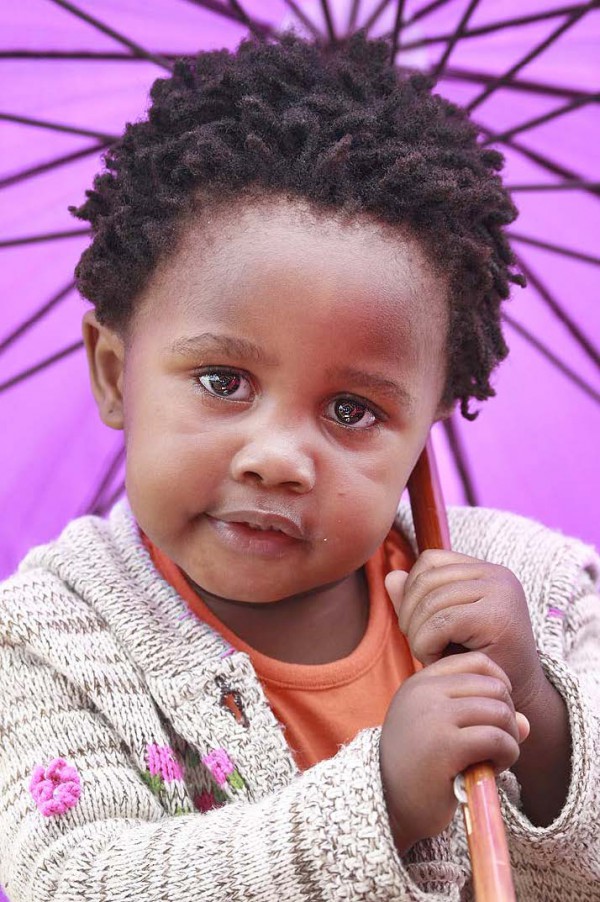
girl with curls v1

photo by Steve Evans from Citizen of the World (South Africa  Uploaded by russavia) [CC BY 2.0 (http://creativecommons.org/licenses/by/2.0)%5D, via Wikimedia Commons

…maybe the most important thing happening in the world today is something that we [journalists] almost never cover: a stunning decline in poverty, illiteracy and disease.”

—Nicholas Kristof, NY Times, Oct. 1, 2015

Things seem so grim some days that sometimes I want to turn off the news. But such a “head in the sand” approach isn’t beneficial — it is important to me to know as much as I can about what’s going on globally. But I keep believing there are many good things that are happening in the world that we just aren’t hearing about — the kindness and compassion of people, the connections that make us truly human, the tireless efforts to educate more children, feed more people, and eradicate diseases.

On a particularly glum day, I was delighted to find a NY Times Op-Ed Column by Nicholas Kristof—something that actually gave me reasons to feel more optimistic about the improving situations of people globally. While the daily struggle continues to be difficult for too many around the world, there actually is some good news.

Funny thing is, US Americans don’t know about it. Kristof puts this lack of knowledge squarely on the shoulders of US journalists, but I wonder if others around the world know this information?

According to Kristof, “…the proportion of the world’s population living in extreme poverty… has fallen by more than half, from 35 percent in 1993 to 14 percent in 2011 (the most recent year for which figures are available from the World Bank).”

What? Why didn’t someone tell me? All this work actually is making a difference! For example, in the 1980s, only half the girls in developing countries completed elementary school; today the number is 80 percent. In 1990, more than 12 million children died before they were 5; now the number is less than half that amount.

Kristof writes: “The world’s best-kept secret is that we live at a historic inflection point when extreme poverty is retreating. United Nations members have just adopted 17 new Global Goals, of which the centerpiece is the elimination of extreme poverty by 2030. Their goals are historic. There will still be poor people, of course, but very few who are too poor to eat or to send children to school. Young journalists or aid workers starting out today will in their careers see very little of the leprosy, illiteracy, elephantiasis and river blindness that I have seen routinely.”

Steven Radelet, a development economist and Georgetown University professor, in a forthcoming book, The Great Surge: The Ascent of the Developing World, notes, “We live at a time of the greatest developmental progress among the global poor in the history of the world.”

All this is very encouraging news—caring, hard working people do make a difference, just as I want to believe! Thousands of people all over the world share their knowledge, skills, and expertise to help others have a better life. We at Cultural Detective salute each of you doing your part to make the world a better place!

Developing Cultural Competency as a Life-long Journey

CSxMJSzXAAARY7-I have long admired Christian Höferle of The Culture Mastery. He is a German-born intercultural trainer and consultant living in Georgia (USA), a certified facilitator of Cultural Detective, and writes a funny and useful blog that has taught US-born me a lot about southern US culture.

Christian recently began a new podcast series—The Culture Guy—that keeps me chuckling while also reminding me what’s important about cross-cultural effectiveness. I was honored to be his third guest, and thoroughly enjoyed the wide-ranging conversation. Christian is intelligent, witty, and committed to excellence. I trust you will find the interview worthwhile; you can listen by clicking the playbar below or on this link.

After you’ve listened to the podcast, please take a moment to share with us one of your “cultural fool” moments, an example of when your “common sense” wasn’t shared, or a favorite tip for success across cultures. We look forward to reading them!

Cultural Appropriation of Day of the Dead?

©1.IMG_0542You may know that I am US American born, and that I live in México. The latter is a huge country overflowing with diversity, art, and tradition. México is the world’s 13th largest economy, home of a growing middle class. Here in Mazatlán where I live, “Day of the Dead” is a big deal. Many families and businesses decorate altars and visit cemeteries to honor, remember, and often party with the dead. We have a huge street walk with marching bands and flowing beer, and a beautiful event involving dance, music, and poetry in our historic theater. Many locals and immigrants paint their faces and dress up.

However, not many of us here realize that there has been quite a backlash outside of Mexico to the cultural appropriation and commercialization of Day of the Dead by non-Latinos.

I first realized how “hot” Day of the Dead was on my recent visit to a US liquor store. There, I was astounded by the quantity of Day of the Dead- or calaca-themed beer and liquor! To be honest, skeletons and skulls in and of themselves seem to be popular, and anything Mexican (amigoslucha libre….), Spanish (Don Quixote), or mystical (voodoo) as well. The commercialization is, indeed, real. Click on any photo to enlarge it or view a slideshow.

Living here in Mexico, where we are privileged to be steeped in the traditions as well as the festivities, I hadn’t realized the concerns about appropriation of Day of the Dead until I read a post by one of the bloggers I follow, Aya de Leon, entitled, “Dear White People/Queridos Gringos: You Want Our Culture But You Don’t Want Us — Stop Colonizing The Day Of The Dead.”

In reading her excellent article and researching the matter a bit more, it seems that most Latinos are proud of this holiday. They understand that recognizing the dearly departed is a universal desire. Most are happy to share and ready to welcome us into the Día de los Muertos traditions, which have existed since Aztec times. But they most definitely and understandably resent our taking on the traditions as our own and transforming them into something they’re not — emptying the traditions of their soul. She writes:

And the urge to colonization is born when your own land and resources have been taken over by the greedy and your cultures have been bankrupted. Halloween has a rich history as an  indigenous European holiday that celebrated many of the same themes as Day of the Dead, but you have let it be taken over by Wal-Mart… You have abandoned Halloween, left it laying in the street like a trampled fright wig from the dollar store.

Take back your holiday. Take back your own indigenous culture. Fight to reclaim your own spirituality.

Please. Stop colonizing ours.

Aya gives examples of Day of the Dead festivals organized by non-Latinos in which Latino voices and faces are not even present! She talks of a sort of Cinco-de-Mayo-ization (my words) of Day of the Dead, in which white hipsters wear calaca face paint, stand amongst broken marigolds listening to white bands, and drink gentrified, holiday-themed micro-brews, without so much as a thought to what the true tradition is or means. She explains, and rightly complains, that we love Mexican culture when it’s convenient and fun, but not when it involves advocating to solve undocumented immigration, illegal gun exports, or rampant femicide.

So where, exactly, is the line between participating in and honoring Day of the Dead and appropriating or colonizing it?

Cultural appropriation is often used as an accusation, implying theft. But cultures, their traditions and artifacts, often aren’t clearly distinguishable. Throughout history people have intermingled, shared, and been inspired by one another.  As an interculturalist, I’m all about diversity, integration, collaboration, creativity. There is nothing inherently wrong in us learning from and building on one another; that is actually, rather, a really good thing!

The problem, Aya tells us, is many who are welcomed to the Day of the Dead table are poor guests. We don’t sit at the table; we take the table over. We don’t pay our respects, acknowledge our hosts, or say thank you. We need to be conscious that if we organize themed events, we should use them as opportunities to showcase Latino artists and musicians, and we should hold the tradition with reverence, respect, and a desire to learn and honor.

In an insightful piece in Quartz, Noah Berlatsky tells us that the problem with cultural appropriation is racism:

“There’s nothing wrong with Elvis loving and imitating Jackie Wilson. But there is something wrong with the fact that Elvis is hailed as the King of Rock n’ Roll, while most people barely know who Jackie Wilson is…

White performers, like Taylor Swift or Miley Cyrus, use twerking in their videos on the way to becoming more successful and awarded than the black women who developed the style in the first place. When the white borrower, predictably, earns more accolades than the borrowee, artistic freedom and admiration is transformed into something much more problematic…

While country music loves black music, it mostly excludes black artists, in the sense that those artists are not considered central, and their contributions aren’t recognized.”

Therefore, all of us need to be vigilant to extend power and privilege, credit and honor, to the origins and originators, not just to those who adapt. However, our modern-day systems are skewed against us. Those who write a book are credited with ideas expressed by others; individuals and corporations can copyright and trademark something that has a long tradition and belongs to a group of people.

Did you know that Disney even attempted to trademark Day of the Dead? They were making a movie called Day of the Dead, and wanted to trademark the title. Thanks to huge response to a petition on Change.org, Disney rather quickly pulled its application. According to an article in the Los Angeles Times, here’s what some of those opposing Disney’s trademark application had to say:

“Our spiritual traditions are for everyone, not for companies like Walt Disney to trademark and exploit,” wrote Grace Sesma, the petition’s creator. “I am deeply offended and dismayed that a family-oriented company like Walt Disney would seek to own the rights to something that is the rightful heritage of the people of Mexico. This is a sacred tradition. It’s NOT FOR SALE,” wrote Consuelo Alba, of Watsonville, Calif.

The trademark application was “odd” to Evonne Gallardo, executive director of the Boyle Heights art center Self Help Graphics. The center puts on one of the largest Day of the Dead celebrations in Los Angeles and has been sponsored by the Walt Disney Co. “The right thing to do is not to attempt to trademark a cultural and spiritual celebration,” Gallardo said. “I have yet to see a trademark on Christmas or Hanukkah.”

The movie was re-titled to “Coco,” no doubt so that Disney could trademark the title and create a website. One of the most spirited activists to oppose the trademark application was cartoonist Lalo Alcaraz, creator of that incredibly powerful graphic above. In a great act of corporate listening and learning, he was recently hired on by Disney to work on the film about which he protested! Our speaking up to defend our heritage can have positive results! The movie is being made, showcasing a beautiful tradition, and it now includes more representation from the very culture it portrays.

Today as I started to write this post, I read an interesting article in The Atlantic: “The Do’s and Don’ts of Cultural Appropriation.” In it, Jenni Avins provides six recommendations to prevent appropriation, including involvement of and engagement with members of the culture. She points out that cultures are fluid and constantly changing, so we can’t ask that they stay frozen in time. On the other hand, foreign passion has often helped preserve native traditions, arts, handicrafts, music, dance, literature and even languages. Like Aya, she highlights the importance of acknowledging and honoring the source, the origin, of cultural arts and traditions. Jenni also provides two “don’ts”: never wear blackface, and never use sacred artifacts as accessories.

If you celebrate Day of the Dead, please, participate in and enjoy the festivities, and use the opportunity to truly remember those who have preceded us in death. Day of the Dead provides a perfect time for us to learn from our Mexican and Latino neighbors and friends, and to share with them a human universal: remembrance and longing for those we’ve loved and lost.

I would heartily welcome your sharing with us stories of when you felt torn between wanting to participate in or honor a culture, and fearing that you were appropriating. For me, I quickly remember two different occasions when esteemed colleagues gifted me beautiful and expensive native dress, and requested that I wear it during training. I just couldn’t. I felt comfortable to wear their gifts for a social occasion, but for an intercultural training, where I was in a power position, and not a member of or fluent in the culture the dress represented, it just didn’t feel right. Yet I know I disappointed my colleagues. I do wear blouses made from kimono fabric, or blouses or skirts from other cultures. There’s just something about a complete outfit and hairstyle combination that makes me feel like I’m trying to be something I’m not.

How about you? Do share!

Focus on Happiness vs. Growth!

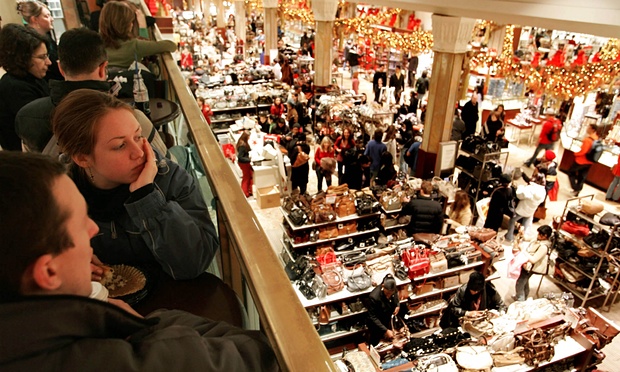
“Overconsumption” photo ©The Guardian.

Interculturalists have long known that the answers to our world problems lie within the diversity of values and wisdom in the people of our world. Today I learned that economists are now agreeing with us.

For over seventy years economists have told us that growth is the solution to world poverty, that “growth” equals “progress.” Progressives and some of the world’s wealthiest have recently begun to advocate taxation schemes to redistribute monies from the wealthiest and thus build a bit of justice into our systems. Yet, neither approach will work.

Since 1980, the global economy has grown by 380%, but the number of people living in poverty on less than $5 (£3.20) a day has increased by more than 1.1 billion. That’s 17 times the population of Britain. So much for the trickle-down effect.
—Jason Hickel in The Guardian, 23 September 2015

We are already over-consuming Earth’s bio-capacity by 60%. The real problem is overconsumption by the world’s wealthiest countries, and the way in which we conceptualize “progress.”

Our planet only has enough resources for each of us to consume 1.8 “global hectares” annually—a standardised unit that measures resource use and waste. This figure is roughly what the average person in Ghana or Guatemala consumes. By contrast, people in the US and Canada consume about 8 hectares per person, while Europeans consume 4.7 hectares—many times their fair share.
—Jason Hickel

In a wonderfully insightful article in The Guardian, Jason Hickel, an anthropologist at the London School of Economics, tells us that an intercultural approach and cross-cultural values may be the solution to problems facing our world. Jason tells us how “economist Peter Edward argues that instead of pushing poorer countries to ‘catch up’ with rich ones, we should be thinking of ways to get rich countries to ‘catch down’ to more appropriate levels of development. We should look at societies where people live long and happy lives at relatively low levels of income and consumption not as basket cases that need to be developed towards western models, but as exemplars of efficient living.” Costa Rica, for example, manages to sustain one of the highest happiness indicators and life expectancies in the world with a per capita income one-fourth that of the US.

“Perhaps we should regard such countries not as underdeveloped, but rather as appropriately developed. And maybe we need to start calling on rich countries to justify their excesses! According to recent consumer research, 70% of people in middle- and high-income countries believe overconsumption is putting our planet and society at risk. A similar majority also believe we should strive to buy and own less, and that doing so would not compromise our happiness. People sense there is something wrong with the dominant model of economic progress and they are hungry for an alternative narrative.”

Jason directs us to Latin American values such as “buen vivir,” living the good life, to which I’d add also a respect for the planet, Pacha Mama, and community values such as the African “ubuntu.” You can find in-depth explanations of hundreds of non-dominant values in Cultural Detective Online. Changing our western- and northern-centric definitions of progress to a definition more inclusive of the eastern and southern value system could be just the ticket to our survival as a species. Jason also points us toward books such as Robert and Edward Skidelsky’s How Much is Enough?

As Jason concludes his article:

Either we slow down voluntarily or climate change will do it for us. We can’t go on ignoring the laws of nature. But rethinking our theory of progress is not only an ecological imperative, it is also a development one.

This is not about giving anything up. On the contrary, it’s about reaching a higher level of understanding and consciousness about what we’re doing here and why.

Cultural Detectives, let us use this new-found recognition as a catalyst to breathe new motivation into our efforts!

University of Valencia Master’s in Cross-cultural Management

logo-uvSo many people in Europe ask us about Cultural Detective Facilitator Certifications and other professional development opportunities. We of course always mention the Intercultural Development Research Institute in Milan, of which I’m a proud faculty member.

Soon there will be a terrific new opportunity: a Master’s in Cross-cultural Management, offered by the University of Valencia in Spain. The program is extensive and very practical, including cross-cultural management theory as well as cross-cultural marketing, project management, negotiation, conflict resolution, global teams, international assignments, and intercultural training and coaching. The program culminates in an internship or final project.

The faculty teaching this program are incredible, and I am proud to be among them. It is an incredibly talented and diverse group of professionals from around the world.

You can pre-register now, or download a brochure to pass on to your students or colleagues.