The latest update on my Middle Eastern travels has been published in the Jerusalem Post. I hope you’ll let me know what you think!
Tag Archives: current events from an intercultural perspective
Link
 This article by Vijay Nagaswami, “Culture vs. culture,” was sent to us via the marvelous Cultural Detective certified facilitator and current SIETAR India President, Sunita Nichani. She says, “Here is an interesting article published this Sunday in one of India’s leading newspapers, The Hindu. With the slow erosion of the custom of marrying within similar communities in India, intercultural competence will be vital for making marriages work.”
Lots of work to do in this world, in so many ways and places. Let’s get started, everyone!
What was the only economy in Europe that did not suffer a contraction in the global debt crisis of 2008-2009?
Reply
What was the only economy in Europe that did not suffer a contraction in the global debt crisis of 2008-2009?
Think before you read! Do you know the answer???
Poland! And you have a terrific resource at your fingertips for doing business in Poland and working with Poles: Cultural Detective Poland.
Here are some reasons you want to keep your eyes on Poland, as explained by CNN:
“Ever since it broke from the Soviet Union back in 1989, Poland has been racing to make up for last time, as a member in good standing of Western Europe. Today Warsaw is the far side of the moon from the decadence and growing indebtedness of Moscow. Poland is staid, predictable, with no wild parties even on weekdays or outrageous displays of new wealth. Since joining the European Union in 2004, Poland has been working hard to meet the additional requirements of joining the Eurozone, which sets very specific targets for government deficits, debt, and other keys to economic stability like inflation and long-term interest rates. While many states that already belong to the Eurozone (from Greece to Spain) failed to achieve these targets, Poland largely succeeded, which is why it was in such good position to weather the crisis of 2008.
Today things look so good that Poland has the most vibrant labor market in Europe, creating jobs at a pace so rapid that many immigrant Poles are returning from the United Kingdom and other hard-hit nations to find work at home. Poland’s success was quite unusual – the only other EU economy in a similar position is the Czech Republic – but it does show that Europe can be a model for growth, at least for those who follow the rules.”
There is Nothing New in Egypt
 Egyptian mobile company Mobinil has found an extremely cheap and effective way to advertise itself in Cairo Airport. Shiny billboards welcome foreign tourists and journalists with provocative quotes from USA President Obama — “We must educate our children to become like young Egyptian people,” and former Italian Prime Minister Berlusconi — “There is nothing new in Egypt. Egyptians are making history as usual.”
On the eve of the new government here, the Obama quote echoes one of my favorite sayings: “When people fear authority, we get dictators. When those in authority fear the people, we get democracy.” Although the young Egyptian people that Obama honored are those who started the revolution and ended up empty handed, it is now clear that the new President — be it Shafiq, the ex-regime candidate, or Morsi, the Muslim Brotherhood candidate — must take its people into account. In short, the people don’t want another Mubarak.
For Berlusconi, he (for once, thank God) has a point. Being one of the three oldest civilizations in the world and still standing after 5000 years, making history seems to be the 9 to 5 job of every single Egyptian. Together with the recent court ruling to dissolve the parliament, Egypt is more than ever at a crossroads and is wide open for surprises.
—
Thán phục hết nước công ty Mobinil của Ai Cập với chiêu quảng cáo vửa rẻ vừa ngon ở sân bay Cairo. Khắp tường trên kính dưới lấp lánh hai câu nói của Tổng Thống Mỹ Obama “Chúng ta phải giáo dục con em mình để chúng giống như những người trẻ tuổi Ai Cập” và của cựu Thủ Tướng Ý: “Có cái gì mới lạ ở Ai Cập đâu. Người Ai Cập chỉ vẫn đang bận bịu với việc tạo dựng lịch sử như chuyện thường ngày ở huyện thôi mà”.
Cái ý của Obama khiến tôi nhớ tới một câu nói tôi từng rất thích (bây giờ thì nhìn với vẻ soi mói hơn là thích): “Chế độ độc tài là khi người dân sợ chính quyền. Chế độ dân chủ là khi chính quyền sợ người dân”. Mặc dù những người trẻ mà Obama vinh danh khởi đầu cách mạng rồi kết thúc trắng tay, có một điều chắc chắn rằng chính quyền mới dù là thân chế độ cũ Shafiq hay Muslim Brotherhood – tổ chức đã cướp diễn đàn của Mùa xuân Ả rập, đều sẽ phải dè chừng người dân hơn.
Về câu nói của Berlusconi, ơn Chúa là ông ta dẫu sao cũng được một lần phun ra vài từ có ý nghĩa (nhận xét có phần hằn học vì bản thân không ưa Berlusconi J). Là một trong 3 nền văn minh lâu đời nhất thế giới, hơn 5000 năm tuổi và vẫn đứng vững vàng, người Ai Cập quả là đáng nể phục. Trước thềm một chính phủ mới, lịch sử Ai Cập lại đứng giữa ngã ba đường, tiếp tục trò chơi ú òa cho thế giới thót tim với vô số điều bất ngờ dấu trong tay áo.
Tahrir Square at 3 am
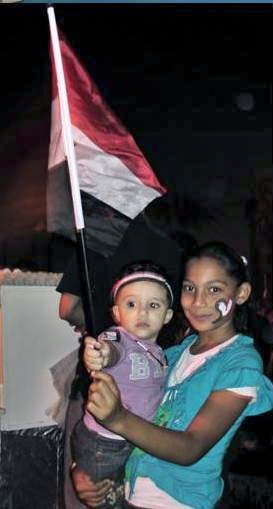 Tahrir Square (Cairo) at 3 am. Thousands of protesters still occupy the ground. They want a new revolution as dictator Mubarak may get away with his crimes in the Supreme Court and his ministers walk free from all charges.
I spent the whole night with the protesters, being introduced to everyone by none other than the leader of one of the most important revolutionary movements in Egypt: The Free Forum for Change.
In this picture, you see Layla and her brother wide awake. At 3 am children their age are supposed to be dreaming about Disneyland. Tonight they are here learning to support a democratic land. Not sure if they understand it, but I am certain they are the youngest protesters on the ground.
PTPI Americas Regional Meeting 2012
 As I had just finished facilitating the PTPI (People to People International) workshop and entering the elevator with some PTPI attendees, I was pleased to hear a funny comment by one participant: “I am so glad this was about developing cross-cultural skills as I was afraid we might be participating in some sort of scavenger hunt!”
Well, it was in fact a hunt in some ways – we searched for clues about what motivates our friends and colleagues to behave the way they do and what motivates us to act and react the way we do!
Key learnings from group wrap up were described as:
- Seek to understand others values and what’s really motivating their behavior
- Look for similar values and use those to collaborate
- Appreciate differences
- Incorporate the strengths of all team members – there is no “right way” to get things done
- Show up with an open mind
The PTPI Cultural Detective session was designed to help the PTPI community members and their board of directors with strategies to improve their diverse recruiting – and it was received very positively with a quick post, “Incredible Presentation by Cultural Detective,” and the above photo from Liz Wegman, PTPI staff member. We had a group of about 35 PTPI leaders in attendance from all over the country and world who will return to their communities with fresh perspectives and strategies around building more diversity in their chapters.
Although diverse recruitment is not typically how I lead into discussions around working with the Cultural Detective tools, it certainly was an applicable organizational need which developing intercultural competence can help solve. Has PTPI’s unique application of the Cultural Detective approach spurred some ideas for you to assist your or your clients’ specific intercultural challenges?
Book Review: Intercultural Communication, Globalization and Social Justice
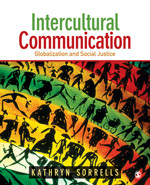
by Kathryn Sorrells, Sage Publications, ©2013 ISBN 978-1-4129-2744-4
Intercultural Communication: Globalization and Social Justice provides fresh voice and much-needed current perspective on intercultural communication competence. Written as an undergraduate and graduate level text, as a 30+ year professional I also read it enthusiastically. From Sorrells’ debunking of racial color blindness (p. 62), to the commodification of culture (p. 190), to her closing call for global citizenship (p. 227), her keen intellect and passionate commitment to social justice is evident and unwavering throughout.
From the beginning the author makes clear the need to put intercultural communication in context and with a clear purpose:
“Regrettably, some of the most egregious injustices—exploitation of workers in homes, fields, and factories and violence perpetrated through racial profiling and ethnic cleansing—are performed within intercultural contexts and are enabled by intercultural communication.” (p. xiv)
…”the globalized context in which we live today makes ethnocentrism and ethnocentric approaches extremely problematic. The assumption that one’s own group is superior to others leads to negative evaluations of others and can result in dehumanization, legitimization of prejudices, discrimination, conflict and violence.” (p. 13)
“This text … provides a framework to create a more equitable and socially just world through communication.” (p. xiv)
By page 38, I knew I was in good hands, as Sorrells wove Amy Chua and her World on Fire into the intercultural mix, providing it as counterpoint to Francis Fukuyama’s The End of History and the Last Man.
The author appears to have challenged herself to address each topic, even the most familiar, through at least four lenses:
- in what ways is the topic complex and contradictory,
- how does the topic appear from micro, mess and macro views,
- what are the local and global connections, and
- how do the complexities and contradictions play out in our world today, particularly in terms of equity and justice?
Sorrells is an excellent teacher, providing rich yet succinct examples—unraveling the various interwoven threads of her stories to enable the reader to more clearly see each thread—while keeping the overall tapestry in mind. Her writing should energize and guide cadres of undergraduates, as well as professionals, to use intercultural communication theory and practice to bring more equity and justice to our world.
Sorrells covers the content you’d typically expect in a basic text on intercultural communication: nonverbal communication, context, dialogue, relationships, communication style, identity theory, use of space. What makes this book different is that she uses important current issues and topics to provide a fresh perspective and powerful, meaningful insight. She examines intercultural communication informed by topics such as power, hegemony, growing socio-economic inequities, the culture of capitalism, race, color-blindness, immigration, glocalization, hip-hop culture, appropriation, hybrid cultures, and online communication. She pulls from a variety of disciplines including feminist theory to address her topic. In the process, she introduced to this practitioner new ideas such as fragmegration (p. 131), culture jamming (p. 144) and polysemic space (p. 91).
The book begins by looking at why the intercultural field has not been able to settle on one definition of culture, tracing definitions of culture from anthropology, cultural studies, and globalization. The author next guides us through a much-needed review of the history of intercultural communication, doing so crisply and meaningfully. Revisiting the origins of the field may help us return to our collaborative purposes and away from the overly analytical comparative studies trends of today.
Each chapter concludes with discussion activities and questions, which for a trainer or coach will be invaluable. And they’ll make lesson planning for the classroom easy.
To enable students to navigate the complex intercultural spaces they inhabit, the author introduces a process of critical, reflective thinking and acting. She calls this “intercultural praxis.” Via six interrelated points of entry (inquiry, framing, positioning, dialogue, reflection, and action), “intercultural praxis uses our multifaceted identity positions and shifting access to privilege and power to develop our consciousness, imagine alternatives, and build alliances in our struggles for social responsibility and social justice.” (p. xvi)
Obviously the text is not intended for a basic-level reader of English! And, while this praxis model is definitely conceptually sound, it is far from easy to put into practice.
What were some of the points in this book that stood out for me? The concept of “positioning” is important:
… “how our geographic positioning is related to social and political positions. As you read these sentences, where are you positioned socioculturally? The globe we inhabit is stratified by socially constructed hierarchical categories based on culture, race, class, gender, nationality, religion, age, and physical abilities, among others. Like the lines of longitude and latitude that divide, map and position us geographically on the earth, these hierarchical categories position us socially, politically and materially in relation to each other and in relation to power.” (p. 18)
Sorrells explains that positioning “directs us to interrogate who can speak and who is silenced; whose language is spoken and whose language trivialized or denied; whose actions have the power to shape and impact others and whose actions are dismissed, unreported and marginalized.”
The author’s reference to modern-day anthropologists Jonathan Xavier Inda and Renato Rosaldo was also valuable. Their premise is that culture, in the context of globalization, has been “deterritorialized.” What this means is that “cultural subjects (people) and cultural objects (film, food, traditions, and ideas) are uprooted from their ‘situatedness’ in a particular physical, geographic location and reterritorialized, or relocated in new, multiple and varied geographic spaces,” (p. 43).
Hence, we find Hindi films and Amitabh Bachchan posters worldwide, with wildly different meanings attached. “Similarly, a person’s or group’s sense of identity, who migrates from Iran to Israel to the United States, for example, is reinscribed in new and different cultural contexts, altering, fusing, and sometimes transforming that identity.”
There were two very minor disappointments for me, amidst all the positives in this text. The first is that while this volume includes a great deal of content that other intercultural texts omit, Sorrells does not adequately address religion and its role in society today. The clash of religious and spiritual beliefs, the gaps between believers and non-believers, the judgments one to another, the fact that religion can provide access to power or motive for distrust, are important. Religion can divide or unite communities, nations, and continents. A chapter or at least a couple of pages devoted to the topic, as seen through Sorrells’ keen perspective, would be a valuable addition.
Second, while the book is overflowing with examples from all over the world, it is unnecessarily US-centered. Perhaps a US publisher wanted the book to sell to US universities, and thus preferred it be written that way. This could so easily have been a non-nation-centric book—with an even bigger market. It comes so very close that it seems a shame not to have gone the extra step.
Intercultural Communication: Globalization and Social Justice is a must-read for any intercultural professional or serious student of the field. And if you have the pleasure of teaching an intercultural communications class, this is a terrific new text.
Egypt on the Brink of a New Revolution
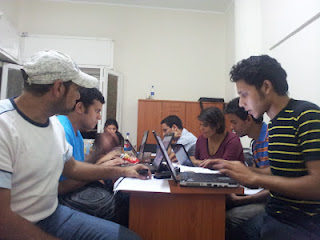 You want to know about the real Arab Spring? Look at this picture. These young people, both Muslim and Christian, are those who started the revolution in Egypt in 2011, demanding dictator Mubarak to step down. However, this spontaneous, penniless, and immature movement has been hijacked by the more organized Muslim Brotherhood who stole the spot light and became the prominent candidates for the new regime.
Yesterday, just a few hours after the voting box closed down, I found myself in a secret apartment in the heart of Cairo, the headquarters of the youth revolution. A dozen young activists were working like bees in a beehive on their laptops, updating thousands of tweets and Facebook posts, sending the results of every single voting spot, reporting to the people of Egypt every potential problem of the election.
“Yes, our revolution has been kidnapped by the Islamists!” admitted Ahmed. “I slept in Tahir square, protesting for days, to see a new regime with a liberal and democratic mind set, not someone from the Muslim Brotherhood who wants the country to be back in the stone age. The only thing we can do right now is to be keen observers to make sure this is a fair election. If the Muslim Brotherhood wins, we will have a new revolution, a real Arab Spring.”
The Holy Land is Here: On the importance of reorienting the nomadic mind
 You could say my Mama was a modern-day pioneer. She packed up one suitcase for the three of us — for herself and her two young daughters — and traveled West for the opportunity to reinvent herself, escaping totalitarianism through the seemingly impenetrable Iron Curtain. That was a quarter of a century ago. Still, after so many years, a mother myself, I have yet to truly commune with the place where I live, feeling no tangible connection to the land here.
Why so disconnected? This land seems foreign and not yet part of my “cellular memory” shaped by centuries of Central European living. It is not where my ancestors are buried. In my life, I’ve moved too many times to count, skirting the land, speeding along its slippery surface as if it were ice. Like the original pioneers, and a great many modern-day transplants and migrants, I have internalized the frontier as a state of mind, to paraphrase Native American activist Winona LaDuke. She faults our society’s culture of transience, our belief that a greener pasture lies somewhere else, calling it a psychosis, for disconnecting us from our responsibility to place.
Writer and Mayan shaman Martin Prechtel explains the underlying cause of the westward migration and transient nature of our society as the modern culture’s inability to feed the spirit world from which we come, and our failure to mourn our ancestors which includes acknowledging the damage they have done to this world. He says:
“If this world were a tree, then the other world would be the roots — the part of the plant we can’t see, but that puts the sap into the tree’s veins. The other world feeds this tangible world — the world that can feel pain, that can eat and drink, that can fail; the world that goes around in cycles; the world where we die. The other world is what makes this world work. And the way we help the other world continue is by feeding it with our beauty. All human beings come from the other world, but we forget it a few months after we’re born. This amnesia occurs because we are dazzled by the beauty and physicality of this world. We spend the rest of our lives putting back together our memories of the other world, enough to serve the greater good and to teach the new amnesiacs — the children — how to remember.”
This rings so deeply true for me I weep when I think about it. I live in a new country, a land where I’ve inherited other ancestors’ pain, and I struggle with how to honor it so that I can develop a personal connection and a sense of responsibility to this place. From studying history, I know the magnitude of pain my current life is built on is unfathomable. Between 1774, the year Europeans first arrived on the Northwest Coast, and 1874, an estimated 80 percent of the indigenous population had been decimated by European diseases, including smallpox and measles. According to University of Washington’s Center for the Study of the Pacific Northwest, across the US, “a rough estimate holds that Old World diseases depopulated native societies by about 90% within the first century of contact.”
And the assault on native tribes and the earth continues. In the Pacific Northwest, for instance, as little as three percent of old growth forest is what may be left.
“The question is: how do we respond to that destruction?” Prechtel says. “If we respond as we do in modern culture, by ignoring the spiritual debt that we create just by living, then that debt will come back to bite us, hard.”
In fact, we will literally be — and already have been — haunted by the ghosts of our ancestors if we continue not paying homage to them. “Ghosts will actually chase you,” is how Prechtel describes our predicament. “And they always chase you toward the setting sun. That’s why all the great migrations of the past several thousand years have been to the west: because people are running away from the ghosts. The people stop and try to live in a new place for a while, but the ghosts always catch up with them and create enormous wars and pain and problems, which feed the hungry hordes of ghosts. Then the people continue on, always moving, never truly at home. Now we have an entire culture based on our fleeing or being devoured by ghosts.”
He suggests that one way to honor our predecessors and repay the spiritual debt “is simply by missing the dead. . . as (expressed by) a loud, beautiful wail, a song, or a piece of art that’s given as a gift to the spirits.” If we don’t do this, we are “poisoning the future
with violence” against other beings and the earth itself because we then have no understanding of home.
Prechtel’s insight, I believe, is the answer to healing and to reconnecting us to our past and the earth. In order to “be at home in a place, to live in a place well,” we must do the following, he says. “We first have to understand where we are; we’ve got to look at our surroundings. Second, we’ve got to know our own histories. Third, we’ve got to feed our ancestors’ ghosts” by grieving. We do this by using the gifts we have been given by the spirits to make beauty.”
As global nomads, globetrotters or migrants with no deep commitment to one place we inhabit and its history, we could be doomed. As LaDuke urges, our mantra should be “the Holy Land is here, not somewhere else.”
Cultural Differences in Dining Etiquette Again Get a Child in Trouble
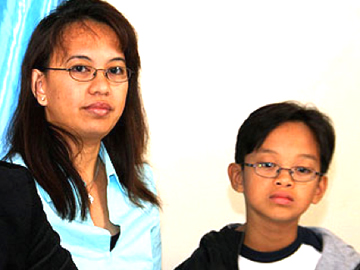 Recently another sad story about dining etiquette across cultures has been in the news.* This time it involves cultural differences over how to use a spoon and fork, and involves a Filipino family living in Canada. Fortunately this child, Luc Cagadoc, was not removed from his family, but his mother, Maria-Theresa Gallardo, explains that the school’s reprimands for Luc eating in a typically Filipino way have negatively affected his self-esteem as well as his performance in school. She won her case before the Quebec Human Rights Tribunal (the judge ordered the school district to pay the family $17,000 in damages), though the case is now in appeals.
Once again, a terrific Cultural Detective has filmed a video about how Filipinos eat with a fork and spoon in combination. This was evidently the behavior that led Luc’s school lunch monitor to conclude that he “ate like a pig and should learn to eat like other Canadians.”
Thank goodness Luc’s Blended Culture mother responded very constructively. She says, “We’ve been travelling around. I’ve been showing him different ways of eating, and saying there’s nothing wrong with what he’s doing.” Unfortunately, she says, her son can’t shake off the incident. “I think it’s going to last him a lifetime to remember what happened in that experience that he had.”
Have you ever gotten in trouble for “poor” dining etiquette that was due to cultural differences? Come on, share your story!
—
* Earlier we reported to you about an Indian family living in Norway, whose children were removed from the family home. One of the reasons cited was that the children ate with their hands. In response to that post, one of our authors made a terrific video about how to eat with one’s hands. Eating with one’s hands is, of course, the norm and custom in many cultures.
 Cultural Detective Blog