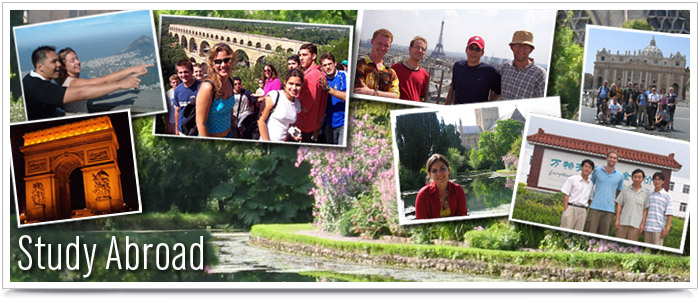
Why Do Kids Study Abroad?

The allure of traveling to exotic places, learning about people, their language and how their lives were shaped differently than our own – these reasons and more attract students globally to explore the opportunities of living and studying abroad.

From my experience, living abroad as a young adult can be one of the first opportunities to see the world through a very different lens. The experience of trying to understand and communicate with a foreign language and adapt to a very different way of daily life can be both eye-opening and a shock to the system.

As an intercultural product development company we have had the unique opportunity to work with several organizations in the study abroad and student exchange industry. I’d like to point out two of them as organizations who not only facilitate the study abroad experience but also enrich the students’ opportunity to have powerfully positive study abroad learning experiences. Both CIEE and AFS International put significant effort into preparing students for their time abroad by teaching about the impact of culture, and how to interpret behavior by getting to what’s underneath – the values that are motivating the behavior.

Enjoy these two different but equally interesting case studies of how enhancing cultural understanding with a core process like Cultural Detective has been successful. I would love to hear your opinion and ideas that have worked for you in this field!

  • Business case for university exchange program by CIEE (Council on International Educational Exchange)
  • Business case for high school exchange program by AFS USA

Cultural Detective Online for Study Abroad

Quite a few of the world’s leading study abroad organizations rely on Cultural Detective. They tell us it’s invaluable to their students’ success. That’s why we are very excited to SOON be able to offer you the Cultural Detective product line as an integrated, online system rather than as stand-alone packages! And, better yet, it’s designed as a personal coach, encouraging your students and staff to track their goals, summarize and apply their learning, and upload, debrief and share with a teacher or counselor their daily life experiences (and the meaning they are making from them).

Be sure to stay tuned for our official launch. Or, enter to win a free subscription for you or your team!

If you are unable to view the video above (if you are on an iPad or other device that doesn’t play Flash), click here to view the video on YouTube. Please feel free to share this video with others who might be seeking a virtual intercultural coach. Thank you!

Mashing-it-Up in Hong Kong: International Schools

By Barbara Schaetti, co-author of Cultural Detective Blended Culture
Reposted from Personal Leadership May 2012 Newsletter

International educators have historically assumed that K-12 international schools are, by default serving multinational and multicultural expatriate communities, providing students with experiences that result in intercultural competence. But are international schools truly teaching students to make meaning of their unique cultural experiences or, when it happens, is it more by good-fortune than by design?

I recently had the honor of being invited to HKISpresent a series of half-, one-, and two-day programs, at the Student Services Summit sponsored by the Hong Kong International School (HKIS). HKIS is among the top tier of K-12 international schools worldwide, and enjoys a well-deserved reputation as a premium institution. Although it was my first time at HKIS, working with and at the School had a quality of home-coming for me: I grew up attending international schools in West Africa and South East Asia, and consulted extensively with international schools throughout Europe and South Asia in the 1990’s. Although each international school varies from the next, the culturally diverse environment they typically offer is very much home territory for me.

And so what a joy to be asked to facilitate a two-day program for international educators titled Deepening Intercultural Competence: Developing an Intercultural Practice. Participants were international educators from across Asia and beyond, mainly developmental guidance counselors (with a couple of administrators too), who share a common passion for preparing their students to participate successfully in a globalized world. They were very ready for a professional development program focused on strengthening their own abilities to role model moment-to-moment intercultural practice.

I centered our time together on The MashUp: A Professional Toolkit for Developing Intercultural Competence. The MashUp (MU) is a natural and powerful combination of two leading processes in the development of intercultural competence: Cultural Detective (CD) and Personal Leadership (PL). Where PL provides a process to disentangle from automatic judgments, emotions, and physical sensations, and to open to the unique possibilities of the present moment, CD provides a process for deconstructing the intercultural dynamics at play, considering the values, beliefs and personal cultural sense that may be motivating people’s words and actions, and developing cultural bridges to close the gap. As an integration of the two, the MashUp offers a proven and exceptionally effective way to successfully strengthen intercultural competence in individuals, in teams, and across organizations.

In Hong Kong, the MashUp was very well received by participants who immediately saw its relevance and practical service to the daily situations they encounter – as international educators and as expatriates themselves. As one person put it:

“How thrilled I am to have experienced these past 2 days – I feel excited and energized, ready to begin a new journey! This has been everything I had hoped it would be, and more. I am leaving today with great ideas to enrich my practice, and steps to move towards this goal. I also believe that I have a group of colleagues who have a similar mindset and interest in adding value to their practice.”

I too left the session inspired. These international HK BAYeducators are ready to intentionally provide their students (no longer simply to trust to good-fortune) with the role-modeling, orientations, and practices that develop intercultural competence. And if that’s true of the educators in my session, then we can know it’s true of many more!
You have two opportunities to learn more about this developmental MashUp of PL and CD.

  1. The first opportunity will be live and in-person at the Summer Institute for Intercultural Communication, July 16-20. Developing Intercultural Competence: An Integrated Practice will be conducted by Dianne Hofner Saphiere and myself, Barbara F. Schaetti.
  2. The second opportunity will be a blended learning course to be held September-December 2012. Developmental Intercultural Competence: Cultural Detective, Personal Leadership, and the DMIS, a transformative professional development course is an avant garde blended learning course focuses on how best to use the MashUp to support the development of intercultural sensitivity as illustrated by the DMIS (Developmental Model of Intercultural Sensitivity). This course will be conducted by Dianne, Heather Robinson, and me.

People To People International Working with Cultural Detective to Diversify Chapter Recruitment

Over the past several years I have enjoyed developing a professional and personally meaningful relationship with the People to People International organization (PTPI). For those of you who are not familiar with PTPI, the organization was founded by President Dwight D. Eisenhower in 1956 and is now run by his granddaughter, Mary Jean Eisenhower. Their mission is “to enhance international understanding and friendship through educational, cultural and humanitarian activities involving the exchange of ideas and experiences directly among peoples of different countries and diverse cultures.” They are a dynamic group of dedicated staff and thousands of volunteers in over 135 countries truly working to promote the benefit of people working and living cooperatively together throughout our world. They are known by their tagline, “Peace Through Understanding.

Last year in November Cultural Detective had the privilege of sponsoring and designing the student curriculum for the PTPI Global Youth Forum 2011 (GYF). We focused on designing curriculum that would readily engage about 130 students and GYF leaders and most importantly inspire them to explore building relationships outside of their perhaps “look and act like me” group of students and friends in their local communities. Based on the testimonials of both students and teachers, we feel we did a pretty good job!

This spring I’ve been asked to present the Cultural Detective Method to PTPI Board Members and the PTPI Community at Large so they can focus their attention on recruitment of diverse leaders and members. In the upcoming session I hope to show how generational differences as well as national cultural differences impact with whom we as individuals may naturally gravitate to, which can limit the growth opportunities possible by confidently reaching out to people of multiple cultures. Stay tuned for more about the event in a future post!

Link

Kevin and Rita Booker, very active Cultural Detective community members and extremely talented professionals, have put together a series of three articles on using film in intercultural education that I think you will find very helpful. If you use movie clips or YouTube videos in your coaching, training or teaching, or if you want to do that more, be sure to take a look. Lots of learning there.

By the way, if you love film, be sure to check out CDTV, our Cultural Detective channel on YouTube, with over 20 playlists. We welcome your recommendations (urls) on videos to add. Together we can build a convenient central repository of films to use to help our world become a more inclusive and collaborative place!

Designing and Implementing Global Diversity

The global scene is expanding and our world has become borderless. Designing and implementing programs for global audiences presents unusual challenges. Familiar activities may be culturally inappropriate, simulations may need revision, or inherent cultural biases may limit our impact.

This five-day workshop will address strategies for adapting programs for highly diverse audiences, and for designing culturally responsive design and instruction. The facilitators will share a learning framework that will help you assess the impact of culture on teaching and learning. You will learn about the success, the challenges, and the next steps for preparing and delivering culturally sensitive global diversity programs.

To be held July 23-27 in Portland, Oregon, as part of the Summer Institute for Intercultural Communication, the workshop is designed for intermediate and advanced designers, developers, and others launching or anticipating launch of a global diversity program within organizations, whether corporate, nonprofit, NGOs, or educational institutions.

In this session, you will:
  • Learn to adapt simulations, games, blended learning and social media for multiple purposes by tailoring design, delivery, and debriefing.
  • Explore multiple approaches to delivering global diversity.
  • Assess how cultural biases impact design and implementation.
  • Identify learning challenges in implementing programs across cultures.
  • Adapt instructional design for culturally diverse populations.
  • Apply new skills to deliver culturally sensitive and culturally adaptive instruction.

The Summer Institute for Intercultural Communication is one of the world’s premier professional development venues. Be sure to join us in beautiful Portland, Oregon this coming July.

“Never Again,” an Apropos Motto in a Climate Increasingly Hostile to Roma

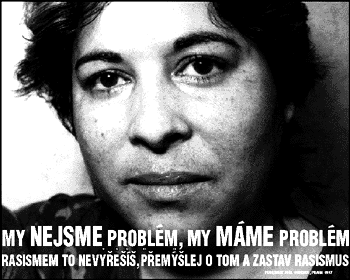
"We are NOT the problem; we HAVE a problem. You won't solve anything with racism.
Think about it and stop racism."
(Czech anti-racism ad campaign poster)

Two generations have not yet passed since ninety percent of Czech Roma, and between a half million and two million European Roma in total perished at the hands of the Nazis in The Great Devouring, or Porrajmos, the Romani word for the Holocaust. Roma, also known by the pejorative term “Gypsies,” make up the largest minority in Europe today with some 10 to 12 million members. Roma face fierce discrimination in accessing employment, education, health care, and public and social services. In spite of repetitious cases of racist violence and hate speech targeting Roma, the community continues its struggle for human rights all across the continent.

Two years ago I paid my homage to those who died in Auschwitz and Hodonín u Kunštátu, a Czech concentration camp for Roma. “Tensions in society are heightening. Perhaps the time will come again when we are sent away to designated areas,” were the words of the priest leading the commemoration service.

Today, many in the Romani community echo these fears, afraid for their safety since numerous neo-Nazi-led marches have been taking place periodically across the country, and several arson attacks at Romani residences have been perpetrated by white supremacists. Racial tensions have been growing more intense with the media printing negative stereotypes, inventing damaging reports and spreading fabricated accounts blaming criminal acts on members of the Romani community.

In mid-February, the director of the European Roma Rights Center, testified that violence against the Roma is on the rise at a hearing in Washington DC held by the Commission on Security and Cooperation in Europe (US Helsinki Commission).

In the Czech Republic, where I was born and raised, a study on extremism commissioned by the Czech Interior Ministry states that there are currently about 4,000 militant neo-Nazi activists in the country. Experts warn that violent crimes committed by neo-Nazis against Romani people will likely rise. The risk of race wars in some regions of the country, specifically between gangs of white Czechs and groups of ethnic Roma, looms large, experts say.

Today’s white supremacist movement is pan-European (with strong German and Italian influences), and international (namely US-inspired). Since the years 2008 and 2009 the movement has become more radicalized and organizationally sophisticated in the Czech Republic, becoming more visible in the streets and infiltrating the political scene.

In Hungary, an armed militia group has been patrolling and terrorizing a Romani village. This following a series of racially motivated murders.

“Gypsy criminality” is one of the most prevalent anti-Roma stereotypes. It permeates all parts of central European life—and can be found as commonly in the media as the local pub. The Roma are also said to abuse welfare and to not want to work. The World Bank just showed the former was absolutely untrue in Slovakia. The latter is a also a damaging myth held by the white majority. These stereotypes are all the more exaggerated in light of the economic downturn and the scarcity thinking the crisis triggers in the white majority.

What are the solutions? Many rights groups are pushing for economic betterment in the form of job creation and training. Organizations are active in producing independent media with a human rights bent, as well as waging campaigns pressuring mainstream media outlets to be accountable and responsible in their reporting. Key are also positive opportunities for cross-ethnic social interactions and education. Those aware must remain vigilant and spread the word about the threat of extremism that exists in European societies. We must never again permit another Great Devouring.

International Women’s Day

Women hold up half the sky, according to Mao Tse-Tung. In many families and communities, women seem to hold up much more than half. And many times women do it for less pay, with less education, or from behind the scenes.

Today is International Women’s Day, and we at Cultural Detective would like to applaud women everywhere, thank them for raising us, for teaching us, and for collaborating with us.

The issues we highlight on March 8 vary by location. They can include access to clean water, education, or the right to vote; ending domestic violence and genital mutilation; advocating for equal pay, better child care, or peace. This year we would like to share with you a preview of an upcoming movie, entitled “Petals in the Dust: India’s Missing Girls,” which will explore the reasons behind “gendercide” in India, the killing of over 7000 baby girls each year. Thanks to Joe Lurie for sharing this with us. The movie is scheduled to be released in December.

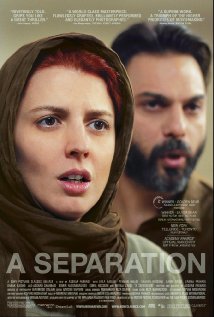
Movie Review: The Separation of Nader va Simin (Iran)

The media attention on Israel’s potential response to Iran’s nuclear activity has piqued my interest to learn a bit more about Iranian culture. Last week our family watched a most incredible film that I felt provided so much insight, so I asked my very good friend, Cultural Detective certified facilitator Pari Namazie, what she thought about what I had learned and seen.

I trust you’ll all enjoy her insights as much as I have. It would seem that this film could be an excellent learning tool for those working with Iranians.

Pari joon, thank you for sharing your insights with us!

They were proud moments for us Iranians when Asghar Farhadi received the Oscar for Best Foreign Film, as well as the Golden Globe and the Golden Bear of Berlinale, for his film A Separation (Jodaeiye Nader az Simin).

The film, which talks about a divorce between Nader and Simin, has two main underlying themes: responsibility and truth. Though one initially thinks the film is about a divorce case, Farhadi cleverly weaves many layers of Iranian society into his film, including power, religion, truth, gender, family, and social class. The points which stuck out most when I watched the film were:

The role of women: Iran is governed by Islamic law. The society is patriarchal and the laws between men and women unequal. Although the foreign media might portray Iranian women as weak and dominated by men, the reality of the matter was captured well in Farhadi’s film, which showed Simin wanting to leave Iran with her daughter, as she believed it was not an environment for a child to grow up in. When her husband refused to immigrate with her (due to his father’s condition), she then insisted on divorce and moved into her parents’ home. It also showed a more religious woman taking fate into her own hands looking for a job, despite the fact that in her family the breadwinner was undoubtedly her husband. Any one who has visited Iran will know the strength of character and conviction of its women.

Truth: The film beautifully portrayed the search for truth in the Iranian culture: from the court, to Termeh (the daughter) asking her father if he knew Razieh (the helper) was pregnant when he pushed her out of the house, to Razieh swearing on the Koran that Nader’s pushing her caused her miscarriage — if she swore on the Koran and it were untrue, then she would condemn her daughter’s future and fate. These behaviors show one of the strongest elements in Iranian culture: the search for truth.

Religion: Beautiful to see how Farhadi craftfully showed the secular and religious segments of society, how they came together respectful of one another, and yet also their existing tensions. Nader and Simin are more secular and Razieh and her family, religious. On one occasion Razieh called her religious authority to ask if it was permitted by Islam to work with an elderly old man, who was not related to her and where she would have to wash and change him.

Responsibility and Family: The relationship and responsibility towards family from the younger to the older generation. In the opening scene at the family court, Nader tells the judge that he cannot immigrate with Simin as he has an elderly father suffering with Alzheimer’s and can not leave him. Other scenes show Nader’s commitment to his father and his relationship with his daughter Termeh. Although he is under many pressures he still maintains his attentive concentration towards Termeh’s studies and taking care of his father, the two main priorities in his life.

Farhadi competently shows the different viewpoints of all the actors, without taking sides, and lets the audience reflect on the circumstances and situations. This film is a must-see if you have not yet!

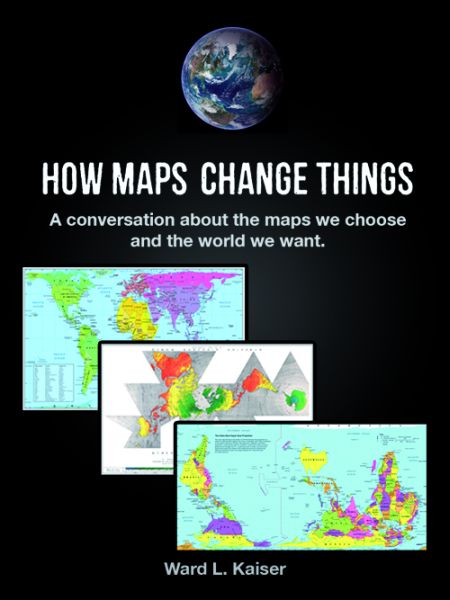
Book Review: How Maps Change Things

by Ward L. Kaiser, published by the New Internationalist and ODT Maps, 2012.
Free download through March 31 for Cultural Detectives

Anyone looking to develop a new class or training program to improve intercultural competence? This just-released book, How Maps Change Things: A conversation about the maps we choose and the world we want, could be the basis of one terrific learning journey! I highlighted something on nearly every one of its 188 pages. I learned so much, on so many different yet related topics, that I now have five or six threads of learning and discovery I want to pursue!

At first glance you might think this is a book about maps. Then you read on page six that it is about

“… how we shape and use maps and how they in turn shape us. It’s about how we see the world and how we therefore understand our place in it.”

So you start to hope that How Maps Change Things could teach us to be careful whether we label a certain body of water the “Arabian Gulf” or the “Persian Gulf,” or color-code parts of Kashmir as Indian or Pakistani, but it goes way beyond that.

“Because such maps encourage the feeling that some areas are home to movers and shakers while others shelter mere pawns.” — page 74

Mr. Kaiser, the author, is a big fan of equal-area projection maps such as the Peters, as most in the global diversity and inclusion field are, and points out how maps such as the Mercator aren’t good for much other than navigation. But in addition to showing us how maps can be used to perpetuate bias, he shows us how maps can also be used to promote perspective shifting, equity, and social justice:

“Through internalizing many ways to see the world we may even develop openness to other people’s points of view and greater self-awareness.”
— page 164

“What if people all over the world threatened by, well, you name it – logging, commercial development, polluting factories, hydrofracking chemicals in drinking water, say – what if they could all see maps as tools of analysis and action? …

How about a map to make clear where the hazardous electronic wastes of the developed world get dumped …

Bring together maps, available technology, human creativity, and people’s willingness to take a stand and you’ve got a powerful recipe for changing events.” — page 176

For these reasons and others this volume will be useful to interculturalists and those interested in diversity, sustainability, and social action.

The author premises that maps are tools that serve a purpose.

“Maps are verbs. They may seem to be tactile objects, documents we can handle or fold – nouns – but don’t be fooled. In persuasively framing questions and selectively supplying answers they act; they initiate; they function as agents.” — page 15

To illustrate this point he shares some terrific stories: one about the role of maps in a territorial dispute between First Nations people and the Canadian government (pages 35-39); another about how a map can skew our view of a country as a source of oil or as a residence of people and families (pages 8-17); and a third showing how a map was used to get one county to pay for a highway interchange that served another county (pages 34-35). There is a chapter about the connection between maps and faith/values (chapter 10 page 141), and how maps are used for disease control and health (page 170), as well as for crime prevention (page 173), a topic of special interest lately with concerns of profiling and ethnic bias.

The book is written in a lively, accessible style, though it gets heavier and slower toward the end; ironically, the final chapters are where Mr. Kaiser’s true passion seems to lie. It contains several embedded learning exercises (e.g., page 121) and interesting conversations such as how indigenous North Americans mapped (page 40). Via this latter conversation, he shows that the “culture” of map-makers is not universal. This, to me, is a hugely important point. Too many people believe their area of professional practice is culture-neutral or universal when, in fact, even science is culturally relative (as well as discipline-relative!).

One of the pleasures of reading How Maps Change Things is that it contains quite a few valuable “hidden” gems. One of my favorites: as the author discusses the huge socio-economic gap in our world, variously referred to by such inadequate (or judgment-laden) terms as North-South, 1st/3rd world, Developed/Developing nations, and Viable/Failed states, he provides in the footnotes a list of experts from diverse political persuasions and walks of life who share a consensus on the absolute need to bridge this gap (pages 138-139).

Through March 31 our friends at ODT Maps, the publisher, are offering this ebook FREE to our Cultural Detective community. I urge you to take advantage of this offer and help the author get this book put to good use!

Maps are tools, and can be purposed to perpetuate bias or to help us to create a better world. Cultural Detective has long been passionate about maps as learning tools. Way back in December of 2005 we dedicated an entire edition of our Cultural Detective e-news to maps (including 3 articles of activities and curricular ideas and a quiz), relying in large part on the expertise and generosity of our friends at ODT Maps.

It included: Using Physical Maps to Transform Mental Maps8 Map Activities for Intercultural Learning; a World Map Detective quizTraining with Map Power; and a free offer (a Mecca-centered Azimuthal map, a Peters Projection map, and a Population Map) from our friends at ODT Maps.

Bob Abramms at ODT has a wealth of books, DVDs, globes, puzzles, games, props, and  world maps for different purposes — terrific training material for intercultural and global diversity and inclusion professionals. If you’re not familiar with his great stuff, be sure to check it out.