SIETAR Europa, a Profile, Valencia, a New Book

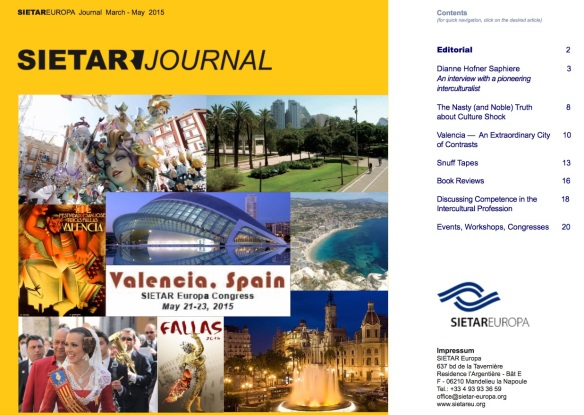
SE Journal coverThe March-May 2015 issue of the SIETAR Europa Journal is out today, and I thought some of you might want to take a look. Pari Namazie conducted a lengthy interview with me when I was last in Vienna, and it is published in the journal on pages 3-9. I find it flattering, embarrassing, encouraging and mortifying, all at the same time. It is humbling to have the honor to be profiled in this way. Thank you, Pari and Patrick Schmidt, editor. Perhaps it will give you insight into some of the experience that has contributed to Cultural Detective.

Also very important in this issue is news of the upcoming SE Congress in Valencia, Spain, 21-23 May. Please plan to attend! There are a wealth of terrific pre-conference workshops, including two focused on Cultural Detective, as well as incredible concurrent sessions, all in the gorgeous setting of Valencia. The full schedule is not yet posted, but you can register for the Congress now and then register later for any pre-conference workshops you want to attend. I hope to see you there!

Finally, I’m very excited that my old friend Joseph Shaules has published his much-anticipated book, The Intercultural Mind, and George Simons has written an insightful review of it on page 16.

You can find the issue of the Journal here.

Lampooning Leads to Apology for Sensationalism

2015.1.27.BF.COMMInaccuracies in journalism are of increasing concern to me, as is the idea that so many consumers of communication media fail to use their critical thinking skills, and, rather, believe a sensational report without checking facts. Journalists can easily fuel people’s worst fears, feeding an “us vs. them” mentality. I spoke about this in my recent Charlie Hebdo post.

If we are to create a world for ourselves in which we respect, understand, and value one another, one in which we are able to cooperate in sustainable ways, we need accurate and thorough information on which to base decisions. We need to be able to discern “gray” areas, and think things through from different perspectives.

On a slightly divergent thought track, I occasionally marvel at how powerful the visual arts, comedy, movies, and performances are in generating a paradigm shift in the general population—the sort of paradigm shift that is needed if we are to develop intercultural competence. I feel that news media should help us think things through by gathering facts, but all too often, it is the arts that help inspire us to do so.

Recently, a post crossed my desk that brings these two ideas together for me in a salient way. One of our Cultural Detective series’ authors—Basma Ibrahim DeVries—shared a link on Facebook to a story that resulted in truth telling. A major news outlet was forced to admit its multiple errors and publicly apologize for their inaccuracies, perhaps, in part, stimulated by a French television comedy show—Le Petit Journal!

Fox News interviewed someone who presented as fact that there are “no-go zones” in Europe—places in which Islamic law supersedes local law and non-Muslims fear to go. “No-go zones,” viewers were told, included the entire city of Birmingham, England and a half-dozen key areas of Paris. Fox also made various other claims, which met with widespread criticism from the likes of British Prime Minister David Cameron, and the threat of a lawsuit from the Mayor of Paris, Anne Hidalgo.

Le Petit Journal was quick to offer its humorous and yet informative rebuttal. Below is a clip of the show, in French with English subtitles.

I live in Mexico, and over the past five years I’ve experienced the negative impact that sensationalism and inaccurate, biased reporting can have on a country and its people.Often, this media bias is not confronted.  In this instance, however, Fox actually issued four separate apologies in one day for portraying Muslims in a negative light.

“Fox News took time out of four broadcasts on Saturday to apologize for four separate instances of incorrect information that portrayed Muslims in a negative light.
—CNN

Once Fox News apologized, our French comedy show, Le Petit Journal, had to gloat, of course. They lampooned Fox with great gusto while munching on super-sized popcorn and soda. Click on the link to view the video.

I am happy to hear that Fox News was forced to apologize for their biased and false “reporting.” I am grateful to know that the public expression of outrage and humor can still have some effect, however fleeting it might be. If, like me, you’d like to read more about the poll Fox cited, that one in six French citizens support ISIS, you might reference a much more insightful piece about it, published by the Washington Post.

The Cultural Detective Method helps people separate facts—what people see and hear—from interpretations, or what the facts mean to a person observing them. Our values influence how we interpret the facts—the meaning we give to the situation. Given personal and cultural differences, the facts may mean different things to different people. This is normal and to be expected. However, what we want from journalists is, to the best of their ability, the specific details and essential data necessary for us to understand a situation more accurately and thoroughly. Situations these days are often complex rather than clear-cut. Reporting on complex realities is difficult in the best of circumstances, and we applaud those ethical journalists who work to make it happen.

Thank you for accompanying us on this journey to build intercultural competence. Together, we can build international understanding, respect, and justice.

Je Suis Ahmed! Je Suis Charlie! I’ll Ride With You!

z17222885AA,-Je-suis-Charlie--Je-suis-Ahmed-Merabet-

The Cultural Detective series includes a critical incident entitled, “Danish Cartoon Controversy” (in the Cultural Detective Global Diversity and Inclusion package), about the backlash against cartoons of the Prophet Muhammad. We publish it to build understanding of diverse perspectives of the issue and promote meaningful dialogue, healing, and community cohesion.

My childhood aspiration was to become a cartoonist. I practiced for years, and even won a few contests. The events that happened in Paris yesterday, the Charlie Hebdo massacre, feel very close to me, despite the ocean separating Mexico and France. I have tremendous respect for all who fight for freedom of speech AND respect for others, as both, together, are key to civil society.

I stand strong with caricaturists, cartoonists, and journalists worldwide. Here in Mexico where I reside such are far from safe professions. And those who responsibly help us to think more deeply, to see more facets to issues facing us, play a hugely important role in society. Those who use their profession (journalist or imam, cartoonist or preacher) to teach racism, hatred, and disrespect instead of critical thinking and insight, or who promote sensationalism, jumping on the bandwagon of the latest craze or fad to gain viewership, do not respect their own role or power, nor do they show responsibility to the community in which we live.

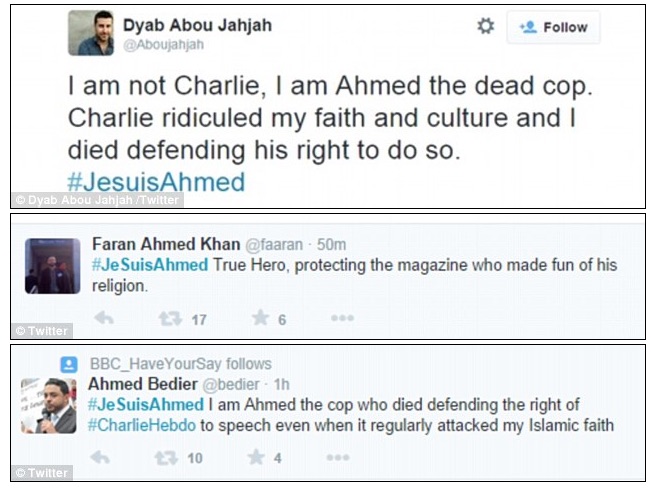
I love that people throughout the world have risen up in protest against terrorism and defense of the right to free speech. Long live the people! I fear, however, that the “Je suis Charlie” movement will be misconstrued or highjacked as pro-France and anti-Muslim, rather than as anti-terror, as happens oh-so-easily on the world stage. Such is the risk, and complexity, of this media-rich global arena in which communication takes place today.

Terrorism is awful. We can all unite against it. Yet, when terrorists are white, there is not the horrible backlash that there so sadly and predictably is when the terrorists are people of color or Muslim. One more ugly white privilege that I don’t want: I am privileged to not be profiled or publicly disdained, despite the fact that the suspect in the bombing of the NAACP building in Colorado Springs is a homegrown white US American, like me.

AhmedI am, therefore, very encouraged that the #JeSuisAhmed hashtag has risen in popularity with the #JeSuisCharlie hashtag so quickly. Ahmed Merabet, a Muslim, was one of the police officers killed during the Charlie Hebdo tragedy in Paris. The Maroon Colony wrote an excellent piece on why the Ahmed hashtag is so important.

And at what point, will we draw the lines between “freedom of speech” and “hate speech”? At what point do mainstream media outlets, which are largely controlled and written by White people, stop racializing Islam and stop creating humor based on the humiliation of people of color and their culture and faiths? At what point do White people have that moment of self-reflection, without the threat of terrorism to do so?
—The Maroon Colony

I found The Maroon Colony article powerful, but then I read a post by Christoph Jakob on a friend’s wall, and it reconfirmed how very complicated, and in need of thoughtful discussion, this all is:

The person on the second cartoon is the very well respected French Minister of Justice, Christine Taubira. She was compared by a right wing politician to a monkey eating bananas because of the colour of her skin For this comparison he was sentenced and excluded from his party. This started a national debate about limits of freedom of speech and expression. Charlie Hebdo published several cartoons on the topic, always defending 100% Christine Taubira and against all sorts of racism. Mrs Taubira herself mentioned the cartoon during a TV interview and thanked Charlie Hebdo for their support. The name of the right wing party is “rassemlement bleu Marine” thats why in the cartoon the text stays “rassemblement bleu racisme”.

We all stand with the victims. We stand with the need for free speech AND for civil discourse, dialogue, respect, understanding, and community building, not violence. And, I hold out hope that an outcome of the horrible violence can be that we all start to reflect on the inherent bias we all have in our worldviews and communication, myself included.

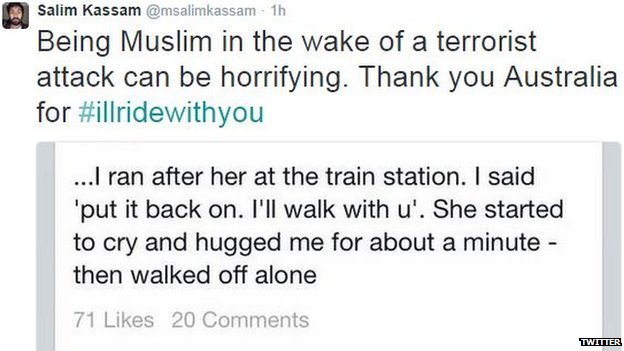
_79734878_thankyouI am encouraged that we increasingly have voices speaking up, so lucidly, to a minority experience, to the experience of those outside the mainstream power centers. I am reminded of the wonderful #illridewithyou movement in Australia, aimed to stand in solidarity with Muslim neighbors and help them stay safe in the backlash of a terrorist attack. I was sooooo so proud of Australians for that!

Let us stand united, everyone. Do not let the terrorists win, by letting them turn us toward hate, toward division, toward drawing lines between us, towards curtailing freedom of speech in this world of ours. Let us unite against terrorism by binding ourselves together, by learning about and celebrating our differences, by charging ourselves to continual learning, reflection on our own biases and communication, so that, together, we can create a world in which all of us can feel safe, valued, and know that our voices matter.

2014 Year in Review

240_F_71469226_XoKVyVhM4OzQ7CXxB9e3H6myQHfmjOP7The entire Cultural Detective Team would like to thank you most sincerely for being part of our community, and wish you much joy, health and success in the new year!

2014 was a big year for Cultural Detective, as we celebrated our 10th anniversary! We are thrilled to have grown into such a large and talented community of people worldwide, committed to making our world more respectful, collaborative, just and sustainable. Thank you for joining us on this very important journey!

LayeredLensesFinalThis year we were able to achieve another milestone: launching our best-selling Cultural Detective Self Discovery (currently in beta) as part of our Cultural Detective Online platform. This is a huge step forward for our small business.

We are proud that our online tool encourages people to look at themselves and others as beings that are influenced by various cultures, not just nationalities. Now, people are able to explore their individual values as well—their uniqueness—and how they’ve been personally influenced by the cultures around them.

After developing a Personal Values Lens, users can then compare their values with those of any other Values Lens in the online system. This offers a way to investigate aspects of a new culture they might resonate with or find challenging. And it provide a way to strategize about how best to adapt for success cross-culturally, while preserving their sense of self and, also very importantly, their ethics. If you haven’t yet given CD Online a go, you are certainly missing out! Nearly every day I hear a new customer tell me they can’t believe how powerful Cultural Detective Online is, and how affordable. So what are you waiting for?

One additional huge milestone in the CD Online system is the improved group functionality. We are thrilled that users within a group can now collaborate on writing critical incidents and debriefs. Think of the possibilities: your learners working together on cross-cultural stories, told from each person’s perspective! Individual learners can choose to share (or not share) their incidents with the group by submitting it to the group administrator—trainer, coach, professor or team lead. The group administrator can then request the learner to edit the incident and debrief further, or can share the incident and debrief with the entire group. This functionality is transforming the way customers use our system and develop intercultural competence. It is thrilling to witness!

online-learningBecause of these two huge enhancements to our online system, we will be adding a couple of standard webinars to our lineup. As you know, we already conduct monthly complimentary webinars introducing people to this powerful process for cross-cultural collaboration. In 2015, we will add to that lineup by offering a webinar on Cultural Detective Self Discovery, and a second one on Using Group Functionality in CD Online.

The first quarter schedule is live at www.CulturalDetective.EventBrite.com, and additional webinars will be announced throughout the year. One series we are hoping to add will deal with race and power issues, with the intent that by the end of the year we will have some constructive ideas on how to dialogue more effectively with friends, family and colleagues, and how to promote societal change and healing.

Check back frequently and please let your friends and colleagues know about these terrific professional development opportunities. We have people joining our webinars at all hours of the day and night. More importantly and unbelievably, they actually THANK us for keeping them up at 3 am! (We do schedule our webinars at different times to allow for time zone differences, by the way. It’s just that some people are more eager than others.)

In 2014, we added 5000 new readers to our blog, with readers joining us from 167 countries this past year. I find that very encouraging! Our social media reach has grown extensively. Cultural Detective has an active presence on Twitter, LinkedIn (group), Facebook (page), YouTube (channel) and GooglePlus, as well as a Pinterest board of proverbs, several ScoopIt boards, and a weekly Paper.li Intercultural Competence News Feed.

Are you curious what sorts of posts attracted all these new readers? Here is a list of the top ten most popular posts we published this year:

  1. The Nasty (and Noble) Truth about Culture Shock Published in August and already outranking posts published earlier in the year, this post contains a wealth of information, debunks a common myth, and includes free downloadable training materials.
  2. Another Intercultural Research Paper Supports the Cultural Detective Approach Published in January 2014, this post soared to the top of our list and proves you are hungry for research. This study came from Bertelsmann, Stiftung and Fundazione Cariplo.
  3. New Year’s Gift: Oldie but Goodie—The STADIApproach An excellent, tried-and-true design piece, this freebie is still yours for the downloading.
  4. Are You Nice? A guest blog post by Carrie Cameron from May, 2014, recommending to our readers the excellent work of Penelope Brown and Stephen Levinson. Congratulations and thanks, Carrie!
  5. We Are Not (Just) Our Nationalities A very important post from June of this year, we hope each and every one of you will read it and pass it around. None of us has just one story, and Cultural Detective helps us learn about the multiple cultures that influence us, while reminding us we are each unique individuals.
  6. Lack of Diversity Correlates with Religious Hostility This post looks at the powerful results of a Pew Research study and was published in April of this year. If you missed it, be sure to take a look now!
  7. Cultural Detective as a Facilitator’s Magic Tool This guest blog post by facilitator and joke-teller extraordinaire, Tatyana Fertelmeyster, is from June 2014. Congratulations and thank you, Tatyana!
  8. User Tip: Bridging Cultures Offering advice for getting the most out of Cultural Detective, this post was shared with us by long-time expert user Meg Quinn, and just published in October. Congratulations and thank you, Meg!
  9. Clean House and Change the Bedding to Greet the Lava A terrific post that came about because an esteemed colleague, Tim Sullivan, shared the video with us. TERRIFIC training material and an excellent resource on the cultural dynamics of current news! Do not miss this one.
  10. 4 Methods of Learning Culture A short and very powerful excerpt from Cultural Detective Self Discovery, published in early September and quickly gaining in popularity.
  11. Are Emoji the World’s Newest Language A world language quiz and Beyoncé video subtitled in emoji accompanied this post, published in October.

We are thrilled that our blog is now read by over 20,000 people worldwide! We would be proud to showcase the work you are doing to promote intercultural competence, so send your draft article or idea to: blog@culturaldetective.com.

Five of the posts that made it into the top ten list of most-read posts this year were actually written in previous years. Those posts include:

  1. Ten Surefire Ways to Divide into Groups Originally published in June 2013, this post hit its height of popularity in September and October 2014, with over a thousand hits each month—proving that trainers love new ideas!
  2. Five Top (Free and Easy) Virtual Collaboration Tools You May Not (Yet) Be Using Published in November 2013, this post has been a consistent reference tool for our readers ever since.
  3. Can you read this? Originally published in July 2012, this post has slowly but steadily gained popularity every month since. It takes a popular Facebook image created for Spanish readers, accompanied by a similar one created for English readers, and asks you to reflect on the definition of culture and its role in what we perceive. If you haven’t read it, you are overdue.
  4. Research Findings: The Value of Intercultural Skills in the Workplace Published March 2013, this is the post with the most popular video we have ever produced, and presents the findings of the British Council study. Videographers we are not, but even the British Council added our video to their web page.
  5. Want to Feel Ukiuki, Pichipichi and Pinpin? Japanese Food Onomatopoeia One of my personal favorites, this post has gained popularity among our food-related posts, and we know you love food!

From the list above, there are four posts that were not in our top ten for 2014, but still make the blog’s overall top ten list. Those include:

  1. Bicycling in the Yogurt: the French Food Fixation, a terrific guest post by Joe Lurie. If you speak French or enjoy eating, give it a read. Thanks again to Joe for his terrific collaboration in so many ways.
  2. “Belief Holding” as an Intercultural Competence: Religious less motivated by compassion One of my all-time favorite comics and one of my all-time favorite cross-cultural competencies (Michael Rokeach’s Open and Closed Mind), plus the findings of a UC Berkeley study.
  3. Using Film in Intercultural Education I’m very grateful this post is still in our all-time top ten, because it helps me feel our dear colleague and friend Kevin Booker is still with us.
  4. More Cultural Appropriation: The Swastika Also grateful to still see this post up high on the list, because it’s about my all-time favorite critical incident. I shouldn’t play favorites, but I absolutely love this story; it’s just so typical of what happens in Global Diversity work.

Finally, when you write a blog, you love it when someone comments. Otherwise, you can easily get to feeling you are writing in a vacuum. Hearty and heartfelt thanks, therefore, to our most frequent commenters in 2014, each of whom are extraordinary builders of intercultural competence in their own right: George Simons, Vanessa Shaw, Shan McSpadden, Anna Mindess, Jenny Ebermann, and Olivier Marsily.

We look forward to having you join us in a webinar, to reading a guest blog post you might submit, or to dialoguing with you via comments on the blog or social media. Bless you for your commitment to building respect, understanding, collaboration and justice in this world of ours! May 2015 bring you health, joy, love and success!

There is No Such Thing as Common Sense

CDModel&BridgeOrganizations want to hire employees with common sense. Parents want to raise children with good common sense. Universities and schools want to teach our young people to have common sense.

The trouble with the concept is this: my “common sense” is not your “common sense.” What’s common sense to one person is not to another. For example, if a friend stumbles and trips but is obviously unhurt, do you:
  1. Express verbal concern, asking if they are ok?
  2. Pretend you did not notice, to spare any embarrassment?
  3. Make a joke, to lighten the mood and relieve any awkwardness?
  4. Smile or laugh awkwardly, to share the embarrassment with your friend?
Each of these responses can be “common sense” in different circumstances, in different cultures. What if an angry customer calls me? A “common sense” customer service response could include, depending on the corporate culture, national, ethnic or generational culture of the customer service agent:
  1. Doing whatever is within my power, exerting all possible avenues to make the customer happy;
  2. Apologizing and then educating the customer so that they learn how something works and won’t feel frustrated again the next time; or
  3. Telling the customer “no,” as what the customer wants is not part of the contract.

What does the dictionary provide us as the meaning of the term?

Common Sense
noun Sound practical judgment that is independent of specialized knowledge, training, or the like; normal native intelligence.
Origin 1525-35; translation of Latin sēnsus commūnis, itself translation of Greek koinḕ aísthēsis

With such a terrific definition, anyone would want to have common sense. Yet, what is “sound practical judgment” in the tropics (how to stay hydrated and prevent heat and sun stroke) is quite different from “normal native intelligence” in snow country (how to stay warm and find food when it’s cold). Common sense for accountants (income vs. payments needs to balance or be positive) may be quite different than that for sales people (invest now for payoffs later). Sound judgment for women is, fortunately or unfortunately, frequently different than that for men; common sense for a Baby Boomer is often remarkably different than that of a Millennial; and US American society is finally starting to realize that common sense (survival instincts) for a black person is radically different than that for whites.

Common sense depends on where we are, how we’ve been raised, and what knowledge is “common” or shared by members of our communities. Common sense is developed so that we can survive and thrive in the world around us. Thus, common sense is really “cultural sense,” common only to those who share it: those who share a given culture.

Common sense is really “cultural sense,” common only to those who share it: those who share a given culture.

How do we say “common sense” in some major world languages? Might that provide further insight?

     Key: native language, transliteration, “literal meaning”

  • In Arabic: الحِس العام, Al ḥes al ‘aaam, “public sense” or “general sense”
  • In Chinese: 常识, chángshì, or “general knowledge”
  • In French: le bon sense, or “good sense”
  • In German: de gesunder Menschenverstand, “the healthy human sense”
  • In Japanese: 常識, johshiki, or “everyday thinking”
  • In Russian: здравый смысл, zdravyy smysl, or “healthy wit,” meaning you must be crazy not to agree with it
  • In Spanish: sentido común, or “shared sense”

This is why “cultural sense” is a core concept in the Cultural Detective Model. You can see it prominently featured in the graphic at the top of this post, along the bottom edge of the circle. What does “cultural sense” mean, exactly?

Most of us act with the best of intentions on a daily basis. We perform our jobs in ways that we feel they should be done. We treat our co-workers in ways we feel reflect sound judgment. We deal with our neighbors in ways our native intelligence tells us is neighborly. We talk to our children in ways we believe will guide and motivate them, help them become better people. We put our common sense, our cultural sense, to use everyday.

Yet, all too often our actions are misperceived, and our customers, co-workers, neighbors and family members experience negativity in our behavior. They may get angry, frustrated, or disappointed with us. They may be confused about why we do what we do. That is because their common sense, their cultural sense, is different than ours. Their assumptions about appropriate behavior in a given situation are different than our own. Their beliefs about how the world is may differ from ours.

We all aspire to have common sense and to form teams and organizations with common sense. But it is important to remember that establishing shared “common sense” is an ongoing process. Miscommunication and misperception provide opportunities for us to better understand our own values and “native intelligence,” as well as to learn more about the values and native intelligence of those around us.

So, the next time you shake your head at someone’s behavior and wonder if they have any common sense, remember that their cultural sense may just be different than your own! It takes effort, but creating a “shared intelligence” or shared common sense provides a context in which all of us can work, live, and be our best. Regular use of Cultural Detective can help you achieve just that.

Part of the #MyGlobalLife Link-Up.

How Do Universities Develop Students’ Intercultural Competence?

543266_10150772354506354_665823583_nAnd why is Cultural Detective quickly becoming a preferred tool?

University of Southern California is the most international campus in the USA. The Marshall School of Business at USC recognizes the value of intercultural competence and is committed to truly developing it in their students.

They know that the mere experience of study abroad, or working in a multicultural team, does not build competence. Experience is not learning. Learning is the sense that we make of our experience. USC knows that research shows developing competence requires ongoing, structured reflection on the part of students—with faculty guidance. They have been using Cultural Detective for the past two years, in a growing variety of programs, because they realize the tool helps them accomplish their goals.

The video below is of Assistant Dean Gita Govahi, telling us why the Marshall School of Business has chosen Cultural Detective, and how they use it:

At Cultural Detective we are particularly impressed with something USC has done: they have students generate learning material for the following semester. For example, while students are abroad and after they return, they are required to upload stories of intercultural interaction from their own experience into Cultural Detective Online. They are also required to debrief those stories, to make sense from them. Each program and each semester, faculty award prizes for the “best of” these stories and debriefs, and honor the student-authors by using them in the pre-departure orientation for the next cadre of students.

This second video shows Professor Jolanta Aritz, giving her opinion as an instructor:

I often say that launching a book or a tool into the world is much like having a child: you nurture them to the best of your ability, and at some point you just have to pray that they do good in the world. Children become independent, with minds and lives of their own. Books and tools are used by people in ways we, the authors and creators, can not always control, despite our best efforts. It’s people like the talented professionals at USC who make us very, very proud of the tool we have created. They are putting it to excellent use and students are learning lifelong skills.

We know you all are doing some incredible things with our tools. Please, share your story and make sure we know about it!

Bananas!!! Training Activity and Nourishment

images

Click on the audio player above to listen to the “Banana Boat Song” by Harry Belafonte as you read this post.

“Vitamin A deficiency is probably the third largest public health problem in the world,” according to James Dale, Director of the Centre for Tropical Crops and Biocommodities at Queensland University of Technology in Australia. “Somewhere between 600,000 and two million children die every year of Vitamin A deficiency, and another million or so go permanently blind. We’ve relied on supplements for a long time to fight malnutrition,” but supplements can be expensive, and many people don’t want to take them.

Stephen Buah, a researcher at the same institution, chimes in, “Ugandans consume about 1.5 kilograms of banana a day, so we’re talking about 400 to 600 kilograms a year. A recent health survey has actually shown that up to 30% of children in Uganda are Vitamin A deficient, and a similar figure goes for women who are pregnant.”

Enter a new project to bio-fortify the East African Highland cooking banana, a staple in the Ugandan diet. Our bodies convert beta-carotene to Vitamin A, so the idea is to increase the naturally occurring beta-carotene in the banana through bio-fortification, using a Papua New Guinean banana. The project has been funded by the Bill and Melinda Gates Foundation since 2005, and the “super-bananas” have just been cleared to begin human trials in the USA.

You may firmly believe that GMO foods are not the answer to world nutritional deficits, or you may applaud this effort. Either way, the project involves cultural twists and ramifications, as such projects always do. This is the interesting part for a Cultural Detective.

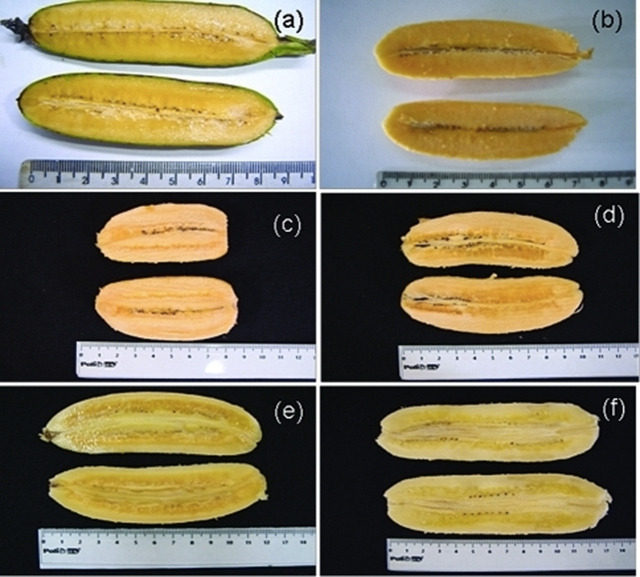
Beta-carotene-heavy "super banana" is very orange

Beta-carotene-heavy “super banana” is very orange

Our challenge is that the beta-carotene-heavy “super banana” is bright orange inside. This could prove an impediment to Ugandans and others adopting it into their diets and using it in their traditional dishes. Here are some thoughts from a recent article in Scientific American:

“…bananas are more than just a food staple in Uganda; they are part of the cultural fabric. The Ugandan word for food is actually the same as the word for a traditional meal made of the stewed banana: matooke. Physical attributes of the fruit itself are particularly important to Ugandans, so altering the fruit could have social consequences. For example, when matooke is prepared properly, it obtains a certain yellow color. If you are a woman who prepares matooke of the incorrect color or texture for your husband, you can be beaten.”

“Furthermore, when we asked what trait farmers would like to see most improved about their crops, they consistently selected nearly every other trait before nutrition.”
—Matthew Schnurr, Dalhousie University, Canada

There are many challenges to making sure everyone gets enough nourishment; cross-cultural understanding and communication are one of them. We applaud those who are taking on these challenges and building bridges to enhance access to healthy food and clean water.

Speaking of bananas, I heard about an activity recently that I think might be helpful to you. If anyone knows the original source of the activity, would you please share it with me, for citation here? Thank you. The instructions and debriefing below are my own, based on the idea of exploring how people peel bananas.

bananaActivity: The Banana Peel

Objectives:
Learners will discover that:
  1. Many of us go through life believing that “our way” is “the way” to do something. We often fail to investigate—or even notice—if there are other approaches to performing a task (such as peeling a banana).
  2. “Common sense” (e.g., how to peel a banana) is really “cultural sense,” common only to those who share the same learned patterns of behavior.
  3. “My way” is not the only “right way” and, in fact, may not be the “best way” for the purpose.
  4. Having alternatives, diversity, and knowing more than one way to do something are assets.

Procedure:
This is a terrific activity to conduct prior to a break, or mid-afternoon when learners may be hungry. After making sure your learners have no banana allergies or other restrictions, give each of them a banana.

Ask your learners to peel their bananas and hold onto the peels. Let them know they are welcome to eat the bananas, as well.

That’s it—quick and simple! Remember, the key to experiential learning is the meaning-making that takes place during the debriefing.

Debrief:
The debriefing is the most important part of any learning activity. It is where sense is made of the experience.

  1. Ask learners how they peeled their bananas. Have a few people share.
  2. Ask learners how they learned how to peel a banana. Who taught them? When? Where? Explain to them that this is how culture is learned. Culture is our “common sense,” the template (learned behavior, habits) for how we make decisions and interact with the world.
  3. Ask learners if everyone in the group peeled their bananas in the same way. Encourage learners to look around and discuss. Usually there will be, at minimum, two different ways learners peel their bananas, particularly if you have an international or multi-ethnic group. Many people peel from the stem end, but others peel from the “top,” as illustrated in the video below.
  4. Ask learners if they realized that others were peeling their bananas differently than they were. If they did not, why not? What “blinded” them to seeing the difference? What assumptions did they make?
  5. Ask learners if they think their way of peeling a banana is better than another way. You can ask a couple of learners to speak to this, even setting up a debate if appropriate for your context. You can even make a list of pros and cons of the different methods of peeling. Be sure to note that people tend to be perfectly happy with the way in which they are used to peeling a banana. It’s the same with culture. We think “our” way of doing things is the “right” way or, often, the “only” way. Then, we discover there are other ways of doing things.
  6. Summarize main learning points, e.g., that differences provide us alternatives and add interest to life. Rather than feeling threatened by difference or resisting it, asking people to “fit in,” we can learn from differences and choose the best ways for our team, family, or organization. In a sense, we can create a “third culture.”

I hope you’ve enjoyed the activity, as well as the info on the super-banana. If you have a favorite cross-cultural training activity that you use in conjunction with Cultural Detective, please share it! We’ll be happy to credit you and link to your page. Together, we can build intercultural competence, justice, and respect in this world of ours. Thank you for being with us on this journey!

Clean House and Change the Bedding to Greet the Lava

Photo by Pahoa-based photographer Sean King/Caters

Photo by Pahoa-based photographer Sean King/Caters

The gem of a video clip below offers a glimpse into an aspect of native Hawaiian culture of which many people may be unaware. As lava flows on the island, there are vast cultural differences in how the native and immigrant cultures view the event. While native Hawaiians prepare to welcome a guest, others talk about ways to change the course of the lava to flow in a more convenient direction.

I am so proud of what the government in Pahoa, district of Puna, county of Hawaii is doing, and not doing, to “divert” the lava flow that is destroying homes, businesses, and lives. The clarity, patience, and wisdom they show in their answers to community members’ questions make me wish they worked in my county.

In the video, you will see Pi’ilani Ka’awaloa, an INCREDIBLE cultural resource person!!! She demonstrates wisdom in her people’s truth, and openness to teaching as well as acting in collaboration with others. She tells us that the native Hawaiians have adjusted to western culture, in that they now “buy” their land. But she also tells us they will never “own” it; it belongs to the goddess Pele.

“We would never tell Pele to go here or there in her own home! If she feels she needs to clean her house, then let her clean her house!”

I believe you will very much enjoy the cross-cultural differences visible in this Question and Answer session after a county informational meeting on the lava flow. What a challenge to bridge two such vastly different cultural orientations, on such a very sensitive subject as saving our homes and businesses.


I learned about what is going on in Pahoa from a friend I have only met virtually, Tim Sullivan, who lives there. Some people say that online “friends” aren’t real, but I can assure you that via social media I am now connected with many people whom I respect and learn much from. Tim recently wrote an extremely insightful and powerful blog post on the cross-cultural aspects of the lava flow in Pahoa. Be sure to check it out.

I think this short video clip would be an excellent piece of material to debrief using a Cultural Detective Worksheet. Give it a try and let us know how it goes! And may blessings be upon all those who make Pahoa their home.

Let’s Investigate What Makes Cultural Detective Unique

ICToolsCollage

Country Navigator™, GlobeSmart®, CultureWizard™, Cultural Navigator® and their logos are the property of their respective parent companies.

We get calls and emails every day, asking us how Cultural Detective compares with some of the other intercultural tools on the market. Thank goodness people are passionate about developing intercultural knowledge and skills, and that there are so many intercultural tools available! That’s a big change in the last two decades, and a huge step in the direction of building intercultural competence in our organizations, our communities, and ourselves!

Most of the well-known development tools in the field—Cultural Detective®, Country NavigatorTM, GlobeSmart®, CultureWizardTM, and Cultural Navigator®, among others, use a values-based approach to understanding cultural differences. Such a method has proven significantly more effective than a “do’s and don’ts” approach, because behavior depends on context. Thus, do’s-and-don’ts advice is frequently erroneous because it has little or no connection to a specific situation you may find yourself confronting.

In addition to a shared focus on values, these tools share the aim of improving cross-cultural understanding. That, however, is about where the similarity ends. Comparing Cultural Detective and the other tools on the market is difficult because, according to leading intercultural competence researcher Doug Stuart, “it’s like comparing apples and oranges.” Both fruits are tasty, and they go well together in a salad, but they are oh-so-different on nearly every other criterion!

Goals

Cultural Detective (CD) is a process-based tool designed to improve communication and collaboration. The other tools mentioned above are designed to compare and contrast cultures. There are strengths in both of these goals, and they can complement one another very well. But the differing goals make these tools fundamentally different species.

Dimensions

Dimensions-based tools allow users to easily compare whether Chinese are more group-oriented than Japanese or Brazilians, and how we personally compare with the national averages of each of those places. The creators of the best of these tools conduct a lot of research to produce statistically reliable comparison data. According to Doug, the strength and weakness of a dimensional comparison (for example, where a culture or an individual stands on Hierarchy vs. Egalitarianism) is that we get a clear general picture of how different two populations may be, but no specifics on how that difference looks behaviorally. The numbers on the scales produced by these tools are culture-specific, but the categories are universal and broad.

Process

Cultural Detective helps develop skill and strategy, both culture-general and culture-specific. The core method is a process designed for use and practice over time, in specific situations and multiple cultures, so that it becomes second nature. Thus, Cultural Detective provides appropriate stimulation at all stages of intercultural competence development. Users develop critical thinking skills to discern similarities, differences, and how best to leverage them for mutual benefit.

Context

Cultural Detective is contextually grounded—the method centers on stories or critical incidents. This reinforces the need to understand people as complex individuals who are influenced by multiple cultures including gender, generation, professional training, sexual orientation, spiritual tradition, organizational and national culture, and lived multicultural experience—not just passport nationality.

Inside-Out vs. Outside-In

Cultural Detective looks at culture from the inside-out. Values Lenses focus on the core values natives of the culture hold near and dear. These are the same values that often confuse non-members of the culture and get in the way of cross-cultural collaboration. This approach enables a native, or someone very familiar with a culture, to explain the culture in a meaningful way to a newcomer. We might consider these Value Lenses as extremely culture-specific “themes” (internal discourse, logic or “common sense”) that are intimately tied to behaviors, and easily and meaningfully illuminated through stories. A culture is a unique expression of these themes, which are difficult or impossible to capture successfully within broad global dimensions.

The other tools mostly look at culture from the outside-in, comparing national cultures according to well-researched categories such as Power Distance or Achievement/Ascription. A table of cultural dimensions that contrasts China and Japan tells you nothing practical about how people behave. Comparing Cultural Detective Values Lenses for China and Japan offers a completely different, immediately applicable line of inquiry: what are the underlying motivators of people’s behavior? Both approaches have their strengths, and many successful coaches, trainers, and educators use them in combination.

Self-Assessment

Many of the other intercultural tools on the market provide users a self-assessment, which, when completed, statistically compares them with their home society and other cultures. Users love seeing themselves, their values and style, especially when correlated with numbers or illustrated in a chart—it’s interesting and engaging.

Cultural Detective users reflect on their personal values, developing a Personal Values Lens that they can compare and contrast with those of team members, their own or other cultures. One approach is dimensions-based, the other based on qualitative analysis. Used in combination, one enhances the other. But they are two very different animals.

Experiential

Cultural Detective Online encourages learners to upload and analyze real stories from their own lives. Users can easily integrate the system’s Values Lenses and Worksheet into analysis of their personal critical incidents. They can invite team members to help them fine-tune the story and the debriefing. As Doug says, “While the cultural themes of Cultural Detective Value Lenses are very transparent to natives and, thus, easily illustrated by stories, the dimensions-based tools usually require an experienced cultural trainer to create ‘critical incidents’ illustrating universal dimension differences, which are more difficult to specify behaviorally across cultures (unless one is very familiar with both cultures). Simply summarized, universal dimensions are generic; they provide a good ‘first look’ at how different two cultures might be. To actually understand those differences as they play out behaviorally, we need the Cultural Detective’s Value Lenses.”

Cultural Detective is not your father’s intercultural tool, to paraphrase an auto industry advert. It utilizes a “culture-specific” approach, while simultaneously building users’ “culture-general” understanding. It provides not just a knowledge base, but a personal skill base from which to strengthen intercultural competence. Best of all, it can be used in a variety of settings to help facilitate intercultural communication and collaboration. Our global team of 130 continues to work hard to collaboratively build a productivity tool that will deepen your learning and jumpstart your effectiveness. Give it a spin! Join us in one of our upcoming free webinars to learn more, and receive a 3-day pass to Cultural Detective Online!
Alone, Asian, Atheist in the Middle East

Obey-Middle-East-Mural

Middle East! Turn around and look East! (Obey Middle East Mural, Shepard Fairey)

Many of you followed Phuong-Mai Nguyen’s journey through the Middle East, as written live right here on the Cultural Detective blog. Last year in Estonia, Mai, the co-author of Cultural Detective Vietnam, keynoted the SIETAR Europa congress. In that speech she shared the ten lessons (‘commandments”) she had learned after almost a year of living in the Middle East after the Arab Spring. Her remarks have now been republished by The Islamic Monthly, and I’m confident you’ll be eager to read them.

As Mai tells us, her learning “touches on threats of Islamism, the tendency to self-victimize, and the need for all of us to establish a genuine relationship with moderate Muslims in the West.” The full article reprinted from her speech contains some of her powerful photos as well as her personal learning and viewpoints. 

The ten lessons she learned from her journey include:
  1. Thou shalt not watch TV
  2. Thou shalt stay thyself
  3. Thou shalt empower thy man
  4. Thou shalt fear God
  5. Thou shalt turn around
  6. Thou shalt break free
  7. Thou shalt seek guidance
  8. Thy land shalt be named
  9. Thy land shalt be named again
  10. Thou shalt acknowledge my new identity

Please, read her remarks and let us and Mai know what you think! I have been fascinated by the fact that she chose to make this journey, and the opportunity to view such an experience through the eyes of a Vietnamese woman.

Best, Dianne