
Building Leadership Resilience with Cultural Detective

ILA_logoBlackblue
Cultural Detective® will be featured in a workshop at the 15th Annual International Leadership Association Conference in Montreal, Canada, Oct 30 – Nov 2, 2013.  Dr. Karen Lokkesmoe, Leadership Across Meridians, and Tatyana Fertelmeyster, Connecting Differences Consulting, co-author of the Cultural Detective® Russia, will lead a workshop demonstrating how CD can be used to build global leadership competencies.

Session Description:
Building Leadership Resilience with Cultural Detective
Saturday, Nov 2  10:15 -11:15   Room: Gatineau
At the Fairmont Queen Elizabeth in Montreal

There are many facets of global leadership, and any number of skills that are required of today’s leaders, but one of the core skill sets is intercultural competency (Moodian, 2010; Lokkesmoe, 2009; Mendenhall, 2008). It has become clear that good intentions, awareness-raising, and exposure to other cultures are not sufficient, in and of themselves, to build global leadership and intercultural capacity (Mendenhall et al., 2008; Vande Berg & Paige, 2009). The focus must be on intentional capacity building. Cultural Detective® is an innovative and engaging methodology that allows for building concrete skills and developing sustainable ability to understand, engage, and lead others in intercultural situations more effectively.

This interactive workshop demonstrates how to use the Cultural Detective framework to build and develop intercultural leadership skills. Participants can expect to learn how to use specific elements of the Cultural Detective (culture-specific Value Lens, Worksheet, and Cultural Detective Online) as practical tools in situational analysis and decision making. Using Cultural Detective as part of your global leadership development strategy will help you increase performance, productivity and profits through loyalty, teamwork, and return on investment. It is a tool you and your employees can use immediately to achieve the bottom-line results that intercultural competence can bring to your organization.

Come put on your detective hat and learn how you can use this fun and engaging tool to enhance your (and your organization’s) global leadership competence! While our world may be shifting rapidly, developing skills to identify cultural similarities and differences, accurately interpreting real life situations from multiple perspectives, and designing creative, interculturally sound solutions help foster the resilience we need to be effective leaders today. We hope to have you join us.
 

The Best-Kept Secret of Successful Teams

4 Phase ModelAlmost every team and community today is diverse in some way or another: gender, age, spirituality, professional training, ethnicity, nationality… While we respect other styles and cultures, most of us still get stuck at some point where we say, “OK, we’re different; now how do we work (or live) side-by-side? How do we harness our differences as creative assets? At a minimum, how do we simply keep from driving each other crazy?”

We might work with partners who view time as flexible and events as unfolding. This may mean that, to them, deadlines are mutable and subject to change. Meanwhile, we push ourselves and our bodies, working overtime to make sure we honor our commitment to an agreed-upon deadline. While we may respect our colleagues’ view of time management on a theoretical basis, and perhaps envy them their apparently healthy work-life balance, how do we succeed with partners who don’t seem to respect their commitments to deadlines?

Perhaps we have a neighbor or even a waiter at a favorite restaurant who communicates very directly, yet we prefer a bit more indirection, thank you. While we respect their communication style, it can get irritating and try our patience.

Too often we fail to actively seek to bridge differences because we see them as something negative, as something that separates rather than unites us. Yet, by ignoring our differences, by pretending they are not there, we imbue them with great power. Eventually they can get the best of us, surprising us at awkward moments and causing frustration and tension. Our reluctance to address differences may stem from a fear that acknowledging their existence may push us farther apart rather than allowing us to collaborate enjoyably.

So, how do we transform these differences into assets? How do we convert them from something to be denied, hidden, or tamped down, into something to be embraced and used for the good of the organization and the team?

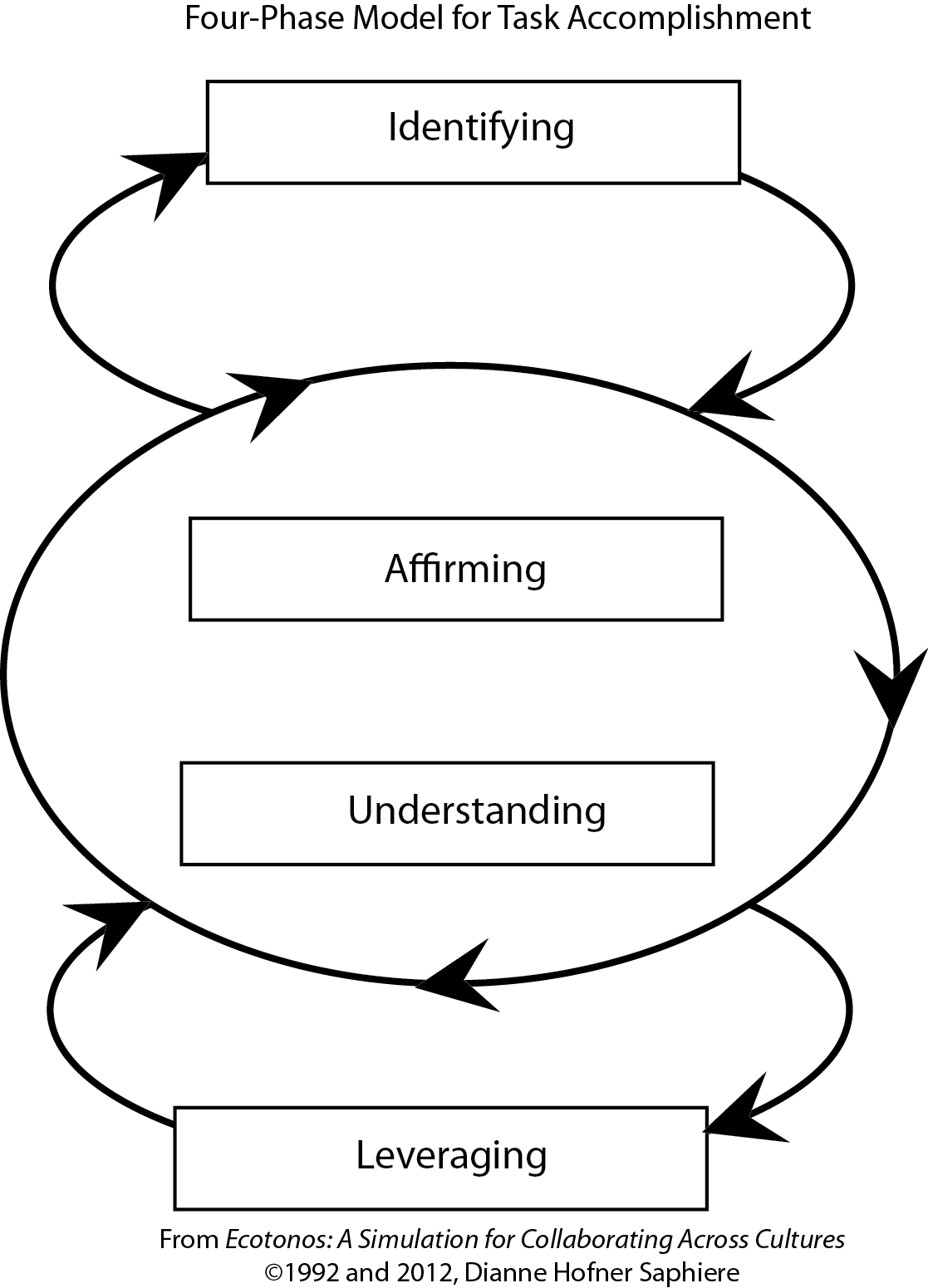
One model that has proven quite useful over the past two decades of use comes from the classic and widely used simulation, Ecotonos: A Simulation for Collaborating Across Cultures. Called the “Four-Phase Model for Task Accomplishment,” this very simple approach guides us to first identify the similarities and differences at play in our interaction, verbally affirm them, spend time understanding them and, finally, explore how to leverage them.

How a specific team leverages similarities and differences will depend on the members of the team and their shared goals and realities. Each team creates its own team culture, ideally based upon and growing out of the first three phases of this Four-Phase Model.

As you can see in the graphic above, the Four-Phase Model is not linear, but rather each phase weaves into and out of the other. For example, understanding may lead to further identifying, or leveraging may lead to added affirmation.

A text description of the Model accompanies Ecotonos and provides further elaboration of the graphic:

Identifying
  • Perceiving similarities and differences
  • Establishing which differences are divisive and which commonalties unite
  • Creating self-awareness of one’s own strengths and styles
  • Appropriate balancing of the tension between sameness and difference
Affirming
  • Confirming individual commonalties and differences
  • Substantiating that difference is desirable
  • Legitimizing difference in the eyes of the group
  • Welcoming conflict and paying attention
Understanding
  • Attempting to understand the other person’s perspective
  • Stepping into the other’s shoes
  • Mirroring/exploring and discovering together
  • Probing for deeper comprehension using various approaches
  • Seeing an issue from several vantage points
Leveraging
  • Defining how team members can contribute to goal accomplishment
  • Agreeing on methods for utilizing team expertise
  • Facilitating the generation of creative solutions
  • Creating a “team” culture
  • Focusing on efficiency and effectiveness

Once people become comfortable with the Identifying Phase, they may perceive the Affirming Phase as something unnecessary, a waste of everyone’s time. “We are all adults. We don’t need to give one another kudos.”

But my extensive experience proves, over and over again, that taking the time and effort to actively engage in the Affirming Phase is well worth the investment. Proceeding more slowly allows the team to accomplish more in less time, so to speak.

Below is one video that illustrates the value of affirmation in our lives. It is pretty long, but you’ll get the idea pretty quickly and I’m confident you’ll enjoy watching it.

The Four-Phase Model is one tool that can powerfully transform conflict into productivity and innovation. And, by the way, don’t forget that you are awesome!


Developmental Intercultural Competence

The ability to collaborate productively and enjoyably across cultures is more important than ever, whether we focus on communicating with elderly parents or teenaged children, or on building trust and producing results with colleagues at the next desk and across the planet. But what do theory and practice tell us about how to gain maximum effectiveness?

One exceptionally rapid and proven way to successfully improve cross-cultural competence is to use the MashUp: a natural and powerful combination of two leading intercultural competence development processes: Cultural Detective and Personal Leadership.

Starting in September we will conduct a four-month course that will transform your personal and professional practice. It will enable you to use the MashUp in a developmentally appropriate manner to support and stretch learners at all stages of intercultural development.

Coursework will be conducted virtually, allowing you to complete the assignments from your office, home, or during travels. There will be individual and pair assignments, in addition to online classes. Do not miss this opportunity to work with some of those who are doing leading intercultural competence work worldwide. Learn more.

Link

This year’s theme is “Leadership Across the Great Divides: Bridging Cultures, Contexts, and Complexities.”

A great theme for Cultural Detectives to contribute their expertise and share this wonderful tool to leaders globally! If you are interested in contributing you’ll need to act fast as call for proposals will close March 15th!

The 14th Annual International Leadership Association Conference will be held in Denver, October 24-27, 2012.

The ILA seeks proposal submissions that represent the best contemporary thinking about leadership from a diverse range of leadership scholars, practitioners, educators, program directors, consultants, students, and other leaders and leadership professionals. I know there are MANY of you out there that fit this description!

I invite you to visit this section of the ILA website to learn more and to submit.