You know that Ecotonos: A Simulation for Collaborating Across Cultures is an incredibly powerful tool for improving virtual team effectiveness, developing abilities to make decisions and solve problems in multicultural teams. Now that COVID-19 has forced so many of us to work and learn online, the learning tool is invaluable and we recently shared a post about how to play Ecotonos online.
Yesterday I learned that one student was unable to participate in the virtual MBA class. The professor, therefore, assigned the student homework: make a video summarizing the experience that you missed. The student interviewed his colleagues and used photos from previous live-and-in-person playing of Ecotonos at his university to put together the video below. It is in Spanish as this all took place at Sergio Arboleda University in Bogotá, Colombia. I believe he did a powerful job. What do you think?
The professor, Fernando Parrado, co-author of Cultural Detective Colombia, has adapted Ecotonos for his international negotiation classes. Rather than using random cards as game instructions advise, he combines Ecotonos rule cards into sets and assigns them to specific countries of interest to his students. He found Ecotonos worked even better online, with students playing from their homes, than it does in the face-to-face classroom!
If you are looking for an enjoyable method for improving decision making, problem solving, and collaboration online, a method that provides immediate results, give Ecotonos a go. It is affordable and can be played several times with the same group if you wish, as there is no “trick.”
Ecotonos: A Simulation for Collaborating Across Cultures is a classic in the intercultural and diversity fields. Learners work in groups to solve problems and complete tasks, improving their ability to work effectively in diverse multicultural teams in the process. The simulation can be played repeatedly for incremental learning and practice, as in contrast to most other simulation, play is different each time.
With the COVID-19 pandemic in full swing, most of our world is either quarantined or socially isolated. We are having to work, learn and socialize virtually, online. Yesterday I received a message from Fernando Parrado, head of Global Minds a professor at universities in Bogotá, Colombia. He has used Cultural Detective with his undergraduate and graduate students for ten years, and Ecotonos for the last four. He texted me to share his delight that his first online play of the simulation went extremely well. He played Ecotonos during his normal evening class with his masters students and there were many advantages to the online learning, he told me. I asked him if we could speak and record his explanation of what he did, so that others might find inspiration. Below is that video and following that I’ll summarize in words what Fernando says.
Interesting to me is that Fernando plays Ecotonos as described in the boxed set, with a few customizations—a practice highly recommended with any tool so that it best suits the audience. He chooses five rules cards from the Ecotonos kit for each of the three cultural groups, but instead of Ecotonos-standard naming (Delphinius, Zante…), with these working professionals in the Masters in International Commerce evening program he names each group after a real country (Saudi Arabia, Japan and USA) and combines the Ecotonos rule cards with the Cultural Detective Values Lenses for that culture. I love this adaptation, to combine with a CD Values Lens! Genius!
Hundreds of universities worldwide have for over a decade used Cultural Detective Online in the classroom and now, increasingly and out of necessity they are using it for the purpose for which it was designed—in their online learning. It is proven effective, developmental and engaging. Fernando says he’s facilitated Ecotonos about eighteen times in the face-to-face classroom; yesterday was his first time to do so online. In his opinion, it had far better results.
Fernando used three different publicly available, free of cost online tools to run Ecotonos virtually.
He used WhatsApp to share instructions and answer questions, particularly with group leaders (leaders were chosen for each cultural group, a practice often not done when playing face-to-face).
The main class, with full attendance, was held in Zoom. Fernando gave out initial instructions, shared rule cards and Values Lenses, and later conducted the debriefing in Zoom.
Each of the three cultural groups worked independently in their own Google Hangout. Fernando was able to drop into each team to monitor its progress and to facilitate as needed.
Fernando talked to me about flexible Latin time, and the online environment very much helped him with that. He was able to allow the students as much time as they needed to get their technology working, and to make sure that they spent sufficient time in each phase of the simulation (acculturation, monocultural work, multicultural work, debriefing). He reported to me that sometimes in a classroom situation it can feel rushed. His class normally ends at 9:30 pm, and Bogotá at that hour can be a bit dangerous. Since his students were in their own homes, in quarantine, he was able to stretch his class to 10:00 pm and the students were overjoyed at their learning and the fact they didn’t have the trek home after class.
More importantly and surprisingly, Fernando told me, was how much more immersive the virtual Ecotonos experience was. Fernando instructed the students to “make your Google Hangout feel like” Saudi, Japan or the USA. How the students would do that was up to them, but Fer told me that their creativity was amazing. Because they were at home, they used props, changed their attire, and jumped fully into the experience.
Debriefing is of course the key to any learning activity; it’s where we help the students make sense of the experience—make meaning and create knowledge and skill. Fernando’s group did the standard Ecotonos debrief, including drawing out the decision-making process used by their multicultural group and answering the reflection questions, summarizing them into a PowerPoint that was shared with the instructor and the class.
All in all, it seems Fernando sees more depth of learning and positive outcome in the online Ecotonos, though he says once things return to normal, he’ll of course continue to use the simulation and Cultural Detective Online in his face-to-face classes as well.
A second online course to learn EPIC (Essential Practice for Intercultural Competence, dovetail of Cultural Detective and Personal Leadership), offered by CultureCrux, will open for registration on March 16th.
If you would like to receive information about the course and registration please contact Debbie Bayes (debbie@culturecrux.org).
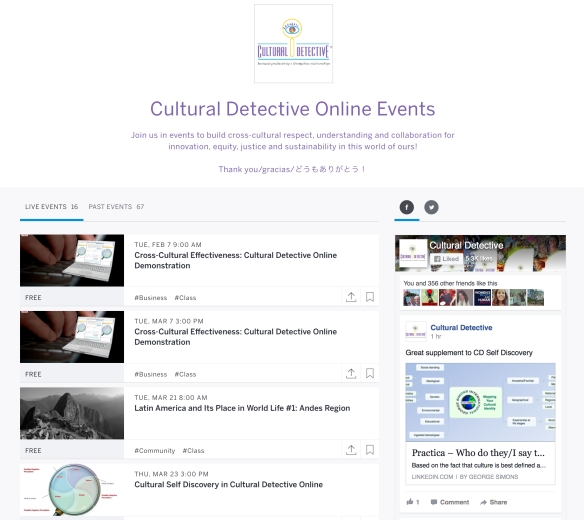
Cultural Detective offers a series of complimentary webinars that you, your colleagues, clients, and prospects should most definitely attend. In the introductory 90-minute webinar, “Cross-Cultural Effectiveness,” participants learn the basic Cultural Detective Method for analyzing interactions in context and using differences as assets, and they receive a three-day pass to the Cultural Detective Online system to explore later on their own. If you haven’t attended, we urge you to do so. And, seriously, invite your colleagues, clients, students, prospects, neighbors; this is great free marketing—many in our community use it as one of the steps in their sales funnel. And don’t forget those in the educational arena—quite a few professors now require Cultural Detective for their classes.
In addition to our introductory webinars, this year we have added four NEW standard webinars, AND we are adding a special series of four online workshops on Latin America! We invite you to join us for one or all of these exciting webinars.
Latin America has assumed a key leadership role in exploring innovative solutions for restructuring societal inequity and promoting responsible development and the sustainable use of natural resources. Many of these efforts are based on popular, direct-democratic movements, including indigenous social movements. Eleven nations include multiculturalism and multilingualism in their constitutions, and an additional four recognize indigenous rights. The region’s economy is the third largest with a GDP of $5,573,397 million USD, its population was estimated at more than 604 million (third in the world), and biggest world territory (it has an area of approximately 19,197,000 km2).Yet Latin America has been culturally misunderstood! It is often treated as a single market with shared language, religion, history and culture, but the region envelops important differences. This highly experiential workshop will enable participants to explore the richness, complexity, irony, and promise of the hundreds of cultures that comprise Latin America.
Cultural Self Discovery in CD Online
During this 90-minute online learning event, participants will learn how Cultural Detective Online allows you to make Personal Values Lenses, a powerful tool for developing understanding of oneself as a cultural being, knowledge that can help you more fully understand why you respond the way you do, and explain yourself to others who may not share your values. Personal Values Lenses can be overlaid and compared with national Values Lenses or Values Lenses of different generations, spiritual traditions, genders, or sexual orientations. Personal Values Lenses are also incredibly helpful tools for enhancing team, family, or community effectiveness. Participants will also leave with a new cross-cultural activity.
Group Collaboration in CD Online
The value of social and collaborative learning are undisputed, and Cultural Detective Online harnesses the power of such learning simply and easily. During this 60-minute online learning event, participants will learn how to: set up and manage group subscriptions, subscribe and unsubscribe group members and enable them to collaboratively write critical incidents and debriefs, instruct group members to share their work with you (or keep it private), approve or edit submissions, and share submissions with other group members. Participants will receive the PowerPoint slides used in the presentation.
Building Intercultural Competence in an Organization Using Cultural Detective
In an age when our world communities are polarized like never before, Cultural Detective is an effective tool for bridging differences, resolving conflict, and engaging in difficult dialogues. During this 60-minute online learning event, participants will explore some of our client’s best practices for building intercultural competence, effectiveness, and innovation by making the most of Cultural Detective Online in their organizations. We will cover both strategies and techniques, small projects and organization-wide efforts. Participants will also leave with a new cross-cultural activity.
How is Cultural Detective Different from Other Intercultural Tools?
These days we are blessed with a broad selection of intercultural communication and diversity tools, exercises, and techniques. Yet, the vast majority of these are based on cultural dimensions—a terrific model for comparing cultures, though not necessarily effective for bridging them, and particularly not for helping us build respect, equity, and justice in our world. During this 60-minute online learning event, participants will take a look at some of the features that make Cultural Detective Online effective and unique in the marketplace, as well as key requisites to developing intercultural competence.
I once heard a Zen Buddhist monk say that the definition of suffering is the gap between what is and what we think should be. The wider that gap, the more we experience stress. Today’s global virtual team, without the right tools, might end up spending a lot of time in that gap. Most teams want to becoming high-performing units with all individuals feeling valued, all cultures being respected, and all tasks getting completed on time. The reality can look quite different, however. In today’s taxing environment, many teams find themselves reacting to fires, completing their tasks but without the benefit of time for intentional reflection or action.
As an intercultural practitioner I’ve had the privilege of working with a variety of global teams in industries from manufacturing to finance. Many of them display similar characteristics. They are often comprised of talented individuals who appreciate cultural diversity and want to collaborate effectively. But why do few teams achieve that vision? What causes the gap between that desire to collaborate and the reality of division or confusion?
So many factors play into the health of a global team, some of which defy explanation — call it chemistry, dynamics, or magic. Some of the factors, however, are more visible. For example, I see many teams become misaligned because they do not have proper communication protocols in place. They make false assumptions about shared understanding of terms or processes which can delay projects. Cultural differences also play a significant role in the effectiveness of global teams. Team members might run into disparate cultural approaches to a project, and rather than observe the problem objectively they immediately begin jumping to conclusions and/or negative evaluations. This premature leap can cause them to chase down incorrect solutions and again delay the project. Also, the team may not take full advantage of the diverse perspectives and resources that the members provide.
How do we close this gap between the theory of a collaborative team and the practice of one? First, a global team must realize that intercultural competence is a learned skill, in some ways like welding or computer programming. Cross-cultural skills may be harder to acquire or measure, but they must be studied and practiced. Cultural Detective Online is an incredible tool for global teams to unite around and hone their intercultural proficiency.
CD Online makes it possible, for example, for teams represented in fifteen countries to come together in a virtual training room and explore several important aspects of collaboration. First, they learn to separate objective facts from their perceptions of situations. That skill alone can increase team trust dramatically. Then they learn through what lenses their colleagues might be looking, and how those values impact the outcome of a business problem. Imagine eighteen members of a global team, all online and on the phone, working through a CD Online scenario together that illuminates the values of cultures they work with every day. Everyone gets to contribute and they physically practice those vital cross-cultural skills right there in the training.
I feel a great sense of excitement about what Cultural Detective Online does to increase the effectiveness of global teams, and not just in theory. Join me and the Cultural Detective team as I walk through a case study of a virtual training designed for a global team using CD Online. This event is free and will take place April 9, 2013. To learn more about this event click here, or to register please click here.
Global teams have amazing potential. What tools have you used to get your global team to high-performance?
—
Vicki Flier Hudson, speaker and Chief Collaboration Officer for Highroad Global Services, inspires people to live, work, and build teams across cultures. She has helped countless large-sized corporations establish successful operations between the United States and India or Europe. Vicki is a certified administrator of the Cultural Detective methodology and the Intercultural Development Inventory (IDI). She has been featured on NBC News, and many of her articles have been published in a variety of magazines.
Cultural Detective is proud to announce the new product launch of Cultural Detective Online! This tool is like having a virtual coach in your back pocket, successfully guiding you through the all-too-common missteps of cross-cultural negotiations and communications. Please check out the four videos on the home page. Today only (15-16 October, depending where you are on the planet) there is a 25% launch discount; enter promo code: CDO-blog25 during checkout.
Huge thanks goes out to each of you who have worked with and incorporated the Cultural Detective Method into work with your clients or employee populations globally, as over the past eight years this tool has become a significant contribution to the intercultural field. Because of our clients and team, Cultural Detective has become globally recognized as one of the premier developmental tools of our time. Now we are on the cusp of very exciting and broader use of the tool through Cultural Detective Online! This new product launch furthers our mission of encouraging communities globally to prosper through intercultural understanding and collaboration.
Cultural Detective Online is useful in a broad range of contexts including global business negotiations and multicultural team effectiveness, international assignments and study abroad, and for successfully communicating within our families and communities, and within and across faith traditions.
A subscription to Cultural Detective Online offers the opportunity to explore the concepts of “culture” and “values” and how they impact communication in everyday life. It provides access to dozens of culture-specific Values Lenses and topic-specific Challenges Lenses, hundreds of real world cross-cultural incidents, and the easy-to-use Cultural Detective process for improving the ability to collaborate successfully across cultures, both on individual and organizational levels.
We are excited to announce that subscriptions are now available for individuals or groups, and we invite you to subscribe to Cultural Detective Online today by visiting http://www.culturaldetective.com/cdonline/ ! Subscriptions start at less than US$100/year, and are less for larger groups of subscribers. You will rarely find more value for your money.



 Cultural Detective offers a
  Check out our new special four-part series called “

 Cultural Detective Blog