Unknown's avatar

About Dianne Hofner Saphiere

There are loads of talented people in this gorgeous world of ours. We all have a unique contribution to make, and if we collaborate, I am confident we have all the pieces we need to solve any problem we face. I have been an intercultural organizational effectiveness consultant since 1979, working primarily with for-profit multinational corporations. I lived and worked in Japan in the late 70s through the 80s, and currently live in and work from México, where with a wonderful partner we've raised a bicultural, global-minded son. I have worked with organizations and people from over 100 nations in my career. What's your story?

Third Anniversary 3•11

3-11

AFLO / MAINICHI NEWSPAPER / EUROPEAN PRESSPHOTO AGENCY

Today in Japan marks three years since the March 11, 2011 earthquake, tsunami and resulting nuclear disaster in the Tohoku area of Japan—the 3/11 triple disaster. Japanese society marks services for the passing of the dead at specified intervals, including one at the third anniversary of death, making this year especially important. I would like to join my heart and prayers with all those honoring the death of loved ones, and the loss of so much history and heritage.

I occasionally worked in Soma, with some wonderful people. On 3/11 I was so proud that they were able to evacuate hundreds of people in LESS THAN FIFTEEN MINUTES, all of them getting to safety and out to help their families and communities. Most of the facility itself was inundated, much of it lost. Not all were so fortunate. On this third anniversary, 2,636 people are still missing. The official death toll stands at 15,884 in Iwate, Miyagi and Fukushima prefectures, according to the National Police Agency. An estimated 200,000 to 300,000 people still live in ‘temporary’ dwellings, three years later.

For many communities, anxiety over radiation poisoning remains high, as many in Japan discuss either re-opening the nation’s nuclear plants or closing them entirely. National planners wish to get Tohoku areas rebuilt but often there is a sense of disjunction between the views of bureaucrats based in central cities and those of local Tohoku dwellers living in affected communities. The Seattle Times has run an excellent article entitled, “Recovery isn’t in sight 3 years after Japan’s tsunami.” I also found an article about the technological advances that are occurring because of this disaster. I have long been opposed to nuclear power, and pray the Japanese people will find other workable power sources for their needs. Last year at this time many Japanese were wearing masks, as chemical pollutants from China had drifted their way. We need to be better stewards of our planet, and what stronger call has there been?

iejiFor those of you who love movies as I do, this month the first Japanese film on the Fukushima nuclear disaster hit theaters. Entitled Homeland (Ieji or “The Road Home” in Japanese) — it features scenes shot in areas once declared no-go zones by the government due to high radiation levels. The film is about a farming family forced to leave their ancestral lands and live in temporary housing. I know I for one can’t wait to view it.

A college friend of mine who is a long-time personality on Japanese television, Dan Kahl, has been wonderfully responsible about keeping all of us informed about developments in the area of Japan in which he has lived for decades. You can follow Dan on Twitter if you are interested (he often posts in Japanese, and in Tohoku dialect at that).

The 3•11 area is really gorgeous. In closing, I thought it might be a fitting honor to share with you a timelapse movie of the natural beauty of Fukushima Prefecture.

View last year’s anniversary post here.

Venezuela: We Want to be Heard!

enhanced-buzz-wide-26838-1392846696-10

Carlos Garcia Rawlins / Reuters

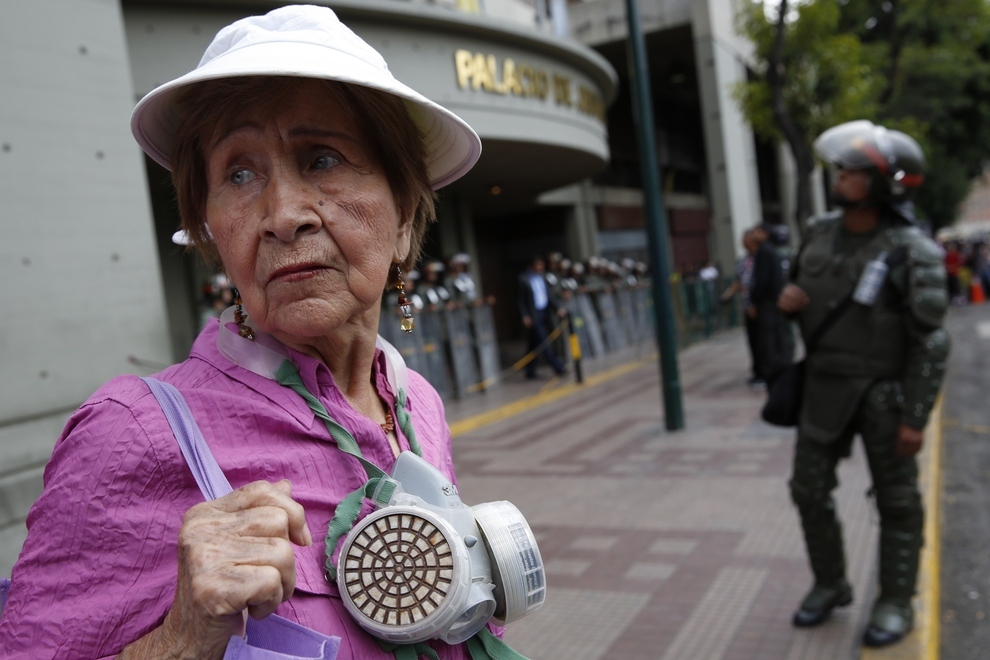
One of my oldest and dearest friends is Venezolana, a teacher who loves her country, fights for the future of children, and hates what’s been happening there—15 years of runaway inflation, shortages, insecurity, lack of opportunities. She write me, “Ay, comadrita, all of this is so sad. They are killing the students. We are very scared. Please pray for us.”

Yesterday we received this very disturbing report, which we immediately passed on via our social media: The Game Changed in Venezuela Last Night – and the International Media Is Asleep At the Switch, by Franciso Toro. The lack of power, lack of voice, lack of justice, finally met a breaking point. People protested. And the reaction from Maduro’s government was swift and violent. Caracas, Valencia, Mérida and San Cristobál have become like war zones.

Protests began innocently enough, with traditional cacerolazos (beating of pots and pans) lead by upstanding citizens. Our friend’s sister is a choir leader at her church; she was attacked by colectivos—state-sponsored paramilitaries on motorcycles—in front of her church while beating a pan. Her glasses were stolen, her photo was taken, and she was threatened with death.

I am repeatedly told that people in Venezuela feel cut off from the international community. Twitter is their only way to really communicate. They desperately want everyone to know what’s going on and how we can help them trying to make change with people power. The Venezuelan diaspora is organizing, called “SOS Venezuela.”

Please do what you can to raise awareness and get help their way. We can transform our world. There is power in each of us, some small step we can take, towards justice and peace.

Check out these additional photos.

42% Fail in Overseas Assignments

As many as two in five managers fail in their overseas assignments, according to a survey released by Right Management. A worldwide average of only 58% of international postings were judged to be successful by their organizations, with little variation across regions.

“This has to be one of the most disappointing findings of our survey,” said Bram Lowsky, Group Executive Vice President Americas at Right Management. “Given the investments being made in bringing along a new generation of leaders and their growing need to be able to think and operate globally, for 42% to fail when they’re sent abroad is hard to fathom. It’s also worth noting that the failure rate is more or less a constant whether it’s Asian, European or North American managers.”

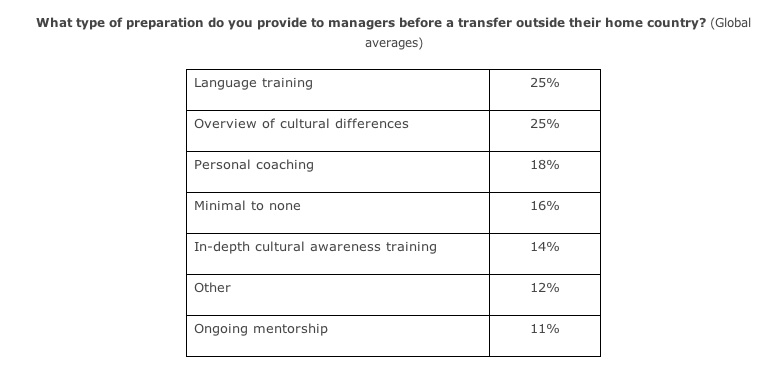
The survey also found disparities in the preparation given expatriates before an assignment, said Lowsky.

Expat Prep

“A global average of 25% of organizations provides language training. However, the average drops to 18% for North American employers, while it’s closer to 33% among European, African and the Middle Eastern companies. Even harder to believe, an average of 16% of companies globally give minimal to no preparation at all, and for North American employers it’s 22% that do virtually nothing. No wonder so many managers don’t perform well outside their home country.”

We know readers of this blog are more savvy than that! There are enough challenges changing jobs within an organization, let alone the additional challenges when transferring to an unfamiliar culture. Smart organizations don’t just invest in training the person going on the international assignment; they invest in building strong relationships among the whole team—domestically and internationally. Learn how Cultural Detective Online can benefit your team by attending one of our free webinars. Or give us a call—we’d be happy to assist you in getting your team subscribed to Cultural Detective Online today!

First Winter Institute for Intercultural Communication

WIIC14 4Have you registered for this new learning opportunity? The Winter Institute for Intercultural Communication will take place at Wake Forest University in Charlotte, NC USA March 12-15, 2014.

There are courses tailor-made to Cultural Detectives! Just look at this selection:

Cultural Detective authors and partners will be presenting these and many other courses. Registration starts at US$405 and is now open.

Happy Tet—New Year of the Horse!

1555587_10152184068913988_503611650_nMay the Lunar New Year of the Horse bring you health, joy, and much success in spreading cross-cultural respect, understanding, collaboration and justice in this world of ours!

2014 is the Year of the Horse. It is also Cultural Detective‘s 10th anniversary year (our CD project was born in the Year of the Monkey). Characteristics of the horse are unremitting efforts to improve oneself, communication, kindness, perseverance, and a love of travel—which is definitely in keeping with what the CD Method and our community are all about! May this new year bring out these and more positive traits in all of us!

On behalf of the Cultural Detective team, here is Phuong Mai Nguyen, co-author of Cultural Detective Vietnam (and her mother) with a greeting for everyone:

10th Anniversary of Cultural Detective!

Cultural Detective 10th Anniversary

Do you know that 2014 is Cultural Detective‘s 10th anniversary year? It’s also the 25th anniversary of my company—Nipporica Associates, and the 35th anniversary of my work in the intercultural field! Help us celebrate! Show our authors some love! Send us a greeting and win a one-year subscription to Cultural Detective Online.

The Cultural Detective Worksheet was born back in the early 1980s in Japan, emerging out of the need for a real-time multicultural conflict resolution tool. The Values Lenses came shortly thereafter—what are today termed “negative perceptions” were then called “the dark side,” echoing the Star Wars popularity of the day.

I used Cultural Detective tools in my proprietary work for about ten years with enormous success. Then, around 2002, Shell Oil began saying that Cultural Detective gave them the most highly rated global management training they’d ever experienced—from Nigeria to Malaysia, The Hague to Houston. They told us they wanted us to develop packages for every country in which they did business. While I envisioned nothing so ambitious, I did ask ten of my most esteemed colleagues to develop five “test packages”—Cultural Detectives England, Germany, Japan, Sweden and USA. They were so enthused about this Method and material that more and more admired colleagues asked if they could author packages. Today, the Cultural Detective series includes 65 packages (with several more to be released in the next few months) and an online subscription service.

Our vision was to provide theoretically sound, practical development tools, easy for the lay person to use, effective for beginners and experienced interculturalists, at accessible prices. Our goal was to help build respect, understanding, justice, collaboration and sustainability in this world of ours. Bless you for accompanying us on this journey thus far!

Thank you so much, to all our authors, our customers, certified facilitators, users, colleagues and friends! What a grand adventure it has been! Growing faster than we ever imagined possible, and building intercultural competence in areas we never dared dream of: spiritual communities, universities and study abroad programs, professional associations, NGOs, governments, and business. Over the last ten years, the Cultural Detective Method as been refined, deepened, and broadened—thanks to all of you!

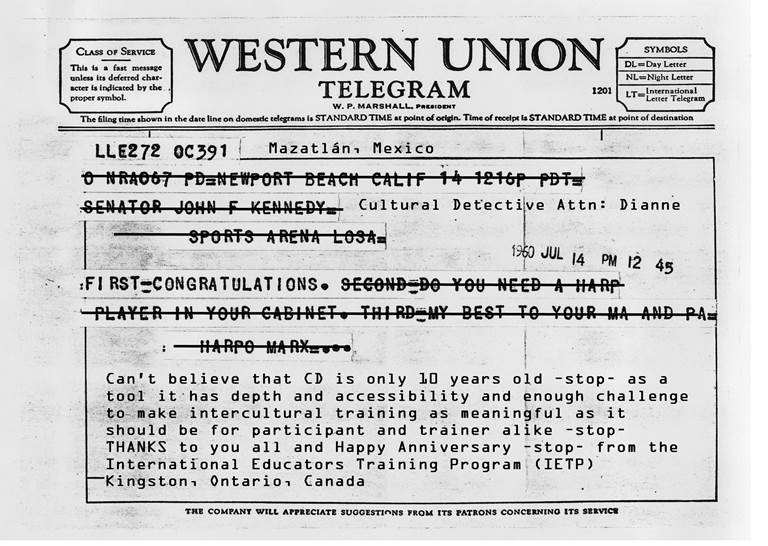
A group of Cultural Detective authors will gather this month—February 2014—in Mazatlán, México to celebrate the project’s 10th anniversary. Other authors are planning events in their locations around the world to commemorate this auspicious occasion. We have started to receive greetings, and I thought you would enjoy seeing a few of them. I’ll post a selection below.

Would you like to get in on the action? Share your greetings? Thank our authoring team? Thank the person who first introduced you to CD? How about if we make it fun?!

10th ANNIVERSARY CONTEST ANNOUNCEMENT
Share your greeting with us, and the authors of our favorite submissions will receive a complimentary ONE YEAR SUBSCRIPTION to Cultural Detective Online!

As you already know, Cultural Detective Online is a terrific personal development too. But what you may not know is that the user agreement allows you to project the contents for your students, trainees or coaches—as long as you tell them Cultural Detective Online is a publicly available tool to which they can subscribe, too. As a colleague told me yesterday,

“Why would any intercultural trainer NOT pay $150 for a TWO YEAR subscription to this tool? It gives me access to over 60 packages, allowing me to conduct such a breadth of quality training!”

How to enter? Record a video and upload it to YouTube, then send the url to ten@culturaldetective.com. Alternatively, you can send a photo greeting to that same address. Here’s the first photo we’ve received. It’s a good one, don’t you think? Many thanks to our partners at the International Educators Training Program, Queens University, Canada.

Allison10thCome on, join in the celebration! Your greeting can be as short as you like, funny or serious. We’d love to hear what Cultural Detective means to you, what difference it’s made for you, what impact it’s had on the field. Perhaps you can share a funny story of cross-cultural miscommunication, or share your success—a Cultural Defective or Cultural Effective! We can’t wait! If this series has meant something to you, please take a moment to let us know.

Send your entries by March 15th, 2014. We will contact the winners by email with instructions on how to redeem their prize of a full year’s access to all the content in CD Online, to use on their own or with their students. We can’t wait to receive your message!

Following are a few of the video greetings that we’ve already received, with a bit of background about each:

Microsoft uses Cultural Detective to coach their international support engineers. The first year they used it, they attributed a 30% increase in customer satisfaction directly to Cultural Detective. The Culture and Communication Program staff is truly inspiring. In the clip below, Shalini Thomas shares her greetings with the Cultural Detective community.

AFS, the international exchange organization with operations in more than 50 countries, has long used Cultural Detective with staff, volunteers, students, and host families. Nearly everywhere I travel, anywhere on our planet, there is almost always someone from AFS in the audience. We are thrilled to know that our leaders of tomorrow are developing intercultural competence through our partnership with AFS! I first met Hazar Yildirim in Istanbul, where he and the AFS contingent there gave me a very warm welcome. Now he’s based in New York. Here is what Hazar has to say:

The Intercultural Development Research Institute (IDRI) is committed to longer-term, sustained development of intercultural competence. Their motto is “coherent theory generates powerful practice.” Thus, it means a lot to me when the co-founder of that Institute, Milton Bennett, says Cultural Detective is a tool that truly translates theory into practice and carries on the heritage of the founders of the intercultural field. I met Milton back in 1982, at the Stanford Institute for Intercultural Communication (SIIC).

The last greeting I’ll share with you here comes from another customer, Atieh International, specialists in emerging and risky markets. “The world of today comes filled with new opportunities hidden in a sea of uncertainty and risk. It is our job to assist our clients to understand and be prepared for the tides and waves, the ebbs and flows in each market, to appreciate the beauty and depth of cultures and diversity and to build sustainable strategies founded on reliable intelligence and trust.” We are privileged to be associated with them. Managing Partner Pari Namazie shares her remarks, below.

Please block some time now to make or record your greeting and send it to us! We are looking forward to hearing from you, and we would especially love to share a gift subscription with you! Our authors work hard, not to pursue monetary wealth, but impassioned by a commitment to the vision of everybody having a voice, sharing their gifts, and realizing their potential. Let them know they have made a difference!

We will post the video greetings we receive to the playlist below. Take a look at those we have so far, including greetings from CIEE, Korn Ferry, and EDS. They are very heartening to watch! We look forward to hearing from you!

Another International Research Paper Supports the Cultural Detective Approach

Study coverBertelsmann Stiftung and Fondazione Cariplo Study*

Many of you ask us how you can make the case for and roll out a strategy for developing intercultural competence in your organizations and communities. Two of the world’s major philanthropic foundations, Germany’s Bertelsmann Stiftung and Italy’s Fondazione Cariplo (Cassa di Risparmio delle Provincie Lombarde), published a research and policy paper that may help a bit in this regard. The objectives of the study were to promote tolerance, integration and cultural dialogue within Europe and with non-European partners. The paper makes several key points that are important for Cultural Detectives to understand as we go about our work. They are points that underscore the value of the Cultural Detective® approach, namely:
  1. The danger of reifying culture. Cultures are not static entities but open, dynamic, complex systems.
  2. Intercultural competence requires a process orientation.
  3. Intercultural competence involves recognition of similarities as well as differences.
  4. Intercultural competence development processes must be the core of school curricula, revisited in different contexts repeatedly over time; they can not be appended as supplementary learning.

In this article I quote from the Bertelsmann-Cariplo study regarding each of these topics, and then make the link to the Cultural Detective approach. Let me begin, however, by quoting from the article on the need for intercultural competence in today’s world.

The Need for Intercultural Competence

“Given the process of pluralization that has resulted from internationalization, the ethnic, religious and cultural heterogeneity of our societies will increase, as will contacts between people of differing cultural values and norms. Thus, in the coming years, the ability to deal constructively on an interpersonal level with cultural diversity and a multitude of attitudes, values, norms, belief systems and ways of life will not only remain a key qualification required of business executives working in international settings; it will also be required generally of each individual as a key factor for contributing to social cohesion and reducing exclusion so that cultural diversity can be experienced positively.” (pp. 3-4)

1. The Danger of Reifying Culture

“By focusing on what was assumed to be an integrated, almost static whole of locality, group and culture … culture was considered (and is still considered by many) to be the way of life of a certain group of people in a specific setting, people who – because of their culture – consider themselves members of the same group and who – because of their culture – are different from other groups in other localities. This notion is often depicted as a global map with different discrete cultural groups, or as a mosaic, whose pieces are distinct individual cultures.

Since Ulf Hannerz (and others) formulated the ideas of “culture as flux” and the idea that cultures are open, dynamic and constantly changing ‘entities’ or ‘practices,’ many leading figures in social theory and cultural studies in the 1990s increasingly relinquished the viewpoint that culture can be understood as a closed and static, island-like entity. In addition internationalization and globalization processes have shown the previous notion – that locality, group and culture exist as one unit – to be false or oversimplifying.

The changed, process-oriented conception of culture as a dynamic entity therefore tries to accommodate the contradictions, the intermixing and the new diversity, which are based more on relationships than autonomy.” (pp. 5-6)

Link 1: Cultural Detective’s Approach to Culture as an Open and Complex System

There are several ways in which Cultural Detective helps users learn that a culture is not a static, definable entity, but a dynamic system. Each Cultural Detective package comes with a page entitled, “What is Culture?” The first words on the page are “culture is a complex …” Culture is said to affect how we do things, with further explanation that “common sense” is really a process of “cultural sense.” Readers are asked to think about central tendencies and patterns of a group of people, and that each individual is a composite of the influences of many cultures simultaneously (nationality, ethnicity, gender, age, spiritual tradition, sexual orientation, organizational culture, professional training).

The Cultural Detective Worksheet is an interactional analysis and planning tool, one that reinforces for the learner that the importance of culture is how it colors what we do, what we perceive, and how we want to proceed. Culture is not presented as some static, separate thing but as affecting individual people in real situations in complex but visible ways.

The Cultural Detective Values Lenses are positioned as a view of group norms or tendencies, a filter through which members of a culture are taught to view the world. The Lenses are used as clues: tools that may or may not prove helpful in unraveling the mystery of a given case study. Not all members of a culture will hold these values; in fact, some may have an almost allergic reaction to a society’s dominant values, even while recognizing the norm. It is also noteworthy that the same or similar values can provoke different or even contradictory behaviors, depending on the person and the context.

Thus, Cultural Detective, by its very nature, relates to cultures as open, dynamic and complex systems.

2. Intercultural Competence Requires a Process Orientation

““…This procedural understanding of culture as a dynamic flow and ongoing process of negotiation between norms, values and lifestyles only underlines the need for a conceptualization of intercultural competence which is in its turn able to take account of the changing nature of culture and the interactions it influences. Some existing models of intercultural competence, in fact, underscore the importance of a process-orientation.”

If the assumption is correct that culture is constantly in flux, then individuals must learn and master the ability to deal with ongoing processes. The development of intercultural competence is thus complex and multidimensional and, depending on the intercultural situation, can take on a variety of forms.” (pp. 6-7)

Link 2: Cultural Detective’s Process Approach to Intercultural Competence

The Cultural Detective Method is a process. It is to our knowledge one of (if not the only) intercultural competence tool available in the world today that is process-based. The approach looks at individuals in real situations, urging the learner to describe the facts of the situation, as would a good detective, filtering out biases and assumptions, and seeing what actually occurred or was said. The learner is then encouraged, at least temporarily, to set aside negative judgment and give benefit of the doubt. What could have been the possible positive intent underlying behavior in the situation? Once possible positive intentions have been formulated, the process asks the learner to discover or create methods in which the contributions of all involved can be most fully used. How might the people in the interaction behave, both to be fully themselves and to be cross-culturally effective? What steps could the organization or community take to encourage and reinforce intercultural competence?

One of the strengths of the Cultural Detective process is that it is not linear. Individuals or groups can jump around and between steps of the process, in a holistic manner, with powerful results.

We would like to caution that saying “culture is constantly in flux” can be as dangerous as the traditional boilerplate. Of course, everything is in flux; Heraclitus told us “you can’t step into the same river twice.” However, our questions can include what is changing, how fast, how much and where? We need to deal with the ongoing process, and we also need a standpoint from which to do this. Cultural Detective gives us exactly that.

3. Requisite Intercultural Competencies

“With regard to the definition [of intercultural competence], one may distinguish four dimensions, namely attitudes, comprehensive cultural knowledge and intercultural skills, an ability to reflect on intercultural issues as an internal outcome of intercultural competence [relativizing frames of reference and feeling empathy], and an ability to interact constructively as an external outcome of intercultural competence.

It is important to remember that the relevant cultural knowledge differs in each intercultural context and, as global knowledge, is potentially unlimited, i.e. too extensive to always be known in the intercultural context. Therefore, many experts attach much more importance to certain behavior related (conative) communication skills than to explicitly knowledge-related (cognitive) elements. According to the specialists, to the degree that comprehensive cultural knowledge cannot be definitively known, process-oriented skills on how to handle the situation grow in importance, skills that make it possible to acquire and process (explicit and implicit) knowledge about one’s own as well as foreign ways of life, cultural determinants and practices.”(pp. 7 and 9)

Link 3: Cultural Detective and the Requisite Competencies

The first two skills upon which Cultural Detective is premised “make it possible to acquire and process (explicit and implicit) knowledge about one’s own as well as foreign ways of life, cultural determinants and practices,” as described above. The first is Subjective Culture: knowing yourself, in context, as a product of personality and multiple cultural influences. Subjective Culture knowledge allows us to explain ourselves, what is important to us, and why we do what we do, to others. It also helps us to predict how we will respond in a given situation. Cultural Detective: Self Discovery is an entire package, approach, and tools for developing subjective culture understanding, and such understanding is developed and reinforced with every critical incident and Worksheet. When learners reflect on a critical incident and complete a CD Worksheet, they naturally reflect on their own values and behaviors: what they would do in a similar situation, how they would expect someone to behave, what would upset them? Analyzing incidents from diverse cultures and situations is an organic, intuitive way of getting to know ourselves, individually and as products of cultural influences.

The second Cultural Detective skill is Cultural Literacy: knowing others individually, in context, as a product of their personalities as well as the multiple cultural influences on them. Cultural Literacy helps us to understand others’ intentions and why we respond to them the way we do. It enables us to put culture “on the table” as a perspective to be used, rather than as something that we don’t recognize or talk about, but which reaches out to bite us when we least expect it. Every Cultural Detective package, critical incident and Values Lens helps the user to develop cultural literacy.

The third Cultural Detective skill goes farther than the Bertelsmann-Cariplo report. It is Cultural Bridge, the ability to leverage similarities and differences for interpersonal, organizational and community satisfaction, productivity and effectiveness. Cultural Bridges allow all parties to retain their authenticity, encourage all parties to develop intercultural competence. They involve processes, structures, and systems that sustain intercultural competence in the organization or community. Sustainable Cultural Bridges must be multi-directional; one-way Cultural Bridges may work in the short term, but are rarely if ever viable over the long term.

a. Specific attitudes (emotion), knowledge (cognition) and behaviors (conation)
One set of questions we are sometimes asked is, “Where does emotion fit within the Cultural Detective framework? By reporting facts and behaviors, are we to divorce ourselves from emotion?” On the contrary, emotions are crucial pieces of a Cultural Detective approach. Contemporary cognitive science is showing that what we consider emotion has cognitive content and vice versa. Evaluation and emotion are automatically present in nearly everything we do. The Cultural Detective Method helps the learner develop the capacity to see this, and the desire, as well as skills, to purposefully shift perspective in order to see a situation more thoroughly and accurately.

Heightened emotion can provide a “beeline” into the salient aspects of deep culture that make a difference in a situation. The things that most upset us are important clues to the underlying values and intent that drive perception and action.

Cognition and conation obviously come into play in the Cultural Detective Worksheet. The “Words and Actions” as well as the “Cultural Bridges” sections of the Worksheet involve behavior and conation. The Worksheet and the Values Lenses involve knowledge and cognition.

b. Internal “relativizing” of one’s frame of reference
The Cultural Detective process requires us to step into the perspective of other people, to shift our frames of reference. The Worksheet provides a visual illustration of such a shift of frame of reference. Each Values Lens, through its positive values and negative perception of those values, involves shifting perspective or frame of reference as well.

c. External performance, or constructive interaction
This final Bertelsmann-Cariplo skill is well represented in the Cultural Bridges portion of the Cultural Detective Worksheet, and is also the focus of the Cultural Detective: Bridging Cultures package.

4. Recognition of Similarities as well as Differences

“Perhaps the search for commonalities is as important in intercultural competence as the sensitivity and recognition of cultural differences that have been talked about so intensively in scientific, political and everyday-life discourses on intercultural competence during the last decades.” (page 13)

Link 4: Similarities, Differences, and Cultural Detective

As a process-based, interactional approach, Cultural Detective naturally encourages the learner to explore similarities as well as differences. When analyzing a critical incident using the Cultural Detective Worksheet, it may become apparent that multiple parties are motivated by similar or compatible values or desired outcomes. An effective Cultural Bridge may involve building upon this shared outlook or purpose, while also acknowledging and working with difference.

Values Lenses also encourage exploration of both similarities and differences. Whether we are discussing our Personal Values Lenses in an attempt to better collaborate, or comparing and contrasting national-culture Values Lenses, the ways in which we are similar and the ways in which we are different make themselves apparent.

5. Intercultural Competence Development Processes as Core of the Curriculum

”The multidimensional and process-oriented nature of the development of intercultural competence can hardly be appended as a supplementary learning module to existing school curricula. Instead, it is necessary to examine to what extent intercultural competence as an educational goal can be established in curricula as they are currently structured.” (page 10)

Link 5: Cultural Detective Process as Core

Herein lies one of the true beauties of the Cultural Detective toolset. Because it is a process, it can be used as a design backbone for nearly any type of curriculum, courseware, teambuilding, coaching, technology transfer, competence development program, mediation or conflict resolution, or merger and acquisition. Because it is so simple, it easily integrates with nearly any topic. It can be taught once, and the learner retains it, being able to use it again and again in different situations for ever deeper or broader learning, applying it both at home and at work, across disciplines, to continue developing knowledge of self, knowledge of others, and the ability to collaborate.

The key, as with any tool or important learning, is to integrate it as part of an ongoing spiral learning approach, revisiting and reusing it at periodic intervals in order to improve users’ facility with the tool and to deepen and broaden user ability and sophistication. A tool left on the shelf serves no purpose.Cultural Detective, as any tool or approach, is useful for certain purposes and not for others, and it can be used well or poorly. We trust your efforts towards intercultural competence will bear positive results.

*This is a reprint from a Cultural Detective Newsletter article originally published in June of 2010.

Join us in Warm Sun AND Accomplish a New Year’s Resolution

snowbeach

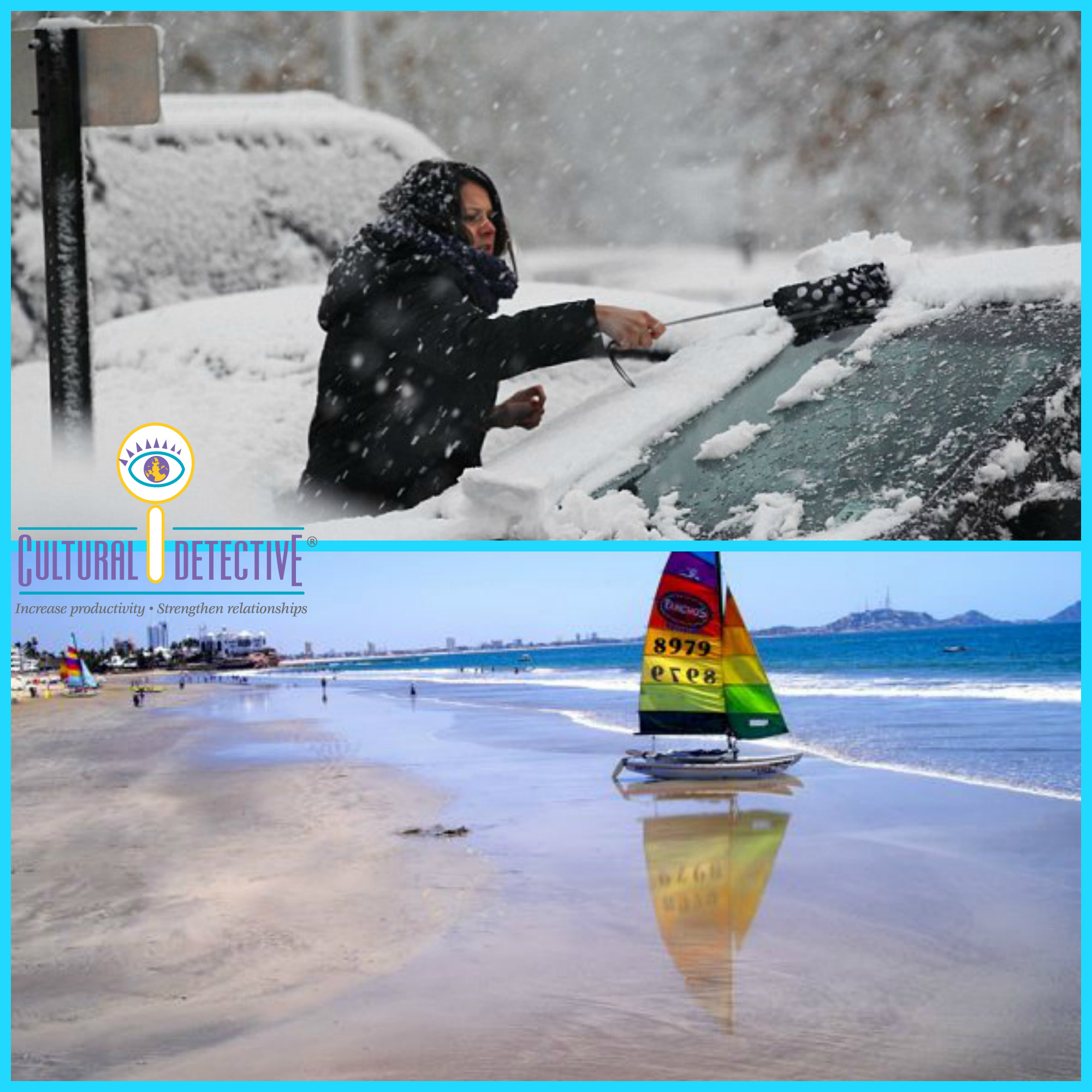
  • Are you tired of the cold, the ice, and the snow? Is it all getting to be too much, and you’d like a break? Are you longing for some warmth, sunshine, the beach, and vibrant Latin music?
  • Have you promised yourself that in 2014 you will spend more time on yourself, invest in your professional development, network with like-minded professionals, or expand your training/facilitation/coaching repertoire?
  • Do you realize that global and multicultural competence are requisites in today’s world, and you want to improve these vital skills and learn to help develop them in others?

You can accomplish all these things by joining us in Mazatlán Mexico in February, or in Atlanta Georgia in March for our Cultural Detective Facilitator Certification Workshop! Early bird registration rates are available, so now is a good time to secure your seat in one of these workshops.

The Cultural Detective Facilitator Certification Workshop receives high accolades from the most experienced interculturalists as well as from those with significant life experience but who are new to the intercultural field. Clients rave about the Cultural Detective Method and use it worldwide. Facilitators love having Cultural Detective in their toolkit. It helps them truly make a difference and secure repeat business from clients—ongoing coaching, training and consulting revenue—as clients commit to the continuing practice that developing true intercultural competence requires.

Many people do not realize that Cultural Detective is flexible enough to integrate nicely with existing training programs—adding depth and practical skills that learners can use immediately and build upon in the future. Participants easily remember the Cultural Detective Method, and can put it into practice when encountering a challenging situation—solving misunderstandings before they become problems!

“It is difficult to exaggerate how fundamentally important Cultural Detective has become for us. The difference between courses we conduct with and without CD is astounding.”
– Chief Academic Officer

“We have achieved, for the first time in my five years working on the Learning and Development team, a 100% satisfaction rating from our learners. Thank you, Cultural Detective!
– Chief Learning and Development Officer

“Our customer satisfaction rates have increased 30% thanks to Cultural Detective.”
– Customer Support Manager

Click here for details on dates, locations and pricing, and click here for a detailed agenda of the workshop. Sound tempting? Get out of the cold AND spend time developing your effectiveness and employability! We’d be delighted to have you join us! Of course, if you are living somewhere warm, we’d gladly welcome you, too!

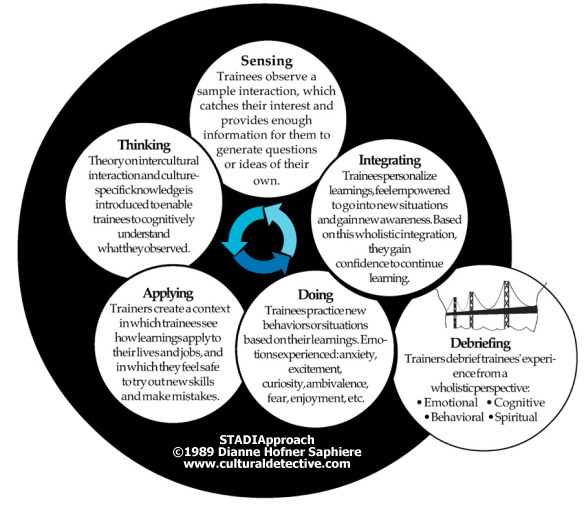
New Year’s Gift: Oldie but Goodie—The STADIApproach

Permission is granted to use this model freely and to circulate it, PROVIDED the © and url are maintained.

Permission is granted to use this model freely and to circulate it, PROVIDED the © and url are maintained.

It is said that experience is the best teacher. But learning does not lie in the experience itself; rather, it is our interpretation of the situation—the meaning we give to our experience—that provides our learning.

How might we better enable learners to constructively give meaning to their intercultural experiences? Are you looking for an easy and highly effective way to structure your next intercultural workshop or coaching session? Are you wondering how you might better enable study-abroad students to understand their experience in a way that builds cross-cultural competence? Do you have employees working internationally or multiculturally, and you’d like them to learn to truly harness the potential of diversity?

This “oldie but goodie,” the STADIApproach to Intercultural Learning, has been used in dozens of organizations worldwide with huge success. Click on the link to view a full article on the approach. I first published it for use with my proprietary clients in 1989; it is now even more useful as it can provide a design framework for blended learning approaches that leverage Cultural Detective Online. The CD Online system has STADI embedded into its core. In the hands of a skilled facilitator, teacher or coach, you can assist your learners to Sense, Think, Apply, Do and Integrate by analyzing the experience of others via the critical incidents in CD Online, as well as probing their own real life experiences.

We trust you’ll find the STADIApproach article helpful! Please accept it and use it as my new year’s gift to you, this January of 2014. It is my wish that the new year will enable all of you, dear readers, to better facilitate intercultural understanding, sustainability, respect and equity on this planet of ours.

Please share your experiences with us, and your designs that effectively leverage Cultural Detective Online to supplement your training, teaching or coaching endeavors.


Living Your Ideal Global Life Summit

SummitCollage-Website-FixedHave you been wanting to launch your ideal global life, but you are unsure where to get started, how to make it happen, or how to figure out what your ideal global life even looks like? 

Cultural Detective colleagues, Cate Brubaker and Sabrina Zieglar, have put together a slate of 20 experts who will present and chat with you free-of-charge during the week of January 13-17, 2014. The five-day summit will be conducted virtually. The full schedule along with daily themes is now live, and registration is open. I am a speaker, several esteemed colleagues are also part of the summit, and there are quite a few others that I don’t know but I am also very excited to learn from. Do not miss this opportunity!

As a supplement to the Summit itself, or if you have to miss some of the sessions, I’m excited to let you know of a value-packed resource of inspiring videos from the 20 experts, including life-changing tools like the Destination: Nomadtopia ebook, the Build Your Online Business ebook, a workbook on relaunching yourself after being abroad, and more. Click here for more information or to purchase the bundle.

BundleImage

Who you are, where you are, and what you’re doing can’t hold you back from living the rewarding global life you desire. Whether you’re a digital nomad, expat, work-at-home mom, or travel newbie, 2014 is the year to launch your ideal global life. And this is the only comprehensive resource available that covers everything for the newly global to the experienced digital nomad.

The bundle is only available for a limited time, so don’t miss out on this chance to launch your ideal global life with 20 experts and their communities supporting you. Through January 13th the bundle will be discounted at US$47; after that date it is forecast to sell for US$97.

I hope to see you at the Summit!