
Unknown's avatar

About Dianne Hofner Saphiere

There are loads of talented people in this gorgeous world of ours. We all have a unique contribution to make, and if we collaborate, I am confident we have all the pieces we need to solve any problem we face. I have been an intercultural organizational effectiveness consultant since 1979, working primarily with for-profit multinational corporations. I lived and worked in Japan in the late 70s through the 80s, and currently live in and work from México, where with a wonderful partner we've raised a bicultural, global-minded son. I have worked with organizations and people from over 100 nations in my career. What's your story?

Happy One-Year Anniversary of this Blog!

congratulations_sticker-p217320826197787657en8ct_325Happy Birthday! The Cultural Detective blog is one year old!

A year ago, on February 17, 2012, we made a commitment to blog regularly to promote cross-cultural understanding, link theory and practice, encourage best-practice use of tools, share resources and techniques, and raise awareness of the importance of building constructive cross-cultural bridges through communication. That commitment was intimidating — life and work are busy and the blog meant adding another major task.

Today, please join us in a bit of celebrating — this is our 128th post — not bad for a busy year and a new undertaking! Our quest isn’t for quantity, but rather to share a variety of quality educational materials.

Playing on the sound of the Cultural Detective, we started our blog with twin themes: 22 posts related to Cultural Effectives and 11 posts illustrating cross-cultural missteps or Cultural Defectives. We welcome your additions to these posts — we all learn from sharing  each other’s experiences!

Speaking of sharing, a terrific gift this year was the series of posts by Phuong-Mai Nguyen, as she made a journey to trace the path of Islam from its origins as it spread outward. And, while we began the blog in English, we are happy to also be able to publish some posts bilingually in Vietnamese and Spanish.

Over the last year, we reviewed 19 resources, including five books, five training and coaching tools, three movies, two sources for research data, and two assessment tools.

We shared eight exercises/activities, eight free gifts/downloads, six how-tos or tips on using the Cultural Detective Series correctly, and one half-day workshop design. We posted four different research studies and theory reviews, as well as seven pieces of feedback and guidance from customers.

We were pleased to see the blog’s popularity building over the course of the year. The blog’s busiest day was December 13th, when seven posts showed record readership:

  1. Respect for All Spiritual Traditions
  2. Developing Intercultural Competence — Online?
  3. Film Review by Sunita Nichani: English Vinglish
  4. Every Organization Needs Intercultural Competence
  5. Resource Review: GDI Benchmarks
  6. What Do You Mean? I Worked Abroad 20 Years and Scored Low?!
  7. Partnerships: 5 Tips for Turning Frustration Into Innovation

Of course you, our readers, are central to us. You are the ones doing the important work in our world, teaching, coaching, educating, consulting, training, managing, guiding, bridging, mediating. You are building intercultural competence, respect, understanding, equity and collaboration in your spheres of personal influence. So who are you?

You come from 152 countries — that’s only 40 fewer than the number of UN member-countries. There is not a lot of information about blog readers except for where your IP address is registered. You, our followers, truly come from all over the world — though we could use some readers in Greenland and a few other locations, as you can see on the map below.
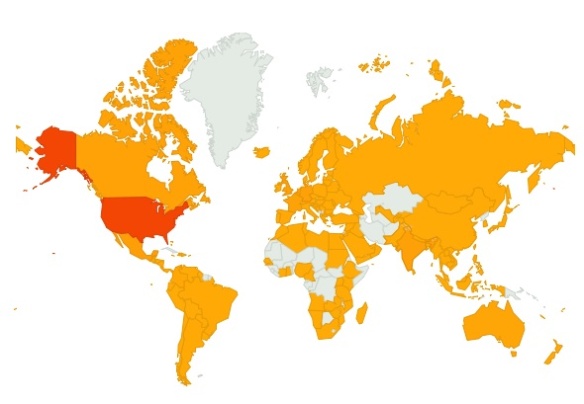
CD Blog Readers Year One

Cultural Detective Blog followers log on from these countries

The top 20 countries from which we draw followers are:

  1. USA
  2. Mexico
  3. India
  4. Germany
  5. UK
  6. Canada
  7. France
  8. Australia
  9. The Netherlands
  10. Colombia
  11. Spain
  12. New Zealand
  13. Argentina
  14. Japan
  15. Switzerland
  16. The Philippines
  17. Israel
  18. Malaysia
  19. Brazil
  20. Belgium

Given the diversity of our followers, and the variety and quantity of content, we wondered what you found most interesting in our first year? Surprisingly, three of our top five most-viewed posts were about food! Congratulations and many thanks go out to guest blogger Joe Lurie, who authored two of those. The top ten posts on this blog in 2012 were:

  1. Joe Lurie’s Bicycling in the Yoghurt: the French Food Fixation
  2. Kevin and Rita Booker’s Using Film in Intercultural Education
  3. An anthem for the use of intercultural communication entitled Every Organization Needs Intercultural Competence
  4. Want to Feel Ukiuki, Pichipichi and PinPin? Japanese Food Onomatopoeia
  5. Joe Lurie’s The Squid Has Been Fried: Language, Culture and the Chinese Food Fixation
  6. A book review of How Maps Change Things
  7. A post on cultural appropriation with the case in point: The Swastika
  8. Our post entitled, Infographics on World Cultures and Immigration Trends
  9. A post explaining how to cull learning from some of those images we find in social media, entitled Can You Read This?
  10. Belief Holding as an Intercultural Competence, a competence that has long been one of my favorites, referencing Milton Rokeach’s Open and Closed Mind

Our top five most commented-on posts included one that didn’t make any of the lists above: Diversity Training Doesn’t Work! Obviously a title for some debate and discussion!

Many, many thanks to our regular authors Kris Bibler, Phuong Mai Nguyen, Tereza Bottman, Maryori Vivas, and Kate Berardo. Many thanks as well to our guest authors and contributors, including: Joe Lurie, Anna Mindess, Sunita Nichani, Piper McNulty, Barbara Schaetti, Pari Namazie, Thorunn Bjarnadottir and Avrora Moussorlieva, Kevin and Rita Booker, Carmen DeNeve, Ruth Mastron, Tatyana Fertelmeyster, George Simons, and Madhukar Shukla. We could not have built this terrific blog community without all of you who have commented, shared your resources, reposted our posts, and reviewed our posts before they were published. Many thanks!

If you have a passion for writing about cross-cultural issues and are interested in joining us here as a guest blogger, please contact me. We would love to be able to provide space for talented people to share their voices! We would also welcome your ideas for stories or resources to review, as well as your feedback.

Thank you for accompanying us during this first year of blogging! We trust that you have benefitted from what we have shared, and the thoughts and comments of readers around the world. We look forward to a peaceful and caring 2013!
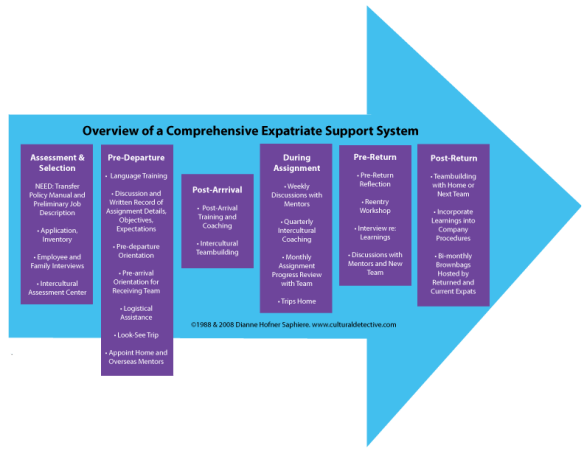
Oldie but Goodie: Comprehensive Expatriate Support System

Expat-Flow

Moving overseas is an exciting yet stressful time for all involved: the person transitioning to a new position, the expat’s family who is relocating, and the organization—both the office dealing with the loss of a valued employee, and the receiving organization. We all know there are a myriad of details involved in preparing someone to work abroad, but where to start and what to include?

Years ago, when Cultural Detective Online was not yet a glimmer in anyone’s dreams, I put together the above guide for a client. You are most welcome to use it if it can be of assistance (click through to view a larger version), though I ask that you retain the copyright and url of the original.

I was proud to work with that client. They valued their international assignees, desiring that the employee and the relocating family become stronger from international assignment, and that both the receiving organization and the organization as a whole learn and grow. They thus asked me to “map” a process to help make that happen.

Today, Cultural Detective Online is an excellent tool to use with expatriates, relocating families, and receiving teams and organizations, at each stage of the relocation process. It offers a process as well as information at your fingertips — anytime, anywhere — to help build bridges across cultures, to help each of us better understand those we work with, and to get to know ourselves better.

“The Cultural Detective Online product is a sound investment for my work as an intercultural and relocation coach. I suggest to my clients to get a subscription for themselves.”
—Maartje Goodeve, Nascence Coaching, BC, Canada

How might you update the process in the graphic above? How could you use Cultural Detective Online in combination with other tools, approaches and your own facilitation to enhance expatriate performance?

Happy Lunar New Year of the Snake!!!

44344_10151448073786252_1540966259_nMay all our readers and community members find joy, health and success in intercultural collaboration in this new year!

We have prepared an interesting cross-cultural card for you, in celebration of Chinese New Year. Please click on this link to view it. Then, let us know which cultures you see blended there.

新年快乐  •  恭喜发财  •  新年如意!
Xin Nian Kuai Le • Gong Hei Fard Choy • Xing Ni Ju Yi!

Cultural Detective African-American Now Available!

coverAfAmThe Cultural Detective team is very pleased to announce the release of one of our most requested and highly anticipated packages — Cultural Detective African American! It is now available both in Cultural Detective Online and via site license.

Cultural Detective® African American explores the complexities of the culture and examines the values and communication styles of this community in an effort to bridge cultural gaps and support more inclusive groups, communities, and workplaces. It joins other domestic diversity packages in the series, including Cultural Detective Generational Harmony, Cultural Detective Women and Men, Cultural Detective LGBT, and the soon-to-be-released, Cultural Detective Latino/Hispanic.

Below, a message from package co-author Kelli McLoud Schingen:

ALI 1I facilitated an Advanced Leadership Institute for the Southwestern Black Student Leadership Conference January 17-20th, and thought that this would be the perfect place to pilot the Cultural Detective African American package that I co-authored with Patricia M. Coleman. There were 25 male and female upper-level students from universities all over the U.S., prepared for an intensive three-day workshop with me on leadership skills and cultural self-awareness. I spent the first day building trust and laying the foundation for the weekend. I facilitated activities that took the students on an exploration of their leadership styles, emotional intelligence, personality types and finally, cultural self-awareness.

ALI 2On the last day I Introduced the Cultural Detective, the purpose and intent of it, and the extensive research and in-depth process that Patricia and I went through to develop the tool. Understandably, the students met the tool with a great deal of suspicion. To say they were skeptical would be a gross understatement. I implored the students to stay with me and trust the process. The students started by working on the critical incidents in the package. I then asked the small groups to present on their findings. They were surprised that there was so much to consider and really convinced that the only valid perspective was the perspective and values of the African American “character” in the incident. I spent a great deal of time sharing how we view things through our own cultural lens, and then I unveiled the African American Values Lens. It didn’t take long for the students to be sold on the process and the values as I walked them through the positive and negative interpretations of each value. They seemed to be having fun and were fully engaged. Many of them commented just how grateful they were to FINALLY have words to describe their feelings, experiences, and cultural norms that they’ve inherited. They laughed at themselves and each other as they peeled back the onion of culture, and were grateful for the opportunity to explore cultural difference in this way. When I asked if they felt that the tool was an authentic representation of African American values they said, “Absolutely Ms. Kelli!”  Then I thought, “I guess we’re ready for launch.”

SIETAR Florida will honor Black History Month 2013 with a dialogue entitled, “Am I Black or African American?” via teleconference.  Featuring co-authors of Cultural Detective African American, Kelli McLoud-Schingen, Immediate Past President of SIETAR USA, and Patricia Coleman, President of SIETAR Florida. Please join us on Wednesday February 13, 2013 at 13h Miami time (1pm EST/12 CST/11MST/10PST).
Please RSVP by February 11th.

Access the event via conference line:

Dial-in Number: (559) 726-1000
Participant Access Code: 857895


Two Values Lens Stories

©Cultural Detective, from Cultural Detective Self Discovery

©Cultural Detective, from Cultural Detective Self Discovery

The beauty of Cultural Detective Values Lenses?

A colleague was just telling me this morning that he had a class of students from France and Italy, and one Thai woman. The students had worked with Cultural Detective Self Discovery; they had reflected on their personal values and history, and created personal Values Lenses.

Next my colleague had walked through the French Values Lens with the class, and asked them to compare their personal Lenses with the national Lens, the country in which all of the students were residing and studying. The French students perceived a lot of resonance with their national culture, and the foreign students identified their experience in France as well.

Next my friend walked through the Italian Values Lens, and got the same reaction.

Finally, when he went to the Thai Values Lens, he realized he knew next to nothing about Thais, and that he couldn’t even pronounce the words on the Lens. Thus, he elected to ask the Thai student, blindsiding her or putting her on the spot if you will — he asked her to come up and introduce the class to the Thai Values Lens, which she had only just seen in that moment!

This Thai participant led the other students, and the professor, on a journey into Thai culture that took their breath away! She shared examples of Thai behavior and their meaning that built the other students’, and the teacher’s, respect for who she is and where she comes from.

Such can be the power of a Values Lens. It is not a stereotype. It captures the central tendency, the norm, of a group of people, in terms people can identify with. Thus, it is usually quite easy for a representative of the culture to introduce the values in a Values Lens, using stories from everyday life in that culture.

Second example, much shorter:

So many people nowadays tell us they are global nomads, TCKs, Blended Culture people. And they are. And, this does not mean that they don’t have a culture; it means they have more cultural strands woven into their identity than perhaps the average person!

The second story involves one young woman, who insisted she was nothing like her national culture. She was an individual, a global citizen: culture-less, in a way. In looking at her national culture Values Lens, she exclaimed out loud during class, “Oh my God! I AM Slovak!”

The goal of Cultural Detective Values Lenses as tools is to facilitate dialogue and understanding, both understanding of self and others, and thus enable collaboration that brings out the best of each of us. Please help us make that happen, by sharing your tips, techniques, and designs, and by encouraging best practice.

Success? It’s All in How We Gauge It…

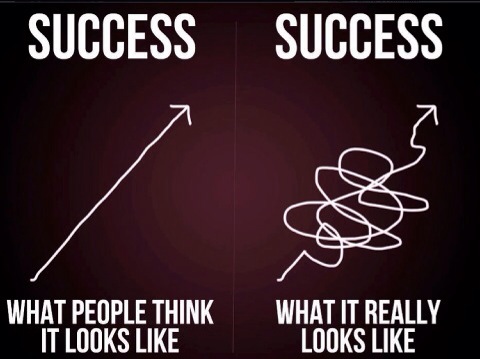
711079_3691916951303_1580871364_nThis is a story, or perhaps, more correctly, a cautionary tale, about a very successful expatriate and the highly respected, much-envied western company for which he worked. It is a story that made me think again about how we define success in our lives, and, in particular, how we define success in the global marketplace and success on an expatriate assignment.

The Company: The company is one of the very first to enter the Japanese market after World War II. It holds key patents on several important technologies, and invests decades establishing partnerships with Japan’s leading firms. It prides itself on hiring and promoting Japan’s best and brightest.

By the 1990s, it is the envy of other foreign-capitalized companies in Japan: it has a dominant market presence in its niche industries; long-established, trustworthy partnerships with major local players; and a stellar reputation for consistency, reliability and innovation. The president of the company is Japanese, and its management team is a strong and diverse mix of local and international executives who respect one another and leverage their expertise.

The Japan operation is a huge profit center, as well as the home of research and development breakthroughs leveraged by the company globally. They have strong cross-cultural programs in place for their staff worldwide, as well as for transferees and their receiving organizations.

The Expat: Our expat is intelligent, ambitious, and very capable. He has worked for the company for over 30 years, and is known as an excellent turn-around manager who had saved several manufacturing plants and regional operations, turning their losses into profits. Originally educated as an engineer, he is logical and methodical, and very good with numbers, graphs, and trends. Our expat is married with grown children and grandchildren, speaks a bit of French in addition to his native English, is well-travelled, but has never before lived overseas. This will be his last assignment prior to retirement.

The Situation: The global company, and most particularly home office, is experiencing economic hardship. A few expensive ventures have failed, and it is time to tighten belts, cut back, and save money across the board. Though the Japan operation is one of the most profitable worldwide, it is part of the overall organization and must join in company-wide budget cuts.

The expat is sent to Japan as the new CEO, and is told to cut millions from the annual budget. It is the first time in over a decade that the CEO of the Japan operation is a foreigner. The expat and his wife relocate to Tokyo, and quickly integrate into the local expat social scene. They love their new life in this amazing metropolis.

The Backlash: Local and existing expatriate management “cry foul.” They say it is a short-sighted decision to slash budgets in Japan when the operation is functioning smoothly and keeping others afloat. They say they are being punished for errors they did not cause, in which they were not involved. They warn that budget cuts will have long-lasting negative effects in the Japanese marketplace.

The new CEO explains that change always has its naysayers; people need to “get onboard or get off the ship.” “Tough times call for tough decisions.” “It’s a new day, a new world, a new economy.”

The cross-cultural consultant and existing management explain that the culture is different here, that the new CEO doesn’t yet understand Japan. Drastic changes have long-lasting effects that can’t be undone, can’t be apologized for. They urge him to send this message strongly to the home office, to push the decision back up. They say it’s his duty to make the home office aware of the repercussions of their top-down decision. They tell him that following instructions will mean the death of the Japan operation.

But the CEO has been down this road before. No one likes belt-tightening. No one likes budget cuts. He knows how to turn an operation around. He’s done it before. He doesn’t need people to “like” him. He knows they will respect him once they see the results he achieves. This is an once-in-a-lifetime opportunity, an incredible capstone to his career.

The Outcome: The expat succeeds, in stellar fashion. He fires people. He closes divisions of the company. He retires long-standing partnerships with important local players. He does exactly what he has been charged to do. And he furthers his career: after his two-year assignment he receives a huge bonus. He departs Japan to begin his retirement, riding the accolades of his success.

Home office is proud of their decision to send him; only an expat could have made these kinds of difficult decisions, taken these drastic measures. A local executive wouldn’t have been able to cut such long-standing local partnerships, couldn’t have bit the bullet to fire staff who had worked their whole careers building the company. It was a perfect decision. Money saved. Bottom line improved.

The Longer Term Outcome: Fast forward to four years after the expat’s departure. The highly successful, highly profitable business in Japan, with the enviable stellar reputation, closes down. Plants close. R&D facilities close. Offices throughout the country close.

Leading companies in the industry are no longer interested in partnering; once burned twice shy. After decades of trust building, smart business and shared success, how can they rely on a company that unilaterally decides to throw it all away to improve bottom-line at some far away home office? Why should they do business with a company that so clearly prioritizes home office needs over international success?

The company’s best and brightest have been hired by the competition. They are sour about their previous employer’s lack of loyalty and its short-sightedness. The company is no longer able to attract talented new hires. Who wants to work for a company that focuses on home office success, punishing those who succeed worldwide?

And today? The Japan operation, such an envied and respected company for over sixty years, is no longer. It was “over-milked,” bled dry. Not financially, but culturally, emotionally, trust-depleted.

So, how would you gauge success in this situation? Knowing what you know now, was the CEO successful? At the time everyone thought so. He achieved the immediate goal. What do you think would have happened had he done things differently? Is there a way the expat could have been successful in his goal and maintained trust? Does this mean that every leader needs special tools when completing an overseas assignment? What can we learn from this?

Please ponder those questions while you read the key takeaways from my point of view.

The Lessons:

  1. As expats, we must learn to distinguish between what we know and what we have to learn. We must ask for help. We must be willing to listen. We need to pause and make sure we understand the cultural context in which we are working.
  2. We must ensure that while we use our strengths, we also use “fresh eyes” to see what’s new and different this time. Not every problem can be approached in the same way it was successfully resolved the last time around, in a different country, with different people.
  3. We must be able to discern when to jump at an opportunity, and when to push a decision back up the chain of command. No person is an island. Even a CEO is part of the interconnected web of relationships, responsibilities, and decisions that make up an organization.
  4. As home office executives, we must be able to weigh our priorities, consciously and purposefully. We must think long-term, even when the short-term is jumping up and down in front of us. It is our job to anticipate the multiple impacts of a decision, and shape the process to benefit the organization.
  5. We must be able to hear the truth, from all perspectives, and separate the facts from the complaining. We need to set aside what we want to hear, what we are used to hearing, and be open not only to what is said, but the context and manner in which it is expressed. A cultural informant may help in “translating” the meaning of the message.
  6. As local management, we must learn to discern when we are accurately predicting the future and when we are just resisting change. These are usually questions to explore through dialogue and open-minded discovery. This can be a challenging process, depending on the cultural norms of local management.
  7. As a global team, we must have the tools to enable us to share, hear, and weigh information in order to make the best decisions, for both the short- and long-term. And it is important to remember that the choice and presentation of information is, to some extent culturally influenced. Without a process to truly understand shared information, team members essentially operate in the dark.
  8. A multinational company, it is wise to employ tools like Cultural Detective to help prepare and guide executives on international assignments. Culturally Effective companies recognize the need, and have found Cultural Detective and a trained facilitator can help prevent stories like this from becoming commonplace Cultural Defectives.

Linked to the My Global Life Link-Up at SmallPlanetStudio.com

Happy 75th Birthday to George Simons!

CDTurkeyCoverWe were very pleased a couple of weeks ago to celebrate the 75th birthday of one of our beloved team members, George Simons, the prolific co-author of seven packages in our CD series, lifelong diversity and cross-cultural professional, and devoted mentor to so many.

It struck me that you might enjoy seeing a couple of the ways in which he was celebrated. The first was in an entry in “Seven Billion Actions: a global movement for all humanity.” This is the site designed to showcase individuals who are actively working to make the UN Millennium Development Goals a reality. Cultural Detective is also honored to have a place on that site.

Another tribute to George that you might find interesting appeared in the Istanbul Post; a pdf version of that issue is available, with George’s profile on page 31. An English translation of the article is below:

Reflections on Culture and Human Communication

Istanbul Post, Nr. 47, January/February 2013, istanbulpost.net.

On 12 January 2013 George Simons celebrated his 75th birthday.  His life still bounces back and forth between the U.S.A. and France, and involves frequent trips elsewhere as a consultant and trainer. He also keeps himself busy developing networks.

Among those working to improve intercultural communication, George Simons is already a legend. He has participated in dozens of projects, written and contributed to many books and publications. One of these projects has been the Cultural Detective Turkey, a result of his collaboration with Dr. Perihan Ügeöz.

Asking questions

George Simons has been involved with culture and intercultural communication for decades. As a consultant to international companies and organizations, he has garnered experience by working in more than 40 countries. One reservoir into which his experience has been pooled is the Society for intercultural Education Training and Research (SIETAR). Another is the aforementioned Cultural Detective series of training materials where questions about many different countries appear.

Somewhat like the famous TV series detective Colombo, with his eye for detail and, at first glance, seemingly simple questions, he has he steadily contributed to the sensitive treatment of people from different cultures.

“Excuse me, sir, sir, just one more question…” Colombo, the detective, with his unique brand of disarming charm, always manages, thanks to his keen eye for what’s going on and his meticulous style, to stumble on a solution to the case. Colombo’s proven method, before passing judgment is always to ask lots of questions, playing along with the game to set the stage…. The Cultural Detective method gives participants a hands-on experience of how to become “cultural detectives.”

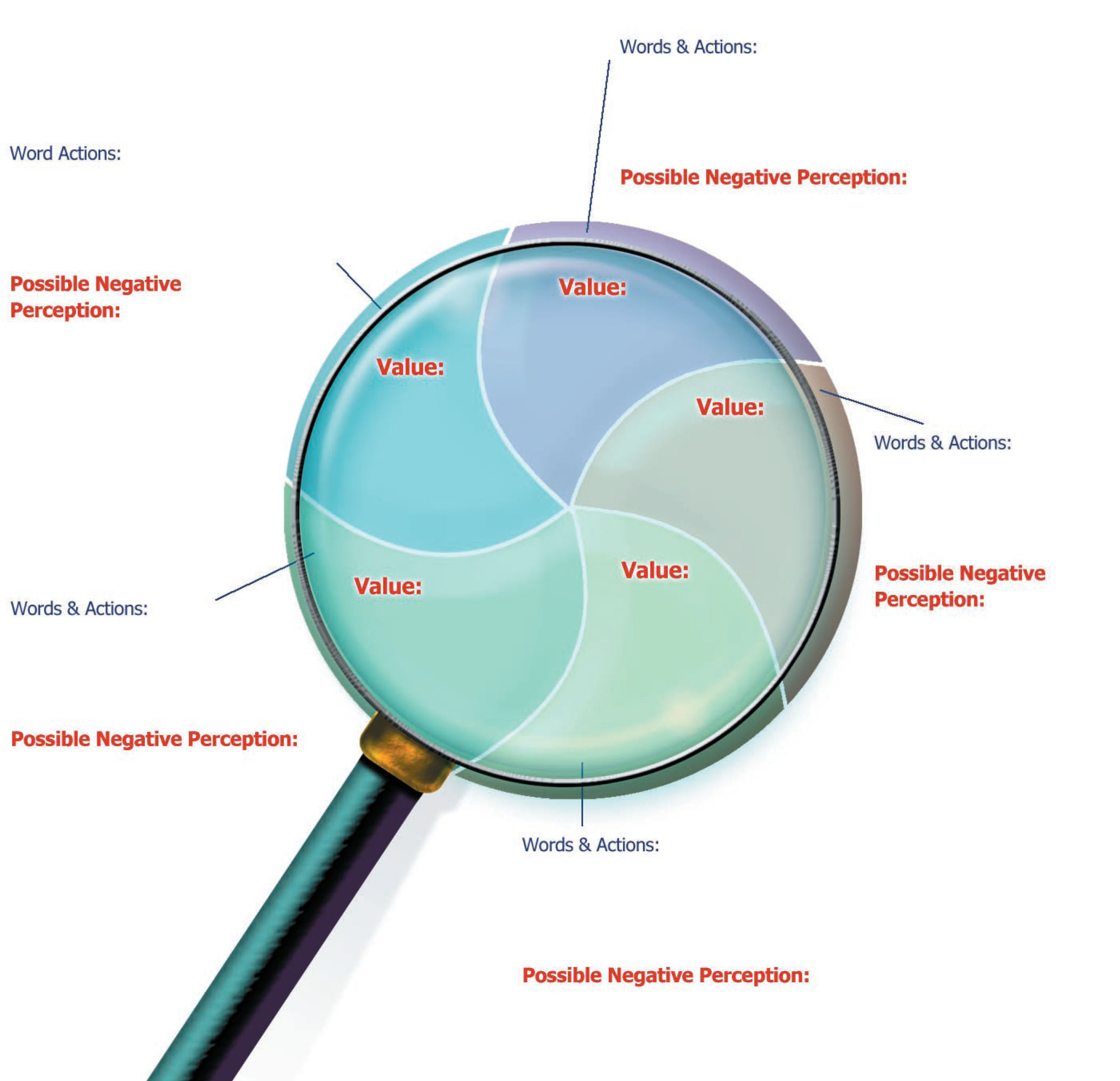
Cultural Detective works with case studies. These cases are not about murder and manslaughter. They are the true stories of people from the business world, who coming from different cultures, must bring off the difficult task of working together. Cultural Detective’s method puts a magnifying glass in your hand, with which you can discover the key cultural values of another society. The detective is called upon to empathize with the story and, loupe in hand, track down the core values that shape the behaviors and motives of the actors in the case histories. Not infrequently it is this lens that leads one to cry out, “Aha, now I understand! ”

Reflecting on oneself

One of the basic principles here is that understanding others begins, first of all with better understanding one’s own self. This is evident not only in the contributions of George Simons to the intercultural profession and in his trainings sessions, but is apparent in his opinion pieces and essays, mainly published in English in US American journals. Here, sometimes ironically and sometimes in the tradition of Lieutenant Colombo, he calls into question developments in U.S. society and invites readers to see things with a fresh perspective.

In our CD iReality years ago we used an animated metaphor of a tree as culture. Nice to see it again, Marcelo.

Shirley Saenz's avatarIceberg Inteligencia Cultural

El concepto de cultura suele ser tan familiar y tan ambiguo al mismo tiempo, que para muchos suele ser muy difícil brindar una definición concreta. La palabra cultura deriva del latín “cultura”, que significa cultivo, pero que tiene muchos significados interrelacionados. Sin embargo, cuando les preguntamos a las personas “¿Qué es cultura?”, la mayoría de las respuestas suelen caer dentro de 2 grandes grupos de definiciones:

  1. Excelencia en el gusto por las bellas artes y las humanidades, también conocida como “alta cultura”.
  2. Conjunto de valores, creencias y conductas aprendidos y compartidos por un grupo de personas interactuantes. (definición propuesta por Milton Bennett)

En el campo de la interculturalidad, esta distinción es crucial para lograr sensibilidad hacia las diferencias culturales, porque la definición número 1 permite determinar fácilmente quienes tienen un mejor nivel de cultura que otras, mientras que la definición 2, no. Lo que nos plantea la definición 2…

View original post 463 more words

Link

from Forbes:Jessica

Screen shot from Forbes.com,
©Jessica Hagy: 40 Things to Say Before You Die

I was not familiar with Jessica Hagy before I read this post — 40 Things to Say Before You Die. Read it; you’ll enjoy it. I believe it will remind you of many of the important things in life.

Why am I posting it on the Cultural Detective blog?

  1. Though not intentionally cross-cultural, I believe you’ll agree that the skills, attitudes, mindsets and practices Jessica illustrates in her post all very much apply to cross-cultural interaction. They are core concepts that help us strengthen our intercultural competence.
  2. It is a rarity in life when someone is able to communicate the complex simply, clearly, and powerfully, without “dumbing it down,” while retaining its core essence. It is oh-so-much easier to write long tomes; capturing the main points without sacrificing the larger context, that’s something else entirely. I believe Jessica does this with her drawings. And you tell me, repeatedly, how the Cultural Detective process does that in your organizations.

Evidently Jessica is very well known, and I’m just late to the party. Such a joy to be late in arriving yet to arrive on time!

Please let me know if you enjoy these sorts of re-posts, and how you feel this applies to intercultural competence. Thanks!

Our Culture on the Firing Line

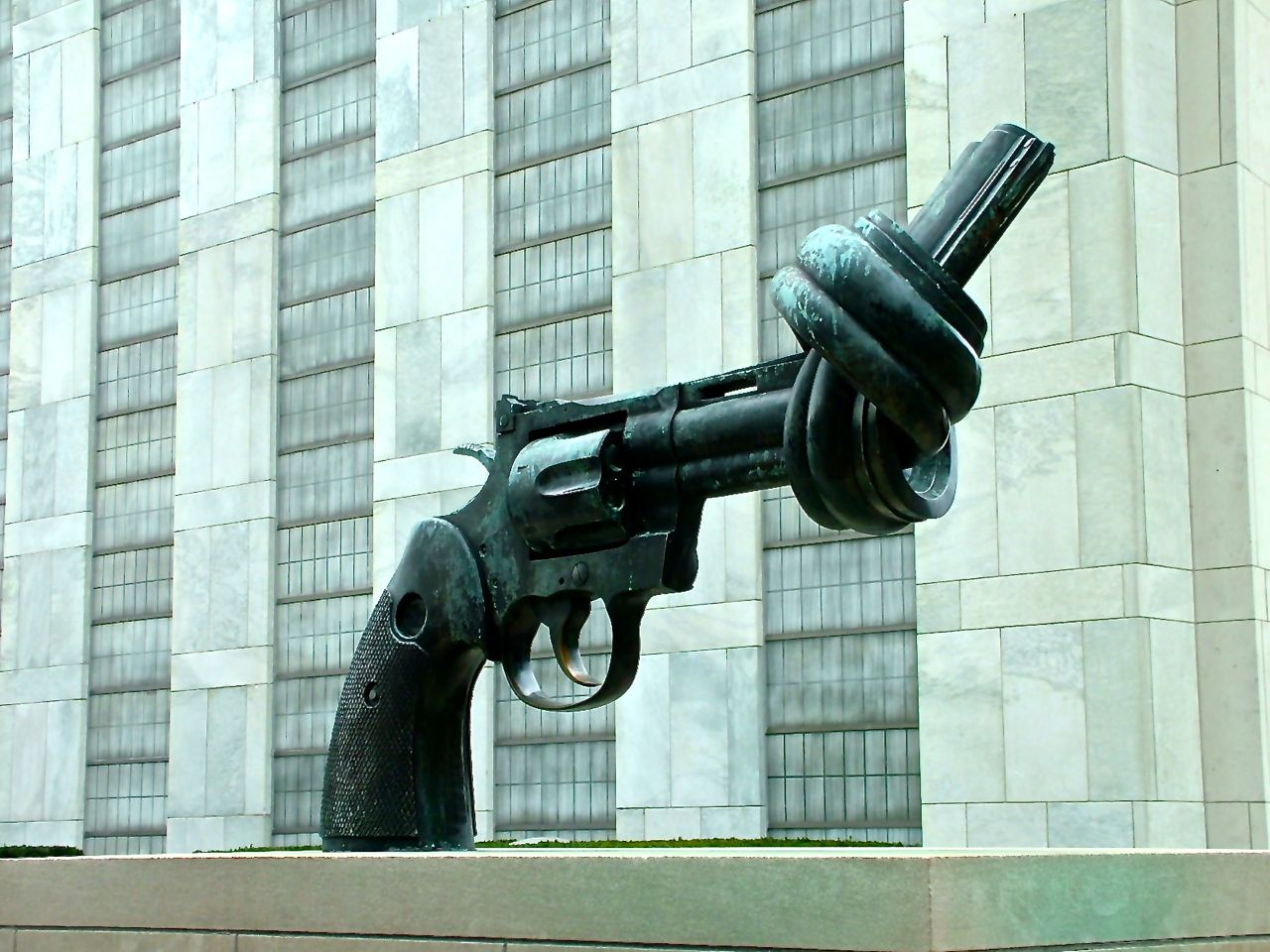
UN gun sculptureWe are very pleased to be able to share with you another guest post by the insightful and talented Joe Lurie, Executive Director Emeritus, University of California Berkeley’s International House. Sadly, the topic is again, or still, timely. We published his first post on this subject, “Language Under the Gun,” in February of 2011. Let us work to change the culture of anger and violence by this time next year!

As introduction to the piece, allow me to share with you Joe’s message, urging me to publish his post sooner rather than later: “If it can be published earlier, given the ‘heat people  are packing’ now in the current ‘ballistic’ and ‘explosive’ reactions to Obama’s proposals, that would be more likely to ‘hit the bull’s-eye’ in the current environment.”

With only 5% of the world’s population, US Americans now possess about 50% of the world’s guns. Is it any wonder then that mass shootings in the US have skyrocketed in the last decade? And in the wake of the grotesque massacre in Sandy Hook, gun sales have spiked dramatically. No wonder that sales of kids’ bullet-proof backpacks have soared, or that our culture more than ever is drenched in the language of guns!

As I watch left and right wing politicians and pundits “up in arms” on TV, battling in a “cross-fire” of blame, each side looking for a “smoking gun” to explain or cast blame for horrifying gun-related catastrophes, I’ve become increasingly aware of how our culture’s preoccupations with guns are reflected even during innocent “shooting the breeze” conversations.

We often value the “straight shooter,” yet we are wary of those who “shoot their mouths off,” and those who “shoot from the hip” or glibly end an argument with a “parting shot.” We caution colleagues to avoid “shooting themselves in the foot,” and counsel them not to “shoot the messenger.”

Without suspecting what drives our language, we are “blown away” by adorable photos of loved ones. At the movies, many audiences are thrilled by “shoot- em-up,”  “double barreled action” scenes, or are excited by car chases where actors “gun” their engines.

I often ask friends to “shoot me” an email and I’ve encouraged job seekers to give an interview their “best shot” and “stick to their guns” during salary discussions. And if a job is offered, I might congratulate them for doing a “bang up” job.

In sensitive business negotiations, I’ve advised patience, urging clients to “trouble shoot” solutions, but to avoid “jumping the gun” and to be aware of “loaded” questions. To get the biggest “bang for the buck,” I’ve recommended bringing the “big guns” to the table. We look for “silver bullet” solutions, hoping for “bulletproof” results. And when success is in sight, we say: “You’re on target,” or “you’re going great guns!”

We encourage entrepreneurial risk taking, even if the project doesn’t have a “shot in hell.” Just “fire away” when you make that “killer” presentation, and if your idea is “shot down,” don’t be “gun shy.” Just “bite the bullet” and go at it again, with “guns blazing.” Don’t be afraid to “shoot for the moon,” even if it looks like a “shot in the dark.”

Having worked as a university executive with students from more than 80 countries, I’ve noticed that students from abroad are struck by the violent language in our songs and films, and they hear it bleeding into our political discourse. Many have asked me in amazement why it is even necessary to state that guns and ammunition are banned from university residence halls. Yet, “son of a gun,” 26 colleges in three states permit guns on college campuses. And gun liberalization legislation for colleges is in the “cross hairs” in at least nine more states.

I’ve heard staff and students alike stressed by an approaching deadline, instinctively describing themselves as being “under the gun.” Sometimes my colleagues have described emotional co-workers as “loose cannons” or having “hair trigger” personalities. And when a student has gone off “half cocked,” psychologists have advised employees to “keep their powders dry” and to review “bullet point” guidelines for handling volatile personalities.

In the same way that the US is flooded with millions of guns (there are 90 guns per one hundred Americans), so our newscasts — “sure as shootin’ ” — are exploding almost nightly with murder stories, reflecting the newsroom mantra: “If it bleeds, it leads.”

When the local story becomes a national tragedy, there is “new ammunition” for both gun control supporters and opponents of fire arm bans in such places as elementary schools, day care centers, churches, or even the neighborhood bar!

The world of guns has had our rhetoric in its sights for a very long time. And our wounded language — now more than ever with a gun to its head — is telling us that our culture is on the firing line.

Joe Lurie, Executive Director Emeritus at the University of California’s International House, is currently a cross-cultural communications consultant, university instructor and Cultural Detective certified facilitator. Contact Joe via email or LinkedIn.

This post builds on Joe’s February 2011 piece, “Language Under the Gun.”