Entre Dios y Alá

(English follows Spanish)

Si pudiera resumir las noticias de las últimas dos semanas, podría sin duda mencionar dos nombres: Benedicto XVI y Hugo Chávez.

El primero desafió toda una organización, un sistema, una tradición. Hoy que escribo esta nota los noticieros hablan del humo blanco saliendo de la Capilla Sixtina que anuncie que hay un nuevo Papa. No me alcanzo a imaginar todos los cambios organizacionales a los que se enfrenta la Iglesia Católica para adaptarse a este nuevo cambio de innegable impacto mundial.

Por otro lado, tenemos la muerte del presidente de Venezuela Hugo Chávez. Los análisis políticos por supuesto han sido los protagonistas de su partida. Pero no podemos dejar de lado ese aspecto que nos une en este espacio de comunicación.

En medio de la sobre-exposición de la noticia en los medios, incluyendo detalles de su vida, su gobierno, sus frases célebres, visitas a países socialistas etc, está una noticia que este lado del mundo apenas menciona.

La foto del presidente de Irán, Mahmud Ahmadineyad, expresando sus condolencias a la madre del presidente Chávez ha causado no menos que indignación en su país y los países que siguen los preceptos islámicos.

Lo que para nosotros puede parecer normal, entendible y simplemente humano al brindar consuelo en un abrazo a alguien que vive el dolor profundo del duelo, en otra latitud no es más que el irrespeto a lo que ordena su ley, la cual indica que no debe haber contacto físico entre un hombre y una mujer si no es de su círculo cercano.

No siempre podemos entonces actuar como actúan otros, es decir a la tierra que vamos hacer lo que vemos. No siempre podemos adaptarnos a otro entorno, a pesar que podamos sentir la inclinación natural a ello.

Las culturas abiertas podríamos describirlas como permeables a otras culturas, donde son fácilmente identificables y permitidos otros valores, costumbres, tradiciones siempre y cuando prevalezca el interés común sobre el particular. Por el contrario, las culturas cerradas son herméticas y poco o nada tolerantes a las demás. El caso que enfrenta al presidente Ahmadineyad es una muestra clara, y atizado además, por comparar al presidente Chávez con Jesucristo.

Se unen de nuevo alrededor de Dios, de nuestras creencias religiosas los dos hechos noticiosos que mantienen en vilo al mundo entero.

Católicos y no católicos pendientes del Vaticano. Entre tanto el mundo Islámico levantando su voz de protesta por un hecho a todas luces, para ellos totalmente inadmisible hasta para un jefe de Estado.

Entre Dios y Alá, entre Dios y Dios. Hasta la próxima.

Between God and Allah, translation by Dianne Hofner Saphiere

If I were to summarize the news of the last two weeks, I could without doubt mention two names: Benedict XVI and Hugo Chávez.

The first challenged an entire organization, a system, a tradition. Today as I write this note there is news in the white smoke coming out of the Sistine Chapel announcing that there is a new Pope.  I can’t begin to imagine all the organizational changes that confront the Catholic Church as it adapts to this new change of undeniable worldwide impact.

On the other hand, we have the death of Hugo Chávez, the President of Venezuela. The political analyses have of course been the protagonists of his departure. But we can not ignore that aspect which unites us in this communication space. Amid the over-exposure of the news media, including the details of his life, his government, his famous phrases, and his visits to socialist countries, etc., lies a story that this side of the world barely mentioned.

This photo of Iranian President Mahmoud Ahmadinejad, expressing his condolences to the mother of President Chávez, has caused no minor indignation in his country and in the countries of the world that follow Islamic principles. What to us may seem normal, understandable, and simply the human act of providing comfort with a hug to someone living the deep pain of grief, in another latitude is nothing more than disrespect to the order of law, which indicates there should be no physical contact between a man and a woman not within the same inner circle.

We cannot always behave as others do, that is to say, doing what we see in the land to which we travel. We cannot always adapt ourselves to another environment, although we might feel the natural inclination to do so.

Open cultures could be described as permeable to other cultures, those in which other values, customs, and traditions are easily identifiable and permitted as long as the common interest in the matter is maintained. By contrast, closed cultures are hermetic, and not so tolerant of others. The case facing President Ahmadinejad is a clear case in point, further stoked by comparisons of Hugo Chávez with Jesus Christ.

Our religious beliefs join again around God, in the two big news items that have captivated the world. Catholics and non-Catholics watching the Vatican. The Muslim world raising its voice in protest to an act committed openly, which for them is completely inadmissible for a Head of State.

Between God and Allah, between God and God. See you soon!
“Signs” of Cross-cultural Difference: Lydia Callis

Cultural Detective Deaf CultureIt seems I missed a huge fifteen minutes of fame during Superstorm Sandy. Such frequently happens to me, living in the “provincias” of Mexico as I do.

The events I mention involve NYC Mayor Bloomberg’s sign language interpreter, Lydia Callis. Reactions by the Hearing community to Lydia’s powerful interpreting skills were discussed on prime-time news and talk shows domestically and internationally. Parodies of Lydia signing appeared on a seemingly endless array of radio and television shows and internet sites.

Mayor Bloomberg deserves major kudos for including sign language interpreting in all major press conferences during the state of emergency. Not only did it convey important information to a large number of people, it raised awareness of the Deaf community and created opportunities for Hearing people to learn about American Sign Language (ASL), professional ASL interpreters and Deaf Culture. There is little question that Lydia is a skilled professional who loves her job. Want to see her in action? A video is below. (My apologies to those of you reading this from places where you are unable to access YouTube. And, the video does not include closed captioning.)

We all know that it usually takes controversy to create those fifteen minutes of fame. So where was the controversy? It centered around some in the Hearing community’s perception of the “animated” nature of Lydia’s “whole body” interpreting.

Just read some of the viewers’ comments posted to the video above: Lydia’s signing is “dumb,” “weird,” and one person types that Lydia looks like a “mime.” These are comments that come from a lack of understanding, from ignorance; they provide—or rather, demand—an opportunity for education.

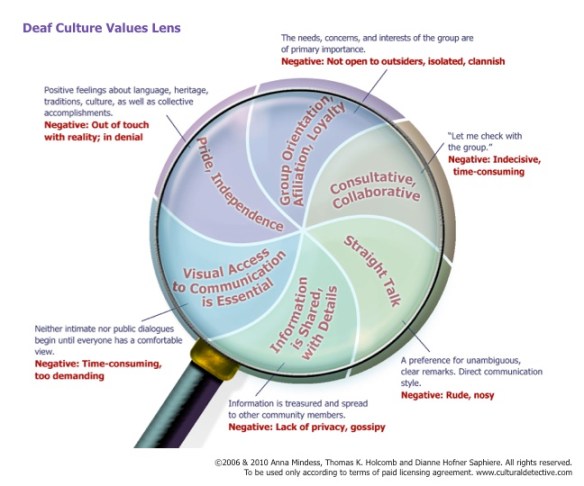
This is exactly the classic Cultural Detective “critical incident”: one person behaving correctly according to the values of her (Deaf) culture, while “outsiders” (Hearing culture) negatively judge that same behavior. One of the strengths of the Cultural Detective series is that each of our Values Lenses includes the Negative Perceptions that may frequently accompany the positive application of values, as does our CD Deaf Culture Lens.

If we take a look at the Deaf Culture Values Lens image above, it’s easy to understand why members of the Deaf community could take serious offense at such evaluative comments. The Mayor understood it was important to get information to everyone. For some in the Deaf community ASL is their first language, not English. This was a way to ensure accurate information was communicated to the Deaf and Hearing communities simultaneously. Signing and universal access were finally getting the attention and respect they deserved.

Then came the spoofs. The icon of US late-night comedy, Saturday Night Live, aired a parody that involved an actual ASL interpreter playing Lydia’s role and using funny signs for “President Obama” (his big ears), “pizzazz” (jazz hands), and quite a few other terms. The SNL skit included a comedic contrast of New York City vs. New Jersey communication styles, as reflected by the two mayors and their interpreters, a spoof of Bloomberg’s poor Spanish, and a send-up of “white” US culture. Want to take a look?

Like any comedy, spoofs can offend, and this one is potentially offensive to interpreters, Deaf people, New Yorkers, people from New Jersey, Latinos and “las personas blancas.” No doubt I’m missing someone here! While I personally find this skit pretty funny, Oscar-winning actress Marlee Matlin, who is deaf, publicly stated that the skit was very offensive.

A Deaf commentator (video below) discussed this situation, and I find it quite interesting to view his take on the situation. Just the fact that he signs it (fairly silently), and that the video does include English language closed captioning, provides a bit of an immersion experience with which many of us who hear may not be familiar. This commentator is not using ASL nor any other of the world’s naturally evolved sign languages, but a more recent pidgin called International Sign, for accessibility to the greatest numbers of Deaf viewers.

So, what can we learn from all of this? Taking a look at Cultural Detective Deaf Culture, we learn that:

  1. Sign language is not universal: “Almost every country in the world has sign language; some even have more than one, as is the case in Canada, with ASL and LSQ (Langue de Signes Quebecois), and Switzerland, which has Swiss-German, Swiss-French and Swiss-Italian Sign Languages.” Like any of the world’s languages, some of these are more inter-related than others.
  2. Lydia’s “animated” interpreting is due to the fact that ASL, as most of the world’s other sign languages, uses facial expressions for grammatical features and emphasis. Again, quoting from CD Deaf Culture: “There are several common features of Deaf people’s language use… An example would be the use of adverbs in signed languages. Although the signs for actions such as ‘working’ and ‘driving’ vary from one sign language to another, inflecting these verbs (for example, ‘working hard’ or ‘driving very fast’) would probably not be accomplished by adding a second, distinct sign, but by altering the manner of making the action sign, including the use of facial grammar.” What a Hearing person might perceive as “animated,” a Deaf person perceives as clarity and accuracy of communication.
  3. Another quick look at the Deaf Culture Values Lens image above will show us why so many people were so deeply offended by the satires of Lydia’s interpreting. Deaf Culture values include pride, loyalty, and group orientation; of course satire could be offensive. Another value is straight talk, a reason so many may have spoken out so quickly and clearly. Here is an opportunity for clarity, for helping the Hearing world understand there is a Deaf Culture. Again, quoting from CD Deaf Culture: “It is often said that language determines culture, and this is true for Deaf people all over the world. Since Deaf people do not have easy access to the spoken languages that surround them, signed languages have developed over hundreds of years, in almost every part of the world, as the most natural mode for communicating. Shared language, traditions, folklore, a strong identity, and a sense of group cohesion work together to create a Deaf culture. “
  4. Finally, according to Anna Mindess, co-author of Cultural Detective Deaf Culture, “The kind of work ASL interpreters often do is interpreting between one deaf person and one hearing person, where we can judge the educational level and language style of the Deaf person involved. However, Lydia was interpreting for anyone who happened to be watching TV (in NY that certainly included foreign-born Deaf people who may not have full command of ASL and deaf people with more or less educational experience) so that’s another reason she made her interpretation so broad as to be clear to the largest possible audience.” Lydia herself, in the Registry of Interpreters for the Deaf, said, “I knew my audience was going to be very broad. I decided to provide as much access for the Deaf Community that I could by mouthing the words and using ASL so that people who fit all along the spectrum could understand what was being interpreted.”

There is much that the Hearing have to learn about Deaf Culture. I urge you to logon to Cultural Detective Online and take a deeper look at Cultural Detective Deaf Culture, authored by Thomas Holcomb and Anna Mindess. In the package resources there you will see links to other tools, including the terrific books and DVDs from Deaf Culture THAT.

I’d also like to share with you three other resources on this topic that I found interesting.

  1. The first is a quick and insightful read I found that explains some of the signs Lydia used, entitled “Why Do Sign Language Interpreters Looks so Animated?”
  2. The second is a great blog post by Kambri Crews, a child of deaf parents who explains both “sides” of the controversy and demonstrates the danger of right/wrong thinking.
  3. And the third is an interesting piece in Forbes Magazine in response to the Lydia Callis buzz, this one on the more general topic of interpreting and translating and their role in our world today.

Please let me know what you think about all of this. What role do those of us building cross-cultural understanding and collaboration have to play? How can we support interpreters as they work to translate not only the message but also the meaning?

I’ve been told that we have a special offer for those of you who read through this post all the way to the very end! You get to take a look at Cultural Detective Deaf Culture in our CD Online version (plus all the other good stuff in there), free for a period of three days. Redeem the code below now through April 12, 2013.

  1. Go to http://www.culturaldetective.com/cdonline/orders/trial
  2. Enter your name and email address where indicated. The email address you enter will be your user ID and will be validated before you can use your subscription.
  3. Enter the promotional code <    Callis2013   > in the last box.
  4. In a few minutes you should receive an email from
    cdonline@culturaldetective.com
    This email may go into your junk or spam folder. To avoid this, please add our cdonline email address to your approved senders list.
  5. In the email you receive there will be link to verify your email. Click that link and follow the instructions in the email and you will be all set.

Two Years After 3/11

Infographic ©Nakanishi, http://visual.ly/great-east-japan-earthquake-two-years-later

Infographic ©NHK, designed by Nakanishi
http://visual.ly/great-east-japan-earthquake-two-years-later

Earthquake in Haiti. Tsunami in Indonesia. Cyclone in Burma. Extreme weather worldwide, from drought and fire to blizzard and flood. Natural disasters are horrific, with perhaps their only redeeming aspect being the way in which human beings come together to aid one another in their wake.

3/11, the “Great East Japan Earthquake,” was a triple disaster: earthquake followed by tsunami followed by nuclear meltdowns. And today is its second anniversary. At 2:46 pm Japan time people will observe a moment of silence in honor of those lost.

I mention it here in commemoration not only of all the lives lost in Japan, but also for those multitude of lives lost worldwide in disasters in recent memory. It has opened a huge and much-needed debate around climate change, the interconnectedness of our planet, sustainable development, nuclear power and alternative energies, and citizen involvement.

On this second anniversary of 3/11, the clearing of debris has mostly been completed. You can take a look in this powerful series of photos from The Atlantic. Though rebuilding is only just beginning, plans are now mostly completed. My college-hood friend Dan Kahl has been very faithful in keeping those of us outside Japan up-to-date on post-3/11 developments. You can find his Twitter feed here.

The major English-language daily, The Japan Time, has a series of second anniversary articles, if you are interested. 

And, if you’d like a more research-oriented, academic look at 3/11, you might be interested in this International Policy Digest article.

I find it meaningful that as we commemorate 3/11, many people in Japan are wearing haz-masks and staying indoors, away from the cloud of yellow sand and chemical pollutants that have blown their way from China. Our planet, indeed, is so inextricably connected; what any one of us does, impacts others, in ways we so often do not anticipate.

My heart is with all my friends, family and colleagues in Japan. I am so sorry for all these trials. And I am so very proud of all of you. May we all do our best to protect this planet we cohabit, and to share our unique gifts fully with one another.

Happy International Women’s Day

473_485282898203686_1761119145_n(Vietnamese follows English)

I hate today, March 8th, which is called the International Women’s Day. While it does not make much sense in other countries, in Vietnam it makes me think that I am praised for the WHOLE DAY because I have been disadvantaged, marginalized, looked down on, and treated unfairly for the rest of the year, so today I can be patronized and my head can be patted on with a hidden patriarchal message: “See! Half of the world; you are not forgotten yet!”

This picture says it all. Born and raised in Vietnam, I have never seen a woman who only lives as a housewife. Vietnamese women always work, and work harder than men. They are expected to be super beings, that is, to “excel at work and be perfect at home.” I’m not exaggerating. This is the official motto of the Vietnamese National Women Association: “Gioi viec nuoc. Dam viec nha.” I suspect that this association is secretly run by men whose plot is to exploit women by telling them that in order to be a real woman, she needs to be earn money like a proper breadwinner, take care of the whole family like a respective full time working nanny, and still, be charming, sexy, obedient, and submissive towards her husband.

I long for the day this stupid March 8th will disappear like a remnant of a time when women have 1 out of 365 days to be remembered as proper humans.

Tôi ghét cay ghét đắng ngày 8/3. Nó làm cho tôi có cảm giác rằng mình được tôn vinh trong ngày này vì 364 ngày còn lại của năm mình đã bị đối xử tệ bạc, không công bằng, không được nhìn nhận đúng đắn hoặc không đực đánh giá đúng mức. Thế cho nên ngày hôm nay tôi được tặng này tặng nọ và được vỗ đầu với một cái thông điệp nặng mùi gia trưởng: “Đấy nhé! Một nửa thế giới! Các cô có hẳn một ngày…”Cả đời tôi chưa bao giờ thấy một người phụ nữ Việt Nam chỉ ở nhà làm nội trợ. Mẹ tôi thậm chí còn bĩu môi dè bỉu một cô em họ rằng “nó chẳng làm gì chỉ biết ở nhà ôm con”. Phụ nữ Việt Nam lúc nào cũng làm việc cật lực. Từ lúc sinh ra, họ đã bị cả xã hội mong chờ sẽ trở thành những siêu nhân, vừa phải “giỏi việc nước”, vừa phải “đảm việc nhà”. Đây thậm chí là một khẩu hiệu của Hội Liên Hiệp Phụ nữ Việtnam, cái hội sinh ra để bảo vệ quyền bình đẳng của phụ nữ nhưng tôi chắc chắn rằng nó đang được quản lý bởi một tổ chức bí mật của đàn ông nhằm bóc lột phụ nữ bằng cách làm cho họ lú lẫn mà tin rằng: Để có thể làm một người phụ nữ hoàn hảo thì cô phải vừa kiếm ra tiền như một người lao động chân chính, vừa quán xuyến việc nhà như một Ô sin mẫu mực, đấy là chưa kể phải vừa quyến rũ, nghe lời, gọi dạ bảo vâng, ngoan ngoãn với đức ông chồng của mình.Đến bao giờ cái ngày chết tiệt 8/3 biến mất? Đến bao giờ đàn bà nước tôi mới hết “được” “tôn vinh” một ngày để tiếp tục đầu tắt mặt tối hai tay hai súng 364 ngày còn lại?P/S sorry, quên mất! Thậm chí trong cái ngày được tôn vinh đấy phần lớn phụ nữ vẫn hào hứng khẳng định vai trò của mình bằng cách ngày thường cắm hoa đẹp rồi thì 8/3 cắm hoa đẹp hơn, ngày thường nấu ăn ngon rồi thì 8/3 nấu ăn ngon hơn…

PP/S. Việc ở nhà chăm sóc gia đình phải được coi là một nghề (cho bất kể đàn ông hoặc đàn bà), nhưng không ai trên đời có quyền yêu cầu một người bình thường phải vừa làm đàn ông vừa làm đàn bà. Hết.

As They Say in Russia

OLYMPUS DIGITAL CAMERAGuest blog by Tatyana Fertelmeyster, Co-author of Cultural Detective Russia and Senior Trainer of Facilitators

There is a Russian saying, “If a face is ugly, don’t blame the mirror.” I have been thinking about it lately as the topic of Russia has come up in different mirrors, and it is not looking all that good.

In addition to all these, Human Rights Watch, in its World Report 2013, addresses a long list of concerns, concluding that 2012 was “the worst year for human rights in Russia in recent memory,” according to  Hugh Williamson, Europe and Central Asia Director at Human Rights Watch.

The official Russian response to all of that? It is complex, nuanced, and as contextual as everything in Russia. And most often it is about blaming the mirror or whoever is putting this mirror in front of Russia’s face. Just in the last few months Russia enacted laws that

  1. Require NGOs with any foreign funding to register as “foreign agents”,
  2. Reinterpret treason so broadly that almost anybody cooperating with foreigners can be — if necessary — accused of selling out the Motherland,
  3. Prohibit Russian orphans to be adopted by US Americans.

Two other very common Russian sayings come to mind:

  • “I am a fool? You are a fool yourself!” and
  • “Don’t teach me how to live my life!”

Considering that Russia is the largest country in the world, with the seventh largest domestic market and the second largest nuclear arsenal, it might be useful to know what they say in Russia. And it will be priceless to understand what they mean when they say it.

Cultural Detective Russia is available in our new Cultural Detective Online system. I hope you’ll give it  whirl and see how it might help make meaning of some of this.

Tatyana Fertelmeyster, Co-author of Cultural Detective Russia
Connecting.differences@gmail.com

Cantemos las mañanitas

(English follows the Spanish)
Para muchos de nosotros los que hemos pasado alguna temporada de nuestra vida en un punto geográfico de América Latina, escuchar Las mañanitas nos hace brincar el corazón. Las hemos tomado prestadas de la tierra azteca, de México lindo y querido y nos hemos apropiado de más de una versión para celebrar el día de cumpleaños.

Pues bien, cantemos hoy Las mañanitas al unísono para este blog y el proyecto que Cultural Detective ha emprendido con el fin de llevarnos de la mano en el camino de la interculturalidad. En uno de sus versos dice  “despierta mi bien despierta, mira que ya amaneció, ya los pajaritos cantan la luna ya se ocultó”.

(Una versión con un personaje italiano que conocí como argentino, el Topo Gigio)

Que salga el sol entonces para todos y podamos seguir enriqueciendo este espacio, este encuentro de mundos, ideas, sabores y colores. Que podamos entretodos establecer el entendimiento de las mentes que puedan traer juntos a los pueblos.

Felicidades Dianne, Felicidades Cultural Detective.

Let’s Sing Happy Birthday

For many of us who have passed a portion of our lives in the geographic area that is Latin America, hearing “Las Mañanitas” brings joy to our hearts. We have received the song on loan from the land of the Aztecs, from “Mexico beautiful and beloved,” and we have appropriated more than one version of it to celebrate our birthdays.

So, today, we sing Las Mañanitas in unison for this blog and for the Cultural Detective project, which has been undertaken to promote our journey towards interculturalism. In one of the song’s verses it says, “Wake up my dear, wake up, look what has risen, the birds are already singing and the moon has disappeared.”

The above video is a version of the song with Topo Gigio, an Italian personality that I thought was an Argentino.

I trust the sun will come out for everyone, and that we can continue enriching this space, this meeting of worlds, ideas, flavors and colors. I hope that together we can establish an understanding of the minds that brings people of all communities together.

Congratulations, Dianne, congratulations Cultural Detective.

Happy One-Year Anniversary of this Blog!

congratulations_sticker-p217320826197787657en8ct_325Happy Birthday! The Cultural Detective blog is one year old!

A year ago, on February 17, 2012, we made a commitment to blog regularly to promote cross-cultural understanding, link theory and practice, encourage best-practice use of tools, share resources and techniques, and raise awareness of the importance of building constructive cross-cultural bridges through communication. That commitment was intimidating — life and work are busy and the blog meant adding another major task.

Today, please join us in a bit of celebrating — this is our 128th post — not bad for a busy year and a new undertaking! Our quest isn’t for quantity, but rather to share a variety of quality educational materials.

Playing on the sound of the Cultural Detective, we started our blog with twin themes: 22 posts related to Cultural Effectives and 11 posts illustrating cross-cultural missteps or Cultural Defectives. We welcome your additions to these posts — we all learn from sharing  each other’s experiences!

Speaking of sharing, a terrific gift this year was the series of posts by Phuong-Mai Nguyen, as she made a journey to trace the path of Islam from its origins as it spread outward. And, while we began the blog in English, we are happy to also be able to publish some posts bilingually in Vietnamese and Spanish.

Over the last year, we reviewed 19 resources, including five books, five training and coaching tools, three movies, two sources for research data, and two assessment tools.

We shared eight exercises/activities, eight free gifts/downloads, six how-tos or tips on using the Cultural Detective Series correctly, and one half-day workshop design. We posted four different research studies and theory reviews, as well as seven pieces of feedback and guidance from customers.

We were pleased to see the blog’s popularity building over the course of the year. The blog’s busiest day was December 13th, when seven posts showed record readership:

  1. Respect for All Spiritual Traditions
  2. Developing Intercultural Competence — Online?
  3. Film Review by Sunita Nichani: English Vinglish
  4. Every Organization Needs Intercultural Competence
  5. Resource Review: GDI Benchmarks
  6. What Do You Mean? I Worked Abroad 20 Years and Scored Low?!
  7. Partnerships: 5 Tips for Turning Frustration Into Innovation

Of course you, our readers, are central to us. You are the ones doing the important work in our world, teaching, coaching, educating, consulting, training, managing, guiding, bridging, mediating. You are building intercultural competence, respect, understanding, equity and collaboration in your spheres of personal influence. So who are you?

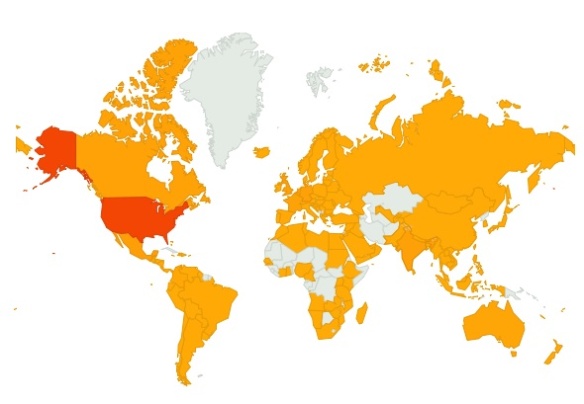
You come from 152 countries — that’s only 40 fewer than the number of UN member-countries. There is not a lot of information about blog readers except for where your IP address is registered. You, our followers, truly come from all over the world — though we could use some readers in Greenland and a few other locations, as you can see on the map below.

CD Blog Readers Year One

Cultural Detective Blog followers log on from these countries

The top 20 countries from which we draw followers are:

  1. USA
  2. Mexico
  3. India
  4. Germany
  5. UK
  6. Canada
  7. France
  8. Australia
  9. The Netherlands
  10. Colombia
  11. Spain
  12. New Zealand
  13. Argentina
  14. Japan
  15. Switzerland
  16. The Philippines
  17. Israel
  18. Malaysia
  19. Brazil
  20. Belgium

Given the diversity of our followers, and the variety and quantity of content, we wondered what you found most interesting in our first year? Surprisingly, three of our top five most-viewed posts were about food! Congratulations and many thanks go out to guest blogger Joe Lurie, who authored two of those. The top ten posts on this blog in 2012 were:

  1. Joe Lurie’s Bicycling in the Yoghurt: the French Food Fixation
  2. Kevin and Rita Booker’s Using Film in Intercultural Education
  3. An anthem for the use of intercultural communication entitled Every Organization Needs Intercultural Competence
  4. Want to Feel Ukiuki, Pichipichi and PinPin? Japanese Food Onomatopoeia
  5. Joe Lurie’s The Squid Has Been Fried: Language, Culture and the Chinese Food Fixation
  6. A book review of How Maps Change Things
  7. A post on cultural appropriation with the case in point: The Swastika
  8. Our post entitled, Infographics on World Cultures and Immigration Trends
  9. A post explaining how to cull learning from some of those images we find in social media, entitled Can You Read This?
  10. Belief Holding as an Intercultural Competence, a competence that has long been one of my favorites, referencing Milton Rokeach’s Open and Closed Mind

Our top five most commented-on posts included one that didn’t make any of the lists above: Diversity Training Doesn’t Work! Obviously a title for some debate and discussion!

Many, many thanks to our regular authors Kris Bibler, Phuong Mai Nguyen, Tereza Bottman, Maryori Vivas, and Kate Berardo. Many thanks as well to our guest authors and contributors, including: Joe Lurie, Anna Mindess, Sunita Nichani, Piper McNulty, Barbara Schaetti, Pari Namazie, Thorunn Bjarnadottir and Avrora Moussorlieva, Kevin and Rita Booker, Carmen DeNeve, Ruth Mastron, Tatyana Fertelmeyster, George Simons, and Madhukar Shukla. We could not have built this terrific blog community without all of you who have commented, shared your resources, reposted our posts, and reviewed our posts before they were published. Many thanks!

If you have a passion for writing about cross-cultural issues and are interested in joining us here as a guest blogger, please contact me. We would love to be able to provide space for talented people to share their voices! We would also welcome your ideas for stories or resources to review, as well as your feedback.

Thank you for accompanying us during this first year of blogging! We trust that you have benefitted from what we have shared, and the thoughts and comments of readers around the world. We look forward to a peaceful and caring 2013!

Happy Lunar New Year of the Snake!!!

44344_10151448073786252_1540966259_nMay all our readers and community members find joy, health and success in intercultural collaboration in this new year!

We have prepared an interesting cross-cultural card for you, in celebration of Chinese New Year. Please click on this link to view it. Then, let us know which cultures you see blended there.

新年快乐  •  恭喜发财  •  新年如意!
Xin Nian Kuai Le • Gong Hei Fard Choy • Xing Ni Ju Yi!

Success? It’s All in How We Gauge It…

711079_3691916951303_1580871364_nThis is a story, or perhaps, more correctly, a cautionary tale, about a very successful expatriate and the highly respected, much-envied western company for which he worked. It is a story that made me think again about how we define success in our lives, and, in particular, how we define success in the global marketplace and success on an expatriate assignment.

The Company: The company is one of the very first to enter the Japanese market after World War II. It holds key patents on several important technologies, and invests decades establishing partnerships with Japan’s leading firms. It prides itself on hiring and promoting Japan’s best and brightest.

By the 1990s, it is the envy of other foreign-capitalized companies in Japan: it has a dominant market presence in its niche industries; long-established, trustworthy partnerships with major local players; and a stellar reputation for consistency, reliability and innovation. The president of the company is Japanese, and its management team is a strong and diverse mix of local and international executives who respect one another and leverage their expertise.

The Japan operation is a huge profit center, as well as the home of research and development breakthroughs leveraged by the company globally. They have strong cross-cultural programs in place for their staff worldwide, as well as for transferees and their receiving organizations.

The Expat: Our expat is intelligent, ambitious, and very capable. He has worked for the company for over 30 years, and is known as an excellent turn-around manager who had saved several manufacturing plants and regional operations, turning their losses into profits. Originally educated as an engineer, he is logical and methodical, and very good with numbers, graphs, and trends. Our expat is married with grown children and grandchildren, speaks a bit of French in addition to his native English, is well-travelled, but has never before lived overseas. This will be his last assignment prior to retirement.

The Situation: The global company, and most particularly home office, is experiencing economic hardship. A few expensive ventures have failed, and it is time to tighten belts, cut back, and save money across the board. Though the Japan operation is one of the most profitable worldwide, it is part of the overall organization and must join in company-wide budget cuts.

The expat is sent to Japan as the new CEO, and is told to cut millions from the annual budget. It is the first time in over a decade that the CEO of the Japan operation is a foreigner. The expat and his wife relocate to Tokyo, and quickly integrate into the local expat social scene. They love their new life in this amazing metropolis.

The Backlash: Local and existing expatriate management “cry foul.” They say it is a short-sighted decision to slash budgets in Japan when the operation is functioning smoothly and keeping others afloat. They say they are being punished for errors they did not cause, in which they were not involved. They warn that budget cuts will have long-lasting negative effects in the Japanese marketplace.

The new CEO explains that change always has its naysayers; people need to “get onboard or get off the ship.” “Tough times call for tough decisions.” “It’s a new day, a new world, a new economy.”

The cross-cultural consultant and existing management explain that the culture is different here, that the new CEO doesn’t yet understand Japan. Drastic changes have long-lasting effects that can’t be undone, can’t be apologized for. They urge him to send this message strongly to the home office, to push the decision back up. They say it’s his duty to make the home office aware of the repercussions of their top-down decision. They tell him that following instructions will mean the death of the Japan operation.

But the CEO has been down this road before. No one likes belt-tightening. No one likes budget cuts. He knows how to turn an operation around. He’s done it before. He doesn’t need people to “like” him. He knows they will respect him once they see the results he achieves. This is an once-in-a-lifetime opportunity, an incredible capstone to his career.

The Outcome: The expat succeeds, in stellar fashion. He fires people. He closes divisions of the company. He retires long-standing partnerships with important local players. He does exactly what he has been charged to do. And he furthers his career: after his two-year assignment he receives a huge bonus. He departs Japan to begin his retirement, riding the accolades of his success.

Home office is proud of their decision to send him; only an expat could have made these kinds of difficult decisions, taken these drastic measures. A local executive wouldn’t have been able to cut such long-standing local partnerships, couldn’t have bit the bullet to fire staff who had worked their whole careers building the company. It was a perfect decision. Money saved. Bottom line improved.

The Longer Term Outcome: Fast forward to four years after the expat’s departure. The highly successful, highly profitable business in Japan, with the enviable stellar reputation, closes down. Plants close. R&D facilities close. Offices throughout the country close.

Leading companies in the industry are no longer interested in partnering; once burned twice shy. After decades of trust building, smart business and shared success, how can they rely on a company that unilaterally decides to throw it all away to improve bottom-line at some far away home office? Why should they do business with a company that so clearly prioritizes home office needs over international success?

The company’s best and brightest have been hired by the competition. They are sour about their previous employer’s lack of loyalty and its short-sightedness. The company is no longer able to attract talented new hires. Who wants to work for a company that focuses on home office success, punishing those who succeed worldwide?

And today? The Japan operation, such an envied and respected company for over sixty years, is no longer. It was “over-milked,” bled dry. Not financially, but culturally, emotionally, trust-depleted.

So, how would you gauge success in this situation? Knowing what you know now, was the CEO successful? At the time everyone thought so. He achieved the immediate goal. What do you think would have happened had he done things differently? Is there a way the expat could have been successful in his goal and maintained trust? Does this mean that every leader needs special tools when completing an overseas assignment? What can we learn from this?

Please ponder those questions while you read the key takeaways from my point of view.

The Lessons:

  1. As expats, we must learn to distinguish between what we know and what we have to learn. We must ask for help. We must be willing to listen. We need to pause and make sure we understand the cultural context in which we are working.
  2. We must ensure that while we use our strengths, we also use “fresh eyes” to see what’s new and different this time. Not every problem can be approached in the same way it was successfully resolved the last time around, in a different country, with different people.
  3. We must be able to discern when to jump at an opportunity, and when to push a decision back up the chain of command. No person is an island. Even a CEO is part of the interconnected web of relationships, responsibilities, and decisions that make up an organization.
  4. As home office executives, we must be able to weigh our priorities, consciously and purposefully. We must think long-term, even when the short-term is jumping up and down in front of us. It is our job to anticipate the multiple impacts of a decision, and shape the process to benefit the organization.
  5. We must be able to hear the truth, from all perspectives, and separate the facts from the complaining. We need to set aside what we want to hear, what we are used to hearing, and be open not only to what is said, but the context and manner in which it is expressed. A cultural informant may help in “translating” the meaning of the message.
  6. As local management, we must learn to discern when we are accurately predicting the future and when we are just resisting change. These are usually questions to explore through dialogue and open-minded discovery. This can be a challenging process, depending on the cultural norms of local management.
  7. As a global team, we must have the tools to enable us to share, hear, and weigh information in order to make the best decisions, for both the short- and long-term. And it is important to remember that the choice and presentation of information is, to some extent culturally influenced. Without a process to truly understand shared information, team members essentially operate in the dark.
  8. A multinational company, it is wise to employ tools like Cultural Detective to help prepare and guide executives on international assignments. Culturally Effective companies recognize the need, and have found Cultural Detective and a trained facilitator can help prevent stories like this from becoming commonplace Cultural Defectives.

Linked to the My Global Life Link-Up at SmallPlanetStudio.com

Our Culture on the Firing Line

UN gun sculptureWe are very pleased to be able to share with you another guest post by the insightful and talented Joe Lurie, Executive Director Emeritus, University of California Berkeley’s International House. Sadly, the topic is again, or still, timely. We published his first post on this subject, “Language Under the Gun,” in February of 2011. Let us work to change the culture of anger and violence by this time next year!

As introduction to the piece, allow me to share with you Joe’s message, urging me to publish his post sooner rather than later: “If it can be published earlier, given the ‘heat people  are packing’ now in the current ‘ballistic’ and ‘explosive’ reactions to Obama’s proposals, that would be more likely to ‘hit the bull’s-eye’ in the current environment.”

With only 5% of the world’s population, US Americans now possess about 50% of the world’s guns. Is it any wonder then that mass shootings in the US have skyrocketed in the last decade? And in the wake of the grotesque massacre in Sandy Hook, gun sales have spiked dramatically. No wonder that sales of kids’ bullet-proof backpacks have soared, or that our culture more than ever is drenched in the language of guns!

As I watch left and right wing politicians and pundits “up in arms” on TV, battling in a “cross-fire” of blame, each side looking for a “smoking gun” to explain or cast blame for horrifying gun-related catastrophes, I’ve become increasingly aware of how our culture’s preoccupations with guns are reflected even during innocent “shooting the breeze” conversations.

We often value the “straight shooter,” yet we are wary of those who “shoot their mouths off,” and those who “shoot from the hip” or glibly end an argument with a “parting shot.” We caution colleagues to avoid “shooting themselves in the foot,” and counsel them not to “shoot the messenger.”

Without suspecting what drives our language, we are “blown away” by adorable photos of loved ones. At the movies, many audiences are thrilled by “shoot- em-up,”  “double barreled action” scenes, or are excited by car chases where actors “gun” their engines.

I often ask friends to “shoot me” an email and I’ve encouraged job seekers to give an interview their “best shot” and “stick to their guns” during salary discussions. And if a job is offered, I might congratulate them for doing a “bang up” job.

In sensitive business negotiations, I’ve advised patience, urging clients to “trouble shoot” solutions, but to avoid “jumping the gun” and to be aware of “loaded” questions. To get the biggest “bang for the buck,” I’ve recommended bringing the “big guns” to the table. We look for “silver bullet” solutions, hoping for “bulletproof” results. And when success is in sight, we say: “You’re on target,” or “you’re going great guns!”

We encourage entrepreneurial risk taking, even if the project doesn’t have a “shot in hell.” Just “fire away” when you make that “killer” presentation, and if your idea is “shot down,” don’t be “gun shy.” Just “bite the bullet” and go at it again, with “guns blazing.” Don’t be afraid to “shoot for the moon,” even if it looks like a “shot in the dark.”

Having worked as a university executive with students from more than 80 countries, I’ve noticed that students from abroad are struck by the violent language in our songs and films, and they hear it bleeding into our political discourse. Many have asked me in amazement why it is even necessary to state that guns and ammunition are banned from university residence halls. Yet, “son of a gun,” 26 colleges in three states permit guns on college campuses. And gun liberalization legislation for colleges is in the “cross hairs” in at least nine more states.

I’ve heard staff and students alike stressed by an approaching deadline, instinctively describing themselves as being “under the gun.” Sometimes my colleagues have described emotional co-workers as “loose cannons” or having “hair trigger” personalities. And when a student has gone off “half cocked,” psychologists have advised employees to “keep their powders dry” and to review “bullet point” guidelines for handling volatile personalities.

In the same way that the US is flooded with millions of guns (there are 90 guns per one hundred Americans), so our newscasts — “sure as shootin’ ” — are exploding almost nightly with murder stories, reflecting the newsroom mantra: “If it bleeds, it leads.”

When the local story becomes a national tragedy, there is “new ammunition” for both gun control supporters and opponents of fire arm bans in such places as elementary schools, day care centers, churches, or even the neighborhood bar!

The world of guns has had our rhetoric in its sights for a very long time. And our wounded language — now more than ever with a gun to its head — is telling us that our culture is on the firing line.

Joe Lurie, Executive Director Emeritus at the University of California’s International House, is currently a cross-cultural communications consultant, university instructor and Cultural Detective certified facilitator. Contact Joe via email or LinkedIn.

This post builds on Joe’s February 2011 piece, “Language Under the Gun.”