
You Trust a Quiz to Tell You Who You Are?

Your profile now!

Depp photo @Examiner
Honsou photo ©Armando Gallo/Retna Ltd

You may have had the same experience I have: clients, students, trainees and colleagues often ask me what assessment tools I recommend. My response, of course, is “for what purpose? What do you want to assess?” Sadly they usually can not answer that question. They know they want something online, something quick. They want something that provides immediate feedback, either inexpensively or for free. But, they rarely have focused in on a purpose, on what they want to learn through the “assessment.”

Sometimes I hear, “To give our people a profile of themselves—a profile of their style that tells them who and how they are.” The assumption is that, by understanding ourselves via this hypothetical quick, online, inexpensive or free assessment, we will immediately (almost magically) become empowered to collaborate more effectively across cultures.

Now don’t misunderstand me: assessments and inventories can be incredibly helpful tools. We are all better served by understanding our learning styles, personality traits, and communication skills. Taking a quick online assessment can also be fun. Heck, those quizzes in the magazines can be entertaining: What kind of personality am I in the bedroom based on whether the quiz says I’m more attracted to Johnny Depp or Djimon Honsou. I had fun just writing that sentence!

However, I can’t help but feel the world is just a WEE bit out of whack when we trust a personal profile, produced by a quick survey, more than we trust our own 20, 50 or more years of experience living with and as ourselves. Profiles can be informative: they can stimulate thinking and conversation. But they are not going to, in and of themselves, improve my ability, either in the bedroom or to work cross-culturally.

What causes us to want a profile? We are by and large intelligent people. We are adults. We know ourselves. Many of us want the quick and easy “answer” because our days are so full. Many of us don’t take time for contemplation, practice, or deep meaningful dialogue—even though these are precisely the acts via which wisdom, happiness and, yes, competence are achieved.

Let’s face it: intercultural competence, like all the other important abilities in life (good parenting, sound health, even skills with technology) involves PRACTICE. We need to stay current, we need to both broaden and deepen our abilities and experience.

So, keeping in mind the importance of HOW we use assessment tools, and the importance of a regular structured practice to improve our abilities, there are a handful of “profile” tools in the cross-cultural field that I find useful. Why do I like these particular instruments? They involve or encourage the contemplation, practice and deep meaningful dialogue of which I’ve written, and that research shows is required in order to improve cross-cultural competence. Some tools I can recommend are:

  1. Cultural Detective Self Discovery: This unique product in the Cultural Detective series helps individuals to investigate their cultural identities and develop a “Personal Values Lens.” Through a structured sequence of short exercises and discussions, individuals identify their core values, the positive and negative aspects of these values, and the thinking and behavior that flows from them. They then explore how their values and behaviors may be similar to and different from those of cultural groups. This Personal Values Lens can be used in conjunction with the Cultural Detective Online system for individualized structured learning, or, better yet, with the guidance of a facilitator or coach.
  2. The International Profiler: This terrific tool by our friends and colleagues at WorldWork involves a web-based psychometric questionnaire, followed by coaching sessions, to help develop an individual’s ability to operate effectively in unfamiliar cultural contexts. Nigel Ewington has been piloting ways of combining The International Profiler (TIP) and Cultural Detective (CD), to harness the best of both. Perhaps we can ask him to do a guest post about that?
  3. Personal Leadership: This methodology offers a way of being and interacting with the world that begins from the “inside out,” one that asks people to be fully present in their lives, awake to their habitual behaviors, and willing to look at situations with “beginner’s mind.” Of particular interest in this context is the personal visioning practice. Barbara Schaetti and Heather Robinson and I have created a MashUp process aimed at leveraging the dynamic interaction possible with Personal Leadership (PL) and Cultural Detective (CD).
  4. The Intercultural Development Inventory (IDI), originally based on the Developmental Model of Intercultural Sensitivity (DMIS), is a statistically reliable, cross-culturally valid measure of intercultural sensitivity. What I love about it is that it is developmental: great for charting individual or group progress. It can be completed online, with the assistance of a qualified administrator, and involves individualized feedback. Ideally the IDI is used as part of a process that also involves development planning and coaching.

We can have all the information in the world about ourselves, but if we do not have the courage and diligence to act on it, it is worth very little. None of the tools discussed above provides instantaneous transformation or the magic pixie dust of cross-cultural collaboration. Nor, I imagine, will they give me an evening with either Johnny or Djimon. But with ongoing, mindful practice and the guidance of a good coach or trainer, we will find worlds open to us that we might never have imagined, and we will develop the ability to collaborate more effectively across cultures—exactly what many of our clients are asking for. Each of the tools above dovetails very well with the Cultural Detective Series: TIP and IDI can help you chart progress using CD as a developmental tool, and PL helps ensure the inner work that should accompany CD use happens.

There are many more inventories, assessments and collaborative tools in the intercultural field. What are some of your favorites? How do you use them for maximum effectiveness? How do you motivate yourself and others to practice? What do you wish existed to address specific developmental needs and challenges?
A New Tool and a New Mashup on Gender Relations

Global Gender Intelligence Assessment and Cultural Detective Women and Men
Guest post by Donna M. Stringer

Using these two instruments in combination could have ground-breaking results in the area of gender relationships in the working environment (and beyond). And if we can improve gender relations, it would be nothing less than a global revolution!

ggia_full_logoThe Global Gender Intelligence Assessment is a new online tool created by Barbara Annis and Alan Richter. It is an outstanding resource that measures gender attitudes and competence in the areas of Insight (Head), Inclusion (Heart) and Adaptation (Hands). These three constructs are combined with scores for Self, Others and World, giving you a 3 x 3 grid of nine gender-related competencies—each with interpretation and developmental suggestions. There are two versions of the assessment: one for general staff and one for leaders.

The most useful aspects of this assessment are the Interpretations and Personal Action Planning sections. These areas offer detailed, practical, and “doable” suggestions for building competencies. Many assessments provide “Developmental” suggestions that are so general that they read like “can’t we just get along.” The GGIA developmental options are different. They are well thought out and so varied that individuals from a wide range of cultural perspectives can find culturally effective and appropriate ideas to implement.

The assessment is also affordable at $11-$15/per person depending on numbers purchased. For further information contact Alan Richter.

coverWomenMenCulture Detective: Women and Men is, of course, not a new tool—it  was developed as the first non-national Cultural Detective package in 2007 and revised in 2010. One of the many advantages of CD programs is that they help people understand culture and their own responses to cultural differences. Exposing people to CDs is a developmental process: it is non-judgmental and allows participants to see the world through a different lens, shift perspectives, and identify ways to bridge the differences that might otherwise create conflict or mis-understanding. CDs take a general understanding and problem solving approach that allows cultural differences to be seen as interesting issues to “solve.” The Cultural Detective Women and Men allows people to explore gender differences in a manner that is fun but not personal. Once individuals are able to approach gender in this manner, they are ready for the next step: examining their own individual gender competencies.

Gender MUThe Gender Mashup!

As a developmental process, it would work beautifully to use the GGIA as a follow-up to the CD Women and Men. Having experienced a non-judgmental process of understanding and considering both one’s own and the “other” gender, and identifying bridging behaviors, most individuals would now be ready to complete an assessment that allows them an interpretation of their responses followed by outstanding strategies for personal development suggestions.

Regardless of one’s occupation, organization, or country, gender is a primary diversity characteristic—and one that virtually everyone encounters in life. As I have traveled and worked around the globe, virtually every organization has gender as a diversity and inclusion issue. Using these two instruments in combination could have ground-breaking results in the area of gender relationships in the working environment (and beyond)—and if we can improve gender relations, it would be nothing less than a global revolution!

Written by Donna M. Stringer, Ph.D.

Film Review: Machuca

Machuca movie posterHow about watching a terrific film from Chile? Our local rental place had a closeout a few weeks ago, and one of the DVDs we happened upon was Machuca, a 2004 film by Andrés Wood. What a terrific find!

I am often asked about status and class in Latin America by those who come from more egalitarian societies. Navigating class differences has been one of our greatest challenges living in México; neither life in the US, Spain, nor Japan equipped us for the expected and often desired separateness here. While a period piece, Machuca viscerally illustrates the class differences and tensions of the era, and I would recommend it as a worthwhile resource.

Machuca takes place in Chile during the final years of Salvador Allende’s government — the first Marxist ever to be elected head of a democracy — and ends about the time of General Augusto Pinochet’s military coup d’état. Taking place during this period of heightened civil unrest, this is fundamentally a story about the friendship of two boys: Gonzalo and Pedro, who come from opposite sides of the river and opposite ends of society. Thus, we get a micro and a macro-level taste of class tension.

Gonzalo is a “junior,” the son of a wealthy family who attends St. Patrick’s, an elite Catholic boys’ school. He is frequently forced to accompany his mother during her afternoon trysts. Pedro (Machuca) lives in a shanty town, and is the son of the woman who cleans house for Gonzalo’s family. Pedro is one of a group of “scholarship students” that the head priest has invited to St. Patrick’s in an attempt to create a bit of equity in society.

The movie shows how difficult it is for these new students to integrate, and there is a memorable bullying scene in which Gonzalo defends Pedro. We gain insight into the home lives of both boys, proving of course that richer or poorer, life is not all roses.

The backdrop to the main story is, of course, a Chile in turmoil. Gonzalo’s own parents seem to come down on opposite sides of the issue, his mother content as a socialite, his father at least to some degree believing in the need for increased equity. The street demonstration scenes capture the anger, the power, and the fear of the time.

We witness the backlash of the parents at school to the priest’s “communist” tendencies, because he attempts to integrate groups they feel best remain separate. We glimpse the resourcefulness of Pedro’s “uncle,” who makes a living selling flags to both sides: the Marxists and the traditionalists. We hear about land redistribution and industry nationalization through radio broadcasts and posters in the streets. In movies like Machuca, stories about young friends trying to make sense of the world around them, there is usually a girl. In this case, she is the girl with whom both boys learn how to kiss. And she is most definitely and passionately a socialist.

Watching this film you will learn a lot about Chilean history, the ingrained status in Latin America, and the difficulty in bridging rich and poor and vice versa. If you’re anything like the members of my family, you’ll be talking about it for days afterwards. I’d urge you to get out your copy of Cultural Detective Chile, particularly the Chilean Values Lens, to aid your discussions of the movie. Enjoy! And please, let me know what you think!

Unsolicited Review

coverAfAmI just had a chance to review the newly released Cultural Detective: African-American, by Kelli McCloud-Schingen and Patricia Coleman, as well as talk to the authors yesterday in the teleconference on the topic of “Black versus African-American.” Normally, I don’t review items in this series, not just because I’m the co-author of several, but because the formula for their success both in printed versions and now online hardly requires special notice for the individual items which now number well over 50.

However, in this case I think a word is necessary. Necessary, particularly because my suspicion is that most folks reading the title twill probably think largely in terms of diversity and inclusion, rather than in terms of culture. While these issues are at a certain point inseparable, one of the weak points of the diversity movement in the USA has been to imagine itself as intercultural, with little attention, and sometimes fear of dealing with the attitudes and values of targeted groups. There is still a lot of sensitivity here. Consequently when people, particularly outside the US, see publications focused on US minorities, they may think to dismiss them as some of the same-old, same-old diversity stuff.

That is not the case here. This is truly a work of intercultural significance, despite the fact that the participant guide runs to only about 30 pages. First of all, the introduction, slightly longer than the average instrument in this series is absolutely brilliant. It gives the user an overview that is rich, thoughtful, insightful, even for, perhaps particularly for US Americans who tend to see racial issues one at a time, without a sense of heritage and culture in their historical context. But it is certainly what outsiders need and should want to know in order to work well with African-Americans.

“Truly a work of intercultural significance!”
“Absolutely brilliant.”
“Rich, thoughtful, insightful.”
“Heritage and culture in historical context.”

For the many expats going from other parts of the world to the USA, there is usually a question of, “What should I know about… How should I behave around… What should I avoid when dealing with African-Americans?” This instrument helps you cut to the chase, not by offering “kiss, bow, and shake hands tips” but providing insight into the values, strengths, and sensitivities peculiar to a part of the US population who are still to a great degree consciously heirs of a trajectory anchored in slavery, passing through personal pain even while also arriving in corporate boardrooms and occupying the Oval Office. This is a solid cultural perspective on the discourse, on the story that leads to the core values of African-Americans today, in all their diversity, and in contexts where bias and discrimination are still possible obstacles to appreciating cultural identity.

So, if you are preparing expats to go to the USA, or if you are one, this is an important tool, and now one of several dealing with internal cultural dimensions of the very diverse USA, now available in the easily accessible online versions of Cultural Detective.


Oldie but Goodie: Comprehensive Expatriate Support System

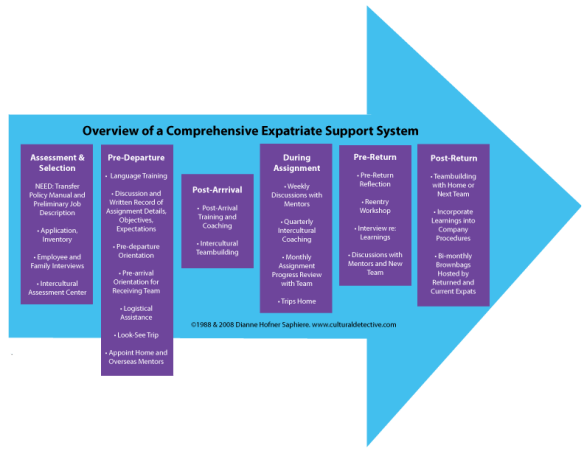
Expat-Flow

Moving overseas is an exciting yet stressful time for all involved: the person transitioning to a new position, the expat’s family who is relocating, and the organization—both the office dealing with the loss of a valued employee, and the receiving organization. We all know there are a myriad of details involved in preparing someone to work abroad, but where to start and what to include?

Years ago, when Cultural Detective Online was not yet a glimmer in anyone’s dreams, I put together the above guide for a client. You are most welcome to use it if it can be of assistance (click through to view a larger version), though I ask that you retain the copyright and url of the original.

I was proud to work with that client. They valued their international assignees, desiring that the employee and the relocating family become stronger from international assignment, and that both the receiving organization and the organization as a whole learn and grow. They thus asked me to “map” a process to help make that happen.

Today, Cultural Detective Online is an excellent tool to use with expatriates, relocating families, and receiving teams and organizations, at each stage of the relocation process. It offers a process as well as information at your fingertips — anytime, anywhere — to help build bridges across cultures, to help each of us better understand those we work with, and to get to know ourselves better.

“The Cultural Detective Online product is a sound investment for my work as an intercultural and relocation coach. I suggest to my clients to get a subscription for themselves.”
—Maartje Goodeve, Nascence Coaching, BC, Canada

How might you update the process in the graphic above? How could you use Cultural Detective Online in combination with other tools, approaches and your own facilitation to enhance expatriate performance?

Resource Review: GDI Benchmarks

We tend to get a lot of phone calls asking us to recommend a cross-cultural assessment instrument. Usually I ask what  seems to me a very logical question: “What is it you are trying to assess?” I am then often shocked to hear that the caller is not able to answer my question!

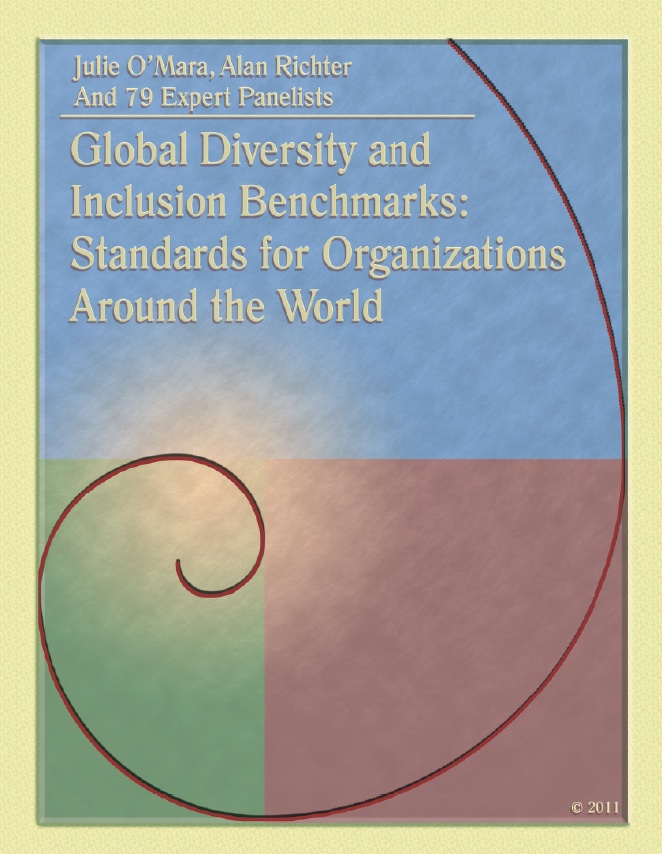
As an organizational effectiveness practitioner I am concerned with individual and interpersonal effectiveness as well as that of the overall organization. We all live and work within systems, and if that system rewards and encourages us NOT to be cross-culturally competent, we are going to nurse burnout if we try to demonstrate and develop that skill. Organizational systems and structures need to support and reinforce individual and interpersonal competence. That is why “Global Diversity and Inclusion Benchmarks: Standards for Organizations Around the World” is one of my favorite assessment tools.

Written by Cultural Detective Global Diversity and Inclusion co-author Alan Richter, along with the very talented Julie O’Mara, the tool is available for use free of charge, though the authors ask that you submit a written request for permission (julie@omaraassoc.com or alanrichter@qedconsulting.com).

Newly updated in 2011, the 32-page booklet is based on a core model of 13 categories arranged into four key areas: Foundational Factors, Internal Abilities, External Benchmarks, and Bridging Competencies (you can already imagine how well this blends with a Cultural Detective approach!). The assessment instrument involves rating the organization at one of five levels for each of the 13 categories. Thus, it is very easy to use and educates as it assesses.

The GDI Benchmarks are based on extensive contributions from 79 experts around the world, and were developed from groundbreaking research in the early 1990s. Please contact Julie or Alan to learn more. And please share with us your organization’s progress with these benchmarks as you use Cultural Detective!

Film Review by Sunita Nichani: “English Vinglish”

Reprint from SIETAR India Newsletter, November 2012
Written by Sunita Nichani

The topic of cultural dimensions (individualism vs. collectivism, monochrone and polychrone) is almost de rigeur in intercultural training workshops. Most of these models remain quite theoretical in the minds of our Indian participants.

As I watched the Bollywood film “English Vinglish,” I saw some great examples of these dimensions being acted out, and am delighted that some of these scenes can be used to illustrate these dimensions in a way that will resonate with Indian audiences. Please note that like with most films that portray another culture through the eyes of a foreigner, some of the situations and characters might seem a bit exaggerated or even culturally inaccurate. However, the film has many select scenes that would be a great resource for intercultural trainers looking for ways to connect theory and application. So read on!

This film by Gauri Shinde is a heart-warming tale of how an Indian housewife, played by Sreedevi, discovers her hidden potential after landing in the US and learning the English language. The film can be used for a variety of training objectives: questioning existing stereotypes, ethnocentrism, or how the film accurately or inaccurately depicts cultural differences.

Being part of a collectivist culture, Sreedevi puts her family’s needs before her own and her individual efforts are often unrecognized or even mocked by her family at home. She is an excellent cook and in India she sells her speciality “ladoos” (an Indian dessert) during weddings and other festivals. During her first English language class in the United States, her English instructor asks her what she does (individualist orientation) and Sreedevi, not used to talking about her individual accomplishments, sheepishly confesses that she sells “ladoos.” Her English instructor provides her with the term “entrepreneur,” and her face lights up at this definition of her individual identity. This theme is quite recurrent in the movie and can be used in discussions on how to leverage the best of both individualism and collectivism. For example, after having discovered the joys of individualism such as “me time,” personal development, and individual accomplishment, Sreedevi does not bail out on collectivism. On the contrary, she explains the core philosophy of collectivism in her speech at the wedding of her niece.

Yet another dimension is beautifully illustrated in the scene where Sreedevi orders a cup of coffee in New York for the first time. To see the differences between monochronic and polychronic attitudes. I encourage you to watch the film!

Thank you for this great review, Sunita, Cultural Detective extraordinaire and current President of SIETAR India.

We would like to encourage all of you to purchase early-bird registration before December 9th for the SIETAR India 2013 conference, “From Internationalization to Intercultural Competence.” It will take place in Mumbai on the 2-3 of February.

Every Organization Needs Intercultural Competence

Nearly every organization these days, even the smallest and most local, works with diverse customers, team members, vendors, and service providers. A corner grocery store serves people from different age groups, ethnicities, and spiritual traditions. So, which holiday greetings should the grocery store use, if any, so as not to offend or exclude? Why do some of the regular customers talk only to male employees? Could the store increase profits or attract new customers if it started offering halal meats or Latino grocery items?

What about the graphic designer who puts up a website or Facebook page designed to attract local clients, only to find that the first inquiries come in from overseas? The mere fact that you have an online presence can mean you offer your products and services worldwide. And what about the free clinic that finds itself dealing with patient care issues of recent immigrants from places halfway across the planet? Or disaster relief agencies attempting to coordinate aid from around the world, getting it to the places it needs to be, quickly?

Cross-cultural competence, the ability to communicate effectively across cultures, is a mandatory skill in today’s interconnected world. It will help you:
  • Service diverse customers in the ways they expect.
  • Attract, retain and make the most of the talented professionals your organization needs to succeed.
  • Sell more products or services, to the people who need them.
  • Achieve success in your negotiations.
  • Discern the “right” mergers and acquisitions for your purposes.
  • Get more productivity and satisfaction out of your local and virtual teams, projects, and vendors.
  • Jump start the outcomes of study abroad and international education, as well as expatriate assignments.
  • Ensure you get the most out of the time and money you invest in international, cross-country and regional business travel.
  • Develop mutually respectful relationships with clients, employees and other stakeholders.

Cross-cultural competence is a needed skill for all of us, and it helps improve our family and social lives as well as our work lives. But amidst all the competing priorities for our time and attention, how can we develop such competence? To most of us, going back to school or even taking a few days off work for a class isn’t doable. And besides, like physical fitness, cultural fitness requires ongoing, structured practice, not just one trip to a training room.

If only there were an online cross-cultural coach available to us anytime, anywhere, at low cost. One that didn’t make us memorize lists of dos and don’ts, that didn’t promote stereotypes but rather encouraged dialogue and critical thinking. An online coach that would provide a process for recognizing cultural differences, helping us to understand and leverage them as assets rather than as roadblocks. Better yet, an online coach that could help us make sense of our everyday experiences, learning how to transform obstacles into opportunities, and frustration into innovation. A tool we could navigate freely, according to our needs and interests, not some online talking heads or narrated slide show. A tool that would be available on our time — when and where we want it…

I am very excited to be able to share with you just such a solution, yours free for three days, no strings attached. It is a brand new online system based on the proven Cultural Detective Method used by governments, NGOs and for-profit organizations around the world.

Free 3-day trial to Cultural Detective Online!

Cultural Detective is directly responsible for a 30% increase in our customer satisfaction ratings.”

Cultural Detective sped up my learning curve; it allowed me to become a part of the team and have an impact on the business more quickly.”

“I have received kudos from my managers and the Vice President for having chosen the Cultural Detective. But the kudos should really go to you. Cultural Detective is a rock solid methodology.”

Pass this offer around; the 3-day-free trial offer is good from now through December 31, 2012.
To redeem:

  1. Log on to http://www.culturaldetective.com/cdonline/orders/trial
  2. Enter your name, email address and the code: Promo3
  3. You will receive a verification email from cdonline@culturaldetective.com. Click the link in the email, follow the instructions and you will be ready to go!

Enter your learning goals, explore 50+ fully integrated packages including full Values Lenses and 400 Critical Incidents, or upload and debrief your own real-life situations. Your customers, partners and employees, even your family members, will notice the difference!

Improve your ability to understand and collaborate across cultures, and help your friends, family members and colleagues to do the same! Let’s create a more inclusive, creative, collaborative and productive world out there! Get a clue!

A Gift for You from Thorunn and Avrora

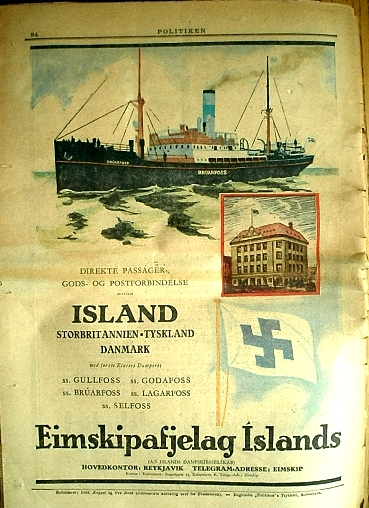
eimskip_1930.jpg

Photo credit to Vilhjálmur Örn Vilhjálmsson, https://fornleifur.blog.is
Used with permission.

The power of social media and online networking just keeps amazing me. Since starting this blog we’ve had soooo many great examples of how you all build on one another’s work and generously share with each other! It is our privilege to hold space here that helps do that.

You will remember our recent post entitled, More Cultural Appropriation: The Swastika? Well, a good friend and respected colleague of mine read it and said, “You know, Dianne, the swastika held a prominent place on a huge building, home to a major Icelandic shipping company, for decades. It’s gone now, though.” As we talked about it, she told me she’d used that story, with quite a few pictures, in a powerpoint slide presentation that she developed with a colleague.

With Thorunn and her co-presenter Avrora’s generosity of spirit, we are privileged to share with you a gift to all Cultural Detectives from them. Their slides summarize the swastika’s history, and include photos of its use in Bulgaria, Greece, Iceland, Native America, and Tibet, as well as the Nazi version. Thorunn and Avrora help you pull learning from these photos with slides explaining culture, judgments, and symbols.

Download their powerpoint slides here. And please let us know how you put them to use!

As an aside, I’d share with you that I recently met an incredibly interesting woman who is Indian and Austrian. Her stories about personal and family conflicts and learning around the swastika were really something to hear! Hopefully I might convince her to share some of them with you in a future guest post.

What Do You Mean?! I’ve Worked Abroad 20 Years and Score Low?!

Image from The Vegetarian Athlete

So many of you seemed to resonate with my blog post about intercultural fitness, Tweeting it, Scooping it and passing it around the social media networks, that I thought you might be interested in a short article I originally drafted back in 2005 that uses the metaphor of an athlete to explain intercultural competence.

Developmental Intercultural Competence and the Analogy of an Athlete

Milton Bennett’s Developmental Model of Intercultural Sensitivity (DMIS), first published in 1986, provides a well-regarded theory about the process people go through as they learn to make sense of the complexity of cross-cultural communication. In the late 1990s after much research, an assessment for measuring intercultural sensitivity based on the DMIS was developed. Version 3 of the Intercultural Development Inventory (IDI) is currently in use by qualified practitioners. Owners and users of the IDI have in turn used their results to revamp the DMIS into the Intercultural Development Continuum (IDC).

While such tools can be useful for measuring program effectiveness when used for pre- and post-testing, and can be hugely beneficial for individuals who want to improve their cross-cultural communication and collaboration, there are downsides. I’ve worked with career expatriates and global nomads, for example, who score quite low on the IDI. What this means is that the low-scorer may have a lot of experience, but has not yet engaged in systematic, structured sense-making of those decades of complex intercultural experience. I’ve also worked with quite a few individuals who value harmony as fitting in, and thus, on a scale that measures celebrating differences, they score comparatively low. Predictably, low scores can cause people to become focused on discrediting the instrument or rationalizing the assessment process, rather than on gaining benefit from what the results have to say.

To help learners focus on the guidance these tools can provide, I often use the analogy of an athlete. Just as athletes need multiple abilities to perform well, so do intercultural communicators. Both athletes and intercultural collaborators can use assessments to guide their performance improvement training.

Let’s say that the data on my athletic performance shows that I need increased flexibility. I dedicate several months to becoming more flexible, and then my coach tells me that I now need to shift my focus to building strength — of course while maintaining my flexibility. Months later, I may find that I need to refine my technique in order to make the most of my superior strength and flexibility. Or, I get injured, and I decide to add to my training a focus on my mental game: overcoming adversity, learning from mistakes, being fully present in the moment. Athletes thus focus on multiple abilities at different points throughout their careers in order to perform at their best.

In a similar way, the DMIS, IDI and IDC can be used to show us which issues we should focus on at a given point in time in order to maximally improve our intercultural performance. While developmental models and assessments are designed as measuring sticks or standards of comparison, their value for personal competence development is to highlight to us what competencies we should focus on building at each point in our careers in order to improve our overall performance.

Each of us has to balance the dynamic between comfort and stretch, challenge and support, growth and rest, in our own ways. Knowing what we are good at, as well as where we can improve, can help ensure we continue to develop. Using an assessment tool to gauge and target our intercultural development, in combination with a competence development tool such as Cultural Detective Online for ongoing, structured learning, is a powerful combination.