Do One Thing for Diversity and Inclusion

Do One Thing logoIn 2001, UNESCO adopted the Universal Declaration on Cultural Diversity and in December 2002, the UN General Assembly, in its resolution 57/249, declared May 21 to be the World Day for Cultural Diversity for Dialogue and Development. The day provides us with an opportunity to deepen our understanding of the values of cultural diversity and to learn to live together better. In 2011, a grassroots campaign ‘Do One Thing For Diversity and Inclusion’, celebrating the annual World Day for Cultural Diversity was launched by UNESCO and the UN Alliance of Civilizations.

Cultural Detective is proud to announce that we have been selected as an ambassador of this global campaign. Goals of the campaign include:

  • Raise awareness worldwide about the importance of intercultural dialogue, diversity and inclusion.
  • Build a world community of individuals committed to support diversity with real and every day-life gestures.
  • Combat polarization and stereotypes to improve understanding and cooperation among people from different cultures.

Won’t you please join us in celebrating diversity and inclusion tomorrow, May 21, 2013? Below we share with you ten ideas from the event’s organizers, and we’re pretty sure that readers of this blog will have more savvy ways to celebrate global diversity and inclusion. We look forward to seeing and hearing what you do!

  1. Visit an art exhibit or a museum dedicated to other cultures.
  2. Invite a family or people in the neighborhood from another culture or religion to share a meal with you and exchange views on life.
  3. Rent a movie or read a book from another country or religion than your own.
  4. Invite people from a different culture to share your customs
  5. Read about the great thinkers of other cultures than yours (e.g. Confucius, Socrates, Avicenna, Ibn Khaldun, Aristotle, Ganesh, Rumi)
  6. Go next week-end to visit a place of worship different than yours and participate in the celebration.
  7. Play the “stereotypes game.” Stick a post-it on your forehead with the name of a country. Ask people to tell you stereotypes associated with people from that country. You win if you find out where you are from.
  8. Learn about traditional celebrations from other cultures; learn more about Hanukkah or Ramadan or about amazing celebrations of New Year’s Eve in Spain or Qingming festival in China.
  9. Spread your own culture around the world through our Facebook page and learn about other cultures
  10. Explore music of a different culture.

The campaign works through a dedicated Facebook page, serving as a platform for people around the world to share their experiences through posts and videos. Following this event, on May 29, 2013, in Baku, Azerbaijan, will be the World Forum on Intercultural Dialogue.
Share With Us Your 6 Second Videos on Crossing Cultures!

VineCDI used to really dislike Twitter — one more social media, and such short messages! We don’t need more information overload in our world, bothering us everywhere we go!

Then I reframed Twitter in my mind. I realized that those tweets (140 characters maximum) are like haiku! Their brevity encourages us to capture the core essence, the deep meaning, in a new and creative way! In that sense, Tweets are perfect for Cultural Detectives or anyone who bridges cultures, whether within the family, neighborhood, or internationally. Now I quite enjoy the medium.

Recently I learned that you can now stream video via Twitter in much the same way as you share photos via Instagram.

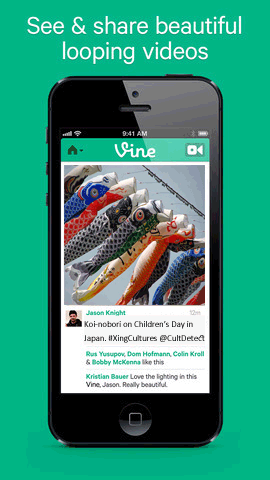
You download a free app called Vine, then use your iPhone, iPod or iPad to record and Tweet 6-second videos. You can also easily post the photos to Facebook. Want to see some samples? Looping videos, short and sweet: multimedia haiku.

So I thought this could be an enjoyable and useful activity for Cultural Detectives: sharing short videos with each other about crossing cultures, from wherever we happen to be based or traveling. Here is the proposal:

I have a fun and exciting challenge for you! Please, capture a short video of your experience crossing cultures: what does bridging cultures effectively, what does cross-cultural competence mean to you?

Then, Tweet it to us at @CulturalDetect using hashtag #XingCultures

And/or, post your video to our Facebook page

I’m sure this could be a whole lot of fun, and provide interesting material that many of you could use. We have followers all over the world, and if you participate and pass this on to your friends and followers, the reach will be even wider.

Looking forward to your insight and creativity!!!!

The Best-Kept Secret of Successful Teams

4 Phase ModelAlmost every team and community today is diverse in some way or another: gender, age, spirituality, professional training, ethnicity, nationality… While we respect other styles and cultures, most of us still get stuck at some point where we say, “OK, we’re different; now how do we work (or live) side-by-side? How do we harness our differences as creative assets? At a minimum, how do we simply keep from driving each other crazy?”

We might work with partners who view time as flexible and events as unfolding. This may mean that, to them, deadlines are mutable and subject to change. Meanwhile, we push ourselves and our bodies, working overtime to make sure we honor our commitment to an agreed-upon deadline. While we may respect our colleagues’ view of time management on a theoretical basis, and perhaps envy them their apparently healthy work-life balance, how do we succeed with partners who don’t seem to respect their commitments to deadlines?

Perhaps we have a neighbor or even a waiter at a favorite restaurant who communicates very directly, yet we prefer a bit more indirection, thank you. While we respect their communication style, it can get irritating and try our patience.

Too often we fail to actively seek to bridge differences because we see them as something negative, as something that separates rather than unites us. Yet, by ignoring our differences, by pretending they are not there, we imbue them with great power. Eventually they can get the best of us, surprising us at awkward moments and causing frustration and tension. Our reluctance to address differences may stem from a fear that acknowledging their existence may push us farther apart rather than allowing us to collaborate enjoyably.

So, how do we transform these differences into assets? How do we convert them from something to be denied, hidden, or tamped down, into something to be embraced and used for the good of the organization and the team?

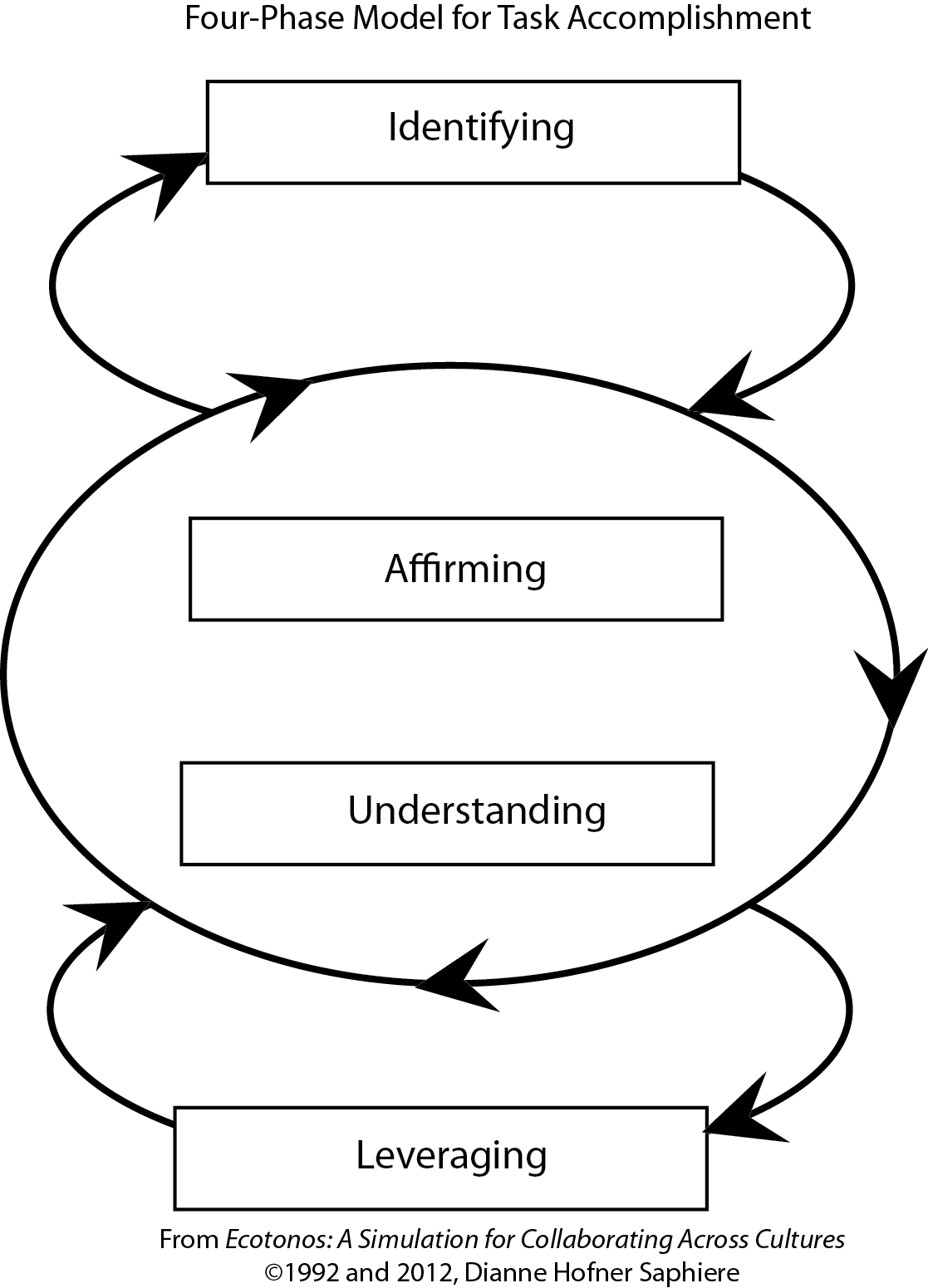
One model that has proven quite useful over the past two decades of use comes from the classic and widely used simulation, Ecotonos: A Simulation for Collaborating Across Cultures. Called the “Four-Phase Model for Task Accomplishment,” this very simple approach guides us to first identify the similarities and differences at play in our interaction, verbally affirm them, spend time understanding them and, finally, explore how to leverage them.

How a specific team leverages similarities and differences will depend on the members of the team and their shared goals and realities. Each team creates its own team culture, ideally based upon and growing out of the first three phases of this Four-Phase Model.

As you can see in the graphic above, the Four-Phase Model is not linear, but rather each phase weaves into and out of the other. For example, understanding may lead to further identifying, or leveraging may lead to added affirmation.

A text description of the Model accompanies Ecotonos and provides further elaboration of the graphic:

Identifying
  • Perceiving similarities and differences
  • Establishing which differences are divisive and which commonalties unite
  • Creating self-awareness of one’s own strengths and styles
  • Appropriate balancing of the tension between sameness and difference
Affirming
  • Confirming individual commonalties and differences
  • Substantiating that difference is desirable
  • Legitimizing difference in the eyes of the group
  • Welcoming conflict and paying attention
Understanding
  • Attempting to understand the other person’s perspective
  • Stepping into the other’s shoes
  • Mirroring/exploring and discovering together
  • Probing for deeper comprehension using various approaches
  • Seeing an issue from several vantage points
Leveraging
  • Defining how team members can contribute to goal accomplishment
  • Agreeing on methods for utilizing team expertise
  • Facilitating the generation of creative solutions
  • Creating a “team” culture
  • Focusing on efficiency and effectiveness

Once people become comfortable with the Identifying Phase, they may perceive the Affirming Phase as something unnecessary, a waste of everyone’s time. “We are all adults. We don’t need to give one another kudos.”

But my extensive experience proves, over and over again, that taking the time and effort to actively engage in the Affirming Phase is well worth the investment. Proceeding more slowly allows the team to accomplish more in less time, so to speak.

Below is one video that illustrates the value of affirmation in our lives. It is pretty long, but you’ll get the idea pretty quickly and I’m confident you’ll enjoy watching it.

The Four-Phase Model is one tool that can powerfully transform conflict into productivity and innovation. And, by the way, don’t forget that you are awesome!


“Collide-o-culture” or “Kaleid-o-culture”: GPS for Human Beings

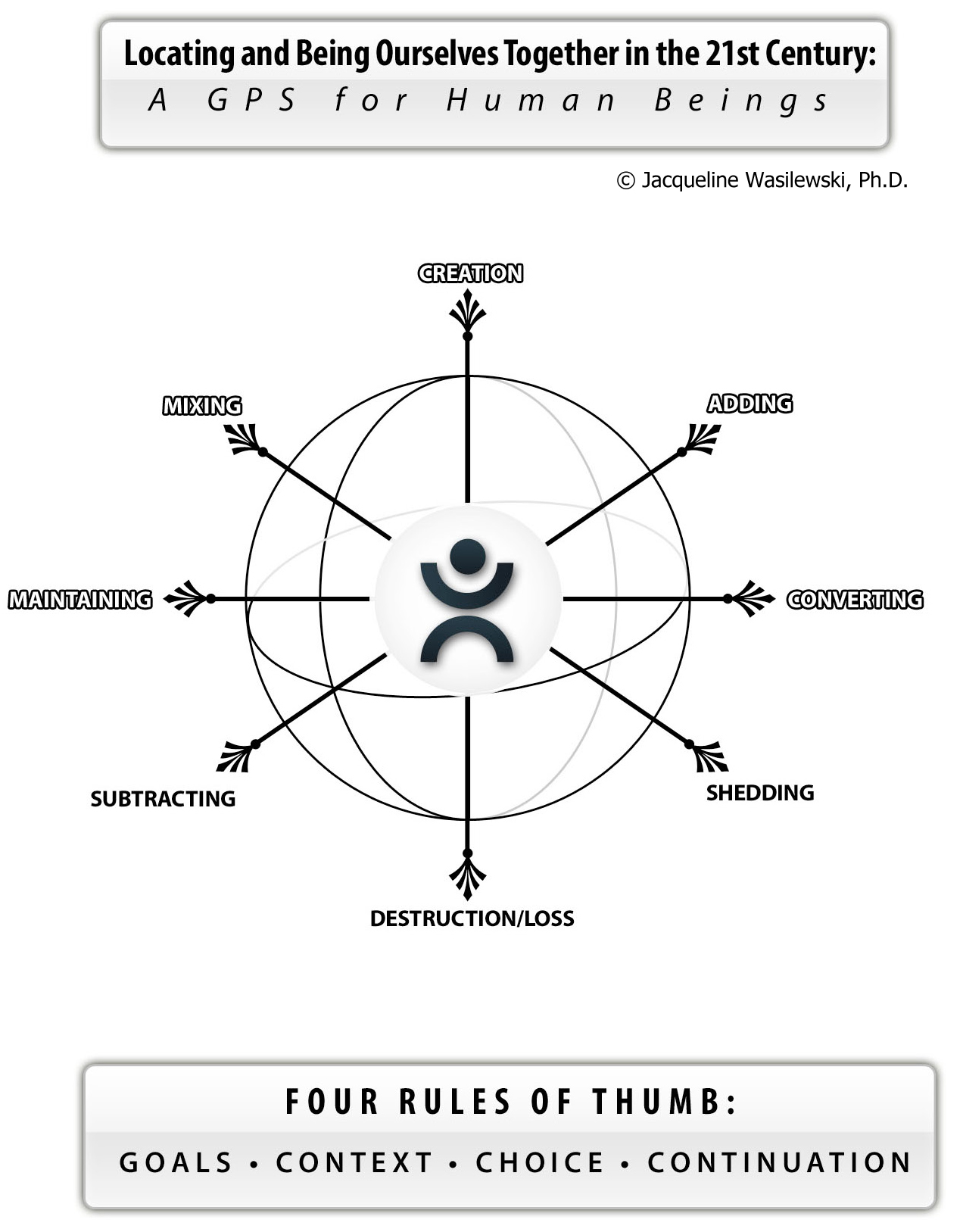
This graphic and the concepts underlying it are the work of Jackie Wasilewski.

“Collide-o-culture” or “Kaleid-o-culture”

I have long been a fan of Jackie Wasilewski’s. She is one of the brightest shining stars in our intercultural field, plus an all-around terrific human being and friend.

Her investigations are motivated by a couple of key objectives that dovetail beautifully with our work at Cultural Detective®:

  • How to include everyone (in her extended family at her holiday dinner table) in their full authenticity?
  • How to reconcile highly contrastive content (how to bridge), when it seems impossible to please everyone simultaneously?

Values ≠ Traditions
One point she makes is that values are not the same as traditions, and the two must not be confused. Values can be held while behavior is changed—a la Cultural Detective. Jackie told us in Spokane that when cultures get threatened, they get reified. That when cultures stop changing, they die. So, our quest needs to be, how to preserve and change, simultaneously?

GPS for Human Beings
Way back when Jackie conducted her Ph.D. research, she analyzed the personal histories of 192 multicultural people. That approach—learning from the inside-out rather than the outside-in, is also the Cultural Detectiveapproach.

One of the outcomes of her research was the graphic shown above, a “GPS” outlining paths to multiculturalism. The negative paths at the bottom of the sphere used to have only one label, subtracting, but over time this label has come to include destruction/loss and shedding, and Jackie tells us that the “choice” of this direction is often the result of oppression. However, this cluster of negative pathways also has a mysterious connection to the creation option at the top of the choice sphere. Sometimes the old has to be wiped away for the new to come into existence. At Cultural Detective we usually aim for mixing, creation, or adding. The final two options in her framework are maintaining and converting/assimilation. Here is a quote from the paper she presented:

To use this “GPS” effectively, each of us has to examine our goals and the characteristics of the context in which we are making the choice. Where do we want to end up? What are the opportunities and constraints of the environment in which we find ourselves? Where are our “degrees of freedom”? What are the costs and benefits of taking each direction? Which “direction” will lead us nearer our goal?

We have to imagine that we are like an aikido master standing in the center of a sphere consisting of the six options or “directions” [maintaining, converting, mixing, adding, creating and the subtractive cluster]. At each choice point, we have to consider all our options, just as if we were considering them for the very first time. None of these directions is better or worse. None is of higher or lower rank. Some are more complex to enact in a given context or set of circumstances. But the best choice is the appropriate one for enabling us to continue towards our goal in that particular context.

To manage these options productively people need a support network; a supra-ordinate goal; the ability to acknowledge their own complexity; the ability to transform negative emotional energy into positive energy; the ability flexibly to use the six options stated above; and at certain key moments, the ability to publicly stand for their full complexity so that new social space can be created.

“Collide-o-culture” or “Kaleid-o-culture”?
One of her definitions of “people power” is the web or sphere of interpersonal relationships we hold. Jackie tells us that if we think in relationships, then when we meet another individual we will realize that we are bringing together two communities. In her words, will it be “Collide-o-culture” or “Kaleid-o-culture”? If we see the relationships, we will be more motivated to try to understand.

Indigeneity and Respect
The concept of “indigeneity” emerged from work conducted by LaDonna Harris, a Comanche woman and political advocate, and Alexander Christakis, a systems scientist. They discovered that indigenous people and 20th century knowledge management specialists had similar approaches to the management of complex problems. The four principles they identified for organizing societies that are both inclusive and just are: Relationship, Responsibility, Reciprocity, and Redistribution. The result of these four R’s is a fifth: Respect. Goals of the ongoing work that has now been taken worldwide include maximum autonomy and maximum choice for the smallest units of society. To again quote Jackie’s SUSA paper:

Physician, therapist and healer, Brenda Davies (2007) says there is “nothing but communication.” Our truth, as we know it, is always what we are communicating. However, we have to be willing to update our truth every second. Our integrity is also a function of our truth as we know it. Each of us has a unique integrity based on our experiences. It constitutes our personal set of rules, but it too is always moving. Understanding another person’s integrity is the best we can do, and it allows us to love them separately from their behavior. The key would seem to be to create discursive spaces like the ones discussed above where we can all update our truth together and enable our mutual integrity to rise exponentially.

This is a VERY brief overview and of course does not do Jackie’s work adequate justice.  I trust it will motivate you to learn more about her work, and to use what she knows in order to use the Cultural Detective method and materials to the highest benefit. You can download a full copy of the paper she presented that this article summarizes.

(This post is taken in major part from an article I wrote in 2010.)

Una Jornada Intercultural con Dianne Hofner Saphiere

Mil gracias a todos los docentes que asistieron, y también a SIETAR Argentina y AFS Argentina y Uruguay. Juntos podemos construir un mundo mejor!


Julia's avatarSIETAR Argentina

483621_450767178324906_1898862114_nEste Abril 2013, tuvimos el agrado de coordinar, presenciar y participar de un evento internacionalmente reconocido ya que Dianne Hofner Saphiere* estuvo visitando la Argentina.

AFS** y SIETAR Argentina coordinaron el evento, junto también a representantes del Ministerio de Educación de la Ciudad de Buenos Aires que promocionó la jornada entre sus docentes.

La jornada tuvo dos partes. Una, por la mañana, dedicada a los docentes de la Ciudad de Buenos Aires y otra, por la tarde, para los profesionales interculturales.

Por la mañana, abrieron la jornada con palabras de bienvenida Juan Medici –Director Ejecutivo de AFS Argentina y Uruguay – y Ana María Ravaglia – subsecretaria de gestión educativa y coordinación  pedagógica del Ministerio de Educación del Gobierno de la Ciudad Autónoma de Buenos Aires.

Acto seguido, Dianne comenzó su presentación refiriéndose a la importancia de la comunicación intercultural como una clave para construir puentes. Con videos y análisis…

View original post 603 more words

Catalysts For Intercultural Conversations and Insights: Advertisements

Lipton tea Chinese flowersThis guest blog post is written by Joe Lurie, Executive Director Emeritus, University of California Berkeley’s International House.

Recently, I taught a course attended by Chinese and French students on the intercultural challenges of marketing across cultures. Midway through the course I asked students to select a print, web or YouTube ad describing how the following items reflected cultural preoccupations, values and behaviors in their cultures:

  • the product being promoted
  • the selection of words in the headers
  • the images and colors being used to reinforce the message

After analyzing the ad as a reflection of one’s culture, the student was to ask a fellow classmate from another culture why the ad would or would not work in their culture. In one example, a Chinese student demonstrated how Lipton tea is marketed in China. He noted that no tea bag was explicitly shown, as tea bags do not speak to the traditional way of preparing tea in China, and so not the best way to convince people to drink the Lipton product in China. Rather, the image was of green tea flowing from a cup on its side, producing green images in the style of Chinese paintings of mountains, fish and flowers, each with a particular symbolic value in Chinese culture. Lipton tea Chinese mountains The French student who was interviewed had no exposure to traditional Chinese painting and saw not lovely images, but rather incomprehensible splotches! He added that the ad would not work in France as tea drinkers are generally accustomed to black or brown teas.

Color in many other ads revealed the power and status implications of yellow in China, yet something to beware of in France where it often suggests infidelity. Below from a French student are two different ways that Volkswagon is promoted in China and France, reflecting a powerful individualistic/collectivistic contrast, and a terrific way for students to engage in a conversation of cultural discovery:

Below you will find an ad for a cleaning sponge selected by a French student, revealing what the student felt is a preoccupation with sex—reflected in explicit and other seductive ways in many other ads for other products in France. Sexual suggestions, so graphically portrayed, would not, according to the Chinese students in my class, be acceptable in Chinese product promotions. And in a French ad for BMW, a man is  shown making love to the body of a woman whose face is in fact a BMW!

BaijuuA Chinese ad for a very strong 38% alcohol rice beverage portrayed a bottle whose shape was interpreted by the French as a perfume bottle, and so it would not be a convincing way of promoting an alcoholic beverage there.

The bold red color signifying affluence and status for the Chinese was seen as over the top by the French students, who noted a preference in the French aesthetic for far more nuanced, muted colors. This prompted a spirited conversation between the Chinese and French in which it was revealed that ads with very high alcoholic content are discouraged or banned in France, but visual ads for condoms were common there, though not generally acceptable in China. That conversation ended with a comparison of toasting custom—the French “drink and sip” vs the Chinese GAMBAY or “bottoms up”—ALL at ONCE!

Should readers of this blog try this approach in their intercultural classes and training sessions, I hope you will consider sharing the fun and insights here….

—Joe Lurie
Executive Director Emeritus at the University of California’s International House, Joe is currently a cross-cultural communications consultant, university instructor and Cultural Detective certified facilitator. Contact Joe via email or LinkedIn.

You Trust a Quiz to Tell You Who You Are?

Your profile now!

Depp photo @Examiner
Honsou photo ©Armando Gallo/Retna Ltd

You may have had the same experience I have: clients, students, trainees and colleagues often ask me what assessment tools I recommend. My response, of course, is “for what purpose? What do you want to assess?” Sadly they usually can not answer that question. They know they want something online, something quick. They want something that provides immediate feedback, either inexpensively or for free. But, they rarely have focused in on a purpose, on what they want to learn through the “assessment.”

Sometimes I hear, “To give our people a profile of themselves—a profile of their style that tells them who and how they are.” The assumption is that, by understanding ourselves via this hypothetical quick, online, inexpensive or free assessment, we will immediately (almost magically) become empowered to collaborate more effectively across cultures.

Now don’t misunderstand me: assessments and inventories can be incredibly helpful tools. We are all better served by understanding our learning styles, personality traits, and communication skills. Taking a quick online assessment can also be fun. Heck, those quizzes in the magazines can be entertaining: What kind of personality am I in the bedroom based on whether the quiz says I’m more attracted to Johnny Depp or Djimon Honsou. I had fun just writing that sentence!

However, I can’t help but feel the world is just a WEE bit out of whack when we trust a personal profile, produced by a quick survey, more than we trust our own 20, 50 or more years of experience living with and as ourselves. Profiles can be informative: they can stimulate thinking and conversation. But they are not going to, in and of themselves, improve my ability, either in the bedroom or to work cross-culturally.

What causes us to want a profile? We are by and large intelligent people. We are adults. We know ourselves. Many of us want the quick and easy “answer” because our days are so full. Many of us don’t take time for contemplation, practice, or deep meaningful dialogue—even though these are precisely the acts via which wisdom, happiness and, yes, competence are achieved.

Let’s face it: intercultural competence, like all the other important abilities in life (good parenting, sound health, even skills with technology) involves PRACTICE. We need to stay current, we need to both broaden and deepen our abilities and experience.

So, keeping in mind the importance of HOW we use assessment tools, and the importance of a regular structured practice to improve our abilities, there are a handful of “profile” tools in the cross-cultural field that I find useful. Why do I like these particular instruments? They involve or encourage the contemplation, practice and deep meaningful dialogue of which I’ve written, and that research shows is required in order to improve cross-cultural competence. Some tools I can recommend are:

  1. Cultural Detective Self Discovery: This unique product in the Cultural Detective series helps individuals to investigate their cultural identities and develop a “Personal Values Lens.” Through a structured sequence of short exercises and discussions, individuals identify their core values, the positive and negative aspects of these values, and the thinking and behavior that flows from them. They then explore how their values and behaviors may be similar to and different from those of cultural groups. This Personal Values Lens can be used in conjunction with the Cultural Detective Online system for individualized structured learning, or, better yet, with the guidance of a facilitator or coach.
  2. The International Profiler: This terrific tool by our friends and colleagues at WorldWork involves a web-based psychometric questionnaire, followed by coaching sessions, to help develop an individual’s ability to operate effectively in unfamiliar cultural contexts. Nigel Ewington has been piloting ways of combining The International Profiler (TIP) and Cultural Detective (CD), to harness the best of both. Perhaps we can ask him to do a guest post about that?
  3. Personal Leadership: This methodology offers a way of being and interacting with the world that begins from the “inside out,” one that asks people to be fully present in their lives, awake to their habitual behaviors, and willing to look at situations with “beginner’s mind.” Of particular interest in this context is the personal visioning practice. Barbara Schaetti and Heather Robinson and I have created a MashUp process aimed at leveraging the dynamic interaction possible with Personal Leadership (PL) and Cultural Detective (CD).
  4. The Intercultural Development Inventory (IDI), originally based on the Developmental Model of Intercultural Sensitivity (DMIS), is a statistically reliable, cross-culturally valid measure of intercultural sensitivity. What I love about it is that it is developmental: great for charting individual or group progress. It can be completed online, with the assistance of a qualified administrator, and involves individualized feedback. Ideally the IDI is used as part of a process that also involves development planning and coaching.

We can have all the information in the world about ourselves, but if we do not have the courage and diligence to act on it, it is worth very little. None of the tools discussed above provides instantaneous transformation or the magic pixie dust of cross-cultural collaboration. Nor, I imagine, will they give me an evening with either Johnny or Djimon. But with ongoing, mindful practice and the guidance of a good coach or trainer, we will find worlds open to us that we might never have imagined, and we will develop the ability to collaborate more effectively across cultures—exactly what many of our clients are asking for. Each of the tools above dovetails very well with the Cultural Detective Series: TIP and IDI can help you chart progress using CD as a developmental tool, and PL helps ensure the inner work that should accompany CD use happens.

There are many more inventories, assessments and collaborative tools in the intercultural field. What are some of your favorites? How do you use them for maximum effectiveness? How do you motivate yourself and others to practice? What do you wish existed to address specific developmental needs and challenges?

Research Findings: The Value of Intercultural Skills in the Workplace


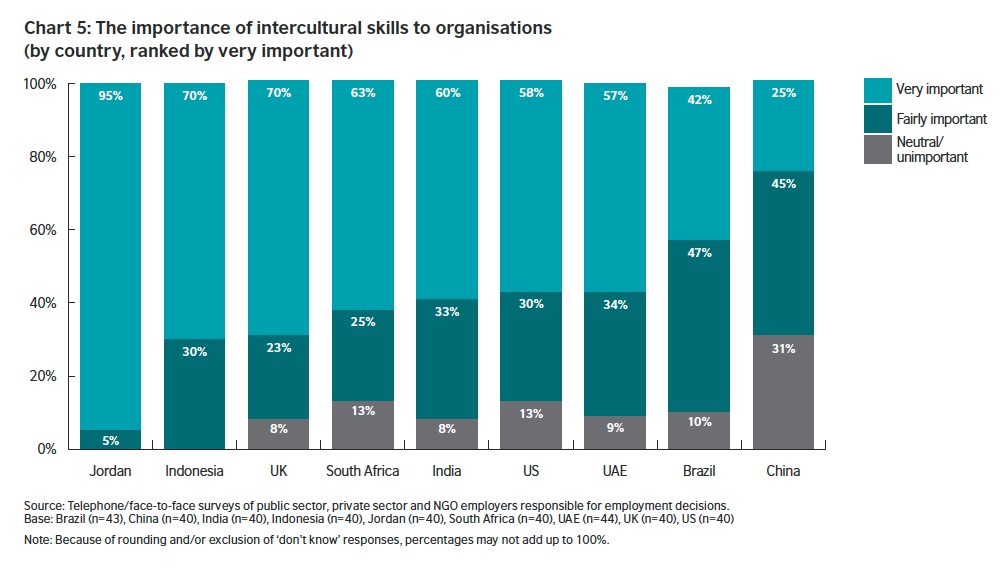
IC Skills importance
Culture at Work: The value of intercultural skills in the workplace
—A survey conducted by the British Council, Booz Allen Hamilton and Ipsos Public Affairs, of HR managers at 367 large employers in nine countries: Brazil, China, India, Indonesia, Jordan, South Africa, the United Arab Emirates (UAE), the United Kingdom (UK), and the United States (US)

The Report’s Conclusions

“Our ability to engage successfully with other countries, organisations and people will depend to a large extent on whether we possess the necessary intercultural and foreign language skills to make fruitful connections, whether in trade and investment, charity/NGO programmes or as government and international organisations. This is fundamentally changing the way in which employers value and seek to develop intercultural skills in the workplace.”

“More and more business leaders are identifying real business value in employing staff with intercultural skills. These skills are vital, not just in smoothing international business transactions, but also in developing long term relationships with customers and suppliers. Increasingly they also play a key role within the workplace, enhancing team working, fostering creativity, improving communication and reducing conflict. All this translates into greater efficiency, stronger brand identity, enhanced reputation and ultimately impact on the bottom line.”

“Employers believe that intercultural skills are integral to the workplace.”

“A common challenge shared by employers around the world is finding employees with adequate intercultural skills. Given that the operating environments of all organisations is increasingly global, it comes as no surprise that employers need employees who can understand and adapt to different cultural contexts.”

What is the international reality in the workplace?

The research shows that employees in most large companies surveyed engage in extensive interaction across international borders.

More than two thirds of employers report that their employees engage frequently with colleagues outside of their country, and over half say that their employees engage frequently with partners and clients outside of their country.

THE BUSINESS VALUE OF INTERCULTURAL SKILLS
Intercultural skills provide business value and help mitigate risk.

The research shows that HR managers associate intercultural skills with significant business benefits. Overall, the organisations surveyed are most interested in intercultural skills for the benefits they bring—benefits that carry significant monetary value to employers:

  • Keeping teams running efficiently
  • Good for reputation
  • Bringing in new clients
  • Building trust with clients
  • Communicating with overseas partners
  • Able to work with diverse colleagues
  • Increased productivity
  • Increased sales

Employers also see significant risk to their organisations when employees lack intercultural skills. Top risks that organisations surveyed are concerned about are:

  • Miscommunication and conflict within teams
  • Global reputational damage
  • Los of clients
  • Cultural insensitivity to clients/partners overseas
  • Project mistakes

How do the organisations surveyed define “intercultural skills”?

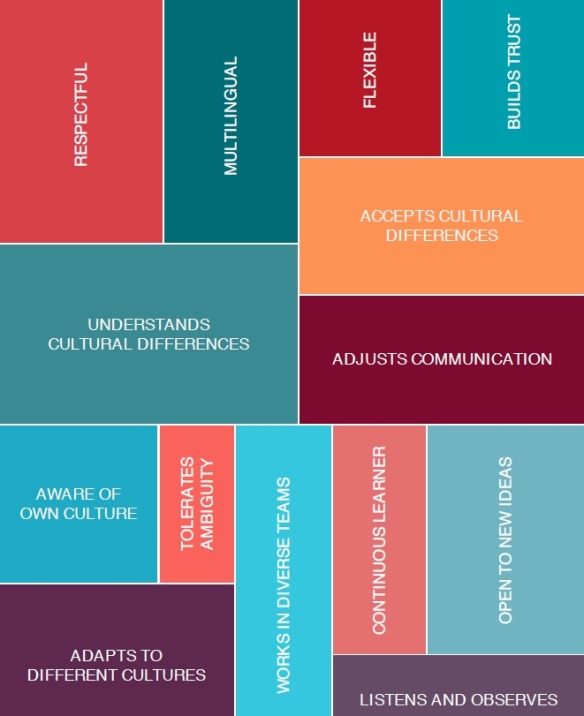
The graphic below shows the words employers used, with size of the block equating to frequency of use.

define%22interculturalskills

The terms employers use to define intercultural skills
Source: Telephone/face-to-face surveys of public sector, private sector and NGO employers responsible for employment decisions. Base: Ipsos Public Affairs, 2012: Global (n=367).

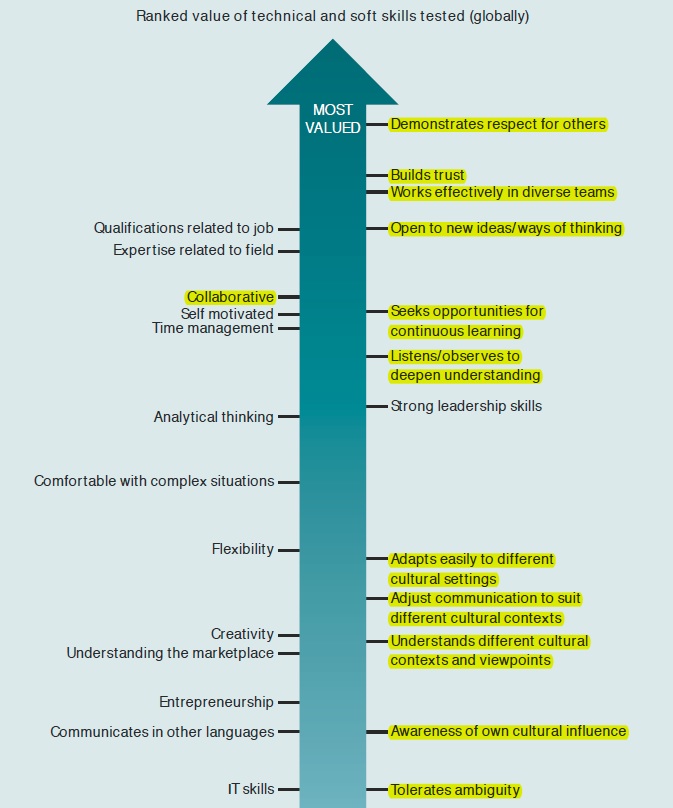
In particular, employers highlight the following as important intercultural skills that they look for in job candidates:

  • the ability to understand different cultural contexts and viewpoints
  • demonstrating respect for others
  • accepting different cultural contexts and viewpoints
  • openness to new ideas and ways of thinking
  • knowledge of a foreign language.

How employers rank different skills in terms of importance

valuedskills

Graphic © the original report, with yellow highlights added by Cultural Detective.

How does the research indicate these skills are developed?

Most employers report encouraging their staff to develop intercultural skills through in-house training, meetings and events. However, employers also say that educational institutions could do more to equip students with intercultural skills.

The findings suggest that policy makers and education providers could do more to contribute to the development of a workforce with the necessary intercultural skills through interventions, such as prioritising:

  • teaching communication skills
  • offering foreign language classes
  • availability of opportunities for students to gain international experience
  • development of international research partnerships.

This research suggests that there is significant opportunity for employers, policy makers and education providers to work together to strengthen the development of intercultural skills to meet the needs of an increasingly global workforce.

Entre Dios y Alá

(English follows Spanish)

Si pudiera resumir las noticias de las últimas dos semanas, podría sin duda mencionar dos nombres: Benedicto XVI y Hugo Chávez.

El primero desafió toda una organización, un sistema, una tradición. Hoy que escribo esta nota los noticieros hablan del humo blanco saliendo de la Capilla Sixtina que anuncie que hay un nuevo Papa. No me alcanzo a imaginar todos los cambios organizacionales a los que se enfrenta la Iglesia Católica para adaptarse a este nuevo cambio de innegable impacto mundial.

Por otro lado, tenemos la muerte del presidente de Venezuela Hugo Chávez. Los análisis políticos por supuesto han sido los protagonistas de su partida. Pero no podemos dejar de lado ese aspecto que nos une en este espacio de comunicación.

En medio de la sobre-exposición de la noticia en los medios, incluyendo detalles de su vida, su gobierno, sus frases célebres, visitas a países socialistas etc, está una noticia que este lado del mundo apenas menciona.

La foto del presidente de Irán, Mahmud Ahmadineyad, expresando sus condolencias a la madre del presidente Chávez ha causado no menos que indignación en su país y los países que siguen los preceptos islámicos.

Lo que para nosotros puede parecer normal, entendible y simplemente humano al brindar consuelo en un abrazo a alguien que vive el dolor profundo del duelo, en otra latitud no es más que el irrespeto a lo que ordena su ley, la cual indica que no debe haber contacto físico entre un hombre y una mujer si no es de su círculo cercano.

No siempre podemos entonces actuar como actúan otros, es decir a la tierra que vamos hacer lo que vemos. No siempre podemos adaptarnos a otro entorno, a pesar que podamos sentir la inclinación natural a ello.

Las culturas abiertas podríamos describirlas como permeables a otras culturas, donde son fácilmente identificables y permitidos otros valores, costumbres, tradiciones siempre y cuando prevalezca el interés común sobre el particular. Por el contrario, las culturas cerradas son herméticas y poco o nada tolerantes a las demás. El caso que enfrenta al presidente Ahmadineyad es una muestra clara, y atizado además, por comparar al presidente Chávez con Jesucristo.

Se unen de nuevo alrededor de Dios, de nuestras creencias religiosas los dos hechos noticiosos que mantienen en vilo al mundo entero.

Católicos y no católicos pendientes del Vaticano. Entre tanto el mundo Islámico levantando su voz de protesta por un hecho a todas luces, para ellos totalmente inadmisible hasta para un jefe de Estado.

Entre Dios y Alá, entre Dios y Dios. Hasta la próxima.

Between God and Allah, translation by Dianne Hofner Saphiere

If I were to summarize the news of the last two weeks, I could without doubt mention two names: Benedict XVI and Hugo Chávez.

The first challenged an entire organization, a system, a tradition. Today as I write this note there is news in the white smoke coming out of the Sistine Chapel announcing that there is a new Pope.  I can’t begin to imagine all the organizational changes that confront the Catholic Church as it adapts to this new change of undeniable worldwide impact.

On the other hand, we have the death of Hugo Chávez, the President of Venezuela. The political analyses have of course been the protagonists of his departure. But we can not ignore that aspect which unites us in this communication space. Amid the over-exposure of the news media, including the details of his life, his government, his famous phrases, and his visits to socialist countries, etc., lies a story that this side of the world barely mentioned.

This photo of Iranian President Mahmoud Ahmadinejad, expressing his condolences to the mother of President Chávez, has caused no minor indignation in his country and in the countries of the world that follow Islamic principles. What to us may seem normal, understandable, and simply the human act of providing comfort with a hug to someone living the deep pain of grief, in another latitude is nothing more than disrespect to the order of law, which indicates there should be no physical contact between a man and a woman not within the same inner circle.

We cannot always behave as others do, that is to say, doing what we see in the land to which we travel. We cannot always adapt ourselves to another environment, although we might feel the natural inclination to do so.

Open cultures could be described as permeable to other cultures, those in which other values, customs, and traditions are easily identifiable and permitted as long as the common interest in the matter is maintained. By contrast, closed cultures are hermetic, and not so tolerant of others. The case facing President Ahmadinejad is a clear case in point, further stoked by comparisons of Hugo Chávez with Jesus Christ.

Our religious beliefs join again around God, in the two big news items that have captivated the world. Catholics and non-Catholics watching the Vatican. The Muslim world raising its voice in protest to an act committed openly, which for them is completely inadmissible for a Head of State.

Between God and Allah, between God and God. See you soon!

“Signs” of Cross-cultural Difference: Lydia Callis

Cultural Detective Deaf CultureIt seems I missed a huge fifteen minutes of fame during Superstorm Sandy. Such frequently happens to me, living in the “provincias” of Mexico as I do.

The events I mention involve NYC Mayor Bloomberg’s sign language interpreter, Lydia Callis. Reactions by the Hearing community to Lydia’s powerful interpreting skills were discussed on prime-time news and talk shows domestically and internationally. Parodies of Lydia signing appeared on a seemingly endless array of radio and television shows and internet sites.

Mayor Bloomberg deserves major kudos for including sign language interpreting in all major press conferences during the state of emergency. Not only did it convey important information to a large number of people, it raised awareness of the Deaf community and created opportunities for Hearing people to learn about American Sign Language (ASL), professional ASL interpreters and Deaf Culture. There is little question that Lydia is a skilled professional who loves her job. Want to see her in action? A video is below. (My apologies to those of you reading this from places where you are unable to access YouTube. And, the video does not include closed captioning.)

We all know that it usually takes controversy to create those fifteen minutes of fame. So where was the controversy? It centered around some in the Hearing community’s perception of the “animated” nature of Lydia’s “whole body” interpreting.

Just read some of the viewers’ comments posted to the video above: Lydia’s signing is “dumb,” “weird,” and one person types that Lydia looks like a “mime.” These are comments that come from a lack of understanding, from ignorance; they provide—or rather, demand—an opportunity for education.

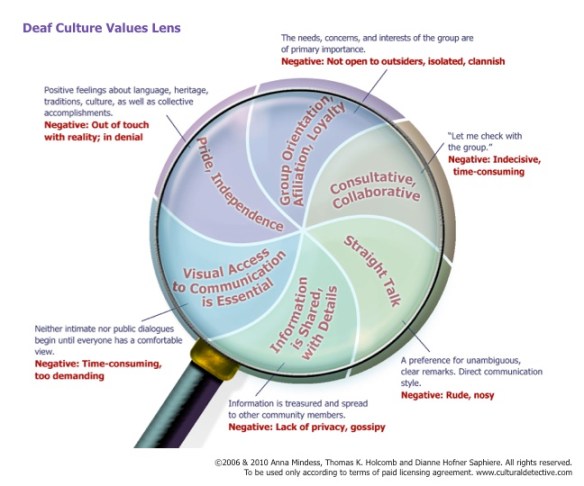
This is exactly the classic Cultural Detective “critical incident”: one person behaving correctly according to the values of her (Deaf) culture, while “outsiders” (Hearing culture) negatively judge that same behavior. One of the strengths of the Cultural Detective series is that each of our Values Lenses includes the Negative Perceptions that may frequently accompany the positive application of values, as does our CD Deaf Culture Lens.

If we take a look at the Deaf Culture Values Lens image above, it’s easy to understand why members of the Deaf community could take serious offense at such evaluative comments. The Mayor understood it was important to get information to everyone. For some in the Deaf community ASL is their first language, not English. This was a way to ensure accurate information was communicated to the Deaf and Hearing communities simultaneously. Signing and universal access were finally getting the attention and respect they deserved.

Then came the spoofs. The icon of US late-night comedy, Saturday Night Live, aired a parody that involved an actual ASL interpreter playing Lydia’s role and using funny signs for “President Obama” (his big ears), “pizzazz” (jazz hands), and quite a few other terms. The SNL skit included a comedic contrast of New York City vs. New Jersey communication styles, as reflected by the two mayors and their interpreters, a spoof of Bloomberg’s poor Spanish, and a send-up of “white” US culture. Want to take a look?

Like any comedy, spoofs can offend, and this one is potentially offensive to interpreters, Deaf people, New Yorkers, people from New Jersey, Latinos and “las personas blancas.” No doubt I’m missing someone here! While I personally find this skit pretty funny, Oscar-winning actress Marlee Matlin, who is deaf, publicly stated that the skit was very offensive.

A Deaf commentator (video below) discussed this situation, and I find it quite interesting to view his take on the situation. Just the fact that he signs it (fairly silently), and that the video does include English language closed captioning, provides a bit of an immersion experience with which many of us who hear may not be familiar. This commentator is not using ASL nor any other of the world’s naturally evolved sign languages, but a more recent pidgin called International Sign, for accessibility to the greatest numbers of Deaf viewers.

So, what can we learn from all of this? Taking a look at Cultural Detective Deaf Culture, we learn that:

  1. Sign language is not universal: “Almost every country in the world has sign language; some even have more than one, as is the case in Canada, with ASL and LSQ (Langue de Signes Quebecois), and Switzerland, which has Swiss-German, Swiss-French and Swiss-Italian Sign Languages.” Like any of the world’s languages, some of these are more inter-related than others.
  2. Lydia’s “animated” interpreting is due to the fact that ASL, as most of the world’s other sign languages, uses facial expressions for grammatical features and emphasis. Again, quoting from CD Deaf Culture: “There are several common features of Deaf people’s language use… An example would be the use of adverbs in signed languages. Although the signs for actions such as ‘working’ and ‘driving’ vary from one sign language to another, inflecting these verbs (for example, ‘working hard’ or ‘driving very fast’) would probably not be accomplished by adding a second, distinct sign, but by altering the manner of making the action sign, including the use of facial grammar.” What a Hearing person might perceive as “animated,” a Deaf person perceives as clarity and accuracy of communication.
  3. Another quick look at the Deaf Culture Values Lens image above will show us why so many people were so deeply offended by the satires of Lydia’s interpreting. Deaf Culture values include pride, loyalty, and group orientation; of course satire could be offensive. Another value is straight talk, a reason so many may have spoken out so quickly and clearly. Here is an opportunity for clarity, for helping the Hearing world understand there is a Deaf Culture. Again, quoting from CD Deaf Culture: “It is often said that language determines culture, and this is true for Deaf people all over the world. Since Deaf people do not have easy access to the spoken languages that surround them, signed languages have developed over hundreds of years, in almost every part of the world, as the most natural mode for communicating. Shared language, traditions, folklore, a strong identity, and a sense of group cohesion work together to create a Deaf culture. “
  4. Finally, according to Anna Mindess, co-author of Cultural Detective Deaf Culture, “The kind of work ASL interpreters often do is interpreting between one deaf person and one hearing person, where we can judge the educational level and language style of the Deaf person involved. However, Lydia was interpreting for anyone who happened to be watching TV (in NY that certainly included foreign-born Deaf people who may not have full command of ASL and deaf people with more or less educational experience) so that’s another reason she made her interpretation so broad as to be clear to the largest possible audience.” Lydia herself, in the Registry of Interpreters for the Deaf, said, “I knew my audience was going to be very broad. I decided to provide as much access for the Deaf Community that I could by mouthing the words and using ASL so that people who fit all along the spectrum could understand what was being interpreted.”

There is much that the Hearing have to learn about Deaf Culture. I urge you to logon to Cultural Detective Online and take a deeper look at Cultural Detective Deaf Culture, authored by Thomas Holcomb and Anna Mindess. In the package resources there you will see links to other tools, including the terrific books and DVDs from Deaf Culture THAT.

I’d also like to share with you three other resources on this topic that I found interesting.

  1. The first is a quick and insightful read I found that explains some of the signs Lydia used, entitled “Why Do Sign Language Interpreters Looks so Animated?”
  2. The second is a great blog post by Kambri Crews, a child of deaf parents who explains both “sides” of the controversy and demonstrates the danger of right/wrong thinking.
  3. And the third is an interesting piece in Forbes Magazine in response to the Lydia Callis buzz, this one on the more general topic of interpreting and translating and their role in our world today.

Please let me know what you think about all of this. What role do those of us building cross-cultural understanding and collaboration have to play? How can we support interpreters as they work to translate not only the message but also the meaning?

I’ve been told that we have a special offer for those of you who read through this post all the way to the very end! You get to take a look at Cultural Detective Deaf Culture in our CD Online version (plus all the other good stuff in there), free for a period of three days. Redeem the code below now through April 12, 2013.

  1. Go to http://www.culturaldetective.com/cdonline/orders/trial
  2. Enter your name and email address where indicated. The email address you enter will be your user ID and will be validated before you can use your subscription.
  3. Enter the promotional code <    Callis2013   > in the last box.
  4. In a few minutes you should receive an email from
    cdonline@culturaldetective.com
    This email may go into your junk or spam folder. To avoid this, please add our cdonline email address to your approved senders list.
  5. In the email you receive there will be link to verify your email. Click that link and follow the instructions in the email and you will be all set.