“Signs” of Cross-cultural Difference: Lydia Callis

Cultural Detective Deaf CultureIt seems I missed a huge fifteen minutes of fame during Superstorm Sandy. Such frequently happens to me, living in the “provincias” of Mexico as I do.

The events I mention involve NYC Mayor Bloomberg’s sign language interpreter, Lydia Callis. Reactions by the Hearing community to Lydia’s powerful interpreting skills were discussed on prime-time news and talk shows domestically and internationally. Parodies of Lydia signing appeared on a seemingly endless array of radio and television shows and internet sites.

Mayor Bloomberg deserves major kudos for including sign language interpreting in all major press conferences during the state of emergency. Not only did it convey important information to a large number of people, it raised awareness of the Deaf community and created opportunities for Hearing people to learn about American Sign Language (ASL), professional ASL interpreters and Deaf Culture. There is little question that Lydia is a skilled professional who loves her job. Want to see her in action? A video is below. (My apologies to those of you reading this from places where you are unable to access YouTube. And, the video does not include closed captioning.)

We all know that it usually takes controversy to create those fifteen minutes of fame. So where was the controversy? It centered around some in the Hearing community’s perception of the “animated” nature of Lydia’s “whole body” interpreting.

Just read some of the viewers’ comments posted to the video above: Lydia’s signing is “dumb,” “weird,” and one person types that Lydia looks like a “mime.” These are comments that come from a lack of understanding, from ignorance; they provide—or rather, demand—an opportunity for education.

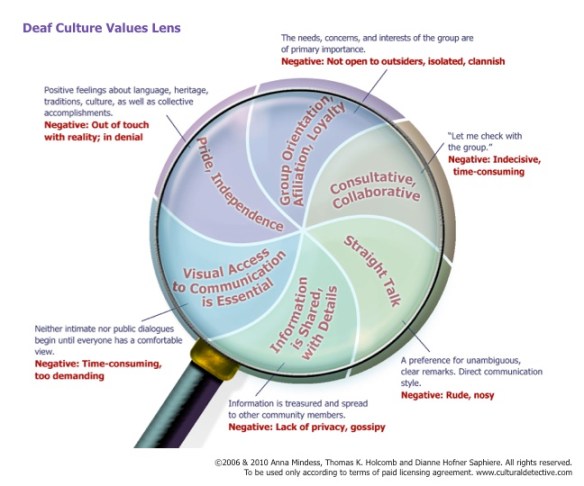
This is exactly the classic Cultural Detective “critical incident”: one person behaving correctly according to the values of her (Deaf) culture, while “outsiders” (Hearing culture) negatively judge that same behavior. One of the strengths of the Cultural Detective series is that each of our Values Lenses includes the Negative Perceptions that may frequently accompany the positive application of values, as does our CD Deaf Culture Lens.

If we take a look at the Deaf Culture Values Lens image above, it’s easy to understand why members of the Deaf community could take serious offense at such evaluative comments. The Mayor understood it was important to get information to everyone. For some in the Deaf community ASL is their first language, not English. This was a way to ensure accurate information was communicated to the Deaf and Hearing communities simultaneously. Signing and universal access were finally getting the attention and respect they deserved.

Then came the spoofs. The icon of US late-night comedy, Saturday Night Live, aired a parody that involved an actual ASL interpreter playing Lydia’s role and using funny signs for “President Obama” (his big ears), “pizzazz” (jazz hands), and quite a few other terms. The SNL skit included a comedic contrast of New York City vs. New Jersey communication styles, as reflected by the two mayors and their interpreters, a spoof of Bloomberg’s poor Spanish, and a send-up of “white” US culture. Want to take a look?

Like any comedy, spoofs can offend, and this one is potentially offensive to interpreters, Deaf people, New Yorkers, people from New Jersey, Latinos and “las personas blancas.” No doubt I’m missing someone here! While I personally find this skit pretty funny, Oscar-winning actress Marlee Matlin, who is deaf, publicly stated that the skit was very offensive.

A Deaf commentator (video below) discussed this situation, and I find it quite interesting to view his take on the situation. Just the fact that he signs it (fairly silently), and that the video does include English language closed captioning, provides a bit of an immersion experience with which many of us who hear may not be familiar. This commentator is not using ASL nor any other of the world’s naturally evolved sign languages, but a more recent pidgin called International Sign, for accessibility to the greatest numbers of Deaf viewers.

So, what can we learn from all of this? Taking a look at Cultural Detective Deaf Culture, we learn that:

  1. Sign language is not universal: “Almost every country in the world has sign language; some even have more than one, as is the case in Canada, with ASL and LSQ (Langue de Signes Quebecois), and Switzerland, which has Swiss-German, Swiss-French and Swiss-Italian Sign Languages.” Like any of the world’s languages, some of these are more inter-related than others.
  2. Lydia’s “animated” interpreting is due to the fact that ASL, as most of the world’s other sign languages, uses facial expressions for grammatical features and emphasis. Again, quoting from CD Deaf Culture: “There are several common features of Deaf people’s language use… An example would be the use of adverbs in signed languages. Although the signs for actions such as ‘working’ and ‘driving’ vary from one sign language to another, inflecting these verbs (for example, ‘working hard’ or ‘driving very fast’) would probably not be accomplished by adding a second, distinct sign, but by altering the manner of making the action sign, including the use of facial grammar.” What a Hearing person might perceive as “animated,” a Deaf person perceives as clarity and accuracy of communication.
  3. Another quick look at the Deaf Culture Values Lens image above will show us why so many people were so deeply offended by the satires of Lydia’s interpreting. Deaf Culture values include pride, loyalty, and group orientation; of course satire could be offensive. Another value is straight talk, a reason so many may have spoken out so quickly and clearly. Here is an opportunity for clarity, for helping the Hearing world understand there is a Deaf Culture. Again, quoting from CD Deaf Culture: “It is often said that language determines culture, and this is true for Deaf people all over the world. Since Deaf people do not have easy access to the spoken languages that surround them, signed languages have developed over hundreds of years, in almost every part of the world, as the most natural mode for communicating. Shared language, traditions, folklore, a strong identity, and a sense of group cohesion work together to create a Deaf culture. “
  4. Finally, according to Anna Mindess, co-author of Cultural Detective Deaf Culture, “The kind of work ASL interpreters often do is interpreting between one deaf person and one hearing person, where we can judge the educational level and language style of the Deaf person involved. However, Lydia was interpreting for anyone who happened to be watching TV (in NY that certainly included foreign-born Deaf people who may not have full command of ASL and deaf people with more or less educational experience) so that’s another reason she made her interpretation so broad as to be clear to the largest possible audience.” Lydia herself, in the Registry of Interpreters for the Deaf, said, “I knew my audience was going to be very broad. I decided to provide as much access for the Deaf Community that I could by mouthing the words and using ASL so that people who fit all along the spectrum could understand what was being interpreted.”

There is much that the Hearing have to learn about Deaf Culture. I urge you to logon to Cultural Detective Online and take a deeper look at Cultural Detective Deaf Culture, authored by Thomas Holcomb and Anna Mindess. In the package resources there you will see links to other tools, including the terrific books and DVDs from Deaf Culture THAT.

I’d also like to share with you three other resources on this topic that I found interesting.

  1. The first is a quick and insightful read I found that explains some of the signs Lydia used, entitled “Why Do Sign Language Interpreters Looks so Animated?”
  2. The second is a great blog post by Kambri Crews, a child of deaf parents who explains both “sides” of the controversy and demonstrates the danger of right/wrong thinking.
  3. And the third is an interesting piece in Forbes Magazine in response to the Lydia Callis buzz, this one on the more general topic of interpreting and translating and their role in our world today.

Please let me know what you think about all of this. What role do those of us building cross-cultural understanding and collaboration have to play? How can we support interpreters as they work to translate not only the message but also the meaning?

I’ve been told that we have a special offer for those of you who read through this post all the way to the very end! You get to take a look at Cultural Detective Deaf Culture in our CD Online version (plus all the other good stuff in there), free for a period of three days. Redeem the code below now through April 12, 2013.

  1. Go to http://www.culturaldetective.com/cdonline/orders/trial
  2. Enter your name and email address where indicated. The email address you enter will be your user ID and will be validated before you can use your subscription.
  3. Enter the promotional code <    Callis2013   > in the last box.
  4. In a few minutes you should receive an email from
    cdonline@culturaldetective.com
    This email may go into your junk or spam folder. To avoid this, please add our cdonline email address to your approved senders list.
  5. In the email you receive there will be link to verify your email. Click that link and follow the instructions in the email and you will be all set.

Healing the Wounds of History

Playback Theatre

Armand Volkas

Cultural Detective is about collaboration, authenticity, respect, and bridging differences. The CD Method has long leveraged drama — primarily through the acting out and resolution of critical incidents — as it involves our whole person: body, heart, head and spirit.

I was delighted to learn recently about one colleague who combines our goals with one of our favorite techniques in incredibly powerful ways! On a daily basis I am astounded by and grateful for the unique contributions you, our Cultural Detective community, make to the world around us, and I’m eager to share with you this latest example.

Armand Volkas is a psychotherapist and drama therapist, the son of Auschwitz survivors and resistance fighters from World War II. He is also the life partner of Anna Mindess, frequent Cultural Detective Series editor and co-author of CD Deaf Culture.

Armand created a process called “Healing the Wounds of History,” in which a group of people sharing a common legacy of historical trauma (Germans and Jews; Palestinians and Israelis; Japanese, Chinese and Koreans; African-Americans and European-Americans, to name a few) use experiential techniques to transform the pain of such legacies into constructive action.

Healing the Wounds of History is based on the premise that there can be no political solutions to intercultural conflict until we understand and take into consideration the needs, emotions and unconscious drives of the human being.”

The project involves:
  • Breaking the taboo against “enemies” speaking to each other.
  • Humanizing each other through sharing our personal stories.
  • Taking steps towards healing personal and collective wounds using creative and experiential methods.
  • Transforming historical trauma into constructive action and service.

While unfortunately the sensitive nature of Armand’s work doesn’t lend itself to filming, those of you interested in a deeper feel for it can read through the transcript of one of his keynotes, which was acted out by members of a theater ensemble as well as Armand himself.

For more information on or to support the Healing the Wounds of History project contact Armand Volkas at +1 (510) 595-5500, Ext 11 or via email at info@livingartscenter.org

As They Say in Russia

OLYMPUS DIGITAL CAMERAGuest blog by Tatyana Fertelmeyster, Co-author of Cultural Detective Russia and Senior Trainer of Facilitators

There is a Russian saying, “If a face is ugly, don’t blame the mirror.” I have been thinking about it lately as the topic of Russia has come up in different mirrors, and it is not looking all that good.

In addition to all these, Human Rights Watch, in its World Report 2013, addresses a long list of concerns, concluding that 2012 was “the worst year for human rights in Russia in recent memory,” according to  Hugh Williamson, Europe and Central Asia Director at Human Rights Watch.

The official Russian response to all of that? It is complex, nuanced, and as contextual as everything in Russia. And most often it is about blaming the mirror or whoever is putting this mirror in front of Russia’s face. Just in the last few months Russia enacted laws that

  1. Require NGOs with any foreign funding to register as “foreign agents”,
  2. Reinterpret treason so broadly that almost anybody cooperating with foreigners can be — if necessary — accused of selling out the Motherland,
  3. Prohibit Russian orphans to be adopted by US Americans.

Two other very common Russian sayings come to mind:

  • “I am a fool? You are a fool yourself!” and
  • “Don’t teach me how to live my life!”

Considering that Russia is the largest country in the world, with the seventh largest domestic market and the second largest nuclear arsenal, it might be useful to know what they say in Russia. And it will be priceless to understand what they mean when they say it.

Cultural Detective Russia is available in our new Cultural Detective Online system. I hope you’ll give it  whirl and see how it might help make meaning of some of this.

Tatyana Fertelmeyster, Co-author of Cultural Detective Russia
Connecting.differences@gmail.com

Global Teams in Theory and in Practice

Global-TeamGuest post by Vicki Flier Hudson

I once heard a Zen Buddhist monk say that the definition of suffering is the gap between what is and what we think should be. The wider that gap, the more we experience stress. Today’s global virtual team, without the right tools, might end up spending a lot of time in that gap. Most teams want to becoming high-performing units with all individuals feeling valued, all cultures being respected, and all tasks getting completed on time. The reality can look quite different, however. In today’s taxing environment, many teams find themselves reacting to fires, completing their tasks but without the benefit of time for intentional reflection or action.

As an intercultural practitioner I’ve had the privilege of working with a variety of global teams in industries from manufacturing to finance. Many of them display similar characteristics. They are often comprised of talented individuals who appreciate cultural diversity and want to collaborate effectively. But why do few teams achieve that vision? What causes the gap between that desire to collaborate and the reality of division or confusion?

So many factors play into the health of a global team, some of which defy explanation — call it chemistry, dynamics, or magic. Some of the factors, however, are more visible. For example, I see many teams become misaligned because they do not have proper communication protocols in place. They make false assumptions about shared understanding of terms or processes which can delay projects. Cultural differences also play a significant role in the effectiveness of global teams. Team members might run into disparate cultural approaches to a project, and rather than observe the problem objectively they immediately begin jumping to conclusions and/or negative evaluations. This premature leap can cause them to chase down incorrect solutions and again delay the project. Also, the team may not take full advantage of the diverse perspectives and resources that the members provide.

How do we close this gap between the theory of a collaborative team and the practice of one? First, a global team must realize that intercultural competence is a learned skill, in some ways like welding or computer programming. Cross-cultural skills may be harder to acquire or measure, but they must be studied and practiced. Cultural Detective Online is an incredible tool for global teams to unite around and hone their intercultural proficiency.

CD Online makes it possible, for example, for teams represented in fifteen countries to come together in a virtual training room and explore several important aspects of collaboration. First, they learn to separate objective facts from their perceptions of situations. That skill alone can increase team trust dramatically. Then they learn through what lenses their colleagues might be looking, and how those values impact the outcome of a business problem. Imagine eighteen members of a global team, all online and on the phone, working through a CD Online scenario together that illuminates the values of cultures they work with every day. Everyone gets to contribute and they physically practice those vital cross-cultural skills right there in the training.

I feel a great sense of excitement about what Cultural Detective Online does to increase the effectiveness of global teams, and not just in theory. Join me and the Cultural Detective team as I walk through a case study of a virtual training designed for a global team using CD Online. This event is free and will take place April 9, 2013. To learn more about this event click here, or to register please click here.

Global teams have amazing potential. What tools have you used to get your global team to high-performance?

Vicki Flier Hudson, speaker and Chief Collaboration Officer for Highroad Global Services, inspires people to live, work, and build teams across cultures. She has helped countless large-sized corporations establish successful operations between the United States and India or Europe. Vicki is a certified administrator of the Cultural Detective methodology and the Intercultural Development Inventory (IDI). She has been featured on NBC News, and many of her articles have been published in a variety of magazines.

Cantemos las mañanitas

(English follows the Spanish)
Para muchos de nosotros los que hemos pasado alguna temporada de nuestra vida en un punto geográfico de América Latina, escuchar Las mañanitas nos hace brincar el corazón. Las hemos tomado prestadas de la tierra azteca, de México lindo y querido y nos hemos apropiado de más de una versión para celebrar el día de cumpleaños.

Pues bien, cantemos hoy Las mañanitas al unísono para este blog y el proyecto que Cultural Detective ha emprendido con el fin de llevarnos de la mano en el camino de la interculturalidad. En uno de sus versos dice  “despierta mi bien despierta, mira que ya amaneció, ya los pajaritos cantan la luna ya se ocultó”.

(Una versión con un personaje italiano que conocí como argentino, el Topo Gigio)

Que salga el sol entonces para todos y podamos seguir enriqueciendo este espacio, este encuentro de mundos, ideas, sabores y colores. Que podamos entretodos establecer el entendimiento de las mentes que puedan traer juntos a los pueblos.

Felicidades Dianne, Felicidades Cultural Detective.

Let’s Sing Happy Birthday

For many of us who have passed a portion of our lives in the geographic area that is Latin America, hearing “Las Mañanitas” brings joy to our hearts. We have received the song on loan from the land of the Aztecs, from “Mexico beautiful and beloved,” and we have appropriated more than one version of it to celebrate our birthdays.

So, today, we sing Las Mañanitas in unison for this blog and for the Cultural Detective project, which has been undertaken to promote our journey towards interculturalism. In one of the song’s verses it says, “Wake up my dear, wake up, look what has risen, the birds are already singing and the moon has disappeared.”

The above video is a version of the song with Topo Gigio, an Italian personality that I thought was an Argentino.

I trust the sun will come out for everyone, and that we can continue enriching this space, this meeting of worlds, ideas, flavors and colors. I hope that together we can establish an understanding of the minds that brings people of all communities together.

Congratulations, Dianne, congratulations Cultural Detective.

Happy One-Year Anniversary of this Blog!

congratulations_sticker-p217320826197787657en8ct_325Happy Birthday! The Cultural Detective blog is one year old!

A year ago, on February 17, 2012, we made a commitment to blog regularly to promote cross-cultural understanding, link theory and practice, encourage best-practice use of tools, share resources and techniques, and raise awareness of the importance of building constructive cross-cultural bridges through communication. That commitment was intimidating — life and work are busy and the blog meant adding another major task.

Today, please join us in a bit of celebrating — this is our 128th post — not bad for a busy year and a new undertaking! Our quest isn’t for quantity, but rather to share a variety of quality educational materials.

Playing on the sound of the Cultural Detective, we started our blog with twin themes: 22 posts related to Cultural Effectives and 11 posts illustrating cross-cultural missteps or Cultural Defectives. We welcome your additions to these posts — we all learn from sharing  each other’s experiences!

Speaking of sharing, a terrific gift this year was the series of posts by Phuong-Mai Nguyen, as she made a journey to trace the path of Islam from its origins as it spread outward. And, while we began the blog in English, we are happy to also be able to publish some posts bilingually in Vietnamese and Spanish.

Over the last year, we reviewed 19 resources, including five books, five training and coaching tools, three movies, two sources for research data, and two assessment tools.

We shared eight exercises/activities, eight free gifts/downloads, six how-tos or tips on using the Cultural Detective Series correctly, and one half-day workshop design. We posted four different research studies and theory reviews, as well as seven pieces of feedback and guidance from customers.

We were pleased to see the blog’s popularity building over the course of the year. The blog’s busiest day was December 13th, when seven posts showed record readership:

  1. Respect for All Spiritual Traditions
  2. Developing Intercultural Competence — Online?
  3. Film Review by Sunita Nichani: English Vinglish
  4. Every Organization Needs Intercultural Competence
  5. Resource Review: GDI Benchmarks
  6. What Do You Mean? I Worked Abroad 20 Years and Scored Low?!
  7. Partnerships: 5 Tips for Turning Frustration Into Innovation

Of course you, our readers, are central to us. You are the ones doing the important work in our world, teaching, coaching, educating, consulting, training, managing, guiding, bridging, mediating. You are building intercultural competence, respect, understanding, equity and collaboration in your spheres of personal influence. So who are you?

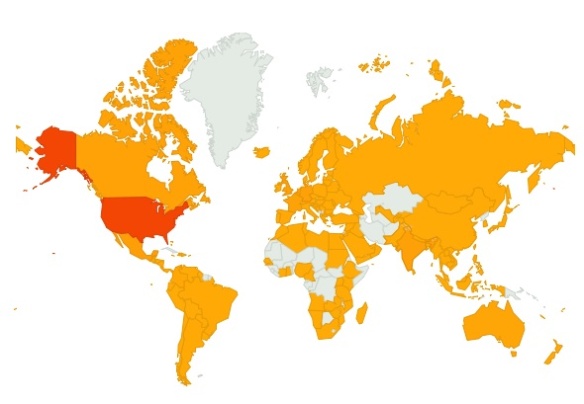
You come from 152 countries — that’s only 40 fewer than the number of UN member-countries. There is not a lot of information about blog readers except for where your IP address is registered. You, our followers, truly come from all over the world — though we could use some readers in Greenland and a few other locations, as you can see on the map below.

CD Blog Readers Year One

Cultural Detective Blog followers log on from these countries

The top 20 countries from which we draw followers are:

  1. USA
  2. Mexico
  3. India
  4. Germany
  5. UK
  6. Canada
  7. France
  8. Australia
  9. The Netherlands
  10. Colombia
  11. Spain
  12. New Zealand
  13. Argentina
  14. Japan
  15. Switzerland
  16. The Philippines
  17. Israel
  18. Malaysia
  19. Brazil
  20. Belgium

Given the diversity of our followers, and the variety and quantity of content, we wondered what you found most interesting in our first year? Surprisingly, three of our top five most-viewed posts were about food! Congratulations and many thanks go out to guest blogger Joe Lurie, who authored two of those. The top ten posts on this blog in 2012 were:

  1. Joe Lurie’s Bicycling in the Yoghurt: the French Food Fixation
  2. Kevin and Rita Booker’s Using Film in Intercultural Education
  3. An anthem for the use of intercultural communication entitled Every Organization Needs Intercultural Competence
  4. Want to Feel Ukiuki, Pichipichi and PinPin? Japanese Food Onomatopoeia
  5. Joe Lurie’s The Squid Has Been Fried: Language, Culture and the Chinese Food Fixation
  6. A book review of How Maps Change Things
  7. A post on cultural appropriation with the case in point: The Swastika
  8. Our post entitled, Infographics on World Cultures and Immigration Trends
  9. A post explaining how to cull learning from some of those images we find in social media, entitled Can You Read This?
  10. Belief Holding as an Intercultural Competence, a competence that has long been one of my favorites, referencing Milton Rokeach’s Open and Closed Mind

Our top five most commented-on posts included one that didn’t make any of the lists above: Diversity Training Doesn’t Work! Obviously a title for some debate and discussion!

Many, many thanks to our regular authors Kris Bibler, Phuong Mai Nguyen, Tereza Bottman, Maryori Vivas, and Kate Berardo. Many thanks as well to our guest authors and contributors, including: Joe Lurie, Anna Mindess, Sunita Nichani, Piper McNulty, Barbara Schaetti, Pari Namazie, Thorunn Bjarnadottir and Avrora Moussorlieva, Kevin and Rita Booker, Carmen DeNeve, Ruth Mastron, Tatyana Fertelmeyster, George Simons, and Madhukar Shukla. We could not have built this terrific blog community without all of you who have commented, shared your resources, reposted our posts, and reviewed our posts before they were published. Many thanks!

If you have a passion for writing about cross-cultural issues and are interested in joining us here as a guest blogger, please contact me. We would love to be able to provide space for talented people to share their voices! We would also welcome your ideas for stories or resources to review, as well as your feedback.

Thank you for accompanying us during this first year of blogging! We trust that you have benefitted from what we have shared, and the thoughts and comments of readers around the world. We look forward to a peaceful and caring 2013!

Oldie but Goodie: Comprehensive Expatriate Support System

Expat-Flow

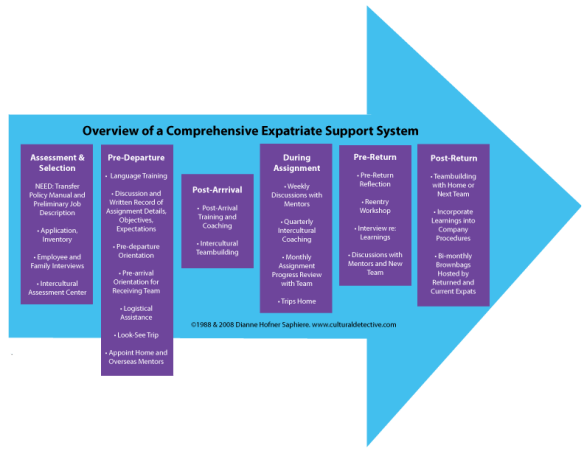
Moving overseas is an exciting yet stressful time for all involved: the person transitioning to a new position, the expat’s family who is relocating, and the organization—both the office dealing with the loss of a valued employee, and the receiving organization. We all know there are a myriad of details involved in preparing someone to work abroad, but where to start and what to include?

Years ago, when Cultural Detective Online was not yet a glimmer in anyone’s dreams, I put together the above guide for a client. You are most welcome to use it if it can be of assistance (click through to view a larger version), though I ask that you retain the copyright and url of the original.

I was proud to work with that client. They valued their international assignees, desiring that the employee and the relocating family become stronger from international assignment, and that both the receiving organization and the organization as a whole learn and grow. They thus asked me to “map” a process to help make that happen.

Today, Cultural Detective Online is an excellent tool to use with expatriates, relocating families, and receiving teams and organizations, at each stage of the relocation process. It offers a process as well as information at your fingertips — anytime, anywhere — to help build bridges across cultures, to help each of us better understand those we work with, and to get to know ourselves better.

“The Cultural Detective Online product is a sound investment for my work as an intercultural and relocation coach. I suggest to my clients to get a subscription for themselves.”
—Maartje Goodeve, Nascence Coaching, BC, Canada

How might you update the process in the graphic above? How could you use Cultural Detective Online in combination with other tools, approaches and your own facilitation to enhance expatriate performance?

Cultural Detective African-American Now Available!

coverAfAmThe Cultural Detective team is very pleased to announce the release of one of our most requested and highly anticipated packages — Cultural Detective African American! It is now available both in Cultural Detective Online and via site license.

Cultural Detective® African American explores the complexities of the culture and examines the values and communication styles of this community in an effort to bridge cultural gaps and support more inclusive groups, communities, and workplaces. It joins other domestic diversity packages in the series, including Cultural Detective Generational Harmony, Cultural Detective Women and Men, Cultural Detective LGBT, and the soon-to-be-released, Cultural Detective Latino/Hispanic.

Below, a message from package co-author Kelli McLoud Schingen:

ALI 1I facilitated an Advanced Leadership Institute for the Southwestern Black Student Leadership Conference January 17-20th, and thought that this would be the perfect place to pilot the Cultural Detective African American package that I co-authored with Patricia M. Coleman. There were 25 male and female upper-level students from universities all over the U.S., prepared for an intensive three-day workshop with me on leadership skills and cultural self-awareness. I spent the first day building trust and laying the foundation for the weekend. I facilitated activities that took the students on an exploration of their leadership styles, emotional intelligence, personality types and finally, cultural self-awareness.

ALI 2On the last day I Introduced the Cultural Detective, the purpose and intent of it, and the extensive research and in-depth process that Patricia and I went through to develop the tool. Understandably, the students met the tool with a great deal of suspicion. To say they were skeptical would be a gross understatement. I implored the students to stay with me and trust the process. The students started by working on the critical incidents in the package. I then asked the small groups to present on their findings. They were surprised that there was so much to consider and really convinced that the only valid perspective was the perspective and values of the African American “character” in the incident. I spent a great deal of time sharing how we view things through our own cultural lens, and then I unveiled the African American Values Lens. It didn’t take long for the students to be sold on the process and the values as I walked them through the positive and negative interpretations of each value. They seemed to be having fun and were fully engaged. Many of them commented just how grateful they were to FINALLY have words to describe their feelings, experiences, and cultural norms that they’ve inherited. They laughed at themselves and each other as they peeled back the onion of culture, and were grateful for the opportunity to explore cultural difference in this way. When I asked if they felt that the tool was an authentic representation of African American values they said, “Absolutely Ms. Kelli!”  Then I thought, “I guess we’re ready for launch.”

SIETAR Florida will honor Black History Month 2013 with a dialogue entitled, “Am I Black or African American?” via teleconference.  Featuring co-authors of Cultural Detective African American, Kelli McLoud-Schingen, Immediate Past President of SIETAR USA, and Patricia Coleman, President of SIETAR Florida. Please join us on Wednesday February 13, 2013 at 13h Miami time (1pm EST/12 CST/11MST/10PST).
Please RSVP by February 11th.

Access the event via conference line:

Dial-in Number: (559) 726-1000
Participant Access Code: 857895


Success? It’s All in How We Gauge It…

711079_3691916951303_1580871364_nThis is a story, or perhaps, more correctly, a cautionary tale, about a very successful expatriate and the highly respected, much-envied western company for which he worked. It is a story that made me think again about how we define success in our lives, and, in particular, how we define success in the global marketplace and success on an expatriate assignment.

The Company: The company is one of the very first to enter the Japanese market after World War II. It holds key patents on several important technologies, and invests decades establishing partnerships with Japan’s leading firms. It prides itself on hiring and promoting Japan’s best and brightest.

By the 1990s, it is the envy of other foreign-capitalized companies in Japan: it has a dominant market presence in its niche industries; long-established, trustworthy partnerships with major local players; and a stellar reputation for consistency, reliability and innovation. The president of the company is Japanese, and its management team is a strong and diverse mix of local and international executives who respect one another and leverage their expertise.

The Japan operation is a huge profit center, as well as the home of research and development breakthroughs leveraged by the company globally. They have strong cross-cultural programs in place for their staff worldwide, as well as for transferees and their receiving organizations.

The Expat: Our expat is intelligent, ambitious, and very capable. He has worked for the company for over 30 years, and is known as an excellent turn-around manager who had saved several manufacturing plants and regional operations, turning their losses into profits. Originally educated as an engineer, he is logical and methodical, and very good with numbers, graphs, and trends. Our expat is married with grown children and grandchildren, speaks a bit of French in addition to his native English, is well-travelled, but has never before lived overseas. This will be his last assignment prior to retirement.

The Situation: The global company, and most particularly home office, is experiencing economic hardship. A few expensive ventures have failed, and it is time to tighten belts, cut back, and save money across the board. Though the Japan operation is one of the most profitable worldwide, it is part of the overall organization and must join in company-wide budget cuts.

The expat is sent to Japan as the new CEO, and is told to cut millions from the annual budget. It is the first time in over a decade that the CEO of the Japan operation is a foreigner. The expat and his wife relocate to Tokyo, and quickly integrate into the local expat social scene. They love their new life in this amazing metropolis.

The Backlash: Local and existing expatriate management “cry foul.” They say it is a short-sighted decision to slash budgets in Japan when the operation is functioning smoothly and keeping others afloat. They say they are being punished for errors they did not cause, in which they were not involved. They warn that budget cuts will have long-lasting negative effects in the Japanese marketplace.

The new CEO explains that change always has its naysayers; people need to “get onboard or get off the ship.” “Tough times call for tough decisions.” “It’s a new day, a new world, a new economy.”

The cross-cultural consultant and existing management explain that the culture is different here, that the new CEO doesn’t yet understand Japan. Drastic changes have long-lasting effects that can’t be undone, can’t be apologized for. They urge him to send this message strongly to the home office, to push the decision back up. They say it’s his duty to make the home office aware of the repercussions of their top-down decision. They tell him that following instructions will mean the death of the Japan operation.

But the CEO has been down this road before. No one likes belt-tightening. No one likes budget cuts. He knows how to turn an operation around. He’s done it before. He doesn’t need people to “like” him. He knows they will respect him once they see the results he achieves. This is an once-in-a-lifetime opportunity, an incredible capstone to his career.

The Outcome: The expat succeeds, in stellar fashion. He fires people. He closes divisions of the company. He retires long-standing partnerships with important local players. He does exactly what he has been charged to do. And he furthers his career: after his two-year assignment he receives a huge bonus. He departs Japan to begin his retirement, riding the accolades of his success.

Home office is proud of their decision to send him; only an expat could have made these kinds of difficult decisions, taken these drastic measures. A local executive wouldn’t have been able to cut such long-standing local partnerships, couldn’t have bit the bullet to fire staff who had worked their whole careers building the company. It was a perfect decision. Money saved. Bottom line improved.

The Longer Term Outcome: Fast forward to four years after the expat’s departure. The highly successful, highly profitable business in Japan, with the enviable stellar reputation, closes down. Plants close. R&D facilities close. Offices throughout the country close.

Leading companies in the industry are no longer interested in partnering; once burned twice shy. After decades of trust building, smart business and shared success, how can they rely on a company that unilaterally decides to throw it all away to improve bottom-line at some far away home office? Why should they do business with a company that so clearly prioritizes home office needs over international success?

The company’s best and brightest have been hired by the competition. They are sour about their previous employer’s lack of loyalty and its short-sightedness. The company is no longer able to attract talented new hires. Who wants to work for a company that focuses on home office success, punishing those who succeed worldwide?

And today? The Japan operation, such an envied and respected company for over sixty years, is no longer. It was “over-milked,” bled dry. Not financially, but culturally, emotionally, trust-depleted.

So, how would you gauge success in this situation? Knowing what you know now, was the CEO successful? At the time everyone thought so. He achieved the immediate goal. What do you think would have happened had he done things differently? Is there a way the expat could have been successful in his goal and maintained trust? Does this mean that every leader needs special tools when completing an overseas assignment? What can we learn from this?

Please ponder those questions while you read the key takeaways from my point of view.

The Lessons:

  1. As expats, we must learn to distinguish between what we know and what we have to learn. We must ask for help. We must be willing to listen. We need to pause and make sure we understand the cultural context in which we are working.
  2. We must ensure that while we use our strengths, we also use “fresh eyes” to see what’s new and different this time. Not every problem can be approached in the same way it was successfully resolved the last time around, in a different country, with different people.
  3. We must be able to discern when to jump at an opportunity, and when to push a decision back up the chain of command. No person is an island. Even a CEO is part of the interconnected web of relationships, responsibilities, and decisions that make up an organization.
  4. As home office executives, we must be able to weigh our priorities, consciously and purposefully. We must think long-term, even when the short-term is jumping up and down in front of us. It is our job to anticipate the multiple impacts of a decision, and shape the process to benefit the organization.
  5. We must be able to hear the truth, from all perspectives, and separate the facts from the complaining. We need to set aside what we want to hear, what we are used to hearing, and be open not only to what is said, but the context and manner in which it is expressed. A cultural informant may help in “translating” the meaning of the message.
  6. As local management, we must learn to discern when we are accurately predicting the future and when we are just resisting change. These are usually questions to explore through dialogue and open-minded discovery. This can be a challenging process, depending on the cultural norms of local management.
  7. As a global team, we must have the tools to enable us to share, hear, and weigh information in order to make the best decisions, for both the short- and long-term. And it is important to remember that the choice and presentation of information is, to some extent culturally influenced. Without a process to truly understand shared information, team members essentially operate in the dark.
  8. A multinational company, it is wise to employ tools like Cultural Detective to help prepare and guide executives on international assignments. Culturally Effective companies recognize the need, and have found Cultural Detective and a trained facilitator can help prevent stories like this from becoming commonplace Cultural Defectives.

Linked to the My Global Life Link-Up at SmallPlanetStudio.com

Get in Intercultural Shape for the New Year!

New Year Collage

Welcome to the New Year — at least for those of you following the Gregorian calendar! Are you ready? Is your organization poised and equipped to make significant positive contributions to this planet of ours? Do you have organizational traditions to kick-off the new year and encourage employees to strive towards new goals?

Most cultures of the world have very special traditions for sending out the old year and bringing in the new one. In Mexico where I live women wear special undergarments on New Year’s Eve — either red for love or yellow for gold or money — symbolizing what they most want to receive in the year ahead. Those who would like to travel carry a suitcase out into the street and around the block.

In Japan where I lived previously, the end of the year is a time to clean the house, purging it of things from the past that are no longer needed. We cook osechi foods, the beautiful make-ahead kinds of delicacies that will feed family and visitors through the first few days of the new year, and allow everyone — including the cook — to enjoy a respite.

What are your traditions for saying goodbye to the past year and greeting the future? Do you make resolutions, set goals, or make plans to learn something new?

My absolute favorite New Year’s was spent with good friends nearly two decades ago. On New Year’s Eve, we wrote down the hurts we’d experienced, the negative habits or memories we continued to carry and wanted to get rid of, the qualities about ourselves that no longer served us, the visions of ourselves, others or our businesses that were not constructive. We made a big bonfire, and we had a field day burning these no-longer-wanted items. Oh how liberating it was! We all felt so light, so energized!

On New Year’s morning we woke before sunrise. We had written, on paper we’d folded into origami boats, the qualities we wanted to receive and nurture in the new year. The positive habits and qualities we wanted to cultivate, relationships and moments we wanted to consciously treasure, and healthy visions of ourselves, others and our businesses that we wanted to hold close. We launched these items into the ocean, setting them into motion.

The beginning of a year is a good time to reflect on our cross-cultural successes (Cultural Effectives) as well as to learn from our mistakes and misunderstandings (Cultural Defectives) and decide what kind of year we want in 2013. Back in October we published a post about intercultural fitness. In November we reiterated why such fitness is so important, why organizations need intercultural fitness.

Maybe reading these posts has helped you to decide what to throw in the fire and what to set out into the water? If your fire is full of cultural missteps and your boat contains a desire to expand your intercultural competence, maybe it’s time you took action!

Cultural Detective wants to encourage you to get fit, too — interculturally fit! Much like committing to an exercise plan or a sensible nutrition plan, committing to prioritizing intercultural competence in the coming year will serve us well personally, in our families, as well as in our work lives. Also, just like a gym, it can be fun. We can spend as much time as we like and we might meet some really interesting people.

The new year is full of special offers for gym memberships, exercise classes, and diet programs — ways to encourage you to get fit in 2013. Just as gyms and diet programs offer incentives this time of year, the Cultural Detective Online intercultural competence gym is offering complimentary three-day subscriptions to help get you focused and motivated!

Here is how to get yours:

  1. Log on to http://www.culturaldetective.com/cdonline/orders/trial before January 31, 2013.
  2. Enter your name, email address and the promotional code: NewYearFitness
  3. You will receive a verification email from cdonline@culturaldetective.com. Be sure to clear it in your spam filter! Click the link in the email, follow the instructions, and explore a new way to improve your intercultural fitness 24/7!

We hope you will take advantage of this special offer to learn how Cultural Detective Online can assist you at home and abroad, with colleagues and friends, in your community and in your organization! Feel free to share this offer with those you care about — we think the world could benefit from a little more intercultural competence on everyone’s part!

Best wishes for a peaceful year ahead from the Cultural Detective team!