
Using Cultural Detective Online in a College Class

BCCUNYhoriz_PMS288_PMS286A guest blog post by Dr. Elisabeth Gareis (Communication Studies, Baruch College, City University of New York)

With many colleges increasing their online course offerings, there is a great need for training tools that can be used as segments in online classes. Last fall, I was looking for such a tool for my graduate class in International Business Communication. In previous face-to-face renditions of the course, I had used Ecotonos with great success. When I couldn’t find a simulation game for online asynchronous settings, I decided to try the Cultural Detective Online (CDO).

One course assignment involves student groups investigating a country of their choice through readings and interviews, focusing on sub-topics such as oral and written communication, business customs, and business-related news events. In the end, the groups create webpages on their country, complete with narrated slideshows on each sub-topic.

Last fall, I assigned the CDO only for exploratory purposes. Before the students embarked on their adventure, I gave a screencast lecture on training tools, covering differences in type (e.g., simulations versus games), giving examples of specific ones (e.g., Barnga, Ecotonos, Diversophy), and discussing different uses (e.g., training versus coaching). The students had various levels of exposure to intercultural communication: some had overseas experience and others were new to the subject matter. None of them had used a training tool before.
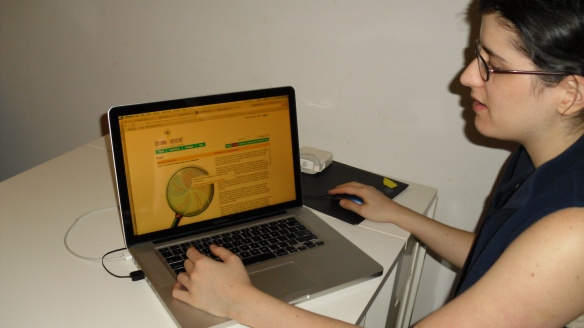
Ellissa Corwin (COM 9656 Fall 2013)
The students all obtained a one-month subscription to explore CDO as an example of a training tool, and, at the same time, to get started on their country research. Their assignment was to view the video tutorials and then to complete the CDO package for their target country (i.e., to explore all sections, including the Lenses, proverbs/sayings, daily life examples, negative perceptions, and all incidents). In the end, they analyzed and discussed the experience. Here are some representative responses:

  • “The interface is easy to use.”
  • “The dashboard is a great way to orient the user at the start of their cultural investigation. It can be very helpful to write out what your aims are when doing research.”
  • “I think the Cultural Detective does a very good job of outlining primary Lenses. I particularly enjoyed the in-depth materials associated with each lens and learning from the interactions. I also appreciated that they include both positive and possibly negative perceptions of each trait.”
  • “I like how the Lenses are organized. I especially like the proverbs and daily-life examples.”
  • “I found it useful to begin learning about my group’s particular country and a good starting point for further research.”
  • “This type of in-the-moment skill-building practice really helps reinforce learning and build user confidence. The Cultural Detective also helped bring our textbook to life and clarify learning.”
  • “I liked the fact that all of the site’s sources are listed. This can really help someone who wants to dive deeper into a particular country.”
  • “Very organized and user friendly!”

Exploring the CDO gave the students insight into the world of intercultural training and coaching, and provided them with quality information on their target country. As it is self-paced, it is easily integrated into asynchronous online college classes.

I am using CDO again this semester, but this time a little differently. In addition to exploring the tool, students’ final presentations will include using their research findings (readings and interviews) to design an activity that is modeled after the incidents in CDO. In other words, each student will contribute an issue from his/her sub-topic to a scenario or dialogue, which will then be analyzed by other classmates. Not only will this better integrate CDO into the course, it will also allow students to directly apply their learning.

Cultural Detective Online is a great tool, and I recommend it highly. Students greatly enjoy their learning via the CDO.

A note from the Cultural Detective Team:

Please contact us if you’d like to learn how to integrate CDO into your classroom experience.

Coming soon—exciting new CDO functionality will allow members of a “group” (e.g., a class or a team) to collaboratively create critical incidents, which can be submitted to the group administrator (professor or team leader) for approval, and then shared with other group members for analysis and discussion.

Have you joined us for a free webinar to see how Cultural Detective Online can be integrated in your academic or business setting? We hold them twice a month—attendance is limited so register now: Cultural Detective Online Webinar
 

Lack of Diversity Correlates with Religious Hostility

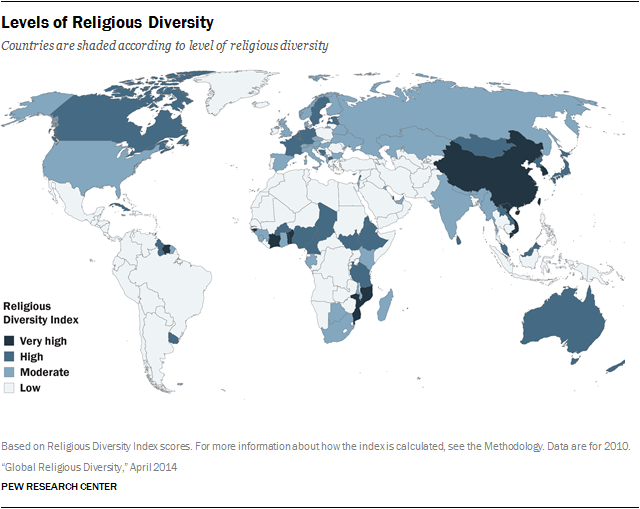
world-religious-diversityQuick! What is the most religiously diverse area of the world? Not the Middle East—it’s primarily Muslim, and not Latin America—it’s primarily Christian.

It is, of course, the Asia Pacific region, home to a great diversity of religious traditions including Islam and Christianity, as well as Buddhism, Hinduism, Confucianism, and loads more. This is just one interesting tidbit from a report on world religions released this week by the Pew Research Center.

More noteworthy than this fact, however, is that some of the world’s least religiously diverse places are home to the highest rates of social violence involving religion. Of the five countries exhibiting the most religious violence:
  • Afghanistan and Somalia both rank in the bottom ten for religious diversity, with a “Religious Diversity Index” or RDI of 0.1.
  • Pakistan ranks as having “low diversity,” with an RDI of 0.8.
  • India (RDI 4.0) and Israel (RDI 4.5) are ranked as “moderately diverse.”

If diversity indeed correlates with lower violence, that is indeed good news for diversity and pluralism, and a desire to discourage violence and promote inclusion are good reasons to put Cultural Detective Islam and Cultural Detective Jewish Culture to good use! And please, help us create packages for other major world religions! Such tools are especially needed given that the Pew Research studies show huge increases in religious hostilities in nearly every world region.

increase in religious hostilities

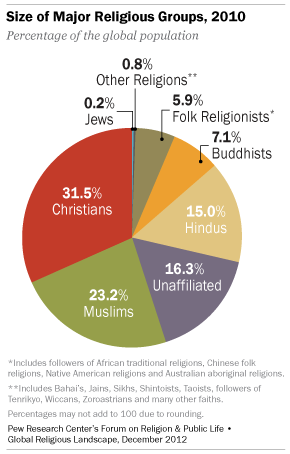
How did this finding, correlating the lack of religious diversity and hostility, come about? In December 2012, Pew Research Center’s Forum on Religion and Public Life published a report entitled, “The Global Religious Landscape,” based on data gathered in 2010. It found, in part, that:

“Worldwide, more than eight-in-ten people identify with a religious group. A comprehensive demographic study of more than 230 countries and territories … estimates that there are 5.8 billion religiously affiliated adults and children around the globe, representing 84% of the 2010 world population of 6.9 billion.”

01_groupsThen, in January 2014 Pew published the results of another study in its article, “Religious Hostilities Reach Six-Year High.” It involved data on 198 countries:

“A third (33%) of the countries and territories in the study had high religious hostilities in 2012, up from 29% in 2011 and 20% as of mid-2007. Religious hostilities increased in every major region of the world except the Americas.”

socialHostilitiesJust this month, April 4, 2014, the Pew-Templeton Global Religious Futures project, which analyzes religious change and its impact on societies around the world, published further analysis that it conducted on the 2010 data. They produced a very interesting index that ranks each country by its level of religious diversity—its RDI, or “Religious Diversity Index.” RDI was calculated based on the percentage of each country’s population that belongs to the eight major religious groups defined by Pew. The closer a country comes to having equal shares of the eight groups, the higher its score on the 10-point index.

To quote from the report,

“In order to have data that were comparable across many countries, the study focused on five widely recognized world religions—Buddhism, Christianity, Hinduism, Islam and Judaism—that collectively account for roughly three-quarters of the world’s population. The remainder of the global population was consolidated into three additional groups: the religiously unaffiliated (those who say they are atheists, agnostics or nothing in particular); adherents of folk or traditional religions (including members of African traditional religions, Chinese folk religions, Native American religions and Australian aboriginal religions); and adherents of other religions (such as the Baha’i faith, Jainism, Shintoism, Sikhism, Taoism, Tenrikyo, Wicca and Zoroastrianism).”

This, of course, means that diversity within these larger religious sub-groups was not examined.

Linking the findings from phase two (social hostility) and phase three (religious diversity) shows the correlation between lack of religious diversity and social hostility.

I would emphasize that the link between lack of religious diversity and increased social violence does not appear to be a finding reported by Pew Research. Rather, it is an observation written by Emma Green in The Atlantic. The top five—and many others—of the most socially hostile countries do indeed have lower RDIs. However, there are countries with low religious diversity that also show low ratings for religious hostility: Namibia, Marshall Islands, Malta, Kiribati, Cambodia, Djibouti, Lesotho, and Grenada among them.

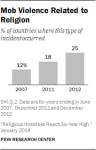
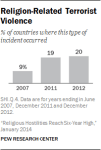
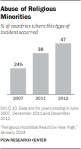
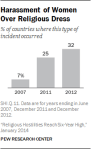
The research is definitely worth reading. The overall increase in religious hostility is driven by certain types of hostility, including abuse of religious minorities, harassment of women over religious dress, violence to enforce religious norms, mob violence related to religion, and religion-related terrorist violence. Click on any photo to enlarge.

Emma Green ends her article with an interesting thought:

“It may not be true everywhere, but these data suggest something remarkable: Religious pluralism can be, and often is, compatible with peaceful societies.”

What do you think? What is your experience? What successful efforts have you seen to bridge religious differences and increase tolerance and respect?

Ten Years of Building Respect, Understanding, Justice and Collaboration!

P1110373Thank you for joining us on the journey to build respect, justice and collaboration across cultures!

A group of our authors recently gathered in Mazatlán, Mexico to celebrate the tenth anniversary of this collaborative project, Cultural Detective. We held three days of work meetings and a facilitator certification workshop; we hosted a wonderful party that included the indigenous Yoreme Deer Dance; and we played—on the beach, in the water, at restaurants, with music, and all around town!

Our community members will have more celebrations around the world throughout 2014; contact us if you’d like to join one!

Below is a slideshow of just some of the many authors and community members who have contributed to making Cultural Detective such an amazing tool, and to using it to transform the world in which we live, bit by bit.

Are you curious about how Cultural Detective came to be? You might want to read this short history of our project.

We have received quite a few greetings from customers and community members—their videos show the breadth of application of this toolset. Take a look at the anniversary playlist on the Cultural Detective YouTube channel.

Want to become more active, transforming the communities in which you live and work? Join us for a free webinar and three-day pass to Cultural Detective Online, or join the conversation on Twitter, LinkedIn or Facebook.

42% Fail in Overseas Assignments

As many as two in five managers fail in their overseas assignments, according to a survey released by Right Management. A worldwide average of only 58% of international postings were judged to be successful by their organizations, with little variation across regions.

“This has to be one of the most disappointing findings of our survey,” said Bram Lowsky, Group Executive Vice President Americas at Right Management. “Given the investments being made in bringing along a new generation of leaders and their growing need to be able to think and operate globally, for 42% to fail when they’re sent abroad is hard to fathom. It’s also worth noting that the failure rate is more or less a constant whether it’s Asian, European or North American managers.”

The survey also found disparities in the preparation given expatriates before an assignment, said Lowsky.

Expat Prep

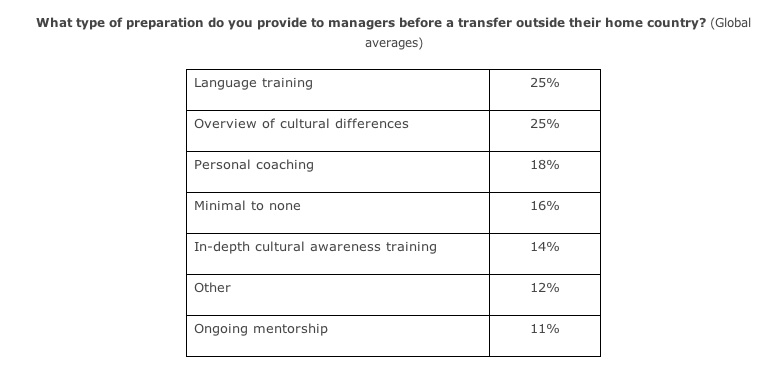
“A global average of 25% of organizations provides language training. However, the average drops to 18% for North American employers, while it’s closer to 33% among European, African and the Middle Eastern companies. Even harder to believe, an average of 16% of companies globally give minimal to no preparation at all, and for North American employers it’s 22% that do virtually nothing. No wonder so many managers don’t perform well outside their home country.”

We know readers of this blog are more savvy than that! There are enough challenges changing jobs within an organization, let alone the additional challenges when transferring to an unfamiliar culture. Smart organizations don’t just invest in training the person going on the international assignment; they invest in building strong relationships among the whole team—domestically and internationally. Learn how Cultural Detective Online can benefit your team by attending one of our free webinars. Or give us a call—we’d be happy to assist you in getting your team subscribed to Cultural Detective Online today!

Happy Tet—New Year of the Horse!

1555587_10152184068913988_503611650_nMay the Lunar New Year of the Horse bring you health, joy, and much success in spreading cross-cultural respect, understanding, collaboration and justice in this world of ours!

2014 is the Year of the Horse. It is also Cultural Detective‘s 10th anniversary year (our CD project was born in the Year of the Monkey). Characteristics of the horse are unremitting efforts to improve oneself, communication, kindness, perseverance, and a love of travel—which is definitely in keeping with what the CD Method and our community are all about! May this new year bring out these and more positive traits in all of us!

On behalf of the Cultural Detective team, here is Phuong Mai Nguyen, co-author of Cultural Detective Vietnam (and her mother) with a greeting for everyone:

Virtual Teaming

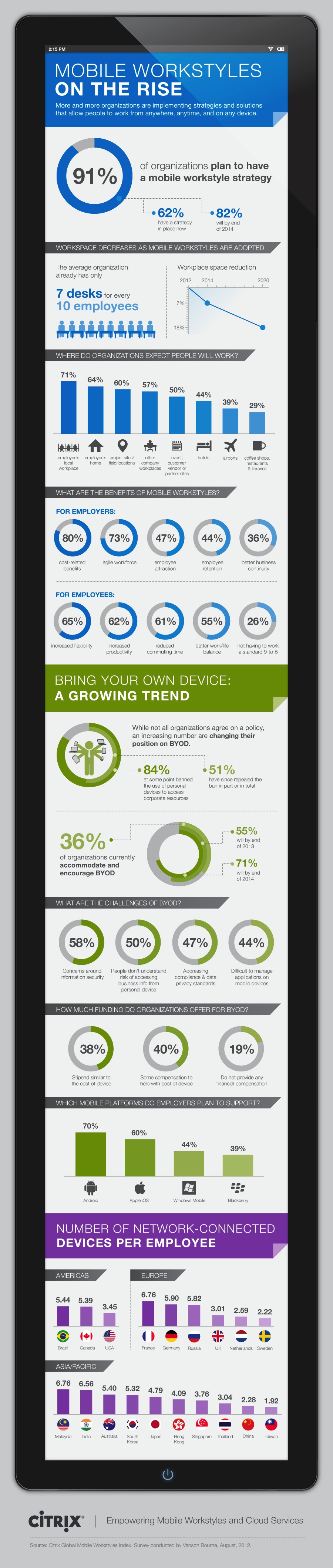
With mobile work styles on the rise, management styles need to change and adjust to the new reality. Along with the obvious benefits to employers and workers, there are significant drawbacks to a mobile work style—policies need to be modified, expectations made clear in different ways, and creating a cohesive work group becomes more difficult.

Any organization has its challenges in trying to shape a random collection of people into a “team” of some sort—whether it’s a small group engaged in a specific project, or the group spirit that often emerges from employees working together to accomplish desired results.

Citrix_Mobile_Infographic_v6_hannah

With a mobile work style, how do we achieve a sense of community, a sense of shared purpose that allows employees to perform at their best to achieve the overall goals of the company?

One answer is found in the Method and tools offered by the Cultural Detective series. Cultural Detective: Self-Discovery is designed to explore one’s own values—what makes each of us “tick.” This self-knowledge is the base upon which to build intercultural competence.

Cultural Detective: Bridging offers a way to look at conflicts and to move beyond a win/lose scenario to “bridge” differences to work more constructively together. Theory and practice are interwoven to provide concrete suggestions for learning to resolve difficult situations.

The Cultural Detective: Global Teamwork package is designed to assist both collocated and remote teams in meeting the five major challenges of teamwork in todays’ global environment. While many companies embracing mobile work styles are located in one geographical location, they wrestle with many of the same challenges as virtual teams working internationally. Cultural Detective: Global Teamwork provides insights, processes, and tools to meet these challenges.

And of course, no mobile work style would be complete without a subscription to Cultural Detective Online, the virtual intercultural coach that is available, anywhere anytime 24/7. So helpful to have a reference available before you email or talk to your new colleague from a culture different than your own! Do they value direct, straight-to-the point communication, or a more nuanced approach? Should you spend some time getting to know them personally, or just get directly to the business discussion?

Did you know you can set up groups within Cultural Detective Online so you can work virtually with employees to enhance their intercultural competence? Let us show you how! Join one of our free webinars to learn about the capacities of CD Online, and ask us how your organization can take advantage of group subscriptions to Cultural Detective Online.

Join us in Warm Sun AND Accomplish a New Year’s Resolution

snowbeach

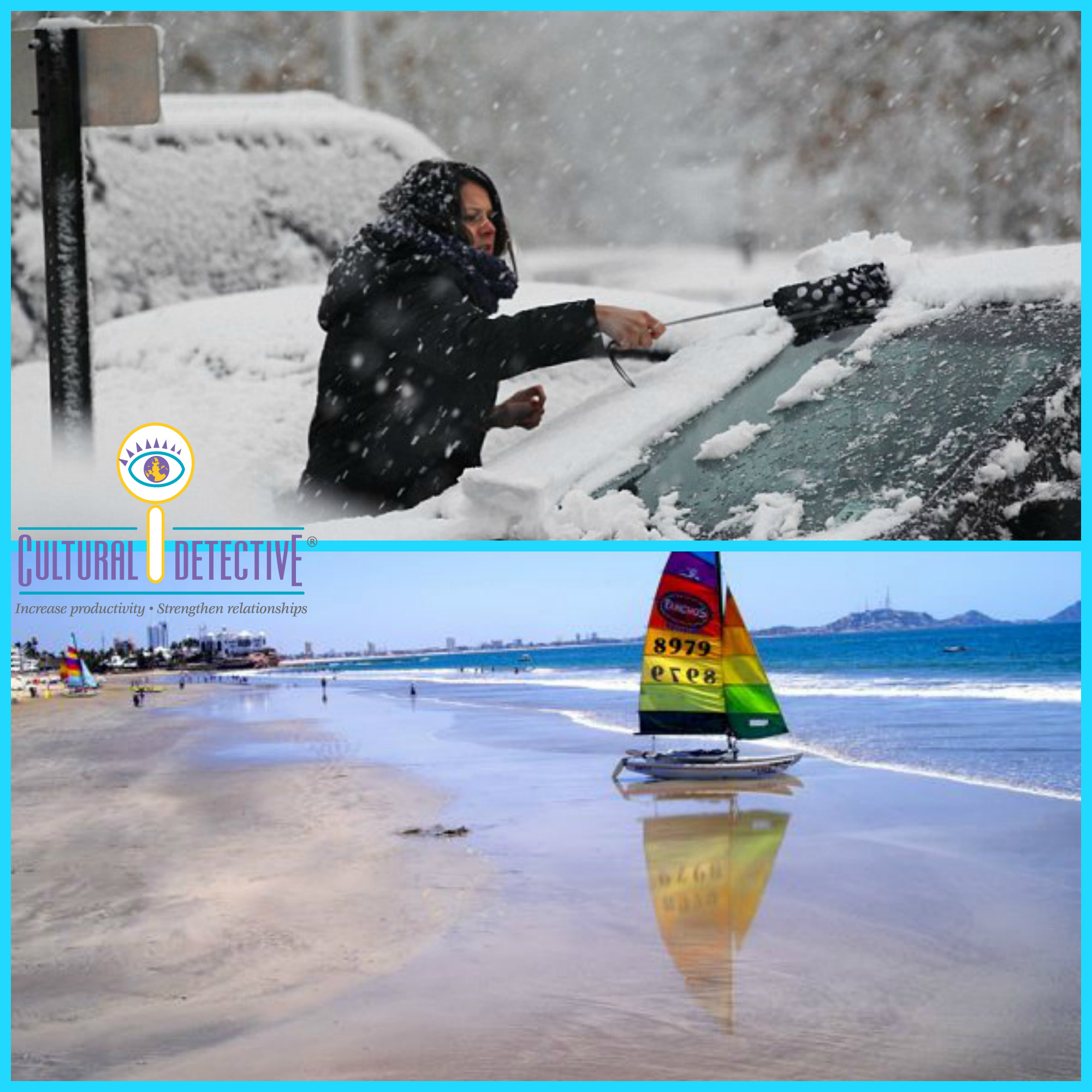
  • Are you tired of the cold, the ice, and the snow? Is it all getting to be too much, and you’d like a break? Are you longing for some warmth, sunshine, the beach, and vibrant Latin music?
  • Have you promised yourself that in 2014 you will spend more time on yourself, invest in your professional development, network with like-minded professionals, or expand your training/facilitation/coaching repertoire?
  • Do you realize that global and multicultural competence are requisites in today’s world, and you want to improve these vital skills and learn to help develop them in others?

You can accomplish all these things by joining us in Mazatlán Mexico in February, or in Atlanta Georgia in March for our Cultural Detective Facilitator Certification Workshop! Early bird registration rates are available, so now is a good time to secure your seat in one of these workshops.

The Cultural Detective Facilitator Certification Workshop receives high accolades from the most experienced interculturalists as well as from those with significant life experience but who are new to the intercultural field. Clients rave about the Cultural Detective Method and use it worldwide. Facilitators love having Cultural Detective in their toolkit. It helps them truly make a difference and secure repeat business from clients—ongoing coaching, training and consulting revenue—as clients commit to the continuing practice that developing true intercultural competence requires.

Many people do not realize that Cultural Detective is flexible enough to integrate nicely with existing training programs—adding depth and practical skills that learners can use immediately and build upon in the future. Participants easily remember the Cultural Detective Method, and can put it into practice when encountering a challenging situation—solving misunderstandings before they become problems!

“It is difficult to exaggerate how fundamentally important Cultural Detective has become for us. The difference between courses we conduct with and without CD is astounding.”
– Chief Academic Officer

“We have achieved, for the first time in my five years working on the Learning and Development team, a 100% satisfaction rating from our learners. Thank you, Cultural Detective!
– Chief Learning and Development Officer

“Our customer satisfaction rates have increased 30% thanks to Cultural Detective.”
– Customer Support Manager

Click here for details on dates, locations and pricing, and click here for a detailed agenda of the workshop. Sound tempting? Get out of the cold AND spend time developing your effectiveness and employability! We’d be delighted to have you join us! Of course, if you are living somewhere warm, we’d gladly welcome you, too!

Terrific Video Clip on “Funny” Names Across Cultures

The clip below is both very funny and a reminder for some of what it feels like to be on the other end of having a “funny name.” It comes from a hugely popular British TV comedy sketch series of the late 1990s —“Goodness Gracious Me”—in which almost the entire cast were British Asians (or “Hounslow Punjabis, to be precise,” as one of the cast members once said). The running gags were about the Asian migrant experience. Many thanks to David Patterson for bringing this clip to our attention.

I share it with you today, Christmas Eve for those of us who celebrate it, in the hopes that it might add some humor to your day, as well as serve as an enjoyable (yet insightful) clip to share with those uncles, cousins or other family members who, despite our love and affection for them, drive us crazy with their stereotypical (racist?) comments during family get-togethers.

This clip is a terrific complement to the video interview I conducted with Dr. Emmanuel Ngomsi on names. Below are the links to those two posts:

Leading Across Cultures

Leading X CulturesBack in February, my friend and respected colleague, Michael Tucker, sent me a white paper on leading across cultures that he had just completed with one of our customers, Right Management. I meant to write about the 24-page report at the time, but, alas, time passes while we are focusing on other exciting things.

This was an interesting study due to its scope: participants included 1867 leaders of 13 nationalities, representing 134 industries.

“As we enter the Human Age, where Talentism is the new Capitalism, no organization can afford to overlook optimizing the performance of leaders who operate globally. … The fact is that cultural issues will dominate the competencies required for global leaders to be successful, now and in the future.”

80% of CEOs and human resource professionals reported Cultural Assimilation as the greatest challenge facing successful expatriates. Study findings showed that global leadership differs from domestic leadership due to the complexity of working with people from different cultures. “The global experience results in leaders developing new worldviews, mindsets, perceptual acumen and perspectives,” the white paper states.

“Leading across cultures is a critical element of leading in the Human Age and unleashing the power of what is humanly possible. It often requires making decisions in complex or ambiguous environments, understanding cultural nuances and adapting one’s style accordingly.”

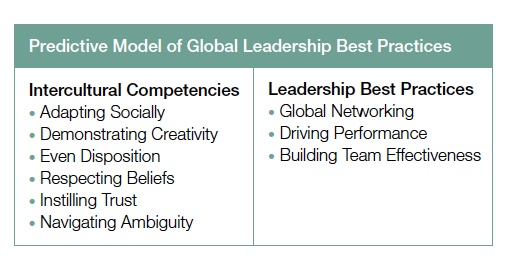
Global Leadership Best PracticesThe study found six competencies required for global leadership success:

  1. Adapting Socially: the ability to socialize comfortably with new people in unfamiliar social situations and to demonstrate genuine interest in other people.
  2. Demonstrating Creativity: the ability to enjoy new challenges, strive for innovative solutions to social and situational issues, and learn from a variety of sources.
  3. Even Disposition: the ability to remain calm, not be critical of self, and learn from mistakes.
  4. Respecting Beliefs: the ability to demonstrate respect for the political and spiritual beliefs of people in other cultures, and the ability to use appropriate humor to diffuse tense situations.
  5. Instilling Trust: the ability to build and maintain trusting relationships. According to the report, trust is the one glue that holds diverse teams together.
  6. Navigating Ambiguity: the ability to work through vagueness and uncertainty, without becoming frustrated, and figure out how things are done in other cultures. Ambiguous situations are the norm in leading across cultures.

“Human Age leaders have the responsibility and opportunity to unleash the potential of all employees who work for them. To effectively unleash this passion and accelerate business success, leaders need new and different skills—managing diverse talent.”

The white paper concludes with four strategies for selecting, developing and retaining leaders who will succeed in a global business environment. An ongoing, structured learning experience such as Cultural Detective Online not only supports, but makes possible, each of the four:

  1. Select Overseas Managers includes assessment processes such as Tucker’s, and developmental tools such as Cultural Detective, used by a competent administrator/facilitator.
  2. Grow International Leadership Bench Strength includes developing and nurturing leaders as well as providing coaching—each of which are greatly aided by the Cultural Detective toolset.
  3. Ensure Success of Leaders in New International Roles includes assigning a coach and meeting for regular reviews, both of which can be significantly enhanced with a subscription to Cultural Detective Online.
  4. Localize Country Management Teams includes the creation of customized leader plans and coaching support. Again, you know what toolset is perfect for this!

This is an excellent report, which I recommend you review in its entirety. We appreciate Tucker International and Right Management making it available. I suspect we can all learn something from this reminder of what it takes to be a competent global leader.

Frogs, Caged Birds, Underwear and Camel Humps

Frogs, Caged Birds, Underwear & Camel HumpsWhat do these four things—frogs, birds, underwear and camel humps—possibly have in common with one another? In the hands of Cultural Detective certified facilitator Joe Lurie, quite a bit, actually. In this series of short video clips, Joe shares with us a couple of proverbs and a few stories on the power of perception. Watch below to learn why some of his Chinese students were utterly shocked…

The first clip is only a minute and a half long. It’s where Joe sets up his story:

Ah, the ability to see beyond our pond involves the ability to ALSO see and understand the pond we are in! An all too often forgotten reality in intercultural competence. How can we explain ourselves to others, or help others to adapt to our home, if we ourselves don’t understand the culture in which we live?

The second clip, three minutes long, tells you just why some of Joe’s Chinese students thought his behavior was so strange.

What do you think? What values show through in the way you do your laundry? In the way you view birds, frogs, and the rest of your world?

You can find these and all sorts of other videos on Cultural Detective‘s YouTube channel: www.youtube.com/CulturalDetective.

See Part 2 of this interview here.