Unknown's avatar

About Dianne Hofner Saphiere

There are loads of talented people in this gorgeous world of ours. We all have a unique contribution to make, and if we collaborate, I am confident we have all the pieces we need to solve any problem we face. I have been an intercultural organizational effectiveness consultant since 1979, working primarily with for-profit multinational corporations. I lived and worked in Japan in the late 70s through the 80s, and currently live in and work from México, where with a wonderful partner we've raised a bicultural, global-minded son. I have worked with organizations and people from over 100 nations in my career. What's your story?

Cultural Differences in Dining Etiquette Again Get a Child in Trouble

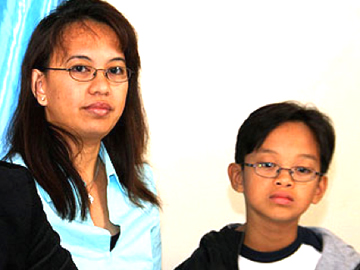
Recently another sad story about dining etiquette across cultures has been in the news.* This time it involves cultural differences over how to use a spoon and fork, and involves a Filipino family living in Canada. Fortunately this child, Luc Cagadoc, was not removed from his family, but his mother, Maria-Theresa Gallardo,  explains that the school’s reprimands for Luc eating in a typically Filipino way have negatively affected his self-esteem as well as his performance in school. She won her case before the Quebec Human Rights Tribunal (the judge ordered the school district  to pay the family $17,000 in damages), though the case is now in appeals.

Once again, a terrific Cultural Detective has filmed a video about how Filipinos eat with a fork and spoon in combination. This was evidently the behavior that led Luc’s school lunch monitor to conclude that he “ate like a pig and should learn to eat like other Canadians.”

Thank goodness Luc’s Blended Culture mother responded very constructively. She says, “We’ve been travelling around. I’ve been showing him different ways of eating, and saying there’s nothing wrong with what he’s doing.” Unfortunately, she says, her son can’t shake off the incident. “I think it’s going to last him a lifetime to remember what happened in that experience that he had.”

Have you ever gotten in trouble for “poor” dining etiquette that was due to cultural differences? Come on, share your story!

* Earlier we reported to you about an Indian family living in Norway, whose children were removed from the family home. One of the reasons cited was that the children ate with their hands. In response to that post, one of our authors made a terrific video about how to eat with one’s hands. Eating with one’s hands is, of course, the norm and custom in many cultures.

“Belief Holding” as an Intercultural Competence – Religious less motivated by compassion

Frequently and for many years I have cited Milton Rokeach’s The Open and Closed Mind when people ask me about intercultural competence. In this book he talks about the importance of holding beliefs tentatively and situationally instead of imposing them on or expecting them of others.

“A closed way of thinking could be associated with any ideology regardless of content. It includes an authoritarian outlook on life, an intolerance towards those with opposing beliefs, and a sufferance of those with similar beliefs.”

According to this line of thinking, open-minded people may hold their beliefs firmly and strongly, but they also respect others’ rights to believe something different. They believe their path is right for them, but they do not believe it is necessarily the one and only path for everyone on the planet. “It is not so much what you believe that counts, but how you believe,” Rokeach tells us.

In our current age of heightened religious and nationalistic fervor, “belief holding” or “permeability of beliefs” seems more important than ever. As do religious or spiritual beliefs as dimensions of culture and cross-cultural interaction.

In this context, today I read the headline, “Highly Religious Less Motivated by Compassion.” Oh dear. I read on to find out that it is the key finding of social psychologists at the University of California Berkeley, who have conducted three separate studies since 2004 on a largely US American sample.

“Overall, we find that for less religious people, the strength of their emotional connection to another person is critical to whether they will help a person or not. The more religious, on the other hand, may ground their generosity less in emotion, and more in other factors such as doctrine, a communal identity, or reputational concerns.”

Perhaps it is time for all of us who coach, train, or educate on the topic of intercultural communication to remember this important competence, which was first published back in 1960.

Global Competitiveness Events in Bogotá Colombia

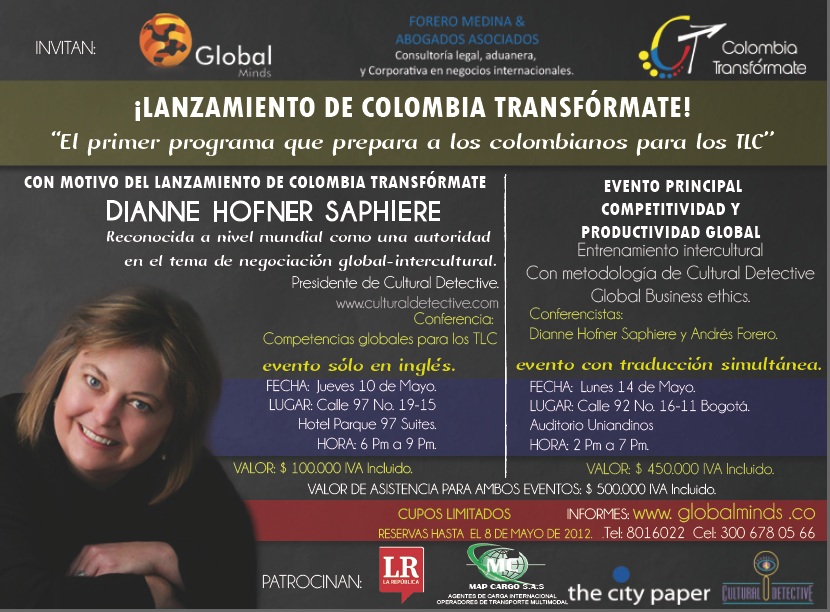
Cultural Detective is very proud to partner in bringing several leading-edge intercultural events to Bogotá, Colombia. We hope you can join us! Please pass this announcement on to your professional and social networks so that we might let everyone know about these unique opportunities.

On Thursday May 10

We will officially launch the Colombia Transfórmate program and the Cultural Detective Colombia package. Cultural Detective President Dianne Hofner Saphiere will facilitate a workshop which will be followed by a cocktail reception. This terrific evening is not to be missed! Cultural Detective is very honored to be part of this incredible project.

On Monday May 14

We will hold a high-energy event designed to ready Colombians to reap the benefits of their recent Free Trade Agreements with Canada and the USA, and upcoming agreements with the European Union and South Korea. Anyone wishing to improve their cross-cultural business acumen will find attendance extremely valuable. We believe this is one of the first-ever public workshops on intercultural communication in Colombia. The workshop will be facilitated by Fernando Parrado of Global Minds, Andrés Forero of the Forero Medina Abogados Asociados, and Dianne Hofner Saphiere of Cultural Detective.

Sponsor These Two Events

Put your organization’s name in the hands of thousands of first-tier Colombians by purchasing a sponsorship. Show your commitment to global effectiveness, and to Colombia! Sponsorship opportunities start at an incredible US$1350, and include two seats at both the Thursday and Monday events, an exhibit table, an introduction of your organization, and your logo on event banners.

Act quickly, as these very affordable sponsorship opportunities will be available for only two weeks.

On Wednesday May 9

Dianne will also present a seminar on intercultural and global business competence for students and staff at Sergio Arboleda University. The seminar will take place on day three of the university’s fifth think tank entitled, Marketing, Sociedad e Interculturalidad: Una Mirada desde la Globalización.

Link

Kevin and Rita Booker, very active Cultural Detective community members and extremely talented professionals, have put together a series of three articles on using film in intercultural education that I think you will find very helpful. If you use movie clips or YouTube videos in your coaching, training or teaching, or if you want to do that more, be sure to take a look. Lots of learning there.

By the way, if you love film, be sure to check out CDTV, our Cultural Detective channel on YouTube, with over 20 playlists. We welcome your recommendations (urls) on videos to add. Together we can build a convenient central repository of films to use to help our world become a more inclusive and collaborative place!

Help End Poverty; Make a $25 MicroLoan for Free!

You’ve heard of micro-lending, and how small loans to the right people can transform poverty and starvation into community-wide collaborative entrepreneurial spirit, leading to clean water, food, light and hope. You all no doubt have many ways in which you help make our world a better place. I’d like to ask you to join us in another terrific and easy way to help alleviate global poverty. Join our Cultural Detective team on Kiva! By clicking on this link, you can make your first US$25 loan for free! Let’s take put this offer to great use!

What do I love about loaning with Kiva?

  • 100% of the money you lend goes to loans, not overhead. Kiva has Charity Navigator’s highest rating.
  • In this case, your first loan is free!
  • You can make your a loan with as little as US$25.
  • You choose who you want to lend to. Kiva allows you to search by gender, country, economic sector, or lending organization to review profiles of people worldwide who are requesting a loan.
  • It is fun to loan with a group of like-minded colleagues. There is strength in numbers! Watching my loans get repaid, and the loans I’ve extended multiply, is even cooler because I can see how much impact all of us together are having! And, I can see how others on the team are loaning, and learn from them. (You can also be perfectly anonymous and private if you choose.)
  • It all happens online. When a loan gets repaid, you get notified. If you want to see what’s going on, you visit the website.
  • You make a loan, the loan gets repaid, you either get your money back, or you get to make another loan! The assistance just keeps echoing out, helping more and more people.
  • I so enjoy looking through all the terrific ways people find to improve the lives of their families and communities. A few minutes spent on Kiva can uplift your soul!

Micro-credit isn’t the only answer to poverty, but it sure seems to have been an answer for millions of people.

Thank you so much for being part of our Cultural Detective community. We are thrilled you have joined us in the quest to make our world a more equitable, sustainable, collaborative place. Joining the CD Kiva team is just one more way of doing that.

Developmental Intercultural Competence

The ability to collaborate productively and enjoyably across cultures is more important than ever, whether we focus on communicating with elderly parents or teenaged children, or on building trust and producing results with colleagues at the next desk and across the planet. But what do theory and practice tell us about how to gain maximum effectiveness?

One exceptionally rapid and proven way to successfully improve cross-cultural competence is to use the MashUp: a natural and powerful combination of two leading intercultural competence development processes: Cultural Detective and Personal Leadership.

Starting in September we will conduct a four-month course that will transform your personal and professional practice. It will enable you to use the MashUp in a developmentally appropriate manner to support and stretch learners at all stages of intercultural development.

Coursework will be conducted virtually, allowing you to complete the assignments from your office, home, or during travels. There will be individual and pair assignments, in addition to online classes. Do not miss this opportunity to work with some of those who are doing leading intercultural competence work worldwide. Learn more.

Official Cultural Detective Animal

We already have a Cultural Detective theme song (La Boca de Cultura) thanks to our multicultural, multi-talented friends Kotolán. I now suggest that, as do many nations of our world, we name an official Cultural Detective animal. And my nomination is the thaumoctopus mimicus.

While many animals change shape or color, the Mimic Octopus studies others and then mimics their movements and their looks — instantly! And this octopus’ repertoire includes at least 15 different species!

Come on, polyglots, global nomads, TCKs, and other blended culture people, can you top that? It changes its behavior to suit its environment, and its behavior is contextually effective. Sound like anyone you know? Wonder who teaches, trains or coaches these octopi?

The thaumoctopus mimicus, or Culturoctopus Detecticus, would definitely seem to be one ethnorelatively developed, or, ahem, shall I say, “marizo-relatively” developed animal. Below you can view a short video of my nomination in action.

Let me know if you have other nominations, or thoughts on this one!

Spiritual Traditions, Passover and Easter Greetings

Throughout my life I have felt strongly that most of the world’s spiritual traditions, paths and practices share a great deal in common. Of course they have significant differences, and in understanding those differences we come to appreciate the true beauty of each. At their core are perhaps some messages hugely important to all of us and the well-being of our world.

Please allow me to wish those of you who practice a blessed Easter and a blessed Passover, Pesach Same’ach. I would like to take this opportunity to share with everyone a prayer and hymn which I sing in my heart frequently during my travels, whether I’m journeying through daily life or through the world at large. While it is a Christian hymn, I believe it carries a message that resonates with many of us who embrace interculturalism and diversity.

First in Spanish, as I most often hear it and think it living here in Mexico, then in English. The words are from Saint Francis of Asisi.

Hazme instrumento de tu paz,
donde haya odio lleve yo tu amor,
donde haya injuria tu perdón Señor,
donde haya duda fe en ti.

Hazme instrumento de tu paz,
que lleve tu esperanza por doquier,
donde haya oscuridad lleve tu luz,
donde haya pena tu gozo Señor.

Maestro, ayúdame a nunca buscar
querer ser consolado sino consolar,
ser comprendido sino comprender,
ser amado sino yo amar.

Hazme instrumento de tu paz,
es perdonando que nos das perdón,
es dando a todos que tú nos das,
y muriendo es que volvemos a nacer.

O Maestro hazme un instrumento de tu paz.

Make me a channel of your peace,
Where there is hatred let me bring you love,
Where there is injury your healing power,
Where there is doubt true faith in you.

Make me a channel of your peace,
Where there’s despair in life let me bring hope,
Where there is darkness only light,
Where there is sadness ever joy.

O Master, grant that I may never seek
So much to be consolded as to  console,
To be understood as to understand,
To be loved as to love with all my soul.

Make me a channel of your peace,
It is in pardoning that we are pardoned,
In giving to all that we receive,
And in dying that we’re born to eternal life.

O Master… Make me a channel of your peace.

Please, share with some of your favorite prayers, meditations and blessings, with a bit of context so that we might learn, won’t you? Another of my childhood favorites comes from the Navajo tradition, but I will save that for another time.

Oldie but Goodie: Indigenous Contributions to Global Management

Because Cultural Detective is used by so many corporations, business schools, and management development programs, we are obviously very interested in strategies for broadening the scope of management teaching.

Recently I was perusing our archives, and found this terrific article from way back in 2005, authored for us by Cultural Detective Malaysia co-author Asma Abdullah. It focuses on indigenous contributions to global management, and I thought some of you might enjoy reading it, for the first time, or seeing it again with new eyes. Oldie but goodie, in my opinion!

Designing and Implementing Global Diversity

The global scene is expanding and our world has become borderless. Designing and implementing programs for global audiences presents unusual challenges. Familiar activities may be culturally inappropriate, simulations may need revision, or inherent cultural biases may limit our impact.

This five-day workshop will address strategies for adapting programs for highly diverse audiences, and for designing culturally responsive design and instruction. The facilitators will share a learning framework that will help you assess the impact of culture on teaching and learning. You will learn about the success, the challenges, and the next steps for preparing and delivering culturally sensitive global diversity programs.

To be held July 23-27 in Portland, Oregon, as part of the Summer Institute for Intercultural Communication, the workshop is designed for intermediate and advanced designers, developers, and others launching or anticipating launch of a global diversity program within organizations, whether corporate, nonprofit, NGOs, or educational institutions.

In this session, you will:
  • Learn to adapt simulations, games, blended learning and social media for multiple purposes by tailoring design, delivery, and debriefing.
  • Explore multiple approaches to delivering global diversity.
  • Assess how cultural biases impact design and implementation.
  • Identify learning challenges in implementing programs across cultures.
  • Adapt instructional design for culturally diverse populations.
  • Apply new skills to deliver culturally sensitive and culturally adaptive instruction.

The Summer Institute for Intercultural Communication is one of the world’s premier professional development venues. Be sure to join us in beautiful Portland, Oregon this coming July.