Grains of Sand and Cross-cultural Adjustment

Ever look at something and find it so beautiful or fascinating that it just sort of sticks with you? Perhaps it gives you a gut feeling that it speaks to something you’re working on? Then, maybe in the shower the next day, it hits you?

That’s what happened to me a while ago when our Intercultural Competence News Feed curated Dr. Gary Greenberg’s photos, taken through a microscope, of grains of sand.

While most of us normally think of grains of sand as looking fairly similar — tan or brown, some crystals, shiny — Gary’s photos show us that deep down, once we “get to know” the grains of sand, so to speak, each of them is quite unique! Now if that isn’t a metaphor for diversity, inclusion and cultural differences, what is?

We hope you’ll be pleased with the train of thought Dr. Greenberg’s gorgeous photos produced. We put together a PowerPoint on cross-cultural dynamics that you are most welcome to download and use. It hasn’t been polished and perfected like the grains of sand, but if you read the presenter notes, we are confident you’ll have fun customizing the ppt for your programs.

We all have favorite photos, metaphors, comics, and stories, or even video clips, that we love to use in teaching, training and coaching. If you have something you would be willing to share, please pass it on. We’ll be happy to get it out there for you and link through to your website or contact information. Together we can build a more respectful, understanding and collaborative world!

“Interculturalidad” – View on Interculturalism from Latin America

During my recent and incredibly learning- and success-filled trip to Colombia, a client asked me to do a short presentation on the state of intercultural competence in Latin America. Such a small request, right (asked wryly and facetiously)? I live in México, but after four years I sure don’t count myself a culture-specific expert, and I am surely not qualified to speak for over half the hemisphere! So, what to do? Turn to an esteemed colleague’s expertise, of course. In this case, I turned to Adriana Medina (and her co-author, John Sinnigen).

The beauty of the source article I used, “Interculturality vs. Intercultural Competencies in Latin America,” is that the authors introduce facts and history we all know, but they put them into a context in such a way that makes total sense and creates new meaning. At least for me.

For example, one of their points is how Latin Americans have lived interculturality for hundreds of years if not longer: wars, imperialism and commerce between the many distinct indigenous cultures, then conquistadores, colonialism, slavery and intercontinental commerce. Intercultural competence on this stage is not some new import during the current age of global economic interdependence. Rather, Latin America’s gold, silver, emeralds and such were important to European economies beginning centuries ago. The authors’ point is, one of the valuable contributions that Latin American interculturalidad can add to the largely northern and western-originated notions of intercultural communication or intercultural competence is this: power, specifically power imbalances.

“Interculturality, the preferred term in Latin America, refers to a historic condition, a radical restructuring of the historically uneven relations of wealth and power that have existed between Europeans and their descendants and indigenous and other subordinated groups during the last half millennium. The aim is decolonization of institutions and the sociocultural fabric of the country.”
— A. Medina-López-Portillo and John H. Sinnigen, “Interculturality vs. Intercultural Competencies in Latin America,” chapter 13 in Deardorff 2009, Sage Handbook of Intercultural Competence

In their article the authors present six strengths that Latin American interculturalidad can contribute to the intercultural communication and competence field. And, speaking for myself, our field is in huge need of hearing and incorporating these perspectives into our theory and practice! Contributions of interculturalidad, according to Medina and Sinnigen,  include that it:
  1. Is counter-hegemonic; focuses on the balance of power
  2. Starts with the needs of marginalized cultures (diverse indigenous movements from Mexico to Bolivia and Ecuador)
  3. Advocates mutual respect and economic and political equality rather than the acculturation of the oppressed
  4. Incorporates Andean/Amazonian concepts such as respect for Pachamama, good living, communitarian practices
  5. Multilingual integration
  6. Decades of dialogue leading to constitutional specificity

I want to thank this client for making this request of me, as it spurred me to learn more about a colleague’s work, and also to learn more about the work of Nestor García Canclini (more about his work in another blog post). I also want to thank Adri and John, whose work, I feel, is very important. I hope this might spur more of us to read, incorporate and build on their findings.

I have posted three PowerPoint slides summarizing this article, and you are welcome to download and use them if they might serve you. Please be sure to retain all source references, including the authors’ and Cultural Detective‘s. Together we can make a difference!

What do you think about the authors’ premises? How might we help the intercultural field to incorporate the Latin American perspective? How do you handle power differences in your work? I look forward to hearing from you!

Born and raised in Mexico City, Adriana Medina-López-Portillo is Assistant Professor of Intercultural Communication and Spanish in the Department of Modern Languages, Linguistics and Intercultural Communication at the University of Maryland, Baltimore County (UMBC). She is an accomplished intercultural trainer, having designed and led workshops for higher education, not-for-profit, governmental, and corporate clients in the United States and abroad. Among her favorite appointments are training for The Scholar Ship, a transnational academic program housed on a passenger ship, and offering pre-departure and on site orientations for the King Abdullah University of Science and Technology (KAUST) in Saudi Arabia. John Sinnigen is Prof. of Spanish and Intercultural Communication at UMBC.  He is the co-editor of América para todos los americanos:  prácticas interculturales (Mexico: UNAM, 2012).

Oldie but Goodie: Map of Key Cultural Differences

Intercultural communication is about how we can communicate effectively with one another. A frequent approach to improving intercultural communication is to develop our understanding of ourselves and of others. And probably the most common way of doing that is to teach about cultural differences, often referred to as the “dimensions of culture.”

There are many different versions of the dimensions of culture. I generally find them valuable as tools to help us compare cultures, or to cognitively learn about ourselves and others. And I also find they really limit us. While not intended this way, their use has a tendency to reify culture, to cause us to think about culture as a “thing” rather than a process. It’s why I’m such a fan of the Cultural Detective Worksheet: it’s a process for understanding self and others, for leveraging similarities and differences in order to collaborate in more innovative, rewarding, and satisfying ways.

Enough about that. This post is about cultural differences. In my training one of the ways I talk about cultural differences is to ask people to think of them as a map of the terrain, and to use them as a scanning tool. In a given interaction, which difference(s) got in the way? For example, was status important for her and not for me, and I just missed it? Was it a different sense of responsibility that really upset me? Maybe he likes to do several things at once, and I’m more one-thing-at-a-time? Was it the fact that I don’t think religion belongs in the workplace that caused him to think I’m not trustworthy?

That is how the map above came to be. It is a graphic summary of some of the cultural differences or dimensions, at least as I saw them back in 2008. It is available for you to use freely under a Creative Commons license. You can introduce the various cultural differences to your team and then, when you get mired in cross-cultural miscommunication, you can take out your map of differences and decipher just which dimension might be causing the problem. Or, maybe it’s something not even on the map.

Just click on the link above for a larger image, and to download the accompanying 11-page article entitled, “Detecting the Culprits of Miscommunication: Values, Actions and Beliefs.” Please feel free to copy and distribute, as long as you retain the copyright and source url.

I’m really interested to hear from you about how you use the dimensions of culture to promote effective interaction. What are your tools and techniques? Your dos and don’ts? And what do you think about this “map of the culprits of miscommunication” idea?

Book Review: How Maps Change Things

by Ward L. Kaiser, published by the New Internationalist and ODT Maps, 2012.
Free download through March 31 for Cultural Detectives

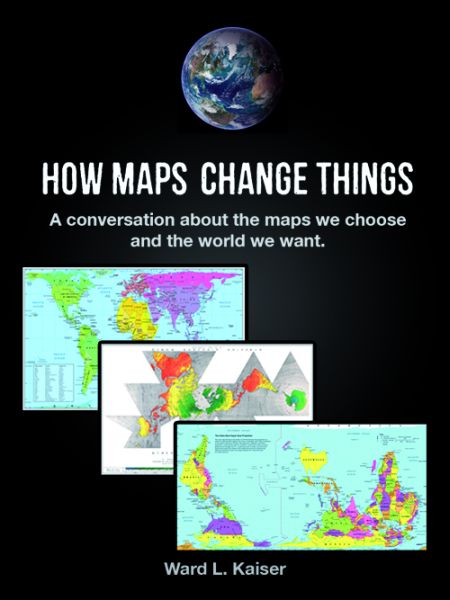
Anyone looking to develop a new class or training program to improve intercultural competence? This just-released book, How Maps Change Things: A conversation about the maps we choose and the world we want, could be the basis of one terrific learning journey! I highlighted something on nearly every one of its 188 pages. I learned so much, on so many different yet related topics, that I now have five or six threads of learning and discovery I want to pursue!

At first glance you might think this is a book about maps. Then you read on page six that it is about

“… how we shape and use maps and how they in turn shape us. It’s about how we see the world and how we therefore understand our place in it.”

So you start to hope that How Maps Change Things could teach us to be careful whether we label a certain body of water the “Arabian Gulf” or the “Persian Gulf,” or color-code parts of Kashmir as Indian or Pakistani, but it goes way beyond that.

“Because such maps encourage the feeling that some areas are home to movers and shakers while others shelter mere pawns.” — page 74

Mr. Kaiser, the author, is a big fan of equal-area projection maps such as the Peters, as most in the global diversity and inclusion field are, and points out how maps such as the Mercator aren’t good for much other than navigation. But in addition to showing us how maps can be used to perpetuate bias, he shows us how maps can also be used to promote perspective shifting, equity, and social justice:

“Through internalizing many ways to see the world we may even develop openness to other people’s points of view and greater self-awareness.”
— page 164

“What if people all over the world threatened by, well, you name it – logging, commercial development, polluting factories, hydrofracking chemicals in drinking water, say – what if they could all see maps as tools of analysis and action? …

How about a map to make clear where the hazardous electronic wastes of the developed world get dumped …

Bring together maps, available technology, human creativity, and people’s willingness to take a stand and you’ve got a powerful recipe for changing events.” — page 176

For these reasons and others this volume will be useful to interculturalists and those interested in diversity, sustainability, and social action.

The author premises that maps are tools that serve a purpose.

“Maps are verbs. They may seem to be tactile objects, documents we can handle or fold – nouns – but don’t be fooled. In persuasively framing questions and selectively supplying answers they act; they initiate; they function as agents.” — page 15

To illustrate this point he shares some terrific stories: one about the role of maps in a territorial dispute between First Nations people and the Canadian government (pages 35-39); another about how a map can skew our view of a country as a source of oil or as a residence of people and families (pages 8-17); and a third showing how a map was used to get one county to pay for a highway interchange that served another county (pages 34-35). There is a chapter about the connection between maps and faith/values (chapter 10 page 141), and how maps are used for disease control and health (page 170), as well as for crime prevention (page 173), a topic of special interest lately with concerns of profiling and ethnic bias.

The book is written in a lively, accessible style, though it gets heavier and slower toward the end; ironically, the final chapters are where Mr. Kaiser’s true passion seems to lie. It contains several embedded learning exercises (e.g., page 121) and interesting conversations such as how indigenous North Americans mapped (page 40). Via this latter conversation, he shows that the “culture” of map-makers is not universal. This, to me, is a hugely important point. Too many people believe their area of professional practice is culture-neutral or universal when, in fact, even science is culturally relative (as well as discipline-relative!).

One of the pleasures of reading How Maps Change Things is that it contains quite a few valuable “hidden” gems. One of my favorites: as the author discusses the huge socio-economic gap in our world, variously referred to by such inadequate (or judgment-laden) terms as North-South, 1st/3rd world, Developed/Developing nations, and Viable/Failed states, he provides in the footnotes a list of experts from diverse political persuasions and walks of life who share a consensus on the absolute need to bridge this gap (pages 138-139).

Through March 31 our friends at ODT Maps, the publisher, are offering this ebook FREE to our Cultural Detective community. I urge you to take advantage of this offer and help the author get this book put to good use!

Maps are tools, and can be purposed to perpetuate bias or to help us to create a better world. Cultural Detective has long been passionate about maps as learning tools. Way back in December of 2005 we dedicated an entire edition of our Cultural Detective e-news to maps (including 3 articles of activities and curricular ideas and a quiz), relying in large part on the expertise and generosity of our friends at ODT Maps.

It included: Using Physical Maps to Transform Mental Maps8 Map Activities for Intercultural Learning; a World Map Detective quizTraining with Map Power; and a free offer (a Mecca-centered Azimuthal map, a Peters Projection map, and a Population Map) from our friends at ODT Maps.

Bob Abramms at ODT has a wealth of books, DVDs, globes, puzzles, games, props, and  world maps for different purposes — terrific training material for intercultural and global diversity and inclusion professionals. If you’re not familiar with his great stuff, be sure to check it out.