Kissing customs vary by culture; we all know that—when greeting, do you kiss, bow, shake hands, hug, fist bump, or use some other gesture? If you do kiss to say hello, do you do kiss once, twice or thrice? Do you kiss the lips, cheek or air?
But when it comes to kissing a lover, to passionate or sexual kissing, well, suddenly we think that is surely universal.
But is it? Are statements such as those below ethnocentric?
According to a recent study of 168 cultures worldwide, romantic-sexual kissing is actually far from universal. In fact, the study shows that only 41% of the world’s cultures engage in romantic kissing! Researchers on the project were anthropologists William Jakowiak and Shelly Volsche, of the University of Nevada Las Vegas, and gender studies researcher Justin Garcia, from Indiana University Bloomington. The paper, entitled, “Is the Romantic-Sexual Kiss a Near Human Universal?”, was published in The American Anthropologist in July, 2015.
Volsche told news.com.au that, “There is a marked absence of kissing in equatorial and sub-Saharan hunter-gatherer societies such as the Hadza, the Turkana, the Maasai, and the Yanomamo.” The Mehinaku of Brazil told one ethnographer that they thought kissing was “gross,” asking why anyone would want to “share their dinner.” This research found that kissing evolves in complex, post-industrial societies in which there is time for and interest in erotic play. Erotic kissing is not common in agricultural, pastoral and hunter-gatherer societies.
Many societies that do not have romantic kissing use other physical expressions of endearment, often an exchange of breath or mutual sniffing of cheeks and necks. The Oceanic Kiss involves passing open mouths, with no contact. It is usually a greeting, and occasionally part of the sexual repertoire. Are you curious about other sexual customs and beliefs that may be culturally relative? If so, check out this article in Bustle.
Cultural Detective is a terrific tool for exploring the methods you use to build trust with and confidence in others, whether they be romantic partners, work colleagues, neighbors or clients. We invite you to join us in one of our complimentary webinars to learn how.
Preparing to waste some time watching an in-flight movie as I flew to Europe from Mexico, I perked up considerably as soon as Los Tigres del Norte’s America came on. This film, McFarland USA, was not going to be a standard high school sports movie after all!
Todos son Americanos, sin importar el color
De América, yo soy, de América, yo soy
We are all Americans, no matter our color
I’m from America, I’m from America
The plot line: Track coach Kevin Costner’s (Mr. White) temper has resulted in him and his family bouncing from one high school to another in a downward spiral of disenfranchisement from family and friends, as well as loss of self esteem and family cohesion. As the movie opens, Mr. White is forced to leave a (very white) school in Idaho for a very rural school in another part of the USA. His daughter’s first words as they pull into their new home? “Dad, are we in Mexico?” It turns out they’ve moved to the agricultural Central Valley of California. Living as a US expat in Mexico, their cultural confusion delighted my soul.
The initial culture shock:
Arriving tired and hungry, the White family heads to a restaurant in search of a burger. “We have tacos, tortas, burritos, quesadillas, tostadas…” recites the waitress. After several repetitions of the phrase, the family orders the only thing they apparently understand, tacos. They imagine their confusion has ended, but oh no… “Do you want asada, al pastor, chorizo, cabeza, lengua…?” While they are dumbfounded by the options, my family would be in heaven!
Low riders cruise the streets and Dad is scared he won’t be able to protect his family—bias incarnate. A rooster wakes them up at dawn, in stereotypical fashion, and a neighbor lady gives them one as a welcome gift. Dad finds a simpatico cultural informant in the local grocery store owner. They go from hating the Virgen de Guadalupe colorfully painted on their living room wall, to loving it.
Cultural adaptation:
Within a week of his arrival to their new home, Dad is fired from his position coaching football. His students’ reaction to the news? “Congratulations, Mr. White. They are treating you like a picker.”
A teacher now without a head coach position, Costner notices that many of the local kids run far distances as part of their daily lives—there isn’t any transportation other than one’s own two feet. He also realizes that the kids wake up early in the morning to help their parents pick crops, before they begin their second day later in the morning at school. The kids’ abilities impress the heck out of him; he is blown away that they have the stamina for both work and study, and disappointed when his students’ parents don’t support their kids’ after-school activities (they need the kids’ help in the fields).
Mr. White gets to know a couple of the local kids, and enlists their help to put together a cross-country running team. Part of his learning journey includes a day with the kids out picking in the fields where, as expected, Mr. White fails miserably.
The movie does an excellent job capturing Mexican values such as family, respect for elders, hard work, dealing with adversity, and joy in life. We watch with delight as Mr. White and his family learn invaluable life skills from their new neighbors and friends, and experience, for the first time in their lives, some of the joys of community and tradition.
The movie as a learning resource McFarland USA is a predictable movie, rather stereotypical, but refreshing and timely. I found it a very worthwhile way to spend a couple of hours on an international flight, and would recommend it to you for summer viewing. I can definitely see using clips from this film in coaching, educational or training environments. Please let me know what you think.
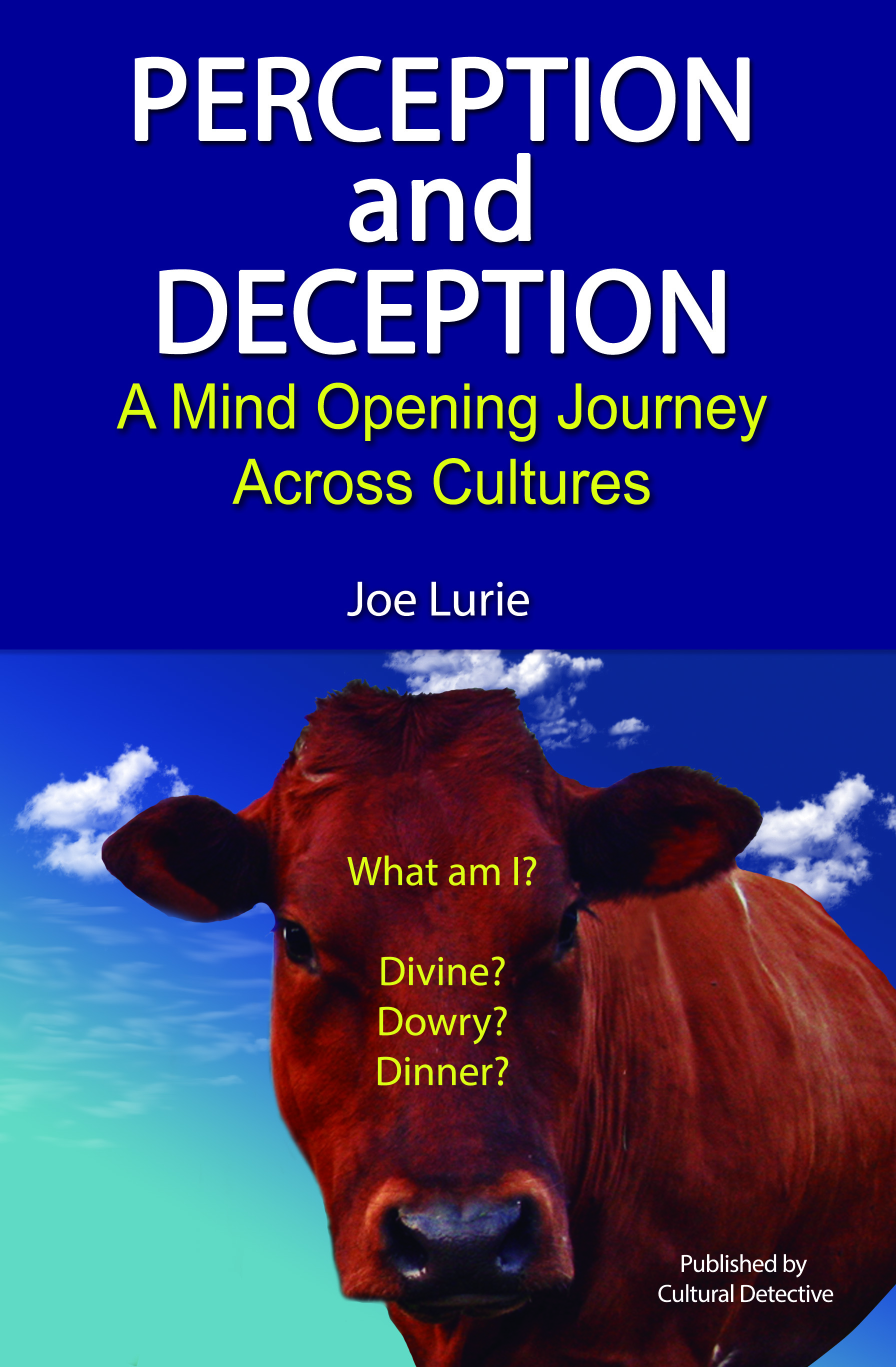
Need a powerful story to illustrate your point about intercultural miscommunication? Want to help someone understand that different cultures may utilize the same word, concept, image, gesture, sound or touch to mean different things? Could you use a proverb that gives insight into another person’s cultural worldview? Search no more—Joe Lurie , intercultural trainer, Executive Director Emeritus at UC Berkeley’s International House, and former Peace Corps Volunteer, has got you covered!
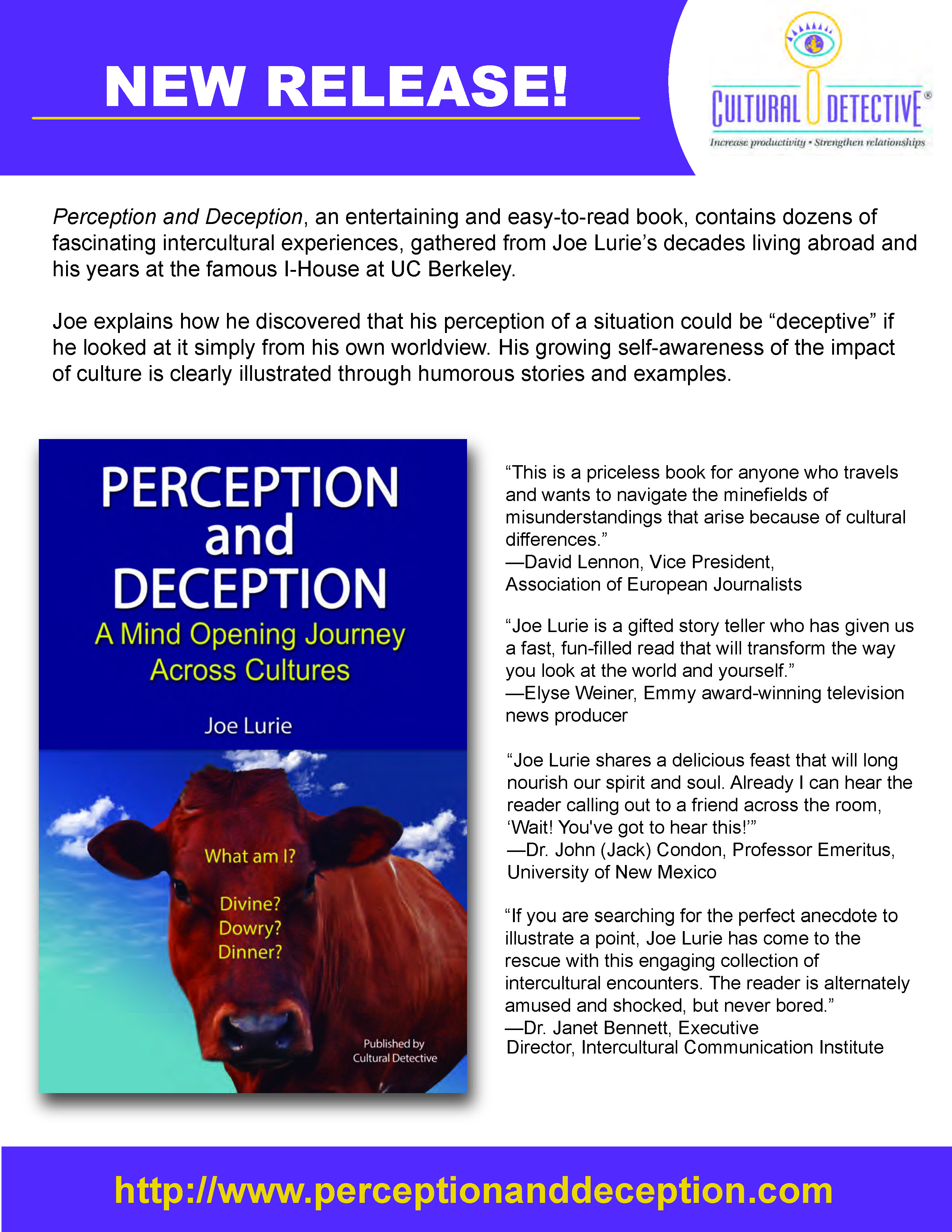
Perception and Deception: A Mind Opening Journey Across Cultures, is an entertaining, eye-opening and easy-to-read book that contains dozens of intriguing intercultural experiences, gathered from Joe’s research and his decades living abroad and managing Berkeley’s International House, one of the largest, most diverse living centers on the planet.
In an informative and enticing manner, the author explains how he discovered that his perception of a situation could be “deceptive” when he looked at it simply through his own Lens. Joe’s growing self-awareness of the impact of culture is clearly illustrated through his humorous stories and striking culture clash examples from news reports across the globe. Better yet, these stories are indexed by culture! Joe also shares pearls of wisdom about perception, perspective and the nature of “truth” from his rich personal collection of proverbs and sayings from around the world.
Joe’s infectious curiosity in uncovering and understanding cultural differences will help readers, no matter their profession, age or cultural background, gain a fuller appreciation for the richness of human diversity, and the multiple things that can go wrong when trying to communicate across cultures. You, your students, colleagues, clients, friends, and family will all enjoy this engaging book, published by Cultural Detective, and now available in paperback. Kindle on Amazon and other e-versions from Barnes and Noble and Apple will be coming soon.
Perception and Deception is an engaging and insightful introduction to cross-cultural communication in a globalized world. For more information, reviews, a peek inside the book, and a link to purchase a copy, visit www.PerceptionandDeception.com.
The 39th annual Summer Institute for Intercultural Communication (SIIC) offers professional development opportunities for people working in education, training, business, and consulting, in both international and domestic intercultural contexts. One of the premier gatherings of professionals in the field of intercultural communication, SIIC presents a unique opportunity to explore the field and network with others in a stimulating and supportive environment. Cultural Detective is proud to have long played a role in SIIC, and 2015 will be no exception. Sign up now as workshops are filling quickly!
The workshops below will all include Cultural Detective components; the Certification focuses exclusively on the Cultural Detective Method.
Psychologist George Kelly has suggested that learning isn’t being in the vicinity of an event, it’s the sense we make of it. If this is so, then experiential learning through games and simulations requires special knowledge and skills to derive the most significant learning. This experiential workshop focuses on current best practices and theories for creating, facilitating, and debriefing meaningful intercultural games, activities, and simulations. We will emphasize the critical importance of debriefing, including the ethics of appropriate responses in challenging situations and a variety of successful strategies that you can use in diverse intercultural settings.
Redundancía and Demonstration of Cultural Detective Online Tuesday July 14, 2015, Evening Session 7-9 pm Dianne Hofner Saphiere
Redundancía is one of the most powerful nine-minute learning games you will ever play. It builds empathy for non-fluent speakers, helps develop listening and communication skills, and captures the dynamics of power in conversation. It is a tool that can be used in a broad variety of educational and training situations.
Cultural Detective®approaches cross-cultural collaboration as a process, not a set of dimensions. It looks at people as individuals affected by multiple layers of culture, including nationality, gender, generation, spiritual tradition, and sexual orientation.
After we play and debrief Redundancía, the facilitator will provide a short tour of the Cultural Detective® Online system.
One of the main challenges for trainers and educators is finding meaningful methods and tools to develop intercultural competence. Actively engaging with conceptually grounded and widely used approaches to intercultural communication competence, such as communication styles, conflict styles, learning styles, the Cultural Detective®, and Personal Leadership®, this workshop will equip you with creative methods for training and coaching for both culture-general and culture-specific contexts. We will focus on effective group dynamics, co-facilitation, adaptation, and strategic management of participants’ and clients’ needs, as well as the creation of your own activities. You can expect to be creatively, experientially, and reflectively engaged.
Cultural Detective® is a core method for developing intercultural understanding, productivity, and effectiveness. It serves as a powerful design backbone for courseware, coaching, and teambuilding, or as a stand-alone tool for conflict resolution, learning and dialogue. A few advantages of the facilitator certification workshop include increased ability to:
Use Cultural Detective® as a backbone to design, reinforcing learning from a variety of activities and experiences in a coherent developmental spiral
Develop competence in a broad variety of international, cross-cultural situations
Foster collaboration and ongoing process improvement in organizations by using a consistent method and vocabulary in multiple locations
During this highly experiential workshop we will participate in a number of different intercultural simulations and games, and then re-introduce, conduct, debrief, or modify them for varying purposes. The day will be fast-paced and high energy. There will be much work in small groups, and participants will take turns facilitating the large group. We will emphasize the critical importance of debriefing and the ethics of proper debriefing, as we illustrate that using different questions and methods can make a single activity produce learning that is applicable to a diversity of purposes. Come ready to engage!
Ecotonos: A Simulation for Collaborating Across Cultures
Tuesday July 21, 2015, Evening Session 7-9 pm Dianne Hofner Saphiere
The Intercultural Communication Institute now publishes this classic simulation on intercultural collaboration, teaming and decision making. Be sure it’s part of your repertoire!
Powerful and extremely adaptable, Ecotonos breaks the usual stereotypes and barriers. Participants improve their skills and strategies for multicultural collaboration and teamwork.
Ecotonos can be used multiple times with the same people by selecting a new problem and different variables, with each replay offering new and different cross-cultural perspectives.
Self-exploration is the most vital learning for anybody who wants to guide others in their identity work. You can expect to be engaged in two days of self-discovery processes, from icebreakers to individual and team exercises, which can be used to explore identity. We will examine different ways to set up and integrate identity exercises into programs that resonate with various work groups, and discuss both the ethical and practical considerations we need to keep in mind when doing identity work. We will address why identity work is essential in intercultural training, leadership development, and team building.
Formed at the end of World War II to help develop countries torn by war and poverty, the World Bank is dedicated to improving the lives of the world’s poorest: to getting them clean drinking water, housing, food, and basic services like electric power. It is a challenging and complicated mission.
The Bank loans $65 billion annually for what have become increasingly large, high-profile projects such as dams, pipelines, and power plants. Projects of this magnitude can displace whole communities and wreak havoc on the natural environment. Sometimes providing water or energy to a city can drastically reduce the quality of life of rural farmers and fishermen. While the Bank has a clear policy of “do no harm” to people or the environment, all too often the Bank’s projects do negatively impact the environment and the lives of the very people the Bank was designed to help.
“Over the last decade, projects funded by the World Bank have physically or economically displaced anestimated 3.4 million people, forcing them from their homes, taking their land or damaging their livelihoods.”
—International Consortium of Investigative Journalists (ICIJ)
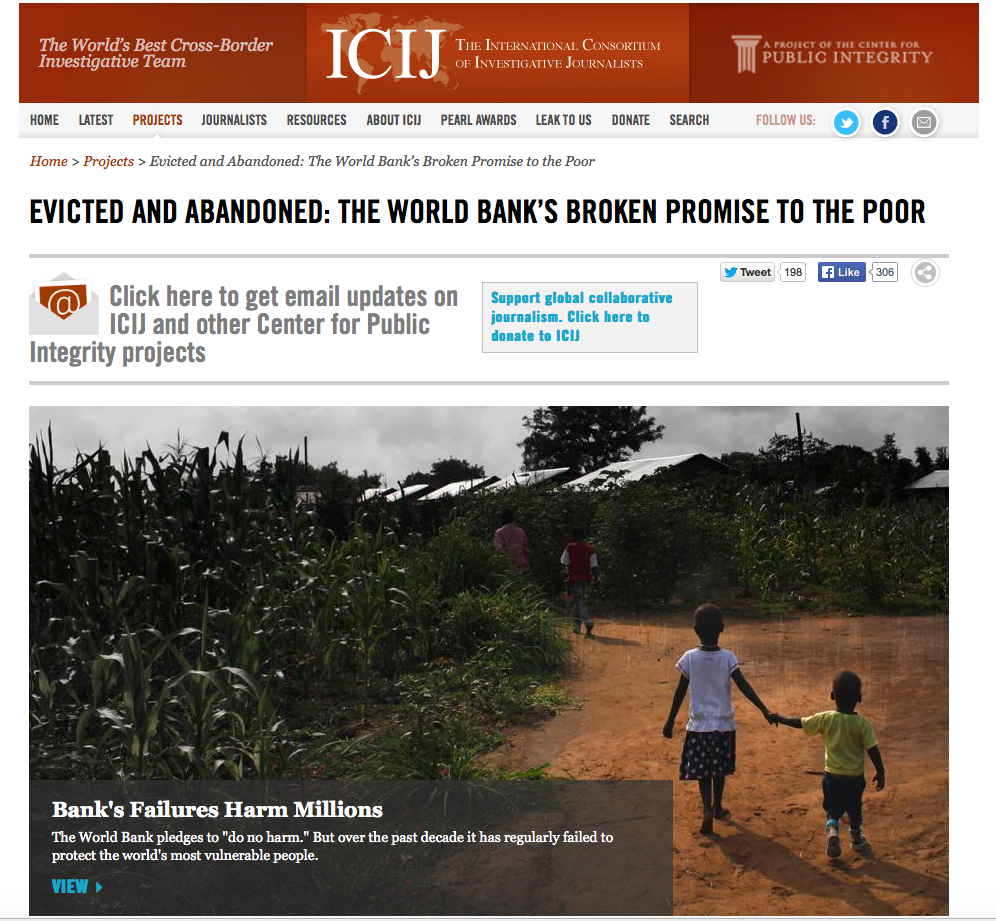
Complaints about the World Bank are nothing new; protests have taken place throughout much of my adulthood. Just a couple of weeks ago the International Consortium of Investigative Journalists added data to fuel the fire when it released the results of a year-long research project involving more than 50 journalists from 21 countries. They analyzed thousands of WorldBank records, interviewed hundreds of people, and conducted on-the-ground investigations in Albania, Brazil, Ethiopia, Ghana, Guatemala, Honduras, India, Kenya, Kosovo, Nigeria, Peru, Serbia, South Sudan, and Uganda. They titled the report, “Evicted and Abandoned: The World Bank’s broken promise to the poor.”
The report states that the World Bank has “regularly failed to enforce its rules, with devastating consequences for some of the poorest and most vulnerable people on the planet.” The most common hardship suffered by those in the path of “progress” is lost or diminished income. Forced relocations involve millions; they can rip apart kinship networks and increase the risk of illness and disease. Resettled populations are more likely to suffer unemployment and hunger, and mortality rates are higher.
“From 2009 to 2013, World Bank Group lenders pumped $50 billion into projects graded the highest risk for ‘irreversible or unprecedented’ social or environmental impacts — more than twice as much as the previous five-year span.”
—International Consortium of Investigative Journalists (ICIJ)
What causes such a well-intentioned mission to go awry? When the Bank is filled with so many people who are dedicated to serving others and making the world a better place, why do the systems become dysfunctional?
Bias is a human reality, and partnership is tricky. All too often, well-intentioned efforts to serve result in the world’s poorest and most historically oppressed suffering even more. Partly that is because we don’t validate what local communities know, and lenders want “experts” in the lead on projects. No matter how committed the Bank might be to partnering with local communities, bias runs deep and it’s an enormous challenge to be sure the expertise, experience, concerns and insight of all involved are heard and valued. It is a reality ripe for Cultural Detective and other intercultural tools, wouldn’t you say?
Greed and glitz, blind capitalism, and the appeal to ego (and to continued funding) of the big, dazzling projects. Major infrastructure projects look good on a dossier or resumé, and they help ensure that member states will pony up the money to support the Bank’s efforts. According to the Evicted and Abandoned report, a 2012 internal audit found that projects in the Bank’s pipeline triggered the Bank’s resettlement policy 40 percent of the time—twice as often as projects the Bank had already completed.
The gap between international funders and national and local governments. The Bank negotiates with those in leadership positions, who themselves may not only have the welfare of the people at heart. Or, there may be different leaders who control different regions or areas, and who consider an agreement with the national government not worth the paper on which it’s printed. Cultural Detective West Africa includes a critical incident on this very topic of negotiating with national governments when it’s local chieftains who control the territory.
Corruption. Corruption can exist at all levels, including soldiers who have been known to beat, rape, and murder in the course of forced evictions. The Huffington Post reports: “’There was often no intent on the part of the governments to comply—and there was often no intent on the part of the bank’s management to enforce,’ said Navin Rai, a former World Bank official who oversaw the bank’s protections for indigenous peoples from 2000 to 2012. ‘That was how the game was played.’” While there are cultural variations in whether we hire those we know and trust or whether we have public, transparent job calls, there is a line beyond which corruption must be called corruption. For example, relocating poor villagers without restitution so that your son-in-law can own an elite oceanside resort is clearly not true leadership. The Cultural Detective series has some powerful critical incidents about the effects of cronyism and how to honor preferential treatment for family, while also ethically honoring one’s goals, as well as incidents dealing with bribery and other ethical issues (Cultural Detective Global Business Ethics).
The world stage is shifting. There are new development banks on the world scene, competitors to the World Bank, that often don’t have the same social standards. Many say that this is leading to ever-lower standards, and disregard for the people and environments that “development” seeks to serve.
Changing a large dysfunctional system is far from easy, no matter how well-intentioned even a top leader is. I’ve seen this in many of my clients over the years, and in a few corporations I’ve worked in as well. Many felt hope when Jim Yong Kim took over as president of the World Bank in 2012. A Korean-American physician known for his work fighting AIDS in Africa, Kim Yong became the first World Bank president whose background wasn’t in finance or politics. Twenty years earlier, Kim Yong had joined protests calling for a shutdown of the World Bank and accusing it of valuing economic growth over assistance to the poor. Despite expected improvements, “an internal survey conducted last year by bank auditors showed that 77 percent of employees responsible for enforcing the bank’s safeguards said they think that management ‘does not value’ their work. The bank released the survey in March, at the same time that it admitted to poor oversight of its resettlement policy,” according to the Huffington Post article. A 2014 World Bank internal review found that in 60 percent of sampled cases, Bank staffers failed to document what happened to people after they were forced from their land or homes, and 70 percent of the cases sampled lacked required information about whether anyone had complained and whether complaints were resolved.
In my opinion we need the World Bank, just as we need the United Nations. For all their foibles and failures as human-run entities, their missions are crucially important. Incorporating cross-cultural best practices into the manner in which projects are managed, meetings are conducted, and decisions are made is a critical first step. Developing intercultural competence in the Bank’s staff and local partners in an ongoing, sustained manner, can make a major contribution to preventing the devastating downsides of development projects.
Vishavjit Singh in Central Park NYC as Sikh Captain America, photo by Fiona Aboud
I recently came across the best “Cultural Effective” (yes, that’s a play on “detective”) I’ve seen in a long time! He has my deepest respect, and he has me rolling on the floor laughing, as well.
I found him via an article that had a photo of a skinny, long-bearded Sikh man posing as—wait for it—Captain America! He had his shield, tights, and turban on, and was ready to fight for justice. Of course it got my attention. I absolutely loved it! The article was an interview with Vishavjit Singh, an engineer, writer, educator, activist, costume player, and the artist behind the terrific series, SikhToons.com.
If you think Sikh Captain America sounds interesting, how about a complete set of Totally Biased Avengers, fighting for justice and equity in our world? They are the brainchild of the talents over at Totally Biased, and include Asian Thor, Black Black Widow, Gay Hulk, and brown Jesus Christ. You readers know that Cultural Detective is awfully cool and helpful, but these Avengers may have us beat, lol. Do yourself a favor and watch the video below. But be careful, you will laugh out loud.
Getting back to Sikh Captain America, however, you have got to check him out. He, er, rather, his alter-ego, Vishavjit, is doing wonderful work in the world! Take a look at his terrific flip book on turbans, for example. Visit his website or follow him on social media to see his latest cartoons and other ventures. I especially appreciate how he teaches people to respond to bias respectfully, rather than sinking to the same level of ignorance or, worse, anger. He demonstrates patience, intelligence, empathy, humor, and both visual and verbal communication skills—definitely a superhero combination!
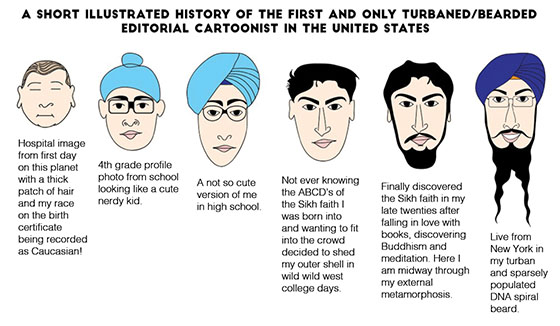
Vishavjit made a cartoon explaining the road he followed to get to where he is today. Those of us interested in the pathways to reconciling Blended Culture identity will no doubt resonate with it. The lightness yet levity with which he operates in the world is especially impressive when you consider he survived the civil unrest that resulted in the deaths of so many Sikhs in India.
Way to go, Vishavjit!!!! Bless you! It is a pleasure to be with you on a journey to build intercultural respect, understanding, and justice in our world. And you seem to be having so much fun doing it!
We are pleased to be publishing a wonderful addition to our series, Cultural Detective: Morocco. It’s perfect for those working with Moroccans, or wanting to do business in or relocate to Morocco. Perhaps, however, you are like me: you have seen tourist posters, watched Casablanca, eaten at Moroccan restaurants, and dreamed about visiting this seemingly exotic place. If so, then you will also enjoy wandering through our new package, even if you have no immediate plans to visit or do business in Morocco—at least not when you start reading the package!
One of the delightful things about Cultural Detective: Morocco is the feeling of almost participating in the culture that begins as you read the introduction. The oral tradition of Morocco is clear throughout the package, and the stories and examples show the hospitality and warmth of the people. To truly navigate successfully within Moroccan culture, you will need the advice of an inside perspective—a cultural informant—to help you develop and maintain the relationships and connections so necessary to doing business in this fascinating country. Cultural Detective: Morocco can provide you with that ongoing guidance, with ideas to save you from being unintentionally rude, and with suggestions that may help you communicate more comfortably and successfully with Moroccans. Click on any photo to enlarge it or view a slideshow.
Cultural Detective: Morocco has truly been a “labor of love,” coming to fruition due to the determination of two very dedicated professionals, Catherine Roignan and Youssef Zahid. Currently, one author lives in France and one in Morocco; both have a great deal of international experience, both have more than full-time jobs, and both have family responsibilities that take up every spare moment. In spite of these challenges, they wrote, revised, and wrote some more.
What is even more remarkable to me is that they wrote in French and then translated their work into English so I could read it. I made suggestions, did some editing, and then my suggestions were translated back into French for their consideration. (While the current version is in English, we will soon publish the French language version.) Of course, part of the authors’ discussion was also about Arabic words, as they explored the nuances of Moroccan culture and the particular choice of words used to describe it. This was a truly multilingual, multicultural creation process, weaving observations from inside and outside of the culture, and shifting worldviews as the authors worked to share the culture of Morocco with us.
One of the Moroccan values highlighted in the package is Daba baada (the present comes first): the only thing one can be sure of is today; one cannot know what tomorrow will be like, as things may change at any moment. We hope you will take the time today to explore this terrific new package, either via the PDF version or by viewing it as part of your subscription to Cultural Detective Online.
“Not only are bilingual young adults more likely to graduate high school and go to college, they are also more likely to get the job when they interview. Even when being bilingual is not a requirement, an interview study of California employers shows that employers prefer to both hire and retain bilinguals.”
—Rebecca Callahan, Associate Professor of Bilingual/Bicultural Education, University of Texas at Austin
Those of us who have worked in and around international education think that learning more than one language is good for people. We think it helps open up the mind to other possibilities, other cultural points of view. We also believe that the “code switching” involved in speaking multiple languages helps develop skills that are useful in social situations and beneficial in keeping the mind sharp.
However, for years no data existed that supported the benefits of being bilingual. And for a long time in many US educational settings, children who did not speak English as their first language were not encouraged to keep their bilingualism. Why would you need a second language when you learned English? The benefits of being able to speak more than one language were not generally recognized in the US.
I was excited to read about some new research by Rebecca Callahan, Associate Professor of Bilingual/Bicultural Education, University of Texas at Austin. In a recent article in Quartz, she writes: “Speaking more than one language may confer significant benefits on the developing brain. Research has now shown that bilingual young adults not only fare better in the job market, but are also more likely to demonstrate empathy and problem-solving skills.”
What does this mean? For study-abroad students, it might encourage them to know that the effort spent in learning and using another language has long-term economic benefits—you are more marketable! This is, of course, in addition to the eye-opening, mind-expanding, life-altering experience of living in a culture different from your own.
For children of immigrants and refugees, it means that making an effort to retain their parents’ native language is beneficial. In reality, many immigrant and refugee children in the US serve as interpreters and cultural bridges from an early age. They are forced to be bilingual—learning English to be successful in the school system, while speaking another language at home. I remember one Cambodian mother telling me, through her son, that if she learned to speak English, her son would forget how to speak Cambodian now that he was here in the US.
“Currently, researchers have begun to use data-sets that include more sensitive measures of language proficiency to find that among children of immigrant parents, bilingual-biliterate young adults land in higher status jobs and earn more than their peers who have lost their home language.
Not only have these now-monolingual young adults lost the cognitive resources bilingualism provides, but they are less likely to be employed full-time, and earn less than their peers.”
—Rebecca Callahan
For many in the US educational system, acquiring a second or third language is not as highly valued as it is in many other parts of the world. I am always impressed (and a bit jealous) when I am around people who can switch among languages—often because they were required or encouraged to learn multiple languages when they were in school. And for a nation of immigrants, it seems strange that only one-in-four US American adults are conversationally proficient in another language, according to a recent Gallup poll. It reminds me of the old joke, so true that it is embarrassing:
Question: What do you call a person who speaks four languages? Answer: Quadrilingual.
Question: What do you call a person who speaks three languages? Answer: Trilingual.
Question: What do you call a person who speaks two languages? Answer: Bilingual.
Question: What do you call a person who speaks one language? Answer: An American!
Of course, this challenge isn’t just limited to US Americans. In an article last year in The Guardian, Vice-chancellor of Cambridge University, Leszek Borysiewicz, pointed out that one in six children in English primary school do not have English as their first language. He noted that their first languages:
“…are real languages: living languages that give people a huge insight into culture and give the children who can speak them additional opportunities.
Isn’t that what education is about – enabling every child to achieve the maximum potential? What I’d love to see is an emphasis that this is an added value that that child has, a talent, and we should aspire to allow other children who may be monolingual to strive to become as bilingual as they possibly can be.”
An article about a study conducted by researchers at University of Guelph in Ontario, Canada, indicates that merely knowing a second language can result in higher earnings. The researchers say that the results of their study, published in the journal Canadian Public Policy/Analyse de Politiques, has implications for bilingual policy in Canada:
“Efforts to promote French in the ROC [rest of Canada] should be continued, not so much because of the earnings advantage that bilingualism confers, but because it results in many social/cultural/political benefits, strengthening the fabric of Canadian society and serving as an example to countries torn by ethnic, religious and linguistic divisions.”
The cultural flexibility inherent in knowing two languages is a valuable ability and a resource to be cherished. If we are to move toward intercultural competence, we need the ability to think outside of our cultural box and explore other ways of seeing the world.
That is what we try to do with our Cultural Detective packages—provide insight into another view of the world, a small glimpse into a different cultural reality, a chance to perhaps understand, just a little, how others see us, and how to work together more effectively.
1. SUSA 15th Anniversary Contest: Detect Opportunities for Cultural Bridging
During April subscribe for one-month to CD Online, giving you access to the complete packages including Values Lenses for more than 60 cultures.
Upload your original critical incident on CD Online, do a debrief, download it all as a PDF, and then submit to SUSA@culturaldetective.com.
That’s all you need to do. What do you get out of it?
Upon receipt of your completed Incident and Debrief, Cultural Detective will upgrade your one-month subscription to six months. This means you will get 5 months of Cultural Detective Online free!
CD will determine Incident and Debrief winners, who will receive a one-year subscription to Cultural Detective Online!
Winning Incident and Debrief will also be showcased in a webinar in which winners can promote their services/organization as well as teach others.
2. April SIETAR USA Member Product Discount In addition to the contest, SIETAR USA is offering their members a code for a 15-month subscription for the price of 12 months. If you are a SUSA member and participate in the contest, you’ll end up getting 21 months for the price of 12! Now that’s a YOU WIN! contest!
3. SIETAR USA 15th Anniversary Conference Proposal Submissions Being Accepted Through May 4th!
Want to earn the opportunity to present at this historic 15th annual conference, October 14-17, 2015 in Orlando, FL.? Session proposals will be accepted through May 4th. Be among the field’s leaders and submit yours now!
I have been fascinated with CarouLLou ever since I met her online about a year ago. She and her husband have been global nomads together for 21 years (and on their own before that). They are, however, unlike any other global nomad I have ever met. Initially they would live two years in a given location—fairly normal, expatriate-type stuff. Over the years, however, as the internet came into being, as communication became easier, as it became possible to rent furnished apartments online, and as visas became more complicated (e.g., non-EU citizens may stay in Europe for six month per year, but only three months in a six-month period), CarouLLou and her “mystery photographer” became more and more nomadic, living in each location for shorter and shorter periods of time. Nowadays, they often stay in a place one-to-three months.
Do they feel like tourists? Well, they do some touristy things; they see the sights, particularly when a place is new to them. But, that place, at that time, is their home. Their only home. What they love is feeling like locals: eating where locals eat, discovering hidden treasures that only locals know about, and doing things even locals wish they could do.
Sound familiar? I know it’s true for me, and I’m confident it’s true for many of you readers as well. How often have we been told we are more Japanese or Mexican than many born to that nationality? Untrue, of course; a metaphor, of course—but a compliment that reflects a desire on the part of the global nomad to put ourselves in the shoes of other people.
In the video below, CarouLLou answers my question about feeling like a tourist vs. being “at home,” what home means to her, and she tells us an interesting story about their life in Venice.
Error
This video doesn’t exist
Why do CarouLLou and her husband choose this lifestyle? Isn’t it difficult? It surely isn’t “normal”! To hear her tell it, the global nomadic life is almost addictive, with the constant stimulation of new experiences and learning. Below she explains why they live the way they do, and the advantages and downsides of their extreme global nomad lifestyle.
Photo courtesy CarouLLou. Click on the photo to learn her packing tips!
CarouLLou and her love travel with one medium-sized suitcase and one carry-on each—65 kilos of luggage. Remember, those suitcases contain everything they own. It definitely puts the quantity of “things” I have in my 3-bedroom condominium to shame. And my stuff has been actively downsized for several years now! So many of us want to live simpler, lighter lives. CarouLLou definitely lives lighter, if not simpler, than most of us.
I am fascinated that all her belongings fit in one medium-sized suitcase and a carry-on, because CarouLLou always looks so gorgeous, so put-together, and so in her element—whether she is in Mexico City, Tokyo or Rome. How in the world does a woman look that great and own so few pieces of clothing and accessories? Her response seems a good guide for many of us.
I well know that the life of an entrepreneur, local or global, can get lonely and isolated if we’re not careful. We don’t have an office full of people to work with everyday, so we have to reach out and actively build community more than some others. The very creative CarouLLou found an innovative way to connect with like-minded people in new cities in which she lives: “brainstorm lunches.” Click on the link to read a full article about these, or view the video clip below to hear her talk about the fit between treasuring friends and family, and the life of a global nomad.
CarouLLou speaks four languages, but obviously she has visited a lot of places in which she doesn’t speak the language of the place. How does she get along? I asked her to share some tips with us on how to communicate and get what we need when we don’t speak the local language.
There are so very many countries in the world, and even though CarouLLou and her husband choose to live mostly in metropolises, how do they choose where to live next? How do they decide whether to go to a new place or revisit a previous “home”? And how do they agree? I love her answer; based on decades of experience, it provides a sound guide for any traveller or sojourner.
Are you curious to know whether, after 21 years of nomadic life, CarouLLou still experiences culture shock? Here is what she says about this challenge.
The Facts This couple has been in 68 countries by the UN nation-count, 82 countries according to the “Travelers’ Century Club.” They like urban areas, and tend to travel East to West, following the seasons. They have twelve or so absolute favorite cities in which they feel at “home” and revisit regularly, and they rotate favorite places with places they’ve never before been to.
Photo courtesy CarouLLou
In 1994, CarouLLou and her husband began traveling, subletting their Montreal apartment, but in 1996 they announced to their family and friends that they were “jumping into the unknown!” They sold all of their belongings—minus a couple of suitcases full of personal items—and a FAX machine—to make their home portable.
How does CarouLLou support herself? She became “location independent” years ago with her marketing business, and then with her coaching business, because she could meet with her clients via fax and phone. (CarouLLou actually gave her clients and collaborators prepaid phone cards so they wouldn’t incur extra charges to communicate with her; how fast technology has changed!) She got her first email in 1998—quite late to the technology world, in my global nomad experience—and started a few online businesses as well as a photo site for her family and friends.
Currently, CarouLLou provides consulting on life potential, for start-up businesses, and marketing strategies, has several websites, some information funded by publicity, and others with affiliate partnerships (among them her travel site, as well as hotel booking and apartment booking sites). She loves fashion; in her blog and Facebook photos she always looks perfectly put together, and her looks are her own, yet change with each city in which she lives. She also has an online jewelry store to enable us to share some of her “finds,” and shares her inspired “looks” for various cities and sells clothes online. She is an investor, engages in currency trading, and has passive income from international organizations she’s set up over the years. CarouLLou also has several paper.li papers: Style, Nomads, and Travel.
Her philosophy includes:
“When we travel with an open heart, our world is full of hearts.”
“Don’t try to spend less, try to find ideas to make more! The more you spend, the more people benefit.”
“Remember the word currency comes from ‘current,’ so be in the current!”
“Work a little everyday, and do something special every day… and you will feel on vacation all your life!”
You can subscribe to CarouLLou’s blog, or follow her on most every social media. Like Cultural Detective, she has about 20,000 followers on social media, and she definitely shares our passion for cultural diversity and competence.

 Kissing customs vary by culture; we all know that—when greeting, do you kiss, bow, shake hands, hug, fist bump, or use some other gesture? If you do kiss to say hello, do you do kiss once, twice or thrice? Do you kiss the lips, cheek or air?







 Cultural Detective Blog