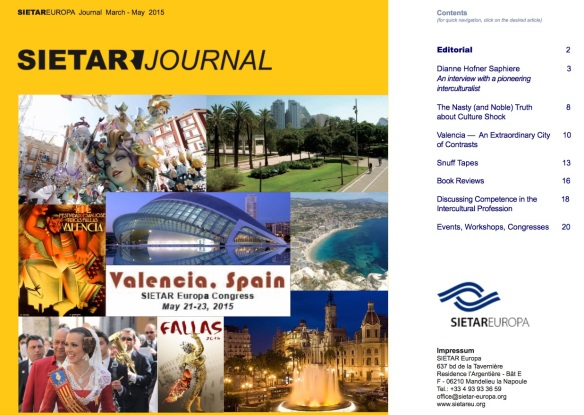
Join Us at SIETAR Europa in Valencia!

Logo_updatedHave you registered for the SIETAR Europa conference in Valencia, Spain May 21-23? The conference is the leading gathering of interculturalists in Europe, and is attended by many professionals from around the world. It is known for the quality of presentations and the intellectual exchange.

“This congress welcomes all those whose life and work puts them at the interface of cultures, from the perspectives of economy, society, and education with the aim of reshaping intercultural discourse, questioning our current cultural paradigms and exploring new thinking to help us navigate complexity in our emerging global world.”
—SIETAR Europa

Since our founding, the Cultural Detective Team has been committed to transparency, professional development, and vetting by our peers, and this congress will be no exception. Cultural Detective will have a huge presence at the congress, and we sincerely hope to see you there!

Firstly, Tatyana Fertelmeyster will conduct a Cultural Detective Facilitator Certification on May 18th and 19th. So many of you who live in Europe ask us for European-based certifications, so here is your chance! This is the only one scheduled in Europe this year. Attendance is limited, so please register early.

Also on May 19th, Pari Namazie and I will have the pleasure of conducting a pre-conference workshop, heavily based on Cultural Detective tools, entitled Blended Culture Identity, Global Ethics and their Value for Leadership and Teaming. I am very excited about where this workshop will take us. Ethics and authenticity are of crucial importance to cross-cultural leadership and teaming, and are too often overlooked.

A third CD-based session will be held on Saturday, the 23rd May at 10:00: Firearms in US Society: a Case Study about the Role of Interculturalists in Polarized and Politicized National Conversations, by Jeffrey Cookson and myself.

You’ll find pre-conference and concurrent sessions by Cultural Detective authors Marie-Therese Claes, Patricia Coleman, Heather Robinson, Catherine Roignan, George Simons, Jolanda Tromp, Rita Wuebbeler, Tatyana and myself, plus sessions by CD translators, certified facilitators and partners. We look forward to meeting you or reconnecting with you in Valencia!

Learn more about the city of Valencia.
Take Cultural Detective author George Simons’ diversophy® quiz on Valencia.

“If you act like a ripe plum, bats will eat you.”

(Proverb submitted by Lamar Gaye, Minnesota, USA, to BBC NEWS Africa website, Africa’s proverb of the day, 29 December 2014)

I so love proverbs—they give a view into a culture that cannot be obtained through any other source. They are tiny stories, gems in the midst of daily life. Although often I only read them in translation, they still provide valuable insight into my own and other’s values and worldviews.

Imagine my delight when I found a collection of African proverbs, contributed by folks from all over, to a site by BBC NEWS Africa. Featuring proverbs sent in during January 2015 and December 2014, I think you will find at least one that delights you or provides fresh insight into a situation.

800px-Monkey_family_in_moss_tree

By Irvin Calicut (Own work) [CC BY-SA 3.0 (http://creativecommons.org/licenses/by-sa/3.0)%5D

“Monkeys do not advise their young ones to be careful on trees. They just remind them of the distance to the ground.”
—Sent by Geoffrey Kosgei, Nairobi, Kenya to BBC NEWS Africa website, Africa’s proverb of the day, 5 November 2014

Did you know that buried within each Cultural Detective package are proverbs and sayings to illustrate the culture’s core values? We periodically convert some of these to graphic format and share them on social media, archiving them on the Cultural Detective Pinterest board and Facebook page. Our authors have fun remembering what their parents or grandparents said to them, and often are surprised when they find out they were each told the same thing—or a close variant of it—even though they grew up in different circumstances!

These “childhood messages” often echo in our minds for years and continue to influence who we are today. We may even find that our core values are reflected in those proverbs and sayings that were shared by important people in our past. Our popular package, Cultural Detective Self-Discovery, uses our favorite proverbs and sayings as one method to investigate our own personal values. Cultural Detective Online now includes Cultural Detective Self-Discovery, which allows you to build your own Personal Values Lens—just as beautiful as the others contained within our series—using a variety of investigative methods.

Of course, there are books with collections of proverbs, but the ones I like best are those that I happen upon in everyday speech. Keep your ears open and let us know what gems of wisdom you hear—from yourself and those around you!

SIETAR Europa, a Profile, Valencia, a New Book

SE Journal coverThe March-May 2015 issue of the SIETAR Europa Journal is out today, and I thought some of you might want to take a look. Pari Namazie conducted a lengthy interview with me when I was last in Vienna, and it is published in the journal on pages 3-9. I find it flattering, embarrassing, encouraging and mortifying, all at the same time. It is humbling to have the honor to be profiled in this way. Thank you, Pari and Patrick Schmidt, editor. Perhaps it will give you insight into some of the experience that has contributed to Cultural Detective.

Also very important in this issue is news of the upcoming SE Congress in Valencia, Spain, 21-23 May. Please plan to attend! There are a wealth of terrific pre-conference workshops, including two focused on Cultural Detective, as well as incredible concurrent sessions, all in the gorgeous setting of Valencia. The full schedule is not yet posted, but you can register for the Congress now and then register later for any pre-conference workshops you want to attend. I hope to see you there!

Finally, I’m very excited that my old friend Joseph Shaules has published his much-anticipated book, The Intercultural Mind, and George Simons has written an insightful review of it on page 16.

You can find the issue of the Journal here.

Lampooning Leads to Apology for Sensationalism

2015.1.27.BF.COMMInaccuracies in journalism are of increasing concern to me, as is the idea that so many consumers of communication media fail to use their critical thinking skills, and, rather, believe a sensational report without checking facts. Journalists can easily fuel people’s worst fears, feeding an “us vs. them” mentality. I spoke about this in my recent Charlie Hebdo post.

If we are to create a world for ourselves in which we respect, understand, and value one another, one in which we are able to cooperate in sustainable ways, we need accurate and thorough information on which to base decisions. We need to be able to discern “gray” areas, and think things through from different perspectives.

On a slightly divergent thought track, I occasionally marvel at how powerful the visual arts, comedy, movies, and performances are in generating a paradigm shift in the general population—the sort of paradigm shift that is needed if we are to develop intercultural competence. I feel that news media should help us think things through by gathering facts, but all too often, it is the arts that help inspire us to do so.

Recently, a post crossed my desk that brings these two ideas together for me in a salient way. One of our Cultural Detective series’ authors—Basma Ibrahim DeVries—shared a link on Facebook to a story that resulted in truth telling. A major news outlet was forced to admit its multiple errors and publicly apologize for their inaccuracies, perhaps, in part, stimulated by a French television comedy show—Le Petit Journal!

Fox News interviewed someone who presented as fact that there are “no-go zones” in Europe—places in which Islamic law supersedes local law and non-Muslims fear to go. “No-go zones,” viewers were told, included the entire city of Birmingham, England and a half-dozen key areas of Paris. Fox also made various other claims, which met with widespread criticism from the likes of British Prime Minister David Cameron, and the threat of a lawsuit from the Mayor of Paris, Anne Hidalgo.

Le Petit Journal was quick to offer its humorous and yet informative rebuttal. Below is a clip of the show, in French with English subtitles.

I live in Mexico, and over the past five years I’ve experienced the negative impact that sensationalism and inaccurate, biased reporting can have on a country and its people.Often, this media bias is not confronted.  In this instance, however, Fox actually issued four separate apologies in one day for portraying Muslims in a negative light.

“Fox News took time out of four broadcasts on Saturday to apologize for four separate instances of incorrect information that portrayed Muslims in a negative light.
—CNN

Once Fox News apologized, our French comedy show, Le Petit Journal, had to gloat, of course. They lampooned Fox with great gusto while munching on super-sized popcorn and soda. Click on the link to view the video.

I am happy to hear that Fox News was forced to apologize for their biased and false “reporting.” I am grateful to know that the public expression of outrage and humor can still have some effect, however fleeting it might be. If, like me, you’d like to read more about the poll Fox cited, that one in six French citizens support ISIS, you might reference a much more insightful piece about it, published by the Washington Post.

The Cultural Detective Method helps people separate facts—what people see and hear—from interpretations, or what the facts mean to a person observing them. Our values influence how we interpret the facts—the meaning we give to the situation. Given personal and cultural differences, the facts may mean different things to different people. This is normal and to be expected. However, what we want from journalists is, to the best of their ability, the specific details and essential data necessary for us to understand a situation more accurately and thoroughly. Situations these days are often complex rather than clear-cut. Reporting on complex realities is difficult in the best of circumstances, and we applaud those ethical journalists who work to make it happen.

Thank you for accompanying us on this journey to build intercultural competence. Together, we can build international understanding, respect, and justice.

Happy Thorri! Celebrate our new CD: Iceland package!

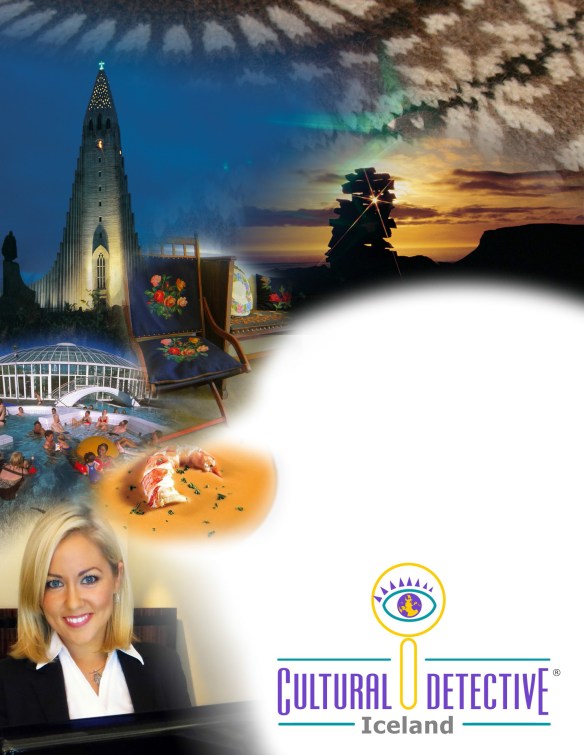
CD Iceland coverIt’s hard to believe that we have finally completed the Cultural Detective: Iceland package! This project spans more than five years, with some stops and starts. After working long hours in Iceland, in the USA, and on Skype, the emphasis was always on finishing what we started with high quality. We were both certain that, in spite of our busy work schedules, other duties, and familes, it would sort itself out, and we would manage to complete this project.

2014-10-23 12.10.15

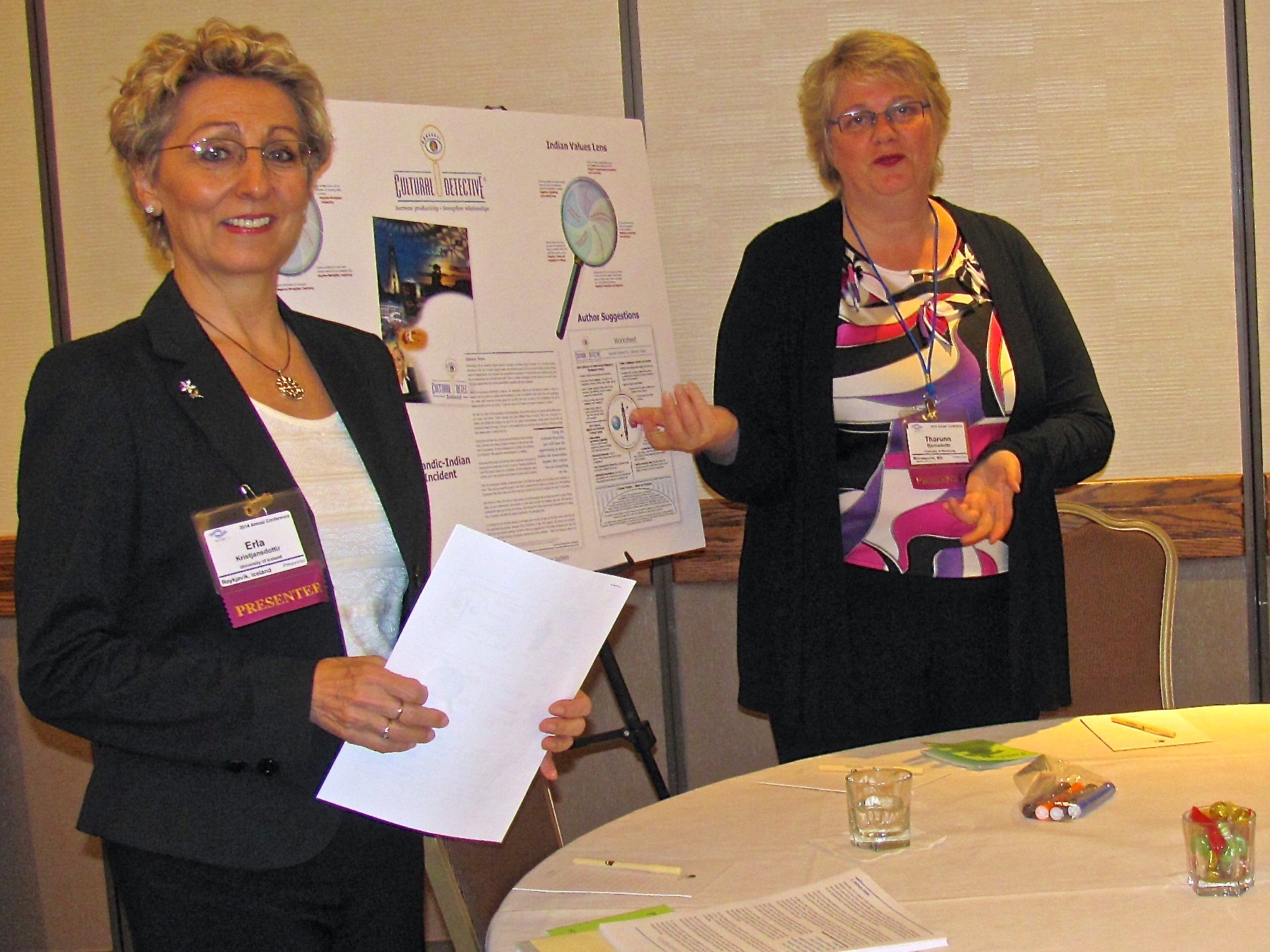
Erla on the left, Thorunn on the right

We were introduced to each other on a beautiful sunny day in Iceland in 2008, and that very day Thorunn asked Erla if she would be interested in collaborating on the Cultural Detective: Iceland project. We immediately “clicked” and decided to meet again and discuss the idea of working together. Throughout this collaboration we learned a lot about ourselves, about each other, and about our culture and what it means to be an Icelander. Through thick and thin, stressful moments, a lot of laughter, travel between Iceland and North America, we established a wonderful friendship for life.

It is perhaps fitting that Cultural Detective: Iceland is announced on Facebook during Thorri season, when Icelanders celebrate in ways no one else in the Western World celebrates: by eating fermented food and using anise or caraway-flavored snaps to help swallow it!

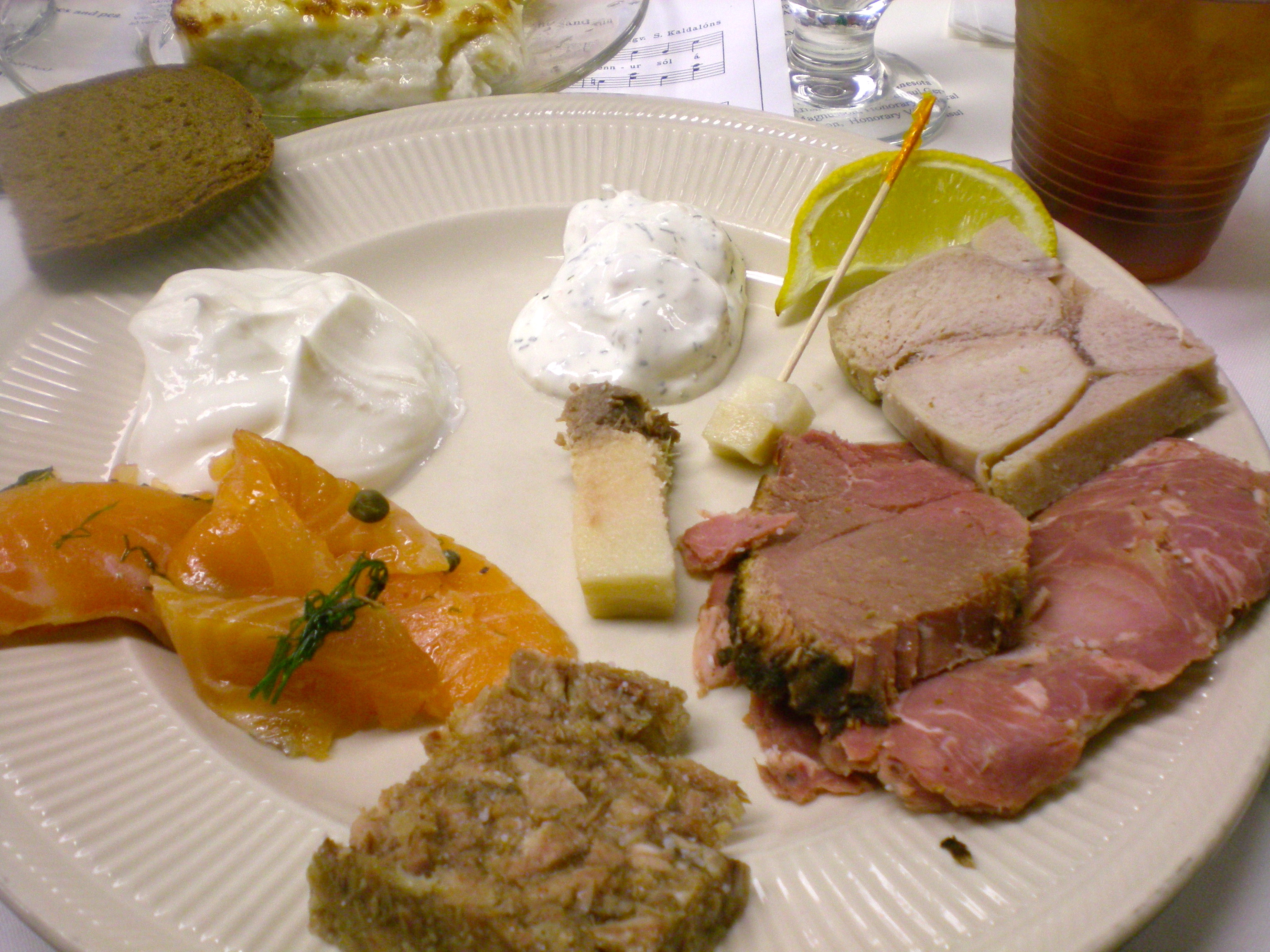
Þorrablot dinner

Þorrablot dinner

This mid-winter season in Iceland is called Þorri (Thorri), and according to the historic Icelandic calendar it starts on January 23rd with Húsbóndagur (Husband Day) and ends on February 22 with Konudagur (Women’s Day). At this time of year, Iceland is cold, dark, and windy. But because the sun rises at about 9:30 am in the morning, it is a whole lot better than in December, when it rises at 11:30 am—so it is time to celebrate as a way to get through the Thorri season! The celebration is called Þorrablot or celebration of the Nordic God Þór (Thor).

These parties are usually attended by people belonging to the same social group such as a fireman’s association, an association of people from a particular fjord, or people who work for the same company, etc. The entertainment varies from a stage performance, to a comedian as Master of Ceremonies, to people making speeches and reciting Icelandic poetry, and usually ends with lots of dancing and singing of national songs. The staple foods at these parties are pickled ram’s testicles, boiled sheep’s head, blood sausages, liver pudding, smoked and cured lamb, and dried fish. Some people have to be “manned” into eating these things, and some parties have these delicacies as side dishes rather than as the main dishes.

Below is a video of Þorrablot at CCP, an international company headquartered in Iceland. A new employee from Denmark has been invited to this celebration. Can you imagine his culture shock?!!

So how do we translate our wonderful yet, at times, strange culture into a manageable frame for others to understand? This was our task as co-authors. It was not easy, but surprisingly rewarding. After interviewing foreigners living in Iceland, and Icelanders working abroad, we began to see the values system emerge.

We struggled quite a bit about which values to highlight through the Icelandic Values Lens. The more we talked to people, the clearer it became to us that Icelanders hold their language as central to the culture. So strong is this value that Icelanders believe that for anyone to be able to work in Iceland, even in menial jobs, they need to learn the language. To support this value, Icelandic companies who hire foreigners generally offer Icelandic lessons during the lunch hour.

Every culture has some things that cannot be translated. In Iceland, one of those things is the phrase, “þetta reddast,” literally translated into English as “it will work out.” However, in English, this phrase seems more of a hope than a reality. In Iceland, we understand the phrase to really mean “things will sort themselves out” and, in the end, they always do, somehow.

Because immigration is making the country more diverse and the travel industry is growing, there is a definite need to enable Icelanders to be more open and knowledgable about cultural differences and gain cultural competency. In addition, Iceland’s economy is export-driven and becoming more integrated into the world economy, so it is important for outsiders to learn how to work with these very direct, honest, and hard-working people with a great sense of humor.

Cultural Detective: Iceland is now included in Cultural Detective Online and also available in a printable PDF format. We are looking forward to using CD: Iceland in universites, companies, organizations, and any place people want to learn about our culture. If you get a chance, we hope you will visit our beautiful country. Meanwhile, we encourage you, a curious Cultural Detective, to learn about Icelandic culture by exploring the new CD: Iceland package!

Vinnan göfgar manninn. “Hard words break no bones.” (Icelandic Proverb)

CD Iceland coverI have the best job in the world: working with our Cultural Detective authors—I always learn so much! Recently, I had the pleasure of working with our authors on the Cultural Detective: Iceland package—the most recent addition to the CD series. This is a culture I know nothing about, therefore, I had no preconceived notions about how it would be to work with these bright ladies, or what I would learn.

Fortunately (from my US American point of view), being direct and straightforward is generally considered being honest, and is highly valued in Icelandic culture. When discussing a topic, everybody tends to share ideas (without evaluation) and then the best course of action is chosen. Questions are answered directly, and disagreement usually is not considered a personal attack. To those from a less direct culture, this style of communication may feel rude and blunt, while to Icelanders it’s just contributing their ideas.

The authors shared a delightful example of language and culture being intertwined: Icelanders do not use the word “love” as US Americans do. Their word for love is used in relation to family. It is a “very expensive/high value” term with a special use for a special purpose. Therefore, the use of “love” was very confusing to our authors when they first arrived in the United States. They were surprised that people loved their pets, loved ice cream, loved a movie, etc. In contrast, one of the authors told me that if her husband ever said he loved her, she would know she was dying! She told me, “Icelandic husbands love their wives so much that they almost tell them!”

This relatively small country (population 320,000) has seven universities, the oldest parliament in the world, and dynamic, high-energy, optimistic people. We look forward to introducing you to CD: Iceland, and a culture whose Viking roots impact the freedom and respect for the individual that are the heart of Icelandic values today. Be sure to check it out, put it to good use, and let us know what you think!

Four Steps to a Happier Life: Actions Don’t “Create” Reactions

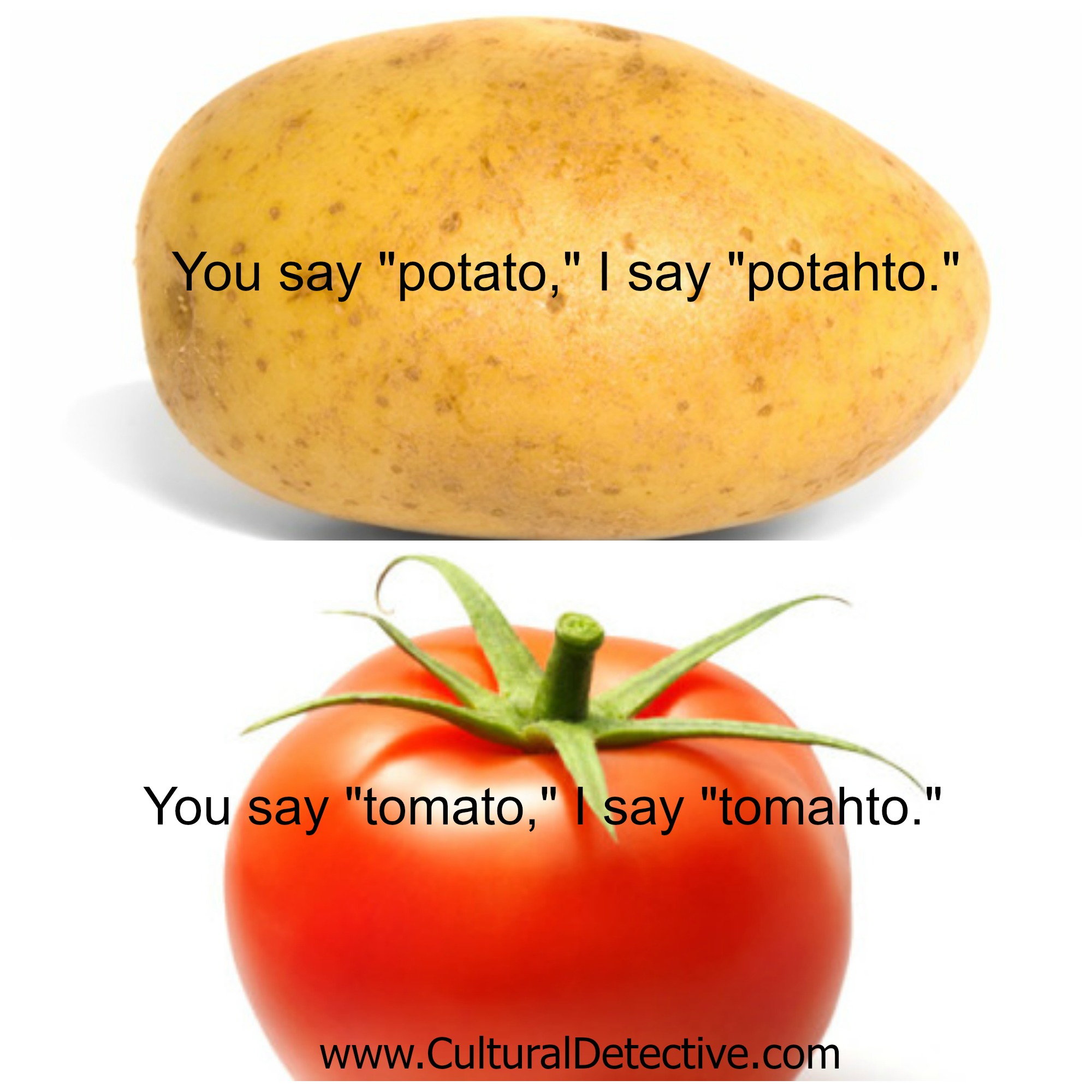
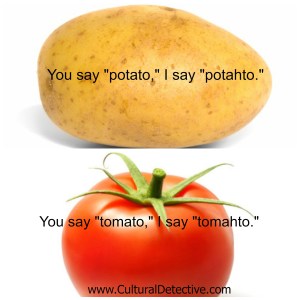
Potato-PotahtoDuring our monthly webinar, attended by people working in academia, NGOs, private enterprise, and a religious community, and geographically from Russia to Egypt to the USA and quite a few points in between, one of the participants summarized for us what she had learned. Cultural Detective had taught her, she said, “that actions don’t ‘create’ reactions; interpretation of actions creates reactions.”

Yes! That is brilliant and powerful learning! And it is crucial to understand this idea if we are to develop intercultural competence. It is a prerequisite to implementing the four steps to a happier life.

“Actions don’t ‘create’ reactions.
Interpretation of actions creates reactions.”

Your Story/My Story
To understand the concept better, think about a time when you had a painful miscommunication with someone, the type of miscommunication that haunts you for days or longer. The example I’ll share with you involves a family member, but yours might involve a friend, family member, important client, or colleague. Got your example? Okay, here’s mine.

Recently, a family member took exception to a text I sent him. It was classic miscommunication. He felt I had jumped to conclusions about him, specifically, that I had falsely accused him of wrongdoing. His negative judgments and assumptions about me made me sad. This is common; there is a downward spiral that so often happens in miscommunication. We want our family, friends, colleagues, and clients to give us benefit of the doubt, to assume we have their backs. It is upsetting when, instead, they think the worst of us.

Communication is a shared process. We send our messages and usually assume that the receivers of our messages understand us. But does our intention, the meaning, as conveyed by our message match the other’s interpretation? This, of course, is the crux of successful communication!

Think about your own example. What happened? How did each of you perceive the miscommunication? How did each of you feel? What was the outcome?

My relative’s upset was real, as was mine. We can’t and shouldn’t deny our feelings and our reactions. Yet, it was especially important to me that, as a family member, we not feel negatively toward one another. One good outcome of the exchange was that I learned something new about him, and now understand an area of sensitivity for him. That knowledge will inform my future interactions, and hopefully help me to communicate with him in ways he finds more supportive. I am confident that he learned something that will inform his future communication with me, as well.

So, did my text “cause” him pain? Did his response “cause” me sadness? Did our differing communication styles “cause” frustration? No, of course not! It is the manner in which we interpret differing communication styles that can cause us frustration and can waste our time, energy, enthusiasm and resources. Your mother may have told you when you were young that your friends can not make you angry; it’s your choice to become angry or not. Differing communication styles can actually strengthen teamwork, and they can add delight to friendships.

Now, think about your example of miscommunication. Did your behavior “cause” negativity for the other person? Did their behavior “cause” it in you? Or, rather, was it the way each of you interpreted the other’s behavior—the meaning you gave to it—that caused the grief?

In my example, there was no negative energy or assumption embedded in the initial text; I had no thought of accusation. Many times, however, our innocent actions result in hurt feelings or negative perceptions, just as they can also help people feel good. In hindsight my text could have been worded better. A lengthier, more explicit text from me (or, better yet, a phone call) may not have “caused” the reaction it did.

However, it was not the text itself but, rather, my relative’s interpretation of the meaning behind my text, that provoked his reaction. We cannot control how others will perceive us, though we can do our best to improve our communication skills. The distinction between behavior causing a reaction versus our interpretation of the behavior influencing us to react in a certain way is an important distinction for cross-cultural and intercultural communication effectiveness.

THE FOUR STEPS TO A HAPPIER LIFE
So, what are these four steps to a happier life, to improving your communication with others?

Step One
The first point to remember is that miscommunication happens—every day, even between loving couples, family members, and friends. How much more frequently can miscommunication happen, then, between strangers or those who come from very different cultural backgrounds?

When we find ourselves in an uncomfortable communication situation, we need to remember not to place blame. It’s happened; miscommunication is natural and normal. But we can use it as a learning opportunity—a chance to understand more about ourselves and others.

Step Two
As the Cultural Detective Method shows us, when we find ourselves involved in miscommunication, or feeling a bit frustrated or judgmental, we are wise to take a look within ourselves. What are my assumptions? What beliefs am I using in my interpretation of events? What does the way I feel tell me about what is important to me? What values do I hold in relation to this situation, and how do I link them to appropriate behavior?

Our past experience and “common sense” (really “personal cultural sense”) cause us to interpret actions in certain ways. Becoming aware of those filters, the ways we view the world, can help us know ourselves better, to be better able to understand and anticipate our own responses, and better able to explain ourselves to others.

Step Three
Once we’ve taken a look into ourselves, it’s time to try to put ourselves into the shoes of the other. Even though we might perceive behavior as negative, let us temporarily, while we think this through, give the benefit of the doubt. What might be other, positively intended reasons that the person did what they did?

Of course, I can also consider whether I know this person to “have it in” for me. Does this person have a history of attacking me, or of acting unprofessionally? If not, the above “positive intent” exercise becomes even more important.

Step Four
Finally, it’s time to reach out and take action to resolve the miscommunication. Preferably,  this includes a combination of apologies for discomfort, questions that seek to understand, explanation of intent, and summary of what has been learned. It should, also, ideally culminate with a path forward: how we’ll try to communicate more effectively with one another from this point on.

Looking at the above four steps, you will see they incorporate the three capacities that the Cultural Detective Model teaches us:

  1. Subjective Culture: Knowing ourselves as cultural beings
  2. Cultural Literacy: Empathy and the ability to “read” the intentions of others
  3. Cultural Bridging: The ability to bring out the best in ourselves, others, and the organization or community

If you haven’t yet joined us for one of our monthly webinars, please do. Those attending receive a complimentary three-day pass to Cultural Detective Online, a tool that can help you integrate these four steps so that they become second nature in your daily life. And, please, share the invitation with your friends, colleagues, and clients! Let’s make this world a happier and more interculturally effective place!

Part of the #MyGlobalLife Link-Up

Want to Get Out of the One-Shot Training Rut?

Ribbet collageOne Client’s Story

A few months ago I received a call from a dear friend and respected colleague. He told me that he had a client very committed to diversity and inclusion, that hired him once a quarter, every quarter, to design a 2-1/2 hour workshop. He delivered the workshop to a total of 300 employees, so he facilitated it about eight times over. Great client, right? A full week of work every quarter, on an ongoing basis…

He told me about some of the topics he’d covered, and some of the methods he’d used; they were all fantastic. He reported to me that everyone attending would have a really great time. The participants would learn, the evaluations would be excellent, and my friend would get hired back.

But he also told me that, while lucrative for him and enjoyable for the learners, he felt his approach wasn’t really accomplishing anything. My colleague was frustrated because he didn’t feel the learners were really developing skills, they weren’t changing what they did at work, and the organization wasn’t developing the intercultural competence it needs. He knows that real competence requires ongoing practice, and he thought Cultural Detective could help.

The client is a division of a major university. The employees interface daily with students and scholars from all over the world, and they, themselves, are a very diverse team. My colleague wanted to embark on a two-year project with a coherent, developmental design for his workshop series. He felt that Cultural Detective could be the anchor, the “backbone,” so to speak, the constant throughout the two years. But how did he plan to do this?

He wanted to start by having me join him for the first workshop, so that I could introduce the 300 employees of this university division to the Cultural Detective Model. While I was there with them, he wanted me to also train him and a few on-site facilitators (Diversity and Inclusion trainers as well as those from Organizational Effectiveness) in the Cultural Detective Method.

coverIslamOver the next two years, he wants to use Cultural Detective to help the employees develop more in-depth knowledge and skills for working with individual cultures. For example, one quarter they might learn more about how to work with East Asians, using CD ChinaCD Japan, etc., as resources. Another quarter they might focus on Muslim cultures, using CD IslamCD MalaysiaCD Arab Gulf, and CD Turkey, etc. In the months between workshops, supervisors will work with employees to ensure that the skills they learn in the workshops are applied on the job. They will use university staff and students as resources and after each workshop, program leaders will agree on an “application plan” to encourage employees to use the ideas presented and practice their skills between workshops.

How, exactly?

In the first workshop, we used critical incidents that were drafted by the client’s Diversity and Inclusion Task Force. These included stories of staff interaction with students from around the world, as well as stories of employee interaction with one another. We analyzed these incidents together in the workshop, and learned what each of us could do to improve our performance, to better understand our customers (in this case, students) and colleagues, and we generated ideas for improving the organization’s systems, procedures, and structures, to make it more inclusive. We also played several learning games and simulations, and participated in other, supplementary exercises.

Here is what program leaders agree will take place after the first workshop and before the second in order to help ensure skill development and application:

  • In the weekly “mini-meetings” that all supervisors conduct with staff, they will ask employees to share a “best intercultural practice” they’ve learned that week, as well as cross-cultural questions or incidents they’ve experienced.
  • The Diversity and Inclusion Task Force members will write up critical incidents and Sample Debriefs for each of the areas of the workplace that they represent. They will invite employees to attend sessions in which they discuss and analyze the incidents, thereby continuing to build employee knowledge and skill, and continuing to interculturalize organizational processes.

cover_selfdiscovery copyThe second workshop is planned for the first quarter of 2015. In that workshop, my colleague is planning to introduce Cultural Detective Self Discovery to the employees, helping them each to develop their own Personal Values Lenses. Employees will then compare their personal values with US American, African-American, and Latino-Hispanic values (the primary composition of the workforce), as well as to those values of the many nationalities of students with whom the employees work. They’ll learn how to remain true to themselves, and how to adapt their behavior to be more cross-culturally effective. They will also use their Personal Values Lenses to get to know one another in a more meaningful way, and to discuss ways to improve their work teams: how to effectively collaborate to bring out the best in each other.

Employee representatives, supervisors, and Diversity and Inclusion Task Force members will meet after the second workshop to decide on an application plan for what the employees have learned. Their goal will be to figure out how best to reinforce the learning on the job, to be sure it gets used, and that employees continue to develop their competence. In addition, they will work to ensure that the organization continues to refine its policies, procedures and structures for intercultural effectiveness.

My guess is they will recommend ongoing team meetings that use the Personal Values Lenses, as well as having teams share their own critical incidents based on their own experiences. In this manner, the group will continue developing their intercultural competence, they will develop a library of resources on intercultural effectiveness to use to train new hires and continue to develop themselves, and they will maximize the intercultural effectiveness of the organization. Program leaders will then plan the third workshop, followed by an application plan, and so on.

In this way, over the next two years, my colleague is confident that these 300 employees he’s had the pleasure of working with will truly develop their understanding of themselves as cultural beings. They will learn how to better manage cross-cultural situations with the students, and how to better function in the multicultural teams of which they are members. Plus, they will help improve the intercultural competence of the division in which they work.

I do hope they will do a pre- and post-assessment, using the IDI (Intercultural Development Inventory) or some other instrument, to track employees’ progress. It would also be useful to record the systemic and procedural changes made, and see if there are differences in work-team functioning and in student satisfaction with employee performance. I believe research of this sort would be invaluable in showing how improving cultural competence can be a worthwhile investment of time, money and people’s energy.

I greatly appreciate the invitation to join the group to be part of the beginning of this grand undertaking. I look forward to watching as the program moves along its path, and intercultural competence spreads among the staff and organization. I am confident my friend’s plan is going to be hugely successful and wish him and the organization the best of luck!

2014 Year in Review

240_F_71469226_XoKVyVhM4OzQ7CXxB9e3H6myQHfmjOP7The entire Cultural Detective Team would like to thank you most sincerely for being part of our community, and wish you much joy, health and success in the new year!

2014 was a big year for Cultural Detective, as we celebrated our 10th anniversary! We are thrilled to have grown into such a large and talented community of people worldwide, committed to making our world more respectful, collaborative, just and sustainable. Thank you for joining us on this very important journey!

LayeredLensesFinalThis year we were able to achieve another milestone: launching our best-selling Cultural Detective Self Discovery (currently in beta) as part of our Cultural Detective Online platform. This is a huge step forward for our small business.

We are proud that our online tool encourages people to look at themselves and others as beings that are influenced by various cultures, not just nationalities. Now, people are able to explore their individual values as well—their uniqueness—and how they’ve been personally influenced by the cultures around them.

After developing a Personal Values Lens, users can then compare their values with those of any other Values Lens in the online system. This offers a way to investigate aspects of a new culture they might resonate with or find challenging. And it provide a way to strategize about how best to adapt for success cross-culturally, while preserving their sense of self and, also very importantly, their ethics. If you haven’t yet given CD Online a go, you are certainly missing out! Nearly every day I hear a new customer tell me they can’t believe how powerful Cultural Detective Online is, and how affordable. So what are you waiting for?

One additional huge milestone in the CD Online system is the improved group functionality. We are thrilled that users within a group can now collaborate on writing critical incidents and debriefs. Think of the possibilities: your learners working together on cross-cultural stories, told from each person’s perspective! Individual learners can choose to share (or not share) their incidents with the group by submitting it to the group administrator—trainer, coach, professor or team lead. The group administrator can then request the learner to edit the incident and debrief further, or can share the incident and debrief with the entire group. This functionality is transforming the way customers use our system and develop intercultural competence. It is thrilling to witness!

online-learningBecause of these two huge enhancements to our online system, we will be adding a couple of standard webinars to our lineup. As you know, we already conduct monthly complimentary webinars introducing people to this powerful process for cross-cultural collaboration. In 2015, we will add to that lineup by offering a webinar on Cultural Detective Self Discovery, and a second one on Using Group Functionality in CD Online.

The first quarter schedule is live at www.CulturalDetective.EventBrite.com, and additional webinars will be announced throughout the year. One series we are hoping to add will deal with race and power issues, with the intent that by the end of the year we will have some constructive ideas on how to dialogue more effectively with friends, family and colleagues, and how to promote societal change and healing.

Check back frequently and please let your friends and colleagues know about these terrific professional development opportunities. We have people joining our webinars at all hours of the day and night. More importantly and unbelievably, they actually THANK us for keeping them up at 3 am! (We do schedule our webinars at different times to allow for time zone differences, by the way. It’s just that some people are more eager than others.)

In 2014, we added 5000 new readers to our blog, with readers joining us from 167 countries this past year. I find that very encouraging! Our social media reach has grown extensively. Cultural Detective has an active presence on Twitter, LinkedIn (group), Facebook (page), YouTube (channel) and GooglePlus, as well as a Pinterest board of proverbs, several ScoopIt boards, and a weekly Paper.li Intercultural Competence News Feed.

Are you curious what sorts of posts attracted all these new readers? Here is a list of the top ten most popular posts we published this year:

  1. The Nasty (and Noble) Truth about Culture Shock Published in August and already outranking posts published earlier in the year, this post contains a wealth of information, debunks a common myth, and includes free downloadable training materials.
  2. Another Intercultural Research Paper Supports the Cultural Detective Approach Published in January 2014, this post soared to the top of our list and proves you are hungry for research. This study came from Bertelsmann, Stiftung and Fundazione Cariplo.
  3. New Year’s Gift: Oldie but Goodie—The STADIApproach An excellent, tried-and-true design piece, this freebie is still yours for the downloading.
  4. Are You Nice? A guest blog post by Carrie Cameron from May, 2014, recommending to our readers the excellent work of Penelope Brown and Stephen Levinson. Congratulations and thanks, Carrie!
  5. We Are Not (Just) Our Nationalities A very important post from June of this year, we hope each and every one of you will read it and pass it around. None of us has just one story, and Cultural Detective helps us learn about the multiple cultures that influence us, while reminding us we are each unique individuals.
  6. Lack of Diversity Correlates with Religious Hostility This post looks at the powerful results of a Pew Research study and was published in April of this year. If you missed it, be sure to take a look now!
  7. Cultural Detective as a Facilitator’s Magic Tool This guest blog post by facilitator and joke-teller extraordinaire, Tatyana Fertelmeyster, is from June 2014. Congratulations and thank you, Tatyana!
  8. User Tip: Bridging Cultures Offering advice for getting the most out of Cultural Detective, this post was shared with us by long-time expert user Meg Quinn, and just published in October. Congratulations and thank you, Meg!
  9. Clean House and Change the Bedding to Greet the Lava A terrific post that came about because an esteemed colleague, Tim Sullivan, shared the video with us. TERRIFIC training material and an excellent resource on the cultural dynamics of current news! Do not miss this one.
  10. 4 Methods of Learning Culture A short and very powerful excerpt from Cultural Detective Self Discovery, published in early September and quickly gaining in popularity.
  11. Are Emoji the World’s Newest Language A world language quiz and Beyoncé video subtitled in emoji accompanied this post, published in October.

We are thrilled that our blog is now read by over 20,000 people worldwide! We would be proud to showcase the work you are doing to promote intercultural competence, so send your draft article or idea to: blog@culturaldetective.com.

Five of the posts that made it into the top ten list of most-read posts this year were actually written in previous years. Those posts include:

  1. Ten Surefire Ways to Divide into Groups Originally published in June 2013, this post hit its height of popularity in September and October 2014, with over a thousand hits each month—proving that trainers love new ideas!
  2. Five Top (Free and Easy) Virtual Collaboration Tools You May Not (Yet) Be Using Published in November 2013, this post has been a consistent reference tool for our readers ever since.
  3. Can you read this? Originally published in July 2012, this post has slowly but steadily gained popularity every month since. It takes a popular Facebook image created for Spanish readers, accompanied by a similar one created for English readers, and asks you to reflect on the definition of culture and its role in what we perceive. If you haven’t read it, you are overdue.
  4. Research Findings: The Value of Intercultural Skills in the Workplace Published March 2013, this is the post with the most popular video we have ever produced, and presents the findings of the British Council study. Videographers we are not, but even the British Council added our video to their web page.
  5. Want to Feel Ukiuki, Pichipichi and Pinpin? Japanese Food Onomatopoeia One of my personal favorites, this post has gained popularity among our food-related posts, and we know you love food!

From the list above, there are four posts that were not in our top ten for 2014, but still make the blog’s overall top ten list. Those include:

  1. Bicycling in the Yogurt: the French Food Fixation, a terrific guest post by Joe Lurie. If you speak French or enjoy eating, give it a read. Thanks again to Joe for his terrific collaboration in so many ways.
  2. “Belief Holding” as an Intercultural Competence: Religious less motivated by compassion One of my all-time favorite comics and one of my all-time favorite cross-cultural competencies (Michael Rokeach’s Open and Closed Mind), plus the findings of a UC Berkeley study.
  3. Using Film in Intercultural Education I’m very grateful this post is still in our all-time top ten, because it helps me feel our dear colleague and friend Kevin Booker is still with us.
  4. More Cultural Appropriation: The Swastika Also grateful to still see this post up high on the list, because it’s about my all-time favorite critical incident. I shouldn’t play favorites, but I absolutely love this story; it’s just so typical of what happens in Global Diversity work.

Finally, when you write a blog, you love it when someone comments. Otherwise, you can easily get to feeling you are writing in a vacuum. Hearty and heartfelt thanks, therefore, to our most frequent commenters in 2014, each of whom are extraordinary builders of intercultural competence in their own right: George Simons, Vanessa Shaw, Shan McSpadden, Anna Mindess, Jenny Ebermann, and Olivier Marsily.

We look forward to having you join us in a webinar, to reading a guest blog post you might submit, or to dialoguing with you via comments on the blog or social media. Bless you for your commitment to building respect, understanding, collaboration and justice in this world of ours! May 2015 bring you health, joy, love and success!

There is No Such Thing as Common Sense

CDModel&BridgeOrganizations want to hire employees with common sense. Parents want to raise children with good common sense. Universities and schools want to teach our young people to have common sense.

The trouble with the concept is this: my “common sense” is not your “common sense.” What’s common sense to one person is not to another. For example, if a friend stumbles and trips but is obviously unhurt, do you:
  1. Express verbal concern, asking if they are ok?
  2. Pretend you did not notice, to spare any embarrassment?
  3. Make a joke, to lighten the mood and relieve any awkwardness?
  4. Smile or laugh awkwardly, to share the embarrassment with your friend?
Each of these responses can be “common sense” in different circumstances, in different cultures. What if an angry customer calls me? A “common sense” customer service response could include, depending on the corporate culture, national, ethnic or generational culture of the customer service agent:
  1. Doing whatever is within my power, exerting all possible avenues to make the customer happy;
  2. Apologizing and then educating the customer so that they learn how something works and won’t feel frustrated again the next time; or
  3. Telling the customer “no,” as what the customer wants is not part of the contract.

What does the dictionary provide us as the meaning of the term?

Common Sense
noun Sound practical judgment that is independent of specialized knowledge, training, or the like; normal native intelligence.
Origin 1525-35; translation of Latin sēnsus commūnis, itself translation of Greek koinḕ aísthēsis

With such a terrific definition, anyone would want to have common sense. Yet, what is “sound practical judgment” in the tropics (how to stay hydrated and prevent heat and sun stroke) is quite different from “normal native intelligence” in snow country (how to stay warm and find food when it’s cold). Common sense for accountants (income vs. payments needs to balance or be positive) may be quite different than that for sales people (invest now for payoffs later). Sound judgment for women is, fortunately or unfortunately, frequently different than that for men; common sense for a Baby Boomer is often remarkably different than that of a Millennial; and US American society is finally starting to realize that common sense (survival instincts) for a black person is radically different than that for whites.

Common sense depends on where we are, how we’ve been raised, and what knowledge is “common” or shared by members of our communities. Common sense is developed so that we can survive and thrive in the world around us. Thus, common sense is really “cultural sense,” common only to those who share it: those who share a given culture.

Common sense is really “cultural sense,” common only to those who share it: those who share a given culture.

How do we say “common sense” in some major world languages? Might that provide further insight?

     Key: native language, transliteration, “literal meaning”

  • In Arabic: الحِس العام, Al ḥes al ‘aaam, “public sense” or “general sense”
  • In Chinese: 常识, chángshì, or “general knowledge”
  • In French: le bon sense, or “good sense”
  • In German: de gesunder Menschenverstand, “the healthy human sense”
  • In Japanese: 常識, johshiki, or “everyday thinking”
  • In Russian: здравый смысл, zdravyy smysl, or “healthy wit,” meaning you must be crazy not to agree with it
  • In Spanish: sentido común, or “shared sense”

This is why “cultural sense” is a core concept in the Cultural Detective Model. You can see it prominently featured in the graphic at the top of this post, along the bottom edge of the circle. What does “cultural sense” mean, exactly?

Most of us act with the best of intentions on a daily basis. We perform our jobs in ways that we feel they should be done. We treat our co-workers in ways we feel reflect sound judgment. We deal with our neighbors in ways our native intelligence tells us is neighborly. We talk to our children in ways we believe will guide and motivate them, help them become better people. We put our common sense, our cultural sense, to use everyday.

Yet, all too often our actions are misperceived, and our customers, co-workers, neighbors and family members experience negativity in our behavior. They may get angry, frustrated, or disappointed with us. They may be confused about why we do what we do. That is because their common sense, their cultural sense, is different than ours. Their assumptions about appropriate behavior in a given situation are different than our own. Their beliefs about how the world is may differ from ours.

We all aspire to have common sense and to form teams and organizations with common sense. But it is important to remember that establishing shared “common sense” is an ongoing process. Miscommunication and misperception provide opportunities for us to better understand our own values and “native intelligence,” as well as to learn more about the values and native intelligence of those around us.

So, the next time you shake your head at someone’s behavior and wonder if they have any common sense, remember that their cultural sense may just be different than your own! It takes effort, but creating a “shared intelligence” or shared common sense provides a context in which all of us can work, live, and be our best. Regular use of Cultural Detective can help you achieve just that.

Part of the #MyGlobalLife Link-Up.