You Trust a Quiz to Tell You Who You Are?

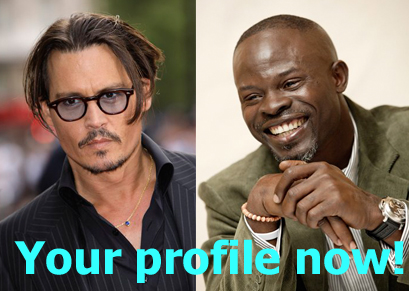
Your profile now!

Depp photo @Examiner
Honsou photo ©Armando Gallo/Retna Ltd

You may have had the same experience I have: clients, students, trainees and colleagues often ask me what assessment tools I recommend. My response, of course, is “for what purpose? What do you want to assess?” Sadly they usually can not answer that question. They know they want something online, something quick. They want something that provides immediate feedback, either inexpensively or for free. But, they rarely have focused in on a purpose, on what they want to learn through the “assessment.”

Sometimes I hear, “To give our people a profile of themselves—a profile of their style that tells them who and how they are.” The assumption is that, by understanding ourselves via this hypothetical quick, online, inexpensive or free assessment, we will immediately (almost magically) become empowered to collaborate more effectively across cultures.

Now don’t misunderstand me: assessments and inventories can be incredibly helpful tools. We are all better served by understanding our learning styles, personality traits, and communication skills. Taking a quick online assessment can also be fun. Heck, those quizzes in the magazines can be entertaining: What kind of personality am I in the bedroom based on whether the quiz says I’m more attracted to Johnny Depp or Djimon Honsou. I had fun just writing that sentence!

However, I can’t help but feel the world is just a WEE bit out of whack when we trust a personal profile, produced by a quick survey, more than we trust our own 20, 50 or more years of experience living with and as ourselves. Profiles can be informative: they can stimulate thinking and conversation. But they are not going to, in and of themselves, improve my ability, either in the bedroom or to work cross-culturally.

What causes us to want a profile? We are by and large intelligent people. We are adults. We know ourselves. Many of us want the quick and easy “answer” because our days are so full. Many of us don’t take time for contemplation, practice, or deep meaningful dialogue—even though these are precisely the acts via which wisdom, happiness and, yes, competence are achieved.

Let’s face it: intercultural competence, like all the other important abilities in life (good parenting, sound health, even skills with technology) involves PRACTICE. We need to stay current, we need to both broaden and deepen our abilities and experience.

So, keeping in mind the importance of HOW we use assessment tools, and the importance of a regular structured practice to improve our abilities, there are a handful of “profile” tools in the cross-cultural field that I find useful. Why do I like these particular instruments? They involve or encourage the contemplation, practice and deep meaningful dialogue of which I’ve written, and that research shows is required in order to improve cross-cultural competence. Some tools I can recommend are:

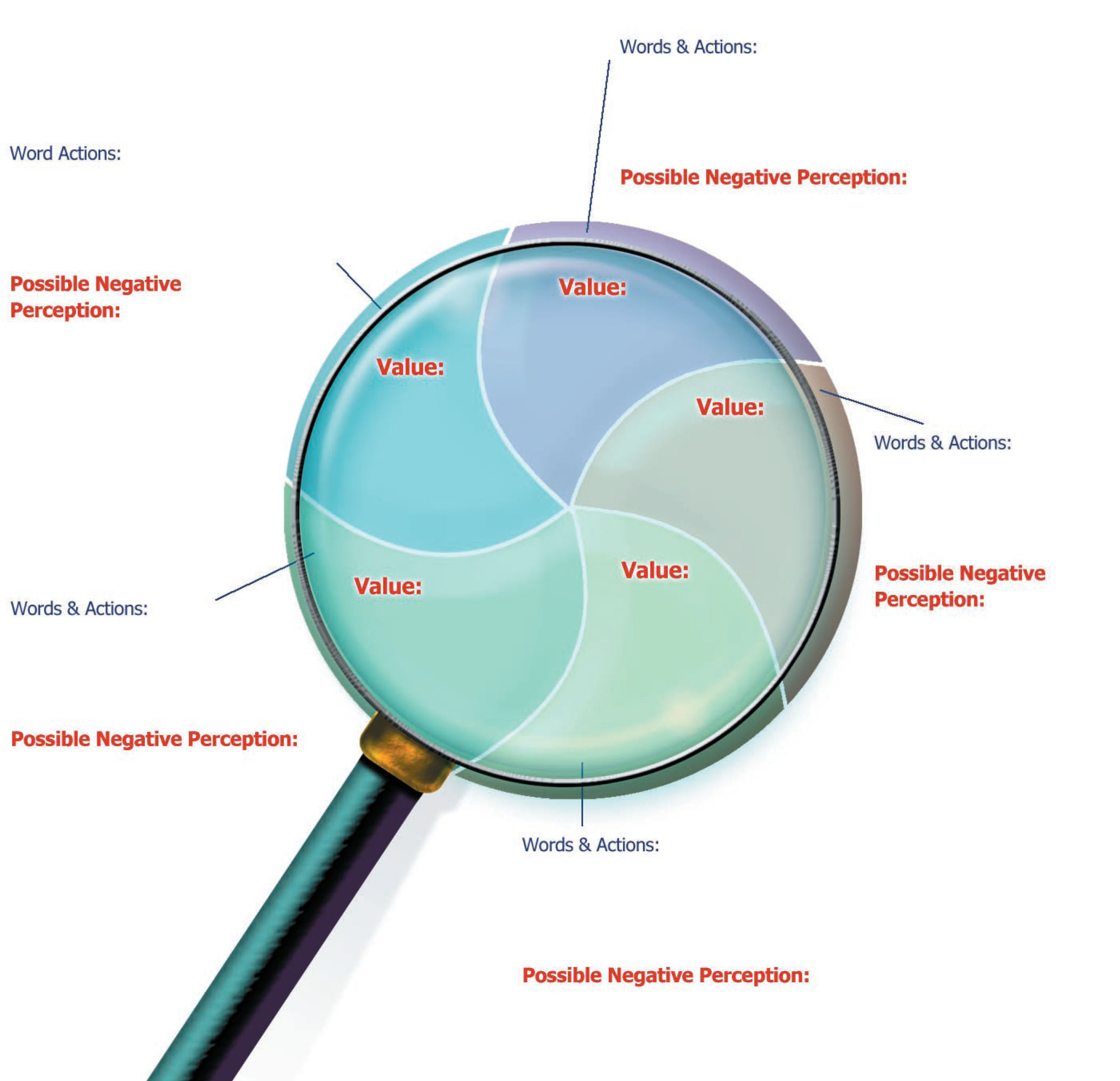
  1. Cultural Detective Self Discovery: This unique product in the Cultural Detective series helps individuals to investigate their cultural identities and develop a “Personal Values Lens.” Through a structured sequence of short exercises and discussions, individuals identify their core values, the positive and negative aspects of these values, and the thinking and behavior that flows from them. They then explore how their values and behaviors may be similar to and different from those of cultural groups. This Personal Values Lens can be used in conjunction with the Cultural Detective Online system for individualized structured learning, or, better yet, with the guidance of a facilitator or coach.
  2. The International Profiler: This terrific tool by our friends and colleagues at WorldWork involves a web-based psychometric questionnaire, followed by coaching sessions, to help develop an individual’s ability to operate effectively in unfamiliar cultural contexts. Nigel Ewington has been piloting ways of combining The International Profiler (TIP) and Cultural Detective (CD), to harness the best of both. Perhaps we can ask him to do a guest post about that?
  3. Personal Leadership: This methodology offers a way of being and interacting with the world that begins from the “inside out,” one that asks people to be fully present in their lives, awake to their habitual behaviors, and willing to look at situations with “beginner’s mind.” Of particular interest in this context is the personal visioning practice. Barbara Schaetti and Heather Robinson and I have created a MashUp process aimed at leveraging the dynamic interaction possible with Personal Leadership (PL) and Cultural Detective (CD).
  4. The Intercultural Development Inventory (IDI), originally based on the Developmental Model of Intercultural Sensitivity (DMIS), is a statistically reliable, cross-culturally valid measure of intercultural sensitivity. What I love about it is that it is developmental: great for charting individual or group progress. It can be completed online, with the assistance of a qualified administrator, and involves individualized feedback. Ideally the IDI is used as part of a process that also involves development planning and coaching.

We can have all the information in the world about ourselves, but if we do not have the courage and diligence to act on it, it is worth very little. None of the tools discussed above provides instantaneous transformation or the magic pixie dust of cross-cultural collaboration. Nor, I imagine, will they give me an evening with either Johnny or Djimon. But with ongoing, mindful practice and the guidance of a good coach or trainer, we will find worlds open to us that we might never have imagined, and we will develop the ability to collaborate more effectively across cultures—exactly what many of our clients are asking for. Each of the tools above dovetails very well with the Cultural Detective Series: TIP and IDI can help you chart progress using CD as a developmental tool, and PL helps ensure the inner work that should accompany CD use happens.

There are many more inventories, assessments and collaborative tools in the intercultural field. What are some of your favorites? How do you use them for maximum effectiveness? How do you motivate yourself and others to practice? What do you wish existed to address specific developmental needs and challenges?
A New Tool and a New Mashup on Gender Relations

Global Gender Intelligence Assessment and Cultural Detective Women and Men
Guest post by Donna M. Stringer

Using these two instruments in combination could have ground-breaking results in the area of gender relationships in the working environment (and beyond). And if we can improve gender relations, it would be nothing less than a global revolution!

ggia_full_logoThe Global Gender Intelligence Assessment is a new online tool created by Barbara Annis and Alan Richter. It is an outstanding resource that measures gender attitudes and competence in the areas of Insight (Head), Inclusion (Heart) and Adaptation (Hands). These three constructs are combined with scores for Self, Others and World, giving you a 3 x 3 grid of nine gender-related competencies—each with interpretation and developmental suggestions. There are two versions of the assessment: one for general staff and one for leaders.

The most useful aspects of this assessment are the Interpretations and Personal Action Planning sections. These areas offer detailed, practical, and “doable” suggestions for building competencies. Many assessments provide “Developmental” suggestions that are so general that they read like “can’t we just get along.” The GGIA developmental options are different. They are well thought out and so varied that individuals from a wide range of cultural perspectives can find culturally effective and appropriate ideas to implement.

The assessment is also affordable at $11-$15/per person depending on numbers purchased. For further information contact Alan Richter.

coverWomenMenCulture Detective: Women and Men is, of course, not a new tool—it  was developed as the first non-national Cultural Detective package in 2007 and revised in 2010. One of the many advantages of CD programs is that they help people understand culture and their own responses to cultural differences. Exposing people to CDs is a developmental process: it is non-judgmental and allows participants to see the world through a different lens, shift perspectives, and identify ways to bridge the differences that might otherwise create conflict or mis-understanding. CDs take a general understanding and problem solving approach that allows cultural differences to be seen as interesting issues to “solve.” The Cultural Detective Women and Men allows people to explore gender differences in a manner that is fun but not personal. Once individuals are able to approach gender in this manner, they are ready for the next step: examining their own individual gender competencies.

Gender MUThe Gender Mashup!

As a developmental process, it would work beautifully to use the GGIA as a follow-up to the CD Women and Men. Having experienced a non-judgmental process of understanding and considering both one’s own and the “other” gender, and identifying bridging behaviors, most individuals would now be ready to complete an assessment that allows them an interpretation of their responses followed by outstanding strategies for personal development suggestions.

Regardless of one’s occupation, organization, or country, gender is a primary diversity characteristic—and one that virtually everyone encounters in life. As I have traveled and worked around the globe, virtually every organization has gender as a diversity and inclusion issue. Using these two instruments in combination could have ground-breaking results in the area of gender relationships in the working environment (and beyond)—and if we can improve gender relations, it would be nothing less than a global revolution!

Written by Donna M. Stringer, Ph.D.

Research Findings: The Value of Intercultural Skills in the Workplace


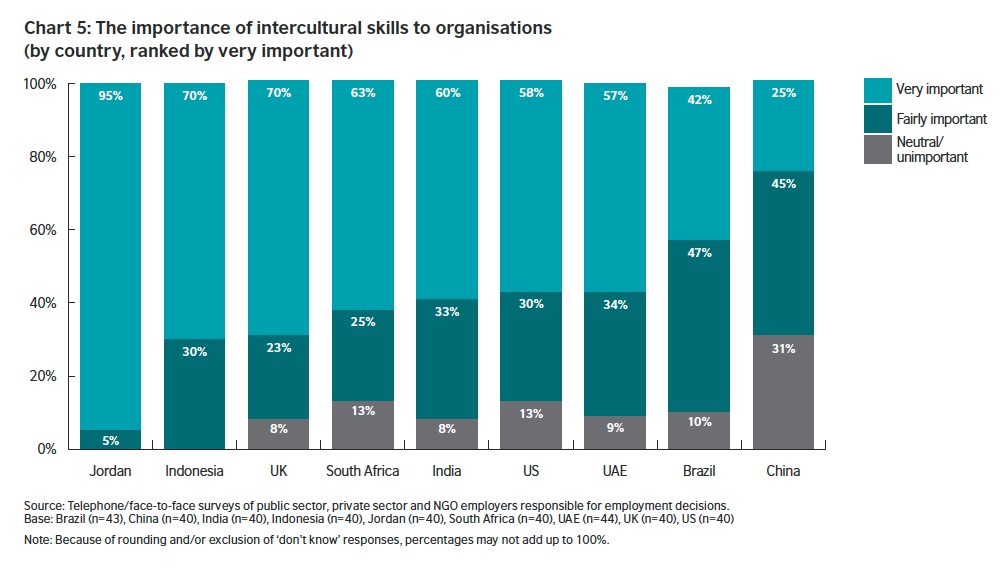
IC Skills importance
Culture at Work: The value of intercultural skills in the workplace
—A survey conducted by the British Council, Booz Allen Hamilton and Ipsos Public Affairs, of HR managers at 367 large employers in nine countries: Brazil, China, India, Indonesia, Jordan, South Africa, the United Arab Emirates (UAE), the United Kingdom (UK), and the United States (US)

The Report’s Conclusions

“Our ability to engage successfully with other countries, organisations and people will depend to a large extent on whether we possess the necessary intercultural and foreign language skills to make fruitful connections, whether in trade and investment, charity/NGO programmes or as government and international organisations. This is fundamentally changing the way in which employers value and seek to develop intercultural skills in the workplace.”

“More and more business leaders are identifying real business value in employing staff with intercultural skills. These skills are vital, not just in smoothing international business transactions, but also in developing long term relationships with customers and suppliers. Increasingly they also play a key role within the workplace, enhancing team working, fostering creativity, improving communication and reducing conflict. All this translates into greater efficiency, stronger brand identity, enhanced reputation and ultimately impact on the bottom line.”

“Employers believe that intercultural skills are integral to the workplace.”

“A common challenge shared by employers around the world is finding employees with adequate intercultural skills. Given that the operating environments of all organisations is increasingly global, it comes as no surprise that employers need employees who can understand and adapt to different cultural contexts.”

What is the international reality in the workplace?

The research shows that employees in most large companies surveyed engage in extensive interaction across international borders.

More than two thirds of employers report that their employees engage frequently with colleagues outside of their country, and over half say that their employees engage frequently with partners and clients outside of their country.

THE BUSINESS VALUE OF INTERCULTURAL SKILLS
Intercultural skills provide business value and help mitigate risk.

The research shows that HR managers associate intercultural skills with significant business benefits. Overall, the organisations surveyed are most interested in intercultural skills for the benefits they bring—benefits that carry significant monetary value to employers:

  • Keeping teams running efficiently
  • Good for reputation
  • Bringing in new clients
  • Building trust with clients
  • Communicating with overseas partners
  • Able to work with diverse colleagues
  • Increased productivity
  • Increased sales

Employers also see significant risk to their organisations when employees lack intercultural skills. Top risks that organisations surveyed are concerned about are:

  • Miscommunication and conflict within teams
  • Global reputational damage
  • Los of clients
  • Cultural insensitivity to clients/partners overseas
  • Project mistakes

How do the organisations surveyed define “intercultural skills”?

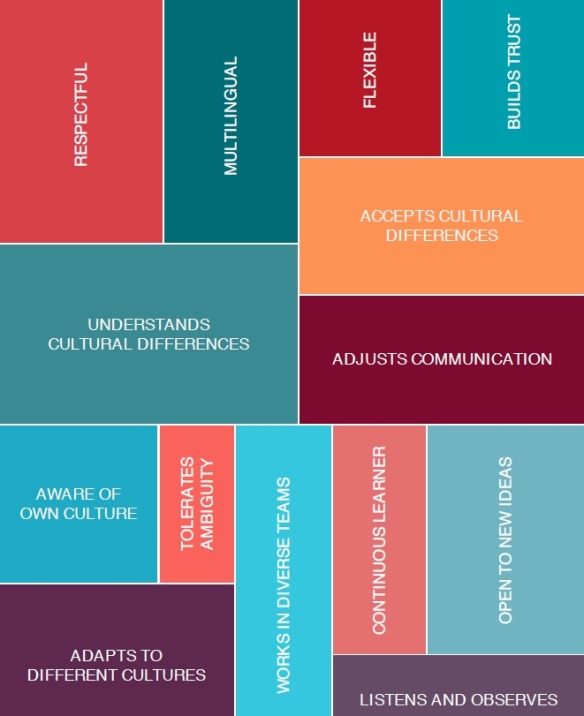
The graphic below shows the words employers used, with size of the block equating to frequency of use.

define%22interculturalskills

The terms employers use to define intercultural skills
Source: Telephone/face-to-face surveys of public sector, private sector and NGO employers responsible for employment decisions. Base: Ipsos Public Affairs, 2012: Global (n=367).

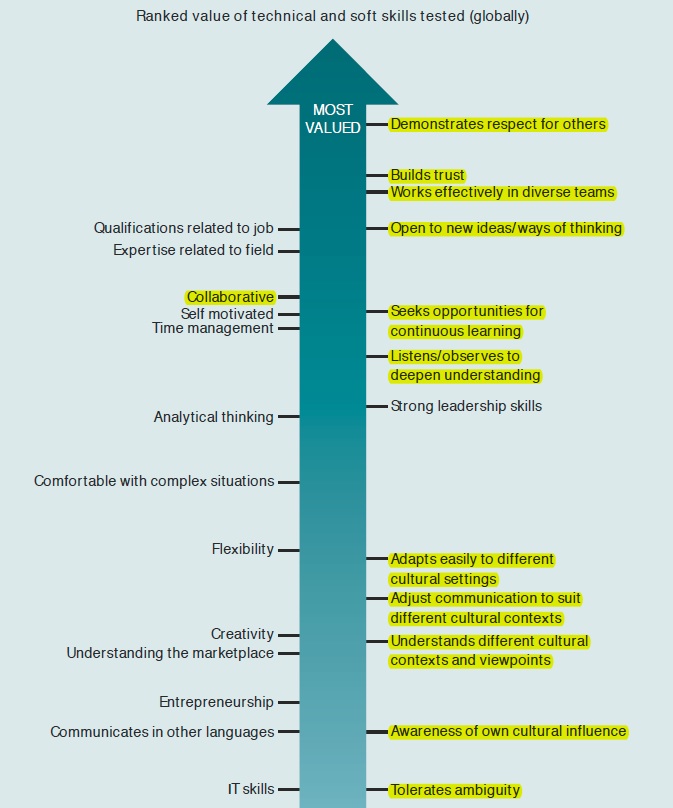
In particular, employers highlight the following as important intercultural skills that they look for in job candidates:

  • the ability to understand different cultural contexts and viewpoints
  • demonstrating respect for others
  • accepting different cultural contexts and viewpoints
  • openness to new ideas and ways of thinking
  • knowledge of a foreign language.

How employers rank different skills in terms of importance

valuedskills

Graphic © the original report, with yellow highlights added by Cultural Detective.

How does the research indicate these skills are developed?

Most employers report encouraging their staff to develop intercultural skills through in-house training, meetings and events. However, employers also say that educational institutions could do more to equip students with intercultural skills.

The findings suggest that policy makers and education providers could do more to contribute to the development of a workforce with the necessary intercultural skills through interventions, such as prioritising:

  • teaching communication skills
  • offering foreign language classes
  • availability of opportunities for students to gain international experience
  • development of international research partnerships.

This research suggests that there is significant opportunity for employers, policy makers and education providers to work together to strengthen the development of intercultural skills to meet the needs of an increasingly global workforce.

Healing the Wounds of History

Playback Theatre

Armand Volkas

Cultural Detective is about collaboration, authenticity, respect, and bridging differences. The CD Method has long leveraged drama — primarily through the acting out and resolution of critical incidents — as it involves our whole person: body, heart, head and spirit.

I was delighted to learn recently about one colleague who combines our goals with one of our favorite techniques in incredibly powerful ways! On a daily basis I am astounded by and grateful for the unique contributions you, our Cultural Detective community, make to the world around us, and I’m eager to share with you this latest example.

Armand Volkas is a psychotherapist and drama therapist, the son of Auschwitz survivors and resistance fighters from World War II. He is also the life partner of Anna Mindess, frequent Cultural Detective Series editor and co-author of CD Deaf Culture.

Armand created a process called “Healing the Wounds of History,” in which a group of people sharing a common legacy of historical trauma (Germans and Jews; Palestinians and Israelis; Japanese, Chinese and Koreans; African-Americans and European-Americans, to name a few) use experiential techniques to transform the pain of such legacies into constructive action.

Healing the Wounds of History is based on the premise that there can be no political solutions to intercultural conflict until we understand and take into consideration the needs, emotions and unconscious drives of the human being.”

The project involves:
  • Breaking the taboo against “enemies” speaking to each other.
  • Humanizing each other through sharing our personal stories.
  • Taking steps towards healing personal and collective wounds using creative and experiential methods.
  • Transforming historical trauma into constructive action and service.

While unfortunately the sensitive nature of Armand’s work doesn’t lend itself to filming, those of you interested in a deeper feel for it can read through the transcript of one of his keynotes, which was acted out by members of a theater ensemble as well as Armand himself.

For more information on or to support the Healing the Wounds of History project contact Armand Volkas at +1 (510) 595-5500, Ext 11 or via email at info@livingartscenter.org

Happy One-Year Anniversary of this Blog!

congratulations_sticker-p217320826197787657en8ct_325Happy Birthday! The Cultural Detective blog is one year old!

A year ago, on February 17, 2012, we made a commitment to blog regularly to promote cross-cultural understanding, link theory and practice, encourage best-practice use of tools, share resources and techniques, and raise awareness of the importance of building constructive cross-cultural bridges through communication. That commitment was intimidating — life and work are busy and the blog meant adding another major task.

Today, please join us in a bit of celebrating — this is our 128th post — not bad for a busy year and a new undertaking! Our quest isn’t for quantity, but rather to share a variety of quality educational materials.

Playing on the sound of the Cultural Detective, we started our blog with twin themes: 22 posts related to Cultural Effectives and 11 posts illustrating cross-cultural missteps or Cultural Defectives. We welcome your additions to these posts — we all learn from sharing  each other’s experiences!

Speaking of sharing, a terrific gift this year was the series of posts by Phuong-Mai Nguyen, as she made a journey to trace the path of Islam from its origins as it spread outward. And, while we began the blog in English, we are happy to also be able to publish some posts bilingually in Vietnamese and Spanish.

Over the last year, we reviewed 19 resources, including five books, five training and coaching tools, three movies, two sources for research data, and two assessment tools.

We shared eight exercises/activities, eight free gifts/downloads, six how-tos or tips on using the Cultural Detective Series correctly, and one half-day workshop design. We posted four different research studies and theory reviews, as well as seven pieces of feedback and guidance from customers.

We were pleased to see the blog’s popularity building over the course of the year. The blog’s busiest day was December 13th, when seven posts showed record readership:

  1. Respect for All Spiritual Traditions
  2. Developing Intercultural Competence — Online?
  3. Film Review by Sunita Nichani: English Vinglish
  4. Every Organization Needs Intercultural Competence
  5. Resource Review: GDI Benchmarks
  6. What Do You Mean? I Worked Abroad 20 Years and Scored Low?!
  7. Partnerships: 5 Tips for Turning Frustration Into Innovation

Of course you, our readers, are central to us. You are the ones doing the important work in our world, teaching, coaching, educating, consulting, training, managing, guiding, bridging, mediating. You are building intercultural competence, respect, understanding, equity and collaboration in your spheres of personal influence. So who are you?

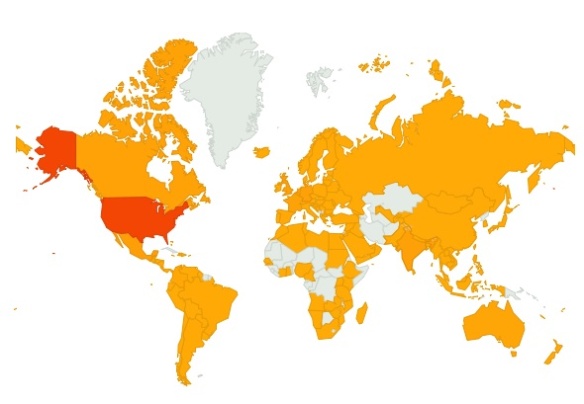
You come from 152 countries — that’s only 40 fewer than the number of UN member-countries. There is not a lot of information about blog readers except for where your IP address is registered. You, our followers, truly come from all over the world — though we could use some readers in Greenland and a few other locations, as you can see on the map below.

CD Blog Readers Year One

Cultural Detective Blog followers log on from these countries

The top 20 countries from which we draw followers are:

  1. USA
  2. Mexico
  3. India
  4. Germany
  5. UK
  6. Canada
  7. France
  8. Australia
  9. The Netherlands
  10. Colombia
  11. Spain
  12. New Zealand
  13. Argentina
  14. Japan
  15. Switzerland
  16. The Philippines
  17. Israel
  18. Malaysia
  19. Brazil
  20. Belgium

Given the diversity of our followers, and the variety and quantity of content, we wondered what you found most interesting in our first year? Surprisingly, three of our top five most-viewed posts were about food! Congratulations and many thanks go out to guest blogger Joe Lurie, who authored two of those. The top ten posts on this blog in 2012 were:

  1. Joe Lurie’s Bicycling in the Yoghurt: the French Food Fixation
  2. Kevin and Rita Booker’s Using Film in Intercultural Education
  3. An anthem for the use of intercultural communication entitled Every Organization Needs Intercultural Competence
  4. Want to Feel Ukiuki, Pichipichi and PinPin? Japanese Food Onomatopoeia
  5. Joe Lurie’s The Squid Has Been Fried: Language, Culture and the Chinese Food Fixation
  6. A book review of How Maps Change Things
  7. A post on cultural appropriation with the case in point: The Swastika
  8. Our post entitled, Infographics on World Cultures and Immigration Trends
  9. A post explaining how to cull learning from some of those images we find in social media, entitled Can You Read This?
  10. Belief Holding as an Intercultural Competence, a competence that has long been one of my favorites, referencing Milton Rokeach’s Open and Closed Mind

Our top five most commented-on posts included one that didn’t make any of the lists above: Diversity Training Doesn’t Work! Obviously a title for some debate and discussion!

Many, many thanks to our regular authors Kris Bibler, Phuong Mai Nguyen, Tereza Bottman, Maryori Vivas, and Kate Berardo. Many thanks as well to our guest authors and contributors, including: Joe Lurie, Anna Mindess, Sunita Nichani, Piper McNulty, Barbara Schaetti, Pari Namazie, Thorunn Bjarnadottir and Avrora Moussorlieva, Kevin and Rita Booker, Carmen DeNeve, Ruth Mastron, Tatyana Fertelmeyster, George Simons, and Madhukar Shukla. We could not have built this terrific blog community without all of you who have commented, shared your resources, reposted our posts, and reviewed our posts before they were published. Many thanks!

If you have a passion for writing about cross-cultural issues and are interested in joining us here as a guest blogger, please contact me. We would love to be able to provide space for talented people to share their voices! We would also welcome your ideas for stories or resources to review, as well as your feedback.

Thank you for accompanying us during this first year of blogging! We trust that you have benefitted from what we have shared, and the thoughts and comments of readers around the world. We look forward to a peaceful and caring 2013!

Unsolicited Review

coverAfAmI just had a chance to review the newly released Cultural Detective: African-American, by Kelli McCloud-Schingen and Patricia Coleman, as well as talk to the authors yesterday in the teleconference on the topic of “Black versus African-American.” Normally, I don’t review items in this series, not just because I’m the co-author of several, but because the formula for their success both in printed versions and now online hardly requires special notice for the individual items which now number well over 50.

However, in this case I think a word is necessary. Necessary, particularly because my suspicion is that most folks reading the title twill probably think largely in terms of diversity and inclusion, rather than in terms of culture. While these issues are at a certain point inseparable, one of the weak points of the diversity movement in the USA has been to imagine itself as intercultural, with little attention, and sometimes fear of dealing with the attitudes and values of targeted groups. There is still a lot of sensitivity here. Consequently when people, particularly outside the US, see publications focused on US minorities, they may think to dismiss them as some of the same-old, same-old diversity stuff.

That is not the case here. This is truly a work of intercultural significance, despite the fact that the participant guide runs to only about 30 pages. First of all, the introduction, slightly longer than the average instrument in this series is absolutely brilliant. It gives the user an overview that is rich, thoughtful, insightful, even for, perhaps particularly for US Americans who tend to see racial issues one at a time, without a sense of heritage and culture in their historical context. But it is certainly what outsiders need and should want to know in order to work well with African-Americans.

“Truly a work of intercultural significance!”
“Absolutely brilliant.”
“Rich, thoughtful, insightful.”
“Heritage and culture in historical context.”

For the many expats going from other parts of the world to the USA, there is usually a question of, “What should I know about… How should I behave around… What should I avoid when dealing with African-Americans?” This instrument helps you cut to the chase, not by offering “kiss, bow, and shake hands tips” but providing insight into the values, strengths, and sensitivities peculiar to a part of the US population who are still to a great degree consciously heirs of a trajectory anchored in slavery, passing through personal pain even while also arriving in corporate boardrooms and occupying the Oval Office. This is a solid cultural perspective on the discourse, on the story that leads to the core values of African-Americans today, in all their diversity, and in contexts where bias and discrimination are still possible obstacles to appreciating cultural identity.

So, if you are preparing expats to go to the USA, or if you are one, this is an important tool, and now one of several dealing with internal cultural dimensions of the very diverse USA, now available in the easily accessible online versions of Cultural Detective.


Intercultural Work—Stuck in its own past? (#1 in a series)

GSportrait

Dr. George Simons has long been researching the stories that make us who we are. In this series of blog posts he will be leading us in an examination of critical challenges that can lead us toward a fresh vision of culture. We will explore how we come to terms with our inner and shared identities and learn about how we construct the realities that shape our now and our future world.

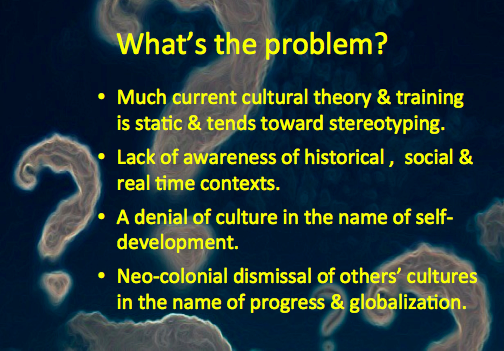
Despite a tide swell in intercultural communication and worldwide immersion in social media, the current field of intercultural communication itself seems static. This blog post articulates five ways in which the field appears to be moving too slowly for the world around it.

1. Essentialism
The word used for the kind of intercultural intervention that leads in the direction of stereotyping is called “essentialism.” One tends to assume that a certain person must inevitably share certain cultural characteristics or behaviors if they come from a particular group, ethnicity or culture. Saying that I am from the USA or that I am German or Nigerian makes a whole mess of things stick to me as stereotypes. Of course, we do have cultural characteristics, but who has them, to what degree as well as when, how and where they’ll be expressed is what we don’t know, and is what we need to learn about each other as we work together. Moreover, we belong to multiple cultural circles that may define us in variable, even contradictory ways. Interculturalists loudly condemn stereotyping but seem less adept at escaping from delivering cultural information.

There may be benefits to identifying with a group despite or in some cases because of the stereotypes, though all too easily an identity is painfully imposed on us. A little story to illustrate this. Nordstrom is a big department store in Los Angeles, in the San Fernando Valley. A young woman in my class at Loyola—let’s call her Yuko—told me how, when working there, a woman making a purchase asked, “Honey, where are you from?” (Yuko had identifiably Asian features in her face). The young woman said, “Oh I’m from right here in the Valley. The woman went on, “But where did your parents come from?” Yuko answered, “Oh, they came from the Valley, too.” The woman persisted, “But where did your grandparents come from?” Yuko answered, “Oh, they weren’t from the Valley, they were from Fresno [another California town].” In fact, Yuko’s Japanese-American family predated the many European immigrants that came at the end of the 19th and first half of the 20th century. Essentialism looks at “difference” as “not belonging.” Yuko suffered this kind of pain repeatedly just because she didn’t look like “everybody else.”

2. Ignoring context
A lack of awareness of the social and particularly historical contexts is another way the intercultural thinking and practice can remain static. A lot of people’s feelings about those different from themselves is not simply a matter of their looking or sounding different, and may be anchored in a story of things that happened in the past. Remember, for example, when Yugoslavia disintegrated into smaller states, how politics called into popular sentiment old memories of “what they did to us” 50 years ago, 500 years ago, 1000 years ago, and so on. These memories live in a culture and affect how we react to individuals in other groups. This is to say nothing of social context, particularly now. Since the financial crisis, we’ve been struggling, in a more conscious way than most of us have done in our lifetimes, with those who have and those who have not. This also provides subtext for our communication with each other.

Questions

©George Simons, blog.culturaldetective.com

3. Cultural denial
A lot of people I work with, particularly many younger people today, have or are encouraged to have an attitude that expresses itself as, “I don’t have a culture,” or “I’m a global person, a global citizen.” This suggests that prioritizing individualism, so strongly promoted in the West, makes it in a way shameful to be connected to our past, to have identifiable roots. This is true not simply of third culture kids (TCK’s), some of whom have been jetsetters while in the womb, but of others, and seems to be part of the educational process. All too many people, and not exclusively the young, have suffered by or are fearful of being labeled, of being stereotyped, as we mentioned above, or they feel a need to disassociate with what feels like the oppression of their origins, their family, religious faith or local context. Having cultural features seems a liability to them, a restriction of freedom. Inability to address this inclination is another point of stasis in intercultural work.

4. Implicit colonialism
An even bigger issue is a kind of lingering sense of better-than-thou-ness, and noblesse-oblige do-goodism that results in a kind of hidden chauvinism, a myopic view of other cultures that too easily infects intercultural efforts and holds them back. Part of this involves interculturalists’ need to come to grips with colonial history and its enduring effects in political and economic terms , not just hand wringing. We are fully aware of having a long history of European colonialism and US colonialism that doesn’t take other people’s cultural and environmental ownership seriously. So we come to enlighten them, to bring them progress, to bring globalization, of course to sell them our products. The need for cultural savvy makes it an important commodity today and this situation begs us to take a larger view. But even more important for intercultural professionals are discovery, exploration and treatment of the psychological residue of colonial thinking in themselves. Failing this, it is hard to imagine our efforts moving forward in the ways we like to think that we intend.

5. Dyadic dimensional thinking
Traditionally, in the boilerplate of the intercultural profession, we studied values in what are called “dimensions.” This was our starting point, something for which we are very grateful to the original researchers, people like Geert Hofstede and Edward Hall. In their observations and studies they raised questions and classified the answers. For example, they identified people as more or less “individualistic” or “collective,” “masculine” or “feminine,” “direct or indirect,” according to how people in different cultures reported their likely behavior given similar situations. Their work made us aware of the fact that there were areas of life in which different people had different ways. Yet, on the other hand, the resulting value labels were a product of Western academic mentality, an attempt to understand other people on our own terms rather than on theirs. This may have been the key to the antechamber of understanding, but leaves us standing in front of a second locked door.

In sum, five road blocks, often in combination with each other, that challenge intercultural thinking and practice. Will social media change our static habits? Perhaps so, because they regularly confront us with evidence from around the world, literally at our fingertips, that may challenge these notions. Yet confirmation bias, our ability to see only what we know or expect to see and make otherness fit into it, is likely to be operative in the online world as well. What think you?

This post originally appeared in the blog of the Center for Intercultural New Media Research and is provided with the assistance of its editor Anastacia Kurylo.

Cultural Detective African-American Now Available!

coverAfAmThe Cultural Detective team is very pleased to announce the release of one of our most requested and highly anticipated packages — Cultural Detective African American! It is now available both in Cultural Detective Online and via site license.

Cultural Detective® African American explores the complexities of the culture and examines the values and communication styles of this community in an effort to bridge cultural gaps and support more inclusive groups, communities, and workplaces. It joins other domestic diversity packages in the series, including Cultural Detective Generational Harmony, Cultural Detective Women and Men, Cultural Detective LGBT, and the soon-to-be-released, Cultural Detective Latino/Hispanic.

Below, a message from package co-author Kelli McLoud Schingen:

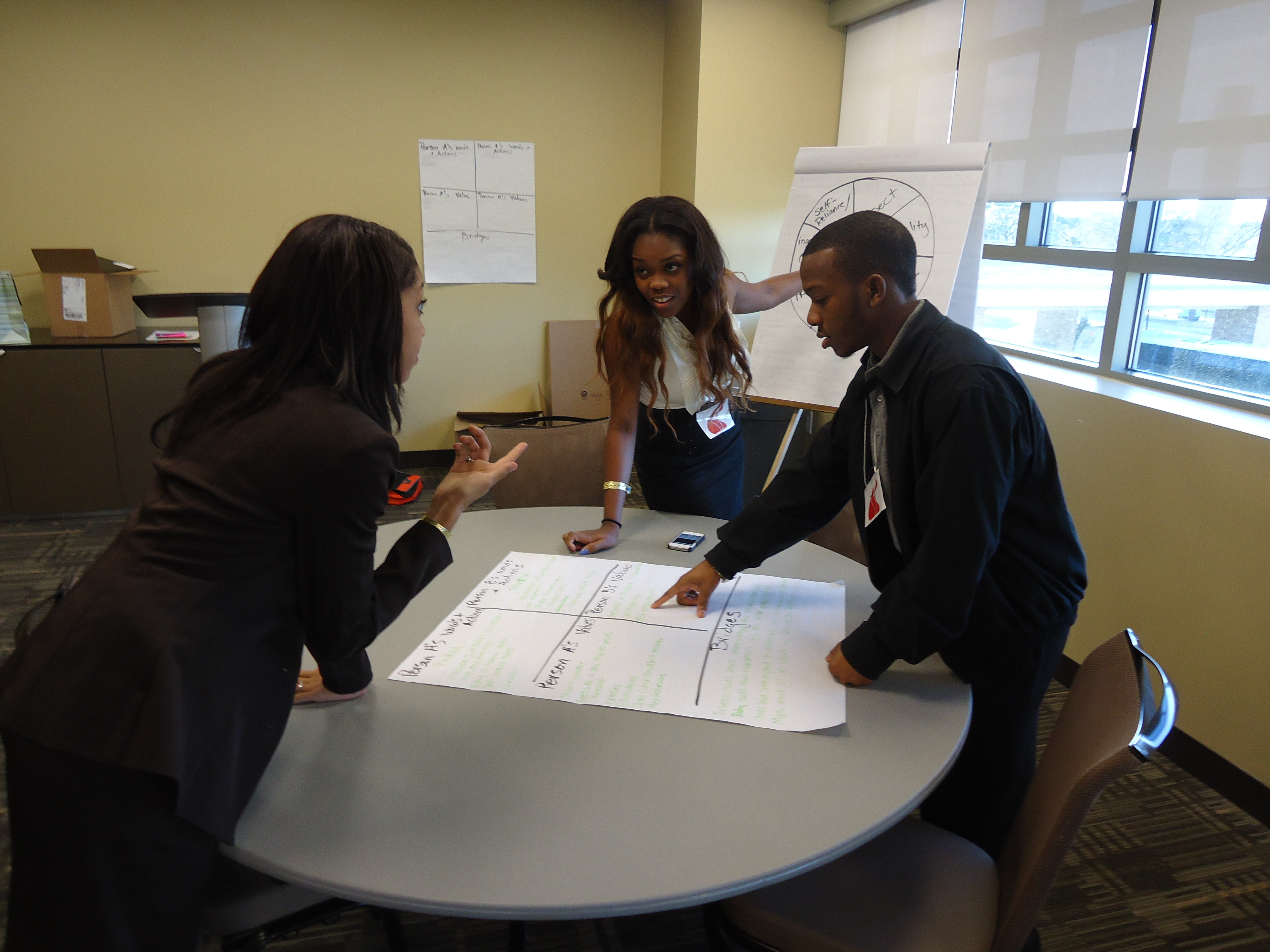
ALI 1I facilitated an Advanced Leadership Institute for the Southwestern Black Student Leadership Conference January 17-20th, and thought that this would be the perfect place to pilot the Cultural Detective African American package that I co-authored with Patricia M. Coleman. There were 25 male and female upper-level students from universities all over the U.S., prepared for an intensive three-day workshop with me on leadership skills and cultural self-awareness. I spent the first day building trust and laying the foundation for the weekend. I facilitated activities that took the students on an exploration of their leadership styles, emotional intelligence, personality types and finally, cultural self-awareness.

ALI 2On the last day I Introduced the Cultural Detective, the purpose and intent of it, and the extensive research and in-depth process that Patricia and I went through to develop the tool. Understandably, the students met the tool with a great deal of suspicion. To say they were skeptical would be a gross understatement. I implored the students to stay with me and trust the process. The students started by working on the critical incidents in the package. I then asked the small groups to present on their findings. They were surprised that there was so much to consider and really convinced that the only valid perspective was the perspective and values of the African American “character” in the incident. I spent a great deal of time sharing how we view things through our own cultural lens, and then I unveiled the African American Values Lens. It didn’t take long for the students to be sold on the process and the values as I walked them through the positive and negative interpretations of each value. They seemed to be having fun and were fully engaged. Many of them commented just how grateful they were to FINALLY have words to describe their feelings, experiences, and cultural norms that they’ve inherited. They laughed at themselves and each other as they peeled back the onion of culture, and were grateful for the opportunity to explore cultural difference in this way. When I asked if they felt that the tool was an authentic representation of African American values they said, “Absolutely Ms. Kelli!”  Then I thought, “I guess we’re ready for launch.”

SIETAR Florida will honor Black History Month 2013 with a dialogue entitled, “Am I Black or African American?” via teleconference.  Featuring co-authors of Cultural Detective African American, Kelli McLoud-Schingen, Immediate Past President of SIETAR USA, and Patricia Coleman, President of SIETAR Florida. Please join us on Wednesday February 13, 2013 at 13h Miami time (1pm EST/12 CST/11MST/10PST).
Please RSVP by February 11th.

Access the event via conference line:

Dial-in Number: (559) 726-1000
Participant Access Code: 857895


Two Values Lens Stories

©Cultural Detective, from Cultural Detective Self Discovery

©Cultural Detective, from Cultural Detective Self Discovery

The beauty of Cultural Detective Values Lenses?

A colleague was just telling me this morning that he had a class of students from France and Italy, and one Thai woman. The students had worked with Cultural Detective Self Discovery; they had reflected on their personal values and history, and created personal Values Lenses.

Next my colleague had walked through the French Values Lens with the class, and asked them to compare their personal Lenses with the national Lens, the country in which all of the students were residing and studying. The French students perceived a lot of resonance with their national culture, and the foreign students identified their experience in France as well.

Next my friend walked through the Italian Values Lens, and got the same reaction.

Finally, when he went to the Thai Values Lens, he realized he knew next to nothing about Thais, and that he couldn’t even pronounce the words on the Lens. Thus, he elected to ask the Thai student, blindsiding her or putting her on the spot if you will — he asked her to come up and introduce the class to the Thai Values Lens, which she had only just seen in that moment!

This Thai participant led the other students, and the professor, on a journey into Thai culture that took their breath away! She shared examples of Thai behavior and their meaning that built the other students’, and the teacher’s, respect for who she is and where she comes from.

Such can be the power of a Values Lens. It is not a stereotype. It captures the central tendency, the norm, of a group of people, in terms people can identify with. Thus, it is usually quite easy for a representative of the culture to introduce the values in a Values Lens, using stories from everyday life in that culture.

Second example, much shorter:

So many people nowadays tell us they are global nomads, TCKs, Blended Culture people. And they are. And, this does not mean that they don’t have a culture; it means they have more cultural strands woven into their identity than perhaps the average person!

The second story involves one young woman, who insisted she was nothing like her national culture. She was an individual, a global citizen: culture-less, in a way. In looking at her national culture Values Lens, she exclaimed out loud during class, “Oh my God! I AM Slovak!”

The goal of Cultural Detective Values Lenses as tools is to facilitate dialogue and understanding, both understanding of self and others, and thus enable collaboration that brings out the best of each of us. Please help us make that happen, by sharing your tips, techniques, and designs, and by encouraging best practice.

Benchmark Statement on Intercultural Competence: AEA

AEA statement coverDo you want to promote intercultural competence in your organization or industry? Are you looking for some guidance? A blueprint? A success story? If so, do I have a “Cultural Effective” for you!

Just over a year ago, friend and colleague Stella Ting Toomey and I had the distinct pleasure of attending the American Evaluation Association‘s annual conference as invited speakers. There I was pleased to witness a commitment to responsible inclusiveness that was truly state of the art.

Six years of diligent work by a task force and other concerned individuals had resulted in a theoretically sound and practical Public Statement on Cultural Competence in Evaluation (AEA 2011, Fairhaven, MA USA).

There is so much about this public statement that stands out for me, not least of which is a definition of culture that is at least on a par with the best of what I’ve seen come out of the intercultural communication field!

Culture can be defined as the shared experiences of people, including their languages, values, customs, beliefs, and mores. It also includes worldviews, ways of knowing, and ways of communicating. Culturally significant factors encompass, but are not limited to, race/ethnicity, religion, social class, language, disability, sexual orientation, age, and gender. Contextual dimensions such as geographic region and socioeconomic circumstances are also essential to shaping culture.

Culture is dynamic, fluid, and reciprocal. That is, culture shapes the behaviors and worldviews of its members and, in turn, culture is shaped by the behavior, attitudes, and worldview of its members. Elements of culture are passed on from generation to generation, but culture also changes from one generation to the next.

Culture not only influences members of groups, it also delineates boundaries and influences patterns of interaction among them. Evaluators frequently work across these boundaries.

I remember my excitement the last couple of times a book has been published with “intercultural competence” in the title. If I am truly honest, I will admit to you that I’ve been disappointed. Amidst good work and steps forward, the books I’ve reviewed rehash a lot of what I feel is old and tired or, even, counter-productive to good practice. But this AEA statement! How do they define intercultural competence? For me it’s spot on — both theoretically sound and skillfully applied!

Cultural competence is not a state at which one arrives; rather, it is a process of learning, unlearning, and relearning. It is a sensibility cultivated throughout a lifetime. Cultural competence requires awareness of self, reflection on one’s own cultural position, awareness of others’ positions, and the ability to interact genuinely and respectfully with others. Culturally competent evaluators refrain from assuming they fully understand the perspectives of stakeholders whose backgrounds differ from their own.

Cultural competence is defined in relation to a specific context or location, such as geography, nationality, and history. Competence in one context is no assurance of competence in another. The culturally competent evaluator (or evaluation team) must have specific knowledge of the people and place in which the evaluation is being conducted—including local history and culturally determined mores, values, and ways of knowing.

The culturally competent evaluator draws upon a wide range of evaluation theories and methods to design and carry out an evaluation that is optimally matched to the context. In constructing a model or theory of how the evaluand operates, the evaluator reflects the diverse values and perspectives of key stakeholder groups.

It is tailor-made for a Cultural Detective: process-based lifelong learning (CD Worksheet); knowledge of self and others and the ability to bridge (3 fundamental CD capacities); situation-specific, contextually grounded effectiveness (CD Critical Incidents); grounding practice in theory (pulling salient theoretical teaching from practical experience); and acknowledging people as complex amalgams of the influences of multiple cultural influences (layering Lenses).

The AEA statement includes the following content:

The Role of Culture and Cultural Competence in Quality Evaluation

  1. What is culture?
  2. Evaluations reflect culture.
  3. What is cultural competence?

Why Cultural Competence in Evaluation Is Important

  1. It is an ethical imperative.
  2. Validity demands it.
  3. Theories are inherently cultural.

Essential Practices for Cultural Competence

  1. Acknowledge the complexity of cultural identity.
  2. Recognize the dynamics of power.
  3. Recognize and eliminate bias in language.
  4. Employ culturally appropriate methods.

The AEA’s blog and their annual conference include lots of project examples and discussions about how to conduct culturally responsible evaluation, through which I’ve witnessed honest dialogue about successes and difficulties. Intercultural competence in evaluation has definitely become an organization-wide effort and an ongoing process for the AEA membership.

The work of the task force continues through today, as they do their best to develop cultural competence in evaluation via education and training, within and outside the AEA, as well as by sharing the public statement and what they have learned via the process they’ve engaged. I am proud to have had a very small role in their extensive process, and pleased to be able to help share it so that others can leverage their work.

Kudos to Dr. Melvin Hall, Cindy Crusto, the American Evaluation Association, and all of those involved in this terrific effort! I know they join me in hoping that their efforts might help you further yours. I will close with an excerpt from their closing:

Evaluators have the power to make a difference, not only directly to program stakeholders but also indirectly to the general public. This is consistent with the Guiding Principle that obliges evaluators to consider the public interest and good in the work they do. In a diverse and complex society, cultural competence is central to making a difference.

Cultural competence connects with and complements existing knowledge and skills in the field. It offers both opportunities and challenges for evaluators. Cultural competence presents evaluators with new horizons for learning, opportunities for renewal, and the potential to deepen understanding of one’s own work in all contexts. Cultural competence challenges evaluators to deepen their self awareness and sensitivity in terms of their own cultures and those of others.

Many evaluators are actively exploring the terrain of cultural competence. They are expanding the boundaries of what it means to respond to cultural diversity in authentic and respectful ways. This statement invites new conversations and connections to advance this sensitive and exciting work.