Book Review: Intercultural Communication, Globalization and Social Justice

by Kathryn Sorrells, Sage Publications, ©2013 ISBN 978-1-4129-2744-4

Intercultural Communication: Globalization and Social Justice provides fresh voice and much-needed current perspective on intercultural communication competence. Written as an undergraduate and graduate level text, as a 30+ year professional I also read it enthusiastically. From Sorrells’ debunking of racial color blindness (p. 62), to the commodification of culture (p. 190), to her closing call for global citizenship (p. 227), her keen intellect and passionate commitment to social justice is evident and unwavering throughout.

From the beginning the author makes clear the need to put intercultural communication in context and with a clear purpose:

“Regrettably, some of the most egregious injustices—exploitation of workers in homes, fields, and factories and violence perpetrated through racial profiling and ethnic cleansing—are performed within intercultural contexts and are enabled by intercultural communication.” (p. xiv)

…”the globalized context in which we live today makes ethnocentrism and ethnocentric approaches extremely problematic. The assumption that one’s own group is superior to others leads to negative evaluations of others and can result in dehumanization, legitimization of prejudices, discrimination, conflict and violence.” (p. 13)

“This text … provides a framework to create a more equitable and socially just world through communication.” (p. xiv)

By page 38, I knew I was in good hands, as Sorrells wove Amy Chua and her World on Fire into the intercultural mix, providing it as counterpoint to Francis Fukuyama’s The End of History and the Last Man.

The author appears to have challenged herself to address each topic, even the most familiar, through at least four lenses:
  • in what ways is the topic complex and contradictory,
  • how does the topic appear from micro, mess and macro views,
  • what are the local and global connections, and
  • how do the complexities and contradictions play out in our world today, particularly in terms of equity and justice?

Sorrells is an excellent teacher, providing rich yet succinct examples—unraveling the various interwoven threads of her stories to enable the reader to more clearly see each thread—while keeping the overall tapestry in mind. Her writing should energize and guide cadres of undergraduates, as well as professionals, to use intercultural communication theory and practice to bring more equity and justice to our world.

Sorrells covers the content you’d typically expect in a basic text on intercultural communication: nonverbal communication, context, dialogue, relationships, communication style, identity theory, use of space. What makes this book different is that she uses important current issues and topics to provide a fresh perspective and powerful, meaningful insight. She examines intercultural communication informed by topics such as power, hegemony, growing socio-economic inequities, the culture of capitalism, race, color-blindness, immigration, glocalization, hip-hop culture, appropriation, hybrid cultures, and online communication. She pulls from a variety of disciplines including feminist theory to address her topic. In the process, she introduced to this practitioner new ideas such as fragmegration (p. 131), culture jamming (p. 144) and polysemic space (p. 91).

The book begins by looking at why the intercultural field has not been able to settle on one definition of culture, tracing definitions of culture from anthropology, cultural studies, and globalization. The author next guides us through a much-needed review of the history of intercultural communication, doing so crisply and meaningfully. Revisiting the origins of the field may help us return to our collaborative purposes and away from the overly analytical comparative studies trends of today.

Each chapter concludes with discussion activities and questions, which for a trainer or coach will be invaluable. And they’ll make lesson planning for the classroom easy.

To enable students to navigate the complex intercultural spaces they inhabit, the author introduces a process of critical, reflective thinking and acting. She calls this “intercultural praxis.” Via six interrelated points of entry (inquiry, framing, positioning, dialogue, reflection, and action), “intercultural praxis uses our multifaceted identity positions and shifting access to privilege and power to develop our consciousness, imagine alternatives, and build alliances in our struggles for social responsibility and social justice.” (p. xvi)

Obviously the text is not intended for a basic-level reader of English! And, while this praxis model is definitely conceptually sound, it is far from easy to put into practice.

What were some of the points in this book that stood out for me? The concept of “positioning” is important:

… “how our geographic positioning is related to social and political positions. As you read these sentences, where are you positioned socioculturally? The globe we inhabit is stratified by socially constructed hierarchical categories based on culture, race, class, gender, nationality, religion, age, and physical abilities, among others. Like the lines of longitude and latitude that divide, map and position us geographically on the earth, these hierarchical categories position us socially, politically and materially in relation to each other and in relation to power.” (p. 18)

Sorrells explains that positioning “directs us to interrogate who can speak and who is silenced; whose language is spoken and whose language trivialized or denied; whose actions have the power to shape and impact others and whose actions are dismissed, unreported and marginalized.”

The author’s reference to modern-day anthropologists Jonathan Xavier Inda and Renato Rosaldo was also valuable. Their premise is that culture, in the context of globalization, has been “deterritorialized.” What this means is that “cultural subjects (people) and cultural objects (film, food, traditions, and ideas) are uprooted from their ‘situatedness’ in a particular physical, geographic location and reterritorialized, or relocated in new, multiple and varied geographic spaces,” (p. 43).

Hence, we find Hindi films and Amitabh Bachchan posters worldwide, with wildly different meanings attached. “Similarly, a person’s or group’s sense of identity, who migrates from Iran to Israel to the United States, for example, is reinscribed in new and different cultural contexts, altering, fusing, and sometimes transforming that identity.”

There were two very minor disappointments for me, amidst all the positives in this text. The first is that while this volume includes a great deal of content that other intercultural texts omit, Sorrells does not adequately address religion and its role in society today. The clash of religious and spiritual beliefs, the gaps between believers and non-believers, the judgments one to another, the fact that religion can provide access to power or motive for distrust, are important. Religion can divide or unite communities, nations, and continents. A chapter or at least a couple of pages devoted to the topic, as seen through Sorrells’ keen perspective, would be a valuable addition.

Second, while the book is overflowing with examples from all over the world, it is unnecessarily US-centered. Perhaps a US publisher wanted the book to sell to US universities, and thus preferred it be written that way. This could so easily have been a non-nation-centric book—with an even bigger market. It comes so very close that it seems a shame not to have gone the extra step.

Intercultural Communication: Globalization and Social Justice is a must-read for any intercultural professional or serious student of the field. And if you have the pleasure of teaching an intercultural communications class, this is a terrific new text.

Mashing-it-Up in Hong Kong: International Schools

By Barbara Schaetti, co-author of Cultural Detective Blended Culture
Reposted from Personal Leadership May 2012 Newsletter

International educators have historically assumed that K-12 international schools are, by default serving multinational and multicultural expatriate communities, providing students with experiences that result in intercultural competence. But are international schools truly teaching students to make meaning of their unique cultural experiences or, when it happens, is it more by good-fortune than by design?

I recently had the honor of being invited to HKISpresent a series of half-, one-, and two-day programs, at the Student Services Summit sponsored by the Hong Kong International School (HKIS). HKIS is among the top tier of K-12 international schools worldwide, and enjoys a well-deserved reputation as a premium institution. Although it was my first time at HKIS, working with and at the School had a quality of home-coming for me: I grew up attending international schools in West Africa and South East Asia, and consulted extensively with international schools throughout Europe and South Asia in the 1990’s. Although each international school varies from the next, the culturally diverse environment they typically offer is very much home territory for me.

And so what a joy to be asked to facilitate a two-day program for international educators titled Deepening Intercultural Competence: Developing an Intercultural Practice. Participants were international educators from across Asia and beyond, mainly developmental guidance counselors (with a couple of administrators too), who share a common passion for preparing their students to participate successfully in a globalized world. They were very ready for a professional development program focused on strengthening their own abilities to role model moment-to-moment intercultural practice.

I centered our time together on The MashUp: A Professional Toolkit for Developing Intercultural Competence. The MashUp (MU) is a natural and powerful combination of two leading processes in the development of intercultural competence: Cultural Detective (CD) and Personal Leadership (PL). Where PL provides a process to disentangle from automatic judgments, emotions, and physical sensations, and to open to the unique possibilities of the present moment, CD provides a process for deconstructing the intercultural dynamics at play, considering the values, beliefs and personal cultural sense that may be motivating people’s words and actions, and developing cultural bridges to close the gap. As an integration of the two, the MashUp offers a proven and exceptionally effective way to successfully strengthen intercultural competence in individuals, in teams, and across organizations.

In Hong Kong, the MashUp was very well received by participants who immediately saw its relevance and practical service to the daily situations they encounter – as international educators and as expatriates themselves. As one person put it:

“How thrilled I am to have experienced these past 2 days – I feel excited and energized, ready to begin a new journey! This has been everything I had hoped it would be, and more. I am leaving today with great ideas to enrich my practice, and steps to move towards this goal. I also believe that I have a group of colleagues who have a similar mindset and interest in adding value to their practice.”

I too left the session inspired. These international HK BAYeducators are ready to intentionally provide their students (no longer simply to trust to good-fortune) with the role-modeling, orientations, and practices that develop intercultural competence. And if that’s true of the educators in my session, then we can know it’s true of many more!

You have two opportunities to learn more about this developmental MashUp of PL and CD.

  1. The first opportunity will be live and in-person at the Summer Institute for Intercultural Communication, July 16-20. Developing Intercultural Competence: An Integrated Practice will be conducted by Dianne Hofner Saphiere and myself, Barbara F. Schaetti.
  2. The second opportunity will be a blended learning course to be held September-December 2012. Developmental Intercultural Competence: Cultural Detective, Personal Leadership, and the DMIS, a transformative professional development course is an avant garde blended learning course focuses on how best to use the MashUp to support the development of intercultural sensitivity as illustrated by the DMIS (Developmental Model of Intercultural Sensitivity). This course will be conducted by Dianne, Heather Robinson, and me.

Oldie but Goodie: Map of Key Cultural Differences

Intercultural communication is about how we can communicate effectively with one another. A frequent approach to improving intercultural communication is to develop our understanding of ourselves and of others. And probably the most common way of doing that is to teach about cultural differences, often referred to as the “dimensions of culture.”

There are many different versions of the dimensions of culture. I generally find them valuable as tools to help us compare cultures, or to cognitively learn about ourselves and others. And I also find they really limit us. While not intended this way, their use has a tendency to reify culture, to cause us to think about culture as a “thing” rather than a process. It’s why I’m such a fan of the Cultural Detective Worksheet: it’s a process for understanding self and others, for leveraging similarities and differences in order to collaborate in more innovative, rewarding, and satisfying ways.

Enough about that. This post is about cultural differences. In my training one of the ways I talk about cultural differences is to ask people to think of them as a map of the terrain, and to use them as a scanning tool. In a given interaction, which difference(s) got in the way? For example, was status important for her and not for me, and I just missed it? Was it a different sense of responsibility that really upset me? Maybe he likes to do several things at once, and I’m more one-thing-at-a-time? Was it the fact that I don’t think religion belongs in the workplace that caused him to think I’m not trustworthy?

That is how the map above came to be. It is a graphic summary of some of the cultural differences or dimensions, at least as I saw them back in 2008. It is available for you to use freely under a Creative Commons license. You can introduce the various cultural differences to your team and then, when you get mired in cross-cultural miscommunication, you can take out your map of differences and decipher just which dimension might be causing the problem. Or, maybe it’s something not even on the map.

Just click on the link above for a larger image, and to download the accompanying 11-page article entitled, “Detecting the Culprits of Miscommunication: Values, Actions and Beliefs.” Please feel free to copy and distribute, as long as you retain the copyright and source url.

I’m really interested to hear from you about how you use the dimensions of culture to promote effective interaction. What are your tools and techniques? Your dos and don’ts? And what do you think about this “map of the culprits of miscommunication” idea?

“Most Multicultural Teams are Dominated by One Cultural Group”

Or so claims Jeanne Brett in a recent Harvard Business Review blog post. I will agree that most of the multicultural teams I’ve worked with over the past 28 years have been dominated by a sub-group of members. My guess is that’s the same for most teams, no matter the visible diversity of their composition.

This idea caught my attention, and I also really liked that rather than the usual analogy of talking about multicultural teams as symphony orchestras or likening them to herding cats, Jeanne relates multicultural teams to fusion cuisine. And who doesn’t like fusion cuisine? Way to sell multiculturalism!

“It turns out that fusion teams often … break a large team into smaller subgroups, encourage informal conversations, and thereby get input from previously quiet team members. Eventually, the subparts have to be integrated back into a whole; this turns out to be less of a problem than you’d think. In the teams we studied, the trust and respect generated within the subgroups made it reasonably easy to facilitate collaboration in the larger group.”

Another of Jeanne’s points very much echoes what the six expert, globally dispersed authors of Cultural Detective Global Teamwork have to say. Many of you know what a dynamite package that is and, if you don’t, please be sure to check it out! To quote Jeanne’s post:

“We’ve come across team leaders who achieve the same result (getting the most out of all cultural subgroups) by carefully establishing team norms at the start of a project. For example, we know of one manager who was leading an English-language software-development project; English was not his first language. In fact, his English was strongly accented. When he met with the team for the first time, he told them, ‘You’ve probably noticed I have an accent. If I could get rid of it, I’d be happy to do so, but since I cannot, we’re going to have to communicate … regardless of my accent or for that matter yours. If you do not understand me, or one another, whether it’s because of accent or anything else, we need to communicate until we do understand.'”

What do you think? In what ways are multicultural teams like fusion cuisine? What are some of your tried-and-true best practices for multicultural teamwork?

New Restaurant Builds Intercultural Communication between Deaf and Hearing Cultures

Ever read or watch something, made for one purpose, and realize how completely perfect it is for another purpose? There is definite joy in that, right?

Yesterday Anna Mindess sent me a link to her  latest food blog. As you have learned by now, our Cultural Detective Deaf Culture co-author very deftly combines her passions for food and new restaurants with her passion for intercultural. Her newest restaurant review teaches us so much about Deaf Culture that I’ve added the video to our CDTV channel. Take a look:

What does this short video teach us about Deaf Culture? About hearing culture? About cross-cultural communication? Please share your responses with us by clicking “Leave a reply” below.

For those of you interested, here are a couple of paragraphs from Anna’s original post: “While Mozzeria proudly holds the distinction of being San Francisco’s first deaf-owned restaurant, the Steins prefer that the focus remains on their food. There is no posted sign to alert customers that many of the employees are deaf. Melody and Russ toyed with the idea of putting an explanatory sheet about Deaf culture in the menu or name tags on the servers identifying who was deaf or hearing, but dropped these as unnecessary. Basically, they believe, if patrons enter with an open mind, the communication will work itself out — and it usually does.

This low-profile set-up stands in contrast to probably the first, and definitely the most famous deaf-run dining establishment in the world, Café Signes in Paris, which I visited shortly after its opening in 2003. That cafe’s menu comes with an explanation of culturally appropriate tips — in Deaf culture, not French culture — for attracting your server’s attention. The list is a great example of the universality of much of Deaf Culture* (the sign languages, by the way, are different in each country). A waving hand, a stomp on the floor, a slight tap on the arm, the toss of a light object within the visual field, instituting a chain of taps among neighbors around the room will all work as attention getting devices. But in the end, Cafe Signes installed small light signals at each table so diners need only flick a switch to get attention.

At Mozzeria, having servers who can all sign (regardless of their own hearing status) makes for an accessible “deaf-friendly” environment. It also carries side benefits for hearing diners. In many restaurants, attempting to get the server’s attention for a simple glass of water can often feel like trying to flag down a racer at the Indy 500. Since the eyes are such an important part of Deaf culture, however, most deaf people are especially attuned to visual cues. I was thrilled to find that to attract my server’s attention at Mozzeria, even from the other end of the long narrow space, all I needed to do was to establish eye contact and raise a finger or even an eyebrow. Hearing customers also seem to appreciate the relatively low noise level which permits actual conversations with their tablemates. (Mozzeria’s hearing employees do set background music nightly, but it is never overbearing).

While Mozzeria has become  a new San Francisco must-visit-destination for deaf visitors from across America and around the world, both deaf and hearing diners probably care more about chowing down on some awesome pizza and all signs point to the fact that this is what you’ll find at Mozzeria. In the end, it might not matter that much who made it all possible. Indeed, a recent Yelper (who failed to mention if he had been enjoying some of their well chosen beer on tap or glasses of Italian wine) didn’t even realize that the staff was mostly deaf, “thought they were just being all Italian, waving their arms around and such.”

Check out more videos on Deaf Culture by visiting our CDTV: Cultural Detective’s channel on YouTube. You’ll see a bunch of package playlists at the lower right. Select Deaf Culture, and watch the videos!

People To People International Working with Cultural Detective to Diversify Chapter Recruitment

Over the past several years I have enjoyed developing a professional and personally meaningful relationship with the People to People International organization (PTPI). For those of you who are not familiar with PTPI, the organization was founded by President Dwight D. Eisenhower in 1956 and is now run by his granddaughter, Mary Jean Eisenhower. Their mission is “to enhance international understanding and friendship through educational, cultural and humanitarian activities involving the exchange of ideas and experiences directly among peoples of different countries and diverse cultures.” They are a dynamic group of dedicated staff and thousands of volunteers in over 135 countries truly working to promote the benefit of people working and living cooperatively together throughout our world. They are known by their tagline, “Peace Through Understanding.

Last year in November Cultural Detective had the privilege of sponsoring and designing the student curriculum for the PTPI Global Youth Forum 2011 (GYF). We focused on designing curriculum that would readily engage about 130 students and GYF leaders and most importantly inspire them to explore building relationships outside of their perhaps “look and act like me” group of students and friends in their local communities. Based on the testimonials of both students and teachers, we feel we did a pretty good job!

This spring I’ve been asked to present the Cultural Detective Method to PTPI Board Members and the PTPI Community at Large so they can focus their attention on recruitment of diverse leaders and members. In the upcoming session I hope to show how generational differences as well as national cultural differences impact with whom we as individuals may naturally gravitate to, which can limit the growth opportunities possible by confidently reaching out to people of multiple cultures. Stay tuned for more about the event in a future post!

“Belief Holding” as an Intercultural Competence – Religious less motivated by compassion

Frequently and for many years I have cited Milton Rokeach’s The Open and Closed Mind when people ask me about intercultural competence. In this book he talks about the importance of holding beliefs tentatively and situationally instead of imposing them on or expecting them of others.

“A closed way of thinking could be associated with any ideology regardless of content. It includes an authoritarian outlook on life, an intolerance towards those with opposing beliefs, and a sufferance of those with similar beliefs.”

According to this line of thinking, open-minded people may hold their beliefs firmly and strongly, but they also respect others’ rights to believe something different. They believe their path is right for them, but they do not believe it is necessarily the one and only path for everyone on the planet. “It is not so much what you believe that counts, but how you believe,” Rokeach tells us.

In our current age of heightened religious and nationalistic fervor, “belief holding” or “permeability of beliefs” seems more important than ever. As do religious or spiritual beliefs as dimensions of culture and cross-cultural interaction.

In this context, today I read the headline, “Highly Religious Less Motivated by Compassion.” Oh dear. I read on to find out that it is the key finding of social psychologists at the University of California Berkeley, who have conducted three separate studies since 2004 on a largely US American sample.

“Overall, we find that for less religious people, the strength of their emotional connection to another person is critical to whether they will help a person or not. The more religious, on the other hand, may ground their generosity less in emotion, and more in other factors such as doctrine, a communal identity, or reputational concerns.”

Perhaps it is time for all of us who coach, train, or educate on the topic of intercultural communication to remember this important competence, which was first published back in 1960.

The Connection between Creativity and Intercultural Competence

If I were to ask you what it takes to be effective across cultures, what comes to mind? If you are anything like me, then you have probably started to rattle off some of the classics: self-awareness, open-mindedness, curiosity, flexibility—maybe communication skills. All important.

But where is creativity in this picture? And why isn’t it closer to the top of the list when it comes to what it takes to be effective when working across cultures?

You could argue that creativity is an output of some of the above: if you are open-minded, curious, and flexible, you are likely to be able to be more creative, which will help you to be more effective. But I think it’s worth highlighting the importance of creativity as a stand-alone competency for working across cultures—especially when it comes not just to being aware of cultural differences, but being able to develop effective bridging solutions to differences you may experience.

Take Morfie, our newly named CD animal mascot, as an example. Sure, he may be curious as he scuttles across the ocean floor, but what makes him effective is his creative problem-solving in the face of challenging situations: his ability to morph himself into another sea-creature to ward off danger.

The importance of creativity is something I learned the hard way. When I first moved to Japan, I moved into an apartment subsidized by the company I was working for. There were all kinds of problems with the apartment when I arrived (for example, the heating was broken and it was the middle of winter in Sapporo—yes, the same location as the Winter Olympics in 1972). What would you do in this situation?

My initial instinct was to take a more ‘American’ approach—to take my contract in to my employer, highlight the conditions outlined in the contract that had not been met, and ask for these to be amended. But I wasn’t in the US. I was in Japan, a more relationship-focused and indirect culture. Surely going in and making these kinds of demands and pointing to a contract would not exactly start me off on the right foot with my employer, I thought.

So instead, I tried a more indirect approach. When they asked me how things were in the apartment, I remember trying to be subtle about naming some of the problems. I think at one juncture I might have even said something like, “This is the first time I’ve lived in an apartment where frost and ice forms on the insides of windows.” I kid you not. This raises a whole other topic of the ineffectiveness that can often happen when more direct speakers try to be more indirect.

The point of that story, beyond revealing how much I had to learn about Japanese culture when I arrived, was that I was far from creative in my solving of that situation. In my mind, I had two options: take the American approach, or take the Japanese approach (at least my limited understanding of it at that juncture). Be direct or indirect. It was bifurcated, dichotomized, overly simplified, and therefore ineffective.
  • What if I had invited some of my colleagues over to my apartment for a meal, during which they could have experienced the issues first-hand?
  • What if I had asked a colleague for a recommendation for a repair service? Or even asked them to call a repair company for me, since I had yet to learn the Japanese word for moldy?
  • What if I had written to the American colleague whose role I was taking over and asked him what he would do in this situation?

The point being, I could have and should have considered a lot more creative solutions here, but simply didn’t. And that’s really the point. Often when we are working across cultures, we stop at the first, most obvious answer, and that’s a limitation.

The good news is that my little housing adventure in Japan likely has helped me to become more creative—and it certainly proved the need for me to do so. Interestingly, recent research at Northwestern University in the US and INSEAD in France has highlighted that individuals who have lived abroad often demonstrate higher levels of creativity on classic ‘creative problem solving’ tasks.

That said, waiting until you are stuck in challenging intercultural dilemmas to flex your creativity muscles—or relying solely on living abroad to develop the muscle, doesn’t seem the right answer. It’s the kind of thing that you want to have so ingrained in you, that when you are faced with a tough situation, you naturally think through a number of different possibilities. In essence, it’s about learning to be Morfie-like, to be able to quickly run through a rolodex of possible options as to how to transform yourself effectively in those situations—and to continually be expanding your repertoire of possible options.

Developing your creative problem-solving skills is one of four main competencies we focus on in the newly released Cultural Detective Bridging Cultures for that reason. In the package, we go through a series of exercises that help people to expand their solution space—to really get beyond solutions of the generic, ‘he should get cross-cultural training, she should take the other person out to dinner’ nature. In an earlier post I shared with you an exercise to get started.

One really useful technique that we practice in the package comes from the work of Michael Michalko, a pioneer in creativity. It’s called challenging assumptions. The process is simple. When you are faced with a challenging situation, you name all the assumptions you are making about those situations and challenge those assumptions. The premise is that often the way we frame a problem limits the potential solutions to it.

If we go back to my Japan example, I made a lot of assumptions:
  • that I couldn’t take a typically American approach (yet my colleagues were very accustomed to working with US Americans)
  • that my colleagues were typically Japanese (they may have been attracted to the company I was working with very specifically because it wasn’t typically Japanese)
  • that the solution lied in me adjusting the way I communicated, from a more direct to indirect style (versus, for example, emphasizing another shared value we had), etc.

Challenging even just one of the assumptions would have opened up a lot of other options for me to effectively address this situation.

The experience I had in Japan was ten years ago now, but the lesson it taught me about the importance of creativity is invaluable. I now adopt a number of different creativity techniques regularly in my work. Beyond challenging assumptions, I also regularly change my physical location to prompt me to think about things differently, and I use techniques like thinking through analogies and wearing the hat of the other individual to help me identify more creative and effective solutions.

I would love to hear your experiences with creativity as they relate to intercultural problem solving: whether you’ve experienced situations similar to mine in Japan where it would have served you to be more creative; whether you’ve found other techniques that have helped you to continue to develop truly innovative intercultural solutions; even whether I should challenge the assumption I now have that creativity is a powerful, often overlooked skill in intercultural problem solving.

Syria — The war within and between

Many have asked me to give a briefing on Syria because I am here in person. Well, here is that briefing, in a VERY simple way.

To many people, the war in Syria is just another Arab Awakening. Being in the country myself, I realize that this is not at all the case. There are at least three conflicts going on:

  1. A true Arab Spring involving young liberals regardless of religious backgrounds, demanding regime reform and democracy.
  2. A war between two Islamic sects, the Alawite government and the Sunni opposition.
  3. A political game with hidden agendas among the big boys (US, EU, Iran, Israel and Saudi).

Mainstream media in the West seems more likely to feature war number 1 and manipulate war number 2 to the advantage of war number 3. Those representing the opposition who appear on CNN and BBC look liberal, westernized and almost victimized.

Next, the media backed by (Sunni) Saudi will call for jihad to provoke war number 2. I saw with my own eyes an opposition’s channel broadcasting from Saudi called “Sunni blood as one.” Note that the Syrian president is not a Sunni Muslim; he is from Alawite, a small sect of Islam.

Last, micro media — social media (blogs, Twitter, forums…etc) and word of mouth will keep circulating around zillions of conspiracy theories and guesswork about war number 3. For example, one of them I have heard: “The West does not want to topple the government; they just want to keep Syria in conflict to the point that it would benefit Israel and weaken Iran, who is Syria’s big ally.”

In this age when images and video clips dominate and cloud our thinking, one easily loses the big picture and falls victim to the vivid power of visual effect. As a good Cultural Detective, please pay attention to hidden biases.

As a journalist, I have the power to CHOOSE what to report. Is there something called “complete objective journalism”? I doubt it.

I have seen demonstrations for and against the regime. Which one would I report? Most secret journalists in Syria would choose to capture the opposition because they and their news (sub)consciously support wars number 1 and 3.

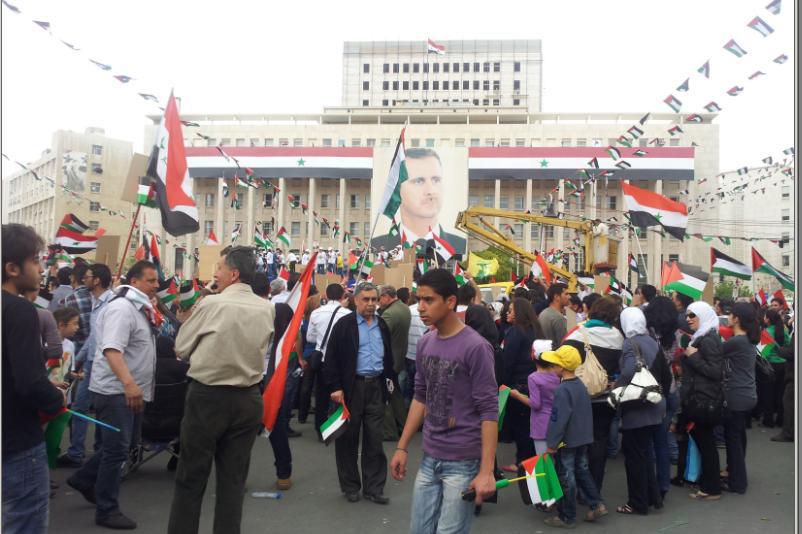
I’ll make a counterbalance here to share with you a view on war number 2. This is the picture of the regime’s supporters who gathered to celebrate with cheerful music and dance. Quoting a local from the crowd: “To be honest, our president is not perfect. But between him and the Sunni extremist opposition, I would go for the lesser of the two evils.”

Culture Eats Strategy For Breakfast!

“Culture eats strategy for breakfast!” — a quote that grabbed me during a recent keynote address by BNI (Business Network International) founder and Chairman Dr. Ivan Misner. He was introducing his new book, Business Networking and Sex (Not What YouThink!).

Those (in the audience of more than 1000 Kansas Citians) with more exposure to culture-related topics probably guessed that the book focuses on networking techniques of the different genders and how to be successful networking with the opposite sex. But to hear so boldly from this networking icon how powerful culture truly is in relationship building and the networking process resonated strongly with this Cultural Detective!

When I heard this statement from Dr. Misner, I wished I could have jumped up on stage and displayed the Cultural Detective Women and Men Values Lenses. It would add to the value of his research by providing clear underpinnings as to what motivates the networking behaviors of men and women, and it would help explain the “whys” behind the stories illustrating their differences which seem to be highlighted throughout the book.

Dr. Misner’s book takes a three-pronged look at business networking across the sexes by offering a surveyed objective look at how men and women think about, approach, and in what ways they are successful at business networking. He then counters that with a “he said” (Frank) and “she said” (Hazel) analysis and interpretation of the survey results.

Over a four-year period they surveyed more than 12,000 businesspeople globally (covering every continent) on 25 questions about business networking. The results and interpreted analysis could bring about some interesting and revolutionary changes to the way in which each sex approaches networking with the other. Communication gaps could be narrowed and connections broadened through Hazel and Frank’s guidance and revealing a bit of the opposite sexes “Lens.”

My only wish was that Dr. Misner would have take the results of the survey to a deeper level by breaking it down to country-specific data. But then again, that’s where Cultural Detective national Values Lenses could shed some light!

NOTE: While the book reviewed in this post references two genders, and we offer an excellent package with this same approach, Cultural Detective Women and Men, there are other ways to look at gender than just a polar division of male/female. Cultural Detective LGBT examines some of these complexities of gender and sexual orientation.