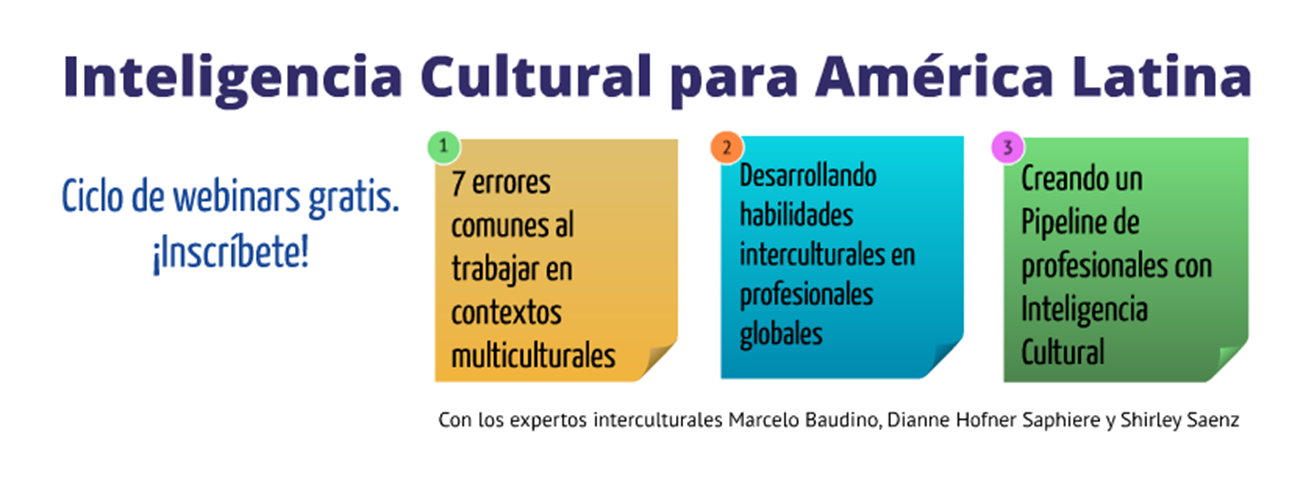
Inteligencia Cultural para América Latina—Ciclo de webinars interculturales

BlogLa globalización y la tecnología han incrementado el comercio, los negocios internacionales y el número de empresas que se expanden alrededor del mundo, dinámica que ha provocado que sean cada vez más los profesionales y ejecutivos que interactúan con otros países y los equipos de trabajo que se forman con personas de diferentes culturas.

Este creciente contexto multicultural, relativamente nuevo para América Latina gracias al papel protagónico que ha venido jugando en los últimos años a nivel internacional, plantea grandes desafíos tanto para las empresas como para cada uno de los individuos que conforman su fuerza laboral. Cada vez son más las multinacionales y empresas latinoamericanas que deciden trasladar sus operaciones globales o regionales a distintos países latinoamericanos y que requieren que sus equipos colaboren y trabajen efectivamente a nivel global, y sobretodo que sean capaces de aprovechar las oportunidades que ofrece este contexto global y multicultural.

Con el objetivo de comenzar a desarrollar las competencias interculturales necesarias en los profesionales globales de América Latina, desde ICEBERG Inteligencia Cultural hemos creado un ciclo abierto y gratuito de webinars interculturales. Este ciclo ha sido diseñado para:
  1. Profesionales y ejecutivos trabajando con personas de otros países, ya sea de manera presencial o virtual
  2. Profesionales del área de RRHH, Capacitación y Desarrollo, Gestión del talento.
  3. Empresarios globales, expatriados e interesados en cuestiones interculturales

web1Webinar 1

La diversidad cultural no es un eslogan, sino un hecho empresarial y laboral diario. Tus colegas, clientes y proveedores probablemente son de culturas diferentes, por lo que necesitas comprender sus valores y comportamientos para gestionarlos y satisfacer sus necesidades. La habilidad para trabajar, comunicar y negociar interculturalmente, constituye una competencia fundamental. En este webinar exploraremos los 7 errores culturales más comunes que les impiden a los profesionales con algún grado de exposición internacional, ser efectivos a nivel intercultural. Mientras más consciente seas de ellos, más fácil te será evitarlos, y entonces, estarás dando el primer paso fundamental hacia el desarrollo de inteligencia cultural.

Fecha: Jueves 10 de octubre de 2013
Argentina: 12 pm • Colombia: 10 am • México: 10 am

Facilitador: Marcelo Baudino
Marcelo es el fundador y director de ICEBERG Inteligencia Cultural, la primera firma argentina especializada en el desarrollo de habilidades interculturales, un servicio de consultoría intercultural innovador para la región. Marcelo es un experto en el diseño y la facilitación de talleres y programas de entrenamiento intercultural para multinacionales y está especializado en América Latina, Estados Unidos y los países del BRICS. Ha impartido cursos para empresas como Deloitte, Cargill, ExxonMobil, Banco Itaú, SC Johnson, Chevron, Tarjeta Naranja, entre otras. Ver perfil de LinkedIn.

Regístrate aquí

web2Webinar 2

Este contexto global e interconectado en el que trabajamos actualmente, nos trae un sinnúmero de oportunidades que claramente queremos aprovechar:
  • La tecnología nos permite desarrollar proyectos y crear equipos con expertos de todo el mundo. Sin embargo, lo que lleva a un equipo multicultural y geográficamente disperso a ser efectivo, son las habilidades interculturales, algo nuevo para muchos de nosotros.
  • Clientes internacionales expresan su interés en nuestros productos y servicios. Sin embargo, ¿Cómo construir relaciones de confianza y entrar en nuevos mercados de manera rentable y sostenible?
  • Queremos ser lo más competitivos posible a nivel global, pero ¿qué significa esto?

Los participantes en este seminario adquirirán herramientas para mejorar sus habilidades a la hora de trabajar en equipos multiculturales, liderar proyectos regionales e internacionales y gestionar una fuerza laboral culturalmente diversa. También recibirán acceso a recursos interculturales y un plan para el desarrollo de competencias interculturales.

Fecha: Jueves 24 de octubre de 2013
Argentina: 2 pm • Colombia: 12 pm • México: 12 pm

Facilitador: Dianne Hofner Saphiere, M.S.

Bio: Dianne ha trabajado activamente en el ámbito de la formación y consultoría intercultural desde 1979, en colaboración con personas de más de 130 países y tres continentes. Su lista de clientes incluye ABB, Hyundai-Kia, Microsoft, Mitsui, Royal Dutch Shell, Schneider Electric, Telecom New Zealand, y Texas Instruments, organizaciones de intercambio internacional como AFS y CIEE, y universidades de todo el mundo. Dianne es la creadora del Cultural Detective®, un sistema dinámico de herramientas para alcanzar la efectividad intercultural y co-autora del libro Communication Highwire: Leveraging the Power of Diverse Communication Styles, publicado por Intercultural Press. Ver perfil de LinkedIn.

Regístrate aquí

web3Webinar 3

La creciente exposición a culturas de todas partes del mundo deja en evidencia la necesidad de prepararse no sólo como individuo, sino también como organización. Ya sea a través de una estructura de organización regional, de un programa de asignaciones internacionales, de un centro global de servicios compartidos o de un joint venture con una empresa extranjera, hoy en día las empresas necesitan desarrollar los procesos y estructuras internas que faciliten la incorporación y el desarrollo de profesionales con aptitud global. En este webinar los participantes conocerán herramientas y técnicas para fomentar el desarrollo de Inteligencia Cultural.  Examinaremos como a través de los procesos de reclutamiento, programas de formación, asignaciones internacionales y el diseño de valores organizacionales, se puede transformar la diversidad cultural de la compañía en una ventaja competitiva.

Fecha: Jueves 7 de noviembre de 2013
Argentina: 2 pm • Colombia: 12 pm • México: 12 pm

Facilitador: Shirley Saenz

Bio: Shirley Saenz es formadora y consultora intercultural en ICEBERG Inteligencia Cultural, firma líder de consultoría intercultural en América Latina y miembro de la junta directiva de SIETAR Argentina (Society for Intercultural Education, Training and Research). Ha investigado sobre las diferencias culturales entre los países de América Latina, la comunicación intercultural y la efectividad de equipos multiculturales. Durante los últimos años, Shirley ha estado viviendo y trabajando en países como Colombia, Francia, China, Brasil, Argentina y los Estados Unidos, lo cual le ha permitido adquirir un profundo conocimiento de estas culturas, y también fluidez en inglés, francés, portugués y español. Shirley se ha certificado en el Summer Institute of Intercultural Communication en Portland, Oregon, en “Métodos para la formación intercultural”, “Liderazgo personal: Trabajo en equipos interculturales efectivos” y “Cultura, comunicación y colaboración en equipos virtuales”. Ver perfil de LinkedIn.

Regístrate aquí

Names Across Cultures (First in a Series of Video Interviews with Authors!)

Name ChangesThere are many reasons people change their names: some people have a stage name, pen name, nickname, religious name, or an earned title or name. All too frequently, however, a name is involuntarily changed when someone immigrates, or when a teacher or teammates have trouble pronouncing the person’s birth name.

Many of us work with individuals who have been “renamed” by other colleagues, or who have changed their names to make them more palatable and pronounceable in a new location. Other times people adopt a different name due to a change in circumstance, profession, or age. For example, as a kid growing up in a small town, my father was called “Charlie:’ however, as a middle-aged adult living in a different town, he became known as “Chuck.”

Many people’s names have special meaning or significance. An interesting way to learn about a new acquaintance can be to ask the meaning and origin of the person’s name. And, if we wish to build trust with our friends and colleagues, in addition to understanding the meaning of their names, we can learn to pronounce their names correctly. You may recall that in January 2012 we shared a link for a handy-dandy little software that allows YOU to record the pronunciation of your name, and add it to your email signature, website, LinkedIn account, etc. What a great way for those unfamiliar with your name to hear it prior to meeting you!

Perhaps you, like me, are known by several different names bestowed on us by friends and colleagues. Dianne is the name given to me by my parents at birth, while my name in Japan is Dai-an (大安 or “great peace”, also a very auspicious day of the month). My Spanish-speaking friends and colleagues call me Diana María, and close friends and family call me Di. In my case, I’d rather be known as “Diana” or “Dai-an” than have my birth name “Dianne” mispronounced.

In many cultures, such as Mexico where I live, it is a sign of cariño or affection to bestow a nickname on others (click here for a list of some unusual terms of endearment in various languages). However, many people worldwide love their birth names, believe they are imbued with power, and would honestly prefer we not change their names for them.

Yet some people do want to change their name for various reasons, and have done so. Here’s a special little drag-and-drop game for you, to see if you can match some famous people’s birth names with the names they are more commonly known by now.

I recently spoke with Dr. Emmanuel Ngomsi, a diversity consultant originally from Cameroon, about the topic of naming. Emmanuel has a wealth of experience, is very passionate, and a consummate storyteller, as you’ll see in the interview below.

Do you have a story related to naming that you’d be kind enough to share with us? Have you changed your name, or has it been changed for you? How do you feel about that? Do you have any advice for others about names and naming?

See Part 2 of this interview.

Cultural Awareness Eases Expatriate Assignments

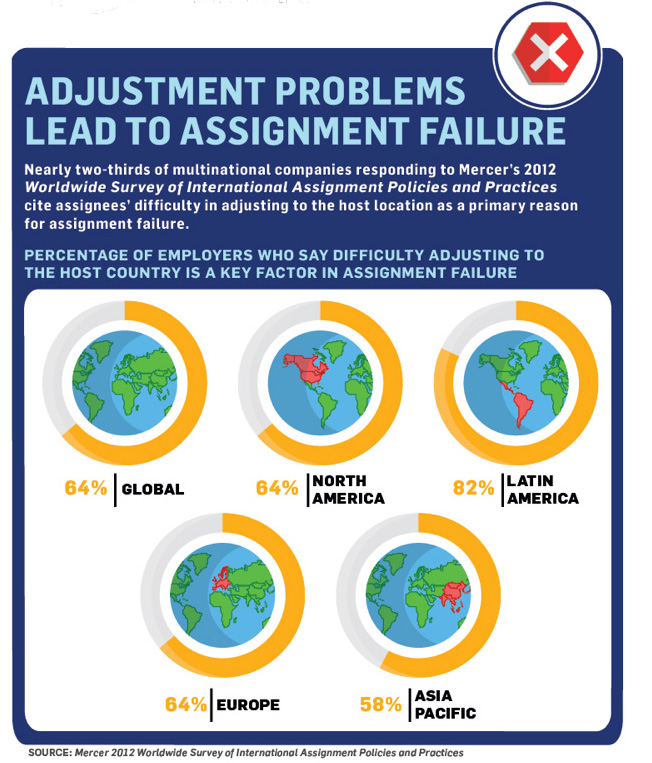
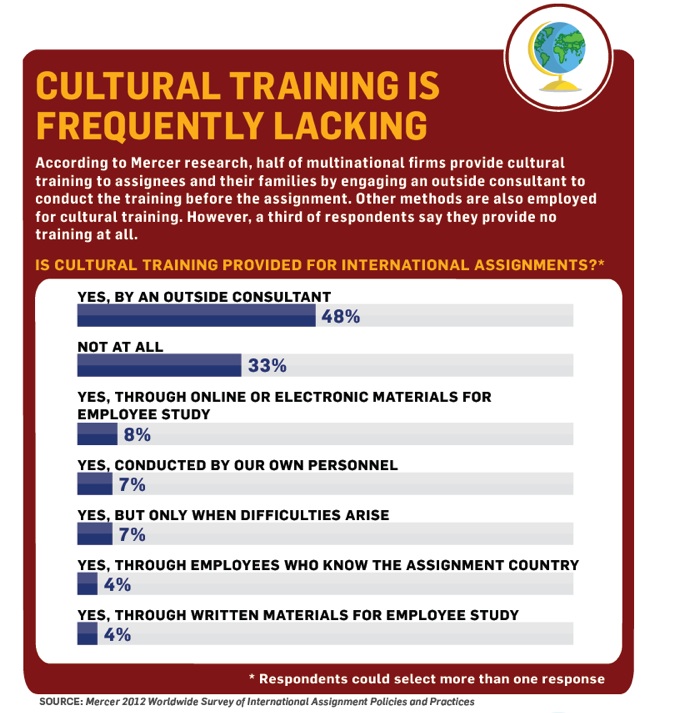
Mercer has released some useful new infographics, based on the findings in their 2012 Worldwide Survey of International Assignment Policies and Practices.

You all know that using Cultural Detective combined with reflexivity and good facilitation, you can do WAY better than “awareness”—developing the ability to collaborate across cultures.

©Mercer

©Mercer

@Mercer

@Mercer

Let’s save the lost money, the aggravation and stress on our people, and the potential loss of talent, by equipping expats and their families for their assignments! Also best to equip the receiving team, and to conduct team building, ongoing mentoring and coaching. Cultural Detective Online, along with good coaching or facilitation and organizational support systems and processes that reward intercultural competence, will make the difference.

Want to Get Rave Reviews AND Truly Make a Difference?

WowlargeHow would you like to revel in unsolicited, overwhelming praise and gratitude? And, on the job, no less?

We all make fun of “happy sheets,” those “feel good” evaluation forms participants are asked to fill out at the conclusion of a training session. But how sweet it is when a hardworking facilitator or coach receives unsolicited kudos! And Cultural Detective can enable you to do just that.

We help you look better and DO better! Cultural Detective provides a core process for developing intercultural competence, and you facilitators, coaches, team leads, study abroad counselors, professors—you add the bells and whistles, the supplementary activities and simulations, the design and personality that weave it all into a smashing success! You know you’re using a state-of-the-art Method, grounded in developmental and constructivist theories, adding both to your credibility and effectiveness.

Here’s an email one corporate trainer recently received after using Cultural Detective. Thank you for sharing it with us!

“Hi,

I trust you are back home, and preparing for your next Cultural Detective training session. I hope all is well.

I want to thank you for coming and bringing your fabulous Cultural Detective presentation and training. I swear to goodness I have used what I learned no less than five times, within our group, to resolve differences that could have been roadblocks otherwise. You squarely “nailed” the subject matter and how to use it. Your passion, your examples, your group exercises, how you drew people out to share their experiences and expectations and your patience (with at least one of us, who shall remain nameless) was inspiring. It was excellent, and the water-cooler talk I heard echoed the same thoughts as mine. I can truthfully say that I got more out of those short, few hours, than any other training I can think of. I am anxious to use the strategy in a discussion with parties of more diverse cultures than my five encounters so far. I’m confident we both will win.

I hope you can carry Cultural Detective all across the organization, because it applies to everyone; I even used it with my wife to determine where we were going to eat, just like the example you used! How about that for an example of classroom to practice! I don’t think it gets any better than that.

Well, thanks again. I just wanted you to know how much I though of your training and what it had done for me, in, what, a week? It was great. Thanks, and if ever I can be of service to you in someway, please don’t hesitate to ask.

Sincerely,

(signature removed for privacy), a practicing cultural detective

Book Review: Global Dexterity

GlobalDexterity

Molinsky, Andy, Harvard Business Review Press. 2013.
ISBN10:1422187276, ISBN13:9781422187272

When it comes to cultural competence, there are some big gaps between knowing about, knowing how to, and actually developing and applying the skills to manage self in real situations. Andy Molinsky, in his new book, Global Dexterity: How to Adapt Your Behavior Across Cultures without Losing Yourself in the Process, has provided us with a methodology for bridging into the third and most critical of these steps. His choice of the word “dexterity” in the title of the book is well chosen to express the fact that we become effective when we have learned how to develop “muscle memory” to respond to real situations in intercultural management and in life, when on strange turf. It is about translating knowledge into behavior and acquiring the habits that make us good at it.

The insights Molinsky provides are not so much about how cultures differ, though the stories he tells make the reader fully aware of the dynamics of these differences. Certainly, one must know and recognize difference, but the book’s key insights are more about how we function wholistically in the circumstances in which we find ourselves. Global Dexterity is a workbook, and the work is up to the user.

Molinsky helps us identify our own “culture code” and that of others — differences in what he calls prototypical thinking and behavior, which may belong to people, to a place or a situation, or to all three at a given moment. In other words, the “detective” work of sniffing out the rules for what is seen as appropriate behavior in a specific cultural setting. The now online Cultural Detective, though not explicitly mentioned in Molinsky’s book, is a good tool for this work. Also, “culture code” as used here should not be limited to the Jungian approach for decoding cultural discourse developed by Clotaire Rapaille, for those familiar with it, though that is also a relevant form of investigation.

Since the variations in code can be almost infinite and therefore paralyzing when it comes to seeking out the right approach to a culture, Molinsky insists we not look for a single “right” behavior, but for a “zone of appropriateness,” a range within which to operate successfully in each culture. He then provides a practical navigational framework for looking into what is most likely to differ as we face situations in this zone. He asks us to pay attention to the relative measures of how direct, enthusiastic, assertive, self promoting and disclosing our behaviors are in comparison with those of the other party. These measures are, admittedly, not exhaustive, but are likely to give us the solid return on our investment of time used to understand and adapt our behavior.

Once aware of the culture code and the zones of appropriateness, the question is how can one stretch one’s comfort zone to overlap with the appropriateness zone of the other’s cultural code. Of course this can be a two way street, but in any case one must diagnose the situation, customize one’s behavior options to fit or bridge the gap, and, ultimately, integrate the customized behavior to the point that it feels right and can become the “new normal” for the situations it fits.

The author identifies three psychological challenges along the way, and he provides a process for dealing with them. First, he uses the word authenticity to speak of the challenge raised by conflict with values and beliefs. Secondly comes competence — does one have the know-how and skill to actually perform the new behavior? The final challenge is dealing with resentment — even if one can perform the behavior, will he or she feel embittered about having to do so?

The helpful metaphor in discussing these challenges is “acting.” An actor needs to learn a new role for a specific part of a drama. Here too, mastering the role needs to be seen as positive acquisition, the realization of potential, rather than as a loss or suppression of self. Today’s language teachers realize this when they no longer speak of “accent reduction” but rather of “accent acquisition.” The search for “authenticity” (the real me) unfortunately is wed to US pop psychology. Objecting, “It’s just not me,” is often an obstacle or an excuse for avoiding the discomfort involved in widening one’s repertoire. Thus, the theater metaphor is particularly useful here. In learning and practicing new skills, it is okay to say, “No, it’s not me…yet…”

So how does one make adopting new paradigm or behavior acceptable to the old self? Besides thinking of it as theater, one can enhance the recognition and acceptance of new behavior by calling on one’s own inner diversity to change one’s perceptions, viz., by aligning the new behavior with one’s goals, weaving it in with other personal or cultural values, or by working to understand and accept the other culture’s logic. If this automatically sounds like rationalistic deviation from what one holds as norms, it must be remembered that we regularly play one value against another in making changes and decisions, and that cultures themselves have both conflicting and complementary discourse to help us navigate life. The author again offers us process, “workbook” pages, for applying this alignment process.

None of this adaptation is likely to occur simply by knowing about differences, and it is here that Molinsky has most to offer to intercultural pedagogy and pedagogues. Few people can incoporate new and alien behaviors spontaneously. It takes practice, practice, paractice, and it is this feature that is most neglected in current intercultural praxis. Gone are the days when a trainer had four or five days to offer participants enough hands-on exercises to try out and then integrate new behaviors in a process of familiarization, rehearsal, and “dress rehearsal” or application to real situations. The reader will have to do this on his or her own, so the author provides pages, tools and questions to facilitate this. There is a potential here for online learning that should be pursued, and Molinsky’s approaches would combine extremely well with a subscription to the Cultural Detective Online tool to provide the ongoing, structured learning needed.

Inevitably, Molinsky points out, we are awash in trial and error, in the challenge of experiential learning. So, he offers further help. There are tips on how to increase one’s chances of being forgiven one’s mistakes, how to look for a cultural model to pattern oneself after, or even how to find a mentor who understands you and your culture well enough to provide feedback, information and support.

What happens, however, when absolutes collide, when ethical standards will be violated if one adapts behavior and accepts practices that are beyond the pale? Here is where the “without losing yourself in the process” line of the book’s title most comes into play. Our creativity for building options is challenged. Humor, gentle insistence, and, if the stakes are not too high, simply contradicting the local norm in your behavior, are given as examples.

Molinsky concludes the book and sums up its import with five key takeaways that compare conventional attitudes about cultural adaptation with the realities that become actionable using the insights, the paradigms and the processes he proposes.

The book is well written and an easy read. The challenge comes if one truly uses the tools it provides to put adaptation into practice. This is incumbant on intercultural professionals who need to model it for their clientele and students. We need to play with Global Dexterity’s excellent start and take it further, lest the old adage, “Those who can do, do; those who can not do, teach!” be applied to preachers of cultural competence who fail to develop and practice “dexterity.”

A Question of Trust

Doi Suthep Temple, Horizontal Image (500x332)A small US American software company has been contracted to design some specialized broadcast technology software for a radio station in Thailand. This is the first time the company has received a contract in Southeast Asia and their company executive, Tom Bennett, is looking forward to doing business in the region.

The initial meetings and negotiations with the radio station management have been successful, and Tom Bennett senses that he has built up a good rapport with Khun Chai, the radio station manager. Khun Chai himself is delighted with Tom Bennett’s interest in Thailand and the local Thai community, and he is particularly impressed with Tom’s liking for spicy Thai food. Khun Chai is already contemplating the possibility of doing business with the American company again in the future.

The price is settled, the contract is signed and a deposit is paid…

Are you are a business leader, coach, consultant, speaker or teacher?  Do you want to become culturally competent and self-confident in the global arena?  Does the above story sound similar to projects in which you, your colleagues or clients engage? Despite this auspicious start, all does not end well, as you’ll discover in our upcoming webinar: Cross-cultural Coaching: A Creative and Transformative Process. In that webinar we will introduce you to a powerful and transformative coaching process with Cultural Detective Online!

The coaching process combined with Cultural Detective Online provides you with a comprehensive learning experience that is stimulating, supportive and transformative! In addition to exploring key cultural concepts and culture-specific information, the collaborative and creative coaching environment helps you develop new perspectives and skills for bridging the gap between your personal cultural “sense” and the cultural “sense” of your colleagues and clients.

Our facilitator will be Jan O’Brien, IAC-MCC, who will show us how she coaches expatriate executives towards cross-cultural success. Jan is President of Culture-Conscious International, a coaching and consulting company based in Houston, Texas. She is a US/UK dual national and has lived and worked extensively overseas, in particular in the US and the South East Asia region. Jan is a Certified Cultural Detective facilitator and a Master Certified Coach with the International Association of Coaching (IAC). She has worked with clients from many language and cultural backgrounds and has personally experienced the benefits and challenges of living and working in the global arena.

Register now, as only a few seats remain.

Meeting time is Tuesday 23 July, 2013 at 10 am Mazatlán, Sinaloa, México time. Meeting place is online. Please consult a world clock to verify your local time. 
  • Los Angeles: 8 am
  • Houston: 11 am
  • New York & Santiago de Chile: 12 noon
  • Buenos Aires or Rio: 1 pm
  • Brussels, Paris, Rome, Johannesburg: 6 pm
  • Abu Dhabi & St. Petersburg: 8 pm
  • Delhi: 9:30 pm

TCK (Third Culture Kid) Stories On Film

Video

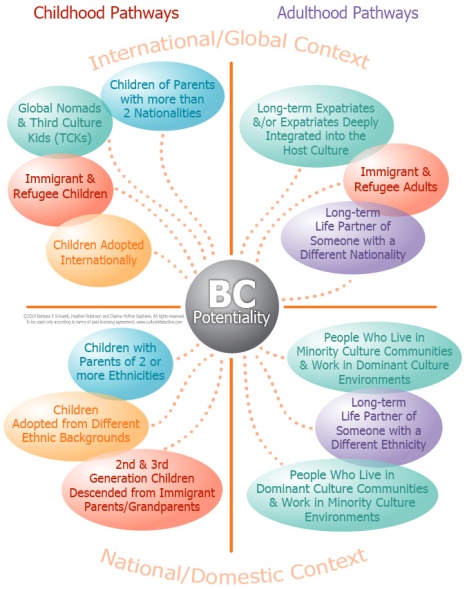
Paths to BCThird culture kids, or “TCKs.” One type of Blended Culture, TCK refers to those of us who have grown up in multiple locations and enlarged our definitions of “home.” We have multiple homes, all near and dear to us. We have multiple cultures, some of which we may be more fluent in than others, and all of which hold deep meaning for us. And, we have created “third cultures,” “blended cultures,” a global, multicultural or cosmopolitan definition of self and family.

The Blended Culture experience is increasingly common. As an expatriate myself, my son is a TCK with multiple national culture affiliations; it’s crucial for me to understand a bit of his experience if I am to parent him appropriately. I pray he grows up to reconcile his identity in constructive, multicultural ways. For those of us who work in international business, schools, study abroad, and with immigrants, it is also extremely helpful to understand at least a bit about the TCK experience. Three recent films may help us do just that.

The first film is called So Where’s Home? A Film About Third Culture Kid Identity, and is by Adrian Bautista. You can view the nine-minute film in its entirety below.

A second film is the award-winning “The Road Home,” directed by Rahul Gandotra. This 24-minute short can be rented or purchased, and the director is currently making a feature length movie about the same characters. You can view a two-minute clip of the film below.

TCKs have unique skill sets and unique challenges. The powerful trailer below (almost nine minutes) shows us what Aga Alegria has in mind as she sets about fundraising to make her documentary film about the TCK experience. Click here to learn more about that effort, or perhaps help her out.

http://vimeo.com/11658942#at=0

We wish all these ventures very well with this important and timely topic! Learn more about a tool to help make the most of the TCK experience.

Cross-cultural Competence Enhances Productivity AND Satisfaction

Last week a new brochure, this week a new introductory presentation! Thank you all for the incredible work you do with this process and these materials, to build cross-cultural respect, teamwork, productivity and equity!!!!

Use it, pass it around, and do the good work! Thank you, everyone!

Help us Build Respect and Collaboration

brochure

CulturalDetectiveBrochure

We have an updated brochure that we are debuting. Please click on the link above to view it.

We are hoping that all of you will please pass it around, use it in your spheres of influence, and put the Cultural Detective Method to good use, building a more cross-culturally respectful, inclusive, collaborative and equitable world, in which our diverse experiences generate innovative solutions to our shared problems.

You can also find the brochure on our website:

Please let us know what you think!

Ask Cultural Detective Your Questions!

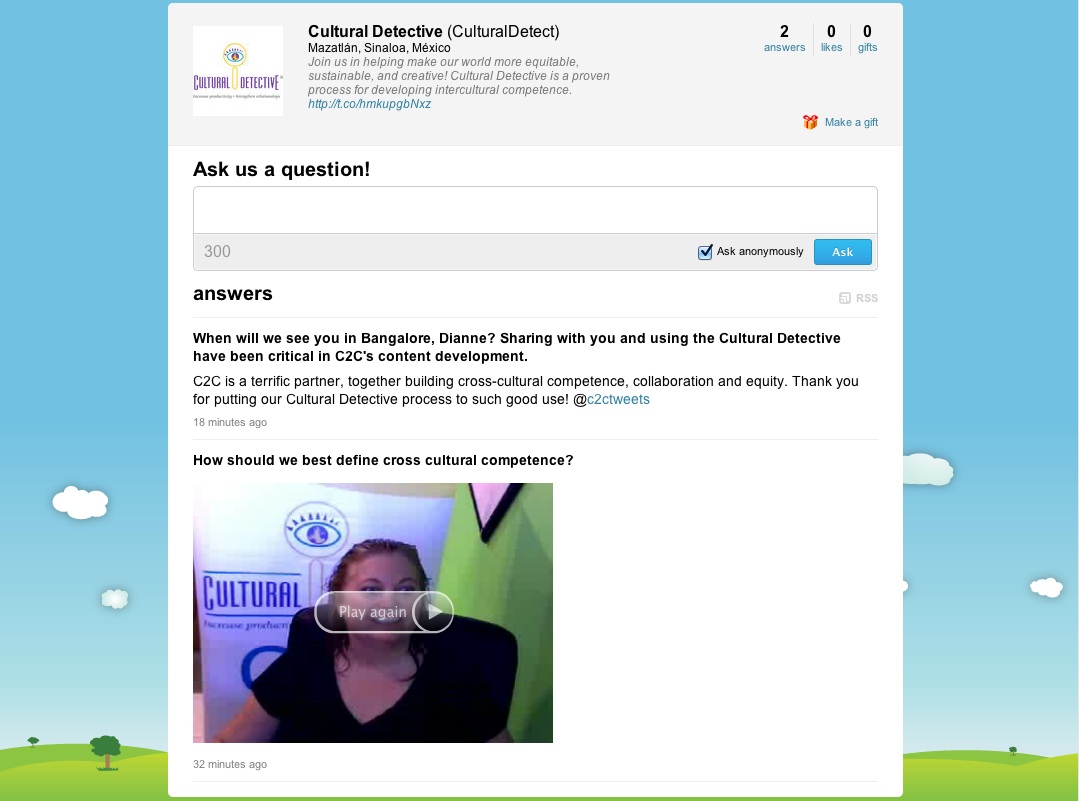
ask.fmHi everyone! We have added a new service for our community members, and trust you will join us in putting it to good use to build equitable and sustainable partnerships across cultures.

Cultural Detective now has a page where you can ask us a question, and we will text or videotape an answer to you. We just launched late last night, and this morning we woke up to two interesting questions. Below is our answer to the first. Click on the link above to view both sets of questions and answers, or share your question with us. We look forward to the dialogue!