Tango! Kabuki! Bollywood! Jazz! What Do They Have in Common?

TangoKabukiJazzBollywood(English followed by Español, 日本語版 and हिंदी संस्करण, below)

Tango! Kabuki! Bollywood! Jazz! You have to admit they all sound exciting—full of life, excitement, drama and…culture. Each is currently the basis of a hugely lucrative industry, and many of us greatly enjoy at least one of these art forms.

But what do the histories of these four forms of entertainment—from such divergent places on our planet—have in common?

Each has its origins among the poor, underprivileged and marginalized of society. And each was, at some point, much maligned and considered improper and lacking decorum. Several of these now-popular forms of entertainment were banned, some more than once, before they grew in popularity and finally gained respectability.

  • Tango, born in the latter part of the 1800s amidst the docks of Buenos Aires, was originally played and danced by poor immigrants. The middle and upper classes were first exposed to tango in bars and brothels. While we can easily imagine they secretly enjoyed it, tango wasn’t something one openly listened to or danced in “polite company.” Given such humble roots, I was shocked at the price of a “tango show” ticket when in Buenos Aires recently!
  • Kabuki, perhaps the most famous form of traditional Japanese entertainment, began in the 1600s among the common people, and was originally performed outdoors on a riverbed. Kabuki was invented and performed by women, often prostitutes, and later by adolescent boys, many times prostitutes as well. Prior to that point, theater in Japan had been for aristocrats only, and primarily involved the very slow-moving noh. Kabuki has come a long way, baby.
  • Bollywood, the Hindi film industry based in Mumbai, rose to prominence during the 1900s, and is only a part of the huge Indian film industry. It has long been seen as a caricature, as melodramatic and unrealistic—not to be respected like classical Indian dance and theater. Yet, these days, you can travel anywhere in the world and enjoy a Bollywood film. The industry has introduced Indian culture to the world, while it speaks to universals such as love and loss.
  • Jazz began in the southern USA from African American roots. Its beginnings can be traced to traditional African music turned into work songs and “field hollers.” The music evolved amidst the injustice of slavery, spirituality that provided the hope of redemption, and courage to face adversity on the quest for freedom. What was to become jazz moved from the fields to the brothels and bars, and eventually was “discovered” and is now respected, admired and played worldwide.

Why are these seemingly very different topics on my mind? If you read this blog regularly, you know that I recently had the pleasure of visiting Argentina, and there I learned about the history of the tango—the first thread. I know about the history of kabuki from the years I lived in Japan, and the similarity of histories intrigued me. Pondering the history of jazz, I noted three similar threads. Then, just yesterday, Lord Meghnad Desai’s article about Bollywood crossed my desk, and it occurred to me that perhaps these threads weren’t just coincidence; I’d better pay attention!

In my academic discipline, intercultural communication, some refer to the concepts of “big C” and “little c” culture (Bennett, 1998). Culture with a capital “C” usually means the objective aspects of a culture, that which is visible and overt. This includes the art, music, dance, etc.—the artifacts of culture, if you will. It also includes what it is that people say and do, the observable ways culture is expressed through its members’ behavior in daily life. This idea correlates with the “Words and Actions” section of a Cultural Detective Worksheet.

In contrast, “little c” culture refers to shared customs, norms, communication styles, values,  assumptions, etc. This subjective part of culture is generally hidden, expressing itself in the verbal and nonverbal behavior of its members. Subjective culture is what lies beneath the behaviors, that is, why people do what they do, and correlates with the “Values, Beliefs and Cultural Common Sense” portion of a Cultural Detective Worksheet.

In some way, I reflected, each of these four art forms derived from an expression of “little c” culture that morphed into “big C” Culture, usually over some decades. Could this be the way of the world?

I first moved to Mexico in the 1970s as a foreign student, and was thrilled to live in Coyoacán, home to both Frida Kahlo and “La Malinche”! I was saddened to learn, however, that both these facts seemed disturbing or embarrassing to my host family; to me it appeared that there was little pride in national traditions or “things Mexican.” People with money purchased European designer brands and housewares; handmade and “artesenal” were looked down upon as signs you couldn’t afford “better.”

How happy I am to be living in Mexico again, and to find that now traditional arts and crafts, and local heritage and traditions, are much more celebrated. This perceived change would seem to echo the question I’d begun asking myself about if and how “culture” evolves into “Culture.”

What, if any, are the characteristics shared by these initially despised but now-celebrated art forms? Each involves overacting, melodrama, emotion, and exaggeration. Usually their themes revolve around the pain of injustice, and, frequently, love spurned, often due to class differences.

While researching these four forms of entertainment for this blog post, I realized the best part: each is a product of the creativity that comes about when cultures begin mixing and changing! Perhaps those often viewed as marginal and on the outskirts of a culture can have a powerful influence on the evolution of the culture. And, just maybe, this intermingling of different peoples in similar difficult circumstances can spark enormous creativity.

As The Jillbrary tells us, Bollywood is an intentional hybrid. It does “not speak to just one religious group, language, geographical area, or caste (as unrealistic as that may be)… The music incorporates styles from various traditions—North Indian and Carnatic classical, light classical, religious, and folk music, Hollywood, Latin, Chinese, and reggae. In Bollywood films, Muslims marry Hindus, Hindus marry Christians, and people from different societal classes can succeed and collaborate.”

Likewise, jazz is a hybrid, born out of African Americans living a marginalized experience, straddling two or more cultures, and dealing with powerlessness. What creativity and power that combination brought forth!

Tango and kabuki both rose to prominence alongside (or inside) brothels, and involved bending and blending of gender identities—in tango men teach men the dance steps, and in modern kabuki male actors play all the roles regardless of gender. Needless to say, these innovations emerged from the margins or edges of the culture; they were not initially activities of “mainstream” society (and thus, were not regarded as “art”)!

I find this tapestry intriguing. There are so many art forms, “Culture,” that originated with those living on the “fringes” of society. Often poor, underprivileged, and lacking resources, it may take time for mainstream culture to recognize such artistic contributions. When I grew up in the US Southwest, “Indian jewelry,” pottery, and weavings were not generally perceived to be worth much more than the materials involved in their creation; they were certainly not popularly considered the prized possessions many are today.

How does this view of “culture” morphing into “Culture” fit with your experience? Let’s continue the conversation! Please share with us some of your favorites, with links, if you would. Many thanks!

TangoKabukiJazzBollywood¡Tango! ¡Kabuki! ¡Bollywood! ¡Jazz! ¿Qué tienen en común?
Traducido por Maryori Vivas

¡Tango! ¡Kabuki! ¡Bollywood! ¡Jazz! Usted tiene que admitir que todos suenan emocionantes  — llenos de vida, emoción, drama y… cultura. Cada uno es actualmente la base de una gran y lucrativa industria, y muchos de nosotros gratamente disfrutamos al menos una de estas formas de arte.

¿Pero que tienen las historias de estas cuatro formas de entretenimiento — desde lugares tan divergentes de nuestro planeta — en común?

Cada una se origina entre los pobres, desfavorecidos y marginados de una sociedad. Y cada una fue, en cierto punto, muy difamada y considerada impropia y con falta de decoro. Muchas de estas ahora populares formas de entretenimiento fueron prohibidas, algunas más de una vez, antes de que ganaran popularidad y finalmente se ganaran el respeto.

  • Tango, nacido a finales de 1800 en medio de los muelles de Buenos Aires, fue originalmente interpretada y bailada por inmigrantes pobres. La clase media y alta fueron expuestas al tango inicialmente en bares y burdeles. Mientras podemos imaginar fácilmente que ellos lo disfrutaran en secreto, el tango no era algo que alguien bailara o escuchara abiertamente “en compañía cortés.” Considerando estas raíces humildes, quedé en shock al conocer el precio de una entrada a un “tango show” cuando estuve en Buenos Aires recientemente.
  • Kabuki, quizás la forma más famosa de entretenimiento tradicional japonés, comenzó a finales de 1600 entre la gente común y era originalmente interpretada en las afueras en el lecho de un río. El kabuki fue inventado e interpretado por mujeres, frecuentemente prostitutas, y más tarde por chicos adolescentes, muchas veces en la prostitución también. Antes de esto, el teatro en Japón había sido únicamente para los aristócratas y principalmente involucraba el muy lento movimiento noh.
  • Bollywood, la industria fílmica Hindú con sede en Mumbai alcanzó posiciones de prominencia durante los años de 1900, y es solo una parte de la enorme industria fílmica India. Durante mucho tiempo se ha visto como una caricatura, melodramática y no realista — no para respetarse como la danza clásica india y el teatro. A pesar de todo, usted puede viajar a cualquier lugar en el mundo y disfrutar un film de Bollywood. La industria ha presentado la cultura india al mundo, mientras envía mensajes universales como el amor y el duelo.
  • Jazz comenzó en el sur de Estados Unidos con raíces afroamericanas. Sus comienzos se remontan a la música tradicional Africana transformada en canciones de trabajo y “gritos en el campo”. La música evolucionó en medio de la injusticia de la esclavitud, la espiritualidad que brindaba la esperanza de la redención, y el coraje para enfrentar la adversidad en la travesía hacia la libertad. Lo que se convertiría en Jazz se trasladó de los campos a los burdeles y bares, y eventualmente fue “descubierto” y ahora es respetado, admirado e interpretado alrededor del mundo.

¿Por qué estos temas, aparentemente muy diferentes, en mi mente? Si usted lee este blog regularmente, usted sabe que recientemente tuve el placer de visitar Argentina y allí aprendí de la historia del tango — el primer sorbo. Conozco de la historia del kabuki de los años que viví en Japón, y la similitud de historias me intrigó. Ponderando la historia del jazz, me dí cuenta de tres historias similares. Luego, sólo ayer el artículo de Lord Meghnad Desai sobre Bollywood llegó a mi escritorio y pensé que quizás esas historias no eran simple coincidencia, ¡debería mejor prestar atención!

En mi disciplina académica, comunicación intercultural, algunos se refieren a los conceptos de la cultura de “C mayúscula” o de “c minúscula”. Cultura con “C” mayúscula usualmente se refiere a los aspectos objetivos de una cultura que son visibles y evidentes. Esto incluye el arte, música, danza etc. – los artifacts  si prefiere. También incluye lo que la gente dice y hace, las maneras observables de la cultura expresadas a través del comportamiento de sus miembros en su vida diaria. Esta idea se relaciona con la sección “Palabras y Acciones” de la hoja de trabajo de Cultural Detective.

En contraste, la cultura con “c minúscula” se refiere a las costumbres, normas, estilos de comunicación, valores, supuestos, etc que son compartidos. Esta parte subjetiva de la cultura está generalmente escondida, expresándose a sí misma en el comportamiento verbal y no verbal de sus miembros. La cultura subjetiva es la que se esconde tras los comportamientos, esto quiere decir por qué la gente hace lo que hace, y se relaciona con la sección “Valores, Creencias y Sentido común cultural” de Cultural Detective.

De alguna manera, reflexioné, cada una de estas cuatro formas de arte se derivan de una expresión de la “c minúscula” que se transforma en “C mayúscula”, usualmente luego de varias décadas. ¿Podría ser esta la manera de ser del mundo?

Me mudé por primera vez a México en los años 70 como estudiante extranjera, y estaba emocionada de vivir en Coyoacán, la tierra de Frida Kahlo y “La Malinche”. Yo estaba muy triste de saber, sin embargo, que estos dos hechos parecían molestar o avergonzar a mi familia anfitriona; a mí me parecía que había poco del orgullo por las tradiciones nacionales o “cosas mexicanas”. La gente adinerada compraba marcas de diseñadores europeos y artículos para el hogar; las artesanías y lo hecho a mano se veía con menosprecio por ser una muestra que usted no podía comprar algo “mejor”.

Qué feliz me siento de estar viviendo en México nuevamente, y de encontrar ahora artes tradicionales y artesanías, y herencias locales y tradiciones, ahora son mucho más celebradas. Este cambio perceptible parecería hacer eco de la pregunta que me había hecho acerca de cómo la “cultura” evoluciona en “Cultura”.

¿Cuáles, si algunas, son las características compartidas por estas formas de arte inicialmente despreciadas y ahora valoradas? Cada una involucra sobreactuación, melodrama, emoción y exageración. Usualmente sus temas se desenvuelven alrededor del dolor de la injusticia, y, frecuentemente el amor desdeñado, usualmente debido a la diferencia de clases.

Mientras investigaba estas cuatro formas de entretenimiento para esta nota del blog, me di cuenta de la mejor parte: ¡cada una es producto de la creatividad que llega cuando las culturas comienzan mezclándose y cambiando! Quizás aquellas que son percibidas como marginales y en la periferia de una cultura pueden tener una poderosa influencia en la evolución de la cultura. Y, tal vez esta interrelación de diferentes personas en similares circunstancias difíciles puede detonar una gran creatividad.

Como nos dice The Jillbrary, Bollywood es un híbrido intencional. “No haba únicamente a un grupo religioso, idioma, área geográfica, o casta (tan irrealista como esto puede ser)… La música incorpora estilos de varias tradiciones — del norte de India y Carnática clásica, clásica ligera, religiosa, y música folclórica, Hollywood, Latina, China, y reggae. En los films de Bollywood, musulmanes se casan con hindúes, hindúes se casan con cristianos, y la gente de diferentes clases sociales puede triunfar y colaborar.

Del mismo modo, el jazz es un híbrido nacido de afroamericanos viviendo una experiencia marginadora, horcajadas de dos o más culturas, y lidiando con la impotencia. ¡Qué creatividad y poder originaron de esa combinación!

El tango y el kabuki los dos llegaron a ocupar un lugar de prominencia junto a (o dentro de) burdeles, e involucraban la participación y mezcla de identidades de género — en el tango los hombres enseñan a los hombres pasos de baile, y en el kabuki moderno los actores (puros hombres) pueden representar cualquier papel sin importar el género. No hace falta decir, estas inovaciones emergieron en el margen o bordes de la cultura; no eran actividades de la corriente principal de la sociedad.

Encuentro todo esto fascinante. Hay muchas formas de arte, “Cultura” que se originaron con aquellos viviendo en al “borde” de la sociedad. Frecuentemente pobres, desfavorecidos y con falta de recursos; puede tomar tiempo para la cultura principal reconocer sus contribuciones artísticas. Cuando crecí en el suroeste de los Estados Unidos la “joyería india’’, cerámica y tejidos no eran generalmente percibidos con un costo mucho mayor que aquel de los materiales usados en su creación; ciertamente no eran popularmente considerados las preciadas posesiones que muchos de ellos son hoy.

¿Cómo esta visión de “cultura” transformándose en “Cultura” se ajusta a su experiencia?  Sigamos con esta conversación. Comparta con nosotros alguna de sus experiencias favoritas con enlaces, si le es posible. Muchas gracias.

TangoKabukiJazzBollywoodタンゴ ! 歌舞伎 ! ボリウッド ! ジャズ ! すべてにつながっていることは?
翻訳:幸田隆

タンゴ ! 歌舞伎 ! ボリウッド ! ジャズ ! これらのすべては人をワクワクさせます。活気、興奮、ドラマ、そして、文化。それぞれのアートは今や、私たちに大きな富をもたらしてくれるものです。これらの中で、少なくとも1つは大いに楽しんでいる人も多いのではないでしょうか。

地球上の様々な場所で広がった、これら 4 つのエンターテイメントの歴史に、共通していることとしては、どのようなことがあるでしょうか。

それぞれのエンターテイメントの原点は、貧しい、恵まれない、疎外された社会にあります。これらすべてのエンターテイメントには、社会で、多くの非難を浴び、不適切で、品性に欠けていると考えられていた時期があります。今や日常的な娯楽となった、これらのエンターテイメントは、社会で、人気を博し、よいものとして認められるまでに、少なくとも一度は禁止されたことがあります。

  • タンゴ: 1800 年代の後半、ブエノスアイレスで生まれ、貧しい移民が演じ、踊ったもの。タンゴは当初、バーや売春宿で、中流、上流階級によって楽しまれたものでした。タンゴを聞いたり、踊ったりすることはマナーのある人が公然とすることではありませんでした。秘かに楽しまれていたタンゴの様子は想像できると思います。このようなひかえめなタンゴの歴史を考えると、最近ブエノスアイレスへ行ったときに見た、「タンゴショー」チケットのあまりにも高い値段にショックを受けました!
  • 歌舞伎: おそらく、日本の伝統芸能で最も有名なもの。1600年代に大衆の間で広がり、もともと、野外の河川敷で行われました。そもそも歌舞伎を始め、演じたのは女性で、その多くは売春婦であったと言われています。しばらくすると、男性によっても演じられましたが、その多くは水商売にかかわる男性でした。歌舞伎以前の演劇は、貴族だけが楽しめるもので、ゆっくりとした動きの能が主なものでした。歌舞伎はこんなにも長い道のりを歩んできたのです。
  •  ボリウッド: 1900 年代に広がり、ムンバイに拠点を置く、インドの映画業界のこと。ボリウッドは、巨大なインドの映画産業の一部です。ボリウッドの映画は、風刺、メロドラマ、非現実的なものとして長い間考えられていて、インドの古典舞踊や演劇のように尊敬を集めるものではありませんでした。でも、今や世界中のどこへ旅をしても、ボリウッドの映画を楽しむことができます。ボリウッドは愛や悲しみという普遍的な価値を伝えながらも、世界中にインド文化も紹介しています。
  • ジャズ: アメリカ合衆国南部、アフリカ系アメリカ人により始められたもの。そのルーツは、仕事をしながら歌う歌、「畑の叫び」に関係した伝統的なアフリカの音楽につながっています。ジャズは、奴隷制度は不当であるという思いから広がりました。自由を勝ち取るために逆境に立ち向かう勇気、いつかは救われるという希望を魂で訴える力から広がりました。ジャズとして確立される前のものは売春宿やバーで表現されていました。それがやがて注目され、今や、よさが認められ、たたえられ、世界中で奏でられるようになりました。

どうして、一見してあまりつながらないようなこれらのエンターテイメントが、私の頭に同時に浮かんだのでしょうか? 定期的にこのブログを読んでいただいている方は、私が最近、アルゼンチンを訪ね、タンゴの歴史(最初の投稿)にふれたことをご存知でしょう。歌舞伎の歴史は、私が日本に数年間住んでいたときに学び、とても興味をもったものです。ジャズの歴史に関しては、ブログで3つの投稿をしています。そして、昨日、メグナッド・デサイ卿のボリウッドに関する記事を、自分の書斎で偶然読みました。これらのことは偶然ではない。深く考えた方がいい。このように思った次第です。

私の専門である、異文化間コミュニケーションの領域では、“大きなC”の文化と“小さな c”の文化という考え方があります。大文字のCで始まるCulture、つまり“大きなC”の文化は、文化のはっきりと、目に見える客観的な側面になります。芸術、音楽、ダンスなど、人間が生み出した工芸品が“大きなC”の文化になります。“大きなC”の文化は日常生活で表現される人々の言葉や行動でもあります。この説明は、異文化間コミュニケーション教材「Cultural Detective Worksheet(異文化の探偵ワークシート)」の「言葉と行動」の章に書かれています。

それに対して、“小さな c”の文化は、習慣、行動規範、コミュニケーション・スタイル、価値観、当たり前と思っている常識などを意味しています。“小さな c”の文化は、文化の主観的な側面で、通常、言葉や非言語の表現の中に潜んでいます。主観的な文化は、行動の背後にあること、つまり、どうして、人はそれをするのかという理由と関係しています。このことは、教材「Cultural Detective Worksheet」の「価値観、信念、文化的な常識」の章に書かれています。

ある意味で、これら4種類のアートであるエンターテイメントは、それぞれ、長い間、“大きなC”の文化に形を変えてきた“小さな c”の文化の表現なのかもしれません。世の中には、このようなことが、よくあることなのでしょうか?

1970 年代、私は留学生として、初めてメキシコに行ったことがあります。私は、メキシコシティのコヨアカンで暮らしました。ここは画家のフリーダ ・ カーロと「ラ マリンチェ」の故郷で、毎日ワクワクした気持ちで過ごしていました。でも、私のホストファミリーにとって、これらの話題は何となくはずかしくて、避けられているものだということを学びました。当時の私には、メキシコ人が「メキシコらしいもの」や自分の国の伝統に、あまり誇りというものをもっていないようにも思われました。メキシコのお金持ちはヨーロッパのデザイナー ブランドや食器類を好んで買い求め、手作りの伝統工芸品は、お金に余裕のない人が買うものとして、避けられているような気がしました。

私は幸運にも今また、メキシコに住んでいます。そして、今は、メキシコの伝統工芸品や地元の遺産や伝統が、人々によって大切にされるように変わったことが感じられます。メキシコで、自国の文化に対する見方がこのように変わったという、この体験が、自分の中で、エンターテイメントの話とつながりました。“小さな c”の文化は、どのように、“大きなC”の文化へと形を変えていくのでしょうか?

初めは人々に軽べつされていても、今になると芸術的なものとして評価を受けているもの。そういうものには、どのような特徴があるのでしょうか? それには、大げさな演技、メロドラマ、感情、誇張表現が関係しています。格差社会によって生み出されることが多い、不公正な現実へのつらい気持ち、拒絶された愛がテーマとなっています。

このブログの投稿のために、これら 4 種類のエンターテイメントについて調べていて気づいたことがあります。それぞれのエンターテイメントは、いくつかの文化が混ざり、変化し始めたときに生まれる創造性の表れであるということ。文化の発展に大きな影響力をもっているのは、そのときの主流の文化からはずれていて、社会の境界線上に住んでいると考えられる人々なのかもしれません。同じ困難な境遇におかれた、様々な人たちがかかわり合うことで、創造性の大きな花が開花していくのではないかと思いました。

ジルブラリィの記事によれば、ボリウッドは、意図的なハイブリッド文化です。ボリウッドは、1つの宗教、1つの言語、1つの地域、1つのカースト (非現実的ではありますね) という枠を超えたものです。ボリウッドの音楽は、北インドの音楽、南インドのカルナティック音楽、ライトクラシック音楽、宗教音楽、フォーク、ハリウッド、ラテン、中国、レゲエなど様々な伝統やジャンルを統合したものです。ボリウッドの映画では、イスラム教徒がヒンズー教徒と結婚したり、ヒンズー教徒がキリスト教徒と結婚したり、様々な社会階層の人が成功したり、力を合わせて働いたりもします。

同様に、ジャズもハイブリッド文化です。社会の本流からはずれる体験、2つ以上の文化にまたがる体験、無力感を味わった体験をしてきたアフリカ系アメリカ人から生まれました。こうした体験が混ざり合って、創造性とパワーが生み出されたのです。

タンゴと歌舞伎は両方とも、売春宿に関係したところ(あるいは、その中)で発展していき、男女の性別が変わったり、混じったりしながら演じられてきました。タンゴでは、男性が男性にダンスのステップを教えていたし、現代の歌舞伎では、すべての役を男性が演じることになっています。これらの革新的なスタイルは、境界線上にある文化に表れたものです。当初は、社会の主流ではありませんでした。

私は、このようなタペストリー (つづれ織り)に心を惹かれます。社会の片隅に暮らしている人々によって創り出されるアート、つまり“大きなC”の文化は、世の中に実にたくさんあります。貧しくて、差別を受け、恵まれない人たちの芸術的な貢献に、そのときの主流の文化の人たちが気づいていくには時間がかかるのかもしれません。アメリカ南西部で育った私は当時、アメリカインディアンの宝物、焼き物、織物が素材以上の価値あるものとしては社会に認められてはいないと感じました。でも、今は、たくさんの人が、それを好んで求め、価値あるものとして認めるようになりました。

いかがでしょうか? “小さな c”の文化が“大きなC”の文化へと形を変えていくという、この考えは、みなさんの経験に当てはまるでしょうか? 話を続けていきましょう。このブログを、みなさんのお気に入りに登録していただいたり、リンクを張っていただければうれしいです。ありがとうございます。

TangoKabukiJazzBollywoodटैंगो! काबुकी! बॉलीवुड! जैज्ज़  ! क्या इनमें कोई समानता है?
मृदुला दास द्वारा अनुवादित

मानना पडेगा कि ये चारों नाम सुनने में काफ़ी मज़ेदार और रोमांचक लगते हैं I  ज़िन्दगी से भरपूर, रोमांचक संकृति के प्रतीक, ये  कला के रूप अपने आप में भिन्न भिन्न  देश और भाषा के लोगों द्वारा तैयार किये गए हैंl  प्रत्येक  रूप अपने  आप में  वर्तमान  में एक बेहद आकर्षक उद्योग का आधार है, और हम में से कई इनमें से कम से कम एक  कला रूप  का आनंद तो लेते ही हैं ।

पर क्या ये चारों  मनोरंजन के अवतार- जो कि  इस धरती के भिन्न भिन्न देशों के उपज हैं- के जन्म और  इतिहास  में कोई समानता है?

प्रत्येक मनोरंजन – टैंगो, काबुकी, बॉलीवुडया जैज्ज़ – का जन्म किसी गरीब,अल्पाधिकारप्राप्त, और  मार्जिनलाइज़ड देश में हुआ हैl प्रत्येक  रूप को किसी न किसी समय में निन्दित और अनुचित एवं असंगत माना गया हैl आज के ये चर्चित मनोरंजन के रूप कभी न कभी, इनके लोकप्रियता में वृद्धि से पहले, समाज और समाज के ठेकेदारों द्वारा  एक बार नहीं, बल्कि अनेकों बार  प्रतिबंधित और वर्जित किये गए हैंl ये और बात है की इन रूपों को अंततः  प्रतिष्ठा  और लोकप्रियता प्राप्त हुई  हैl

  • टैंगो की पैदाइश   ब्यूनस आयर्स (Buenos Aires) के नाव घाट के बीच १८००  के उत्तरार्द्ध में हुई हैl  टैंगो, मूल रूप से  गरीब आप्रवासियों द्वारा नृत्य किया गया और खेला जाता था.मध्यम और उच्च वर्गों के रसिक  टैंगो से  पहल पहल मदिरालय और वेश्यालयों में  परिचित हुएl  हम आसानी से कल्पना कर सकते हैं कि  ये वर्ग के लोग इस मनोरंजन का चुपके से मज़ा तो ले रहे थे लेकिन उसे सभ्य समाज में अभी तक कोई मान्यता प्राप्त नहीं थी और लोग उसे खुलकर सबके सामने नाचने और मज़ा लेने की जुर्रत नहीं करते थेl इस अत्यंत ही गरीब  कला का हाल ही में जब ब्यूनस आयर्स में एक ” टैंगो शो” के  टिकट खरीदने गयी तो टिकेट की कीमत  देख कर  मैं  अचंभित हो गयीl
  • काबुकी, शायद सबसे प्रसिद्ध  परंपरागत जापानी मनोरंजन का रूप हैl यह  आम लोगों के बीच १६०० सदी  में शुरू हुआ था , और मूल रूप से सड़क पर या नदी के  सूखे  ताल पर प्रदर्शन किया  गया था। काबुकी का आविष्कार और प्रदर्शन मूल रूप से महिलाओं और कभी कभार वेश्याओं द्वारा की जाती थीl  आगे चलके इसका प्रदर्शन सिर्फ किशोर बालक और वेश्याएं ही करने लगेl  इसके पहले  जापान में रंगमंच  केवल  संभ्रांत श्रेणी के लिए था और इस पर अत्यंत ही धीमे गति वाला नोह का प्रदर्शन होता थाl  काबुकी अपने आदि रूप से काफी आगे पहुँच चूका है और आज हम सब को रोमांचित करने में कोई कसार नहीं छोड़ी हैl
  • बॉलीवुड ने, जो की  मुंबई स्थित  हिन्दी फिल्म उद्योग का हिस्सा है , १९००  के दौरान प्रमुखता प्राप्त  की l  इसे  लंबे समय तक एक कार्टून, नाटकीय और अवास्तविक  कला के रूप में देखा गया और इसको शास्त्रीय भारतीय नृत्य और थियेटर की तरह सम्मान नहीं  दिया गया l फिर भी, इन दिनों, आप दुनिया के  किसी भी कोने में बॉलीवुड फिल्म का आनंद लें कर सकते हैंl  इस उद्योग  ने दुनिया को  भारतीय संस्कृति से परिचित  कराया है जबकि इसमें अन्तर्हित सार्वभौमिक प्रेम और वियोग कथा सभी दर्शकों के लिए सामान हैl
  • जैज्ज़ अमेरिकी अफ्रीकी जड़ों से दक्षिणी संयुक्त राज्य अमेरिका ( साउथ अमेरिका) में शुरू हुआ। इसकी शुरुआत पारंपरिक अफ्रीकी संगीत को कर्म क्षेत्र गीतों,यानी काम के साथ साथ गाये गए गीतों) के रूप में  हुई l यह संगीत गुलामी से मुक्ति  और आजादी की  खोज करने वाले बंधुआ मजदूर को विपरीत परिस्थितियों का सामना करने के लिए  साहस  और आध्यात्मिक शक्ति प्रदान करता रहा l धीरे धीरे जैज्ज़  खेतों से निकल कर मदिरालय और वेश्याघरों में पाया जाने लगा l अंततः इसकी प्रतिष्ठा  स्थापित हो गयी और अब जैज्ज़ को सम्मान और प्रशंसा के साथ दुनिया भर  में बजाया  और गाया जाता है l

अब प्रश्न यह है कि  इन अत्यंत अलग दिखने वाले विषयों को क्यों मैं एक कड़ी में बाँधने की कोशिश कर रही हूँ?

अगर आप मेरा ब्लॉग नियमित्ग रूप से पढ़ते हैं तो आपको पता होगा की हाल ही में मैं अर्जेंटीना गयी  थी  और वहां मुझे जैज्ज़ के इतिहास का ज्ञान हुआ— इस प्रसंग की पहली कड़ीl  जापान में रहते हुए काबुकी के इतिहास के बारे में मैं पहले ही जानती थी l इन दोनों कलाओं के  इतिहास की समानता मुझे काफी कुतूहल कर रहा हैl अब जैज्ज़ के इतिहास के बारे में सोचते हुए मुझे तीन सामान कड़ियाँ मिल रही हैंl कल ही मैं लार्ड मेघनाद देसाई ( Lord Meghnad Desai) की  लेख पढ़ रही थी जिसमें बॉलीवुड के इतिहास का ज़िक्र हैl  अब मुझे इन सभी कड़ियों को जुड़ने और इनके समानता का आभास हो गया हैl

मेरे अकादमिक डिसिप्लिन, “इण्टर्कल्चुरल कम्युनिकेशन”  (Intercultural Communication)में बिग C ( Big C) और स्माल c (Small c) कल्चर ( संस्कृति) का ज़िक्र उठता हैl  बिग C  कल्चर का मतलब है  किसी भी संस्कृति का वस्तुनिष्ठ  पहलू  जो की  दिखाई देता है और लोगों  को उपरी सतह पर नज़र आता है, जैसे की  नृत्य, संगीत इत्यादि– जो की कला के प्रतिकृतियाँ हैंl  इस केटेगरी में लागों के बोलचाल और व्यवहार भी सम्मिलित है जो प्रत्यक्ष रूप में किसी भी दर्शक के लिए उपलब्ध है यह विचार  कल्चरल डिटेक्टिव कार्यपत्रक ( Cultural Detective Worksheet) के “शब्दों और कार्यों”  (“Words and Actions” ) अनुभाग के साथ सम्बंधित है l

इसके विपरीत, “छोटी सी” संस्कृति  लोगों के रीती, रिवाज़, बोलचाल के ढंग,  मूल्यों, मान्यताओं, आदि को दर्शाता है l संस्कृति का  इस व्यक्तिपरक भाग  आम तौर पर अपने ही सदस्यों की बोलचाल और हाव भाव में अव्यक्त रूप से  छिपा हुआ  रहता है l व्यक्तिपरक संकृति ( सब्जेक्टिव कल्चर ) लोगों के व्यवहार के पीछे छिपे अर्थ को उजागर करता है l  यह ये बताता है की लोग जो करते हैं या कहते हैं उसके पीछे क्या कारन हो सकता है और वो ऐसा क्यों करते हैं l  कल्चरल डिटेक्टिव  कार्यपत्रक (Cultural Detective Worksheet )के  “मूल्यों, विश्वासों और सांस्कृतिक सामान्य ज्ञान”  (“Beliefs, Values, and Cultural Common Sense” ) अनुभाग  में इस बात का ज़िक्र है l

काफी चिंतन के बाद मुझे ऐसा लगता है कि ये चारों कला के रूप का अविर्भाव  कहीं न कहीं स्माल सी कल्चर के बिग सी कल्चर में  सम्मिलित और परिवर्तित होना दर्शाता है l किसी भी संस्कृति का उभर के आना कोई एक या दो दिन का काम नहीं, इसके लिए सदियाँ लग जाते हैं. शायद यही दुनिया कि रीत है l

मैं पहली बार मेक्सिको में  एक विदेशी छात्र के रूप में 1970 के दशक में  गयी , और कोयुआक्न (Coyoacán ) में ठहरी, जो कि  फ्राइडा  काहलो (Frida Kahlo) और “ला  मालिंचे” (La Malinche) का जन्म स्थान था l मैं तो बहुत खुश थी , लेकिन मुझे ये बात सता रही थी कि मेरे मेजबान, जिनके घर मैं ठहरी थी, इस बात से काफी शर्म महसूस करते थेl  मुझे ऐसा लगा कि अपने राष्ट्रीय परंपरा और हस्त कला पर  यह लोग कुछ ज्यादा गर्व महसूस नहीं करते हैं l पैसे वाले लोग यूरोपीय डिसाइनर ब्रांड्स और घर का सामान खरीदते हैं  स्थानीय हस्तकला या मेक्सकन चीज़ों को इस्तेमाल करने से कतराते हैं क्योंकि यह गरीबी का सूचक है l

अभी मैं फिर से मेक्सिको में रहती हूँ और यह देख कर खुश हूँ कि आजकल यहाँ स्थानीय  हस्त कला  और और पारंपारिक वस्तुओं को बहुत मान्यता दे रहें हैं l यह जो सोच में बदलाव आया है,यह मुझे मेरे मूल प्रश्न को दुबारा दोहराने पे मजबूर करता है कि अगर  स्माल सी  कल्चर बिग सी कल्चर में बदलता है तो कैसे बदलता है ?

ये चारों कला  के रूप आपस में कई समानताओं के कारन जुड़े हुए हैं l चारों के चारों शुरू में निन्दित और तिरस्कृत थे, लेकिन अभी अपने अपने संस्कृति के अभिन्न रूप बन गए हैं l चारों  में ओवरएक्टिंग, भावनाओं कि अतिशयोक्ति और मेलोड्रामा शामिल है l आम तौर पर उनके विषयों में  दर्द, अन्याय, ठुकराइ हुई प्रेमकथा, वर्ग भेद के कारण  किया हुआ अन्याय का प्रदर्शन है l

इस ब्लॉग पोस्ट ( Blog post) के लिए मनोरंजन के इन चार रूपों पर शोध करते हुए, मुझे यह एहसास हुआ कि हर एक रूप अपने आप में भिन्न भिन्न  संस्कृतियों  के मिश्रण और वृद्धि के समय उमड़े हुए रचनात्मक उबाल का परिणाम है l शायद  लोग जो  मार्जिनलाइज्ड, और  समाज के उपांत में है उनका संस्कृति के विकास पर एक शक्तिशाली प्रभाव है. और शायद इसी तरह कठिन परिस्थितियों में  रहने वाले अलग अलग लोगों के मिलने जुले और एक दुसरे के संस्पर्श में आने  से एक भारी रचनात्मकता चिंगारी  उत्पन्न हो सकता है ।

जैसे कि ” द जिल्ल्बैरी” (The Jillbrary) में कहा गया है, बॉलीवुड एक सुविचारित  मिश्रण है– यह किसी जाती या धर्म विशेष, भाषा या भौगोलिक क्षेत्र को  संबोधित नहीं करता है l  बॉलीवुड संगीत  विभिन्न परंपराओं का सम्मिश्रण है- इसमें  हिंदुस्तानी और शास्त्रीय संगीत, धार्मिक और लोक गीत, हॉलीवुड, चीनी, रेगे इत्यादि सभी का इस्तेमाल होता है l बॉलीवुड सिनेमा  में हिन्दू, मुस्लिम, ईसाई सभी एक दुसरे से शादी कर सकते हैं और समाज के उच्च और निम्न वर्ग मिल जुल कर एक दुसरे के सहायता से सफल हो सकते हैं l

ठीक इसी तरह जैज्ज़  भी एक सम्मिश्रण है. अफ्रीकी अमेरिकियों के मार्जिनलाइज्ड होने का अनुभव से  उत्पन्न यह कला उनके दो संस्कृतियों के बीच बंधे रहने कि बेबसी से निपटने कि अनुभूति कि पैदाइश है l  इस रचनात्मक  शक्ति  का प्रदर्शन अतुलनीय और  अत्यंत ही प्रभावशाली है l

टैंगो  और काबुकी दोनों कि प्रसिद्धी  वेश्यालयों के प्रसिद्धी के साथ (और वेश्यालयों के अन्दर) ही बढ़े l दोनों कला रूपों में पुरुष ही नृत्य प्रदर्शन करते हैं और एक दुसरे को सिखाते भी हैं, भले ही पात्र नारी या पुरुष का हो l आधुनिक काबुकी में पुरुष अभिनेता ही  पुरुष एवं नारी दोनों भूमिकाएँ निभाते हैं l  ज़ाहिर है कि इनका आविर्भाव समाज के  मुख्यधारा के बाहर हुआ है;  वे शुरू में “मुख्यधारा” समाज की गतिविधियों नहीं थे!

मुझे यह चित्रपट लुभावना लगता है। यहाँ  कई कला रूपों, “संस्कृति” ( Culture)( बिग सी) का उत्पन्न समाज के “किनारे” पर रहने वाले लोगों के साथ हुआ है l  अक्सर गरीब, वंचितों और कम संसाधनो द्वारा  सृजन किये गए इन कलात्मक योगदान को पहचान देने में मुख्य धारा संस्कृति काफी समय लगाता है l US Southwest में, जहाँ मैं पली बढ़ी, इंडियन ( Native American) गहने, मिटटी के कलात्मक वस्तुएं, बुनावट, आदि का मुल्यांकन अपने सृजन में शामिल सामग्री से अधिक  नहीं किया जाता था; आज के जैसे उन वस्तुओं को  निश्चित रूप से लोकप्रिय, बेशकीमती संपत्ति नहीं माना जाता था l

आपके  हिसाब से यह स्माल सी और बिग सी का सम्मिश्रण क्या आपके अनुभव के  साथ ताल मेल खाता है? इसे पढ़ने के बाद, अगर आपको सही लगे तो, कृपया आपके अनुभव हमारे साथ बांटिये. अगर आपने इसे  किसी किताब या नेट आर्टिकल से लिया है, तो उसका रेफेरेंस और  लिंक भी भेजना मत भूलियेगा. धन्यवाद!

Six Powerful Ways to Build Cross-cultural Effectiveness

numeral button-sixWe have some very exciting news for you! Cultural Detective has teamed up with several of our partners to offer you SIX innovative ways to harness the innovation and power of diversity!

Yes, six upcoming events, several of which are free of charge.

Please take the time to sign up now to secure your seats, as these events will sell out quickly.

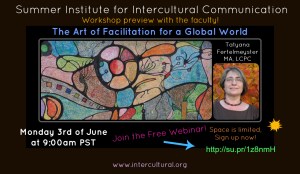
Tatyana Webinar FINAL#1: JUNE 3, Online
The Art of Facilitation for a Global World

This free-of-charge webinar will be conducted by Tatyana Fertelmeyster, and will preview three of the many dynamite learning opportunities that will be offered at the Summer Institute for Intercultural Communication in July, each of which will include Cultural Detective. Her unique technique of Spontaneous Facilitation allows her to work with individuals and groups with maximum concentration on the reality of the present moment. Click here to learn more or register.

IMG_9443#2: JUNE 5 & 20, JULY 10 & 18, AUGUST 7 & 22, Online
Enhancing Cross-Cultural Collaboration:
Demonstration of Cultural Detective Online

These events are free-of-charge. Participants learn to leverage similarities and diversity as assets, rather than minimizing or managing around difference. You will experience some of the wealth of content and process available in the Cultural Detective Online system, and see how easily the system can be incorporated into existing courseware. Participants in the webinar receive a free three-day pass to Cultural Detective Online.

Click here to view client testimonials and videos on the Cultural Detective Online system. From that page, click on “Learn More/Subscribe” for details and pricing information. To learn more about this event or sign up click here.

Flyer seminario sin

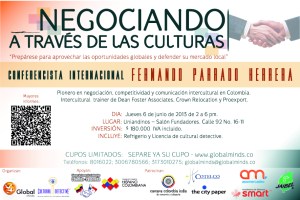
#3: JUNE 6, Bogotá COLOMBIA
Negociando A Través de las Culturas

Cultural Detective is proud to sponsor this event conducted by Global Minds. Facilitated by Fernando Parrado, it will be held in the Salón Fundadores at the beautiful Uniandinos. The event will focus on joint ventures between Colombia and India.

60772_497965080240721_1862908967_n#4: JUNE 25, Online
Coaching and the Cultural Detective: A Creative and Transformative Process

This is a brand-new, first-time-ever offering! Are you are a business leader, coach, consultant, speaker or teacher? Do you want to become culturally competent and self-confident in the global arena? In our webinar we will introduce you to a powerful and transformative coaching process for cross-cultural competence!

The coaching process leverages the core process and wealth of content in the Cultural Detective Online to provide you with a comprehensive learning experience that is stimulating, supportive and transformative! In addition to exploring key cultural concepts and culture-specific information, the collaborative and creative coaching environment helps you develop new perspectives and skills for bridging the gap between your personal cultural “sense” and the cultural “sense” of your colleagues and clients.

The webinar will be facilitated by Jan O’Brien, IAC-MCC, President of Culture-Conscious International, a coaching and consulting company based in Houston, Texas. Jan is a US/UK dual national and has lived and worked extensively overseas, in particular in the US and the South East Asia region. She is a Certified Cultural Detective® facilitator and a Master Certified Coach with the International Association of Coaching (IAC). Jan has worked with clients from many language and cultural backgrounds and has personally experienced the benefits and challenges of living and working in the global arena. To learn more or register click here.

ici#5: JULY 20-21, Portland Oregon USA
Cultural Detective Facilitator Certification

Live and in person, this two-day facilitator certification program is the ONLY PUBLIC CERTIFICATION we have scheduled this year.

This workshop will be held between Sessions 2 and 3 of the Summer Institute for Intercultural Communication, to make it convenient for you to attend and take advantage of other professional development opportunities in the same trip. Facilitated by Tatyana Fertelmeyster. This workshop will include a one-month subscription to Cultural Detective Online.

Click here to register. Click here for more information.

highroaders_logo#6: SEPTEMBER 24, Online
High-Performing Global Teams: How to Combine Virtual Training and
Cultural Detective for Incredible Results

This event sold out within 26 hours the first time we held it. This will be the second time it’s offered. Global teams have become the norm in most business environments today, but many teams never achieve “high-performance.” Why? Because team members from around the world are expected to achieve consistent results across languages, time zones, cultural values, and more but they are not given all of the skills they need to match this expectation.

Join us for an interactive webinar and learn the latest creative techniques for preparing today’s global teams to excel. Explore how global teams can come together via virtual training platforms and use Cultural Detective to work through scenarios relevant to their business challenges.

In this webinar, Vicki Flier Hudson, Chief Collaboration Officer for Highroad Global Services will walk you through a demonstration of a global team training designed for a large company using a variety of tools including Cultural Detective Online. You will gain ideas, tips, and strategies to help bring your global team together, build solid relationships, and achieve high-performance. To learn more or register click here.

You Trust a Quiz to Tell You Who You Are?

Your profile now!

Depp photo @Examiner
Honsou photo ©Armando Gallo/Retna Ltd

You may have had the same experience I have: clients, students, trainees and colleagues often ask me what assessment tools I recommend. My response, of course, is “for what purpose? What do you want to assess?” Sadly they usually can not answer that question. They know they want something online, something quick. They want something that provides immediate feedback, either inexpensively or for free. But, they rarely have focused in on a purpose, on what they want to learn through the “assessment.”

Sometimes I hear, “To give our people a profile of themselves—a profile of their style that tells them who and how they are.” The assumption is that, by understanding ourselves via this hypothetical quick, online, inexpensive or free assessment, we will immediately (almost magically) become empowered to collaborate more effectively across cultures.

Now don’t misunderstand me: assessments and inventories can be incredibly helpful tools. We are all better served by understanding our learning styles, personality traits, and communication skills. Taking a quick online assessment can also be fun. Heck, those quizzes in the magazines can be entertaining: What kind of personality am I in the bedroom based on whether the quiz says I’m more attracted to Johnny Depp or Djimon Honsou. I had fun just writing that sentence!

However, I can’t help but feel the world is just a WEE bit out of whack when we trust a personal profile, produced by a quick survey, more than we trust our own 20, 50 or more years of experience living with and as ourselves. Profiles can be informative: they can stimulate thinking and conversation. But they are not going to, in and of themselves, improve my ability, either in the bedroom or to work cross-culturally.

What causes us to want a profile? We are by and large intelligent people. We are adults. We know ourselves. Many of us want the quick and easy “answer” because our days are so full. Many of us don’t take time for contemplation, practice, or deep meaningful dialogue—even though these are precisely the acts via which wisdom, happiness and, yes, competence are achieved.

Let’s face it: intercultural competence, like all the other important abilities in life (good parenting, sound health, even skills with technology) involves PRACTICE. We need to stay current, we need to both broaden and deepen our abilities and experience.

So, keeping in mind the importance of HOW we use assessment tools, and the importance of a regular structured practice to improve our abilities, there are a handful of “profile” tools in the cross-cultural field that I find useful. Why do I like these particular instruments? They involve or encourage the contemplation, practice and deep meaningful dialogue of which I’ve written, and that research shows is required in order to improve cross-cultural competence. Some tools I can recommend are:

  1. Cultural Detective Self Discovery: This unique product in the Cultural Detective series helps individuals to investigate their cultural identities and develop a “Personal Values Lens.” Through a structured sequence of short exercises and discussions, individuals identify their core values, the positive and negative aspects of these values, and the thinking and behavior that flows from them. They then explore how their values and behaviors may be similar to and different from those of cultural groups. This Personal Values Lens can be used in conjunction with the Cultural Detective Online system for individualized structured learning, or, better yet, with the guidance of a facilitator or coach.
  2. The International Profiler: This terrific tool by our friends and colleagues at WorldWork involves a web-based psychometric questionnaire, followed by coaching sessions, to help develop an individual’s ability to operate effectively in unfamiliar cultural contexts. Nigel Ewington has been piloting ways of combining The International Profiler (TIP) and Cultural Detective (CD), to harness the best of both. Perhaps we can ask him to do a guest post about that?
  3. Personal Leadership: This methodology offers a way of being and interacting with the world that begins from the “inside out,” one that asks people to be fully present in their lives, awake to their habitual behaviors, and willing to look at situations with “beginner’s mind.” Of particular interest in this context is the personal visioning practice. Barbara Schaetti and Heather Robinson and I have created a MashUp process aimed at leveraging the dynamic interaction possible with Personal Leadership (PL) and Cultural Detective (CD).
  4. The Intercultural Development Inventory (IDI), originally based on the Developmental Model of Intercultural Sensitivity (DMIS), is a statistically reliable, cross-culturally valid measure of intercultural sensitivity. What I love about it is that it is developmental: great for charting individual or group progress. It can be completed online, with the assistance of a qualified administrator, and involves individualized feedback. Ideally the IDI is used as part of a process that also involves development planning and coaching.

We can have all the information in the world about ourselves, but if we do not have the courage and diligence to act on it, it is worth very little. None of the tools discussed above provides instantaneous transformation or the magic pixie dust of cross-cultural collaboration. Nor, I imagine, will they give me an evening with either Johnny or Djimon. But with ongoing, mindful practice and the guidance of a good coach or trainer, we will find worlds open to us that we might never have imagined, and we will develop the ability to collaborate more effectively across cultures—exactly what many of our clients are asking for. Each of the tools above dovetails very well with the Cultural Detective Series: TIP and IDI can help you chart progress using CD as a developmental tool, and PL helps ensure the inner work that should accompany CD use happens.

There are many more inventories, assessments and collaborative tools in the intercultural field. What are some of your favorites? How do you use them for maximum effectiveness? How do you motivate yourself and others to practice? What do you wish existed to address specific developmental needs and challenges?

Healing the Wounds of History

Playback Theatre

Armand Volkas

Cultural Detective is about collaboration, authenticity, respect, and bridging differences. The CD Method has long leveraged drama — primarily through the acting out and resolution of critical incidents — as it involves our whole person: body, heart, head and spirit.

I was delighted to learn recently about one colleague who combines our goals with one of our favorite techniques in incredibly powerful ways! On a daily basis I am astounded by and grateful for the unique contributions you, our Cultural Detective community, make to the world around us, and I’m eager to share with you this latest example.

Armand Volkas is a psychotherapist and drama therapist, the son of Auschwitz survivors and resistance fighters from World War II. He is also the life partner of Anna Mindess, frequent Cultural Detective Series editor and co-author of CD Deaf Culture.

Armand created a process called “Healing the Wounds of History,” in which a group of people sharing a common legacy of historical trauma (Germans and Jews; Palestinians and Israelis; Japanese, Chinese and Koreans; African-Americans and European-Americans, to name a few) use experiential techniques to transform the pain of such legacies into constructive action.

Healing the Wounds of History is based on the premise that there can be no political solutions to intercultural conflict until we understand and take into consideration the needs, emotions and unconscious drives of the human being.”

The project involves:
  • Breaking the taboo against “enemies” speaking to each other.
  • Humanizing each other through sharing our personal stories.
  • Taking steps towards healing personal and collective wounds using creative and experiential methods.
  • Transforming historical trauma into constructive action and service.

While unfortunately the sensitive nature of Armand’s work doesn’t lend itself to filming, those of you interested in a deeper feel for it can read through the transcript of one of his keynotes, which was acted out by members of a theater ensemble as well as Armand himself.

For more information on or to support the Healing the Wounds of History project contact Armand Volkas at +1 (510) 595-5500, Ext 11 or via email at info@livingartscenter.org

Culture’s Flow (#4 in a series)

writeshareIn the first three posts ( (#1 in the series, #2 in the series, #3 in the series), I have been hinting at a metaphor for culture that I will explicitly discuss in this post. Let me introduce it with a poem, Culture’s Flow.

FlowPoem

Old conversations and new
Sometimes I ask my trainees or students to close their eyes and imagine culture as this river. Its source, high on a mountaintop, starts with the melting ice that flows from the glacial peaks where the old wisdom of our people and our history has been stored from time beyond memory. In our primeval stream of culture are stories that have been handed down for generations—they carve the deep river bed for the stream of the discourse that flows within us.

Fresh waters of discourse, tributaries join our river’s flow from other places, from others’ mountaintops, from forest-hidden springs and history-pooled rainstorms of experience. Our stream collects, incorporates, assimilates endless sources of discourse. We absorb conversations from face-to-face contact with each other, hear rumors from elsewhere. Especially today, we are inundated by electronic streams of discourse from all over the globe, pouring through virtual media, sometimes going viral. If you’re in social networks, you may get more stories, ideas, reflections, comments than you know what to do with. They overflow your banks. Little by little, and large by large, sometimes tiny imperceptible memes, sometimes by seeping flood, sometimes by tempest and tsunami, they join this river, widen and deepen it and increase its flow. There are stagnant backwaters and rich deltas.

The mix
Discourses intersect. Some join the deeper currents; others cause raging rapids and whirlpools of power and contradiction. We belong and contribute to all kinds of discourses. Everything from our nation to our favorite football team has its story, a discourse about who we are and what we are about. These discourses meet in us to create our culture, shape what we call our person and personality. They produce the endless conversation that we have with ourselves, as we noted last time. We group ourselves with others by the importance, the gravity, and the glue of what we see as our common discourse. The river is meant to nourish the land it cuts through.

When we talk about waters of ancestral glaciers for centuries, we could call them our “primitive conversations,” origins lost in time, those that we share. Then there are “prevailing conversations,” discourse in the air, on the airwaves in cyberspace, conversations that we hear and think about or just absorb, that reflect the cultural values of the specific contexts that we find ourselves in. Prevailing conversations may indeed seem different from the original ones, but then again, not always. Culture is enduring. Its discourses don’t go away, but they flow deeply and they intimately blend with the discourses of the current moment, carrying them along in the river’s course.

Forever old, forever new (Plus ça change, plus c’est la même chose!)
When I was growing up, if you needed to take care of yourself, you went to the doctor and did what the doctor told you. A generation or so later, many of us got into natural foods, natural healing and healers. It looked like a cultural revolution. What didn’t change, but actually got stronger, was the discourse that ran, “I can control my health if I do all the right things.” It is a discourse related to, “I can control my life.” “I can control my career,” etc.”

I remember a European colleague once saying to me, “You Americans think if you do all the right stuff, you can live forever.” He didn’t share my strong US discourse of control, the belief that we are in charge, or think we should be. When I was younger, medical doctors were gods (maybe they still are in some places). Now there are prevailing discourses that tell us that we can diagnose our own problems, for example, through websites like WebMD. What happens when we discuss the problems with only relying on prevailing discourse in spite of older wisdom? While Internet information may help us ask good questions, self-diagnoses based on Internet searches can also go horribly wrong.

That is just one example of how, hearing the prevailing discourse, we may think it’s far afield from primitive wisdom. Yet looking carefully, we may find that it’s just a fresh way of expressing a more ancient discourse flowing from the river’s deep streams. Sometimes there are landslides and earthquakes, events so deep and moving that they may seem to dam up the river and alter its direction, but the power of water…

Seeing culture as a river with both ancient sources fresh inflows helps us see how streams of culture combine to create our reality. We are in a cultural flow. The metaphor allows us to visualize and acknowledge the strong streams and the mix, to accept and speak about both the endurance and the flexibility, the fluidity of culture.

fullnotemptyFull, not empty
More importantly, this metaphor helps us imagine culture as inner fullness of stories and their discourse, replete with possibilities, not emptiness or alienation from our sources. Culture is forever flexible, forever moving, something that belongs to us, something that can irrigate our land and shape our landscape. Flow makes it invalid, impossible for me to stereotype or to label others or myself in fixed, inflexible ways, because we’re all part of the Flow.

Flow is everywhere, everything is flowing. We can see it, we can describe it, we hear its discourse and build our worlds with it. Yet, as the sixth century philosopher, Simplicius of Cicilia said, “You can’t step into the same river twice.” Why? The river has flowed on and you have changed as well. The challenge of viewing culture as a flowing river is that it requires us to accept that we have both inherited and that we continue to create, shape, dismantle, and destroy through the discourses that flow within us.

What can we do with this metaphor?
We can learn about ourselves and about the groups we are part of, identifying, reflecting on and taking ownership of our cultural streams. We can seek out our deepest discourse, the primitive undertows, as well as listen our prevailing self-talk and the chatter around us. We can ask what conversations are “primitive” and which are “prevailing.” What words and tones of our mother’s voice do we still hear, for example? For a humorous but confirming evidence of mother’s voice, listen to Anita Renfroe’s “The Mom Song.”

We can list or map our discourse and the courses it takes us on. I have often recommended using a personal journal for this—some years back I created a handbook on personal writing that is downloadable. When you wish to share, or explore a group’s cultural discourse, a personal or shared blog or a Facebook or LinkedIn group could focus on identifying the streams of identity we take part in. Colleagues and I developed a tool called the Cultural Detective: Self Discovery that provides some basic exercises for identifying our own or our organization’s core values, looking at how our discourse was and is being shaped by people and forces in our story. Mind mapping can be a resource for this. I use MindManager but there are quite a few software tools for this. Take a walk along your river and see what you can see…

This post originally appeared in the blog of the Center for Intercultural New Media Research and is provided with the assistance of its editor Anastacia Kurylo.

I am a creator and destroyer of worlds – and so are you! (#3 in a series)

How We Construct Culture and Reality

In my previous posts (#1 in the series, #2 in the series), I stressed how important it is for us to develop a dynamic rather than a static view of culture. Today we will launch our boat on the river of culture and peer into its sometimes clear and often murky waters to come up with a better sense of what’s down there. We noticed last time how we are ever talking to ourselves. Everything we create is a result of this inner self-talk, this discourse, our listening. So the things that we call “culture,” in the broad sense of the word, arts, music, industry, all of these things are products of this the stories we tell ourselves, this dialogue that goes on within us and around us that helps us shape and break the rules by which we make and do things.

Blog 3.1

Dr. George Simons has long been researching the stories that make us who we are. In this series of blog posts he will be leading us in an examination of critical challenges that can lead us toward a fresh vision of culture. We will explore how we come to terms with our inner and shared identities and learn about how we construct the realities that shape our now and our future world.

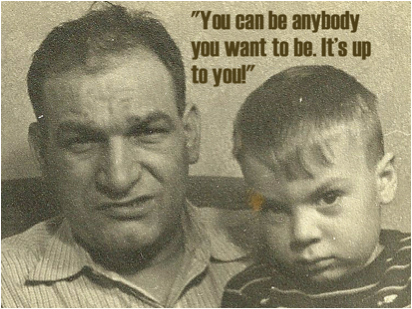
I grew up in the USA. My father was a second-generation immigrant, which often meant trying to be “more American than the Americans” because it wasn’t okay to be “too immigrant.” My father would say to me again and again, “You can be anybody you want to. It’s up to you.” “You have to take charge of your life.” “The squeaky wheel gets the grease.” Such maxims and counsel that were repeated over and over again in my family, during my education, among my peers, in the groups I belonged to, became my outlook, my world, the culture that still flows in me.

Some things we don’t ever forget. When it rains, I still hear my mother’s voice, “Take your rubbers with you.” If you saw the film Outsourced about the manager expatriated to India, you no doubt had a good howl at his conversation with his workers about the meaning of “rubbers”. (If you missed it, have a look.) Rubbers, in my case, were neither erasers nor condoms, but rubber overshoes. I don’t have any now and I haven’t had any in years, but I can still hear my mother’s voice…

Cultural discourse takes the form of memories, stories in our heads and hearts that guide us about how to act, what to think. They shape our attitudes, provide our norms. They are the raw material of our culture. Even if, and especially if these pass into the background of our minds and we no longer explicitly hear them, the ideas and feelings contained in these memories still resonate with us and lead us on.

How do we construct a dynamic definition of culture?
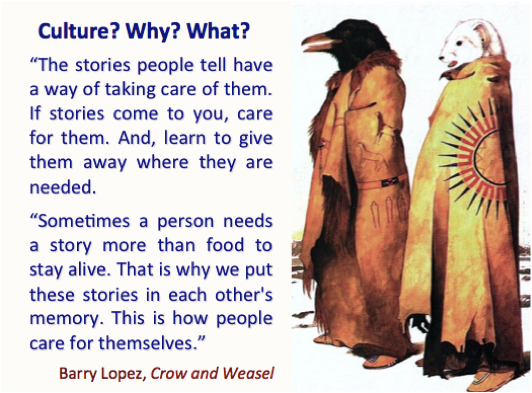
My very favorite definition of culture doesn’t come from a textbook. It comes from a children’s book called Crow and Weasel by Barry Lopez. His is the most disarming definition of culture I’ve ever laid eyes on:

“The stories people tell have a way of taking care of them. So, if stories come to you, care for them, and learn to give them away where they are needed. Sometimes a person needs a story more than food to stay alive. That’s why we put these stories in each other’s memory. This is how people care for themselves.”

Lopez furnishes us with a powerful, very powerful statement about how and why we create and pass on culture. Stories are told and retold in such a way as to shape us, giving us a common memory, common values and behavioral, even moral imperatives “for our own good.” Seeing culture this way, as adaptation to our environment, challenges our more static definitions.

Blog 3.2

Once upon a time, an anthropologist pitched tent in Borneo. Using an interpreter, he interviewed local people, looking for insight into the life and culture of the tribes native to the place. One day, questioning a local chieftain through the interpreter, the anthropologist couldn’t help noticing that the chieftain couldn’t take his eyes off a camp chair—you know, those seats with fold-up wooden frames. Nowadays, most have plastic or metal tubing, but a century ago they were simply canvas and wood. Finally, the anthropologist prompted the interpreter to ask about the chieftain’s fixation on the chair. The interpreter asked, “Why do you keep looking at the chair?” The chieftain replied quizzically, “Why do you stack your firewood that way?”

If you don’t have a use for something, you may not have a discourse for it. It may not even exist for you, or not exist in the way it exists for others. One of the critical tasks of living in a multicultural world is learning how to look at what we’ve never seen before, or have never seen in the fashion that is being presented to us. Things we’ve never “seen” before may not be physical artifacts. They may be feelings and perceptions. They may be opinions, judgments. They may even be colors – not every culture sees or names colors in the same way. We miss out on discourses that drive other people that would never drive us or might “drive us crazy!” These are not easy to discover, certainly not as obvious as puzzlement about a camping chair. Still, ask we must. We are embedded within a cultural discourse that we treat as real, but that is created by, as well as limited to what our own stories have to tell us. 

Blog 3.3Who creates?
In our times, realities, different from and deadly to each other, run rampant. Like it or not, we are challenged to understand our culture, other people’s culture, become familiar with the discourse that drives our behavior, our creativity, and perhaps brings us together in new and different ways and allows us to peacefully cohabit the planet.

So we must ask, where do our realities, where does this culture come from? Well, since culture is a conversation, since it’s discourse, it’s coming from you and me! It’s coming from everybody within earshot, from every handheld device connected to ours. Discourse requires people. It’s going on all the time, and, whether we intentionally listen to it or not, it seduces us with its themes and memes.

Sometimes, probably more often than we think, we deliberately attempt to create realities for ourselves and others. We work on shaping a reality that serves our purposes through the stories we tell in social media, traditional media, conversations with others, as we rehearse and repeat these stories in our own heads. We are as much the creators of these discourses of culture as GM and Volkswagen are designers and manufacturers of automobiles. Like the family car, some discourses can be very helpful and humane. Other discourses can be quite ugly. Like a fast set of wheels, you can use your inner discourse to rob a bank or save somebody’s life by rushing them to the emergency ward.

Roger Peterson, a US academic, is quoted saying this—and I like it:

“The collective memory [the discourse that we share] is systematically unfaithful to the past in order to satisfy the needs of the present. In other words, we attempt to address the present by reconstructing the past as if it always existed in the way we now adopt it.”

Through the stories we tell ourselves we produce a discourse. This discourse is the dynamic way we collectively create the cultural constructs that put our diverse realities, our cultures together. These constructs may be the bearers of mythology, fictional imagination, or as we all know too well, political propaganda. People are competing with their stories to create the realities they want for themselves and for others. For the sake of consistency and credibility we try to present our new story as the true and eternal story.

Enter the discourse of new media
How are new media affecting, constructing this flow? It is probably too early to tell, but certainly not too early to pay attention. For sure, they are being used both in traditional and novel ways.  Certainly they have multiplied by a factor of Xx the sheer volume and range of participation within one generation. They can be the conveyors of the traditional discourse which we consider wisdom, discourses that certain of us would like to impart to the rest of us, philosophical and religious, or New Age ideals; at the same time they are also the tools of revolution and the conveyors of revolutionary values, often drawn from the same sources, but re-expressed and broadcast in nanoseconds in a volume that hitherto would have been deemed sorcery.

How do we sort out what is new and fresh from what is newly or freshly restated to fulfill a desire or to meet a contemporary challenge? The wish to “sort out” in some definitive way is perhaps a false aspiration, a question to which there is no answer, a cul-de-sac, whose alternative is ongoing reflection as an essential part of our reality construction process. In new media, as in any other media that we use to create reality by discourse, these fresh tools are appropriated to change and introduce the realities that its authors, consciously or unconsciously, wish to disseminate.

Blog 3.4We all know that the Internet allows us to create reality ex nihilo. Fake user names create “people,” as do avatars of “aliens.” We even build virtual worlds that allow people to accept a second and a third and perhaps an infinite number of lives and realities. If you can imagine it, say it, you can be it. Yea, “Ye are gods.” Like the Jehovah of Genesis, we say, “Let there be…” And behold, there it is! And, if we are the ones who said it, we are also likely to proclaim that it is good. Like Shiva of old, I am the creator and destroyer of worlds – and so are you!

Charlatans, con men, name changers, shapeshifters and princes donning pauper’s clothing are not new to our human story. But the possibility and the temptation to creation on a quasi-divine level, and the consequences for doing so have never been so available and up for grabs. Even so, we like to imagine the world as somehow stable and static, at least in our desire to create something solid and lasting, even or perhaps especially in a virtual environment. Our human minds and hearts, even in intangible media, are inclined to treat our creations, our culture as real, not constructed.

John Lennon, a great interculturalist in my book, said “The more real you get, the more unreal the world gets.” The more you can get perspective on the discourse that flows around you, the better chance you have of seeing these things, not as useless or false, but for what they are, our attempts to construct things for benefit, for surviving and succeeding. We will look at this again as we seek a fresh cultural discourse to reshape our perspective. Meanwhile, how do you react to this fearful relativity of reality, or to the multiplicity of realities that new media have put at our disposal and which often invade our stability? What have you created as real for you? Are there real worlds, or only virtual ones…?

In Cultural Detective: Self Discovery® we offered some exercises to help you listen to your inner conversations and stories. These are only starting points. In this blog you will sometimes see pictures I have extracted from my past. This is not an exercise in nostalgia or ego promotion, but a suggestion that you might also explore the images and sounds of the past to bring the sources of your cultural discourse into focus.

This post originally appeared in the blog of the Center for Intercultural New Media Research and is provided with the assistance of its editor Anastacia Kurylo.

Culture’s Dynamic… What Are You Listening? (#2 in a series)

Dilemma

Dr. George Simons has long been researching the stories that make us who we are. In this series of blog posts he will be leading us in an examination of critical challenges that can lead us toward a fresh vision of culture. We will explore how we come to terms with our inner and shared identities and learn about how we construct the realities that shape our now and our future world.

If how we talk about culture, as I mentioned in the last post, appears too static, it is not because culture itself is static. Its dynamism penetrates every corner of life. Why this paradox? Why? We need to look at culture not as an idea, but in action.

I can’t tell how many of you are having conversations with your partner, children, dog, or friends at the moment you are looking at this blog, but what I am sure of is that, even if you’re not talking to anybody, you are talking a mile a minute. Research suggests that even in a face-to-face conversation, people are speaking to themselves about eight times as fast as they talk to each other. In a tele-conversation you can mute the microphone but not your mind. This means that, even if you’re not talking to any friends, pets, or other things in your ambience at the moment, you’re talking to yourself—unless of course you’ve fallen asleep and may be dreaming. Sometimes we are totally with these inner conversations—we call it “daydreaming.”

Screen Shot 2013-02-09 at 10.28.47 AMTalking and listening
This is to say, with your inner chatter you’re asking yourself, “What’s this all about?” “What’s he saying?” “Is this useful to me?” “Do I understand this, or this, or this?” Your mind is proposing all kinds of things about what’s going on around and in you, “What am I hearing?” “What am I doing?” “What am I feeling?” Trying to make what we are sensing fit in with what we know. There are even those little conversations we mislabel as distractions, “What’ll I do tomorrow or this afternoon or have for lunch?” We’re always talking to ourselves. We can’t help it. It’s the way we are. Some of us may have learned to meditate to slow down or to quiet our inner voices at times, but they keep chattering on most of the time, whether you pay attention to them or not. What are you talking to yourself about at this moment?

What is this inner flow all about? It is what we call “listening.” I know that sounds crazy because we’ve all probably been taught that to listen, we should shut up, stop thinking and hear the other out. Well, you can’t do that very well. What really happens is that the mind is forever proposing theories about: What’s going on here? What am I reading, hearing? Do I have a second opinion? What should I do? Is this good bad, beautiful or ugly, worth my time? Should I go do something else? And so on and so forth.

Listening is that voice—I’m describing it simply as a voice, but the flow of listening contains pictures, imaginative scenarios and feelings of all kinds that come up in reaction to what’s going on around you and in you. Actively listening means engaging with these conversations, deciding which are focal, which should take priority, which ones we wish to avoid, pursue, take action on.

This is culture!
The conversations, the discourse that you listen to is what we call “culture.” In other words we have inherited, built, built upon, and shared such discourse all of our lives. Today I’m inviting you to take a look at it in this new and different way.  Listening is culture speaking.  It is at once process and content. We have inner conversations, discourses about all kinds of things, about our goals, about the people we are, whether we’re how we should be or not. We have basic discourses about such things as: What’s a man? What’s a woman? How to live out my masculinity, my femininity? We have discourses that come from where we are born, the gangs we hang out with, and discourses that prevail at a certain point in my generation, in your generation.

That discourse not only originates from outside of us, but also springs up from within, as our unconscious mind brings these strains together. With old conversations rubbing up against the new, sometimes helpful, sometimes contradictory, we are ever awash with fresh ideas in the wired, or should we start saying, “wireless” world that we live in.

A torrent of discourse
So today the culture that builds our inner listening is a flow of discourse coming from countless sources; we live in worlds that are continually shaped by these flows of discourse within us and around us. They are continually flowing over us and into us, following old channels and carving new paths. What was once a slower moving stream of discourse has now become a torrent with the explosive growth of social media and facile, inexpensive means of communication. It sometime seems that everyone is wired, everywhere, or, again replacing the aging terminology, it seems that “everyone is wireless everywhere!”

When I was a student at Notre Dame graduate school, I kept a notebook in my dorm room where I jotted down what I needed to research at the library. Every Tuesday and Friday afternoon I trekked across campus toward the arms of “Touchdown Jesus,” the mosaic mural that welcomed scholars to the Hesburgh Library, to satisfy my learning needs and humor my serendipity. Today I can Google and Wiki most information quicker than I can stand up and walk over to the bookcase where I know the exact book that holds my answers. In terms of sheer quantity, I suspect that, now as a septuagenarian, I am learning a hundred times more each day than I did as a collegian. Shivering in the wee hours of the winter morning, I Skype with heat-oppressed colleagues in Australia or friends in Indonesia without thinking it magic. Yesterday I bought a USB flash drive about the size of the first joint of my index finger, but large enough, I am told, to hold 32 copies of the Encyclopedia Britannica I once owned. Go figure!

On the sociopolitical level, we see new media: Twitter, blogs, and Facebook, support the Occupy protests, the Arab Spring, and provide a conduit for wikileaks, all calling into question the way the culture of power is structured and exercised. Battlefields are managed from half a world away. On the commercial level we may feel helpless in the face of mind-bending electronic advertising, victims of strangers who can know everything about us, not just where but how we live, but our likes and dislikes, as well as the GPS coordinates of our smart phones at any given moment. Ought we call in the exorcist or take a digital sabbatical when our inner voices start to babble?

Dynamic culture
There is no end in sight. On one hand our identity seems diluted in the flow of discourse, sound bites and memes, while on the other hand we have powerful means to connect and coordinate our values and our actions to shape both the world we have inherited and this emergent electronic global village we now live in. Given this, we need a truly dynamic discourse about culture, not just a static definition that puts labels on what people have in common and do in similar ways, but one that enlightens us on the ways we share and influence, as well as misunderstand each other.

Please share some reflections on how you see your identity in this new context. What is changing? What is not? How are you and those about you connected, supported, or threatened by the discourse you share? What do you listen? What are the inner voices saying? What is culture telling you?

This post originally appeared in the blog of the Center for Intercultural New Media Research and is provided with the assistance of its editor Anastacia Kurylo.

Intercultural Work—Stuck in its own past? (#1 in a series)

GSportrait

Dr. George Simons has long been researching the stories that make us who we are. In this series of blog posts he will be leading us in an examination of critical challenges that can lead us toward a fresh vision of culture. We will explore how we come to terms with our inner and shared identities and learn about how we construct the realities that shape our now and our future world.

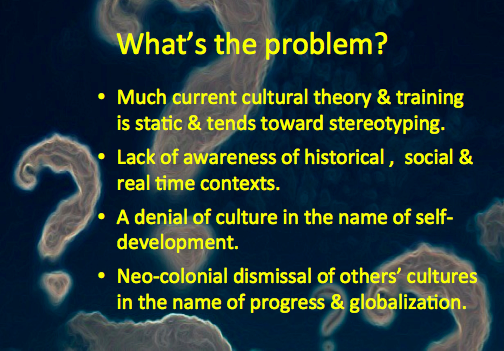
Despite a tide swell in intercultural communication and worldwide immersion in social media, the current field of intercultural communication itself seems static. This blog post articulates five ways in which the field appears to be moving too slowly for the world around it.

1. Essentialism
The word used for the kind of intercultural intervention that leads in the direction of stereotyping is called “essentialism.” One tends to assume that a certain person must inevitably share certain cultural characteristics or behaviors if they come from a particular group, ethnicity or culture. Saying that I am from the USA or that I am German or Nigerian makes a whole mess of things stick to me as stereotypes. Of course, we do have cultural characteristics, but who has them, to what degree as well as when, how and where they’ll be expressed is what we don’t know, and is what we need to learn about each other as we work together. Moreover, we belong to multiple cultural circles that may define us in variable, even contradictory ways. Interculturalists loudly condemn stereotyping but seem less adept at escaping from delivering cultural information.

There may be benefits to identifying with a group despite or in some cases because of the stereotypes, though all too easily an identity is painfully imposed on us. A little story to illustrate this. Nordstrom is a big department store in Los Angeles, in the San Fernando Valley. A young woman in my class at Loyola—let’s call her Yuko—told me how, when working there, a woman making a purchase asked, “Honey, where are you from?” (Yuko had identifiably Asian features in her face). The young woman said, “Oh I’m from right here in the Valley. The woman went on, “But where did your parents come from?” Yuko answered, “Oh, they came from the Valley, too.” The woman persisted, “But where did your grandparents come from?” Yuko answered, “Oh, they weren’t from the Valley, they were from Fresno [another California town].” In fact, Yuko’s Japanese-American family predated the many European immigrants that came at the end of the 19th and first half of the 20th century. Essentialism looks at “difference” as “not belonging.” Yuko suffered this kind of pain repeatedly just because she didn’t look like “everybody else.”

2. Ignoring context
A lack of awareness of the social and particularly historical contexts is another way the intercultural thinking and practice can remain static. A lot of people’s feelings about those different from themselves is not simply a matter of their looking or sounding different, and may be anchored in a story of things that happened in the past. Remember, for example, when Yugoslavia disintegrated into smaller states, how politics called into popular sentiment old memories of “what they did to us” 50 years ago, 500 years ago, 1000 years ago, and so on. These memories live in a culture and affect how we react to individuals in other groups. This is to say nothing of social context, particularly now. Since the financial crisis, we’ve been struggling, in a more conscious way than most of us have done in our lifetimes, with those who have and those who have not. This also provides subtext for our communication with each other.

Questions

©George Simons, blog.culturaldetective.com

3. Cultural denial
A lot of people I work with, particularly many younger people today, have or are encouraged to have an attitude that expresses itself as, “I don’t have a culture,” or “I’m a global person, a global citizen.” This suggests that prioritizing individualism, so strongly promoted in the West, makes it in a way shameful to be connected to our past, to have identifiable roots. This is true not simply of third culture kids (TCK’s), some of whom have been jetsetters while in the womb, but of others, and seems to be part of the educational process. All too many people, and not exclusively the young, have suffered by or are fearful of being labeled, of being stereotyped, as we mentioned above, or they feel a need to disassociate with what feels like the oppression of their origins, their family, religious faith or local context. Having cultural features seems a liability to them, a restriction of freedom. Inability to address this inclination is another point of stasis in intercultural work.

4. Implicit colonialism
An even bigger issue is a kind of lingering sense of better-than-thou-ness, and noblesse-oblige do-goodism that results in a kind of hidden chauvinism, a myopic view of other cultures that too easily infects intercultural efforts and holds them back. Part of this involves interculturalists’ need to come to grips with colonial history and its enduring effects in political and economic terms , not just hand wringing. We are fully aware of having a long history of European colonialism and US colonialism that doesn’t take other people’s cultural and environmental ownership seriously. So we come to enlighten them, to bring them progress, to bring globalization, of course to sell them our products. The need for cultural savvy makes it an important commodity today and this situation begs us to take a larger view. But even more important for intercultural professionals are discovery, exploration and treatment of the psychological residue of colonial thinking in themselves. Failing this, it is hard to imagine our efforts moving forward in the ways we like to think that we intend.

5. Dyadic dimensional thinking
Traditionally, in the boilerplate of the intercultural profession, we studied values in what are called “dimensions.” This was our starting point, something for which we are very grateful to the original researchers, people like Geert Hofstede and Edward Hall. In their observations and studies they raised questions and classified the answers. For example, they identified people as more or less “individualistic” or “collective,” “masculine” or “feminine,” “direct or indirect,” according to how people in different cultures reported their likely behavior given similar situations. Their work made us aware of the fact that there were areas of life in which different people had different ways. Yet, on the other hand, the resulting value labels were a product of Western academic mentality, an attempt to understand other people on our own terms rather than on theirs. This may have been the key to the antechamber of understanding, but leaves us standing in front of a second locked door.

In sum, five road blocks, often in combination with each other, that challenge intercultural thinking and practice. Will social media change our static habits? Perhaps so, because they regularly confront us with evidence from around the world, literally at our fingertips, that may challenge these notions. Yet confirmation bias, our ability to see only what we know or expect to see and make otherness fit into it, is likely to be operative in the online world as well. What think you?

This post originally appeared in the blog of the Center for Intercultural New Media Research and is provided with the assistance of its editor Anastacia Kurylo.

Cultural Detective Online is LIVE!!!!!!!!

Cultural Detective is proud to announce the new product launch of Cultural Detective Online! This tool is like having a virtual coach in your back pocket, successfully guiding you through the all-too-common missteps of cross-cultural negotiations and communications. Please check out the four videos on the home page. Today only (15-16 October, depending where you are on the planet) there is a 25% launch discount; enter promo code:   CDO-blog25  during checkout.

Huge thanks goes out to each of you who have worked with and incorporated the Cultural Detective Method into work with your clients or employee populations globally, as over the past eight years this tool has become a significant contribution to the intercultural field. Because of our clients and team, Cultural Detective has become globally recognized as one of the premier developmental tools of our time. Now we are on the cusp of very exciting and broader use of the tool through Cultural Detective Online! This new product launch furthers our mission of encouraging communities globally to prosper through intercultural understanding and collaboration.

Cultural Detective Online is useful in a broad range of contexts including global business negotiations and multicultural team effectiveness, international assignments and study abroad, and for successfully communicating within our families and communities, and within and across faith traditions.

A subscription to Cultural Detective Online offers the opportunity to explore the concepts of “culture” and “values” and how they impact communication in everyday life. It provides access to dozens of culture-specific Values Lenses and topic-specific Challenges Lenses, hundreds of real world cross-cultural incidents, and the easy-to-use Cultural Detective process for improving the ability to collaborate successfully across cultures, both on individual and organizational levels.

We are excited to announce that subscriptions are now available for individuals or groups, and we invite you to subscribe to Cultural Detective Online today by visiting http://www.culturaldetective.com/cdonline/ ! Subscriptions start at less than US$100/year, and are less for larger groups of subscribers. You will rarely find more value for your money.

Cultural Detective Online for Study Abroad

Quite a few of the world’s leading study abroad organizations rely on Cultural Detective. They tell us it’s invaluable to their students’ success. That’s why we are very excited to SOON be able to offer you the Cultural Detective product line as an integrated, online system rather than as stand-alone packages! And, better yet, it’s designed as a personal coach, encouraging your students and staff to track their goals, summarize and apply their learning, and upload, debrief and share with a teacher or counselor their daily life experiences (and the meaning they are making from them).

Be sure to stay tuned for our official launch. Or, enter to win a free subscription for you or your team!

If you are unable to view the video above (if you are on an iPad or other device that doesn’t play Flash), click here to view the video on YouTube. Please feel free to share this video with others who might be seeking a virtual intercultural coach. Thank you!