
Un Gringo Chévere! A Cool Gringo!

(English follows the Spanish)

Con el permiso de nuestros lectores gringos, este espacio se lo quiero dedicar a uno en especial. Quiero hablar de un gringo chévere con el que he tenido oportunidad de trabajar para un proyecto de inversión en Colombia. Y quiero resaltar más lo chévere que lo gringo, que dicho sea de paso él no considera ofensivo desde ningún punto de vista.

En mi país un gringo es un forastero que habla enredado. No importa si habla sueco, alemán, italiano, inglés u holandés. Un rubio (o castaño claro) de tez más clara que nuestro promedio, es gringo. Y no lo hacemos por ofender, sino tal vez porque eso quedó en el imaginario colectivo como un sinónimo de “no es de aquí”.

Este gringo chévere vivió veintiún años fuera de su país entre Suráfrica, Bahreim, Francia, Reino Unido y China. Ha dado la vuelta al mundo más de seis veces y, aunque siempre vinculado al sector financiero, ha podido trabajar en diferentes industrias que le dan un vasto conocimiento en muchos temas. Departir con él es sumamente enriquecedor.

Trabajar con este gringo es desafiante. Le admiro sus habilidades y conocimientos en el área financiera, pero él sabe que lo que más admiro es su gran capacidad de entender a los otros, de buscar similitudes y no diferencias, de centrarse en el modo de integrar las partes que se involucran en una negociación y de ver con ojos interculturales su entorno. Es un gran conciliador y excelente negociador. Además posee una gran habilidad para poner en contexto cultural las partes involucradas, casi siempre logra identificar la manera como piensa el otro.

Yo siempre le he dicho, que de lejos me parece el más intercultural de los estadounidenses con los que he trabajado. Tiene una mente global y una carrera profesional que le ha permitido desde cargos directivos confirmar que herramientas gerenciales sin aprehensión cultural no permiten un liderazgo efectivo. La satisfacción de los clientes o la motivación de los empleados se ven impactados directamente por sus expectativas y necesidades, y todos no necesitamos lo mismo.  Cuando comparte muchas de sus experiencias puedo transportarme a muchos escenarios en diferentes latitudes, y logra describir personas y entornos tan diversos sin caer en estereotipos ni prejuicios. Por supuesto que hay situaciones que agradan más que otras, pero es parte de nuestra interacción con cada entorno. Algunos sencillamente nos son más favorables.

Se ganó el título de chévere porque siempre está dispuesto a aprender, no critica sino pregunta, analiza y compara. Este gringo le da la importancia debida al entendimiento de un lugar, una cultura, un pueblo.  Es el que una vez cerrando un negocio en Medio Oriente tuvo que comer ojos de camello y aquí prueba las obleas, las almojábanas y queda encantado con las pitahayas, tanto que llega a buscarlas en su ciudad de residencia, las encuentra en el mercado chino, descubre que su sabor es muy diferente al colombiano y decide ¡comerlas con sal! Jamás he comido pitahaya con sal, aquí son muy dulces…pero esa es la interculturalidad, este gringo es del sur y dice allí comen con sal la sandía y el melón.  Cómo se dan cuenta, es un poco de cada lugar, un poco de aquí y de allá.

A veces centramos nuestros entrenamientos interculturales en aprender teorías y conocer de autores que nos han clasificado de una manera u otra. A veces nos dejamos llevar por la ilusión de pretender cambiar los seres humanos con un discurso y dejamos de lado lo simple, lo básico, como lo es el hecho que ser interculturales comienza en esa disposición misma de aceptar y reconocer.

Aceptar que somos diferentes. Reconocer que pensamos y actuamos diferente a partir del entorno que nos rodea, y de lo que nos ha sido heredado — valores, creencias, etc. Al aceptar y reconocer, se nos hacen fácilmente evidentes también los dilemas a los que nos enfrentamos en medio de las diferencias y que ponen a prueba nuestras habilidades a nivel interpersonal, empresarial y social. Al poner nuestras habilidades a favor de nuestra interacción con nuestro entorno – corporativo, social – podremos construir enlaces y puentes de entendimiento que nos permitan entonces entendernos a nosotros mismos y de esta manera entender a los demás.

Gracias gringo chévere, por permitirme trabajar contigo y aprender tantas cosas a la vez. Gracias por compartir tus aventuras en cada rincón del planeta y tus experiencias laborales y de vida con gente tan diversa. Gracias por permitirme presentarte un poco de mi país, de lo que somos y lo que brindamos.

Gracias y ¡hasta pronto señor!

With the permission of our gringo readers, I’d like to dedicate this space to one in particular. I’d like to talk about a cool gringo I had the opportunity to work with on an investment project in Colombia. And I’d like to emphasize that this cool gringo does not consider the term offensive in any way.

In my country a gringo is an outsider who talks weird. It doesn’t matter if he’s Swedish, German, Italian, English or Dutch. Someone who is blonde or has a lighter complexion than our average is gringo. We don’t say it to offend, but rather because that term has entered our collective imagination as a synonym for “not from here.”

The cool gringo of whom I’m writing lived 21 years outside his country, in South Africa, Bahrain, France, the UK and China. He’s been around the world more than six times, and while he’s always worked in the financial sector, he has been able to work in different industries that have provided him a vast knowledge of diverse subjects. To spend time with him is extremely enriching. He possesses a great ability to put things in cultural context, and is almost always able to identify how the other person thinks.

I have always said that he is by far the most intercultural of the US Americans I’ve worked with. He has a global mind and a professional career that have permitted him to ascertain which management tools permit effective leadership only when used with cultural appropriateness. Customer satisfaction and employee motivation are directly impacted by their expectations and needs; we don’t all need the same thing. When he shares his experiences I’m transported to many scenes in different latitudes, and he is able to describe diverse people and environments without falling into stereotypes or prejudices. Some situations are of course more appealing than others, as it depends on our interaction in each environment. Some situations are simply more favorable.

To work with this gringo is challenging. I admire his abilities and his knowledge in the area of finance, but he knows that what I most admire is his great capacity to understand others, to look for similarities and not differences, to focus on how to integrate the parties involved in a negotiation and watch the context with intercultural eyes. He is a great mediator and excellent negotiator.

He achieved the “cool” title because he is always ready to learn, not to critique but to ask, analyze, and compare. This gringo gives due importance to the understanding of place, culture, and people. He’s the type that, closing a negotiation in the Middle East, had to eat camel’s eyes. Here in Colombia he tried obleas (wafers), almojábanas (crullers), and was delighted with pitahayas (dragon fruit), even going so far as to try to find some where he lives. He finally found them in a Chinese market, but found they tasted very different from the Colombian variety, so he decided to eat them with salt! I’ve never eaten dragon fruit with salt; here they are very sweet. But there’s something about interculturalism. This gringo is from the southern US, where he says they eat watermelon and cantaloupe with salt. As you’ve no doubt noticed, he is a bit of every place he has lived, a bit from here and a bit from there.

At times we focused our intercultural training on learning theory and getting to know authors who have classified us in one manner or another. Sometimes we got carried away with the illusion of trying to change human beings via our conversation, ignoring the basic, simple fact that intercultural beings begin with a predisposition to acceptance and acknowledgement.

To accept that we are different. To acknowledge that we think and act differently depending on the context and on what we’ve inherited — values, beliefs, etc. Accepting and acknowledging make readily apparent the dilemmas we face in the midst of our differences, those that challenge our skills on interpersonal, organizational and social levels. By behaving appropriately to the corporate or social situation we can build links and bridges of understanding that then permit us to understand ourselves and, in this way, to better understand others.

Thank you, cool gringo, for enabling me to work with you and to learn so many things at once. Thank you for sharing your adventures in each corner of our planet, your work and life experiences with such diverse people. Thank you for giving me the opportunity to explain a bit about my country, about who we are, about what we provide.

Thanks, and see you soon, sir!

Watch Out! What a Values Lens is—and is Not!

Our users love Cultural Detective‘s Values Lenses. Many of them even call our toolset “Cultural Detective Lenses” rather than “the Cultural Detective Series.”

Customers tell us they use Values Lenses to:

  • Quickly build recognition that cultures are, indeed, different.
  • Establish credibility that these tools and their facilitation are effective.
  • Supplement—amplify and deepen—the analysis of a critical incident, or better understand a personal life event.
  • Reflect on ways in which they have become who they are by overlaying national, gender, generational, religious tradition or sexual orientation Lenses with Personal Lenses.
  • Contrast their “home culture” Lens with that of a new culture to predict where there might be synergy and resonance, as well as potential difficulties or challenges.
  • Learn to focus on the things that make a difference, to observe and respect deep culture, rather than becoming preoccupied with dos and don’ts.
  • Empower members of their organization to explain their culture(s) to others. Though they may not individually hold the values on the culture’s Lens, the Lens enables them to explain the larger society’s tendencies in ways that help newcomers to be successful.

All of this is fine and good, except that Values Lenses scare the bejeebers out of me!

Ever since publishing Ecotonos back in the early nineties, I’ve said that publishing a tool is like launching a child out into the world: products, like children, take on lives of their own. They do not always do what their parents or creators might have intended. Tools serve certain purposes and not others. Tools can be used expertly or misused.

Since Values Lenses can be such powerful tools, they can also be dangerous tools when misused. Thus the reason for this post. We want to make sure you understand how to use Values Lenses appropriately, and help us keep them from being used counterproductively.

So, what are Values Lenses? And what are they not?

  • Values Lenses summarize the top five to seven core values or general tendencies of a group of people, a culture. They do not apply to individuals within a culture, and the values have a complex influence on sub-cultures of the Lens culture.
  • They illustrate how members of a culture tend to see the world—looking out through the Lens, and how a culture tends to influence its members—like sun shining in through the colors of the Lens. It is important to remember it is “tend to,” not “always do.” Context is key.
  • They capture the ideal and actual aspects of a culture, intention and perception, positive and negative, yin and yang. A Lens both illustrates the values that members of a culture aspire to, and some ways in which the expression of those values might be negatively perceived by those who don’t share them. A Values Lens is a starting point for inquiry; it does not contain every value held by every member of a culture.
  • Values Lenses are tools for discovery and dialogue, clues that may give us an idea about what makes people tick. They are not yet another “box” into which to stereotype people!

Values Lenses can be extremely effective tools, and they are a key component of the Cultural Detective Method. Remember, however, that it is the process of using the Cultural Detective Worksheet that is fundamental to the Cultural Detective approach.

We’d love to hear your ideas and techniques for helping others learn through the use of Cultural Detective Values Lenses! Let us know how you are creatively applying Values Lenses in your life—personally and/or professionally.

Cultural Detective Online: Virtual Coach for Expats and Business Travelers

You’ve already told us Cultural Detective is fabulous. That it’s helped your team achieve its deliverables. That it’s rocketed your performance to new levels. That’s why we are very excited to SOON be able to offer you the Cultural Detective product line as an integrated, online system rather than as stand-alone packages! And, better yet, it’s designed as a personal coach, encouraging you to track your goals, apply your learning to your business objectives, and upload and debrief your own life experiences.

Be sure to stay tuned for our official launch. Or, enter to win a free subscription for you or your team!

If you are unable to view the video above (if you are on an iPad or other device that doesn’t play Flash), click here to view the video on YouTube. Please feel free to share this video with others who might be seeking a virtual intercultural coach. Thank you!

Diversity and Attrition in the Global Executive Suite

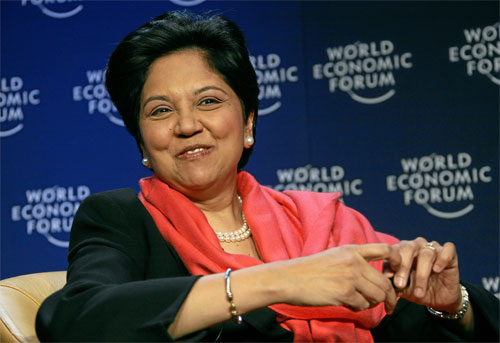
Image of Indra Krishnamoorthi Nooyi, PepsiCo CEO (NOT the subject of this post)

A major global corporation lost a 25-year senior executive at the prime of her career. She explained in her exit interview, “The corporate culture here is too parochial and I am tired of fighting it.”

How did the company lose such a gifted executive, at the point it could have most benefited from her contributions?

I will tell you a story that she shared with me, one that will hopefully provide a taste of how she felt during her career with this company. She shared the story with me at the conclusion of a two-day training course I had conducted, in which she had just participated.

“Dianne, I have so very much enjoyed this global management training you have facilitated for us. These are exactly the cross-cultural skills and mindsets needed in our world today! You are providing us tools and processes for acknowledging and using unique contributions, hearing the voice and perspectives of all involved. This type of training is so very different from diversity training,” she told me.

Well, I happen to be a fan of diversity training. I was troubled by her words, and wanted to understand what this obviously intelligent, wise woman did not like about it.

“Well, Dianne, in my experience diversity trainers go through the motions. They do activities and they often don’t know why. I’ll give you just one example. A year or so ago I was in a senior management diversity training. The facilitator asked us to stand in a line, side by side. He instructed us to take one step back if English was not our first language. A step back if our skin color was not white. He said to take another step back if we were not Christian. A step back if we had not attended a first-tier university. On and on he cited the categories, and I took so many steps back that I was the only person at the far side of the room, alone. There were several others in between, but I was visibly alone.”

“I thought to myself, ‘YES! THIS is what I’ve been trying to tell you all these years! This company forces me to do backbends and jump through hoops in order to succeed! I have to lose who I am to influence decision making. I have to communicate in a way I dislike in order to be heard! Let’s change this corporate culture to be more inclusive!’ Oh, Dianne, I was so excited by this powerful exercise!”

“But, do you know what happened? The President of the company looked at me standing there in the back of the room and said, ‘Look how inclusive we are. A dark-skinned woman, an Indian Jain, can become a senior director!’ I thought to myself, do you know how much harder than a man I have had to try to succeed? How much harder than a white skinned person? How much harder than a European or American? He seemed to have no idea of the price I’d had to pay for my promotions. He didn’t acknowledge my accomplishments or the super-human efforts of other minorities in our organization. Rather, he prided the company on its color-blindness! And worse yet, the trainer didn’t say anything! The exercise concluded, and we went on to the next activity! Rather than a learning moment, the activity only reinforced ignorance and legitimized discrimination! I was absolutely crushed and stunned.”

Such a loss for this corporation. Such a difficult decision for this woman to have had to make. It was also a challenging position for the trainer to have been in; hindsight is 20-20 regarding how the trainer could have handled the President’s comments, and debriefed the activity, more effectively.

Let me close by asking you this: Have we all taken the time today to empathize, to put ourselves in someone else’s shoes? Have we done our part to change dysfunctional systems? What have each of us learned today?

I look forward to your comments on this post. Thanks!

Linked to the My Global Life Link-Up at SmallPlanetStudio.

Global Edge: Terrific resource

Are you familiar with GlobalEdge? Funded in part by the USA Department of Education, the project provides free, centrally located international data from a variety of sources.

  • The Global Insights section includes data sortable by country, by 11 trade blocs, or by industry.
  • The Reference Desk includes a resource directory, online course modules, tutorials on international business, and a glossary of international business terms.
  • Their Knowledge Tools, my personal favorite, include tests of knowledge, economic rankings, a terrific “Database of International Business Statistics” to help you generate the custom reports you might need, an index to evaluate emerging markets, diagnostic tools to aid your business decisions, and a country comparison tool.

Many thanks to Cultural Detective facilitator Janet Graham, Baker University professor of international business, for highlighting this resource !

Fortune 500 Client Prepares to Support Global Clients

“We have achieved, for the first time in my five years working on the Learning and Development team, a 100% satisfaction rating from our learners. This is quite an achievement, considering that learners spent 12 hours over three days in the classroom. They typically are resistant to being in the classroom for more than two hours at any given time!”

Such feedback from one of our Fortune 500 Learning & Development Managers is so wonderful to hear and just as powerful is what led to these results — it is a great story to repeat. Take a read!

“Our initial plan was to offer strict localization training that would concentrate on such basic details about Australia as spelling, unique business terminology, time zones, and the fact that they use the metric system. We also planned to train basic Australian etiquette: the do’s and don’ts.

In my search for training that we could purchase and customize to our specific needs, I came across Cultural Detective and discovered that we could, using your materials and methodology, offer our learners much more than the basics. In fact, what I found in Cultural Detective was an approach to cross-cultural communication that would leverage and greatly enhance the communication skills that our team already puts to use every day to achieve shared understanding with our U.S. business-to-business customers.

Clearly, Cultural Detective was a natural fit for us—a fact that was driven home when I attended the FOLE (facilitated online learning event) sessions and saw a great example of how the training could be delivered online (something I very much appreciated, since most all of our training will be virtual by next year!). The FOLE sessions put all the pieces of the puzzle together for me and gave me plenty of ideas for conducting the training in a fun and engaging way.

After attending the FOLE sessions, I worked closely with an Australian SME who works on our Customer Services team. His willingness and enthusiasm to share his culture made adapting Cultural Detective to our purposes a real joy. As your methodology strongly suggests, having someone who grew up in the culture directly participate in the development process helped breathed life into the content, and it also added a level of credibility to the training that made it even more engaging and effective.

But what really made the Australian training effective was the fact that we prefaced it with your Self-Discovery course. Learners who may have been a bit skeptical about having to take part in a course on “culture,” when they typically receive “nuts-and-bolts” training on how to meet their customers’ technical and marketing needs, were plainly won over to the idea, at times in moving ways. Members of our team whom I have known and trained for a number of years, and who rarely participate in the classroom, shared powerful childhood stories that demonstrated their ability to connect the personal and the cultural in deep and meaningful ways.

The Self-Discovery course cleared the way for us to dig into the Australian Cultural Detective course and make what in some cases were startling discoveries. One such discovery emerged when my Australian SME, who was in the training session (not only because he is my SME, but because he will be part of this new Australian program), shared his cultural core values with the rest of the group, all of whom are native-born Americans. His values were not only quite different from the rest of the group, but they meshed perfectly with the Australian core values, once I revealed that lens to everyone. The impact on the class, including on my SME, was clear and immediate: they were startled by concrete evidence of fundamental cultural differences.

Because of this discovery, as well as their very personal engagement with their own cultural makeup, learners were able to engage with the Critical Incidents deeply, perceptively, and energetically. We were able to pull out and analyze many “clues” from the incidents, while having a lot of fun doing so!

The other discovery came when I was working with another trainer on my team whose focus was on our new client company’s marketing strategy and how it evolved over many years in Australia. When he shared his extensive research on that strategy, it was immediately clear that the Australian core values I was covering were at the heart of our client’s branding. Based on that finding, we were able to weave our courses together into a powerful and cohesive curriculum.

To ensure that the lessons learned in the classroom stick and continue to grow, our coaching team (who participated in both beta sessions and live training) are now making connections back to the Cultural Detective method, concepts, and terminology as they guide learners through the initial relationship-building process with our customers. And the anecdotal evidence of the overwhelming effectiveness of this coaching is pouring in already.

I have received kudos from my managers and the Vice President of Services for having chosen and successfully delivered the Cultural Detective training. But the kudos should really go to you and your company, Kris. Cultural Detective is a rock solid methodology.

Thanks again for all your help making this training possible. When we take our next step into the global market, we know who we will turn to for training solutions.”

When you take your next step into the global marketplace, who will you turn to?

The Case of Who’s in Charge: Whose language will we speak?

Or: “How to lose a US$1 million investment in less than an hour.”

Cultural Detective and the Case of Who’s in Charge

This case takes place in one of the world’s largest companies. The company has recruited, at much expense, a leading Nigerian scientist to head up a project; he is perhaps the only person in the world with the unique knowledge base, experience and connections needed to see this major project through to fruition.

The company has gone to great expense to relocate the Nigerian project manager to western Europe, and to assemble a cross-functional team of the company’s leading professionals to aid with the project. The project is of huge significance for the company. The plan is that it will break new ground and shift the way such projects are implemented worldwide. There is much hope and excitement, as well as huge investment and anticipated return, riding on it.

The project manager, the Nigerian scientist, calls a meeting with three of his team members. All four people greet one another in English, shake hands, and sit at a table for the meeting. The project manager introduces the agenda, in English. After a few minutes the discussion seems to naturally shift from English into the local language, and continues for about 45 minutes.

At the conclusion of the meeting, the four gentlemen stand up, again shake hands, and shift back to English to congratulate one another. One of them says, “I think we have devised an excellent plan.”

The project manager replies, “Oh, yes? And what would that plan be?”

The three others appear puzzled. “The plan we just agreed to,” they say. “The plan we’ve been discussing.”

The Nigerian responds, “I didn’t understand a word you were saying. I don’t speak that language.”

“Why didn’t you say so?! We could have switched to English!!” The others’ mouths drop open in disbelief at this waste of time, and the scientist’s failure to speak up.

“I am the project manager. I called this meeting, and I started it in English. All our correspondence has been in English. You all changed the language. It is a power play. Your colonialist ways never seem to change.”

After this meeting, the project manager requested his removal from the project. It appeared this hugely anticipated effort was dead before it had even gotten going!

An orientation to cross-cultural collaboration, including work on understanding and learning to deal with issues of post-colonialism, may have prevented this rocky start. There are times when, once mistakes have been made, there is no rescue or remedy. Convincing these team members to give it another go, to get past their doubts and discuss ways of respectfully and productively working together, required skilled facilitation. The project manager was convinced that his team members were racist, and the team members were convinced the project manager was overly sensitive. Both thought the other arrogant.

What are some of the techniques you might use in such a scenario? How might you help the team members gain empathy for what the project manager was feeling? How might you equip them with the skills they need to demonstrate respect in such an environment? How might you help the project manager develop the skills he needs to manage team members effectively, given post-colonialist realities?

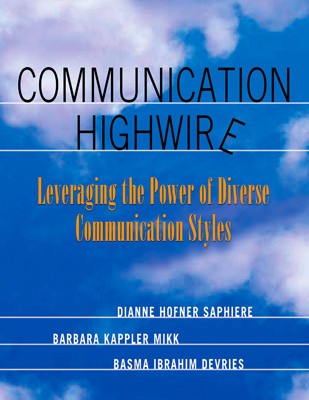
Book Review: Communication Highwire

by Dianne Hofner Saphiere, Barbara Kappler Mikk, and Basma Ibrahim DeVries
Intercultural Press, ©2005

Communication Highwire: Leveraging the Power of Diverse Communication Styles

Review written by Piper McNulty
Originally published in the The CATESOL Journal vol. 20.1

Communication Highwire, as the circus metaphor implies, explores the balancing act inherent in any intercultural interaction: how to remain true to oneself while exploring aspects of other styles, with a goal of achieving more effective communication.

After decades of teaching and training across, and about, cultural differences, these three authors have found that labels such as “direct,” “low context,” or “polychronic,” while providing initial insights, are not sufficient for their purposes, and that a more “robust, and dynamic” (p. xi) analysis framework is needed. In addition, unlike most books on intercultural interactions, Communication Highwire moves beyond appreciation of cultural difference to suggest ways to leverage diverse styles for improved communication across cultures.

Their model is additive, with a goal of expanding each individual’s communication-style repertoire. The book is divided into four sections: an introduction, five factors affecting communication style, a detailed breakdown of 16 specific styles, and an extensive collection of activities. The authors return throughout the book to the ongoing, often contentious relationship between two businessmen, Mike and Tanaka-san, who struggle to understand each other’s behaviors, articulate their own goals and preferences, try each other’s styles, and ultimately work together productively. Examples from many other cultures and contexts are also used to illustrate the concepts and strategies throughout the book, drawing on the authors’ extensive intercultural experience, both professional and personal.

Saphiere, Mikk, and DeVries explore communication across cultures from different client needs and perspectives, and they argue persuasively that successful communication requires a combination of styles. The best coauthored books present a mixture of ideas, experiences, and analysis and we are the richer for these authors’ extensive collaboration. Each chapter, and the themes that carry throughout the text, appear to be the result of extensive discussion, reflection, and collaboration. The book is full of engaging, highly readable examples, discussion prompts, and skills activities, which take the reader well beyond the obvious and the “common sense” of communication theory. Occasionally the sentences get a bit wordy, but the writing is clear and cogent throughout, and the authors do an excellent job of selectively substituting everyday terms where field-specific jargon could simply distract and frustrate the reader.

The book also stands out for its gentle reminders to consider multiple perspectives, to “hold…individual goals loosely enough to hear, accept and more fully understand each other’s goals” (p. 79). In addition, the analysis checklists are exceptionally thorough. For example, most intercultural communication (IC) texts simply state that in some cultures one should avoid eye contact with authority figures, yet we all know that eye-contact rules are not that simple.

These authors list four different descriptors of eye contact, and while such detailed analyses might seem more than the average ESL/EFL student needs, or can handle, adults in a second-culture context often struggle to adjust their communication behaviors to be more effective with their new interlocutors, and they are often very aware of fine nuances of style. Such students are usually more than ready to embrace this depth of analysis, because they want to understand why their interactions across cultures do not always go as intended.

Of particular interest to TESOL members will be the detailed analyses of functional language. Students trained to analyze miscommunication as these authors suggest will be at a significant advantage when discussing, negotiating, persuading, critiquing, or receiving feedback, skills that can come into play in academic contexts, the workplace, when renting an apartment, or opening a bank account. Also addressed are idea presentation, turn taking, expectations of communication process, use of emotion, permeability of new ideas, apologies, requests, praise and disagreement, feedback, and humor, among others. Language for describing details of both vocal characteristics and nonverbal behaviors are also provided. Making this global range of styles explicit is of great benefit to instructors and students alike.

The authors also emphasize that no individual will be predictably direct, or emotionally expressive, or quick to touch others in all contexts (to name just a few), but that communication styles are a situational tendency, providing a link between behavior and underlying intentions. To leverage our understanding of others’ styles, they present a four-step method: (a) reflecting, (b) analyzing, (c) discussing, and (d) deciding. While these steps might seem easy to carry out, discussing and deciding are not found in most IC literature, and the authors’ engaging analysis of the ongoing relationship between Mike and Tanaka-san helps instructors and clients develop their own version of the suggested analysis strategies.

The book is such a rich source of information and analysis tools to seem, at times, overwhelming, but the outline format and use of charts allow the reader to skim the chapters’ subtopics, selecting the specific communication styles or functions that are most applicable to their client/student population.

As for the activities, we have all read step-by-step instructions of skill-building activities and wondered whether we could achieve the outcomes promised by the author. Intercultural and diversity training can be particularly idiosyncratic and context specific, making it difficult for others to duplicate their success. However, the activities presented here are easy to envision, and the tips and suggested adaptations allay concerns that the exercises are too dependent on the original facilitator’s approach. In addition, the relatively large font, line spacing, and the wide margins leave plenty of room for underlining and notes.

Communication Highwire is an excellent resource for ESL/EFL instructors whether or not they use the activities in their own classrooms, as the tools provided may help them recognize where, and why, their own interactions with their clients, of any age or level, have gone awry, and what may be causing disconnects in their classrooms. The authors explore culturally different communication styles with depth, clarity, and insight.

Communication Highwire would be a useful supplement for teacher-training programs and a valuable addition to any ESL/EFL instructor or trainer’s library, no matter what the level or context of instruction.

Communication Highwire: Leveraging the Power of Diverse Communication Styles is a gem!

Link

Interesting article in Diversity Executive magazine about product naming problems in the global market, some good examples, and a link to an article on the value of intercultural competence.

Kudos to all our interpretation and translation colleagues!

What are you favorite “Cultural DeFective” examples? And your strategies for preventing them?

Sample Half Day Global Competitiveness Program Design

Many of us have found ourselves in the difficult situation in which people ask us to equip others to be cross-culturally effective and globally competitive – and then give us just a few short hours to do so.

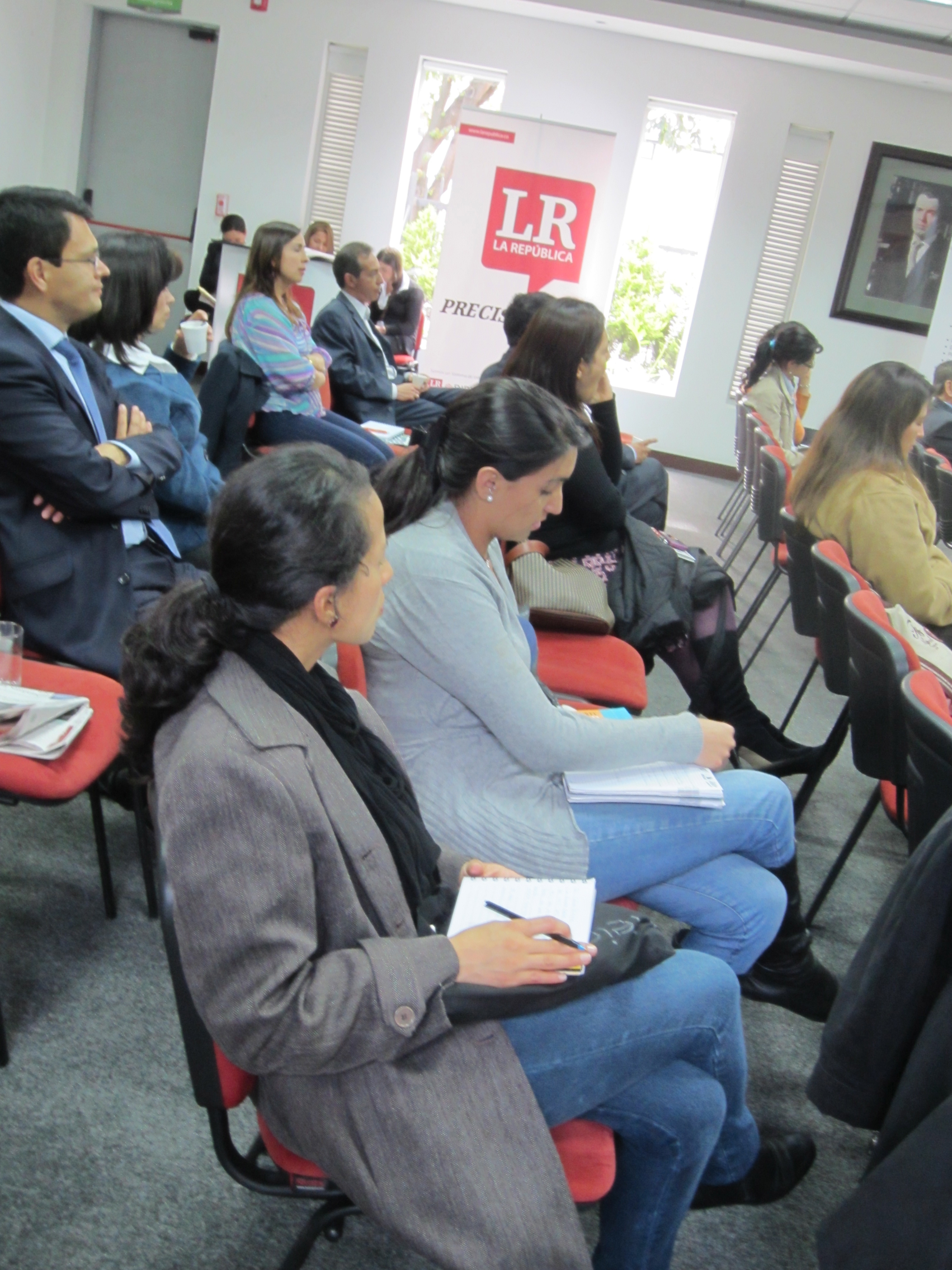
Such was my task recently in Bogotá. The Colombian government had just signed a Free Trade Agreement (FTA) with the USA, and I had been invited to work with a lawyer and a business consultant, so that the three of us could, in five hours (ok, we started a bit later than scheduled, so really 4-1/2 hours), better enable local businesses to make the most of this new opportunity. My colleagues were excellent, and thanks to terrific teamwork and generous sharing of expertise, we were able to take a very diverse group of enthusiastic participants a long way in a short time.

I thought some of you might find the design useful for adapting to your own needs.

Session Title: Global Competitiveness and Productivity

Advertised Session Objectives: Learn how to make the most of the new FTA, how to conduct business at international levels of quality and competitiveness, and how to negotiate effectively with US Americans.

Advertised Session Components: Legal context of the new FTA, negotiating with US Americans, and global business ethics.

OUR DESIGN

Legal Aspects of the FTA – one hour

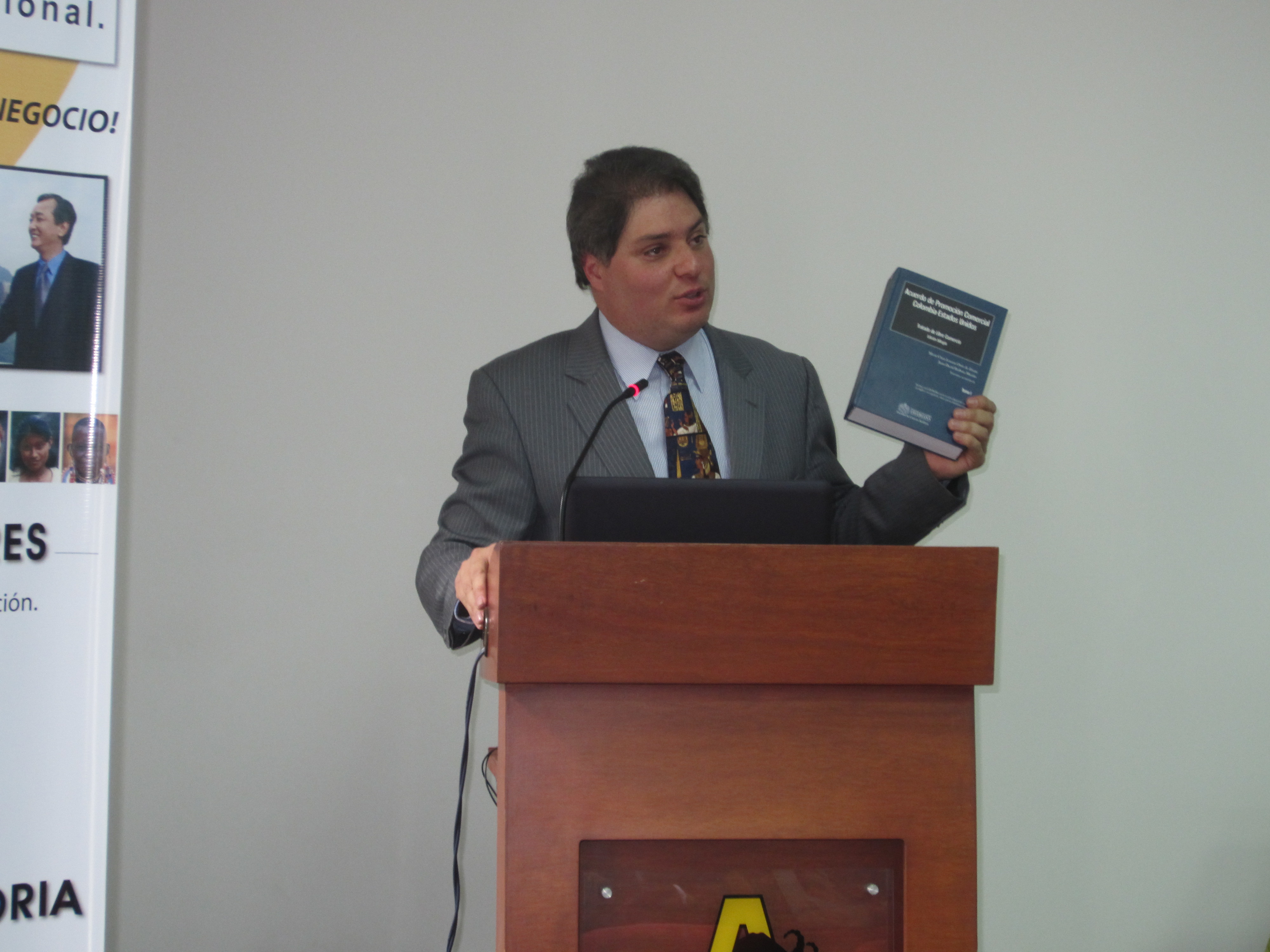
First, a very talented international lawyer, Andrés Forero, based in Bogotá, walked us through the various aspects of the new FTA, including a summary of the opportunities it presents for Colombian businesses. This was a most interesting session; Andrés knows the FTA inside and out, and he knows Colombian business. He took the complex and made it practical and understandable. He motivated those in attendance by explaining about the huge opportunities. And he also scared us a bit, telling tales of cross-cultural failures that he’d witnessed. Of added interest was the fact that he had been involved in translating the text of the FTA into English, and showed the full two volumes to the public for the first time ever.

Negotiating with US Americans – 2 hours

The extremely talented business consultant with whom I was working, Ing. Fernando Parrado, and I decided that we needed to just “jump in” with this group and immerse them in a case study of a typical Colombian-US negotiation. So we did. We told the story, and we debriefed it using the Cultural Detective (CD) Worksheet. This took about 45 minutes.

Once we had the Worksheet completed, we urged the participants to reflect on what they had done. They saw two different world views, two different approaches, both “correct” and both with value. They saw connections between actions and values, and that values and beliefs motivate behavior. And they saw that really effective strategies use the resources provided by all parties. This took another 10 minutes.

From there we introduced the three intercultural capacities on which Cultural Detective is premised (subjective culture, cultural literacy, cultural bridge), and then reviewed instructions for using the CD Worksheet/the CD Method properly. This took another 15 minutes or so.

Focusing on the US American values section of the now completed Worksheet, we began talking about what is important to US Americans. We defined the concept of culture, cultural diversity, and cultures such as regional, ethnic, socioeconomic, gender, and generational. We made sure participants understood that when we generalize we want to talk about central tendencies of a group of people. We don’t want to stereotype, to “box” an individual into the central tendency of the group.

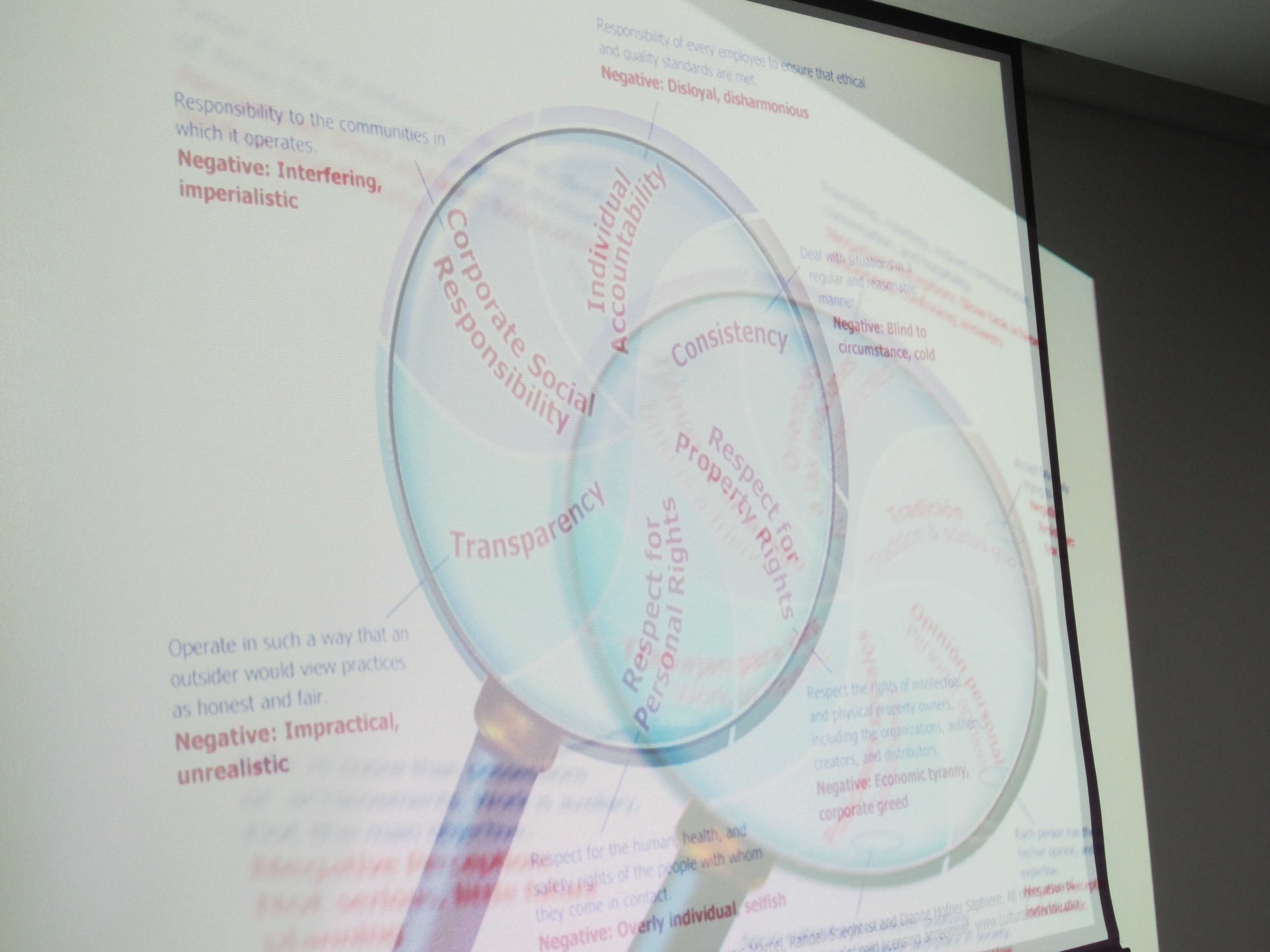
Then we introduced the concept of a Values Lens: that there are core values or central tendencies of a group of people. And that for each value there is a negative perception, that is, a way in which it can be viewed negatively by those who do not share the value or its expression. I told the participants, as I always do, about the danger of the Values Lenses. I cautioned them not to use them as yet another box into which to fit people, but rather as a tool for discovery, as clues for analysis. The values might apply to the situation, or they might not; they are a guide, a place to start.

These last two items took another ten minutes. It was quick. We covered a lot of territory in a short amount of time.

From here we introduced the US American Values Lens, sharing sample behaviors for each value, and sample negative perceptions. We asked participants if the Values Lens provided them any further clues to understanding the behavior of the US American in the case study, and indeed it did. Participants shared their stories of working with US Americans, and we were all able to learn from one another. This part took about 30 minutes.

Then we took a short break to eat some wonderful cheese-filled pastries and drink some of the famous Colombian coffee.

Understanding Colombians – 45 minutes

We came back from break ready to experience the debut of Cultural Detective Colombia. And what a debut it was! Fernando walked us around the Colombian Values Lens, sharing a story about each value, and explaining how to use it as a strength in working across cultures and making the most of the Free Trade Agreement. He also explained the Negative Perceptions for each value, again with illustrations, and positioning them as skills or competencies to develop when working internationally, at global standards.

Participants, who came in feeling that they had to “change” in order to be successful, now glowed with pride that they already held within them a heritage to be proud of, and onto which they could wisely add cross-cultural competence.

We again asked the participants if the Values Lens provided any further insight into the critical incident, and they found that it did. They enthusiastically declared the accuracy of the Colombian Values Lens. I felt very fortunate to be present for its debut.

This portion took about 45 minutes. While it was not requested by the client, it was an aspect we knew was very important if the participants were to achieve their objectives.

Global Business Ethics – 20 minutes

I am not an ethics professional, but the Cultural Detective Global Business Ethics enabled me to be able to define the topic of ethics in an understandable way. More importantly, I was able to explain the difference between compliant and ethical behavior, and the grey areas created by cultural differences: an action might be “non-compliant” yet seen as the ethical or right thing to do, or an action might be “compliant” but seen as unethical or wrong from a cultural perspective.

With the help of Andrés, our lawyer, we introduced the CD Global Business Ethics Values and Negative Perceptions, using real-life examples. We then asked participants if the values from this ethics lens provided further insight into the Colombia-US negotiation case study. Indeed it did! We also asked them to overlay the Colombia Lens with the Global Business Ethics (GBE) Lens, and the USA Lens with the GBE Lens, and the huge contrasts were apparent. They saw the difference that culture makes on perceptions of right and wrong. Unfortunately we were only able to spend about 30 minutes on this portion.

Personal Values Lenses – 30 minutes

Why such a short time on Global Business Ethics? Because I knew that, if these people were to succeed in global business, they also really needed a grounded understanding of who they were as individuals. Thus, we gave participants about 15 minutes to fill in their own Personal Values Lenses, using an exercise and Lens from Cultural Detective Self Discovery. They could then easily compare their Personal Lens to the Colombian Lens and the USA Lens, as well as the GBE Lens.

In closing, we passed out laminated copies of the 75 or so Lenses in the Cultural Detective series, so participants could get a feel for how they might adapt their approach to a German or an Israeli or South Korean marketplace.

All in all, it was a very fast romp across a very broad territory. But, oh, the insights the participants gained! They left the room in the evening standing tall and looking enthused, which I tend to take as a very good sign.

Fernando and Andrés, thank you so much for this opportunity to work with you both in this way. It is not often I have the pleasure of working with people for the first time and we are able to find such synergy of talents; it was truly a privilege and a joy!

Everyone: what do you think of this design? What are your strategies for doing the impossible in a very short amount of time? I’m eager to hear!