Building Leadership Resilience with Cultural Detective

ILA_logoBlackblue
Cultural Detective® will be featured in a workshop at the 15th Annual International Leadership Association Conference in Montreal, Canada, Oct 30 – Nov 2, 2013.  Dr. Karen Lokkesmoe, Leadership Across Meridians, and Tatyana Fertelmeyster, Connecting Differences Consulting, co-author of the Cultural Detective® Russia, will lead a workshop demonstrating how CD can be used to build global leadership competencies.

Session Description:
Building Leadership Resilience with Cultural Detective
Saturday, Nov 2  10:15 -11:15   Room: Gatineau
At the Fairmont Queen Elizabeth in Montreal

There are many facets of global leadership, and any number of skills that are required of today’s leaders, but one of the core skill sets is intercultural competency (Moodian, 2010; Lokkesmoe, 2009; Mendenhall, 2008). It has become clear that good intentions, awareness-raising, and exposure to other cultures are not sufficient, in and of themselves, to build global leadership and intercultural capacity (Mendenhall et al., 2008; Vande Berg & Paige, 2009). The focus must be on intentional capacity building. Cultural Detective® is an innovative and engaging methodology that allows for building concrete skills and developing sustainable ability to understand, engage, and lead others in intercultural situations more effectively.

This interactive workshop demonstrates how to use the Cultural Detective framework to build and develop intercultural leadership skills. Participants can expect to learn how to use specific elements of the Cultural Detective (culture-specific Value Lens, Worksheet, and Cultural Detective Online) as practical tools in situational analysis and decision making. Using Cultural Detective as part of your global leadership development strategy will help you increase performance, productivity and profits through loyalty, teamwork, and return on investment. It is a tool you and your employees can use immediately to achieve the bottom-line results that intercultural competence can bring to your organization.

Come put on your detective hat and learn how you can use this fun and engaging tool to enhance your (and your organization’s) global leadership competence! While our world may be shifting rapidly, developing skills to identify cultural similarities and differences, accurately interpreting real life situations from multiple perspectives, and designing creative, interculturally sound solutions help foster the resilience we need to be effective leaders today. We hope to have you join us.


Firearms Policy—Role of Interculturalists?

Rate of Firearm Possession per 100
Guest blog post by Jeffrey Cookson, Global Diversity Inclusion Specialist, Organizational Effectiveness Consultant

U.S. firearms policy… a very heated national debate, and a frequent topic of discussion worldwide. You might already have a sense of the role you play personally, among friends and family, or politically. To move towards a society less polarized by the ownership/control debate, we ask you this — what role in this effort might you play as an interculturalist?

With similar and different values held by firearms and control enthusiasts, how can we bridge the gap? We’ve been exploring just that and invite you to join us at the upcoming SIETAR-USA (Society for Intercultural Education, Training and Research) conference in Arlington, VA, November 6-9, 2013.

Cultural Detective will be used in several concurrent sessions during the conference, including in Dianne Hofner Saphiere’s and my session: Gun Violence, Gun Rights and Gun Control: Do Interculturalists Have a Role in Firearm Policy? That session will be held Friday afternoon, November 8, from 3:45-5:00. We hope to see you there!

We believe interculturalists are uniquely positioned to build constructive dialogue around this important national concern and using the Cultural Detective Model, we would like to share our work with you.

Tips for Working Cross-culturally in Health Care Settings and Beyond

Marilyn does an excellent job with her blog, and today’s is no exception. If you work in healthcare, I believe you’ll find this helpful. —Best, Dianne

Marilyn's avatarMarilyn R. Gardner

Through my years of living, working, and communicating across cultural boundaries I’ve realized two things that sum it all up: one — this road is humbling and two – it’s a life-long learning process. Just when I think I have it all figured out, something, someone will come into my life and challenge my thinking and my well-worn tool box of ‘how to live and communicate across cultures’.

This is setting the stage for this post that is co-authored (though she doesn’t know it yet) by my cultural broker, colleague, and close friend Cathy. Cathy has taught me much about living and working across cultural boundaries. We have worked together to bring resources and workshops on culturally responsive, culturally competent care to health care providers in the Northeast for a number of years. Together we have come up with this list, compiled from a variety of sources. While we work…

View original post 433 more words

What do you REALLY intend?

Car crashA guest blog by Susan McCuistion, Principal, daiOne—Strategy building for business and for life

We see any situation we’re dealing with first from our own perspective. While this is a perfectly natural thing to do, if we don’t also think about the situation from other perspectives, we may jump to conclusions that are incorrect.

The Cultural Detective Model is a great way to help us interpret and understand different perspectives. Key to using this model is to assume positive intent on the part of all parties involved. This gives us the opportunity to step back from our immediate interpretation of a situation, based only on our own perspective, and consider other ways in which the same situation may be viewed.

While this external view—assuming positive intent on the part of others—is important, there is also an internal step we can take before any interaction. That step is to understand our own intentions in what we are communicating.

Let’s face it . . . we’re all human and sometimes we say or do stupid things. No one is immune. We often say we don’t “intend” to hurt someone or do something thoughtless, but whether we intend it or not, the impact of what we say or do is felt by other people.

If other people are continually upset by our words or actions, at some point, we need to stop hiding behind “I didn’t intend to do that.” When we keep bumping up against reactions and challenges that we did not intend to cause, then we need to understand that the impact of what we are doing is not effective.

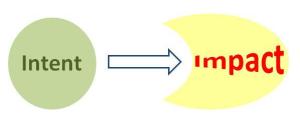
intent impact

When we continue to do something “unintentionally,” after awhile, doesn’t that become “intentional”? If we aren’t changing how we’re acting or what we’re doing or saying, that means we’re intentionally choosing to remain ignorant of ourselves, our motivations, and the effect of our words and actions on others. If you are not self-aware, and you keep running into the same problems, then you’re just being deliberately unaware.

Getting really clear on what we want to say or do requires self-awareness. We need to be able to understand what we are feeling and take a moment to think before we act. We must take some ownership in the communication process, especially when the reaction we get is not what we expect. And finally, we must take time to develop an understanding of other perspectives, so we can recognize at least some of the ways in which our message might be received. Cultural Detective Self Discovery as well as all the series’ other packages can greatly help in this regard.

“That’s not what I intended” may be an excuse the first time, but not the tenth. Once you are aware of the impact of your words or actions, adjusting them is up to you.

How are You Celebrating Hispanic Heritage Month ?

national-hispanic-heritage-month(or do you even know it is happening now?)

September 15th to October 15th is National Hispanic Heritage Month in the USA.

I’ve always been interested in the application of intercultural communication concepts to domestic diversity issues. Perhaps this has to do with where I was living when I first learned about intercultural theory—a racially mixed neighborhood where people of good intentions occasionally had minor misunderstandings.

Working with the Cultural Detective: Latino/Hispanic package renewed my interest in the link between USA diversity and intercultural, specifically about Hispanic issues and how they impact USA society today. Latinos are a vital and dynamic part of the country, yet many in the USA do not know much about the underlying values that may influence Hispanic world views and behavior.

The Pew Research Center recently published an article in their FactTank, “5 facts about Hispanics for Hispanic Heritage Month.” It inspired me to prepare the following short quiz, to see how much you know about Latinos and Hispanics in the USA. Check your answers in the original article.

QUIZ

1. More than half of the USA’s Hispanics live in three states. Which three?
    • New York
    • Florida
    • New Mexico
    • Arizona
    • California
    • Alabama
    • Texas

Latinos are moving to all parts of the USA, and are no longer only living in the areas where they have more traditionally settled. A comprehensive report by the Pew Research Center, based on analysis of U.S. Census Bureau data, shows Hispanics residing in every state: Mapping the Latino Population, By State, County and City.

2. How much did the Latino population grow between 2000 and 2011?
    • 22%
    • 36.4%
    • 57%
    • 47.5%
    • 63.5%

Not only did the number of Hispanics grow tremendously between 2000 and 2011, Pew found that Hispanics account for more than half of the nation’s growth in the past decade. The human resource potential is enormous, and understanding the underlying values of this group will allow organizations and communities to be more inclusive and utilize these resources more effectively. Cultural Detective: Latino/ Hispanic explores the important core values that may guide behavior and influence decision-making among Hispanics.

3. The terms “Hispanic” and “Latino” embrace a wide variety of backgrounds. What percentage of Hispanics/Latinos trace their heritage to Mexico?
    • One-half
    • Two-thirds
    • Three-quarters
    • Seven-eights

In the USA, people who trace their heritage to over 20 nations consider themselves to be (or are considered by others as) of Hispanic origin. Statistical information on the largest groups are examined in the Pew report, Diverse Origins: The Nation’s 14 Largest Hispanic-Origin Groups.

4. Over the last decade, college enrollment has increased among Latino high school graduates. Can you match the correct percentage of USA high school graduates who enrolled in college in 2012 with their ethnicity?
    • Hispanics                                                  • 45%
    • African-Americans                                    • 49%
    • White Americans                                       • 47%

What are the current educational trends? Latinos now make up one-quarter of all public school students in the USA, the rate of Hispanics dropping out of high school continues to fall, and more young Latinos than ever are preparing to go to college. In fact, among recent high school grads, Hispanic college enrollment rate surpasses that of whites.

5. According to the USA Census bureau, how many of the nearly 52 million Hispanics (age 5 and older) speak Spanish at home?
    • 47 million
    • 35 million
    • 25 million

Spanish is the most frequently spoken language other than English in USA homes, and it is also spoken among non-Hispanics. Among Latinos, most agree it is important for future generations to learn Spanish as well as English, even though a growing share of Latinos get their news in English.

As part of Hispanic Heritage Month, let’s take a fresh look at our organizations and communities. Are structures and policies in place to facilitate the contributions of Hispanics? Do we respect a different point of view, and can we incorporate it to better our communities for all members? How can we get from “here” to “there”?

If you are looking for a resource that can be easily woven into existing training to learn about Latino/Hispanic culture, Cultural Detective: Latino/Hispanic is your answer! By exploring the core cultural values and using the Cultural Detective Method to analyze real-life situations, you can offer practical skills to build bridges within your workplace and community.

[Day 1 of 5] SIETAR Europa Congress Tallinn: Daily Wrap Up

For those of you who are passionate about intercultural but, like me, were not able to get to Tallinn, Estonia for the SIETAR (Society for Intercultural Education, Training and Research) Europa Congress, here is Vanessa’s first day wrap up. Enjoy!


Vanessa's avatarthe book of ness

Wednesday was “Pre-Congress How-To Workshop Day”.  We are wrapping up, and what were the biggest take-aways?

Image

Sabrina and I were first to present this morning.

We framed Social Media Marketing through an intercultural lens.  Have you ever been a tourist?  Have you ever been a traveler?  What’s the difference?  Tourists might just casually visit a country, without a strong connection or engagement with the local community, perhaps get easily distracted to shiny objects and come home with a suitcase packed full of purchases they didn’t anticipate.

What about a traveler?  Perhaps they spend more time planning and preparing for the visit to the new land.  Relationship building, engaging with local community, and being a conscious participant is the approach of a traveler.  Apply this to Social Media and get your passport ready for your journey.

Image

We have more inspiring stories about building a social media campaign using competencies…

View original post 428 more words

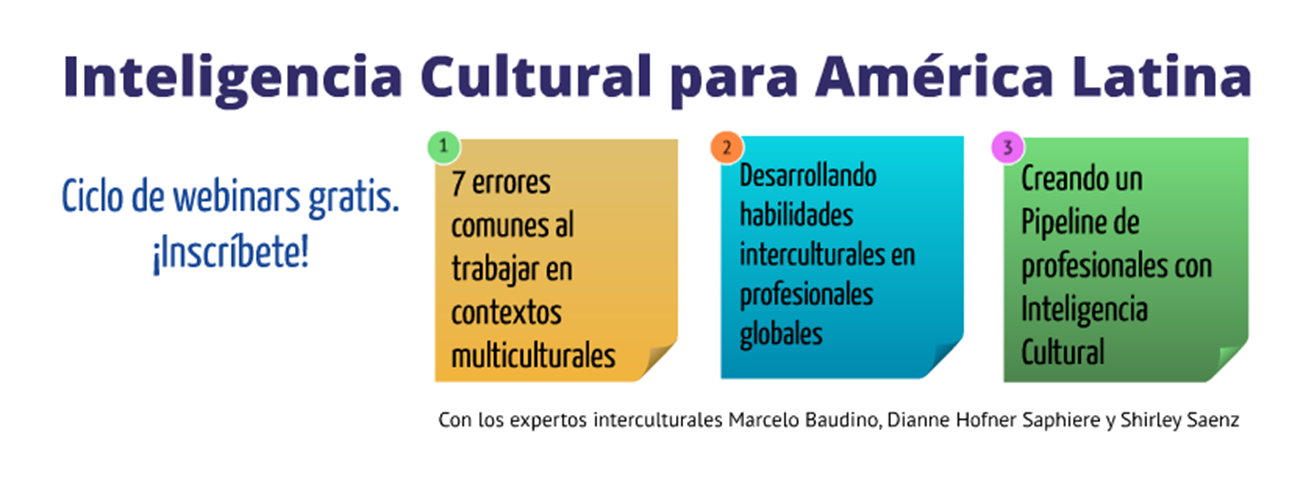
Inteligencia Cultural para América Latina—Ciclo de webinars interculturales

BlogLa globalización y la tecnología han incrementado el comercio, los negocios internacionales y el número de empresas que se expanden alrededor del mundo, dinámica que ha provocado que sean cada vez más los profesionales y ejecutivos que interactúan con otros países y los equipos de trabajo que se forman con personas de diferentes culturas.

Este creciente contexto multicultural, relativamente nuevo para América Latina gracias al papel protagónico que ha venido jugando en los últimos años a nivel internacional, plantea grandes desafíos tanto para las empresas como para cada uno de los individuos que conforman su fuerza laboral. Cada vez son más las multinacionales y empresas latinoamericanas que deciden trasladar sus operaciones globales o regionales a distintos países latinoamericanos y que requieren que sus equipos colaboren y trabajen efectivamente a nivel global, y sobretodo que sean capaces de aprovechar las oportunidades que ofrece este contexto global y multicultural.

Con el objetivo de comenzar a desarrollar las competencias interculturales necesarias en los profesionales globales de América Latina, desde ICEBERG Inteligencia Cultural hemos creado un ciclo abierto y gratuito de webinars interculturales. Este ciclo ha sido diseñado para:
  1. Profesionales y ejecutivos trabajando con personas de otros países, ya sea de manera presencial o virtual
  2. Profesionales del área de RRHH, Capacitación y Desarrollo, Gestión del talento.
  3. Empresarios globales, expatriados e interesados en cuestiones interculturales

web1Webinar 1

La diversidad cultural no es un eslogan, sino un hecho empresarial y laboral diario. Tus colegas, clientes y proveedores probablemente son de culturas diferentes, por lo que necesitas comprender sus valores y comportamientos para gestionarlos y satisfacer sus necesidades. La habilidad para trabajar, comunicar y negociar interculturalmente, constituye una competencia fundamental. En este webinar exploraremos los 7 errores culturales más comunes que les impiden a los profesionales con algún grado de exposición internacional, ser efectivos a nivel intercultural. Mientras más consciente seas de ellos, más fácil te será evitarlos, y entonces, estarás dando el primer paso fundamental hacia el desarrollo de inteligencia cultural.

Fecha: Jueves 10 de octubre de 2013
Argentina: 12 pm • Colombia: 10 am • México: 10 am

Facilitador: Marcelo Baudino
Marcelo es el fundador y director de ICEBERG Inteligencia Cultural, la primera firma argentina especializada en el desarrollo de habilidades interculturales, un servicio de consultoría intercultural innovador para la región. Marcelo es un experto en el diseño y la facilitación de talleres y programas de entrenamiento intercultural para multinacionales y está especializado en América Latina, Estados Unidos y los países del BRICS. Ha impartido cursos para empresas como Deloitte, Cargill, ExxonMobil, Banco Itaú, SC Johnson, Chevron, Tarjeta Naranja, entre otras. Ver perfil de LinkedIn.

Regístrate aquí

web2Webinar 2

Este contexto global e interconectado en el que trabajamos actualmente, nos trae un sinnúmero de oportunidades que claramente queremos aprovechar:
  • La tecnología nos permite desarrollar proyectos y crear equipos con expertos de todo el mundo. Sin embargo, lo que lleva a un equipo multicultural y geográficamente disperso a ser efectivo, son las habilidades interculturales, algo nuevo para muchos de nosotros.
  • Clientes internacionales expresan su interés en nuestros productos y servicios. Sin embargo, ¿Cómo construir relaciones de confianza y entrar en nuevos mercados de manera rentable y sostenible?
  • Queremos ser lo más competitivos posible a nivel global, pero ¿qué significa esto?

Los participantes en este seminario adquirirán herramientas para mejorar sus habilidades a la hora de trabajar en equipos multiculturales, liderar proyectos regionales e internacionales y gestionar una fuerza laboral culturalmente diversa. También recibirán acceso a recursos interculturales y un plan para el desarrollo de competencias interculturales.

Fecha: Jueves 24 de octubre de 2013
Argentina: 2 pm • Colombia: 12 pm • México: 12 pm

Facilitador: Dianne Hofner Saphiere, M.S.

Bio: Dianne ha trabajado activamente en el ámbito de la formación y consultoría intercultural desde 1979, en colaboración con personas de más de 130 países y tres continentes. Su lista de clientes incluye ABB, Hyundai-Kia, Microsoft, Mitsui, Royal Dutch Shell, Schneider Electric, Telecom New Zealand, y Texas Instruments, organizaciones de intercambio internacional como AFS y CIEE, y universidades de todo el mundo. Dianne es la creadora del Cultural Detective®, un sistema dinámico de herramientas para alcanzar la efectividad intercultural y co-autora del libro Communication Highwire: Leveraging the Power of Diverse Communication Styles, publicado por Intercultural Press. Ver perfil de LinkedIn.

Regístrate aquí

web3Webinar 3

La creciente exposición a culturas de todas partes del mundo deja en evidencia la necesidad de prepararse no sólo como individuo, sino también como organización. Ya sea a través de una estructura de organización regional, de un programa de asignaciones internacionales, de un centro global de servicios compartidos o de un joint venture con una empresa extranjera, hoy en día las empresas necesitan desarrollar los procesos y estructuras internas que faciliten la incorporación y el desarrollo de profesionales con aptitud global. En este webinar los participantes conocerán herramientas y técnicas para fomentar el desarrollo de Inteligencia Cultural.  Examinaremos como a través de los procesos de reclutamiento, programas de formación, asignaciones internacionales y el diseño de valores organizacionales, se puede transformar la diversidad cultural de la compañía en una ventaja competitiva.

Fecha: Jueves 7 de noviembre de 2013
Argentina: 2 pm • Colombia: 12 pm • México: 12 pm

Facilitador: Shirley Saenz

Bio: Shirley Saenz es formadora y consultora intercultural en ICEBERG Inteligencia Cultural, firma líder de consultoría intercultural en América Latina y miembro de la junta directiva de SIETAR Argentina (Society for Intercultural Education, Training and Research). Ha investigado sobre las diferencias culturales entre los países de América Latina, la comunicación intercultural y la efectividad de equipos multiculturales. Durante los últimos años, Shirley ha estado viviendo y trabajando en países como Colombia, Francia, China, Brasil, Argentina y los Estados Unidos, lo cual le ha permitido adquirir un profundo conocimiento de estas culturas, y también fluidez en inglés, francés, portugués y español. Shirley se ha certificado en el Summer Institute of Intercultural Communication en Portland, Oregon, en “Métodos para la formación intercultural”, “Liderazgo personal: Trabajo en equipos interculturales efectivos” y “Cultura, comunicación y colaboración en equipos virtuales”. Ver perfil de LinkedIn.

Regístrate aquí

Names Across Cultures (First in a Series of Video Interviews with Authors!)

Name ChangesThere are many reasons people change their names: some people have a stage name, pen name, nickname, religious name, or an earned title or name. All too frequently, however, a name is involuntarily changed when someone immigrates, or when a teacher or teammates have trouble pronouncing the person’s birth name.

Many of us work with individuals who have been “renamed” by other colleagues, or who have changed their names to make them more palatable and pronounceable in a new location. Other times people adopt a different name due to a change in circumstance, profession, or age. For example, as a kid growing up in a small town, my father was called “Charlie:’ however, as a middle-aged adult living in a different town, he became known as “Chuck.”

Many people’s names have special meaning or significance. An interesting way to learn about a new acquaintance can be to ask the meaning and origin of the person’s name. And, if we wish to build trust with our friends and colleagues, in addition to understanding the meaning of their names, we can learn to pronounce their names correctly. You may recall that in January 2012 we shared a link for a handy-dandy little software that allows YOU to record the pronunciation of your name, and add it to your email signature, website, LinkedIn account, etc. What a great way for those unfamiliar with your name to hear it prior to meeting you!

Perhaps you, like me, are known by several different names bestowed on us by friends and colleagues. Dianne is the name given to me by my parents at birth, while my name in Japan is Dai-an (大安 or “great peace”, also a very auspicious day of the month). My Spanish-speaking friends and colleagues call me Diana María, and close friends and family call me Di. In my case, I’d rather be known as “Diana” or “Dai-an” than have my birth name “Dianne” mispronounced.

In many cultures, such as Mexico where I live, it is a sign of cariño or affection to bestow a nickname on others (click here for a list of some unusual terms of endearment in various languages). However, many people worldwide love their birth names, believe they are imbued with power, and would honestly prefer we not change their names for them.

Yet some people do want to change their name for various reasons, and have done so. Here’s a special little drag-and-drop game for you, to see if you can match some famous people’s birth names with the names they are more commonly known by now.

I recently spoke with Dr. Emmanuel Ngomsi, a diversity consultant originally from Cameroon, about the topic of naming. Emmanuel has a wealth of experience, is very passionate, and a consummate storyteller, as you’ll see in the interview below.

Do you have a story related to naming that you’d be kind enough to share with us? Have you changed your name, or has it been changed for you? How do you feel about that? Do you have any advice for others about names and naming?

See Part 2 of this interview.

Cultural Awareness Eases Expatriate Assignments

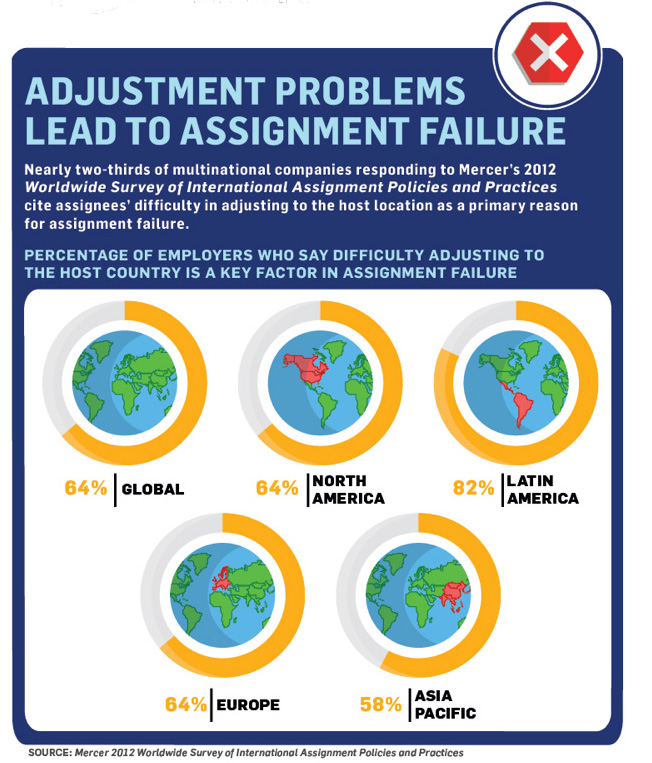
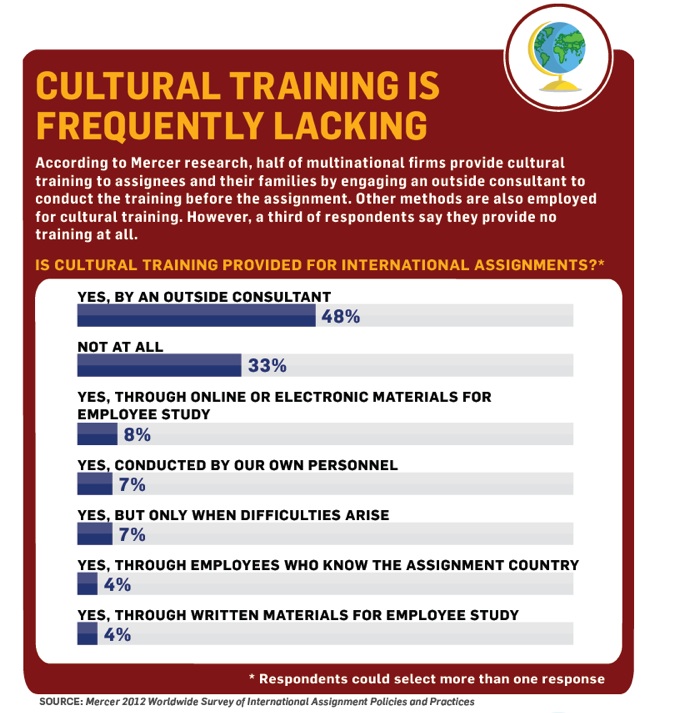
Mercer has released some useful new infographics, based on the findings in their 2012 Worldwide Survey of International Assignment Policies and Practices.

You all know that using Cultural Detective combined with reflexivity and good facilitation, you can do WAY better than “awareness”—developing the ability to collaborate across cultures.

©Mercer

©Mercer

@Mercer

@Mercer

Let’s save the lost money, the aggravation and stress on our people, and the potential loss of talent, by equipping expats and their families for their assignments! Also best to equip the receiving team, and to conduct team building, ongoing mentoring and coaching. Cultural Detective Online, along with good coaching or facilitation and organizational support systems and processes that reward intercultural competence, will make the difference.

We Have to Teach in Context!

Apple-butterfly

What we learn has to “fit” with what we know.
It has to be appropriate for where we live and work.
Part of learning is to apply the new to the old, integrating the two.

A client called us, saying they had hired a young woman with an MS in Intercultural Communication to design courseware for them. The objective of the courseware is to improve participants’ job performance, in this case, to make them more effective and efficient at servicing international customers.

“We had a lot of hope for intercultural communication training. But we’ve been doing it for nearly two years now, and we are very disappointed with the results. We have seen no bottom-line impact on performance.”

In reviewing the courseware, I found that it in many ways it was very savvy, but appeared to have been taken nearly verbatim from the woman’s graduate studies. The exercises and activities were designed for master’s students in intercultural communication, and had not been adapted for customer service representatives!

We heard from another client recently that had invested three years developing a curriculum to improve the intercultural competence of their global staff. A diverse group of their international employees attended professional development classes in intercultural communication, and an elite group at head office developed a standardized curriculum to be used worldwide. One of the main objectives of this effort is to be able to better resolve conflicts and misunderstandings more effectively.

So what’s the problem? Everyone loves the new curriculum. However, they leave the program feeling no better equipped to resolve conflicts. They love the tools they’ve learned, they enjoy the trainers, but they don’t know how to use the new tools and skills in a real situation!

THE PROBLEM IN BOTH SCENARIOS
What do these two scenarios have in common? In both cases, the training designer was replicating a graduate-level education course—designed for professionals—and repurpose it, as-is, for skill building. And that just doesn’t work! I’ve seen it far too often in recent years, and it’s a distinction we really need to make. Doctors graduate to practice medicine and to help their patients learn healthy lifestyles; they do not generally teach patients how to be doctors.

Professionals need skills they can use on the job, and that includes cross-cultural skills. But those skills must be taught in context, via application and practice in simulated and, eventually, real situations.

SOLUTION ONE
In the first case, Cultural Detective was added into the client’s existing customer service training. Leveraging pre-existing company-specific case studies and audio-visual scenarios, we used the Cultural Detective Worksheet and Values Lenses to supplement the debriefing. In this way, the need for intercultural skills became more evident and was linked to job success for the customer support engineers. In addition, all practice of cross-cultural skills was integrated with the practice of vital job skills.

We retained many of the exercises and activities included in the original, separate cross-cultural curriculum. However, we wove them into the customer service training to supplement, amplify, and deepen learning using the Cultural Detective Method. Once cross-cultural skills were grounded in the business at hand—the purposes of the employees’ work (customer service)—they made all the difference in the world.

This client reported to us a 30% increase in customer satisfaction that they directly attribute to Cultural Detective.

SOLUTION TWO
The second case is still in process. I very much admire the quality of the curriculum and the incredible coordination it has taken to get so many trainers in such diverse locations “up to speed” with the material. Yet, they are starting to realize that although the training has been well-received, staff is not able to use what they have learned once they are back on the job. Yet with so much investment, they don’t want to completely redesign. And they don’t want to be dependent on outside material.

I advised them to weave into their curriculum a simulated conflict scenario, one that could be worked on and revisited throughout the training. In this way they do not need to completely redo their superb design, and the training they have already provided will still be useful. The difference? The revised curriculum is grounded in their reality and will allow staff to practice cross-cultural skills in simulated situations. That way, when they return to work, they will know when and how to apply the cross-cultural skills and tools they have learned.

SAMPLE DESIGN
Let’s look at a typical training curriculum, and then look at how easy it is to weave Cultural Detective into the existing design. Let’s say on Day One they teach what is culture (Iceberg, observable behavior linked to underlying values) and D.I.E. (learn to Describe before we Interpret and then only with culturally appropriate information, to Evaluate). On Day Two, they teach intention/perception and cross-cultural adjustment (culture shock).

Instead, they might start Day One by introducing a case study involving an everyday challenge. Having introduced the context, trainers facilitate learning as planned in the original curriculum (Iceberg and D.I.E.—Description, Interpretation, Evaluation). After doing so, however, they return to the case study, the professional context, and explore: how do values apply to this case study? What are the Evaluations that I am making, based on what Descriptions? From there, it’s a very easy introduction to the Cultural Detective Method, which this client has already licensed and, therefore, is welcome to use.

On Day Two, intention/perception can be taught as part of the debrief of the Cultural Detective Worksheet for the case study. And, the same case study can be used to ground teaching around culturally-appropriate service or cultural adaptation. From there, as they facilitate the remainder of the designed curriculum, they can provide staff the opportunity to speak with the individuals in the case study, in a simulated environment, and to use CD Values Lenses and the CD Worksheet to help them better understand their own values and worldviews. Finally, staff can use the CD Worksheet Method to facilitate a resolution to the case study—harnessing the advantages of diversity rather than navigating around or ignoring them.

If you’ve licensed the CD Method, you know how versatile it is. But what you may not realize is that Cultural Detective doesn’t need to replace other methods. Often, if you put Cultural Detective at the core of what you are already doing, you’ll find the rest supplements it quite naturally.

Always remember, adults tend to learn best in context; they want to know why something is important to know or do. If adults learn to use and apply intercultural tools in situations that replicate real life, they’ll be much more likely to employ them when the need arises.