Intercultural Work—Stuck in its own past? (#1 in a series)

GSportrait

Dr. George Simons has long been researching the stories that make us who we are. In this series of blog posts he will be leading us in an examination of critical challenges that can lead us toward a fresh vision of culture. We will explore how we come to terms with our inner and shared identities and learn about how we construct the realities that shape our now and our future world.

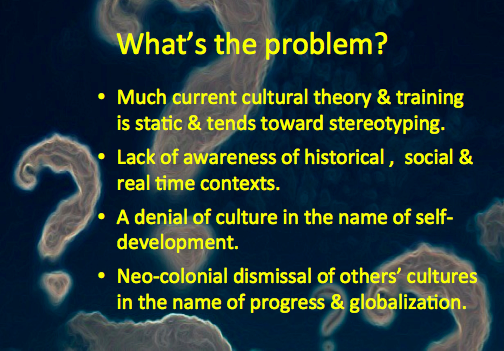
Despite a tide swell in intercultural communication and worldwide immersion in social media, the current field of intercultural communication itself seems static. This blog post articulates five ways in which the field appears to be moving too slowly for the world around it.

1. Essentialism
The word used for the kind of intercultural intervention that leads in the direction of stereotyping is called “essentialism.” One tends to assume that a certain person must inevitably share certain cultural characteristics or behaviors if they come from a particular group, ethnicity or culture. Saying that I am from the USA or that I am German or Nigerian makes a whole mess of things stick to me as stereotypes. Of course, we do have cultural characteristics, but who has them, to what degree as well as when, how and where they’ll be expressed is what we don’t know, and is what we need to learn about each other as we work together. Moreover, we belong to multiple cultural circles that may define us in variable, even contradictory ways. Interculturalists loudly condemn stereotyping but seem less adept at escaping from delivering cultural information.

There may be benefits to identifying with a group despite or in some cases because of the stereotypes, though all too easily an identity is painfully imposed on us. A little story to illustrate this. Nordstrom is a big department store in Los Angeles, in the San Fernando Valley. A young woman in my class at Loyola—let’s call her Yuko—told me how, when working there, a woman making a purchase asked, “Honey, where are you from?” (Yuko had identifiably Asian features in her face). The young woman said, “Oh I’m from right here in the Valley. The woman went on, “But where did your parents come from?” Yuko answered, “Oh, they came from the Valley, too.” The woman persisted, “But where did your grandparents come from?” Yuko answered, “Oh, they weren’t from the Valley, they were from Fresno [another California town].” In fact, Yuko’s Japanese-American family predated the many European immigrants that came at the end of the 19th and first half of the 20th century. Essentialism looks at “difference” as “not belonging.” Yuko suffered this kind of pain repeatedly just because she didn’t look like “everybody else.”

2. Ignoring context
A lack of awareness of the social and particularly historical contexts is another way the intercultural thinking and practice can remain static. A lot of people’s feelings about those different from themselves is not simply a matter of their looking or sounding different, and may be anchored in a story of things that happened in the past. Remember, for example, when Yugoslavia disintegrated into smaller states, how politics called into popular sentiment old memories of “what they did to us” 50 years ago, 500 years ago, 1000 years ago, and so on. These memories live in a culture and affect how we react to individuals in other groups. This is to say nothing of social context, particularly now. Since the financial crisis, we’ve been struggling, in a more conscious way than most of us have done in our lifetimes, with those who have and those who have not. This also provides subtext for our communication with each other.
Questions

©George Simons, blog.culturaldetective.com

3. Cultural denial
A lot of people I work with, particularly many younger people today, have or are encouraged to have an attitude that expresses itself as, “I don’t have a culture,” or “I’m a global person, a global citizen.” This suggests that prioritizing individualism, so strongly promoted in the West, makes it in a way shameful to be connected to our past, to have identifiable roots. This is true not simply of third culture kids (TCK’s), some of whom have been jetsetters while in the womb, but of others, and seems to be part of the educational process. All too many people, and not exclusively the young, have suffered by or are fearful of being labeled, of being stereotyped, as we mentioned above, or they feel a need to disassociate with what feels like the oppression of their origins, their family, religious faith or local context. Having cultural features seems a liability to them, a restriction of freedom. Inability to address this inclination is another point of stasis in intercultural work.

4. Implicit colonialism
An even bigger issue is a kind of lingering sense of better-than-thou-ness, and noblesse-oblige do-goodism that results in a kind of hidden chauvinism, a myopic view of other cultures that too easily infects intercultural efforts and holds them back. Part of this involves interculturalists’ need to come to grips with colonial history and its enduring effects in political and economic terms , not just hand wringing. We are fully aware of having a long history of European colonialism and US colonialism that doesn’t take other people’s cultural and environmental ownership seriously. So we come to enlighten them, to bring them progress, to bring globalization, of course to sell them our products. The need for cultural savvy makes it an important commodity today and this situation begs us to take a larger view. But even more important for intercultural professionals are discovery, exploration and treatment of the psychological residue of colonial thinking in themselves. Failing this, it is hard to imagine our efforts moving forward in the ways we like to think that we intend.

5. Dyadic dimensional thinking
Traditionally, in the boilerplate of the intercultural profession, we studied values in what are called “dimensions.” This was our starting point, something for which we are very grateful to the original researchers, people like Geert Hofstede and Edward Hall. In their observations and studies they raised questions and classified the answers. For example, they identified people as more or less “individualistic” or “collective,” “masculine” or “feminine,” “direct or indirect,” according to how people in different cultures reported their likely behavior given similar situations. Their work made us aware of the fact that there were areas of life in which different people had different ways. Yet, on the other hand, the resulting value labels were a product of Western academic mentality, an attempt to understand other people on our own terms rather than on theirs. This may have been the key to the antechamber of understanding, but leaves us standing in front of a second locked door.

In sum, five road blocks, often in combination with each other, that challenge intercultural thinking and practice. Will social media change our static habits? Perhaps so, because they regularly confront us with evidence from around the world, literally at our fingertips, that may challenge these notions. Yet confirmation bias, our ability to see only what we know or expect to see and make otherness fit into it, is likely to be operative in the online world as well. What think you?

This post originally appeared in the blog of the Center for Intercultural New Media Research and is provided with the assistance of its editor Anastacia Kurylo.


Some Cultural Detective Training and Coaching Activities

Exploring how we value our own and each other’s cultural values–another step in CD sleuthing.

All too often we trainers are apportioned a less than useful amount of time for impacting the attitudes of our trainees. This affects our use of Cultural Detective as well as many other tools that we may choose or not choose to use under the pressure of diminished schedules.

When using Cultural Detective, I find it ever more important to differentiate what we do with the Values Lenses and the indigenous discourse that lies behind them from a lot of other intercultural training approaches that focus on dimensions and increasingly lead to stereotyping. When we speak about the values in Cultural Detective, it is important to remember that these have been developed through and by the inner language and feelings of the very members of those cultures that the instruments represent.

Nonetheless, when speaking of values, it is becoming increasingly common for us to have individual participants who question them, who do not identify with them, or who even dismiss them as stereotypes. Given that the best way of dealing with resistance in a pedagogical context (as well as many other contexts) may be to flow with it and direct its energies, I have developed a few approaches that I feel may help us in these somewhat challenging situations. I’ve described them as they might be used in a teaching or training context, but they may be adapted to individual and team coaching situations as well.

First, wherever possible, I use Cultural Detective: Self-Discovery, or at least an exercise or two from it, so that participants can at least claim some inheritance of cultural values and identify them as their own. This legitimizes the discussion of culture where it might be resisted. It usually overcomes or at least mitigates the participant’s temptation to see him or herself as acultural and the tendency to vaunt oneself as a global citizen, uncontaminated by inherited culture. This is not to deny, but to affirm the fact that TCKs and others like them may be digesting a smorgasbord of cultural influences as well as generating certain cultural features pertinent to their common experiences (explored in Cultural Detective: Blended Culture and CD Generational Harmony). Often elements of cultural identity are denied because they have caused pain in growing up and finding social inclusion. Once culture is legitimated as a topic of discussion and a relevant problematic for the individual being coached or the group being trained, other things become possible.

Here are some approaches that we use when one culture is trying to learn about another specific culture, as for example, when working with teams resulting from mergers and foreign acquisitions and installations. In such cases cultural conflicts and misunderstandings are often the elephant in the room, potentially touchy subjects. While Cultural Detective may be the ideal tool for pursuing understanding on both sides, it is not always a given that participants will spontaneously identify with the values of their own culture as they are presented in the Cultural Detective materials.

So, let’s say, for example, that we are dealing with German and US cultures, either in an organizational relationship or collaborative team. Daimler-Chrysler has already demonstrated that even a good bit of upfront diversity work and intercultural instruction may not be adequate to deal with our own deeply rooted values and our perceptions of others unless they are continually identified and addressed. Thus the Cultural Detective process must be mastered and practiced and in many cases facilitation must be applied on an ongoing basis until a functional collaborative culture is established. This can take quite a while.

Facing the possibility of denial of difference as well as the possibility of participants rejecting their own or the others’ cultural Values Lens as stereotypical or just plain wrong, here are a few strategies that I’ve found to be successful. Perhaps some of you have already discovered these on your own. If so, I would be interested in hearing your versions.

  1. Evaluating the strength of the discourse and the value that sums it up. I ask participants to study their own culture’s Lens and then rate on a scale of 0 to 5, weak to strong, their own sense of how they’ve personally appropriated and express in everyday words and actions each of the values described. Then I ask them to share this with their compatriots as well as with the representatives of the other culture who are participating with them. This is a matter of not only sharing their numerical rating of the values, but talking about how each cultural value expresses itself in their thinking and behavior, as well as what parts of it don’t seem to fit or which they don’t like to identify with. This may or may not resemble or relate to the “Negative Perceptions” found on the Lens itself.
  2. Identifying commonalities: Following this discussion, I ask the individuals of each culture to study the other culture’s Lens and to do two things. First, again on a scale of 0 to 5 to assess whether, and if so, the degree to which they identify with each of the cultural values of the other group as found on the lens. Then, secondly, and this is extremely important, to identify and jot down the keywords of their own inner conversation or discourse about the importance they accord to the values they seem to share and the ways in which they may practice each of them.  Thirdly, depending on the size of the group, ask them to share their results either individually, or to conduct a discussion within their same culture group and then have the groups report out their results to each other. Here is where the essential value is gained from seeing how people would express their appropriation of elements belonging to the other culture.
  3. How do we like to be treated? Given adequate time, here is another very valuable activity that could occur at this point, but might be even better to use after the group has resolved a critical incident or two. Ask each separate culture as a group to meet together to discuss and identify and list both the attitudes and kinds of treatment that they appreciate coming from the other culture, as well as those kinds of speech and behavior that they may find uncomfortable or even damaging to the collaborative and social relationship they are trying to create with each other. The previous activities at various points are likely to lead toward the identification and discussion of stereotypes, giving rise to another possibly useful activity. I have found that frequently trainers and teachers, perhaps out of a misguided sense of political correctness avoid the discussion of specific stereotypes or stereotypical expressions, missing a valuable learning opportunity.
  4. Investigating stereotypes: We’ve long accepted the fact that stereotypes contain a kernel of truth, but that the perspective with which they are expressed maybe overgeneralized and conducive to negative judgment. So, instead of dismissing stereotypes out of hand, we can use them as starting points for deeper discussion and further understanding. So, when stereotypes surface, I ask participants to discuss questions like the following ones:
    • What is the truth in them, however small? What do you think brought them about in the first place? What perpetuates them? What insights or cautions do they deliver to us? What is the discourse that we carry about self that makes them true for us when they are about us?
    • What exaggeration do they contain? What is the discourse that makes them noxious, conflictual, etc.? When are they likely to be painful or damaging? What limits do they place on our knowledge and our inquiry about others?

So, as I mentioned above these are some of the useful practices that I keep in my tool bag for enhancing the effectiveness of Cultural Detective.  It would be good to hear what others of you have developed or ways in which you view similar activities.

Cómo perder su puntualidad en quince días

3191265-mujer-abrazar-un-reloj(English follows the Spanish)

Estas fiestas de fin de año me han dejado la nostalgia de los ausentes a quienes no pude abrazar con el anhelo del reencuentro. En contraste, me han dado la oportunidad de gozarme lo simple de nuestras tradiciones más sentidas. Una de ellas sin duda para mí es la cocina. Debo confesar soy de las que cocina escuchando música de diciembre, desde villancicos como tutaina o mi burrito sabanero, hasta los infaltables temas de la Billos Caraca’s Boys, Los Melódicos o Los Hispanos. Crecí con esta música y a falta de estaciones, en Colombia es Navidad desde que las emisoras comienzan a emitir estas melodías y las vitrinas de tiendas presentan sus decoraciones. El gran inicio es nuestra fiesta de las velitas el 7 de diciembre, cuando todos los alumbrados oficialmente se encienden y  las casas se visten de luz con velas de colores y faroles que se extinguen al amanecer. Es nuestra fiesta de luz.

El ritmo cambia y el tiempo se hace aún más amigo. Contrasta el agite de las calles y sus trancones — embotellamientos — con el ritmo al que se llevan muchas tareas. Esta singular amistad con el tiempo se torna evidente para quienes nos visitan.

Tuvimos con mi familia la gran oportunidad de acoger a quienes estaban solos de paso por nuestra ciudad. Para Navidad, nuestra invitada de California se ganó la membresía en el club de los “gringos chéveres”. La citamos a las 10:00pm, llegó a las 10:15pm pues el taxista la buscó un poco más tarde en el hotel. Brindamos, cenamos y mis padres sin hablar más que yes or hello, le transmitieron nuestras tradiciones — bueno sí, mis hermanos y yo asistimos en la traducción — pero las sonrisas y la música son parte de un idioma universal.  La despedimos de madrugada el 25, luego de tres días en Bogotá se preparaba a disfrutar San Andrés y Cartagena. Su periplo apenas comenzaba.

Para fin de año, nuestros invitados esta vez fueron de Alemania y Francia. Los dos invitados de Alemania ya llevan varias semanas en el país. Su periplo ya los había llevado por Cartagena, la zona cafetera, Boyacá y alrededores del Cañón del Chicamocha. En resumen, se han recorrido casi la mitad del país. La cita a cenar era la misma 10:00pm, y mi razonamiento fue, como son alemanes les decimos a las 10:00pm para que cenemos juntos.

Pasaron las 10:15pm, las 10:30pm y nada. Estos invitados se hicieron amigos del tiempo. Llegaron unos 50min tarde luego de varias llamadas al celular disponible. Uno llega a preocuparse si fue que se perdieron o pararon en la cena equivocada. Cuando llegaron ya habíamos iniciado, simplemente pensamos algo se presentó y no iban a venir, !son alemanes! Llegaron, cenaron, brindamos… y hasta bailamos. Uno de ellos ha dicho que es la mejor Nochevieja de su vida.  Los tres hablan español muy bien, así que pudieron compartir sus experiencias con todos en casa, y fue así como pidieron mil excusas pues en uno de sus recorridos un simpático colombiano los citó “en diez minutos” que se volvieron tal vez cuatro horas.

Su lógica fue, nos dicen a las 10:00pm así que podemos llegar tarde. Al final les dije de este blog y que les contaría a todos como se puede perder la puntualidad en quince días de paso por Colombia. Ahora uno de ellos está de regreso en Alemania, y un alemán y un francés amigos del tiempo están en las playas de San Andrés.

Mis padres han sido los más alegres con estas visitas. Poco saben de sociedades policrónicas o monocrónicas, de alto o bajo contexto, ni tienen idea que el trabajo de Cultural Detective le muestra al mundo que el tiempo es un amigo en este país. Sin embargo ellos saben lo que nos hace auténticos y algo que siempre han enseñado en casa es el valor de querer lo nuestro, nuestras tradiciones y lo que somos — por supuesto, abiertos a aprender de los demás. Mis padres fueron sin duda los grandes anfitriones, hasta mi madre sacó a bailar a uno de los chicos y dió clases de música tropical. Sin duda para todos unas fiestas inolvidables. Como diría mi padre “my home is your home, welcome”.

Si quiere hacerse amigo del tiempo… visite Colombia.

Felicidades y un muy fructífero 2013.spanishfriday

How to Lose Your Punctuality in 15 Days, Written by Maryori Vivas
Translated by Dianne Hofner Saphiere

These end-of-the-year holidays have filled me with nostalgia for those I am unable to hug despite the desire for a reunion. In contrast, they have given me the opportunity to enjoy the simplicity of some of our deepest traditions. One of these for me is without doubt that of the kitchen. I must confess that I am one of those who cooks while listening to holiday music, everything from carols such as Tutaina or Mi Burrito Sabanero, to infallible tunes such as those of the Billos Caracas Boys, Los Melódicos, or Los Hispanos. I grew up with this music; in Colombia Christmas begins when the radio stations start playing such melodies and the shop windows display their holiday decorations. The great beginning of the festivities is the Festival of Lights on December 7th, when holiday lights are officially turned on and the houses are filled with the light of colorful candles and lanterns that aren’t turned off until dawn. This is our Festival of Lights.

The rhythm changes at this time of year, and time becomes even more of a friend than usual. Contrast the excitement of the streets and their traffic jams — traffic stops really — with the rhythm with which we complete the many tasks of the season. This unique friendship with time gradually becomes evident to our guests.

Our family had the wonderful opportunity this year of welcoming into our home those who were traveling alone in our city. For Christmas, our guest from California won membership in the “cool gringos” club. We invited her for 10 pm. She arrived at 10:15, because the taxi had picked her up late at her hotel. We toasted, dined, and my parents, who can’t speak more than “yes” or “hello” in English, communicated our traditions to her — ok, my sister, my brother and I assisted with the translation — but smiles and music are universal languages. We bade her goodbye at dawn on the 25th. After three days in Bogotá she was preparing to enjoy San Andrés and Cartagena. Her journey was just beginning.

On New Year’s Eve, this time our guests were from Germany and France. Our two guests from Germany had already been in our country for several weeks. Their journey had already taken them to Cartagena, the coffee region, Boyacá and the area around the Canyon of Chicamocha. They had travelled over half the country. I told them the same 10 pm for dinner, and my reasoning was that as they are Germans they’d arrive right around 10 pm so we could dine together.

10:15 pm passed, 10:30 pm, and nothing. Our guests had become friends with time. They arrived about 50 minutes later, after various cell phone calls. One starts to worry whether guests have gotten lost or have ended up at the wrong dinner. When they arrived we had already begun, simply imagining that something had come up and they weren’t going to be able to come. After all, they’re German. But they arrived, we ate, we toasted, and we even danced. One of them told us it was the best New Year’s Eve of his life.

All three speak Spanish very well, so they were able to share their experiences with everyone in the house. It was in this way that they asked a thousand pardons for their late arrival, explaining that in one of their travels a kind Colombian had told them “in ten minutes,” which had turned into perhaps four hours. Their logic had been that we’d told them 10 pm, so they could arrive late. In the end I told them about this blog, and that I would tell everyone the story about how to lose punctuality in 15 days of travel in Colombia. Now one of them is back in Germany, and the other German and the French friends of time are enjoying the beaches of San Andrés.

My parents have been the happiest with these visits. They know little about polychronic or monochronic societies, of high or low context, and they have no idea that the work of the Cultural Detective demonstrates to the world that time is a friend in our country. However, they know what makes us authentic and what has always been taught at home: the value of loving what’s ours, our traditions and who we are — of course with an openness to learning about others. My parents were without doubt wonderful hosts; my mother even got one of the young men to dance with her and gave a class on tropical music. These were definitely holidays to remember. As my father would say, “my home is your home; welcome!”

If you would like to be friends with time, visit Colombia.

Happy New Year! I wish you a very successful 2013.

A Gift for You from Thorunn and Avrora

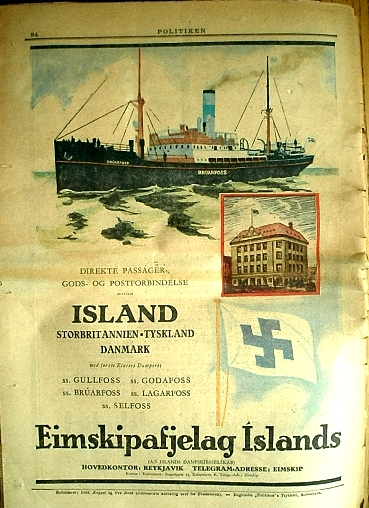
eimskip_1930.jpg

Photo credit to Vilhjálmur Örn Vilhjálmsson, https://fornleifur.blog.is
Used with permission.

The power of social media and online networking just keeps amazing me. Since starting this blog we’ve had soooo many great examples of how you all build on one another’s work and generously share with each other! It is our privilege to hold space here that helps do that.

You will remember our recent post entitled, More Cultural Appropriation: The Swastika? Well, a good friend and respected colleague of mine read it and said, “You know, Dianne, the swastika held a prominent place on a huge building, home to a major Icelandic shipping company, for decades. It’s gone now, though.” As we talked about it, she told me she’d used that story, with quite a few pictures, in a powerpoint slide presentation that she developed with a colleague.

With Thorunn and her co-presenter Avrora’s generosity of spirit, we are privileged to share with you a gift to all Cultural Detectives from them. Their slides summarize the swastika’s history, and include photos of its use in Bulgaria, Greece, Iceland, Native America, and Tibet, as well as the Nazi version. Thorunn and Avrora help you pull learning from these photos with slides explaining culture, judgments, and symbols.

Download their powerpoint slides here. And please let us know how you put them to use!

As an aside, I’d share with you that I recently met an incredibly interesting woman who is Indian and Austrian. Her stories about personal and family conflicts and learning around the swastika were really something to hear! Hopefully I might convince her to share some of them with you in a future guest post.

Infographics on World Cultures and Immigration Trends

Our world is swimming in information, so much so that we often drown in it and find it difficult to make sense of. That’s why infographics play such a valuable role. Recently I’ve come across two different sets that I thought Cultural Detectives might be interested in seeing and using (or making your own for your own purposes).

Borrowing heavily from a concept by Danish designer Peter Orntoft, the Millward Brown Agency designed the two infographics below that put data in context. Interesting, no? More memorable than otherwise?

Photo by Millward Brown

Photo by Millward Brown

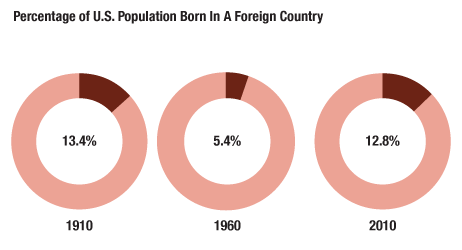
Secondly, Lam Thuy Vo of USA’s National Public Radio (NPR) created two graphics which clearly make the point that immigrants comprise about the same percentage of the US population as they did 100 years ago, though their geographic origins have changed.

Graphic by Lam Thuy Vo of USA’s National Public Radio (NPR)

Graphic by Lam Thuy Vo of USA’s National Public Radio (NPR)

Do you use infographics in your work? Please share! Have you created any? Strikes me that interculturalists could sure use this terrific approach to creating and communicating meaning.

Cultural Appropriation — A Cultural “EF”ective Story

I want to share with you a very exciting “Cultural Effective” that has just come to my attention. It is a wonderful story that shows the power of saying our truth, listening with heart, and taking action on what feels right.

It seems a southern California-based fashion house, Paul Frank, hosted a huge party/event with a Native American theme. They seem to sell (or to have sold) quite a few products that include adaptations of native designs (the designer, Paul Frank, is also a cartoonist).

The people at Native Appropriations, among others, complained about cultural appropriation of native designs, and the Paul Frank company reached out to them to ask, learn and take action! They have not only issued an apology but yanked photos of the event and removed all native designs from their product line!

I don’t know the people over at “Native Appropriations,” but the work they are doing indeed looks wonderful! And kudos to Paul Frank for their openness and even eagerness to learn and develop!

There are so many ways we can inadvertently offend one another. Refusing to take offense but rather to tell one’s truth without blame or judgment, and then to be greeted by someone fully listening and wanting to hear and learn from that truth… What a great example they have set for us!

Appropriation is a slippery slope. I can think of several times in my life when a colleague or friend kindly and generously gifted me with traditional dress from their home. I wanted to wear it, to demonstrate my thanks and to show respect. And, in others’ eyes, wearing such dress, when I am not from that place, can insult. So many times appropriation begins as a compliment, as admiration. And so much is in the eye of the beholder.

While I have no direct knowledge or involvement in this story, it appears to be a good example of going beyond “political correctness” to really listening to and collaborating with one another.

“The Innocence of the Muslim” Provokes Mismatch in Cultural Understanding

Media has indeed become the strongest destructive weapon one can dare to imagine. An idiot with next to no ethics or professional knowledge can produce a stupid, laughable, amateuristic film about Islam, put it on the internet, and there you go: one ambassador murdered, hundreds wounded, thousands of others threatened with death, and escalating protests across the whole Middle East.

A silly movie with a quality that deserves to die slowly and peacefully in a mossy corner of the internet suddenly caused waves of unrest around the world.

If anyone has 14 minutes to waste and not regret, watching the trailer of “The Innocence of the Muslim” will help to confirm this and this message only: the movie was made to ignite violence, exactly what we are witnessing at the moment. Producer Sam Bacile has reached his goal, gloriously, to lure easily-agitated Muslims to fall into the trap. Now the whole world is sitting in front of the TV, thinking to themselves: “Oh dear! It is right! Islam is indeed violent.”The core of the conflict is none other than a classic mismatch in cultural understanding. For the West, it is firmly decided that freedom of speech can not be sacrificed, no matter how offensive the content may be. For many others who are religious, freedom of speech does not necessarily mean the freedom to offend others. Also herein lies the dangerous border: to what extent can something be seen as offensive?It is naiveté for protesters to demand that Western governments ban religiously offensive media. Hello? It is 2012, just in case one happens to have short-term memory. We have entered an era where a five year old children can play with their parents’ notebook and share with the whole world everything that their parents would kill to keep secret. With today’s technology, absolute control is simply impossible.Last but not least, let’s delve into that concept called “control.” Demanding protesters in Middle East should understand that governments in some Western countries do not act, and can not possibly act, like parents. They issue laws based on a certain level of democratic process, exactly the sort of democratic system that many Middle Eastern people have been fighting and dying for in the Arab Spring.
Chưa bao giờ mạng xã hội lại trở thành một thứ vũ khí lợi hại hơn cả một đạo quân lớn như ngày nay. Một gã đàn ông vô danh tiểu tốt sản xuất một bộ phim không chuyên, nực cười và ngu dốt nhằm vào Hồi Giáo, tung lên mạng, và thế là tằng tằng

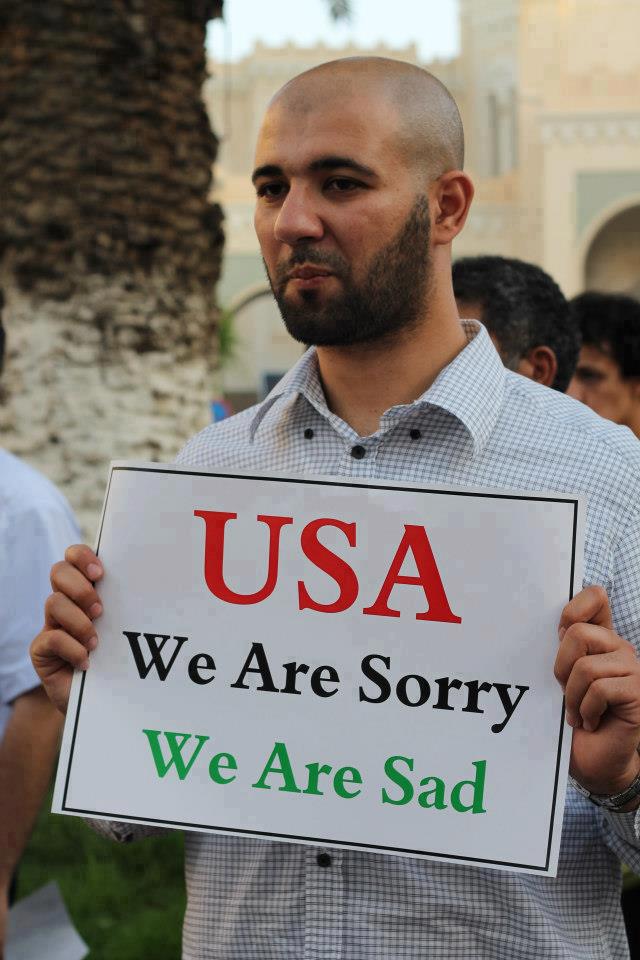
 tằng, một ông đại sứ bị bắn chết, hàng trăm người khác bị thương, hàng ngàn người bị dọa giết, và liên tu bất tận các cuộc biểu tình không ngưng nghỉ.Nếu ai đó rỗi hơi đến mức có thể vứt đi 14 phút quý báu của đời mình mà không hối tiếc, xin mời ngó thử cái đoạn quảng cáo của phim “Sự vô tội của người Hồi” (The innocence of the Muslim). Kết luận duy nhất chỉ có thể là Sam Bacile làm bộ phim này để kích động người Hồi dùng vũ lực, chính xác là kiểu vũ lực và giết chóc mà chúng ta đang được chứng kiến. Người Hồi mắc bẫy thảm thương. Các lãnh tụ Hồi giáo cực đoan thù ghét phương Tây nhân cơ hội đẩy mạnh thánh chiến. Phần còn lại của thế giới ngồi trước TV, bụm miệng kêu thầm: “Ối trời ơi! Hóa ra bọn đạo Hồi này đúng là ưa bạo lực” . Mục đích của Sam đã đạt được một cách vinh quang, chói lọi.Có 3 điểm cần nhấn mạnh ở đây. Thứ nhất, phương Tây tôn thờ tự do ngôn luận tuyệt đối. Điểm này mẫu thuẫn với văn hóa của rất nhiều đất nước cho rằng tự do ngôn luận không có nghĩa là tự do phỉ báng người khác.Thứ hai, việc những người biểu tình yêu cầu Mỹ và phương Tây phải có luật ngăn cấm các sản phẩm văn hóa xúc phạm tôn giáo là điều không thể. Bây giờ là mấy giờ rồi ạ? Năm 2012 nếu ai đó bị mắc chứng trí nhớ ngắn hạn. Một đứa trẻ con 5 tuổi có thể toáy ngoáy máy tính của bố mẹ và tung lên mạng tất tần tật những bí mật mà bố mẹ nó thà chết chứ không để lộ ra ngoài. Với công nghệ thông tin như hiện nay, cấm văn hóa mạng là một điều không tưởng.Cuối cùng, đó là việc dân biểu tình ngây thơ cho rằng Mỹ và phương Tây có thể hồn nhiên cấm cản điều này điều nọ. Luật pháp phương Tây được xây dựng trên một hệ thống chưa phải là toàn diện nhưng tương đối có tính dân chủ. Trớ trêu thay, đây chẳng phải là điều mà bao nhiêu người ở Trugn Đông đã hy sinh để đạt được trong Mùa Xuân Ả Rập đó sao?Xin gửi các bạn một hình ảnh từ Libya, nơi rất nhiều người Hồi hối hận, buồn bã về việc Đại Sứ Mỹ Steven bị giết.

Appearance Can Be a Life or Death Matter

Immediately when I heard about the attack on the Sikh temple in Wisconsin (USA), the first thought that came to my mind is that the shooter must have confused Sikhs for Muslims because they wear turbans and grow beards. There have been many similar incidents, one of them in 2002 when four teenagers burned down the Sikh temple Gobind Sadan in New York. The teens told authorities that they believed the temple was named “Go Bin Laden” (!!!)

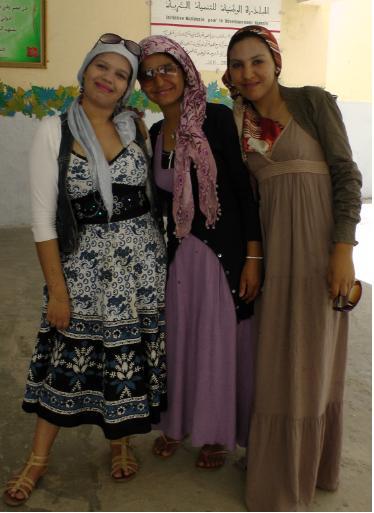
Similarly, Christian figures and nuns may be mistaken for Muslims, with their loose outfits and head coverings. A picture taken in Jerusalem may confuse many, for it can be very unclear who is Jewish, who is Muslim and who is Christian. I have asked lots of my friends and they often think that the three Morrocan Muslim girls in this picture look more like Jewish women because of their headscarf style and their dress.

Almost everwhere I go in the world, people on the streets mostly call me Chinese. I have embraced a business idea of producing millions of T-shirt that say, “Everything is made in China. NOT ME!” and sell them to desperate and angry Japanese, Korean, Singaporean and Vietnamese tourists. I’ll probably be rich and earn enough money to travel more.
When I was in Syria lately, immediately upon stepping into a neighboring house, Abdullah my friend shouted out even before the host could see my face: “She is not Chinese!” Very wise of him, because the man we were visiting belongs to the opposition, who is of course very pissed off with China and Russia for their support towards Assad’s government.
Looks do matter, regardless of how superficial they are. Of course no one should be killed, and most religions have love and respect at their core. It can be detrimental and become a matter of dealth and life in this age of speed, in which people only have time to watch, not to think, and news is more important than knowledge.

Can you read this?

No? Yes? If you can read the above, quick, tell me what it has to do with culture. If not….

Can you read the next one?

Yes? Perhaps this second one was easier for you? Why? Why is it we can read the above?

Our minds interpret a lot of things every day, constantly. They make sense of the world around us. They do this by recognizing patterns, putting information into templates that are familiar to us.

Obviously when we enter a new culture, the rules are different. The patterns are different, the templates unfamiliar. Our inability to make sense of what’s happening around us can cause us to feel disconcerted, maybe to lose confidence. Our past knowledge, from another place, can cause confusion. It can lead us to think we understand what we really don’t, to fail to see what is really there, or to miss important information.

There are so many interesting photos and images floating around social media networks. How many of them are you able to use to promote cross-cultural understanding, like the two above? Come on, share your favorites!

Reading key to the above images is below:

Este mensaje es para demostrar las
cosas tan increibles que puede
hacer nuestro cerebro. si logras
leer esto puedes sentirte
orgulloso de tu inteligencia, ya
que solo ciertas personas lo
logran. esto se debe a que el
hemisferio derecho del cerebro
asocia los simbolos parecidos a las
letras que conocemos normalmente
y asi logramos leer con facilidad.

This message
serves to prove how our minds
can do amazing things!
Impressive things!
In the beginning it was hard but now,
on this line your mind is reading
automatically without even
thinking about it. Be proud!
Only certain people can read this.

Grains of Sand and Cross-cultural Adjustment

Ever look at something and find it so beautiful or fascinating that it just sort of sticks with you? Perhaps it gives you a gut feeling that it speaks to something you’re working on? Then, maybe in the shower the next day, it hits you?

That’s what happened to me a while ago when our Intercultural Competence News Feed curated Dr. Gary Greenberg’s photos, taken through a microscope, of grains of sand.

While most of us normally think of grains of sand as looking fairly similar — tan or brown, some crystals, shiny — Gary’s photos show us that deep down, once we “get to know” the grains of sand, so to speak, each of them is quite unique! Now if that isn’t a metaphor for diversity, inclusion and cultural differences, what is?

We hope you’ll be pleased with the train of thought Dr. Greenberg’s gorgeous photos produced. We put together a PowerPoint on cross-cultural dynamics that you are most welcome to download and use. It hasn’t been polished and perfected like the grains of sand, but if you read the presenter notes, we are confident you’ll have fun customizing the ppt for your programs.

We all have favorite photos, metaphors, comics, and stories, or even video clips, that we love to use in teaching, training and coaching. If you have something you would be willing to share, please pass it on. We’ll be happy to get it out there for you and link through to your website or contact information. Together we can build a more respectful, understanding and collaborative world!