Thank you for joining us on the journey to build respect, justice and collaboration across cultures!
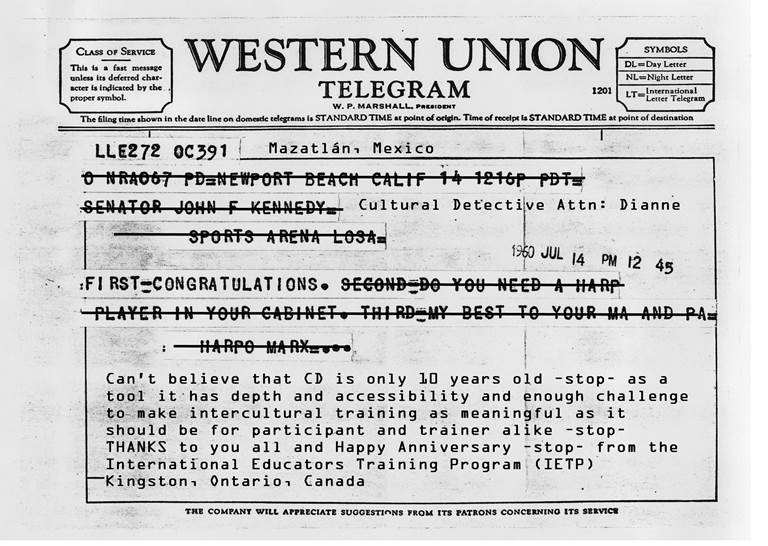
A group of our authors recently gathered in Mazatlán, Mexico to celebrate the tenth anniversary of this collaborative project, Cultural Detective. We held three days of work meetings and a facilitator certification workshop; we hosted a wonderful party that included the indigenous Yoreme Deer Dance; and we played—on the beach, in the water, at restaurants, with music, and all around town!
Our community members will have more celebrations around the world throughout 2014; contact us if you’d like to join one!
Below is a slideshow of just some of the many authors and community members who have contributed to making Cultural Detective such an amazing tool, and to using it to transform the world in which we live, bit by bit.
May the Lunar New Year of the Horse bring you health, joy, and much success in spreading cross-cultural respect, understanding, collaboration and justice in this world of ours!
2014 is the Year of the Horse. It is also Cultural Detective‘s 10th anniversary year (our CD project was born in the Year of the Monkey). Characteristics of the horse are unremitting efforts to improve oneself, communication, kindness, perseverance, and a love of travel—which is definitely in keeping with what the CD Method and our community are all about! May this new year bring out these and more positive traits in all of us!
Do you know that 2014 is Cultural Detective‘s 10th anniversary year? It’s also the 25th anniversary of my company—Nipporica Associates, and the 35th anniversary of my work in the intercultural field! Help us celebrate! Show our authors some love! Send us a greeting and win a one-year subscription to Cultural Detective Online.
The Cultural Detective Worksheet was born back in the early 1980s in Japan, emerging out of the need for a real-time multicultural conflict resolution tool. The Values Lenses came shortly thereafter—what are today termed “negative perceptions” were then called “the dark side,” echoing the Star Wars popularity of the day.
I used Cultural Detective tools in my proprietary work for about ten years with enormous success. Then, around 2002, Shell Oil began saying that Cultural Detective gave them the most highly rated global management training they’d ever experienced—from Nigeria to Malaysia, The Hague to Houston. They told us they wanted us to develop packages for every country in which they did business. While I envisioned nothing so ambitious, I did ask ten of my most esteemed colleagues to develop five “test packages”—Cultural Detectives England, Germany, Japan, Sweden and USA. They were so enthused about this Method and material that more and more admired colleagues asked if they could author packages. Today, the Cultural Detective series includes 65 packages (with several more to be released in the next few months) and an online subscription service.
Our vision was to provide theoretically sound, practical development tools, easy for the lay person to use, effective for beginners and experienced interculturalists, at accessible prices. Our goal was to help build respect, understanding, justice, collaboration and sustainability in this world of ours. Bless you for accompanying us on this journey thus far!
Thank you so much, to all our authors, our customers, certified facilitators, users, colleagues and friends! What a grand adventure it has been! Growing faster than we ever imagined possible, and building intercultural competence in areas we never dared dream of: spiritual communities, universities and study abroad programs, professional associations, NGOs, governments, and business. Over the last ten years, the Cultural Detective Method as been refined, deepened, and broadened—thanks to all of you!
A group of Cultural Detective authors will gather this month—February 2014—in Mazatlán, México to celebrate the project’s 10th anniversary. Other authors are planning events in their locations around the world to commemorate this auspicious occasion. We have started to receive greetings, and I thought you would enjoy seeing a few of them. I’ll post a selection below.
Would you like to get in on the action? Share your greetings? Thank our authoring team? Thank the person who first introduced you to CD? How about if we make it fun?!
10th ANNIVERSARY CONTEST ANNOUNCEMENT
Share your greeting with us, and the authors of our favorite submissions will receive a complimentary ONE YEAR SUBSCRIPTION to Cultural Detective Online!
As you already know, Cultural Detective Online is a terrific personal development too. But what you may not know is that the user agreement allows you to project the contentsfor your students, trainees or coaches—as long as you tell them Cultural Detective Online is a publicly available tool to which they can subscribe, too. As a colleague told me yesterday,
“Why would any intercultural trainer NOT pay $150 for a TWO YEAR subscription to this tool? It gives me access to over 60 packages, allowing me to conduct such a breadth of quality training!”
Come on, join in the celebration! Your greeting can be as short as you like, funny or serious. We’d love to hear what Cultural Detective means to you, what difference it’s made for you, what impact it’s had on the field. Perhaps you can share a funny story of cross-cultural miscommunication, or share your success—a Cultural Defective or Cultural Effective! We can’t wait! If this series has meant something to you, please take a moment to let us know.
Send your entries by March 15th, 2014. We will contact the winners by email with instructions on how to redeem their prize of a full year’s access to all the content in CD Online, to use on their own or with their students. We can’t wait to receive your message!
Following are a few of the video greetings that we’ve already received, with a bit of background about each:
Microsoft uses Cultural Detective to coach their international support engineers. The first year they used it, they attributed a 30% increase in customer satisfaction directly to Cultural Detective. The Culture and Communication Program staff is truly inspiring. In the clip below, Shalini Thomas shares her greetings with the Cultural Detective community.
AFS, the international exchange organization with operations in more than 50 countries, has long used Cultural Detective with staff, volunteers, students, and host families. Nearly everywhere I travel, anywhere on our planet, there is almost always someone from AFS in the audience. We are thrilled to know that our leaders of tomorrow are developing intercultural competence through our partnership with AFS! I first met Hazar Yildirim in Istanbul, where he and the AFS contingent there gave me a very warm welcome. Now he’s based in New York. Here is what Hazar has to say:
The Intercultural Development Research Institute (IDRI) is committed to longer-term, sustained development of intercultural competence. Their motto is “coherent theory generates powerful practice.” Thus, it means a lot to me when the co-founder of that Institute, Milton Bennett, says Cultural Detective is a tool that truly translates theory into practice and carries on the heritage of the founders of the intercultural field. I met Milton back in 1982, at the Stanford Institute for Intercultural Communication (SIIC).
The last greeting I’ll share with you here comes from another customer, Atieh International, specialists in emerging and risky markets. “The world of today comes filled with new opportunities hidden in a sea of uncertainty and risk. It is our job to assist our clients to understand and be prepared for the tides and waves, the ebbs and flows in each market, to appreciate the beauty and depth of cultures and diversity and to build sustainable strategies founded on reliable intelligence and trust.” We are privileged to be associated with them. Managing Partner Pari Namazie shares her remarks, below.
Please block some time now to make or record your greeting and send it to us! We are looking forward to hearing from you, and we would especially love to share a gift subscription with you! Our authors work hard, not to pursue monetary wealth, but impassioned by a commitment to the vision of everybody having a voice, sharing their gifts, and realizing their potential. Let them know they have made a difference!
We will post the video greetings we receive to the playlist below. Take a look at those we have so far, including greetings from CIEE, Korn Ferry, and EDS. They are very heartening to watch! We look forward to hearing from you!
Are you tired of the cold, the ice, and the snow? Is it all getting to be too much, and you’d like a break? Are you longing for some warmth, sunshine, the beach, and vibrant Latin music?
Have you promised yourself that in 2014 you will spend more time on yourself, invest in your professional development, network with like-minded professionals, or expand your training/facilitation/coaching repertoire?
Do you realize that global and multicultural competence are requisites in today’s world, and you want to improve these vital skills and learn to help develop them in others?
You can accomplish all these things by joining us in Mazatlán Mexico in February, or in Atlanta Georgia in March for our Cultural Detective Facilitator Certification Workshop! Early bird registration rates are available, so now is a good time to secure your seat in one of these workshops.
The Cultural Detective Facilitator Certification Workshop receives high accolades from the most experienced interculturalists as well as from those with significant life experience but who are new to the intercultural field. Clients rave about the Cultural Detective Method and use it worldwide. Facilitators love having Cultural Detective in their toolkit. It helps them truly make a difference and secure repeat business from clients—ongoing coaching, training and consulting revenue—as clients commit to the continuing practice that developing true intercultural competence requires.
Many people do not realize that Cultural Detective is flexible enough to integrate nicely with existing training programs—adding depth and practical skills that learners can use immediately and build upon in the future. Participants easily remember the Cultural Detective Method, and can put it into practice when encountering a challenging situation—solving misunderstandings before they become problems!
“It is difficult to exaggerate how fundamentally important Cultural Detective has become for us. The difference between courses we conduct with and without CD is astounding.”
– Chief Academic Officer
“We have achieved, for the first time in my five years working on the Learning and Development team, a 100% satisfaction rating from our learners. Thank you, Cultural Detective!”
– Chief Learning and Development Officer
“Our customer satisfaction rates have increased 30% thanks to Cultural Detective.”
– Customer Support Manager
It is said that experience is the best teacher. But learning does not lie in the experience itself; rather, it is our interpretation of the situation—the meaning we give to our experience—that provides our learning.
How might we better enable learners to constructively give meaning to their intercultural experiences? Are you looking for an easy and highly effective way to structure your next intercultural workshop or coaching session? Are you wondering how you might better enable study-abroad students to understand their experience in a way that builds cross-cultural competence? Do you have employees working internationally or multiculturally, and you’d like them to learn to truly harness the potential of diversity?
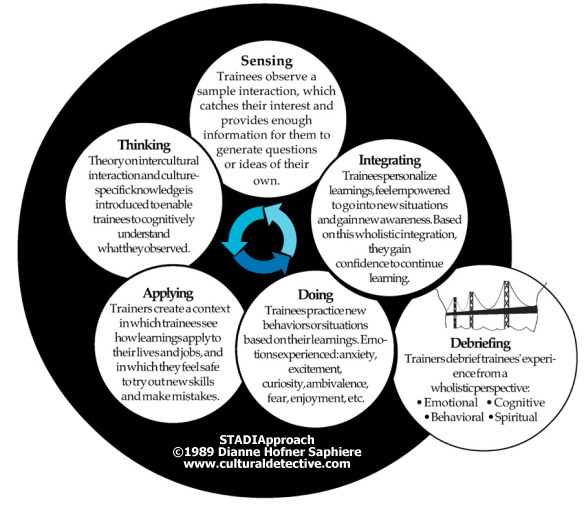
This “oldie but goodie,” the STADIApproach to Intercultural Learning, has been used in dozens of organizations worldwide with huge success. Click on the link to view a full article on the approach. I first published it for use with my proprietary clients in 1989; it is now even more useful as it can provide a design framework for blended learning approaches that leverage Cultural Detective Online. The CD Online system has STADI embedded into its core. In the hands of a skilled facilitator, teacher or coach, you can assist your learners to Sense, Think, Apply, Do and Integrate by analyzing the experience of others via the critical incidents in CD Online, as well as probing their own real life experiences.
We trust you’ll find the STADIApproach article helpful! Please accept it and use it as my new year’s gift to you, this January of 2014. It is my wish that the new year will enable all of you, dear readers, to better facilitate intercultural understanding, sustainability, respect and equity on this planet of ours.
Please share your experiences with us, and your designs that effectively leverage Cultural Detective Online to supplement your training, teaching or coaching endeavors.
Happy New Year! May 2014 bring you health, joy, love, and much success in your endeavors to build respect, understanding, and collaboration across cultures! We so appreciate you being part of the Cultural Detective community!
As we enter into the third year of this blog, I am quite proud of the quality—and the quantity—of what we have been able to provide. Are you curious about which posts were the most viewed in 2013?
Our top post of 2013 was Research Findings: The Value of Intercultural Skills in the Workplace. A very powerful study of 367 employers in nine countries, commissioned by The British Council and conducted by Booz Allen Hamilton and IPSOS Public Affairs, found that employers want to hire people with intercultural skills. The most frequently cited intercultural skills these employers desired were the ability to demonstrate respect for others, the ability to build trust across cultures, and the ability to work effectively in diverse teams. This was my first time creating an animated-drawing video, and I am pleased that it was republished widely. The British Council put narration to it and published it on their YouTube channel to help promote the original study, and we published a Spanish language version of the video as well. If you didn’t get a chance to read this important study or view the video summary, don’t miss it.
Many of you work in virtual teams and across distances, so not surprisingly, our second most popular post of 2013 was 5 Top (Free & Easy) Virtual Collaboration Tools that You May Not (Yet) Be Using. These five virtual collaboration tools attracted broad readership, and in addition so did the summaries of important research on virtual, multicultural team development. I am hoping that by sharing such information we can heighten awareness of the need for cross-cultural skills, and promote understanding that development of these skills requires discipline and practice.
Our third most popular post of the year was rather surprising to me: 10 Surefire Ways to Divide into Groups. This post gained traction and spread throughout the training and education communities, rather than staying purely within the intercultural space. Perhaps the popularity of this post shows that teachers and trainers are always looking for new-to-them creative techniques. Frankly, I have consulted the list a couple of times myself when designing workshops! It’s so easy to reinforce cross-cultural awareness—even in the ways we divide our learners into small groups.
I am proud that the post on the Benchmark Statement on Intercultural Competence: AEA was among our top five for 2013. It is a terrific example of an organization committing itself to intercultural competence, developing a strategic plan, and investing in competence development over an extended period of time. If you have not read through the American Evaluation Association’s statement, I urge you to do so. As I said in the original post, some of their definitions are better than some of those provided by interculturalists!
Rounding out our top-five blog posts of 2013 was a guest post by Joe Lurie, entitled Catalysts For Intercultural Conversations and Insights: Advertisements. Joe authored several of our most popular blog posts last year, all focused on food and eating. In 2013 his top post focused on print- and video-advertising and how to use them in a classroom environment to compare and contrast cultures. As always, Joe, thank you for your contributions to this community, and to building intercultural competence!
A big and very sincere THANK YOU to all our guest bloggers in 2013, and to those whose work we re-posted. And many thanks, also, to those who contributed comments and additional resources, either directly here on the blog, or via our pages on LinkedIn, Facebook and Twitter. Our community now numbers about 14,000 people, including 130 authors, 420 certified facilitators, a solid group of experienced customers, and an ever-growing group of users and collaborators. Together we can achieve our goals to develop intercultural respect, understanding and collaboration!
We welcome posts by those of you who wish to reach out to our community and aid us in developing intercultural competence in this world of ours. Please contact me about requirements and benefits.
Finally, we would also like to extend our sincere thanks and bring your attention to those who have most frequently referred new readers to this blog in 2013. These, of course, include social media, search engines (Google, Yahoo…), and content curation sites (Scoop.it, Paper.li, Clipboard) that I have not included in the list below. However, this top-15 list shows the broad diversity of contexts and applications for the Cultural Detective Method and materials:
feel like you belong: sharing the life stories of immigrants, expatriates, and refugees to the United States
Thank you all for joining us in this grand endeavor! We hope to see you, dear readers, on this list next year. Let us know what is on your mind, and how this blog can you help further intercultural competence in your corner of the world! Happy New Year!
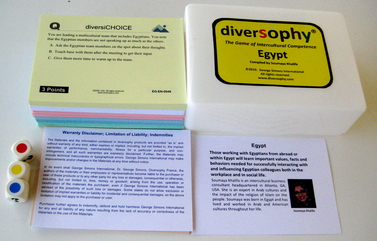
Many thanks to Cultural Detective author George Simons and his colleague Wiebke Döscher, who have put together a small diversophy game about holiday food habits across cultures and traditions, and offered it free to their colleagues to play as we slip into the New Year.
Each of the zip files contains the full game of fifty cards, along with printing and playing instructions:
“At any given moment, a woman is likely to be using her whole brain while a man is using half of his. Men are more likely to be right-brained (more intuitive) or left-brained (more logical) than women.”
—Ruben Gur, neuropsychologist and one of the study authors
A just-published study of the brain functionality of 949 young people shows striking differences in brain wiring between men and women. The authors of the study suggest that male brains are biologically structured to facilitate connectivity between perception and coordinated action (motor and spatial abilities), whereas female brains are designed to facilitate communication between analytical and intuitive processing modes (memory, social adeptness, multi-tasking).
The study of 428 males and 521 females aged 8-22 was conducted by ten colleagues at the University of Pennsylvania and published in the Proceedings of the National Academy of Sciences. They used a technique called “diffusion tensor imaging” (DTI), which scans the paths travelled by water molecules around the brain.
“The maps show us a stark difference in the architecture of the human brain that helps provide a potential neural basis as to why men excel at certain tasks and women at others.”
—Ragini Verma, researcher
The story is making a big splash in the press and in social media. It is a notable study, however, the main interpretation the researchers and the media seem to be taking from the study is that gender differences are biologically determined. I found such a conclusion very puzzling, because the study results themselves show that differences in brain wiring are not congenital!
The study showed that boys and girls are born with similar connectivity, and that differences in brain pathways between the genders begin to manifest at about 13 years of age, and diverge even further at 17. The study authors attribute this to the time sex begins to become important in a person’s life. I suppose that means the time hormones begin to kick in? But, of course I wondered if the differences emerge during the teenage years because that is about the age that gender socialization really begins to manifest.
Then Kathryn Stillings, our editor, found this article by science writer of the year Robin McKie. Robin explains that the study’s findings actually disprove the authors’ interpretations and reinforce the view that gender differences are the result of acculturation.
“Yes, men and women probably do have differently wired brains, but there is little convincing evidence to suggest these variations are caused by anything other than cultural factors. Verma’s results showed that the neuronal connectivity differences between the sexes increased with the age of her subjects. Such a finding is entirely consistent with the idea that cultural factors are driving changes in the brain’s wiring. The longer we live, the more our intellectual biases are exaggerated and intensified by our culture, with cumulative effects on our neurons. In other words, the intellectual differences we observe between the sexes are not the result of different genetic birthrights but are a consequence of what we expect a boy or a girl to be.”
—Robin McKie, The Observer
I trust you’ll read the study and the various interpretations, and draw your own conclusions. Either way, via biological determinism, acculturation/socialization, or a mix of the two, Cultural Detective Women and Men is a terrific package that delves into gender differences in a practical, dynamic way. It combines beautifully with national, religious tradition or generational packages. We trust you will try it out in your work, to help ensure that the broadest spectrum of cognitive skills are accessed for innovation and effectiveness in our organizations and societies.
More on the New Brain Study
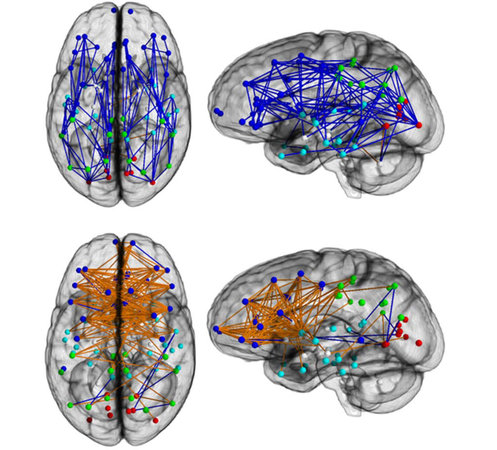
The study’s findings show that the dominant connections in the male cerebrum (top left image above) are within either the left or right hemisphere (blue lines), and the dominant connections for females are between hemispheres (bottom left image/orange lines).
In the cerebellum (right-hand images, lower part of brain) it is just the opposite: the average male brain shows connections between hemispheres while the average female brain has dominant connections within hemispheres.
“Forget right-brain or left-brain thinking. What may be more important from a gender standpoint is back-to-front or side-to-side thinking.”
—Stacey Burling, Philly.com
“The strong link with the cerebellum might make men more action oriented, better at tasks that require quick response time or an ‘I-see-and-then-I-do’ attitude. The side-to-side thinking likely boosts women’s memory and social skills and seems designed, the authors said, to combine analytical and intuitive thinking. Communication within the hemisphere facilitates connection between perception and coordinated action,” writes Stacey Burling in her online review of the study in philly.com. Women’s brains “more easily integrate the rational, logical, verbal mode of thinking and the more intuitive, spatial, holistic mode of thinking,” she quotes Gur as saying. “Women’s thinking is likely to be more contextual. Their brains are better connected between their decisions and their memories. For men, memories are memories. Decisions are decisions.”
It is noteworthy that DTI or diffusion tensor imaging provides only indirect measures of structural connectivity and is, therefore, different from the well validated microscopic techniques that show the real anatomy of axonal connections,” says Marco Catani, of London’s Institute of Psychiatry. “Images of the brain derived from diffusion tensor MRI should extreme caution.”
I am curious about the results we’d see of a similar brain study of people older than 22, as I feel we change significantly as we age. This point is echoed by Professor Heidi Johansen-Berg of Oxford University, who attacked the idea that brain connections should be considered as hard-wired. “Connections can change throughout life, in response to experience and learning.” Hopefully the next step of this work will include such a study.
Care to learn more? Click the link above to the abstract of the original study, or read this terrific article from The Atlantic.
What do these four things—frogs, birds, underwear and camel humps—possibly have in common with one another? In the hands of Cultural Detective certified facilitator Joe Lurie, quite a bit, actually. In this series of short video clips, Joe shares with us a couple of proverbs and a few stories on the power of perception. Watch below to learn why some of his Chinese students were utterly shocked…
The first clip is only a minute and a half long. It’s where Joe sets up his story:
Ah, the ability to see beyond our pond involves the ability to ALSO see and understand the pond we are in! An all too often forgotten reality in intercultural competence. How can we explain ourselves to others, or help others to adapt to our home, if we ourselves don’t understand the culture in which we live?
The second clip, three minutes long, tells you just why some of Joe’s Chinese students thought his behavior was so strange.
What do you think? What values show through in the way you do your laundry? In the way you view birds, frogs, and the rest of your world?

 Thank you for joining us on the journey to build respect, justice and collaboration across cultures!








 Cultural Detective Blog