Virtual Teaming

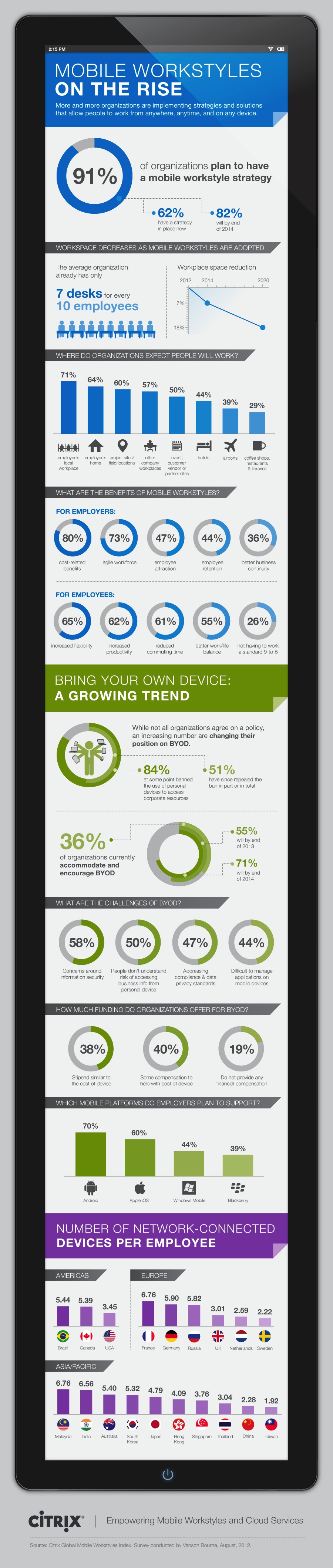
With mobile work styles on the rise, management styles need to change and adjust to the new reality. Along with the obvious benefits to employers and workers, there are significant drawbacks to a mobile work style—policies need to be modified, expectations made clear in different ways, and creating a cohesive work group becomes more difficult.

Any organization has its challenges in trying to shape a random collection of people into a “team” of some sort—whether it’s a small group engaged in a specific project, or the group spirit that often emerges from employees working together to accomplish desired results.

Citrix_Mobile_Infographic_v6_hannah

With a mobile work style, how do we achieve a sense of community, a sense of shared purpose that allows employees to perform at their best to achieve the overall goals of the company?

One answer is found in the Method and tools offered by the Cultural Detective series. Cultural Detective: Self-Discovery is designed to explore one’s own values—what makes each of us “tick.” This self-knowledge is the base upon which to build intercultural competence.

Cultural Detective: Bridging offers a way to look at conflicts and to move beyond a win/lose scenario to “bridge” differences to work more constructively together. Theory and practice are interwoven to provide concrete suggestions for learning to resolve difficult situations.

The Cultural Detective: Global Teamwork package is designed to assist both collocated and remote teams in meeting the five major challenges of teamwork in todays’ global environment. While many companies embracing mobile work styles are located in one geographical location, they wrestle with many of the same challenges as virtual teams working internationally. Cultural Detective: Global Teamwork provides insights, processes, and tools to meet these challenges.

And of course, no mobile work style would be complete without a subscription to Cultural Detective Online, the virtual intercultural coach that is available, anywhere anytime 24/7. So helpful to have a reference available before you email or talk to your new colleague from a culture different than your own! Do they value direct, straight-to-the point communication, or a more nuanced approach? Should you spend some time getting to know them personally, or just get directly to the business discussion?

Did you know you can set up groups within Cultural Detective Online so you can work virtually with employees to enhance their intercultural competence? Let us show you how! Join one of our free webinars to learn about the capacities of CD Online, and ask us how your organization can take advantage of group subscriptions to Cultural Detective Online.

Another International Research Paper Supports the Cultural Detective Approach

Study coverBertelsmann Stiftung and Fondazione Cariplo Study*

Many of you ask us how you can make the case for and roll out a strategy for developing intercultural competence in your organizations and communities. Two of the world’s major philanthropic foundations, Germany’s Bertelsmann Stiftung and Italy’s Fondazione Cariplo (Cassa di Risparmio delle Provincie Lombarde), published a research and policy paper that may help a bit in this regard. The objectives of the study were to promote tolerance, integration and cultural dialogue within Europe and with non-European partners. The paper makes several key points that are important for Cultural Detectives to understand as we go about our work. They are points that underscore the value of the Cultural Detective® approach, namely:
  1. The danger of reifying culture. Cultures are not static entities but open, dynamic, complex systems.
  2. Intercultural competence requires a process orientation.
  3. Intercultural competence involves recognition of similarities as well as differences.
  4. Intercultural competence development processes must be the core of school curricula, revisited in different contexts repeatedly over time; they can not be appended as supplementary learning.

In this article I quote from the Bertelsmann-Cariplo study regarding each of these topics, and then make the link to the Cultural Detective approach. Let me begin, however, by quoting from the article on the need for intercultural competence in today’s world.

The Need for Intercultural Competence

“Given the process of pluralization that has resulted from internationalization, the ethnic, religious and cultural heterogeneity of our societies will increase, as will contacts between people of differing cultural values and norms. Thus, in the coming years, the ability to deal constructively on an interpersonal level with cultural diversity and a multitude of attitudes, values, norms, belief systems and ways of life will not only remain a key qualification required of business executives working in international settings; it will also be required generally of each individual as a key factor for contributing to social cohesion and reducing exclusion so that cultural diversity can be experienced positively.” (pp. 3-4)

1. The Danger of Reifying Culture

“By focusing on what was assumed to be an integrated, almost static whole of locality, group and culture … culture was considered (and is still considered by many) to be the way of life of a certain group of people in a specific setting, people who – because of their culture – consider themselves members of the same group and who – because of their culture – are different from other groups in other localities. This notion is often depicted as a global map with different discrete cultural groups, or as a mosaic, whose pieces are distinct individual cultures.

Since Ulf Hannerz (and others) formulated the ideas of “culture as flux” and the idea that cultures are open, dynamic and constantly changing ‘entities’ or ‘practices,’ many leading figures in social theory and cultural studies in the 1990s increasingly relinquished the viewpoint that culture can be understood as a closed and static, island-like entity. In addition internationalization and globalization processes have shown the previous notion – that locality, group and culture exist as one unit – to be false or oversimplifying.

The changed, process-oriented conception of culture as a dynamic entity therefore tries to accommodate the contradictions, the intermixing and the new diversity, which are based more on relationships than autonomy.” (pp. 5-6)

Link 1: Cultural Detective’s Approach to Culture as an Open and Complex System

There are several ways in which Cultural Detective helps users learn that a culture is not a static, definable entity, but a dynamic system. Each Cultural Detective package comes with a page entitled, “What is Culture?” The first words on the page are “culture is a complex …” Culture is said to affect how we do things, with further explanation that “common sense” is really a process of “cultural sense.” Readers are asked to think about central tendencies and patterns of a group of people, and that each individual is a composite of the influences of many cultures simultaneously (nationality, ethnicity, gender, age, spiritual tradition, sexual orientation, organizational culture, professional training).

The Cultural Detective Worksheet is an interactional analysis and planning tool, one that reinforces for the learner that the importance of culture is how it colors what we do, what we perceive, and how we want to proceed. Culture is not presented as some static, separate thing but as affecting individual people in real situations in complex but visible ways.

The Cultural Detective Values Lenses are positioned as a view of group norms or tendencies, a filter through which members of a culture are taught to view the world. The Lenses are used as clues: tools that may or may not prove helpful in unraveling the mystery of a given case study. Not all members of a culture will hold these values; in fact, some may have an almost allergic reaction to a society’s dominant values, even while recognizing the norm. It is also noteworthy that the same or similar values can provoke different or even contradictory behaviors, depending on the person and the context.

Thus, Cultural Detective, by its very nature, relates to cultures as open, dynamic and complex systems.

2. Intercultural Competence Requires a Process Orientation

““…This procedural understanding of culture as a dynamic flow and ongoing process of negotiation between norms, values and lifestyles only underlines the need for a conceptualization of intercultural competence which is in its turn able to take account of the changing nature of culture and the interactions it influences. Some existing models of intercultural competence, in fact, underscore the importance of a process-orientation.”

If the assumption is correct that culture is constantly in flux, then individuals must learn and master the ability to deal with ongoing processes. The development of intercultural competence is thus complex and multidimensional and, depending on the intercultural situation, can take on a variety of forms.” (pp. 6-7)

Link 2: Cultural Detective’s Process Approach to Intercultural Competence

The Cultural Detective Method is a process. It is to our knowledge one of (if not the only) intercultural competence tool available in the world today that is process-based. The approach looks at individuals in real situations, urging the learner to describe the facts of the situation, as would a good detective, filtering out biases and assumptions, and seeing what actually occurred or was said. The learner is then encouraged, at least temporarily, to set aside negative judgment and give benefit of the doubt. What could have been the possible positive intent underlying behavior in the situation? Once possible positive intentions have been formulated, the process asks the learner to discover or create methods in which the contributions of all involved can be most fully used. How might the people in the interaction behave, both to be fully themselves and to be cross-culturally effective? What steps could the organization or community take to encourage and reinforce intercultural competence?

One of the strengths of the Cultural Detective process is that it is not linear. Individuals or groups can jump around and between steps of the process, in a holistic manner, with powerful results.

We would like to caution that saying “culture is constantly in flux” can be as dangerous as the traditional boilerplate. Of course, everything is in flux; Heraclitus told us “you can’t step into the same river twice.” However, our questions can include what is changing, how fast, how much and where? We need to deal with the ongoing process, and we also need a standpoint from which to do this. Cultural Detective gives us exactly that.

3. Requisite Intercultural Competencies

“With regard to the definition [of intercultural competence], one may distinguish four dimensions, namely attitudes, comprehensive cultural knowledge and intercultural skills, an ability to reflect on intercultural issues as an internal outcome of intercultural competence [relativizing frames of reference and feeling empathy], and an ability to interact constructively as an external outcome of intercultural competence.

It is important to remember that the relevant cultural knowledge differs in each intercultural context and, as global knowledge, is potentially unlimited, i.e. too extensive to always be known in the intercultural context. Therefore, many experts attach much more importance to certain behavior related (conative) communication skills than to explicitly knowledge-related (cognitive) elements. According to the specialists, to the degree that comprehensive cultural knowledge cannot be definitively known, process-oriented skills on how to handle the situation grow in importance, skills that make it possible to acquire and process (explicit and implicit) knowledge about one’s own as well as foreign ways of life, cultural determinants and practices.”(pp. 7 and 9)

Link 3: Cultural Detective and the Requisite Competencies

The first two skills upon which Cultural Detective is premised “make it possible to acquire and process (explicit and implicit) knowledge about one’s own as well as foreign ways of life, cultural determinants and practices,” as described above. The first is Subjective Culture: knowing yourself, in context, as a product of personality and multiple cultural influences. Subjective Culture knowledge allows us to explain ourselves, what is important to us, and why we do what we do, to others. It also helps us to predict how we will respond in a given situation. Cultural Detective: Self Discovery is an entire package, approach, and tools for developing subjective culture understanding, and such understanding is developed and reinforced with every critical incident and Worksheet. When learners reflect on a critical incident and complete a CD Worksheet, they naturally reflect on their own values and behaviors: what they would do in a similar situation, how they would expect someone to behave, what would upset them? Analyzing incidents from diverse cultures and situations is an organic, intuitive way of getting to know ourselves, individually and as products of cultural influences.

The second Cultural Detective skill is Cultural Literacy: knowing others individually, in context, as a product of their personalities as well as the multiple cultural influences on them. Cultural Literacy helps us to understand others’ intentions and why we respond to them the way we do. It enables us to put culture “on the table” as a perspective to be used, rather than as something that we don’t recognize or talk about, but which reaches out to bite us when we least expect it. Every Cultural Detective package, critical incident and Values Lens helps the user to develop cultural literacy.

The third Cultural Detective skill goes farther than the Bertelsmann-Cariplo report. It is Cultural Bridge, the ability to leverage similarities and differences for interpersonal, organizational and community satisfaction, productivity and effectiveness. Cultural Bridges allow all parties to retain their authenticity, encourage all parties to develop intercultural competence. They involve processes, structures, and systems that sustain intercultural competence in the organization or community. Sustainable Cultural Bridges must be multi-directional; one-way Cultural Bridges may work in the short term, but are rarely if ever viable over the long term.

a. Specific attitudes (emotion), knowledge (cognition) and behaviors (conation)
One set of questions we are sometimes asked is, “Where does emotion fit within the Cultural Detective framework? By reporting facts and behaviors, are we to divorce ourselves from emotion?” On the contrary, emotions are crucial pieces of a Cultural Detective approach. Contemporary cognitive science is showing that what we consider emotion has cognitive content and vice versa. Evaluation and emotion are automatically present in nearly everything we do. The Cultural Detective Method helps the learner develop the capacity to see this, and the desire, as well as skills, to purposefully shift perspective in order to see a situation more thoroughly and accurately.

Heightened emotion can provide a “beeline” into the salient aspects of deep culture that make a difference in a situation. The things that most upset us are important clues to the underlying values and intent that drive perception and action.

Cognition and conation obviously come into play in the Cultural Detective Worksheet. The “Words and Actions” as well as the “Cultural Bridges” sections of the Worksheet involve behavior and conation. The Worksheet and the Values Lenses involve knowledge and cognition.

b. Internal “relativizing” of one’s frame of reference
The Cultural Detective process requires us to step into the perspective of other people, to shift our frames of reference. The Worksheet provides a visual illustration of such a shift of frame of reference. Each Values Lens, through its positive values and negative perception of those values, involves shifting perspective or frame of reference as well.

c. External performance, or constructive interaction
This final Bertelsmann-Cariplo skill is well represented in the Cultural Bridges portion of the Cultural Detective Worksheet, and is also the focus of the Cultural Detective: Bridging Cultures package.

4. Recognition of Similarities as well as Differences

“Perhaps the search for commonalities is as important in intercultural competence as the sensitivity and recognition of cultural differences that have been talked about so intensively in scientific, political and everyday-life discourses on intercultural competence during the last decades.” (page 13)

Link 4: Similarities, Differences, and Cultural Detective

As a process-based, interactional approach, Cultural Detective naturally encourages the learner to explore similarities as well as differences. When analyzing a critical incident using the Cultural Detective Worksheet, it may become apparent that multiple parties are motivated by similar or compatible values or desired outcomes. An effective Cultural Bridge may involve building upon this shared outlook or purpose, while also acknowledging and working with difference.

Values Lenses also encourage exploration of both similarities and differences. Whether we are discussing our Personal Values Lenses in an attempt to better collaborate, or comparing and contrasting national-culture Values Lenses, the ways in which we are similar and the ways in which we are different make themselves apparent.

5. Intercultural Competence Development Processes as Core of the Curriculum

”The multidimensional and process-oriented nature of the development of intercultural competence can hardly be appended as a supplementary learning module to existing school curricula. Instead, it is necessary to examine to what extent intercultural competence as an educational goal can be established in curricula as they are currently structured.” (page 10)

Link 5: Cultural Detective Process as Core

Herein lies one of the true beauties of the Cultural Detective toolset. Because it is a process, it can be used as a design backbone for nearly any type of curriculum, courseware, teambuilding, coaching, technology transfer, competence development program, mediation or conflict resolution, or merger and acquisition. Because it is so simple, it easily integrates with nearly any topic. It can be taught once, and the learner retains it, being able to use it again and again in different situations for ever deeper or broader learning, applying it both at home and at work, across disciplines, to continue developing knowledge of self, knowledge of others, and the ability to collaborate.

The key, as with any tool or important learning, is to integrate it as part of an ongoing spiral learning approach, revisiting and reusing it at periodic intervals in order to improve users’ facility with the tool and to deepen and broaden user ability and sophistication. A tool left on the shelf serves no purpose.Cultural Detective, as any tool or approach, is useful for certain purposes and not for others, and it can be used well or poorly. We trust your efforts towards intercultural competence will bear positive results.

*This is a reprint from a Cultural Detective Newsletter article originally published in June of 2010.

Join us in Warm Sun AND Accomplish a New Year’s Resolution

snowbeach

  • Are you tired of the cold, the ice, and the snow? Is it all getting to be too much, and you’d like a break? Are you longing for some warmth, sunshine, the beach, and vibrant Latin music?
  • Have you promised yourself that in 2014 you will spend more time on yourself, invest in your professional development, network with like-minded professionals, or expand your training/facilitation/coaching repertoire?
  • Do you realize that global and multicultural competence are requisites in today’s world, and you want to improve these vital skills and learn to help develop them in others?

You can accomplish all these things by joining us in Mazatlán Mexico in February, or in Atlanta Georgia in March for our Cultural Detective Facilitator Certification Workshop! Early bird registration rates are available, so now is a good time to secure your seat in one of these workshops.

The Cultural Detective Facilitator Certification Workshop receives high accolades from the most experienced interculturalists as well as from those with significant life experience but who are new to the intercultural field. Clients rave about the Cultural Detective Method and use it worldwide. Facilitators love having Cultural Detective in their toolkit. It helps them truly make a difference and secure repeat business from clients—ongoing coaching, training and consulting revenue—as clients commit to the continuing practice that developing true intercultural competence requires.

Many people do not realize that Cultural Detective is flexible enough to integrate nicely with existing training programs—adding depth and practical skills that learners can use immediately and build upon in the future. Participants easily remember the Cultural Detective Method, and can put it into practice when encountering a challenging situation—solving misunderstandings before they become problems!

“It is difficult to exaggerate how fundamentally important Cultural Detective has become for us. The difference between courses we conduct with and without CD is astounding.”
– Chief Academic Officer

“We have achieved, for the first time in my five years working on the Learning and Development team, a 100% satisfaction rating from our learners. Thank you, Cultural Detective!
– Chief Learning and Development Officer

“Our customer satisfaction rates have increased 30% thanks to Cultural Detective.”
– Customer Support Manager

Click here for details on dates, locations and pricing, and click here for a detailed agenda of the workshop. Sound tempting? Get out of the cold AND spend time developing your effectiveness and employability! We’d be delighted to have you join us! Of course, if you are living somewhere warm, we’d gladly welcome you, too!

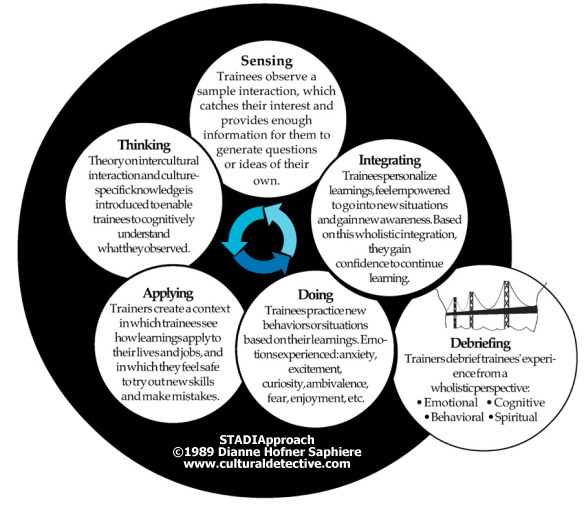
New Year’s Gift: Oldie but Goodie—The STADIApproach

Permission is granted to use this model freely and to circulate it, PROVIDED the © and url are maintained.

Permission is granted to use this model freely and to circulate it, PROVIDED the © and url are maintained.

It is said that experience is the best teacher. But learning does not lie in the experience itself; rather, it is our interpretation of the situation—the meaning we give to our experience—that provides our learning.

How might we better enable learners to constructively give meaning to their intercultural experiences? Are you looking for an easy and highly effective way to structure your next intercultural workshop or coaching session? Are you wondering how you might better enable study-abroad students to understand their experience in a way that builds cross-cultural competence? Do you have employees working internationally or multiculturally, and you’d like them to learn to truly harness the potential of diversity?

This “oldie but goodie,” the STADIApproach to Intercultural Learning, has been used in dozens of organizations worldwide with huge success. Click on the link to view a full article on the approach. I first published it for use with my proprietary clients in 1989; it is now even more useful as it can provide a design framework for blended learning approaches that leverage Cultural Detective Online. The CD Online system has STADI embedded into its core. In the hands of a skilled facilitator, teacher or coach, you can assist your learners to Sense, Think, Apply, Do and Integrate by analyzing the experience of others via the critical incidents in CD Online, as well as probing their own real life experiences.

We trust you’ll find the STADIApproach article helpful! Please accept it and use it as my new year’s gift to you, this January of 2014. It is my wish that the new year will enable all of you, dear readers, to better facilitate intercultural understanding, sustainability, respect and equity on this planet of ours.

Please share your experiences with us, and your designs that effectively leverage Cultural Detective Online to supplement your training, teaching or coaching endeavors.


Best Wishes for 2014

Happy-New-Year-2014-1-1Happy New Year! May 2014 bring you health, joy, love, and much success in your endeavors to build respect, understanding, and collaboration across cultures! We so appreciate you being part of the Cultural Detective community!

As we enter into the third year of this blog, I am quite proud of the quality—and the quantity—of what we have been able to provide. Are you curious about which posts were the most viewed in 2013?

  1. Our top post of 2013 was Research Findings: The Value of Intercultural Skills in the Workplace. A very powerful study of 367 employers in nine countries, commissioned by The British Council and conducted by Booz Allen Hamilton and IPSOS Public Affairs, found that employers want to hire people with intercultural skills. The most frequently cited intercultural skills these employers desired were the ability to demonstrate respect for others, the ability to build trust across cultures, and the ability to work effectively in diverse teams. This was my first time creating an animated-drawing video, and I am pleased that it was republished widely. The British Council put narration to it and published it on their YouTube channel to help promote the original study, and we published a Spanish language version of the video as well. If you didn’t get a chance to read this important study or view the video summary, don’t miss it.
  2. Many of you work in virtual teams and across distances, so not surprisingly, our second most popular post of 2013 was 5 Top (Free & Easy) Virtual Collaboration Tools that You May Not (Yet) Be Using. These five virtual collaboration tools attracted broad readership, and in addition so did the summaries of important research on virtual, multicultural team development. I am hoping that by sharing such information we can heighten awareness of the need for cross-cultural skills, and promote understanding that development of these skills requires discipline and practice.
  3. Our third most popular post of the year was rather surprising to me: 10 Surefire Ways to Divide into Groups. This post gained traction and spread throughout the training and education communities, rather than staying purely within the intercultural space. Perhaps the popularity of this post shows that teachers and trainers are always looking for new-to-them creative techniques. Frankly, I have consulted the list a couple of times myself when designing workshops! It’s so easy to reinforce cross-cultural awareness—even in the ways we divide our learners into small groups.
  4. I am proud that the post on the Benchmark Statement on Intercultural Competence: AEA was among our top five for 2013. It is a terrific example of an organization committing itself to intercultural competence, developing a strategic plan, and investing in competence development over an extended period of time. If you have not read through the American Evaluation Association’s statement, I urge you to do so. As I said in the original post, some of their definitions are better than some of those provided by interculturalists!
  5. Rounding out our top-five blog posts of 2013 was a guest post by Joe Lurie, entitled Catalysts For Intercultural Conversations and Insights: Advertisements. Joe authored several of our most popular blog posts last year, all focused on food and eating. In 2013 his top post focused on print- and video-advertising and how to use them in a classroom environment to compare and contrast cultures. As always, Joe, thank you for your contributions to this community, and to building intercultural competence!

A big and very sincere THANK YOU to all our guest bloggers in 2013, and to those whose work we re-posted. And many thanks, also, to those who contributed comments and additional resources, either directly here on the blog, or via our pages on LinkedIn, Facebook and Twitter. Our community now numbers about 14,000 people, including 130 authors, 420 certified facilitators, a solid group of experienced customers, and an ever-growing group of users and collaborators. Together we can achieve our goals to develop intercultural respect, understanding and collaboration!

We welcome posts by those of you who wish to reach out to our community and aid us in developing intercultural competence in this world of ours. Please contact me about requirements and benefits.

If you are curious what the Cultural Detective project is all about, join us for one of our twice-monthly complimentary webinars. Subscribing to Cultural Detective Online or licensing our print materials does not require certification, but even the most experienced coaches, teachers and trainers rave about our Facilitator Certification Workshops. Sign up for one near you today!

Finally, we would also like to extend our sincere thanks and bring your attention to those who have most frequently referred new readers to this blog in 2013. These, of course, include social media, search engines (Google, Yahoo…), and content curation sites (Scoop.it, Paper.li, Clipboard) that I have not included in the list below. However, this top-15 list shows the broad diversity of contexts and applications for the Cultural Detective Method and materials:

  1. feel like you belong: sharing the life stories of immigrants, expatriates, and refugees to the United States
  2. Expat Everyday Support Center: we help expats connect to their worlds
  3. Zest n Zen/Anne Egros, Intercultural Executive Coach: Global Leadership, International Career, Expat Life, Intercultural Communication
  4. Jenny Ebermann: coach, trainer, speaker, consultant
  5. Slovensko drustvo evalvatorjev
  6. Worldwise: intercultural training and services
  7. KQED: public media for Northern California
  8. InCulture Parent: for parents raising little global citizens
  9. Vekantiebabbels.nl: voor het uitwisselen van je vakantieverhalen
  10. Southeast Schnitzel: interpreting German-American differences in the Tennessee Valley and beyond
  11. Intercultural Humanities Manchester
  12. The Intercultural Communication Center: its all about communication
  13. Global Minds: consultoría en Colombia
  14. Blogos: news and views on languages and technology
  15. ESL: language studies abroad

Thank you all for joining us in this grand endeavor! We hope to see you, dear readers, on this list next year. Let us know what is on your mind, and how this blog can you help further intercultural competence in your corner of the world! Happy New Year!

Frogs, Caged Birds, Underwear and Camel Humps

Frogs, Caged Birds, Underwear & Camel HumpsWhat do these four things—frogs, birds, underwear and camel humps—possibly have in common with one another? In the hands of Cultural Detective certified facilitator Joe Lurie, quite a bit, actually. In this series of short video clips, Joe shares with us a couple of proverbs and a few stories on the power of perception. Watch below to learn why some of his Chinese students were utterly shocked…

The first clip is only a minute and a half long. It’s where Joe sets up his story:

Ah, the ability to see beyond our pond involves the ability to ALSO see and understand the pond we are in! An all too often forgotten reality in intercultural competence. How can we explain ourselves to others, or help others to adapt to our home, if we ourselves don’t understand the culture in which we live?

The second clip, three minutes long, tells you just why some of Joe’s Chinese students thought his behavior was so strange.

What do you think? What values show through in the way you do your laundry? In the way you view birds, frogs, and the rest of your world?

You can find these and all sorts of other videos on Cultural Detective‘s YouTube channel: www.youtube.com/CulturalDetective.

See Part 2 of this interview here.

Ochobo’s “Liberation Wrapper”

liberation-wrapper-415x260What a terrific, culturally appropriate marketing ploy! When I lived in Japan, I was oh-so-conscious to cover my mouth with my hand when I laughed out loud, or if I had to open it real wide while eating. “Ochobo,” or a small mouth, is traditionally seen as a sign of feminine beauty in Japan.

A national hamburger chain wanted to sell more of its biggest, juiciest, wide-mouthed burgers to women, so it came up with an ingenious idea: the “liberation wrapper”—a stiff paper burger wrapper, imprinted with a closed mouth. The person eating is able to hide behind a dainty little face, saving others from having to watch them chow down.
Every society is changing, and there are plenty of women in Japan who eat burgers in public. There are also those who don’t cover their mouths when laughing. But, hey, this is fun and cool! Maybe next will come a not-so-culturally-necessary but cool men’s “liberation wrapper”!

Here’s an article on the promotion, from the Japan Daily Press.

This promotion reminds me of a story years ago, recounted to me by the then-Director of Tokyo Disneyland. In planning for Adults’ Day (成人の日), the workers realized that many young women would be coming to Disneyland in silk kimono. Knowing that the water spray could damage the expensive kimono, the workers prepared signs, warning the young women of the danger and cautioning them to avoid certain water rides.

The Director scolded them, saying their signs ran counter to the Disney way. “You must figure out a way to let the young women enjoy the rides, in their expensive silk kimono.” The solution? They had a bunch of plastic raincoats made special for Adults’ Day.

What is your favorite culturally appropriate customer service or marketing story?

HUGE Response to Our Post on Names Across Cultures

Name ChangesOur first blog post on Names Across Cultures hit powerfully and emotionally for so many of you! A few typical comments include:

“Names are part of a person’s identity. If people ‘get it’ across cultures we often feel they ‘get’ us, too.”

“We can’t know all languages or accents or tones, now could we? Having said this I would consider it wrong to be forced to change a name because someone can’t pronounce it—are you kidding? Why should the weakness or inability of one (the name changer) be even acceptable?!”

“My name is a point of pride for me. Even though nearly nothing about me screams ‘I’m a Korean immigrant,’ my name tells a very interesting story about who I am. I suppose my life would be marginally easier and I’ve probably gotten looked over for a handful of jobs because of the ‘foreignness’ of my name, but I like it. It’s unique and it’s me.”

“Changing people’s names was another turn of the screw in the arsenal of tricks that the colonial powers used to subjugate people under their dominion.”

We very much enjoyed reading the stories and comments posted here on the blog as well as in the social media. Thank you! We found them quite insightful, and believe you will, too. We heard from people who:
  1. Feel they are avoided at parties and gatherings because others find their names hard to pronounce. “People are embarrassed to mispronounce my name, so they sometimes avoid me altogether.” Talk about insidious discrimination!
  2. Have had others correct their pronunciation of their own name! “Such arrogance! How dare they! Do they even look at signatures on emails? They invariably correct me!” Sadly, this wasn’t just one person sharing this experience with us.
  3. Have been told their name is “wrong,” because it’s a man’s name not a lady’s, or because its origins are in a certain language and this is how it SHOULD be pronounced.
  4. Express the opposite opinion: “Many of us actually mispronounce our own name without knowing it. People who live in countries with a long history of immigrants and their intermarriage, will in due time pronounce a name according to what their ‘new’ language has taught them. Is this now wrong? Well, maybe to some degree yes, but since the new pronunciation is not something done out of maliciousness but rather due to having been told of it wrong.”
  5. Proclaim, “Those of us with unusual names need to stand our ground!”
    1. “I am waiting for the day I can go back to my roots and not cringe every time someone speaks to me!”
    2. “I prefer to have people change my name than butcher (by mispronouncing) my name!”
  6. Advise, “Forget my last name; use my first!” (or vice-versa) for ease in pronunciation.
  7. Are happy to have a different name for the varied contexts in which they live and work.
    1. “If someone calls me Karinka, or makes up another name that is easier for them, or pronounces my name incorrectly, I do not mind at all. I myself am certainly not in a position to pronounce everybody’s names properly, and I know how difficult it can be.”
    2. “It is all relative. When people ask me ‘What is your name?’ I say ‘Marianne.” The spelling stays the same but I pronounce it differently: Marianne (pronounced the German way), Mary Ann (the English way) or Ma Li An (pronounced the Chinese way). Personally I like to make people comfortable in my presence and have no preference how people pronounce my name.”
    3. “My name is Robert. I call myself Rob. In Egypt I’m Mr. Rob, in Finland I am Roope, in China I’m Lobert’t, and in Japan I’m Lobba. I answer to them all, and I’m comfortable with them all. But, then again, I am an intercultural trainer.”
    4. “I had a friend in China and was trying really hard to pronounce his name in Chinese, except he got mad at me. He wanted to be called by his self-assigned English name, and considered it rude that I was even trying to pronounce his name in Chinese.”
  8. Find the whole thing amusing, and leverage the pronunciation difficulties as a method to build relationship and understanding: “I really don’t mind you butchering my name. I understand: Höferle is hard to say if you are unfamiliar with the German language. Changing my last name’s spelling to the English keyboard-friendly Hoeferle also hasn’t helped. It made for funny moments, though. Something sounding awfully close to ‘hopefully’ or ‘hofferly’ has been the usual outcome in recent years. No matter how often I tell people to just forget about saying my last name and instead stick with Christian, they still try to get it right. Which is a really nice gesture, I think.” Bravo! Christian even, most kindly, sent us a link to his blog post on names and a link to learn more about pronouncing names with umlauts.
  9. Comment, “My last name has been spelled, Simons, Simmons, Simms, Symonds, Simonis, Simon, Simone—sometimes two or more versions in the same document. I find this more annoying than mispronunciation, which I am used to and expect, given that I am widely traveled and have lived in a number of countries, and realize that different language speakers use their own preferences for how the vowels sound. Misspelling can make authentication of documents difficult. Sometimes my family name is taken as a first name in documents and George(s) becomes my last name.”
  10. Share with us, “US immigration officers in the 19th and early 20th centuries were not beyond renaming immigrants on the spot, crossing out ‘Walentinowicz’ and writing in ‘Walters.’ 

Catholic Baptisms were conducted in Latin years ago, and it was required that a Saint’s name be given a child. There is no St. Nancy, so my cousin was named Venantia Fortunata (which I never let her forget).”
  11. “Dutch speakers use their digraph ij pronunciation which is the wrong pronunciation for my surname, as the languages are not even remotely related. Ironically, English language has roots in Anglo Frisian, yet native English speakers seem to have more difficulty with pronouncing my surname than just about any other heritage speaker. I can understand difficulties arising from having no equivalent sounds in other languages, but can not fathom where anyone gets the additional consonants…”
  12. And the humorous, “I once dated a guy who couldn’t pronounce my name properly, even though his former girlfriend of seven years was also called Kaisa. No need to say it didn’t last long…”

Readers very much enjoyed the quiz we put together, and shared with us another name to add to it: by what far more famous name was Margaretha Geertruida Zelle known? (answer at the bottom *)

There was obviously a broad range of responses from one imaginable end of a continuum to another—just begging for someone to conduct research into naming and our responses to name changes, spelling and pronunciation across cultures.

How do the use, pronunciation and spelling of names affect international organizations? Readers expressed:
  1. A lot of resentment around computer systems not having non-“standard” letters, because it means that people’s names often show up with strange characters in them, rather than being spelled correctly (“Brünnemann” not “Brünnemann”). “I do wonder when big, supposedly ‘international’ organisations or institutes do not even have their software in a position to spell international names,” said one of our community members. We know first-hand. It seems every other week one of our web pages has spontaneously changed to show strange rather than correct characters in one of our author’s names!
  2. “Dear marketers and copywriters: Inserting umlauts into your American brand names, logos or slogans may help you create some awareness. But it will also let you look really ignorant of other languages and cultures.”
  3. “I do have a problem when, for example, I read in a Peruvian paper, ‘Principe Carlos,’ where both the word ‘Prince’ and ‘Charles’ were translated into Spanish. It would have been OK if it were only Principe Charles. Why did they not stop there? Why not call Michael Jackson ‘Miguel HijoDeJacobo’? I know the reason behind it, btw, nevertheless I find it amusing.”
  4. “It’s so unfortunate when people and institutions feel they need to change the spelling of my name. Went to vote today in the NYC primaries and somehow my name got automatically changed to Bo Y. Kang. I have never written my name like that and I’m super duper conscious of getting the whole Bo Young part right under the section that says First Name so that they realize that’s my first name. I always leave the Middle initial section completely blank. Other ways my name gets written even after I’ve spelled it correctly:
    1. The magical hyphen: Bo-Young Kang
    2. The other magical hyphen: Bo Young-Kang
    3. The switcharoo: Bo Kang Young (and all its variations Kang Bo Young, Young Bo Kang, Kang Young Bo, Young Kang Bo)
    4. The disappearing game: Bo Kang
    5. The other disappearing game: Bo Young (this one I don’t mind so much because it’s technically correct, just missing a part)
    6. The condenser: Boyoung Kang
    7. The other condenser: Bo Youngkang
    8. And those are just the ones that include all the right letters. You don’t even want to get me started on the Bow, Boo, Booh, Yung, Ying, Yong, Kan, Li, Rhee variations I get all the time. 
    9. My name isn’t that hard. It’s spelled exactly like it sounds.”
Strategies for dealing with difficult-to-pronounce names that our readers shared with us included:
  1. Rhymes and mnemonics you’ve made up to help people learn to pronounce your name: “

Over the decades I’ve created stories to help people pronounce my name—’Think of going to the MALL. After a long day of shopping, you need a cup UH TEA. 

One year ago, someone blithely said, ‘Oh, your name rhymes with ‘Quality.’ 

Now when I meet someone, I introduce myself cheerfully: ‘Hi, my name is Malati. It rhymes with ‘Quality.’ This immediately releases the tension. 

’Rhymes with Quality’ is on my email signature, business cards, nearly anywhere my name appears!”
  2. “An interesting way to learn about a new acquaintance can be to ask the meaning and origin of the person’s name. Every nation has a trend of calling up by some peculiar name which helps a lot for better communication and understanding.”
  3. “Years back while in Nigeria the head of the Media Department there was Igbo. One time I listened carefully and repeated his family name again and again and could never get it right—though it did sound the same to my year (and herein lies an importance to note) I could not do so. Time passed, making myself more familiar to the language so I tried again, and once more I could not achieve it. More time passed with the same negative results. He would smile at me every time I pronounced his last name, knowing I had it wrong but was at least genuinely trying. He was also nice enough to let me know I was the one who came closest to it and that no one before or after me ever tried so hard. Just so you know, the Igbo language is one of the few languages that actually has sounds going in (like inhaling) when speaking.”
  4. “I actually take great pains myself to repeat until I have someone’s name correct if it is ‘foreign’ to me … surely this is a minimum sign of respect!!!”
  5. “Your link to audioname.com is a terrific resource, and I recommend all in this community adopt its use. If your name is not hard to pronounce, you can use your 30-second audio-byte to talk about the origins of your name. It will encourage others to use this and help make our world more pronounceable and accommodating.”

The common theme, however, is BE CAREFUL WITH NAMES. Ask! Show respect. Discuss and don’t assume. And definitely avoid changing someone’s name without their permission; it’s a rare person who loves a nickname or name change that has been “assigned” or “imposed.”

I have one more video clip to share with you, from my interview with Dr. Emmanuel Ngomsi. In this short clip, he tells us how names are traditionally given in his home, Cameroon.

A common characteristic of many cultures around the world is the importance placed on naming a child. Factors that may be considered might include gender, birth order, astrological factors, family tradition, naming the child after a parent or beloved relative, date of birth, or characteristics valued in the birth culture or family and with which those naming the child want to imbue the newborn, among a wide variety of others. In some traditions family members do not share a family name. Do the parents choose a child’s name? Do the grandparents? Is there some ceremony in which the child chooses his/her own name? Does the state dictate selection from an official list of acceptable names, as has been the case in Iceland?

Here’s the video:

* Answer: Mata Hari

Please do share with us your further reactions, experiences, stories and advice. It is obviously a topic that merits some study as well as some training.

See Part 1 of this interview.

My Global Life Link-Up

La Supervisión de una Fuerza de Trabajo Multicultural

web2Un segundo video tomado del webinar “Desarrollando habilidades interculturales en  profesionales globales”, el 24 de Octubre 2013, en el cual cuento una historia de la gerencia de un equipo de trabajo intercultural. Es la historia de un mecánico Holandés que trabaja como jefe de equipo en un buque de perforación petrolera frente a las costas de Argentina. La falta de competencias interculturales requeridas conlleva la pérdida de tres empleados, mucho dinero, y la reputación de la empresa en el mercado. Desafortunadamente es una situación muy común—una que Cultural Detective te ayuda a evitar.

Por favor, cuéntanos tu historia…

Historia 1

Historia 3

Una Historia de Abrir Mercados Nuevos

web2Tomado del webinar “Desarrollando habilidades interculturales en  profesionales globales”, el 24 de Octubre, 2013, en cuyo video cuento la historia de unos clientes míos, tratando de abrir nuevos mercados sin haber desarrollado las competencias interculturales requeridas. Es una situación muy común, que conlleva la pérdida de millones de dólares y la reputación en el mercado. Es una experiencia que Cultural Detective te ayuda a evitar.

Por favor, cuéntanos tu historia…

Historia 2

Historia 3